
Neotropics

Black Flooded
Forest
Exploring the blackwater lakes of Eastern Ecuador, with notes on Amazon diversity and adaptation.
Before light, I head out with my two guides on the black water lake under a night sky of stars that are all foreign to me. Their paddle strokes are silent, and with the way the stars mirror back from the surface of this black lake, there is a sensation that this canoe is a vessel floating through heavens.
Under darkness, Carlos and Pablo paddle to a narrow opening in the flooded forest that surrounds the lake. This is one of the three labyrinthine black rivers on the lodge's 5,000 acre preserve.
This preserve lies only a few miles from Yasuni National Park, one of a handful of candidates for the most biodiverse place on Earth. But you wouldn’t know it, from the way it looks around here, especially in the dark. All I see are dark shadows of buttressed trees, and vines hanging over the water. No floral bouquets, no brightly colored macaws resting on tree stumps, and no wily-eyed puma, staring back at us.
From the sky, the Amazon will look flat, and its only geographic markers are often the twisty bands of rivers cutting through. But the Amazon has many unique geographies and habitats, and this particular habitat is blackwater swamp, slow moving water darkened like tea, but clear, with the tannins of decaying vegetation.
A flash blasts through the narrow river. Too dark out to show any color, too fast to see. Just a suggestion, an invisible paint-stroke across the black light. It’s a kingfisher, awake early to hunt for fish. Everything here is like that. It’s there, you just can’t see it. I leave my underwater video camera in the black, empty water. When I retrieve it to watch the footage, I know that the water is alive with fish. It’s there, it’s everywhere, and its alive, this whole place is crawling with life.
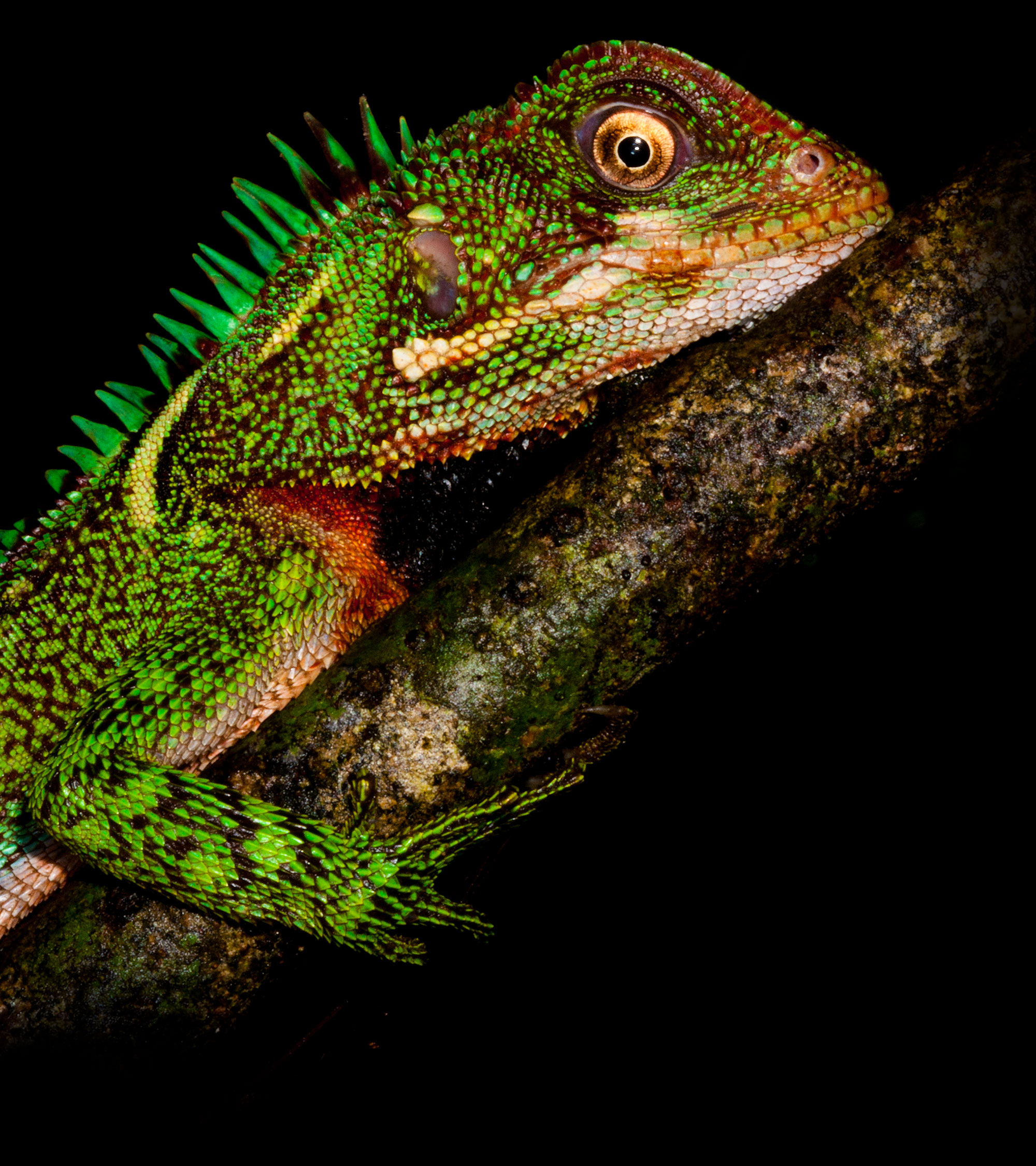
Amazon Forest Dragon (Enyaloides laticeps)
Although Pablo and I have learned to communicate well, despite our language barriers, sometimes, when I ask him about his children, or his wife, he looks at me blankly and then says, “No, I think it is a Green-and-rufous Kingfisher.” And when I ask him about the local food in Coca, he might say, “That was a Black-capped Donacobius along the riverbank.”
The Amazon Rainforest itself was formed a really, really long time ago, during the Eocene Era, which means that about fifty million years ago, the plates that separated South America and Africa were widening, which meant that a flow of moist Atlantic air encouraged the growth of moist forests along the Atlantic coast of South America.
Most ecosystems around the world are in many ways much, much newer than the one in which we are now. We might describe the Cabo Pulmo coral reef off the Baja Peninsula as the oldest coral reef in North America. But you know what?, The reef is only twenty-thousand years old!
Here is another example. The Desert Southwest Sonoran Desert is only 9,000 years old. It is essentially the modern invention of changing climates. And the Amazon has always been in flux too, the makeup of its thousands of trees, lianas, birds, amphibians, fish, insects and mammals ever changing, as the slow arc of climate change coaxes new species into being, dwindling and isolating the rest.
But the Amazon, and particularly this part of the Amazon, the eastern third of Ecuador known as the Ecuadorian Oriente, has always remained one of the least impacted places by the climatic events of the past – the geography and weather patterns of time have protected the Oriente from the shifting climates of the rest of the world. In fact, some scientists believe the Oriente, with a more static climate over millions of years, has seeded the rest of the Amazon over and over again as other parts of the Amazon felt the impacts of time.
Climate changes certainly produce new life forms, and changes the face of the Earth. In that way, biodiversity is dynamic. But rapid climatic events, or rather, any rapid event on Earth also means mass extinctions. So, it can take the Earth’s biodiversity 30 million years to recover from an extinction event. Can you imagine, then, how vital a place like this is? It’s like a natural seedbank for the Amazon, over the millennia.

A Monkey Hopper (genus Eumastacidae), in a forest near the Napo River in Eastern Ecuador. Canon EOS 40D. 100mm macro lens. 1/100 sec at F/6.3.
At the end of the navigable portion of the river, where a striated heron fishes quietly, we depart the boat. Up a hill, along a path, I notice that while the biodiversity is almost completely hidden, it appears in the most hidden nooks and crannies. Leaves are folded over. Leaves are sewn together. Branches and sticks are not always what they seem. But you can be there, right in front of them, and you don’t see that its not a stick at all, but a lizard, a spider, an orchid vine.
For the next three hours, we travel on a narrow path through the wet forest, combing the leaf litter for poison frogs. Seeing something so small, but painted so vividly is a shock to the senses. Normally, the lower you go toward the ground, the more the tendency is for animal color to dissolve into the darkest and dimmest browns and slates.
And then, when we see an aquatic coral snake sliding down a slope, the pattern emerges again – if you’re dangerous on the forest floor, you may have some adaptive advantages that you to tend toward brightness.
My guides and I split up, instinctually flanking the snake down the hill from three positions; we all know we want to photograph him as he approaches. But as we take our positions at the bottom of the hill, the snake panics and bullets for safety. As my guides consider the tree trunk, a glasswing butterfly lands next to me. Its wings, like many other clearwing and glasswing butterflies in this region, are as clear as glass. But the tail end shimmers in bright pink, and as it takes off, fluttering sloppily, it’s like drunk magic lighting up the forest with an awkward wake of pink light.
I follow it through the jungle, entranced by it, and when it disappears, I return to my guides, who are still looking for the snake. I tell them to forget the snake, to keep moving, and we do.
When we get to a large, impassable body of water, we climb a wooden tower, with an old, rusty home-made zipline. Carlos, built like a tank, straps himself in and zips across the water. Without any device to slow his speed, he crashes into the tree to which the line is affixed. Dazed, he spends a moment collecting himself, and then motions me to follow.
As I zip down the line, I see Carlos, who is about five-feet tall, grinning uneasily and positioning himself to catch me. But I just crash right into him and we both hit the tree. Pablo, next, slams into the tree, and now, bruised, we head deeper into the forest, and are greeted by patches of sunlight, where butterflies seem to collect.
It's apparent that we have entered into a newly productive portion of the forest. If most of our walk was almost devoid of life, now, there is a sense of a shift, even though there is no discernable difference in the type of trees and lianas. Life is patchily distributed in the rainforest, due to reasons science will probably never be able to measure - subtle differences that make one part of the forest productive and popular at this particular moment.

Brilliant orange legs on a Paryphes Leaf-footed insect in the Amazon jungle. Canon EOS 40D. 100mm Macro. 1/640 sec at F/7.1.
Pablo, who grew up in the city of Coca and spent his youth exploring these forests, has a way of seeing in the jungle that is astounding. He knows that something is alive and that it is about sixty or seventy feet away. It’s a bird. And, as we know, if a bird lives in the understory, it’s almost certainly going to be dark brown or slate. Every color in the rainforest has meaning; an animal adapts because that color is advantageous. If you are a bird who is adapted to fill some forest floor niche, you are very likely going to be dingy.
In the rainforest, visual and auditory clues are subtle. You have to take them all in to make sense of it all. You can't call something out right away. You have to let it sink in.
Pablo spends a few minutes looking into what, to me, is just a mess of green. His ability to find a small brown bird so far away, to establish it through just a few visual clues to genus and then species, is undeniably fascinating.
We are all equipped to have the same skills as Pablo. We evolved to make sense of our environment like that. This foraging strategy is how our brains and our wicked senses adapted. When we spend too many hours in the duck blind, we forget that there is more to hunting and foraging, fishing and collecting than sticking a gun into a swamp and shooting. The joy of it is in the use of our human senses. It’s not a coincidence that in countries like ours, where we isolate ourselves further from nature, we learn as we get older that the only things that fulfill us are to fish, hunt, garden, walk or observe; to be an active participant in the world we evolved to live in.

Mushrooms (Marasmius genus) abound in the leaf litter of the dark forest floor of the Ecuadorian Amazon.
Pablo finds the bird. And another, and another. And we keep moving this way through the jungle. Pablo grew up honing these skills as he explored the Amazon in his youth. As an adult, observation became his profession. Carlos has a strange eyesight too, but it is very different from Pablo’s. Carlos grew up in a small indigenous village nearby here. He grew up in an environment not all that different from the one in which we evolved. In that way, growing up, he would have been required to observe in the jungle for his own family sustenance.
To watch Carlos pick out a hawk or a monkey six or seven miles away is to see the differences in the natural skills of observation between these two men. Each of us, stuck in offices, have similar talents in observation, but few of us ever learn to discern which natural advantage we were granted over the fellows at the water cooler. We just need time in the field and a will to observe, and those natural talents will reveal themselves in time.
We move deeper through the forest. Beetles crawl, strange purple mushrooms rise up from the branches, and a monkey passes above us, stopping only briefly to look down on us and observe.