
Plains

Catfish Heaven:
Winter on the Louisiana Bayou
Road trip notes from Louisiana's Bayou Country.
I'm driving down a dirt road. Almost to the salt marsh coast in a Jeep on some out-of-bounds construction site. I'm headed for the cypress cemetery south of the fishing village of Theriot. Land of pickled dead trees, killed by increasing salinity as the gulf envelops Louisiana’s southern lands.
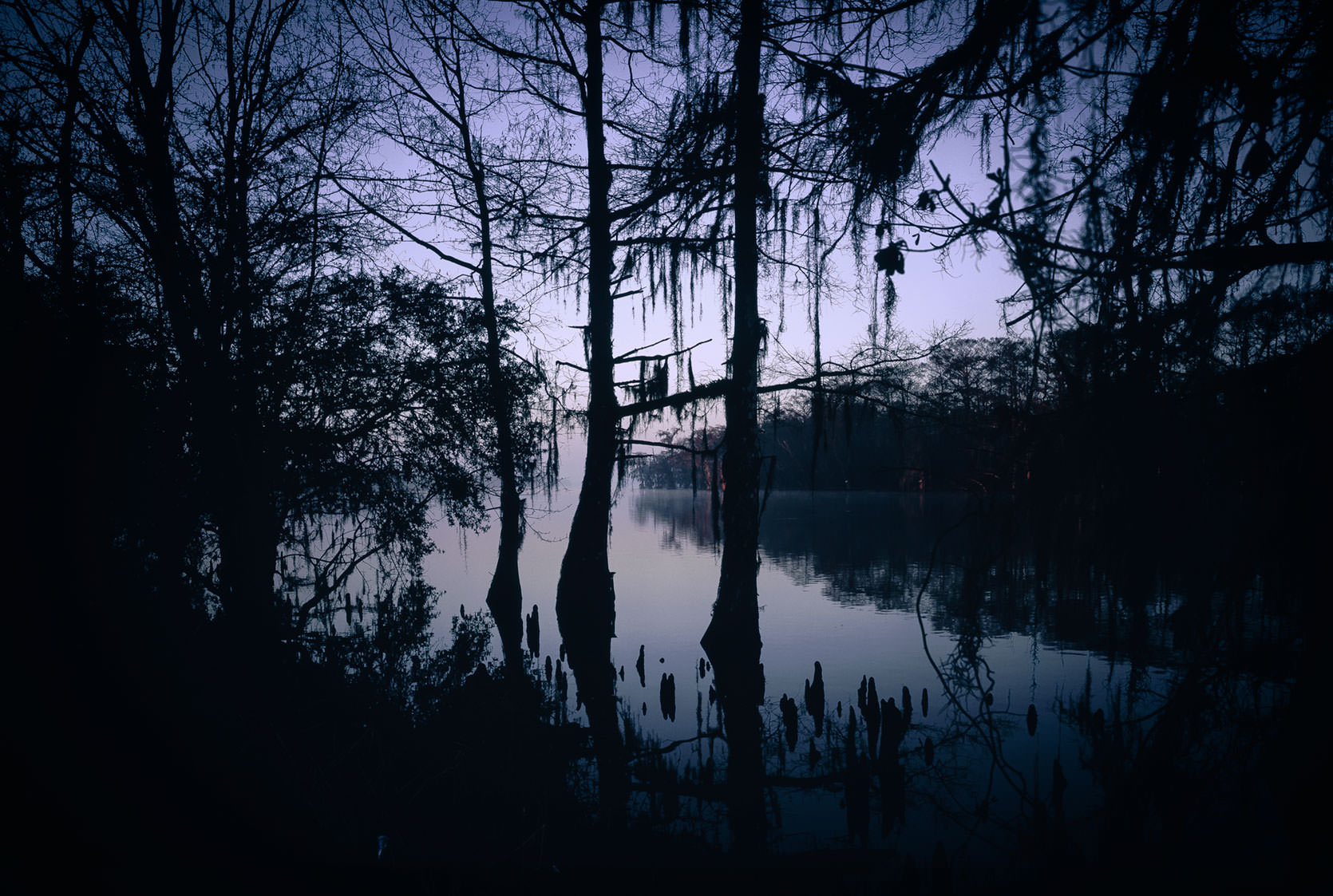
Its spooky here; five A.M. and the trees all dead and stuff, and the stiff wind howling down the cold winter-time canal. Most of the shrimpers have taken the winter off and pursued other means of income. The shrimp won’t spawn for another two months, so even the shrimp boats are still and haunted-looking. I walk out and head for the dead forest, and what I find makes no sense to me.
What I find are generators honking away, and steel tubes pumping water and spitting it out elsewhere. I follow one of these tubes, hoping the cutaway through the marsh will gain me access to the wooden cemetery. But no luck. I get as far as the pump's exit hole, which is spitting out a column of water 12 inches in diameter.
In the distance are towering cypresses, dead for years now.The next day, I’m in the town of Gibson, northwest of Theriot. It's an island in the sense that the bayous surround it. The bayous surround everything in Southern Louisiana's Atchafalaya Basin.
I am knocking on the door of a small house, which is raised three feet in the air and rests comfortably by the bayou.

Jon talks about the bayou by an old-growth cypress.
A man opens the door just a crack, staring at me guardedly. I ask him if he remembers talking to me. I'm the guy who wanted to rent his Pirogue, and maybe he could take me out for the day and introduce me to the backwater of the Chacahoula Swamp, at the center of the Atchafalaya, America's largest wetlands.
Jon slowly opens his door, and after a few minutes of chatter, invites me into his home. We sit between an alligator skull donning a pair of sunglasses, and several stacks of paper each towering in the air. "I've been busy with my hydrogen research," he says. He says he is getting closer to a way to separate hydrogen from oxygen cheaply. He points to the stacks of papers: organization before computers.
Odd perhaps, that this bearded old man thinks he may be solving the world's energy problems. But he also thinks he knows how to keep Louisiana from sinking. And not only that, but he can do it cheaply. And at least in one instance, the Governor listened.
But Jon says, "The government of Louisiana is the most corrupt in the United States."
He pauses and explains, "That last governor, Edwin Edwards he's in jail now for unrivaled corruption. And you know what, I guarantee you when he comes out of jail, if he would run for office, he'd get elected again. That's the way it is down here. That's how stupid people are in this state. That's why I'm leaving Louisiana."
Not only had Edwards been involved in a massive racketeering, extortion and fraud scheme, but Louisiana legislators had been up to their knees in corruption literally going back to its roots as a French territory. I was surprised to find that Jon's statement about Louisiana was not a bitter exaggeration.
Jon has been in two motorcycle accidents. The most recent involved swerving off the road to avoid a nine year old on an all-terrain vehicle. So he walks slowly, still recovering. We stroll out to his outboard.
Rewind 11,000 years and we’re coming out of the ice age, and the glaciers have totally flattened out and created the American Great Plains, and thus the birth of the Mississippi River. The Mississippi drains almost half of the United States, as well as parts of Canadian Great Plains. The water from thirty-one states all ends up flowing into and out of Louisiana, either through the Mississippi itself or through distributaries like the Atchafalaya River.
The Atchafalaya Basin, which contains the river, is a hundred and fifty mile length of wetlands, the scar tissue of the Mississippi's old route to the sea.
Fast forward to today, and we're speeding down the bayou in Jon's skiff. We duck down under the highways, raised just a few feet off the bayou. And then we're screaming down oil company canals, dredged for so many years as a means of controlling thousands of miles of oil pipelines.
And then, Jon takes a left turn into a waterway covered in gray Spanish moss and gray barren trees and the black water of winter. This area is called Tiger Bayou.
A bayou is a Louisiana French word which means ‘sluggish,’ and no word better represents these miles of connected natural canals of slow-moving water, the vast swamps between them, and the salt marsh connected to the Gulf of Mexico. The bayou system extends beyond the Atchafalaya Basin, but nowhere encompasses the idea of the bayou more than Atchafalaya.
Even before Louisiana started sinking, Jon explains, the bayou country was imperiled by introduced species. An entire bayou corridor we pass by is choking under the wrath of a plant called the water hyacinth.
In 1884, one enterprising individual thought he could beautify the swamps by introducing a curious plant from Venezuela that bloomed like a lily and brightened the water.
"Four years later," Jon says, "most of South Louisiana's water was covered by the water hyacinth."
The plant floats freely, and so we pick some up and eat its roots. We'll be eating things from the swamp all afternoon. Since I forgot my lunch, I take a few extra bites of anything he pulls from the dark water.
Jon taught himself since the age of nine how to use just about everything in the swamp. "My mom was pretty good with the hickory switch," he says, "so my brother and I would spend our weekends living and camping in the bayou."

Stephensville, Louisiana
Later, he would spend three months out here, with 'my wife, a pirogue, some olive oil, flour, salt and pepper."
In that summer, "the best days of my life", Jon learned to hunt alligator, to fish, to utilize hundreds of swamp plants as medicine, insect repellent, seasoning. "We just ate and survived," he says, stopping along the way to show me dozens more plants.
In 1939, the most famous Louisianan, the man who invented Tabasco, had a plan. An ingenious plan! To rid Louisiana of the dreaded water hyacinth, E.A McIlhenny held captive a large rodent, with the hopes of experimenting with an animal that would eat away Louisiana’s hyacinth problems. A hurricane damaged their pens, and dozens of these oversized water rats with their nasty faces bred in the wild. Rather than eating the hyacinth, the nutria ate everything else in the swamp, and wouldn't lick their nasty chops near a water hyacinth.
This overgrazing rodent began causing massive damage by eroding the riverbanks. In a few years, the bayou's woes doubled as the nutria proliferated at an alarming rate.
But then a tiny plant, the water fern, was also introduced to the bayou. Unlike other ferns, this aquatic genius produces by cloning, as opposed to spores. Soon after its introduction, the water fern propagated into every nook and cranny the water hyacinth could not. Because it propagates five times faster than the water hyacinth, it is estimated to become the dominant species of the entire bayou, suffocating nearly everything in its path.
The history of invasive species in Louisiana's bayou country pales compared to what ecologists found out fifty years ago. The bayou coast is sinking, and along with it will go the shrimping industry, the petroleum industry, the largest bird flyway in North America and one of America's last unique subcultures.
To understand the plight of the bayou, we need to understand the dominant culture of the region, a people called the Cajuns.
So push the rewind button 214 years. It’s 1791 and you're on the island of Hispaniola, which now contains Haiti and the Dominican Republic.
Adrien and his wife are running for their lives. The plantation owner for whom Adrien worked for and his entire family, all dead. It’s a slave uprising, and Adrien has cornered a route down the mountain he knew as a child.
Generations of cruelty toward slaves had just welled up into a revolution, sending shockwaves across the slave-owning Americas, and firing off a war that will leave half the territory’s citizens – French of African – dead.
But Adrien was no slavemaster, no land owner. His family’s route to Hispaniola was a tale of generations of refugees spread across the Americas. When the French sent his family to Hispaniola, little did they know they were being sent to work in harsh plantation conditions.
Rewind again and it’s the early seventeenth century. Adrien’s ancestors migrated from France to a region in Canada, which now roughly encompasses Nova Scotia. They set out to build a new life in this land they called Acadia.

But soon after they arrived, Acadia fell to the English. The land shifted between the two old world empires for a hundred years until the British launched a military campaign to claim the region at last. The French Acadians, they demanded, must renounce their Catholic faith and their allegiance to France.
The Acadians stubbornly refused, and things got worse as the years progressed, until finally the English began a series of deportations. France now had to find new lands to dump the refugees from their lost colony. Many were shipped directly to France’s Louisiana territory, others were dropped off on France’s various West Indies holdings. Others still made their way into the United States; places like Pennsylvania and Georgia.
The French and Spanish colonists who had already been profiting in the region for years had taken up the good land in Louisiana. So these Acadians struck out west from New Orleans and settled the backwaters.
France was so intent to maintain their stake in the island of Hispaniola that Napoleon Bonaparte sent an army to squash the slave uprising. France needed control of Louisiana as a military and economic staging ground for Hispaniola. But by 1803, the slaves crushed the French military so severely that France needed to sell their Louisiana territory just to keep up with their renewed war with Britain.
Buying this ‘Louisiana Purchase’ from France was a bargain – a bargain of desperation by a country broken by their own slaves, and forced by Britain to turn their heads elsewhere. By 1804, the French half of Hispaniola was independent from France, and the Louisiana Acadians were now governed by the United States.
As slave rebellions spread throughout the West Indies, more and more people of Acadian heritage found their way north to the bayous. Through time, the term Acadian Americanized to ‘Cajun.’
Fast forward back to today, and many of these Cajuns still speak English as a second language, are isolated culturally and physically from the rest of America, and maintain a culture of incredible hospitality and cuisine.
Jon says that for a hundred years, man has been dredging this Cajun region, and levying the Mississippi River.
Because this part of Louisiana is built from the silt water sediments of the Mississippi River, it is naturally compacting. The land maintains itself as the Mississippi carries sediments south from the rest of the Great Plains. As the soil compacts, new soils materialize during the yearly flood season.
But the Louisianans levied their Great River and the oil industry built its own levees and canals in the basin, and so today, the Atchafalaya region receives no sediments to replenish the land.
The protective barrier islands are being eaten up, and many of the coastal regions have already sunk. In thirty to fifty years, the sea will swallow up Cajun Country. The locals are reporting that many of the places they fished and played as children have completely sunk.
Even this far north in Gibson, the bayou canal banks have flooded over, killing oaks and palmettos. Some of the flooded palmettos are still alive, which means some of these areas have only become inundated within the last few years.
I ask Jon why he thinks nothing’s being done about it. He explains the costs of the current proposals. Fifteen billion dollars. Twenty billion dollars. Twenty five billion dollars.
Jon believes the solution is easier than that. He says it’s a matter of controlled flooding of the Mississippi River. Of man reproducing the traditional flooding season by opening up a portion of the Mississippi into the Atchafalaya, and of the state and federal governments working with the oil industry to help pay for their past mistakes.
"You mean like Yellowstone?" I say. "You mean the problem with sinking in Louisiana is as simple as the fire policy in Yellowstone?"
Instead of let in burn, I said, "A let it flood policy?"
"Yup."
"In Theriot,” I say, some of the houses were on stilts, and about twenty feet in the air. Some were three feet in the air, some were brick structures on the ground."
"Exactly. You know, the Indians who lived here, their houses were on stilts. And now there are regulations requiring you to build your house a certain level above the ground."
But the fact is apparent. If Louisiana has a tradition of corruption in government, and self-motivated legislators are concerned about current votes, a policy that would flood and effectively harm thousands of personal properties would cause them to delay work to future administrations, even if the costs to the Louisiana economy escalate by each year delayed.
Those costs, Jon says, include the devastation of a hurricane. "If a hurricane would hit the bayou, or worse, New Orleans, the whole place would sink. Death everywhere. The fact is those salt marsh islands were the only protection against the wind. The slowed the hurricane down."
I explain the water pumps I saw near Theriot, and Rubin explains that everything is being drained, sucked out and displaced, making things even worse.

Nobody knows the exact purpose of the cypress knees, but they are believed to act as interlinking stabilizers between the trees root systems.
After years of speaking at the Coalition to Restore Coastal Louisiana meetings, the Governor’s office finally wrote Jon a letter, thanking him for his ideas and that yes, he was likely right all along. The letter detailed specific policy concepts, and when I read it, I felt like there was a sense of hopelessness. You’re right, it suggested, but politics is more complicated than that.
In the evening, Jon parks his skiff next to the grocery in Gibson and we share a boudin – rice, pork and spices encased in a pig’s intestine. Jean, the owner of the grocery, offers me a piece of dark meat, and then gives Jon a spry look I wasn’t meant to see. “If it’s alligator, that’s no big deal,” I say, trying to size up the meat. Jean smiles and Jon tries to keep from doing the same.
I ask Jon if he’s ever eaten nutria. He says all the time, it’s delicious. He explains that Cajun chef Paul Prudhomme almost lost his reputation by adding Nutria to his menu, but that in reality its great meat, and people shouldn't be afraid of it just because its a giant water rat. I say, “Even if this is nutria, I’ll eat it.” I thought that would be the best way to fool their cruel joke.
And then I eat it, and Jean says, “You just ate roast beef!”
Fast forward a day and the bar to go in Morgan City is at The Holiday Inn. You may find that funny, but Morgan City, northwest of Gibson, is a so-called Anglo town. When I ask for a recommendation on a restaurant in Morgan City, a young lady says, "Well, there's four Chinese Restaurants and ten fast food restaurants, and then there's here. You choose your pick." That's Morgan City, because Morgan City isn't Cajun.
So I opt for a couple Powerbars and some Jamaican rum at the bar. Here I meet Rubin, whose bar buddy just announced to everybody that 'they're remaking the Dukes of Hazzard. No shit, yeah?'
Rubin is dressed like a businessman, with a yellow polo shirt and khakis. He's bored by what's on the bar television (a show called the O.C., which the bartender says she 'lives for'). So I ask Rubin about what he does. "I run a freight and transport company. I've got boats running here and in other states too. I run a service that takes employees and freight out to the oil rigs."
"Morgan City is pretty much the capital of the oil industry, and the shrimper industry too," he says. "With access to the bayous, the intercoastal waterway and the gulf itself, it's kinda a hub for Louisiana’s big industries."
"What do you make of this talk about the bayous sinking?" I ask him.
"Hah. Its not talk. Every month, I can tell the difference. I make the trip to the rigs a couple times a month myself," Rubin says. "Look, there is not a shrimper or a boater in South Louisiana who will tell you we're not losing our land. And it's going fast!"
Rubin is intelligent, reasonable headed, and well-dressed in the way you would expect a banker to be well-dressed. So I ask, "if what you're saying is true, why doesn't Louisiana just fix it?" And then I add, "Like if the al Qaedas were trying to take over Louisiana's bayous, we'd be all over that. What's the difference?"
The bartender is dressed in a red shirt with some words on it. She puts pickled carrots and spiced green beans on our bar napkins and says "Tas' em, dare good." And Rubin crunches, "Well you see, this is Cajun Country, and the thing is most of these people can't read or write. And English is a second language to a lot of them, you have to remember. They know they have a problem but they don't have the means to organize themselves."
Rubin's friend says that he heard Jessica Simpson is going to play Daisy Duke. The bartender says who's Daisy Duke and I ask Rubin if he knows where I can rent a pirogue or a canoe around here?
Rubin says, "Why not mine?"
"Like twenty bucks or something?"
"Nah, just come by tomorrow. You have a phone? Call me for directions in the morning."
That some stranger offered me his pirogue would be odd almost anywhere else. That I’ve been offered food, directions, stories, handshakes, and "just pee in my backyard" at the drop of a bucket is extraordinary.
I’m on a dirt road with a pirogue borrowed from a stranger. It's tied down above the Jeep. A pirogue is a similar to a canoe, but with a flat bottom and a tiny draft.
This gravel road leads north of Stephensville, into what looked from the maps to be some of the deepest sections of the Atchafalaya. When I'm pretty far from anything, I dump the pirogue in the water and leave the Jeep behind.
I paddle next to the road for a few miles. To my left is some of the darkest swamp I have ever seen. Shades of brown and black that hang and droop into a green mush.
Three black folks are fishing off the bridge, and so I decide to see what they are catching. I dock the pirogue by the road and climb up to the bridge.
”What do you fish for here?” I ask. The water is muddy and looks inhospitable to fish. “Everything,” the lady says. “Crappies, bass, stripers, flatheads, catfish.”
They are fishing with small grass shrimp, which the lady says she finds right there in the water. I look for some in the water but find nothing.
”You want to try,” she says, offering me the line.
”No, no. Can I see what you caught?”
”Yeah, jus’ look in the pail,” she says.
"Oh, he looks dead,"
"Yeah, he in catfish heaven now."
When I ask the lady about the area, she says that she is actually from New Orleans, spending a weekend with her relatives to enjoy fishing. She is what you might call a sports fisherman.
I paddle some more until I find an oil cutaway, a slim passage through the cypress trees. I turn left, and in. Jon had warned me about these narrow corridors, because of how easily you are tricked into losing your direction. But the duckweed is thick, lending a breadcrumb path home.
I paddle for a quarter mile and then lay the paddle inside the pirogue and listen. This is when the owls swoop and the wood ducks wade and the water rats rise. But not the alligators. They are here, underneath me, but in hibernation for winter.
The alligator so fascinates Americans that bayou country actually profits immensely from this curiosity common to everyone. There may be more to this than meets the eye: Some scientists believe man instinctually fears crocodiles (alligators are crocodilian lizards).
In his infancy, before technically he was man, our small and monkeylike ancestor Australopithecus was thought to migrate from Savannah to Indian ocean seasonally. He was what primatologists might call a generalist species: utilizing different skills to find different types of food.
This act would have required him to move through the great East African swamps of this era. Some argue further that this swimming through swamps would naturally have been dangerous - Australopithecus was prey, and especially so from the crocodile. By learning to wade upright, he naturally selected himself into walking man. What this theory means is a lot of your ancestors may have been crocodile food. And that maybe the crocodiles made man stand on two feet.
Perhaps I forgot to tell you. I am trespassing. The oil companies own this water. So many travel writers are paid to write about hotels and resorts and destinations that it is only appropriate that another kind of travel writer exists – one who goes where nobody wants him, just to even things out.

Oil companies always have a bad rap with the public - with all of yesterdays oil spills, and even here in Warning No Entry, the oil companies are responsible for a good deal of damage. Even here in Forbidden Danger Keep Out, the oil companies have been creating the very narrow passageways I am navigating, for a century. All these channels and passageways, in unison with the levees designed to keep water from flowing here, have depressed the bayou’s ability to hold onto sediment.
Now I'm a few hours out of the swamp and I've thanked Rubin for his pirogue and no I wouldn't be needing any food for my way west to Avery Island.
I'm almost to Avery Island, where the Tabasco Corporation mines salt and experiments with the breeding of its peppers, which it grows in Central America. Avery Island attracts birdwatchers: It's migration season for the birds in North America’s largest flyway, and I want to catch up with some of the folks who follow this rich migration to Cajun country.
McIlhenny, Tabasco founder and early American environmentalist, was upset that the once vast local populations of snowy egrets were dwindling to extinction. So he set up a sanctuary for them on Avery Island and now the species abounds there.
At a gas station, I run into a different sort of birdwatcher. But I don't know that yet. There they are, two curiosities on big motorbikes, talking over a map at the corner of the gas station.
Black t-shirts, Teutonic fonts, big boots - the Harley Davidson look is tired. And nothing speaks more of conformism than the commercialism of some guy wearing a black shirt made by Harley itself. You can look dirty and look cool, but these guys look dirty and like old dishrags.
But what's kind of cool is what I find out when I approach them: Yup, that's right. These guys carry their roosters on the back of their motorbikes. Enclosed in concealed metal cages with breathing holes. After I introduce myself, I ask where they come from.
They say Texas. I say I am pretty much harmless and not an animal rights activist and would they maybe answer me a few questions about cockfighting.
I already know that cockfighters are a secretive bunch. But they are here in Louisiana because it is one of the only states where the act is legal in certain counties. Cockfighting is legal because the state legislature argued that chickens weren't animals at all and therefore aren't privy to cruelty laws, because chickens are just game fowl.
Some small talk and they get my trust and the guy with the bad shave says, "it's a great sport."
Now, I don't like this right off the bat. Cockfighting is not a sport. It's not very hard to know what is and what isn't a sport. For example, watching other men on television is not a sport. And watching chickens fight is not a sport. It may be a sport for the chickens, but it's not a sport for the humans.
People who are like cock fighters have accused me of not being into sports. Somebody who runs in the morning, surfs in the afternoon and plays basketball with the guys at work would be considered not into sports. But somebody who knows football statistics or watches chickens, that guy's into sports.
I ask if they have any equipment. Any sports gear. Yeah, of course they do. The one guy goes into some compartment on his motorcycle and shows me what's like a mini dog collar with steel spikes. He shows me what looks like a rotary blade with rivets attached to a leather collar. Then there's what the bad-shave guy calls his 'trusty.' It’s like a long scythe with an extra-sharp blade.
What you do is you attach this gear to your rooster's feet to make them more deadly. If you're playing at one of the big cockpits, these types of more extreme devices might be against regulations and the law. But if you're playing in more specialized, more secretive cockpits, pretty much anything goes. If that's what you're into.
When I say goodbye and the bad shave guy mock-hits my shoulder and says, 'Good luck with the egrets', I feel they were touched that an outsider was interested in their peculiar and grotesque subculture.
When I arrive at McIlhenny 's Bird City, I meet a couple from Arkansas who've come to see the thousands of snowy egrets who've built their nests in this convenient sanctuary.
They say to me many things. But what's important is they say go now...go...drive north. Into Lafayette. Take a left here, a right there, another left. Go, go, go and so I do.
Hours later, I am listening to a twenty-one minute version of Phish's The Story of the Ghost while I'm walking down the gravel road across Martin Lake's marshlands. This is where the birdwatchers told me to go.

Roseate Spoonbills use a special spoon-shaped bill in unison with strange head-swings
to catch a variety of underwater prey. I cannot imagine a more exotic bird that lives in North America.
The sun is drawing and the clouds are piled up like giant airships, and the wind is a marshes' whisper. In the marsh trees there are thousands of snowy egrets engaging in weird mating dances. They have grown special feathers for this act, making them flamboyant. Like the clouds, they are perched everywhere, in a thousand trees. In a way, it's like all these long white necks are bending and swaying to my music. Three thousand dancing birds, swinging and turning in their marshy nests.
And then some enormous pink birds with paddle beaks and green featherless heads go by. They're foraging under the thousands of egrets, wading in a fast moving single file through the marsh.
A scrawny guy had been walking toward me. And now he approaches me and says, "the reason they get'ya is becoz ya can't see-um."
I say, "huh?" and take out my earphones.
He says, "see there." I hadn't. A nine-foot alligator about fifteen feet away from us. "An over dare." He points to a twelve-foot alligator, a giant about forty feet from us. But weren't they asleep for the winter? "They commup on sunny days."
Just for fun, I ask the man (calls himself Skillet) if he's ever heard of anyone ever being attacked by an alligator in this area. 'Nah, I ain' never heard." We chat for a while about alligator and crocodile stories.
Meanwhile, those prehistoric pink birds march past us again in single file, whipping their spoonbills voraciously through the water.
Unlike saltwater crocodiles, which kill an estimated 2,000 people a year, American Alligators are famously docile. Steve Irwin, the Crocodile Hunter, proved this with his usual enthusiasm by swimming through Florida rivers and tackling alligators in their own nests with a carelessness he would never allow himself with the more hostile Australian and African saltwater crocodiles.
I tell Skillet about this article I read. About some crocodile in Burundi who some believe has killed 200 people. "Why doesn't someone jus' shoot 'er?" Skillet says.
I say, "I think they've shot her, and she has bullet wounds, but the problem is the country is in a civil war and nobody wants to hunt a giant crocodile in such a dangerous country."
Skillet says, "cool man! Aigh, look at that one right dare." He tells me that he’s loved watching alligators since he was a kid. He says that alligators and gharials (from India) are pretty friendly, but Caimans and Crocs are mean. He knew some stories about alligator attacks in Florida. Some years, he says, they take up to eight people. Usually little kids.
We talk about alligator sex. It turns out the gender of the American alligator is determined not at conception but at the egg stage. The temperature somehow messes with their private parts. Air temperature determines alligator sex. Maybe the dinosaurs became extinct when the Earth's climate changed to such a degree that they bore all males or all females for an extended period of time.

The dinosaurs were lucky to have ruled during Earth's most steady and serene climate. One hundred and sixty million years of perfect weather. They ruled for millennia and perhaps they fell simply of an evolutionary fault, time capsuled in the American alligator.
While crocodiles may hint at the dawn of man, alligators may hint at the dawn of mammals.
Skillet is incredibly thin and wears a gold chain and a white t-shirt and sun bleached whiskers. As our conversation just gets going, a mini-van pulls up and he jumps in. It's his wife driving, and baby in the passenger seat. Skillet introduces me to his family. They live a few miles away, and drive out this way sometimes, to look for big gators. The wife, the baby, maybe you could say they didn't seem that excited about the alligators. 'Skilly larves all-e-gat-ers' the wife says to me, and then they are gone.
The road through Martin Lake is filled with birdwatchers from Alabama, Arkansas, Texas. People have driven all day and all night to get here. Bird watchers tend to be older, and statistically they are also Republican. The hunters and fishermen, statistically Republican. The Louisiana oil industry? The conservative Catholic Cajun shrimpers? The American-loving Vietnamese immigrants brought to the Louisiana Coast as a favor for their help in the war?
Before I left for the bayou, I wanted to learn a little about what the environmental organizations thought about the sinking bayou. When I visited the Sierra Club website, I was distracted by a prominently displayed series of animated jokes about the President and about his political party - the one that Americans call the Republicans. The Republicans were oil hungry monsters driving around monstrous Hummers. The President was evil. Middle Eastern oil. And so on.
And I thought, isn't this The Sierra Club? Have they not just isolated the half of the country they most need to convince? It’s no secret that elected Republicans have had a reputation of being funny on these sorts of issues.
But that wasn't always the case. A Republican - Theodore Roosevelt - introduced modern environmentalism to the world and created the world's first national park system. Richard Nixon signed the Endangered Species Act, the clean air act and consolidated several federal agencies into what is called the Environmental Protection Agency. Some of the most profound environmental legislation passed in the United States has been under the pen of past Republicans.
The sinking bayou problem is a perfect case of an environmental problem that would benefit from the inclusion of Republicans. Or more specifically, the sinking state makes a good case for ending the partisanship of American environmental reforms.
Louisiana is a Republican state whose last two Republican Governors failed to publicly recognize that there was a problem at all, even though the foundations of the problem were recognized as early as the nineteen sixties. The consequence of that oversight, if prolonged, means that within fifty years the destruction of America’s second largest fishery, huge costs for Louisiana's oil industry, and the so-called sportsmen industry. The alligator watchers. The lady from New Orleans fishing for catfish.
In time, the lady from New Orleans would have no incentive to visit bayou country. The out-of-state swamp hunters, coastal fishermen and birdwatchers will face an ecosystem that has literally vanished under the sea. And all three major industries of bayou country – shrimping, oil, sports tourism - will be faced with incredible costs or will themselves vanish. Worse yet, if a hurricane actually hits New Orleans, the integrity of the coast will be so poor, the entire region may simply...sink.
Last winter, conservative Louisiana elected a Democrat from bayou country as Governor, and among her top priorities was the restoration of coastal Louisiana. To stop her state from sinking.
Now, to a lot of out-of-state environmentalists, the election of Kathleen Babineaux Blanco is the happy ending. I see it differently. If environmentalism remains partisan, the party with the monopoly on the issue could easily sway from a focused agenda. If one party has a monopoly on an issue, the execution of the solution loses quality, just like the products and services of a monopoly.
In an issue like Louisiana coastal restoration, it is impossible to disassociate environmentalism from its economic consequences. What's interesting is that a Republican state relied on electing a Democrat to solve an issue (protecting industry) that typically Republicans thrive in.
Governor Blanco may be taking the wrong route to Louisiana's problems. Although her current plan, approved and supported by the President – to which she should be commended for – calculates a current cost of two billion. But the reality is that this current plan implies future spending and future doubt. Her policies will demand costs of twenty, thirty, maybe forty billion dollars.
She's got the Army Corps of Engineers working for her, and she's got thumbs up from the folks in bayou country. Her heart is in the right place, but her solution requires federal micromanagement and big government spending.
For the sake of argument, let's say that swamp maverick Jon from Gibson is right, and that there is a simpler solution at a fraction of the cost. If you just let the Mississippi flood a third its water into the Atchafalaya (coincidentally an amount that will not impede barge navigation on the Mississippi), you’re just letting the Mississippi do what it was meant to do. To spill and build land in Louisiana. Getting the Army Corps of Engineers to manage a huge project to divert and micromanage water to get it to do your bidding will be monumentally expensive, and quite possibly a failure. Continuuing to build more levees like bandages does not imply long term land-building. Levees, after all, are part of the problem.
Republicans like to think that a free market works because human nature is compelled to perform best when unrestrained by economic bandages. The point isn't that Republicans might do a better job than Blanco, the point is as long as Republicans stick their noses at rational environmental reforms, there will always be an inefficient monopoly on protecting our national resources.
If you just let the basin flood, the coast will rebuild itself in time, nobody doubts that. That’s a simple solution – it sounds like free market thinking to me.