
Neotropics
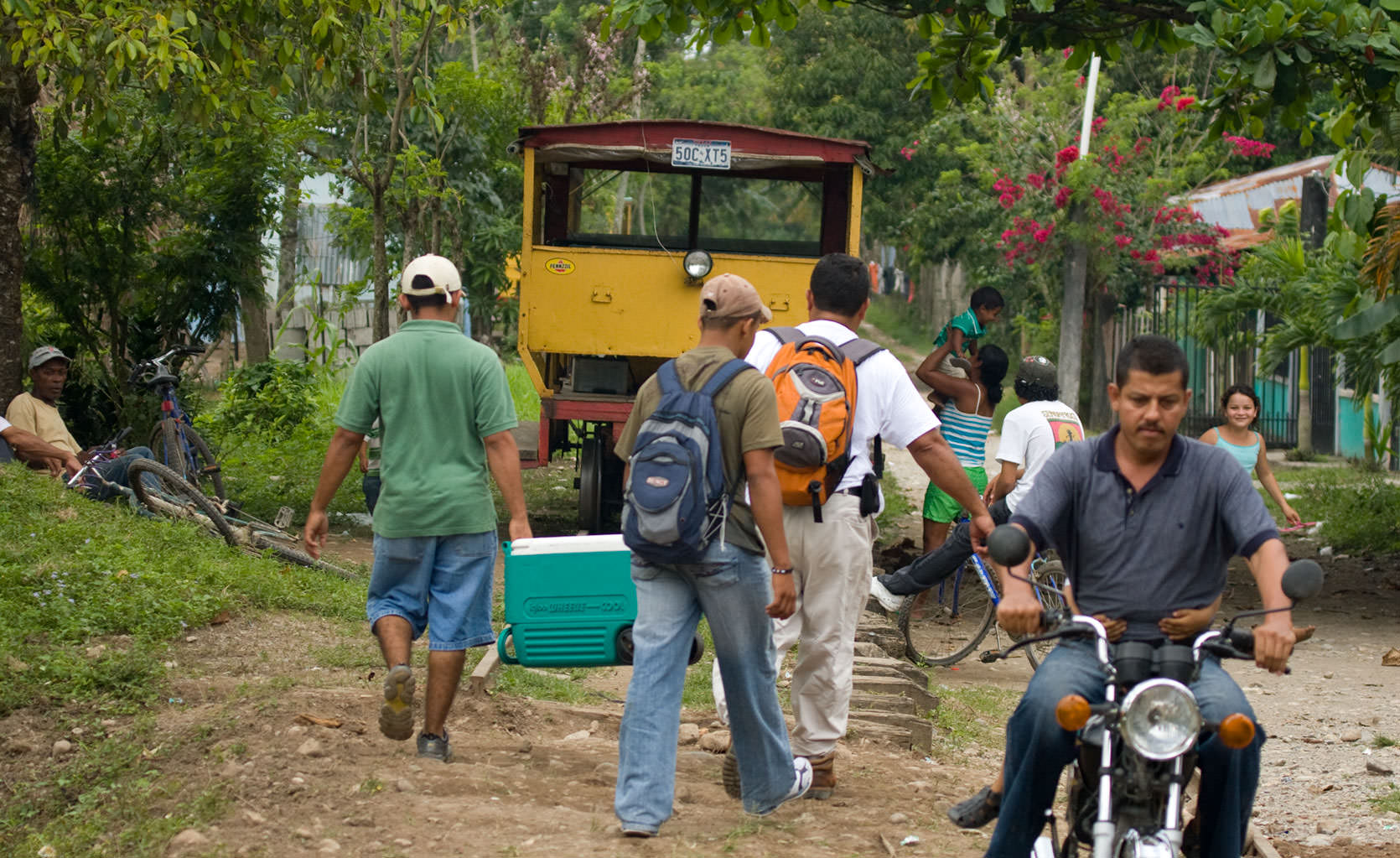
Coconut Train to
Cuero y Salado
Riding on one of Honduras' last functioning antique coconut trains.
I am on the coconut train to La Union. I share the second train car with Germán, my wilderness guide from the Pico Bonito Lodge.
In the daytime, you can see how this old track passes over marshes on rotting bridges and through fields of palms and oxen. You can see an abundance of blue blossoms between the palms.
Tonight is a blue night; overcast, drizzly, and that light is going fast and now it’s only the light of fireflies. A million fireflies. The contours of meadow and forest edge are like an upside-down night sky. The coconut train is all metal – tottering old metal painted yellow and red, and it makes quite a noise. The kind of noise that makes people say, "I can't even think!"
But noise makes me think, and travel makes me alive, and I realize that most of my life, this is the place I've been trying to get. The rural, almost mythical lands of Northern and Eastern Honduras have captivated me forever, and jolted by the banging of this old track, it all comes together for me.
I yell to Germán about the fireflies.
"Yes," he says, digging in his backpack. "So beautiful."
Germán grew up in the Nombre de Dios mountain range which lies directly south of us and in an area that has now become part of Pico Bonito National Park.
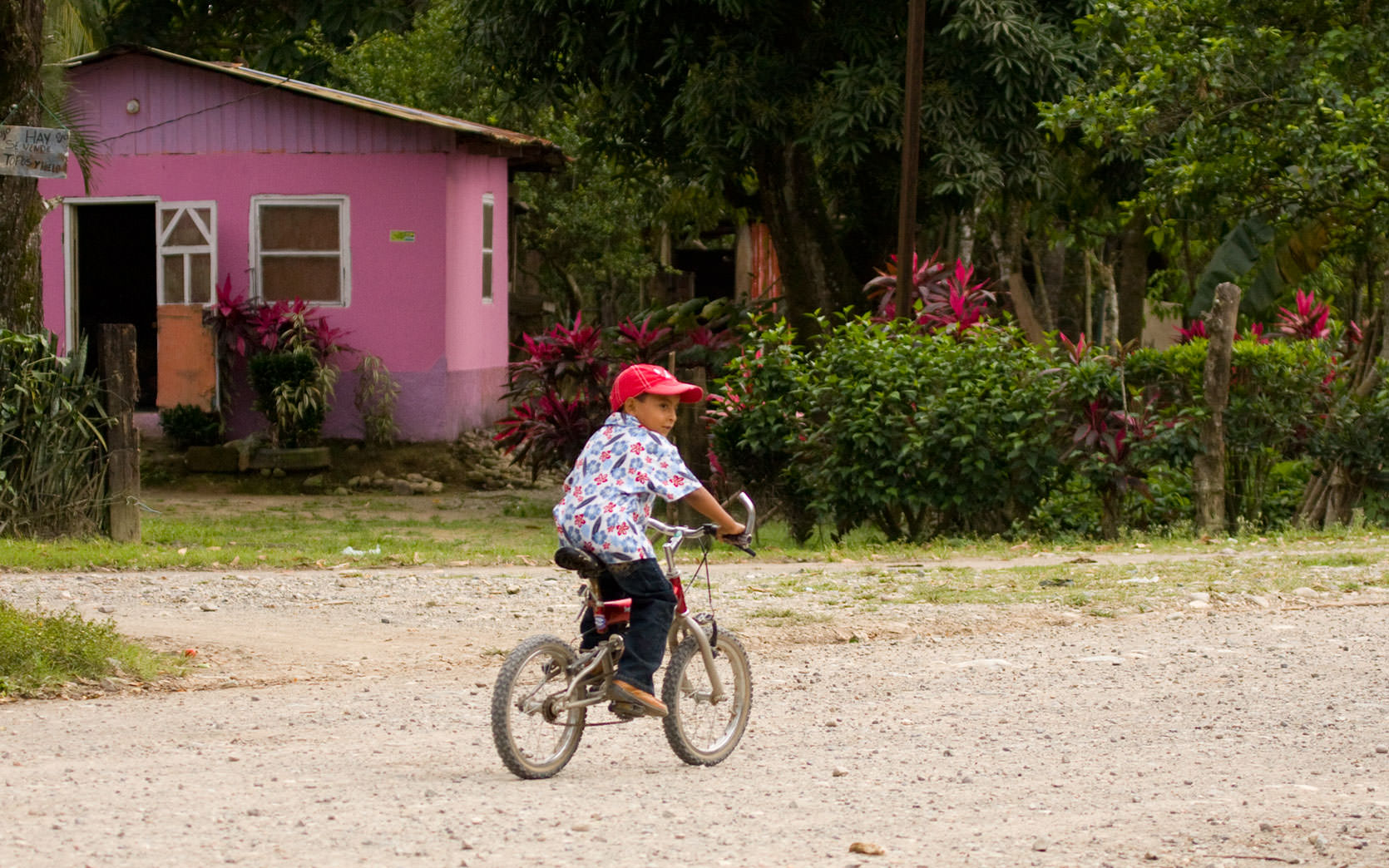
The train passes through a tiny dot of a hamlet called Monte Pobre. Through open doors painted pink or yellow, I see men playing billiards, women in formal white dresses roasting dinner on open fires, children sitting on footsteps.
The coconut train to Cuero y Salado is a segment of one of many tracks built in Honduras between the late nineteenth century and early twentienth century by the two competing banana companies. Hurricanes, floods, washouts and time have put much of the tracks out of commission. But a few stretches of track still rumble. This one remains to bring the coconuts out of the fields and into the processing plant. And because there is no road.
Germán finds a gigantic flashlight in his pack, and shines it in the field. "Pauraques," he says of the pink eyes looking at our light – nightbirds fresh in the field from migration.
The coconut train stops at La Union, where a driver meets us. We drive through Dole's pineapple fields. "You know something about pineapple work," Germán says, "two hours after your first day, you can't feel your back."
"You would think they could automate some of that work?"
"They tried that. In the past, they tried machines. But they found that the pineapples got bruised and they couldn't export them. It can only be done by hand."
Like so many who grew up near the Caribbean city of La Ceiba, Germán worked as a general laborer in the Dole pineapple fields. Pineapples are only harvestable once a year, and the fruit must be tended throughout the year. But the fruit sits in the middle of a nasty, oversized bromeliad with thorns and spikes. Men who labor for these fruits face incredible hardship.
"So many of my friends lose an eye," he explains. "They go in to get the pineapple, but you have to be careful." In the headlights, we look out at a thousand pineapple plants. "If you aren't thinking, you go for the pineapple and you lose your eye and you are blind as a young man."
"Why don't they give them sunglasses?" I ask.
"These days, yes. Green sunglasses, so they see the pineapple better."
Germán began his career as a ranch hand, and then worked the pineapple fields, and once spent a year off the mainland to repair boats for a seafood company on Roatan. It was his earlier life in the foothills of the mountains though, that sent him on the path to becoming a senior wilderness guide. When his mountains became a national park, Germán was accepted into the park service, and his job was to protect the area against poachers, plying its ledges for the secretive signs of hunters seeking to extract the area's biological bounty.
Earlier in the day, Germán described his days protecting the park. "The bad people are always there, and there are only a few of us to protect our country's nature," he said. "There are not so many jobs in Honduras as dangerous as park ranger." He went on to tell me about rangers being beaten and even killed.
The work helped prepare Germán for his role as a wilderness guide. He has summited the mountain known as Pico Bonito eleven times. The peak is not that high by mountain climber's standards. It is not quite 8,000 feet. But the jungle so very well protects it that very few people have ever summited Pico Bonito. An expedition takes a week. Many of the smaller mountaintops in Pico Bonito have never been summited, and much of the entire park has never truly been explored.
Germán, who has seen all five of the country's wild cat species while on expeditions to the top of Pico Bonito explained to me the genuine danger of such a trip. "One slip on those rocks, and no one will ever get you out. You're done. You're gone. These days, say there are ten people that want to be guided to the top. They each pay me so much, and it is a lot of money. But no amount of money is worth my life."
Hearing Germán's stories of the Honduran jungle reminds me of how this area shaped me for so much of my life. A very long time ago, I first heard the stories of a lost city that may or may not exist in Eastern Honduras.
The idea, and the apparent credibility behind the possibility of a completely undiscovered city-sized ruin on my own continent confounded and entranced me.
As time went on, any sort of a story about Eastern Honduras caught my attention. I started to stray from my interest in the lost city, and built up an interest in the actual geography of the land, and how so much of Eastern Honduras was simply unexplored. Books like Paddle to the Amazon and The Savage Shore helped me peer into a place that was almost impossible to know, because it has been, for most of time, off the map. The question became – what might exist in Eastern Honduras that no one knows about?
In another phase of my youth, it was the people of Eastern Honduras that captivated me – tribes who traveled in dugouts, Garifuna who fish the Caribbean coasts, and the stories of eccentric foreigners who remade their lives at the end of the world from driftwood.
All of my sustained interest in this place, though, started with a frustration about my education in Minnesota. It's own history as a state, both before and after statehood, is one worth telling. We grew up with the names of our lakes and our street names and our towns having exotic native names. And we grew up next to fields of corn, and nearby, old homesteads, and along the great river. But for all the countless qualities of Minnesotans, an understanding of our own state's history is not one of them. I learned better with context. I needed to see things to understand them.
History class was never about Minnesota – we were taught American history primarily through the eyes of New England's great events. And while these great events surely are the climax of America's early history, I now believe we would have been better served to have seen American history more through the lens of the history that surrounded us.

Basilisk on red mangrove branch, Cuero y Salado National Park, Honduras.
We arrive at the lodge, exchange farewells, and I head for the bar.
Nobody is at the bar, maybe because this is an off-day in the off-season during an international recession. But this serves me just fine, because I have the two bartenders to myself, yet another night.
Danilo already knows my drink – dark rum, no ice. And since there is no one else at the bar, no one will mind if I lay my camera equipment out on the bar table, to clean my lenses and pull twigs from the bellows. I explain to Danilo that Germán and I attempted to photograph the Caribbean coast from the mangroves at sunset. And that we had boated deep into the mangroves, where we waited silently looking for kingfishers.
While Danilo tells me a story about a boa constrictor that ended up wrapped to a rafter in the main dining hall, I pull out my moleskine and work on the sketch I started of the mangroves. The mangroves on Honduras' coast are the exact same species as the mangroves in the northern Bahamas, which I have come to know so well. But here in Honduras, these same plants tower to eighty feet in the air, with thick prop roots spanning dozens of feet, and creating a world that is both jungle and ocean, river and cave.
The fruit companies have removed most of Northern Honduras' coastal mangroves. For years, scientists warned what dangers doing such a thing could do to a country. When Hurricane Mitch came in 1998, the northern coast of Honduras was devastated. Germán, for example, who already cared for his family of five, lost his home and remained homeless for a year.
As I continue my sketch of the mangroves, Danilo continues his story of the boa constrictor. He explained that one day, a guest commented at breakfast that they had such a lovely boa on the ceiling. The staff was shocked, and without knowing quite what to do, they brought in a ladder and tried to pull the snake from the rafters.
He wouldn't budge, and for several days, they didn't know what to do. One morning, they found the snake inside the liquor cabinet. "We don't know how he got there," Danilo explained, pouring me another rum.
I take out my paints, and add some color to the sketch. I understand now why this part of Honduras has always been my traveler's muse. First in the mangroves, and then on the Coconut Train to Cuero Y Salado, it finally made sense. I can explain it to you - follow me, into the jungle. I'm going in early tomorrow morning, and I'll explain everything.
I am walking with Elmer, a junior guide from the Pico Bonito lodge. We are on the steep slope of a mahogany plantation. We pause because we think we have seen a pair of purple fairies whizzing through.
From this slope at the foothills of Pico Bonito is a hazy morning view of Honduras' north coast. To the northeast, we can see the outer edge of La Ceiba. On the broad plain in front of us are Dole's plantations – lime green rows of pineapples. To the west is the Cuero y Salado National Park, where just a sliver of mangroves have been preserved. Beyond it, the silvery Caribbean.
This Honduran Province, Atlántida, is not the end of the world, but geographically, it is close. You could say, in fact, that Atlántida is sort of the edge of the wilderness. Were we to walk east from here, we would end up in the province of Colón, and then Gracias a Dios. The coastal edge of those Provinces are the Mosquito Coast - one of the last true wild places left in this hemisphere. To the east lie marshy riverine lowland so inaccessible that to this day, vast tracts of it remain only thinly inhabitated. Were we to walk south, we would end up in Olancho, a rugged pine-laden backcountry.
Even right at the edge of Pico Bonito National Park, we are at the edge of a wilderness still containing places never seen by man.

Juvenile American Saltwater Crocodile, Cuero y Salado National Park, Honduras.
I don't speak Spanish. I am in no way ready to travel alone to northeastern Honduras' outpost towns alone. By staying for a few days at the Pico Bonito lodge, I have the luxury of bilingual guides, I have access to well-maintained trails and I am surrounded by comfort. My experience in Honduras will be simple and limited. But it is this place that I have been trying to get to for so long.
Wallace Stegner wrote, "We simply need that wild country available to us, even if we never do more than drive to its edge and look in. For it can be a means of reassuring ourselves of our sanity as creatures, a part of the geography of hope."
If you were to walk down the Pacific coast of Alaska, through British Columbia and Washington, Oregon, California, and into Mexico, Guatemala and El Salvador, you would end up on the Pacific coast of Honduras.
And if you were to walk south, say, from Nunavut, all the way down the Atlantic Seaboard, looping around Florida, taking the curve of the gulf through Mexico and Belize, you would end up on Honduras' Caribbean coast.
If, during this walk, you paid particular attention to the rocks, and the plants, the people and the animals along the way, you very will probably make out relationships between the succession of species, the evolving accents. And relationships in the stories told by the rocks.
So much of North America seems to converge right into Honduras. And so, while riding just briefly on that train, I realized that I could name the trees in the distance, and that I recognized the ethnicity of the man in the canoe, and that I knew details of the dark history of these plantations.
It's not that I know so much about Honduras itself. Only that the mysteries of these eastern frontier-lands have conspired to lure me on nearly every single path of discovery I've sought for ten years, and now, I have been able to peer into the very edge of a wilderness that has mingled in the recesses of my mind for a decade of my life.
Elmer and I continue up a path, into a valley.

I ask him about his life growing up near La Ceiba, and about the apocalyptic days after Hurricane Mitch. We crush a plant and spread it on our skin. "In town, we have bunches of this in our homes," he explains of the mosquito deterring plant. But I realize it will be no use against the jungle chiggers – tomorrow my legs will be red with two hundred bites. Now I know why Elmer wears rubber rain boots.
Off the path, I see a giant orchid plant affixed to a giant tree. Several stalks dangle hundreds of flowers. There are few things in the world quite like finding a wild orchid. In Pico Bonito, over a thousand species have been identified – an incomprehensible number. But orchids are even more elusive than birds and lizards. You see the plants sometimes high up in treetops, or hidden in inconspicuous places, but so rarely in bloom.
What fascinates me about this orchid isn't so much its beauty. Not so much its peculiarities. But the very fact that it is representative of a thousand other orchid species which lie deeper in this jungle. That is the thrill of the orchid – the mystery that it represents.
In my early teens, I spent a week every summer in Northern Minnesota with an out-of-state family that summered there. They were a family of astronomers, educators and architects. I vacationed with them at a spartan resort on a lake. All day, the extended family would talk about books they were reading, and when the light of day was completely gone, family members would collect on the dock under a full night sky, and the astronomers would ruminate, for the benefit of the rest of us, over theories about the existence of the universe, over the history of constellations, and over strange galaxy phenomena. What a strange way to live, finding joy in the mysteries of our world.
One uncle of this family finished a book he had been reading in a lawn chair. It was Paddle to the Amazon, and it was the story of a Canadian father and son who paddled, literally, from Canada to the Amazon. I opened the book and read about the pair portaging to the Mississippi's headwaters in Northern Minnesota, and suddenly, I was connected geographically to a hemisphere.
Up there in Northern Minnesota, history and science and geography were not something of textbooks; they were alive. And Minnesota, suddenly, wasn't that place where nothing happened. It was connected, and played a role. And if you paddled down that stream over there, you could keep going and end up paddling to that 'fabled coast' of Honduras.
Over the next few hours, Elmer and I will walk through incredible diverse terrain. We are deliberately slow, talking about all the creatures we find along the way. An animal pounces and disappears across a ridge. I am shocked by its size, but Elmer explains the large tail is deceiving. It's a tayra, the mink of the Central American jungle.
Elmer asks me why I decided to come to Honduras.
I've always wanted to come here, I tell him.

Green Iguana in the canopy
I explain that I have this hobby where I write a travel blog. "But it's not for work and I am not a writer for my living. So, I can do whatever I want. You'd be surprised, but it is very unusual for anyone to be able to write about whatever they want, and still have some sort of an audience for it."
Elmer is curious about all of this – I suspect it is the same curiousity that got him out of the maintenance division at the Pico Bonito Lodge, and into guiding. Weedwacker – that's his name around the lodge – because he was the guy who trimmed the hedges.
I explain to Elmer that I like to really get into the things that I write about; I let it consume my life in a way. "For example," I tell him. "For a long time, I was writing about the deserts in California. And I was fascinated by the cactuses there, because there are so many different kinds. So, I would bring the subject home, by growing cactuses at home, and learning to propagate them."
But in silence, I recount the ways Eastern Honduras led me on my path of traveler's questions, beginning with the old legend of the lost city.
The lost city of Eastern Honduras was the first legend that captivated me. Hernan Cortes heard about a fabled city - Ciudad Blanca - deep within the land east of here. The White City, so named because accounts describe it as a city built of white limestone cut from riverbanks, is believed to have been a robust riverside city deep with the Mosquito jungle from the heights of Mayan civilization.
As Mayan civilization collapsed by 900 A.D., and its survivors grabbed to life in isolated pockets of Central America, the farthest outposts of civilization were swallowed up by the jungle. Roads would have been the first to go; all evidence of their existence would vanish in a handful of years. But the ruins of cities themselves disappear as well. Temples become but bumps in the terrain, administrative buildings become the grappleholds of towering buttressed trees. In time, everything vanishes.

La Union, Honduras, near Cuero Y Salado National Park.
Throughout the last five-hundred years, bits and pieces of the legend have surfaced. Explorers, pilots and archeologists will from time to time claim having witnessed the city. Photographs and hi-tech, high-altitude images appear sometimes. But nothing is ever definitive and never scientific.
To this day, the lost city appears in the news from time to time, as some new group attempts its discovery.
Extraordinary stories, stories that verge on science fiction, entrance me, and few have entranced me as much as this one. I am a skeptic, and the reason the lost city has compelled me is that I could never break it; could never entirely conclude it to be complete nonsense.
In the last ten years, while following the news of the lost city, I started learning that lost Mayan cities were being unearthed throughout Mesoamerica, some of which, if completely excavated, could be as impressive as well-known ruins like Copán or Tikal.
Meanwhile, in Eastern Honduras itself, discoveries of artifacts have increased, and with it, more of an understanding of just how populated these now remote lands had been in the past. The likelihood of an extravagant city waiting to be uncovered is certainly not supported by archaeologists. But for me, the question has always been: how will future archaeological finds in Eastern Honduras shed light on a history that has been buried by time?
When I began to write The Oregon Testament, it came about largely because of the questions that interested me about Eastern Honduras' native history. I began to see the Isthmus as the historical center of the Americas; where civilization brimmed. What did it mean to have a history that was mostly buried? And I always sensed that the fact that we knew so little about the history of the Americas had a role in so many of the cultural problems of the Americas. Even in my own country, for example, in the paranoid years after 9/11, so many people pulled European heritage and Judeo-Christian heritage into their political vocabulary as an aggressive subcontext to their own political motivations.
Something about this never smelled right to me, because while no doubt the old world plays a considerable role in the culture of the Americas, in the increasingly diverse cultural landscapes of the new world, countries would be well served to embrace their only unifying history – the one under their feet.
But, what is the history of the American countries? And is it important that nations filled with people from different places put a value in the deep history of the place they live?

A female Northern Jacana walks on marsh plants in Cuero y Salado National Park.
That question has always been blurred, I think, by the fact that the Americas were populated by a monoculture. The Bering Land Bridge was a literal genetic bottleneck, all Native Americans were born from a very narrow set of genes. When they came in contact with Europeans, as we all know, two continents of people and history nearly vanished.
In the last ten years, archaeologists have begun to rewrite the Americas' history with new evidence. And authors like Charles Mann (1491: Revelations of the Americas before Columbus) have popularized these shifting views on the Americas. Native America, we are learning, was much more organized, made much more significant advances in the sciences, and had much more an affect on our societies today than we ever imagined.
The thrill of having questioned these mysteries while traveling was doubled by the thrill of seeing some of their answers slowly get pieced together. But if, as some scientists now believe, the Americas contained at their Pre-Columbian height 1/5th of the world's population, the history of their demise has a genetic, if not, evolutionary, explanation.
Genetics and evolution have played a central role in the history of this province as well. In fact, you could say that this tiny, narrow coastal province of Atlántida has played the most profound role in the history of modern Honduras, because Atlántida is the heart of Honduras' banana growing history.
The banana comes from the far east, but the invention of the global fruit industry took place in Central America, with much of the action centered on Atlántida. Train tracks were laid throughout the region, rainforests were razed, and cities sprung up, all to support the very real challenge of moving fruits that rot out of the jungle and into the cities of North America and Europe.
Throughout Central America, banana barons played puppeteer with governments and lives. Genocides, overthrows of Democratic governments, invasions of countries.
Like corn, commercial bananas have evolved to require human intervention to exist – they have no seeds. They are just clones - commercial bananas are a worldwide monoculture. And like the Mayans five hundred years ago, a simple disease could devastate our worldwide population. Just a single disease, and all the bananas will vanish. The threat is not theoretical. Disease has just been discovered in our world's commercial bananas – and it is spreading quickly through Asian and African countries. That is the risk of monoculture; it can crush economies and ruin lives.

A Green Kingfisher waits for minnows below his perch.
This fascinating story of the banana, which to this day is playing out on the coasts of Honduras, intensified when, in 1998, Hurricane Mitch devastated and destroyed seventy percent of the nations crops, including most of the banana plants. The cost was so great, Honduras' President declared the country's economy had been set back fifty years.
This is the other question I always ask at the edge of the wilderness. What is the importance of biodiversity versus monoculture? What are the cascading impacts of removing habitat from a country? Because if Hurricane Mitch were even partly a product of human-induced climate change, the height of its devastation in Honduras, Belize and Nicaragua are believed by scientists to have been largely multiplied by the fact that farmers and the fruit industry have removed, or through soil degredation, weakened, the once rich mangrove coastlines of Caribbean Central America.
Honduras' mangroves and marshy coastlines are the epitomy of North America's unexplored wilderness, and so for the last ten years, the stories of Honduras' coastlines have begged me to pursue the mysteries of these spectacular habitats. And so, it was this Honduran coast that pushed me, in 2004, to visit Louisiana's bayou coast. And it was there where I met with people who explained that if a hurricane were to visit Louisiana, it would be our tinkering with coastline habitats that would multiply the devastation. And it was the Honduran mangroves which fueled my interest in the golf developments of the Northern Bahamas, to be built by removing small islands' last mangrove networks.
To travel is to see it before it happens, to ask questions that others can't yet see. There are always forces at work on Earth that conspire to intervene in our history.
I have arrived at my traveler's muse, the edge of the wilderness, a geography of mystery rich in wonder. Elmer and I walk in silence to a cascading set of waterfalls, which pour into a pool fringed by ferns. Lead me mysteries of Honduras, what new questions will you throw me next?