
Neotropics

The Wise Glass Frog of
El Valle de Antón
Exploring isolated streams in the El Valle caldera, and notes on the amphibian epidemic.
Dear Lola,
The Chinese have this saying. They say the frog sees only the sky from the bottom of the well. We travelers are like this too, the way we travel two thousand miles to isolate ourselves in museums and preserved antiquity.
I sense that what happens now, or is about to happen tomorrow, reveals more about our world than tumbled-down bricks and aged parchment. To travel into today is to climb out of the well.
That's why I am writing you from the small town of El Valle de Antón, which sits inside a volcanic caldera, and which is sometimes known as ground zero for global extinction.
On Sundays, El Valle de Anton's open-air market fills up, and vendors come in to sell fresh fruits, decorative plants and artwork. Among brilliant lilies and serpentine orchids, you will find that vendors offer hundreds of carved and sculpted yellow frogs on sale. Many of these frogs sit hopefully on toadstools, looking at the sky. Some cheerfully adorn ceramic cookery or sit in sexually suggestive poses. Others are talking on cell phones or surfing the internet.

Grandfather and granddaughter, El Valle de Anton
The Panamanian golden frog is a brilliant bright yellow amphibian — a toad, actually — with blotches of animated black; a kind of living jewel. And everything about it — its delicate and slight body, its elusiveness, its unusual behaviors, and the myths and folk tales it has spawned across Panama — have made the frog become like a national symbol. The frog is a Buckingham Palace, a Bald Eagle, an Eiffel Tower for a young country.
If you were to go back in time and bring back the evolutionary history of this tiny animal in time-lapse footage, you would see a story of narrow escapes and incredible odds. A story populated by dinosaurs and shifting continents, exploding volcanoes. You would experience one episode of the greatest story on Earth. The time-lapse footage would have ended two years ago, right here in El Valle de Anton, when David Attenborough's BBC film crew announced that the golden frog was extinct.
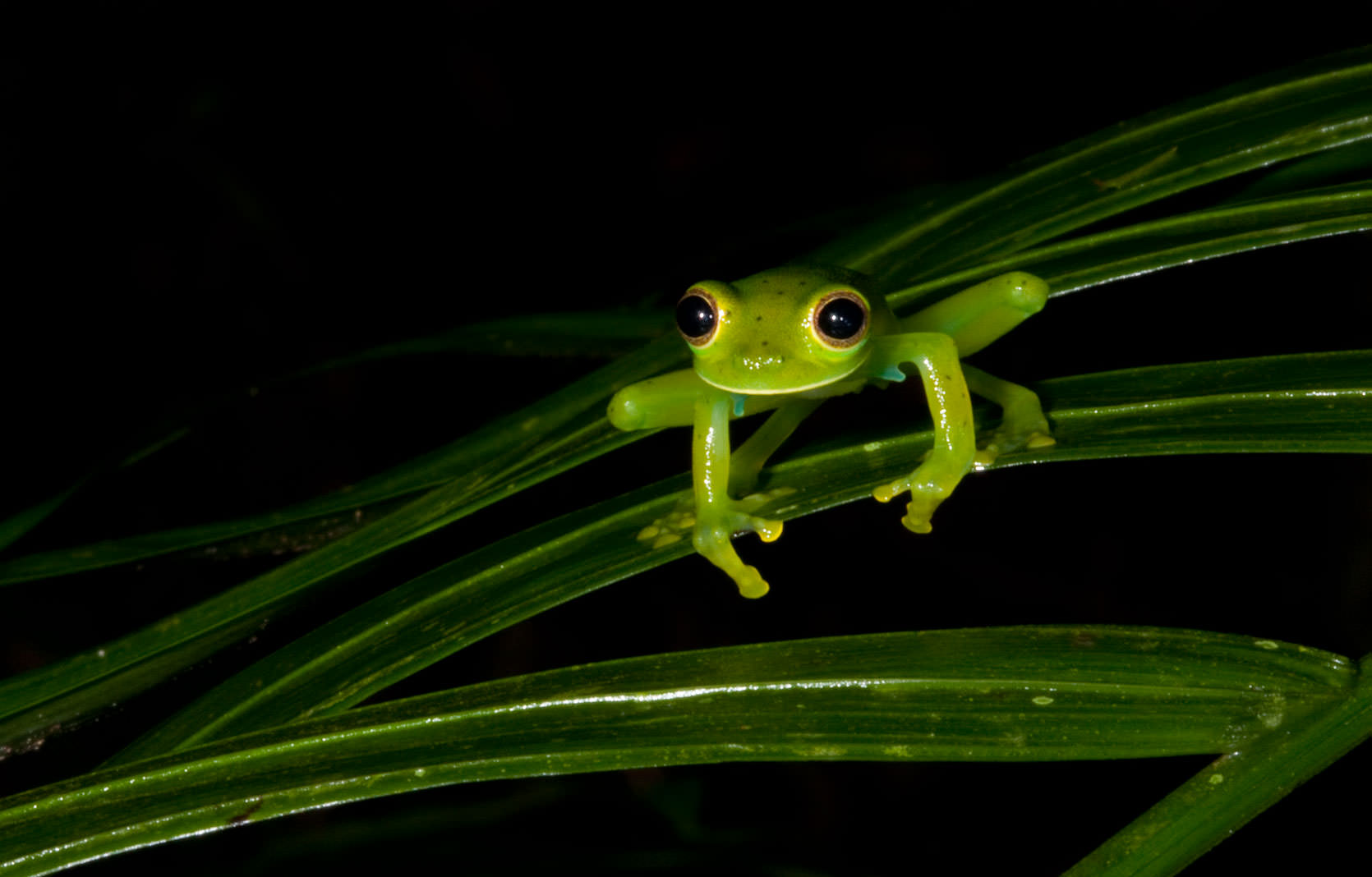
Glass frog, photographed at night in a river near El Valle.
Today, the rain came down so hard that the creek turned to a raging river, forcing logs loose and pulling branches off trees that hung above water. Although it’s the rainy season in Panama, today's weather was fierce enough to break dams in El Valle de Antón and pull apart asphalt on the roads.
I am sitting at dinner in the open dining area of the Canopy Lodge with eight birders. We were strangers this morning, but already we share wine and stories.
A man enters the dining area wearing camo fatigues, wading boots, a lantern and a snake stick. I had arranged Mario to guide me up the creeks and streams of El Valle before I came to Panama. Ever since high school, I have been haunted by the story of the world's vanishing frogs.
I am thankful that Jose is joining us. He is the hard-working birding guide at the lodge, and he has offered to join us on his own time. Nobody has ever done something like this at the lodge, he explains.
From the van, I stare out into the darkness while Mario and Jose banter in Spanish. I try to follow their conversation, wondering what people in El Valle talk about. But every once in a while, I hear Bufo marinus or Euphonia — they're talking about frogs and birds.

A Creon Skipper of the Lilliana subspecies (Creonpyge creon lilliana), rests on a leaf above a creek in the La Mesa area of El Valle de Anton.
This photograph may be the first published image of a live Lilliana Creon Skipper.
Lola, I am thinking about this conversation I had last year. I've maybe had a bit too much wine, which for a moment I regret, because I need to keep my wits sharp. A friend was visiting my family and speaking broadly about climate change. He tried to refute my insistence on the science of global warming by saying that every generation believes his to be the most important, and that climate change was just a sort of collective outlet for our arrogance and our generational need to have meaning.
I explained that each generation's challenges actually are compounding in their importance as we catapult ourselves into overpopulation and ultra-efficiency, and that our children's and grandchildren's world will contain more grave choices and more unimaginable challenges than our grandparents who sat in trenches with fevers. Don't forget the course of the last hundred years, I told him, which went from World War I, to an even more horrible war, to the Cold War, which contained in it the first genuine threat for mankind to distinguish himself from Earth.
Now, Lola, I'm thinking about you too. I am very much thinking about our conversations about the meaning of extinction, as we jump out of the van into the night.
We leave the road and head over a foot-bridge, passing over aquatic farms and then down into a small river. I had told Mario that I wanted to look for frogs.
"What are your target species?" he wanted to know.
No, I had explained, I have no target species. He talked about the golden frog. No, I am not hoping to find the vanished frog. What about poison-dart frogs, I asked him, referring to the world's most beautiful amphibians, which range from Panama to the Amazon.
"No," he said. "Chytrid fungus," referring to the skin-suffocating fungus that has embattled the populations of many frog species. "There are still poison-dart frogs in El Valle, but it's unlikely you will find any." He named some species that used to abound in the crater. I recognized one of them — the spectacular green and black poison-dart frog.
No, I explained. I just want to get out there.

A spider hunts on a heliconia bract above a swamp in Panama.
Mario, a biologist and freelance herp guide, knows the calls of each species and has a knack for locating anything in the dark. Almost immediately, we begin scanning the trees for frogs. This river is crawling with life at night. I turn around — a basilisk is staring back at me in a tree. I look down — a half-foot cane toad in the water, cockroaches on the bank, katydids and caterpillars on the branches, ants up the vines, snakes on the riverside, butterflies in repose dangling from leaves, wolf spiders resting in plain sight.
Quite quickly, we find a frog. He stares at us from a small leaf on a tree hanging over the river. This frog is a glass frog, which means he is from a particular order of frogs, of which many species are see-through. Some are so clear that their bodies are like aquariums of organs.
Beyond their transparency, glass frogs tend toward the petite, making their features — eyes, legs, mouth, face — almost cartoonishly anthropomorphic. Our lamps all flood down on this tiny animal, and we crouch in to look. This creature, with tiny arms and quaint fingers, turns. He looks up at the black sky, and he appears like a proud man who has lived a thousand years and knows everything, and has braced for a great sorrow.
Frogs exist in nearly every environment where man exists, and they thrive in our folktales and proverbs. Throughout human history, regardless of culture, the frog represents unexpected wisdom, unseen wisdom, or cunning. In the various frog princess fairytales of Europe (which inspired The Frog Prince), a man who chooses the frog is rewarded with an enchanted princess. In cultures around the world, the frog often possesses a cunning intellect or knowledge about the world that only his owner sees, or that he only reveals at an advantageous moment.

The glass frog's translucent skin is visible under the flash bulb.
The biological diversity in this part of the world is astounding. Just this morning, I photographed a butterfly which, according to lepidopterists, is the first live photograph of this subspecies ever. This luck suggests that taxonomy between the continents is still a bit of a Wild West. But despite the apparent endlessness of it all, the world of diversity has limits, and I think, when talking about diversity, it's important to know those limits.
The world contains about 44,000 arachnids, 82,000 molluscs, and about 250,000 species of flowering plants. The total number of insect species? Over a million. Diversity can seem boundless, but the numbers seem more finite when you look exclusively at the advanced animals.
The world contains about 32,000 species of fish; 6,800 reptiles; 9,800 birds; 4,200 mammals; and 6,500 amphibians. Of the 6,500 amphibians, about 4,800 are frogs. Since the 1950s, about 1,800 of these species have become threatened with extinction. Another 120 have actually gone extinct.
Rarely do articles that talk about extinction talk about totals, but it's been my experience that when you get out in the field and get a sense of the distribution and populations of different animal groups, you start to see the importance of these numbers, because the numbers start to have context.
Throughout the history of the world, most extinctions have been natural events. New organisms which can exploit an ecological niche are always evolving, and species become extinct when they can no longer compete with changing conditions, or face extinction when other organisms evolve more efficiently to compete in their niche.

PHOTO: A green katydid rests on a leaf in a tree above a river in El Valle de Antón.
Scientists often say that 99.9% of all species that have lived are now extinct. So why should we be concerned about extinctions today? Let's say the average species is expected to exist for about ten million years. Then what does it mean when an entire order of animals is collapsing within a timeframe of a hundred years? What does it mean when extinctions are happening at 1,000 times the rate of the recent fossil record? And what does it mean when scientists tell us that they estimate that by 2100, half of all the species in the world will be gone?
We wade upriver, our lamps shining in unison as the next frog calls or the next stick breaks. Frogs with brilliant yellow spots, amber bodies, red eyes. In all, so far, we find eight species.
Night is a lovely place to consider big questions about our world; every detail remains in darkness except for what we momentarily hold in focus. I am focused on this: why are the frogs dying? Is the golden frog really extinct? And can we deduce any sort of real wisdom about the world by peering into the brilliant eyes of a glass frog?

The view from La Mesa
Dear Lola,
We continue upriver through the night. When the river becomes too narrow and entangled by hanging vines, we walk up to a path that follows the river.
Here, only a dozen feet from the river, our flashlights capture a completely different biological world. Butterflies hang upside down from leaves. Until now, I never gave a moment of thought to where butterflies sleep.
If you look carefully between the legs of sleeping butterflies, you can see leafcutter ants moving like robots along trails of scent and chemical. Don't stop there, because underneath the legs of the ants are tiny white specks with red eyes moving in the opposite direction.
There are frogs here too. Large brown treefrogs. I say large only because I have just been staring into the eyes of tiny glass frogs.
Lola, I am thinking about our conversations. Why do small species with no apparent benefit to man matter? You posed this question to me when we discussed our endangered species laws:
"The question is, are we morally bound to save every species that is in trouble, for whatever reason? We still have pockets of alpine plants in the Appalachians. Certainly everyone will agree that there is no way the Appalachians are truly alpine. Are these misfits, left over from the ice age, worth saving? The pika has evolved into an animal that thrives in a very limited environment. There are many species, especially plants, that have a little niche like this… As we all know, there is no complete agreement, with all due respect to Erik, on whether these things are happening due to man's activities or whether this is a natural phenomenon. If it is natural, then we are playing God by interfering."
The story of the vanishing frogs is illustrative of our disagreement. Let me explain. There is no unifying theory as to the disappearance of the world's amphibians. For many years, this allowed critics of extinction warning calls to say: there is no complete agreement; do not jump to conclusions.
Ever since the 1980s, frog populations have been crashing. Sometimes entire populations disappear. There is no one global theory, no single reason why this is happening. Rather, it's a host of reasons—pesticides to pollution, introduced species to UV-B radiation, climate change to disease, poaching to encroachment.
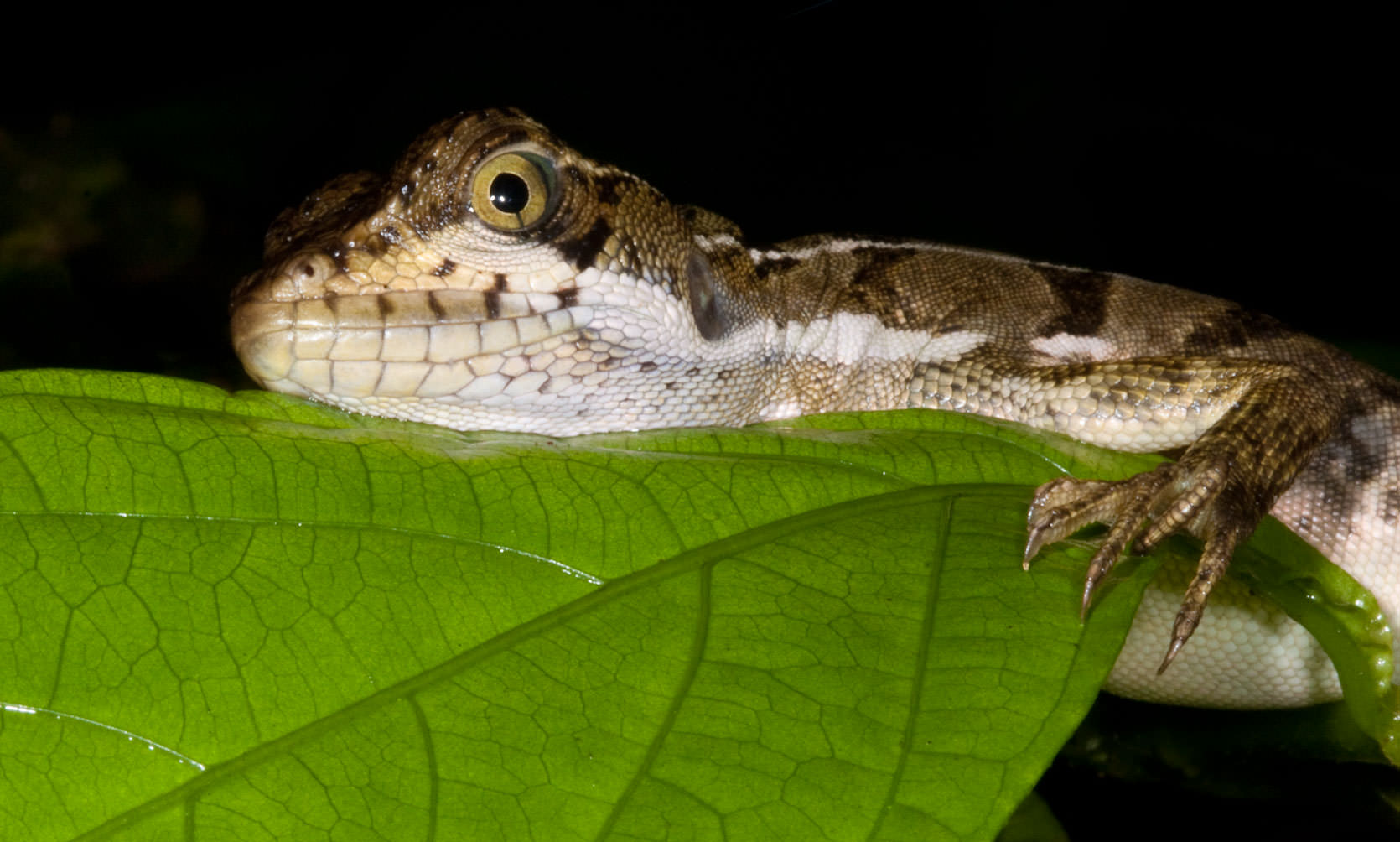
A female Common Basilisk lizard perched above a river in El Valle.
The Panamanian golden frogs once lined mountain rivers like this one. They were daytime frogs, and instead of just croaking at each other to communicate, the golden frogs would wave at each other with their webbed feet—an evolutionary adaptation to compensate for the noise-drowning rumbling of fast-moving El Valle rivers.
The golden frog started disappearing only in the late 1990s. It happened so fast that there is no definitive answer as to why it happened. The most likely explanation is that the golden frog fell prey to a mix of chytridiomycosis disease, habitat encroachment, and pollution.
The chytrid fungus, which is responsible for chytridiomycosis, appears to be behind a number of the population declines around the world, specifically in cooler areas like this high-altitude Panama location. The animal is infected by zoospores, which quickly catch hold and begin to expand.
The animal begins to have convulsions. Its skin hardens. The animal loses its ability to flee. It sits there, its legs sticking out in the wrong directions, and then it dies.
When chytrid fungus hits a location, half of the species in that area will vanish within a year, and eighty percent of the total amphibian individuals will disappear.
But the relationship between the disease and the amphibian declines is confusing. It is not known, for example, whether frog populations have always hosted the fungus and have only recently become more susceptible.
It is believed that climate change and other human triggers are playing a role in the power of chytrid disease, because although the disease affects cooler temperate regions, and the fungus cannot survive in warmer climates, it is believed that climate change is sending water vapor into the air of temperate climates, increasing the moist habitat the fungus prefers.

A glass frog positions himself to call from a leaf overhanging a river.
I tend to hold the view shared by most evolutionary biologists: that, under average circumstances, any one species on Earth may be expected to exist for, say, ten million years before going extinct or evolving into something else.
The rate of extinction for all species on Earth is now about two hundred times higher than the average rate of extinction in other ages.
If you count the world's endangered species, that number increases to 20,000 times the natural rate of extinction. The numbers, along with a wide body of reigning theories on different endangered species, eviscerate the contention that we must deliberate whether extinctions are man-made or natural.
If you look at these facts alongside the more specific example of the worldwide amphibian decline, you have, in my view, a very clear indication that statistically very few threats of extinction in our world today would be natural, and that any natural extinctions taking place today would be statistically insignificant.
Also, conservationists and biologists aren't concerned with saving "every species that is in trouble, for whatever reason." Rather, the prevailing view in the conservation movement is to consider the total sum of the Earth's diversity and to target ways to save the most diversity.
The part of our planet that matters to us is a thin band of atmosphere populated by organisms that sustain that atmosphere. The Chinese have a saying: "The man who removes a mountain begins by removing small stones." Our disappearing species are the first small stones. Science can never know the cumulative effect of removing any one of the smallest components of our biosphere, but we have a large body of data and theories on the effects of continued species losses.
And thus, here is your fallacy: if we do not know, we must delay action in saving species.
It is rather the opposite. We do not know the effects of the loss of one species, but we know that the cumulative effects of the loss of species and habitats provide a set of grim consequences for our own species. It is therefore advisable that we strengthen, not weaken, our means to protect these habitats and species.
This is what I am thinking about, Lola, here at ground zero for extinction, when a tree branch breaks and our lights catch, for just a brief moment, a whir of white. We are now a few miles upstream in dense wilderness, where almost anything may be wandering.
Jose whispers, "possible Crested Owl," referring to an enigmatic bird rare for this area. We rush forward into the dark, and soon enough more branches break, and our lights catch the red of eyes down the cliff near the riverbank.
We decide to scramble down the cliff toward what appears to be night mammals.
Here the river rushes faster, and so we jump from rock to rock approaching the source of the noise. Mario moves fastest downstream and follows fast-moving gray fur up the bank of the river and into the trees—it's one of the local possum species, although we can't be sure.
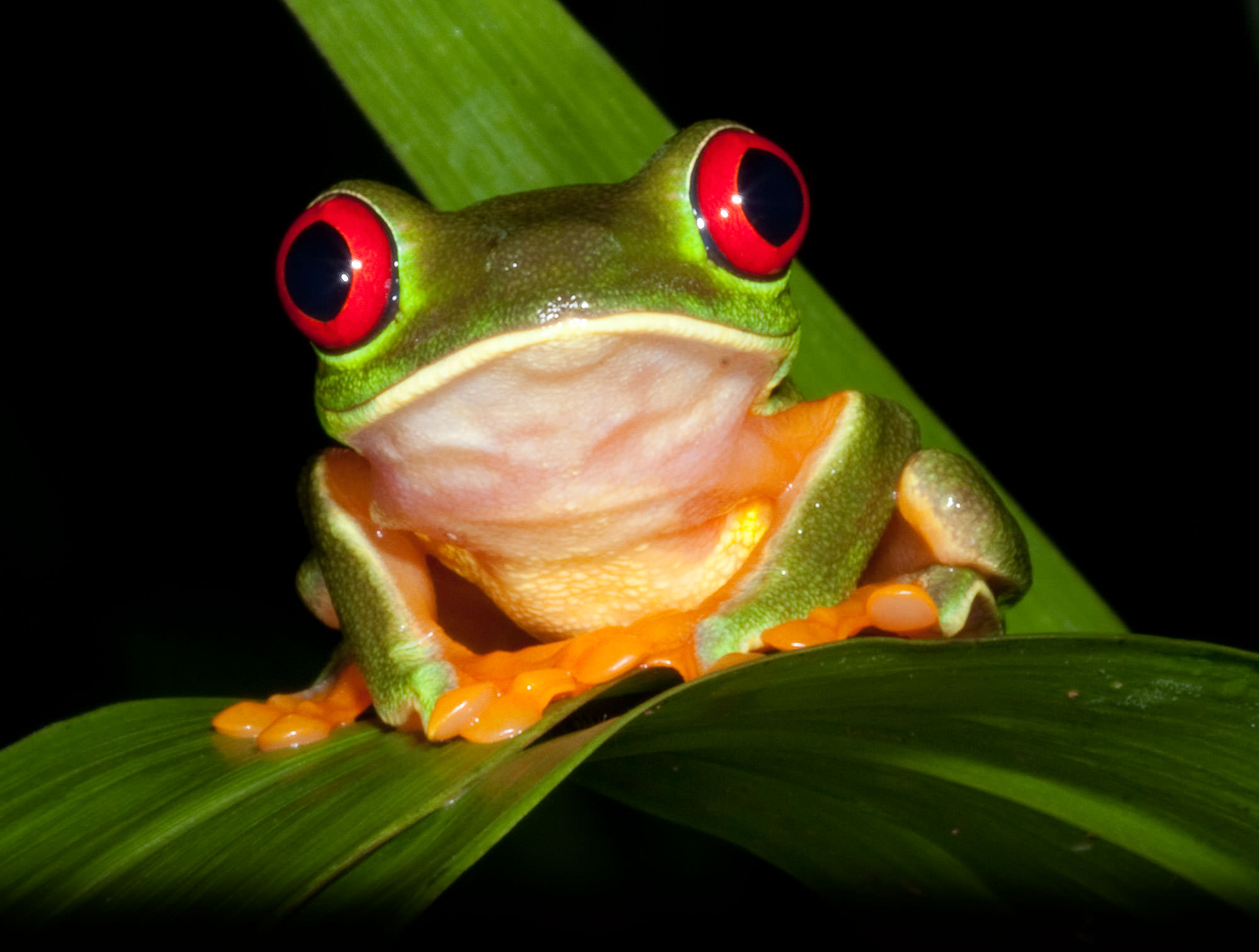
Male Red-eyed Leaf Frog perches on marsh plants.
When the animal disappears, we hear a frog. And then another. In a tiny pocket of this river, we find three, possibly four more glass frog species.
I cannot explain why, Lola, but I am thrilled to see these frogs, like little jewels of life. I guess there are more majestic things in the world than small green frogs, but right now I am at the entrance to Petra and the London Philharmonic and the tearing down of the Berlin Wall all at once.
A few days later, I am sharing dinner with the birders at Canopy Lodge when a couple enters the open dining area. The birders recognize them immediately. Raúl Arias de Para and his wife join us for dinner.
Raúl is the grandson of Tomás Arias, one of the founding fathers of Panama. Raúl was schooled in the United States and came back to Panama a businessman. In 1968, Panama's elected president was yanked from office by the National Guard only a week and a half after being elected. The National Guard continued to expand its reach and control over the Panamanian government, running a regime marked by human rights violations, assassinations, torture, and fraud. It was in this environment that General Manuel Noriega built up a government whose income was becoming increasingly tied to an underground criminal empire composed of money laundering, drug smuggling, and Chinese immigrant smuggling.
Raúl left business and became a major player in the opposition against the Noriega regime. He went on to write the book Anatomy of a Fraud, which continues to be the country's bestselling book of all time. The book was an extensive exposé of the 1984 elections.
Today, Raúl is a prominent Panamanian businessman, a conservationist, and the owner of a small group of successful eco-lodges. He had heard about our night walk looking for frogs, and he recounts the story of David Attenborough's BBC film crew coming to El Valle to film the golden frogs.
He describes the situation after the BBC film crew brought attention to the golden frog.
The species had one chance for survival.
That chance, in fact, is a method of desperation—a last-resort method. Rush into the species' habitat, collect all remaining individuals, drop them in Ziploc bags, rush them to quarantine, then house them in aquariums and attempt to breed them.

Cricket frog male calling from a swampy perch.
This is the strategy all over the world. It is called the Amphibian Ark—a network of zoos and amphibian conservation organizations that understand the only way to keep these species from extinction is to extract them from their environment and hold them, with the hope of one day reestablishing their populations in the wild.
In El Valle, local biologists collected the last of the known individuals and brought them to a newly established center known as the Panama Amphibian Rescue and Conservation Project. Here, dedicated biologists house what may be the last individuals of dozens of frog species. The total number of individuals for each species differs: fifty, a hundred, two hundred. All over the world, small institutions struggle to keep tiny populations alive. Many of these species, like the golden frog itself, were once ever-present in their habitat.
This is desperation, but it is also a hint of what is to come for the world our grandchildren will live in. It all starts with the small stones, Lola.