
West Indies

The Abaco Islands
from Little Abaco to Sandy Point
Notes from my travels throughout the interior of the Abaco Islands
We remember islands by memories and photographs. After a lifetime of driving by car on the Abaco Islands in the Northern Bahamas, I have begun to erase old memories and photographs of beaches and water, for stories of dusty roads and lonely towns. Today, I remember the Abaco Islands by their interiors.
The Abaco Islands consist of two slender, long islands - Little Abaco and Great Abaco, which are connected by a small bridge, and dozens of smaller cays, islets and mangrove hammocks. Today, I am at the farthest point north in Little Abaco – a jut of sand, rock and coppice near the township of Crown Haven.
Crown Haven, home to around a hundred people is known for only one thing – it’s home to the ferry dock from the more cosmopolitan island of Grand Bahama. Crown Haven is as quiet as you can imagine a place. As a black town in Abaco, this is fitting. After Abaco's blacks were emancipated, they erased themselves from history. Black Northern Bahamas retreated into isolation, and for two hundred years they subsisted on fishing and agriculture. They left the old loyalist towns and sprung new villages on distant coasts and under unknowable pines.
Like their fellow British loyalist islanders, nothing substantial could have happened in this time; this is the Bahama backwoods after all. So it is perhaps no great loss to history that little of this time is known. But for me, small histories are beautiful, and so this is a missing puzzle-piece in the fabric of North American history. Sometimes, people say that what they like most about traveling is learning the history of a place. But in places with no recorded history, you have to extrapolate and imagine what life was like based on the little information you have. And that to me, is just as enjoyable as knowing something.

Rusting fire engine in Marsh Harbour, Great Abaco.
People equate the word Bahamas with Mr. Howell of Gilligan's Island, or with offshore gambling and banking, and the Atlantis Resort, hundreds of miles away from here. But the Bahamas are in fact one of the last intact wildernesses in North America. Rather than palms and groomed beaches, the Bahamas is a sea, pine, coppice and mangrove wilderness only sparsely dotted by development. Seven hundred islands, but if you count the islets, that number escalates to nearly three-thousand. If you look at a map, the Bahamas encompasses an area that masks most countries.
If the Bahamas is a wilderness and its ethnic history is missing, then what happens in and near those villages and townships today?
We drive south from Crown Haven, through Fox Town and Cedar Harbour, and then we pass over a tiny bridge to Great Abaco. This area contains one of the last unlogged stands of Caribbean Pine in the West Indies.
Cooper’s Town, where the Prime Minister of the Bahamas grew up, is also small, quiet and unassuming. and further south near the entrance to a development called Treasure Cay, is the colorful, somewhat hidden squatter’s camp called the Sandbank Settlement.
For years, I had looked at Sandbank while passing by. Today, my dad and I have a chance to visit Sandbank with a friend who lives there. Havvy, who is thirty years old, came to Abaco ten years ago in a makeshift boat from Haiti, where his wife lives. Like most of the squatters here, he came to make money to wire back to his wife and five children.
Sandbank is a maze of small clapboard shacks and narrow alleyways. Many of the shacks are built on stilts, out over the mangrove water and connected by plywood and corrugated metal walkways.
Although the total area of Sandbank may be an acre or two, there may be upwards of 750 people living here, many of them children. And while the entire island of Abaco has only about 13,000 Bahamian residents, some estimate that an additional 10,000 illegal Haitians live in the Abacos.
Despite living on Abaco for the last ten years, Havvy, who visits his family in Haiti once a year, does not speak English. He is able to explain that many of the small children do not have parents, and are taken in by the community as a whole. These children, who, by being born in the Bahamas are Bahamian citizens, are free to attend public school.
Haitian children from the squatter camps don’t always have the money to pay for school lunches, so they will stay home until they can afford the school lunch. Learning this helped me understand the weirdness of these Abaco shanty towns: Sandbank lies only a few miles from Treasure Cay, a place of enormous wealth. But Sandbank is virtually invisible to the community at Treasure Cay. That invisibility is enforced by just about everybody. The Haitians, for one, are extremely nervous to find two white men walking through their camp. And Havvy himself appears nervous to be escorting us through.
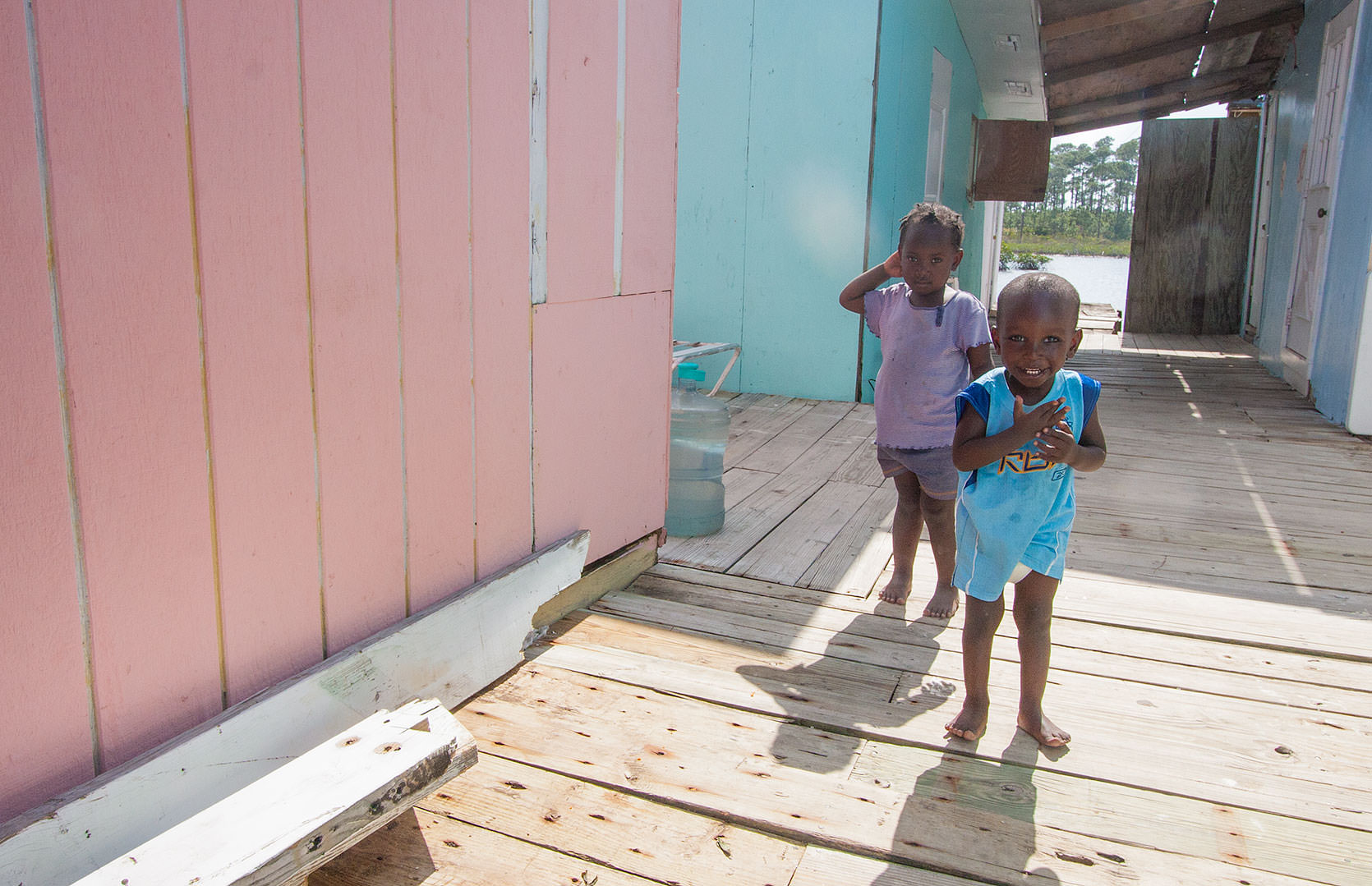
Children in a Haitian camp in the Abaco Islands
“I wouldn’t touch that one with a ten foot pole,” people will say. Nobody wants to talk about the shanty towns. Fires have broken out several years in a row through the shanty towns further south on the island – each time these fires break out, these men, women and children, lose everything they own.
Having heard that we would be visiting Sandbank, one man said, “To learn how bad it stinks in there?”
Native Abaconians have particularly strong feelings about the squatter settlements. “They could do better for themselves if they wanted to, you know,” an Abaco man explains while staring into the flat-bed of his pickup truck. “They make about a thousand dollars a month, okay. This is not bad money to live on in Abaco. But they send eight hundred of it back to Haiti, and they live on the two hundred.”
The debate over illegal immigration gets fiercer in print and online, where Bahamians can discuss anonymously. In many ways, it is the same debate you hear the world over, only on island scale. Anonymously, you can hear the reverberating hatreds and xenophobia the subject can create - they take our jobs, they act like they own the place. That sort of thing. Removed from all this, though, I can see that mostly everyone is most comfortable when nobody is talking about the Haitians. If those little kids who have no parents are invisible, we don't have to extend our humanity to them.
Some Haitians, who started out in these camps or as illegals, working on the nearby citrus farms, made their way from poverty to wealth. You would think, guys like that, they could really help out their communities. Get the kids to learn English, teach them some skills to help themselves. But it never happened. And that way, Sandbank stays perfectly invisible, even though it’s right there, on the side of the road that cuts through Abaco.
Treasure Cay itself is a development whose construction began in the 1950's, centered around a partially natural harbour for recreational boaters. A few nights ago, I had agreed to meet my family for dinner here, at the one restaurant in the development.

Sandy Bank Haitian Camp, near Treasure Cay, Abaco Islands
After ordering dinner, I excused myself and picked up my toddler son. "I'm going to take him to the harbour, and let him look at the fish."
We walked down the docks and crouched up against the cement wall. "Look, see that fish there? That's a striped grunt. See that, that's an upside-down jellyfish."
Seeing harbour fish is hardly like seeing them in the water, but I said, "sometimes, you have to just be patient and keep looking. You never know what might turn up in these waters."
Just a minute later, I could have been dreaming, an eight foot fish rambled through the water right under our noses. My boy was ecstatic. This was impossible. The fish was giant, much bigger than the sharks we see sometimes on the reefs, but certainly this was no shark.
My wife came out to find us. Yes, under ordinary circumstances, we would be back by now. I felt like I was telling a fish tale. "We just saw an eight foot fish!" I said.
And my boy said so too. "It was really big!"
Just then, seven more of these giant fish passed right under our noses, all of them in two or three feet of water. But what were they? Later that night, I looked up their field marks - giant scales, torpedo-shape, silvery sides, a long tail. Only one fish fit the description - tarpon. I told my boy, right then, that he better never forgot what he just saw.

The road to Hole-in-the-Wall.
On December 26, in 2004, my brother Hans and I decided to drive to Sandy Point, a seaside village on one of Abaco's two southern points. It is so far from anything that driving there is an afternoon on a paved road alongside wooded pine and thick mangroves.
The village is wooden houses, painted in pastel colors underneath palms and electric poles.
Two years of hurricanes have left Sandy Point weathered, but it is not the kind of place that is trying to impress outsiders anyway. Sandy Point is a fishing village - conch, lobster, grouper. It is mostly a black town, but there are whites too. Americans, mostly it seems: older folks in fishing hats.
We filled the van with fishing spears and snorkeling equipment and a stash of food, and some flashlights and a map of the island, and a birding guide. A tent and sleeping bags.
After we passed Marsh Harbour, Abaco's capital and the third largest city in the Bahamas, (famously containing Abaco’s only stoplight), all development begins to subside and Abaco becomes just a road darkened by the pines.
The pines narrow at times on either side and give way to still water thick with shrubs and odd trees. These are Abaco's vast mangrove systems. If they're on the left side of the road, they are probably part of one of many brackish lips protected from the Atlantic. If they're on our right side, they are most likely an inland part of Abaco's marls - a hundred miles of water covered in sandy shoals and dense mangrove thickets – a sort of wilderness that is not quite land, and not quite water.
We walk out into the mangroves barefoot, following a system of red mangrove trees covered in a variety of snails and insects. Hans crouches near the water and says, "I bet that in a minute, water is going to rush in here."
You're probably right, I am thinking. But what he means is literally one minute. This is shallow, flat, Bahamas water - imagine a beach so flat it's five miles wide - so when the Atlantic tide is rising, these mangroves are bound to inundate instantly.
And suddenly it happens, the water pours in like a hurricane surge in miniature, filling the rivulets and making a muddy backwater look like a gentle lake in a moment. Thinking back at that moment haunts me because in a few hours we will learn about the Boxer Day Tsunami in Indonesia.

White-tailed Tropicbirds circle the cliffs near Hole-in-the-Rock, Abaco Islands, in search of nesting grounds.
This tidal process in waters like this, occurring roughly twice a day, was for most of history misunderstood. The tides are linked undeniably to the health of both the mangrove and the sea itself.
Hans looks up at the waning moon and explains how the tide's ferocity is a result of our two relevant gravitational bodies - the sun and the moon. When the moon is full, he explains, the sun is at at odds with the moon. But today the sliver of moon suggests the moon and sun are acting together, adding to the gravitational pull.
Bahama tides are not severe, but they are unquestionably important to the ecosystem. And all that is tied into the mangroves.
The word mangrove has two meanings. It refers to a type of plant, and also a coastal habitat consisting of plants that flourish in saltwater and the creatures which abound in them.
Regardless, the Abaco mangrove system is both - consisting primarily of the plant family called mangroves and being a botanical community which exists in the saltwater.
Mangroves are derided by many for being buggy, swampy and smelly, virtually worthless places. But the mangroves feed the sea. Just looking under our feet, we see bounding schools of minnows. Deeper, sharks and fish of every ilk breed their young here. Green turtles come into these waters to forage on seaweeds. It is the safest place in the sea. The mangrove gathers nutrients and the tide flushes all that into the seas. The mangroves feed the sea grass and form the breeding ground for the coral reef. Life in the West indies then, begins here.

Bahama Palm Shores area in southern Great Abaco.
Even many of Bahamas’ plentiful shark species breed their young here. At times, wading flyfishermen seeking a bonefish are urged to be wary of fast moving lemon sharks prowling in the shallows.
We leave the mangroves and pass into pine again. The area we pass through now is protected by the Bahamian Government. It’s the sole refuge of Abaco’s population of the Rose-throated Parrot, a colorful rock burrowing bird, and the most northerly breeding population of native parrots in the world.
We arrive at Sandy Point. Modest and beautiful all the same, it's littered with the detritus of the recent hurricanes, and time. There are a number of terns and gulls on the sandy bars that jut out from Sandy Point, huddling against the Nor'Easter weather. About nine miles beyond that is a stiff choppy surf, and a gigantic vessel, visible even in the haze of rain and fog. The vessel hints at land beyond. A small island that used to be called Gorda Cay.
For five year leading up to 1983, Gorda Cay was one of the major smuggling points for cocaine and marijuana heading into the United States and beyond. A few guys from Sandy Point had somehow gotten on the bad side of Gorda Cay's owner. So the owner, a man by the name of Frank Barber, asked the island's caretaker to hold them hostage, and leave them for dead on a small rock just off Gorda Cay.
The island passed through several owners in this period, all of them bent on maintaining a secret drug trade route to Florida.
Freighters from Columbia and planes flying low against the water would drop in regularly. A waiting Cigarette boat would be prepared to haul ass to Florida under the cover of night.
Eventually, the DEA caught on and set up shop on the island. They formed Operation Grouper, and by allowing Frank Barber leniency for information, the DEA snatched up 90 drug villains.
Today, the ship that sits near its shores is owned by Disney. It's the so-called Big Red Boat.
Now the island is called Castaway Cay. You cannot see the island from here, only that giant ship.
Disney's boat used to be docked nearer the developed part of Abaco, on an island called Great Guana Cay. But the dredging project which was designed to keep the Big Red Boat from catching sand, failed, and not only that but the dredging process destroyed huge tracts of one of Earth's largest coral reefs by the silt kept churning through the narrow passage that funnels water between the Atlantic and the Bahama whitewater.
Disney sells people on an island filled with Caribbean history. Pirate history. But the only Pirates of the Caribbean I can imagine here are those drug runners dropping some innocents off on a lone rock in the ocean.
Now that the drug runners are gone, maybe Disney is the new Pirate of the Caribbean. What vast amounts of drugs passed through these waters can in no way amount to the devastation Disney created on the Guana Cay reef. If Gorda Cay was a refuge for pirates of the 1980's, maybe Castaway is one of the last refuge's for giant cruise ships in the Caribbean.

Native passionflower plants cover coppice forests in Southern Abaco.
Just before leaving for Sandy Point, I had read that a new trend in the Caribbean is to begin banning giant cruise ships from entire nations. Islands are beginning to see that the huge amounts of wealth these ships bring to their islands doesn't exceed the negative images and economic circumstances these ships bring to their island. The trend will ultimately make cruise ships seek small refuges such as Gorda Cay.
In Sandy Point, we stop in at Eric's Pub for a Kalik beer. Three guys are sitting at the only table in the darkened room. They wear heavy jackets; Bahamians have trouble with December weather, and drink concoctions of vodka and condensed milk as a sort of denialism.
The guys in the bar are the first ones to tell us the horrible news. They tell us about the Tsunami in Indonesia, which they mistakenly refer to as, 'California.'
We talk to them about the Sandy Point fishing industry. I ask if everybody here adheres to the brand new Grouper fishing laws which restrict anyone from fishing for Grouper for two months in the winter. Their answer is a unanimous yes, absolutely. Abaco fishermen take their laws seriously.
We leave Sandy Point and begin tinkering down any old dirt road we can find. The first of these is the road to the Sandy Point dump, which is where you go to dump your 1967 Buick, and your dead dog.
And where the turkey vultures hang out.
The turkey vulture is a lurid creature; with brown and gray wings and a nasty beak with a large nostril.
There are about 10 of them, perched on a dead tree above that dead dog. Lurid though they may be, the turkey vultures are amazing. In a BBC documentary, naturalist David Attenborough visits these birds on the island of Trinidad. He takes a cooked piece of beef and hides it in the Trinidad jungle, burying it under leaves. Within three-quarters of an hour, the meat has encouraged a swarm of turkey vultures into the air, from miles away. Somehow, in a manner unknown to science, the turkey vulture is able to smell the faintest, faintest scent of decay and then locate the material by circling in a pattern of increasing scent, until, quite quickly, he is able to locate his decaying meal.

Painted Bunting in North Great Abaco
Hoping to run into some Abaco Parrots to make up for these vile monstrosities, we head out on the main Abaco Highway, and then down the road to their refuge, through the middle of Abaco National Park. Hans the whole time telling me to watch those potholes.
It happens with a thud. Tire trashed, there will be no parrots today.
Forward a few years, and it’s a year ago.
A year ago, I was back in the Abaco Islands, and I met the Doctor. The Doctor is a retired American whose interest in ornithology had meant a life of chasing birds around the world. Here in the Bahamas, he is one of a small handful of experts on Bahamian birds. Last year, the Doctor showed me how to find those parrots. Seeing those parrots for the first time gives you a different perspective on the Abacos, because it sets the island in a whole new light. It makes those endless rows of pine trees feel more magical, more like something is hiding behind them.
This year, the Doctor and I had plan to spend a full day in the field.
But upon arriving in Abaco, he sends me a note. A few days ago, the Bahamas National Trust had contacted him asking him to check out some reports that locals had been making in various villages about an unusual oriole they had been seeing.
Somebody with some naturalism experience in the Abacos might know that Greater Antillean Orioles had once inhabited this part of Abaco. But the last sighting of this oriole species was about 20 years ago, while American ornithologists were running field studies in Abaco National Park.

Sisal plants and a vast expanse of coppice forest at the Hole-in-the-Wall Lighthouse, Great Abaco.
The oriole is considered extirpated from Abaco, which means that in the country of the Bahamas, it lives only on one island group, not two. This is significant in conservation, but it became even more significant when scientists decided to split the Greater Antillean Oriole into four unique species. The Cuban Oriole lives in Cuba. The Hispaniolan Oriole lives in the Dominican Republic and Haiti. The Puerto Rican Oriole lives in Puerto Rico. And the Bahama Oriole, which once lived on Abaco and the Andros Islands, now only lives in Andros.
Today, I get to help the Doctor determine if there might be any truth to these reports. We’re going to look for a needle in a haystack – to prove whether the Bahama Oriole lives in Abaco.
Rediscovering a bird in a region can be significant. For one, it helps nature tourism. But more importantly, the Bahama Oriole’s fate is uncertain. In Andros, another bird species, the Shiny Cowbird, which parasitizes nests of orioles, moved north from other islands, to Andros. So, as development encroaches on the Andros oriole habitat, and the cowbirds continue aiding in the decline of the species, the Bahama Oriole has become critically endangered. To rediscover the bird in Abaco would be to alter its fate.
The doctor and I meet in the dark of early morning. We throw our bikes in the back of his pickup. “In case something happens to the pickup, we can bike out of there.” Last time I had been driving Abaco with the Doctor, his pickup did break down, which is why I double-checked the bike tires.
We drive south in the dark, to the road to Hole-in-the-Wall Road, a rocky 16 mile road, which winds first through the pines, and then to a segment of coppice. Fires have been raging in this unusually dry spring, and so for much of the drive, we see plumes of smoke rising on either side.
The Doctor unrolls a large map of the area. Dozens of unmarked roads, most of which are overgrown and impassable, would get us to the area where scientists had last seen the oriole in the early 1990’s. Finally, we reach the correct section of the pine forest, which has been heavily burned only a few weeks ago.
We proceed by foot down the road. According to the American scientist who had conducted field studies here, there was an area along the road where cabbage palms were plentiful among the pines. Proof of the oriole would be finding the hanging nests they create dangling off of the palms.

Red mangrove saplings take root in the Abaco Islands.
When we get to the area where cabbage palms form an oasis, it is clear that the whole area is in bad shape from the fires. It would be unlikely that any oriole would continue to nest here. “Did the Bahamas National Trust tell you what villages they thought they saw the orioles in?” I asked.
“No, and they didn’t get back to me, so we have no idea where these reports are coming from.”
We decided to switch gears. Rather than looking for nests, we would try to find one of the people who thought they saw the oriole. We made our way to Crossing Rock Settlement, a small village which, until a few years ago, was a bright fishing village which hung right over the beach. A hurricane nearly vanquished the entire settlement, and so the villagers rebuilt a mile inland.
Here, we find a bar, where we ask to use a telephone. The Doctor knows of a man living here who had some bird identification experience. He thought it would be possible this would have been one of the witnesses.
The bartender finds the number for the man. His name is Israel, and, yes, he is available, and we would be welcome to come by his house, which is just a few blocks down from the bar.
We drive to the man’s house, and he invites us to his backyard. The Doctor has a hardcover volume on the orioles of the New World in his hand. He hands me a tape-recorder, and asks me to keep the tape playing.
“I saw him right here,” explains Israel, in that bush. He points to a large bush growing in his backyard.
While I play the Bahama Oriole tape, the Doctor begins to interview Israel, by opening the book and pointing to various plates of orioles. The plates do not have the names of the orioles on them, only numbers, and I can tell he is asking him about South American species’, birds which would never be found in the Bahamas.

The Atala Butterfly is a vibrant denizen of the Abaco interior.
The Doctor has a way of talking about naturalist ideas in an almost folksy tone, making complex ideas and questions easy to understand. And with the same patience he offered me in our forays, he delicately asks Israel everything he can about the oriole.
Israel insists the oriole he saw was a deep yellow, almost an orange. “Yes, but is it possible,” asked the Doctor, over the call of my tape, “that it was the morning light casting that shade on lemon yellow feathers, like this?” he said, pointing to another bird.
After fifteen minutes of questions, Israel had described the bird well enough that the Doctor concluded the man had seen an Orchard Oriole. An Orchard Oriole would be rare enough in the Bahamas that anybody who saw one and knew something about birds would find it significant.
I gave the Doctor a look that said, there’s our answer. There are no Bahama Orioles here.
The face he gives me back is, yes, these reports were all over an Orchard Oriole.
We thank Israel. We shake hands, and on the way out, the Doctor says, “by the way, who did you report your finding to?”
Israel looks at us strangely, then says. “Nobody. You two are the only ones who’ve talked to me about this.”
In the pickup, I say, “Up until that very last sentence, we thought we knew the witnesses were confused about which bird they were seeing, and that there is no Bahama Oriole on Abaco. Now, we find out he wasn’t even one of the witnesses!”