

Zion Canyon and the Theology of Sin
The Narrows, the Mormon heartland and a coming culture war.
Updated October 2, 2026
A lot of people I know have read the book, Under the Banner of Heaven, by Jon Krakauer. The book was about the strange views and violence that fundamentalism inflicts on a people. The book was written in the context of the Mormon fundamentalists of Southwestern Utah, but a lot of people came away from the book with the affirmation that mormons are crazy, nuts and deranged.
That accusation, of course, is false. Mormons are great people, most of them live a beautiful, healthy life, and even though their Book of Mormon and their Joseph Smith are a little wacky, the fact is, so are the texts and prophets of any other religion, especially from the viewpoint of somebody else.
This is a story about my own experiences with the Mormons of Southwestern Utah, fundamentalism, and the Christian right. It is also the story of the Gay Mormon, the fabled National Park in Utah, Zion Canyon, and the Zion Narrows.
The story of Zion Canyon actually begins in Nevada. It's a small town on the border of Utah called Mesquite. I stay in this town often en route to Utah, because the hotel rooms are cheap.
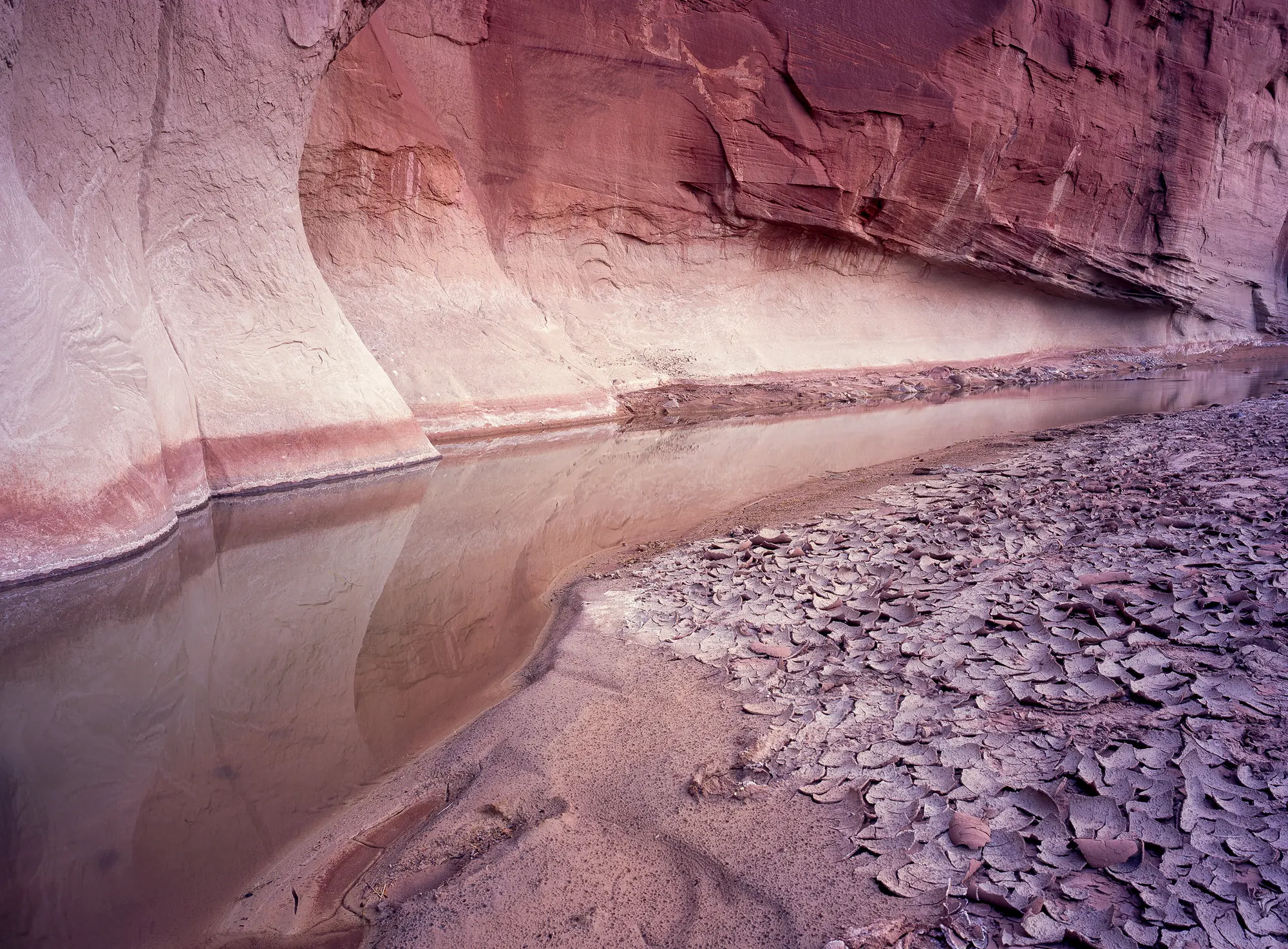
Caked mud in the Paria Canyon.
Across the Line in Mesquite
One evening, I sat down at the blackjack table. Gambling in Mesquite never draws the same crowds as Las Vegas, making it quiet and pleasant. Even in the evening, the tables can be empty. This one certainly was, so I talked it up with the dealer, who was losing to me. She was older than the female dealers in Las Vegas, but still the casino hooked her up in a skimpy top and high heels and a short skirt. Appalling, but then, Las Vegas also exports its older female dealers — without the looks and only the skills, they find employment here on the Nevada-Utah border much easier.
Since no one was around, Ramona felt free to tell me about life in Mesquite. "I can finally own land for my horses," she said. "That is what life is all about, some land and lots of trails." She talked about the Indian hieroglyphics in the area, and the summer heat. And, "I'd say about eighty percent of the young people gambling here are Mormons from Utah. They come across the border to be bad. To drink and smoke and do everything they can't get away with in Utah."
"The town of Mesquite actually has a lot of Mormons too. It creates a lot of problems for us, especially for my son."
I asked her why. "Well, the thing to do if you're a Mormon kid in Mesquite is to have this bumper sticker. It's just a little sticker, but it says S.T.L."
"And what does it mean?"
"Not sure exactly, something like 'Shine the Light.' But what it is, is a way for the Mormons in the area to know each other, know who's on their side. The problem is that the cops go around leaving those cars alone. But my son, he's not a Mormon. They pull him over all the time because he doesn't have the sticker."
"Does your son maybe attract the cops for any other reason?"
"Well, he's a kid, you know. He's got long hair, I don't know."
I enjoyed talking to Ramona, but I was a bit suspicious of her story. Maybe her son was a troublemaker in his own right, and certainly I never noticed any of those stickers myself. But I did want to learn a little more about those Mormon youths who cross the border, to be sinful. I said goodbye to Ramona and wandered around the casino-hotels. I had a fresh wad of cash, plenty of time.
The Inside-Outsiders
I found an escalator in one of the hotels, and then some sort of bar, where young people were buying drinks and chain-smoking. I sat down and ordered a beer, and read my book.
I watched the background noise of these mormons while glancing from my book. The result was not so peculiar, because mormon youth are no different from anywhere else. The guys were making advances on the girls, some were buying expensive drinks and blowing smoke rings. I remembered that movie, The Devil's Playground, a documentary about the Amish tradition of sending Amish teens to experiment with the outside world, doing whatever they wish. Drugs, rock music. It's called rumspringa, and these children who are more or less cut off from the outside world quickly adopt all the customs of the outside world, and perhaps even more so than outside people themselves. If the music is crass, like rap, they adopt it. If the drug is hard, like meth, it's their drug of choice.
But most of these Amish folks, like the Mormon sinners of Southwestern Utah, go back and accept their staid life — shunning what they enjoyed, affirmed in their belief after their ludicrous binges that the way is righteous.
What I see next is something I never quite forget. In any teen gathering, there is a group of inside-outsiders. The people who are accepted by the crowd, but slightly more alternative, and usually forming smaller groups on the periphery of the gathering. Even these Mormon alternative kids wear dark clothes. The one guy — tall, gawky, telling the girls a story with his hands in the air. Maybe I'm wrong, but I'd bet this teenage boy is a gay Mormon, and that nobody here, maybe not even him, knows it yet.
I grew up the way a lot of straight guys did, cringing a bit at the whole thing and never thinking much about what it was like to be on the other end of that cringe.
But this guy, telling these girls some story, this guy has a hard life ahead of him. I can already see it — in the closet for another ten or fifteen years. Playing it straight, slowly becoming more and more closed off to his own people. His interests are urban, he longs for the intellectual stimulation of those girls from his teen years — but they married and are showing, and they stay indoors most of the time now. In this place, the gay Mormon's life will be hell.
And for the gay Mormon, things will only get worse — because the Mormons of Southwestern Utah are some of the most aggressive anti-gay folks in the country.

Kolob Canyon, Zion National Park
An Inward Pursuit
I wake the next morning with that singular passion that all travelers carry with them — to go. And so I do, towards Zion Canyon in Southwestern Utah. I've conveniently forgotten my observations from the night before; I am no social commentator, I am just a landscape photographer. There are stereotypes even about people like me. The landscape photographer is patient, and yet also a bore. He is rural, and poor, but fakes the suburban life. He seeks what a thousand before him did.
My goal in Zion Canyon is to wade slowly up the Virgin Narrows, a segment of the Virgin River which tunnels into a slot canyon — the most famous slot canyon in the world. The entire stretch is sixteen miles. Hikers hoping to wade this entire stretch begin upriver. I'm carrying a forty pound camera pack. I hope only to wade as far upriver as the day will take me.
The walk up these famed waters is beyond enjoyable. This narrow slot of wind and water is the most famous for a reason — the colors of spring, the color of the southwest, the steep cliffs: this narrow swatch of Americana is simply unbelievable.
The wade upriver, however, is also an inward pursuit. After the first mile, all the gentle-mannered tourists turn back, and the canyon goes empty. My sloshy steps echo.
My thoughts turn to that guy — you know, the gay mormon.
As an American, I'm kind of predisposed to travails of the suppressed. That gay mormon, he's just bugging me.
Every step up the Virgin narrows is slow. The river in Spring is ripe, the threat of a deadly flood is real. Each step is a wander into destiny. But, okay, — this is what I am thinking — the gay guy — what does his religion really say about him? Should his religion hold him back?

Scarlet Monkeyflowers in the Virgin Narrows, Zion National Park.
Not Zion
Flash forward to my desk a couple weeks later and the agenda is finding out if American religions should be so firm in doing all the things they do to attempt to change, regulate and shun the gay folks life.
The world of homosexuality politics is incredibly strange. And for those of you who think this is an odd subject, or that it is completely irrelevant, don't forget that the issue is coming to dominate America's elections. More and more, voters in the United States vote on moral values above any other issue. And the only moral values issue that matters is whether gay folks should be allowed to get married. The case against is entirely a religious case.
But I love religious texts. I have read many of them, and I am always wary about how groups imagine the meaning in ancient texts to explore some weird component of their religious views.
Before I open my religious texts, however, I read up on the history of Zion Canyon itself.
Zion Canyon's modern inhabitants were nineteenth century Mormons who had been instructed by the prophet Brigham Young to inhabit the area. These settlers farmed the land in the beautiful valley through the 1860s and are reported to have fallen in love with this magnificent canyon. When Brigham Young came to check up on their progress, he was aghast.
The Mormons of Zion Canyon were drinking, smoking, playing cards.
The settlers had called their canyon 'Zion', after the description in the Old Testament Book of Psalms:
Beautiful in elevation, the joy of the whole earth,
Is Mount Zion in the far north,
The city of the great King. (Psalm 48:2)
But to Brigham Young, this surely was no Zion, for the people of Zion Canyon were sinful. So he declared the name of the place 'Not Zion,' and for a while, the settlers called it that, half in jest.
But when President Taft designated the area a National Monument in 1909, the US Government chose the safe name - Mukuntuweap, a politically safe ode to the early Indian inhabitants.
Years later, the monument was renamed Zion, and when it became a national park in 1919, there was no outcry from the Mormons of Utah.
A Question for Science
I open my evolution texts and I ask myself, what is homosexuality? I ask this because the religious people who want to legislate against homosexuals have to convince us that homosexuality is a disease, and/or it is a result of bad parenting.
But by definition, both of these instances are impossible. The word was coined in 1869 by Karl-Maria Kertbeny, a Hungarian writer publishing in German, who used it to mean someone born with a sexual preference for their own kind.
Nobody knows exactly how or what creates homosexuality, and certainly it is not purely a genetic trait, as gay people have fewer children on average. Although scientists in the field are always pursuing the elusive origin of homosexuality, there is only one kind of 'scientist' who claims to know the truth — 'scientists' funded by, or a part of, religious organizations.
But real science says, we just don't know yet. And, that idea is kind of nice. I hope scientists can never explain sexuality in a few formulas.
However, there is one key piece of evidence that indicates that homosexuality is likely a condition some men and women are born with: Homosexuality occurs in equal numbers in every race and population throughout history. In every society, homosexuality pops up at a few percent of the population. Religious 'scientists', like Jeffrey Satinover, want to convince us that homosexuality is a result of bad parenting or a failing society. But if homosexuality is consistent and shows up in every population at the same level, then surely this is entirely false, because bad parenting and societal downfalls do not occur equally across society and history.
There are two more likely explanations for homosexuality, and one of those is simply that it is a genetic variation that continues to appear in humanity. More likely, homosexuality is another example of the variety that evolution leaves in us. If you look at simpler life forms, the barnacles for example, you'll see that many species have an evolutionary history of switching between separate sexes, hermaphroditism and even asexual reproduction. The ability for a creature to mutate quickly in a sexual manner was a benefit to species in a constantly changing world. As species' populations rose and fell, hermaphroditism or asexuality may have fluctuated as the ideal condition for the species to survive.
Mankind is very much a new species on Earth, and to some extent we still have a wide range of mutating characteristics. Although studies suggest that homosexuality is not directly passed down genetically, or as a function of a genetic trait, there is reason to believe it is hardwired into our genes as some sort of ancient biological trait.
It turns out that a lot of rural Christians are absolutely convinced that homosexuality is sinful, and typically they'll first direct us to the old testament or torah. They will say clearly, the old testament says homosexuality is wrong and a sin.
But if somebody is born homosexual, how can a religion seriously call that person sinful? Because homosexuality, first of all, is not an act but just a type of sexuality. Even if somebody could theoretically adopt homosexuality, nobody who knows gay people well believes they just turned themselves that way.
Still, strangely, a lot of Christians believe that homosexuality is something that you just turn on, that society turns you into, or that your bad parents force you into. What I tell these people is that we heterosexuals could never, ever force ourselves to engage in homosexual acts. I tell them that people, everywhere on Earth, have very, very similar tastes in everything from architecture to food. Everywhere you go, people basically have the same preferences for things like food tastes and colors. So why do Christians believe that a guy who is at one time attracted to women can just switch over. Sexuality, like our tastes and preferences for other things, is something we carry with us throughout our life.
A Thorn in the Flesh
Neatly hidden away it may be, but both mainstream Christianity and Mormonism may nod to homosexuality in their earliest years, although in very different ways.
Today, Mormons are among the strongest anti-homosexual groups in America. But curiously, Mormon founder Joseph Smith may have been far more at ease with affection between men than his followers are today; historians like D. Michael Quinn have argued as much. Smith, in fact, believed Mormonism to be a sexually liberating religion, which is why polygamy was so important to him. In an 1843 funeral sermon for his friend Lorenzo Barnes, Smith says:
"...to bring it to the understanding, it would be upon the same principle as though two who were vary friends indeed should lie down upon the same bed at night locked in each other's embrace talking of their love and should awake in the morning together. They could immediately renew their conversation of love even while rising from their bed, but if they were alone in separate apartments they could not as readily salute each other as though they were together..."
There is really no basis for the weird views of modern Mormons on homosexuality. It certainly isn't in the Book of Mormon. I wonder sometimes if how a mormon reacts to homosexuals is God testing them.
The relationship between the beginning of Christianity and homosexuality is less clear. The New Testament sought to distance itself with all the rules of the Old Testament. Similarly, Christians have distanced themselves from all the specific religious rules of the Old Testament: masturbation is no longer sinful, women appearing in public during menstruation is no longer sinful, sex during menstruation is no longer sinful, having sex with a non-Jew is no longer sinful. But one of the Old Testament laws clearly still has Christians causing a stir: the one presumably regarding homosexuality.
The clearest mention of homosexuality in the New Testament was written by Paul:
"For this cause God gave them up unto vile affections: for even their women did change the natural use into that which is against nature: And likewise also the men, leaving the natural use of the woman, burned in their lust one toward another; men with men working that which is unseemly, and receiving in themselves that recompence of their error which was meet." - Romans 1:26-27
The Apostle Paul was, as Christianity itself was, focused on the excesses of the Roman world. This quote, from a letter to them, was basically what Christianity was all about. To unite the Jews and Gentiles against the power of excess and social decay, Rome.
Rome was already bloated, wealthy, and seeing the decay that a welfare state brings. People gorged on food and lavished on excess. Strange as it may seem, powerful Roman men were free to use slaves and social inferiors for sex, men included. That was about power, not homosexuality. It has more in common with what happens in our prisons than with two people in love.
So for Paul to assess all this as a part of social decline was probably accurate. But even more revealing is the revelation that the Apostle Paul was quite possibly homosexual himself.
The Apostle Paul was deeply self-aware and ashamed of his body. He has strong emotions and talks freely about sexual issues. To say that Paul might have been gay is not to try to instill scandal. Rather, his own words seem to guide us toward this possibility:
And to keep me from being too elated by the abundance of revelations, a thorn was given me in the flesh, a messenger of Satan, to harass me, to keep me from being too elated. Three times I besought the Lord about this, that it should leave me; but he said to me 'My grace is sufficient for you, for my power is made perfect in weakness' 2 Corinthians 12:7-9
Homosexuals in Paul's era may have been executed, so if Paul was gay, surely he was confused by it, threatened by it. He spoke constantly of a sexual itch which could not be cured. He also mentioned homosexuality as being vile and unnatural. He saw it as a way of God punishing, or testing men. Perhaps it was God testing him, and this is why he was such a zealous man.
I'm not the first to wonder. In 1991, John Shelby Spong, the Episcopal Bishop of Newark, looked at the same passage in Rescuing the Bible from Fundamentalism and asked, “Could this also be his thorn in the flesh, about which he wrote so plaintively?” Spong believed Paul was a gay man, tormented and rejected, and that his struggle with his own body shaped his whole understanding of grace. A bishop said it first. The fundamentalists just never quote him.
The Burden of Proof
Christianity's strange war on homosexuality seems to be strengthening in its fervor, but I sense that is largely because they are already losing the battle. Christian groups have taken the war against gay rights to the battlefield of science. But none of the science is peer-reviewed, and none of it is credible in any way. The trick, in waging a scientific battle over homosexuality, is to simply produce as much material as possible. Thousands of Christian websites (many of them very slimy) compete for search engine positioning on terms like 'are people born gay?'
All these websites refer to the same 'science', they quote the same studies; they refer to each other as experts. Drill down, and there is no actual scientific source. There is no science.
But what's important, in proving this sort of thing to regular Americans, is quantity. And quantity, even if it's all fictional, seems to be working. Twenty-five percent of all Americans believe in a form of Christianity which places high emphasis on a coming rapture; this group, roughly known as evangelicals, believe, more or less, in the inerrancy of the New Testament.
A politically motivated fellow needs only to constantly point out the Apostle Paul's few statements on homosexuality over and over again, and suddenly, you have the largest voting bloc in the country, ready and willing.
I never thought much about things like gay marriage. What a waste of time. But after looking at all these propaganda science sites, I started to think about it a bit. Gay people are the most qualified to judge whether they are born gay or whether it is a product of their own cultural downfall. Since there is no baseline for the answers, shouldn't we defer to them on the subject?
And since gay folks already have the burden of living a life in the shadows, and since we are questioning whether we have the right to deny them the privileges we offer ourselves, doesn't the scientific burden of proof become that much higher for the Christians who are attempting to disrupt their lives?
In the end, it's not even so much about gay marriage. In the end, it's about parents — and society — identifying a young person's homosexuality when it becomes clear, and working to make that child's life as comfortable as we make our heterosexual children's lives. Most of what some Christians look down on has nothing to do with being gay. It is what happens to anybody who gets pushed to the periphery of society.
I'm walking through the narrow canyon. Now the Virgin River's slot canyon has become so narrow that the echoes of my feet crunching against the river rocks seem to bounce in every direction. I just cannot imagine what fixates christians and mormons to gay people. Jesus and Joseph, they were both big on hanging with the persecuted types. And that's really what it's all about.
Since Then
This story comes from the years before same-sex marriage was legal anywhere in the United States. Here is where things stand in 2026.
When I waded up the Narrows, that gay Mormon kid in Mesquite had no legal way to marry anyone, and most Americans were fine with it. In the early 2000s, Gallup found only about four in ten Americans supported same-sex marriage. In 2015, the Supreme Court made it the law of the land in Obergefell v. Hodges. In 2022, Congress put it into federal law with the Respect for Marriage Act, and the Church of Jesus Christ of Latter-day Saints, of all institutions, said it supported the bill. In November 2025, the Supreme Court turned away Kim Davis’s request to overturn Obergefell.
The church took the long way around. In 2015 it labeled members in same-sex marriages apostates and barred their children from baptism. In 2019 it reversed the policy.
The science I was reaching for has moved, too. In 2019, a study of nearly half a million people, published in Science, found no single “gay gene,” but many small genetic influences that together explain part of the picture. Real science still says we don’t know exactly. The religious ‘science’ sites are still out there.
The culture war didn’t end. It moved. Once marriage was gone, the fight went to the florist, the cake baker and the wedding website designer, then to bathrooms, school libraries, drag shows and transgender kids. On that last front, religious conservatives are winning for now. In June 2025, the Supreme Court upheld Tennessee’s ban on gender-affirming care for minors, and Gallup’s May 2026 poll found support for same-sex marriage down to 65 percent from its peak of 71, with Republican support at 37 percent.
But the pattern is the one I saw in the Narrows. Find a new group of people on the periphery, point to a few lines of scripture over and over again, and call it science. They lost the last battle. I expect they’ll lose this one too.
Years later, I went back to southern Utah and back to this subject, in Kanab, the small Mormon town that passed a “Natural Family” resolution in 2006, and in the sexual diversity found everywhere in nature. That story is Waves of Sand in Rainbow Country.