
Dr. Tom Goreau and the Fight for Great Guana Cay's Reef
Dr. Thomas J. Goreau's Global Coral Reef Alliance surveyed and monitored Great Guana Cay's reef through the Bakers Bay Golf & Ocean Club's construction, documenting the disease outbreaks and algae blooms tied to its fertilizer runoff.
Updated August 31, 2026
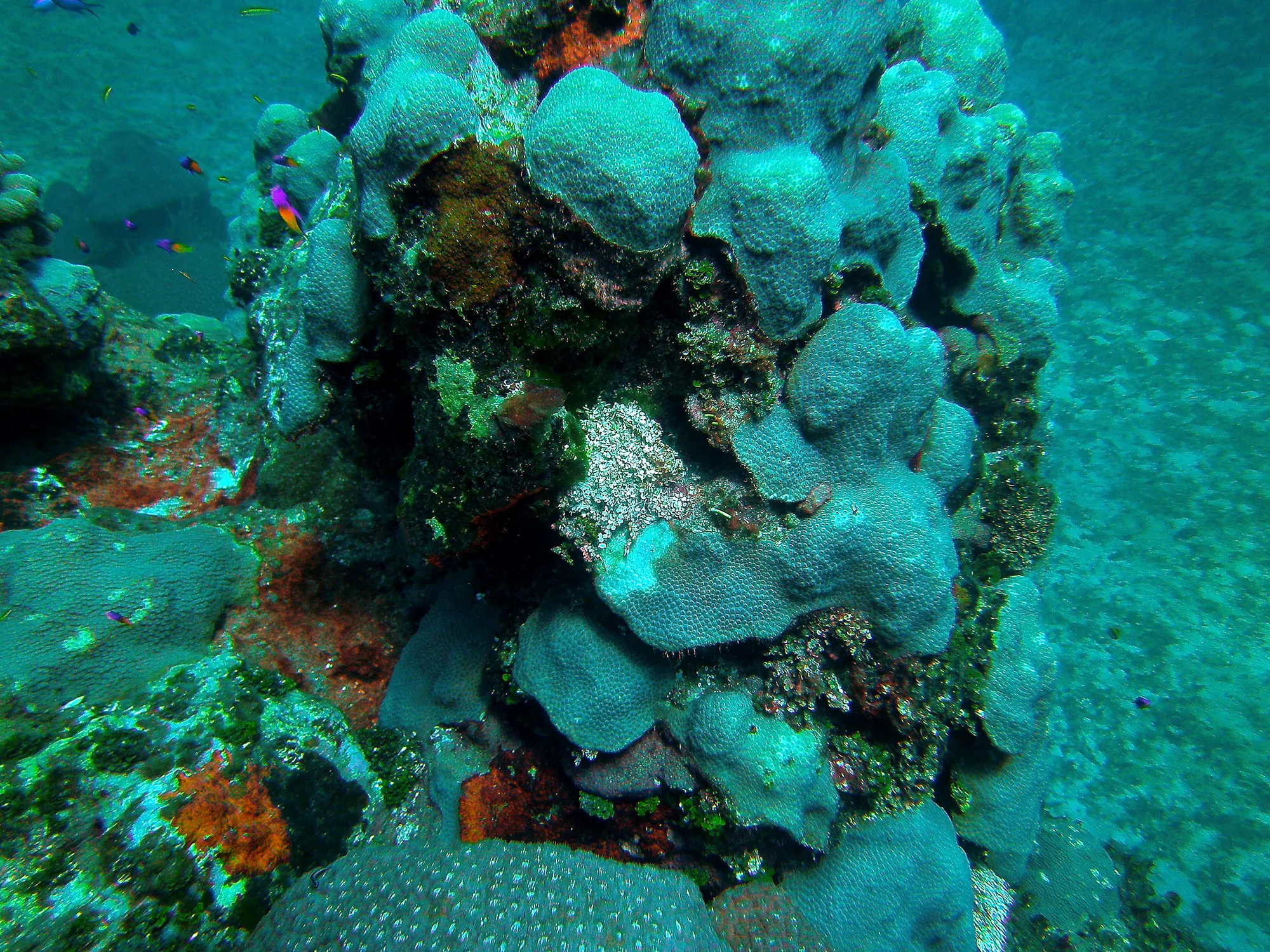
Dr. Tom Goreau's Global Coral Reef Alliance did more than comment on the Bakers Bay fight from a distance — it directly surveyed and monitored Great Guana Cay's reef as the golf course was built, and presented its findings in public. Below is that record, followed by Dr. Goreau's biography.
Reef Monitoring at Guana Cay
Dr. Goreau's connection to Great Guana Cay goes back to 2007, when he surveyed the reef fronting the future Bakers Bay site and found it largely recovered from a 2005 bleaching event, with only a single case of Yellow Band disease and one minor case of White Plague — building on Dr. Michael Risk's healthy 2004 baseline survey and Dr. James Cervino's 2005 follow-up.
By January 2012, after the golf course had been built and fertilized, Goreau returned with Save Guana Cay Reef Association president Troy Albury and Cervino (then at Woods Hole Oceanographic Institution) to survey the reef again. What they found was markedly different: roughly 15 active cases of White Plague disease, concentrated on lettuce coral (Agaricia agaricites), along with Dark Spot disease, a case of Yellow Band disease, and a possible new coral disease — against almost no disease at comparison sites upstream and downstream of the golf course.
The survey also documented around 20 corals being overgrown from the base by weedy algae, a bloom of the nutrient-indicating red alga Martensia pavonia, and cyanobacteria mats spreading across corals, gorgonians, and sediment closest to shore, concentrated where the course's greens — built five to ten feet above sea level with little vegetated buffer — drain most directly toward the water.
Goreau, Albury, and Cervino wrote the findings up as a full scientific report, and that spring Goreau presented the data in person at the Bahamas National Natural History Conference in Nassau. Video of that talk, along with footage of the algae bloom itself at the shoreline where the golf course comes closest to the sea, is linked below.
- Video: Tom Goreau presents the Guana Cay reef data in Nassau, Spring 2013
- Video: the algae bloom at the Bakers Bay shoreline
The report's central argument echoed what Goreau, Risk, and Cervino had each separately concluded elsewhere at Bakers Bay: fertilizer moving through Guana Cay's porous limestone with no meaningful barrier was the only plausible source for algae growth that increased steadily toward the shoreline and fell off with distance from it — a textbook nutrient-gradient signature. At the time of the survey, Bakers Bay had no permanent residents, sewage system, or completed marina in operation, which let the report isolate the golf course's fertilizer program as the driver rather than one of several possible pollution sources.
As a point of comparison, the report pointed to Dragon Bay, Jamaica, where cutting off a nutrient source had caused a similar algae bloom to visibly recede within weeks and disappear within two months — evidence, the report argued, that the damage at Guana Cay could still be reversed if the golf course's nutrient inputs were brought under control.
Biography
Dr. Tom Goreau, President of the Global Coral Reef Alliance, a non- profit organization for coral reef protection and sustainable management, has dived longer and in more coral reefs around the world than any scientist. His father was the world's first diving marine scientist, and he grew up swimming in coral reefs as soon as he could walk. He was previously Senior Scientific Affairs Officer at the United Nations Centre for Science and Technology for Development, in charge of global climate change and biodiversity issues. He has published around 200 papers in all areas of coral reef ecology, and on global climate change, the global carbon cycle, changes in global ocean circulation, tropical deforestation and reforestation, microbiology, marine diseases, soil science, atmospheric chemistry, community-based coastal zone management, mathematical modeling of climate records, visualizing turbulent flow around marine organisms, scientific photography, and other fields.
He developed the method to predict the location, timing, and severity of coral bleaching from satellite data with Ray Hayes. He holds patents with Wolf Hilbertz for new methods for preserving coral reefs from global warming and pollution, restoring marine ecosystems, shore protection, mariculture, and non-toxic methods of preserving wood from marine boring organisms, termites, rot, and fire, in order to increase the lifetime of wood and decrease logging. In 1998 he and Wolf Hilbertz were awarded the Theodore M. Sperry Award for Pioneers and Innovators, the top award of the Society for Ecological Restoration. Dr.Goreau led developing country NGO efforts in marine and climate issues at the United Nations Conference on Environment and Development (Rio de Janeiro, 1992), the UN Summits on Development of Small Island Developing States (Barbados, 1994, Mauritius, 2005), and the UN World Summit on Sustainable Development (Johannesburg, 2002).
Dr, Goreau works with tropical fishing communities around the world to restore their coral reefs and fisheries, especially the Guna Indians of Panama, the only Native people of the Americas who have preserved their cultural and political independence. He is also a hereditary leader of the Yongu Dhuwa Aboriginal clan of Arnhem Land, Australia, that preserves the oldest creation myth in the world. Of Panamanian origin, he was educated in Jamaican primary and secondary schools, at MIT (B.Sc in Planetary Physics), Caltech (M.Sc in Planetary Astronomy), Yale,Woods Hole