
Map of Baja
My first watercolor map for Notes from the Road: 775 miles of desert, mountain and sea.
Stories from Baja: Baja Norte · Baja Sur · Espíritu Santo · The San José del Cabo estuary
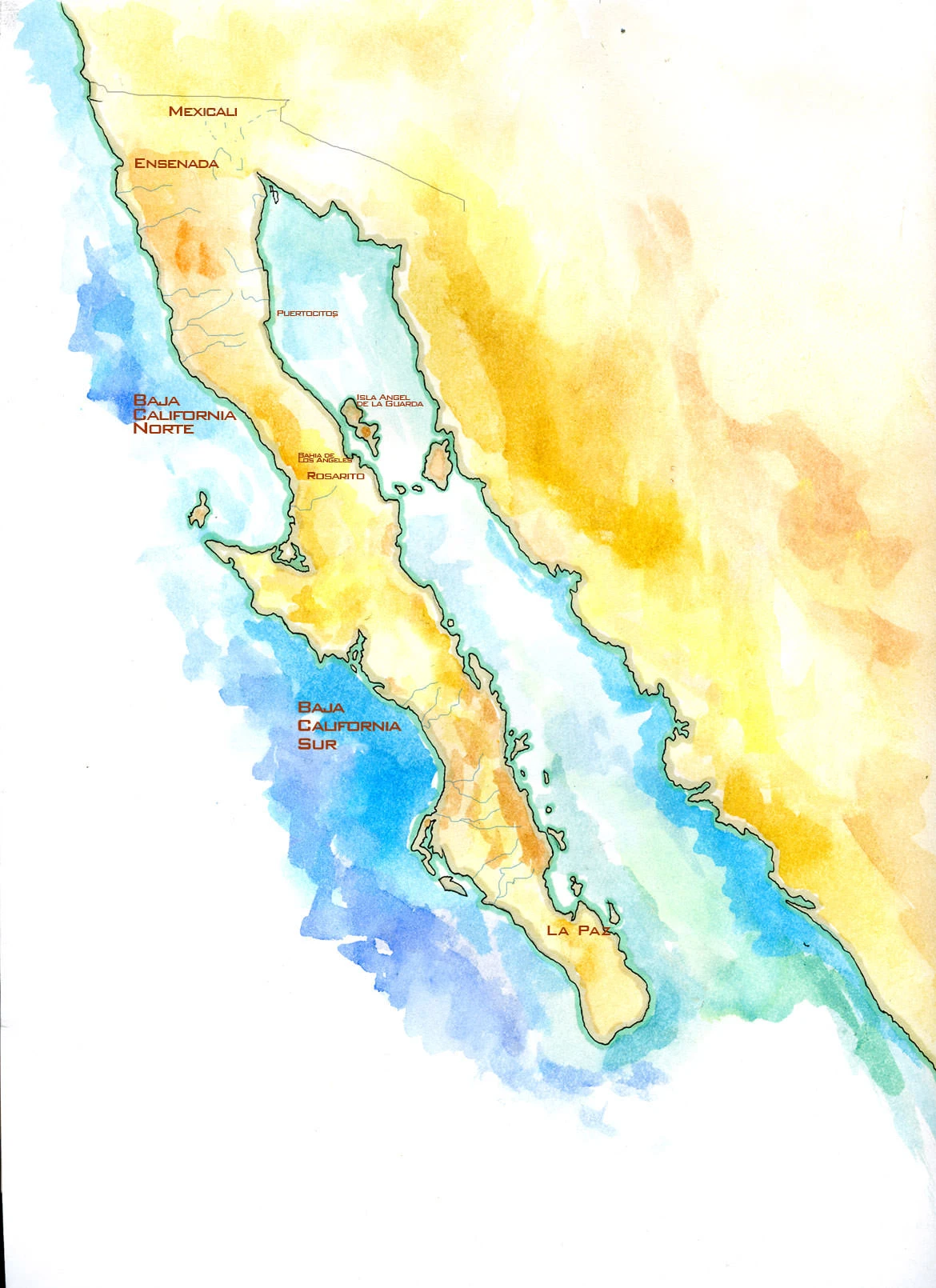
Baja California is a piece of the continent that is slowly leaving. About five or six million years ago, the land that would become the peninsula began tearing away from mainland Mexico, riding northwest with the Pacific Plate along the same fault system that runs through the San Andreas. The Sea of Cortez filled the gap behind it. The result is a strip of land 775 miles long and, in places, less than thirty miles wide, with a spine of granite and volcanic mountains running nearly its whole length. In the north, the Sierra de San Pedro Mártir rises to Picacho del Diablo, over ten thousand feet, where there is snow in winter above a desert that sees almost no rain. At the southern tip, the Sierra de la Laguna holds islands of pine and oak forest that feel nothing like the lowlands around them.
Between those mountain ranges is some of the strangest desert in North America. The Central Desert and the Vizcaíno are fog deserts, cooled by the Pacific and watered more by mist than by rain, and they grow plants found almost nowhere else: the cirio, or boojum tree, which looks like an upside-down carrot fifty feet tall, and forests of cardón, the largest cactus in the world. On the Pacific side, the lagoons of Ojo de Liebre and San Ignacio are where gray whales come every winter to give birth, after a migration from the Arctic. The Pacific coast and the Gulf coast can feel like two different countries, one cold, foggy and wave-battered, the other hot, glassy and turquoise.
The islands of the Sea of Cortez are where Baja becomes a natural laboratory. There are hundreds of them, from tiny guano-white rocks to large desert islands like Ángel de la Guarda, and many have been isolated long enough to evolve their own species. Isla Santa Catalina has a rattlesnake that has lost its rattle. San Esteban has a giant chuckwalla found nowhere else. The islands and their waters are now protected as a UNESCO World Heritage Site, and Jacques Cousteau famously called the Sea of Cortez the aquarium of the world. I have explored a few of these islands myself, on Espíritu Santo and in the islands of Loreto Bay, and each one feels like its own small, dry world.