
Traveling with Nib Pens
A wooden holder, a steel nib and a small bottle of ink may be the most reliable drawing kit you can pack.
Updated September 24, 2026
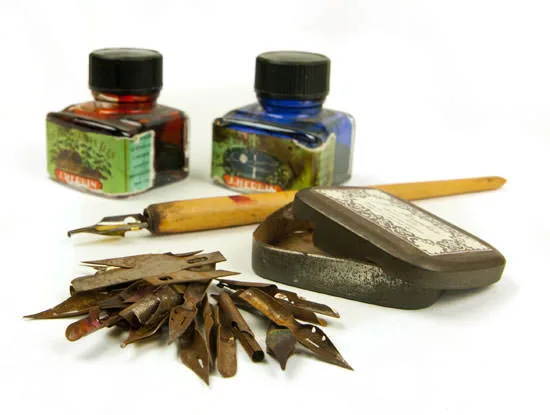
Nib pens are about as simple as a drawing tool can get: a wooden shaft, a small steel nib, and a bottle of ink. They are the pens of nineteenth-century naturalists and mapmakers, and most people assume they belong on a desk, not in a backpack. But after years of filling travel journals, I’ve come to think they are one of the best tools you can bring on the road. Here’s why.
They Survive the Airplane
Rapidographs and other technical pens will often explode in an airplane from the change in cabin pressure, and I’ve lost more than one to a leak that ruined a page, a pocket, or both. Fountain pens have the same problem. A nib pen has no reservoir to burst, because the ink stays in its bottle until the moment you dip. Nib pens are such simple pens, but with a precision close to a rapidograph’s, so they make a great replacement. I keep my ink in a small, tightly sealed bottle inside a zip-top bag, and I’ve never had a problem.
They Work in Any Weather
Other pens act funny in extreme weather. Felt tips dry out in the desert, gel pens skip in the cold, and ballpoints smear in the heat and humidity of the tropics. Nib pens always work, provided you keep your nib clean. After a day of sketching, I wipe the nib dry with a rag so it doesn’t rust or clog, and the next morning it’s ready to go again, whether I’m in a rainforest lodge or a cold tent in the high desert.
A Line That Breathes
Nibs offer more control over the flow of ink than modern pens, so they bring some of the qualities of painting to your travel journal. Press lightly and you get a hairline; press harder and the tines spread into a bold, dark stroke. A single line can go from thin to thick and back again, which gives a sketch a life that the even, mechanical line of a technical pen never has. With a waterproof ink, you can lay watercolor right over your drawing once it dries, and the two work together beautifully.
They Slow You Down
There is one more reason, and it may be the most important. Dipping a pen forces you to pause every few strokes, and those pauses make you look again at what you’re drawing. Sketching with a nib pen is slower than snapping a photo, and slower than scribbling with a ballpoint, but that’s the point. You notice the shape of a doorway, the way a bird holds its head, or the texture of a stone wall, and people often stop to watch, which is how a lot of good conversations on the road have started for me.
What I Pack
My kit is small: two holders, a few nibs, one fine nib for detail and a more flexible one for expressive lines, a small bottle of waterproof ink, and a cotton rag. It all fits in a pencil case alongside my watercolors, weighs almost nothing, and has outlasted every fancy pen I’ve ever bought.