
Nicaragua Moleskine Travel Journal
Updated September 29, 2026
I created this Moleskine journal during a trip to Nicaragua. It's the classic pocket-size version—the kind that fits neatly into a daypack or cargo pocket. For these sketches, I used Micron and Rapidograph liner pens and watercolor.
Jane and I took this trip after a long, wet stretch in the Pacific Northwest, when I had promised her the tropics and I needed a break from months of writing about Great Guana Cay. We began at Morgan’s Rock, a hacienda and forest reserve on the Pacific coast north of San Juan del Sur, then went on to Granada and the cloud forest of Volcán Mombacho.
Those days became three stories: The Howling Coast, Granada Libre and Jungle in the Sky. The journal holds the rest: the animals of the dry forest and the cloud forest, the streets of Granada, and a few people met along the way. You can also see my hand-painted map of Nicaragua.
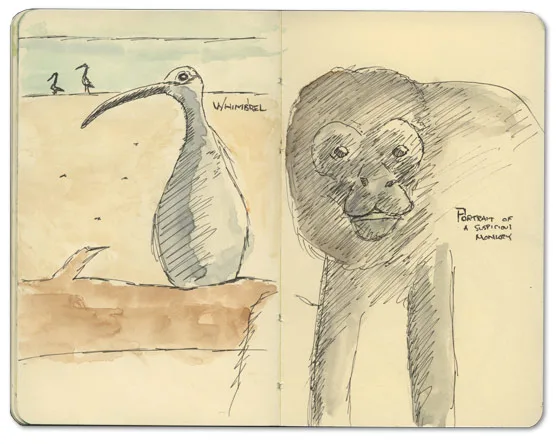
A whimbrel on a driftwood log, and a portrait of a suspicious monkey.
Notes Regarding Our Travels
The journal starts before we landed, at the airport in Houston, and picks up in a Managua taxi with a plastic pope on the dashboard. Nicaragua is the largest country in Central America, with Lake Nicaragua and a chain of volcanoes running down its Pacific side and a long, thinly settled Caribbean coast on the other.

Notes from the Houston airport on the way south, with a boy outside the Fox Sports Cafe and the promise I made Jane after thirty-six straight days of rain.
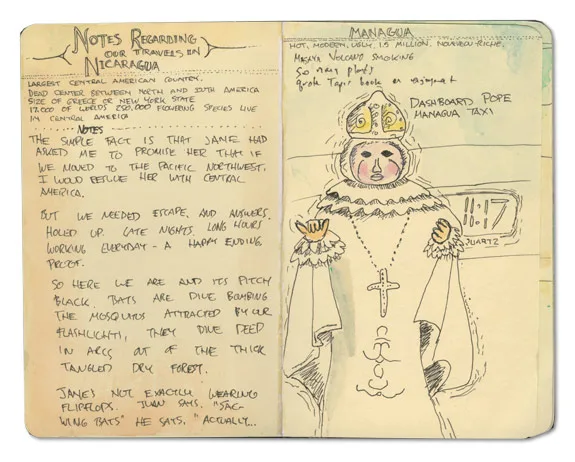
Notes Regarding Our Travels in Nicaragua, beginning with bats diving at our flashlights in the dry forest, facing the dashboard pope of a Managua taxi.
The Dry Forest at Morgan’s Rock
Tropical dry forest once covered much of the Pacific side of Central America, and very little of it is left. At Morgan’s Rock it runs down to the sea. On a night walk, our guide Juan named the sac-wing bats diving through our flashlight beams, and by day the forest held howler and white-faced monkeys, parrots, iguanas, armadillos and a walking stick as green as a leaf.
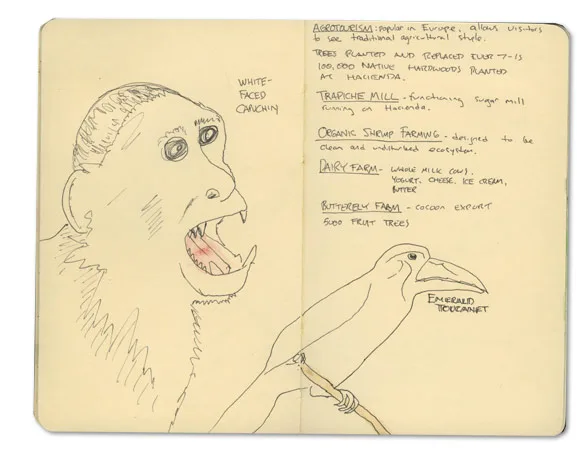
A white-faced capuchin and an emerald toucanet, with notes on the hacienda: its native hardwood plantings, a working trapiche sugar mill, a dairy and a butterfly farm.
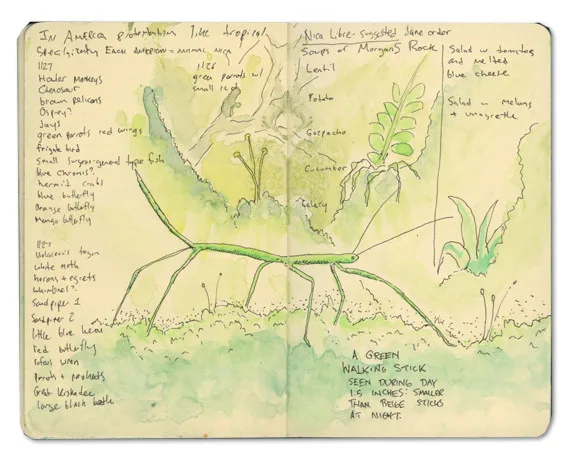
A green walking stick, with a list of what we saw, from howler monkeys and ctenosaurs to brown pelicans, hermit crabs and a great kiskadee, and the soups on the menu at Morgan’s Rock.
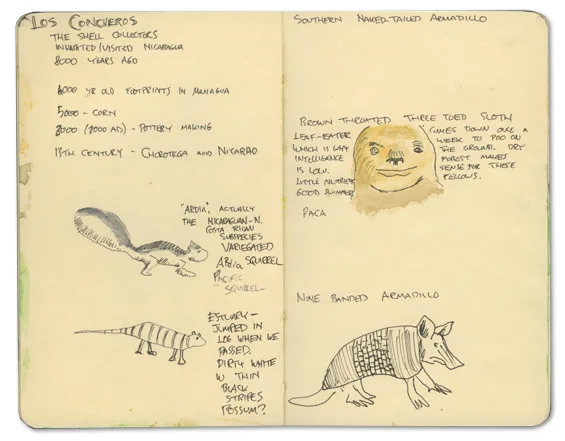
Notes on Los Concheros, the shell collectors who lived here thousands of years ago, with a variegated squirrel, a brown-throated three-toed sloth and two armadillos.
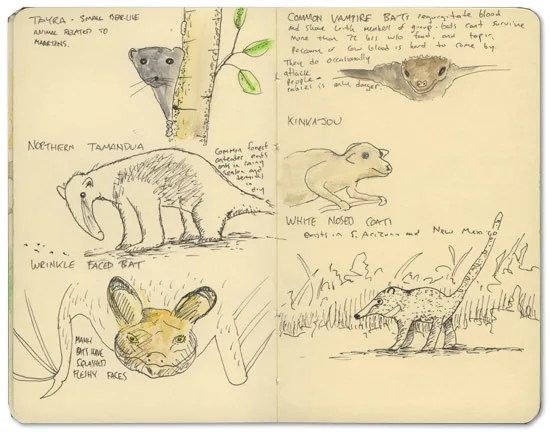
A tayra, a northern tamandua, a wrinkle-faced bat, a common vampire bat, a kinkajou and a white-nosed coati.
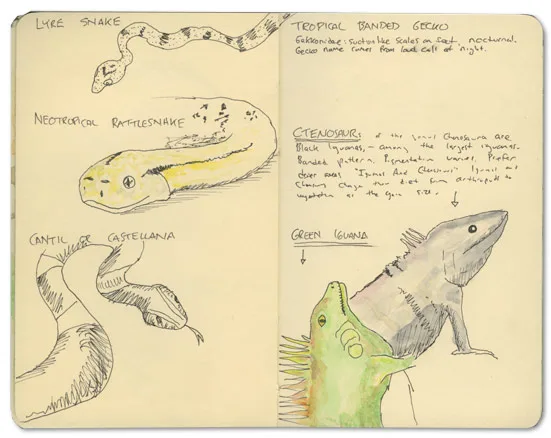
A lyre snake, a neotropical rattlesnake, a cantil, a tropical banded gecko, a ctenosaur and a green iguana.
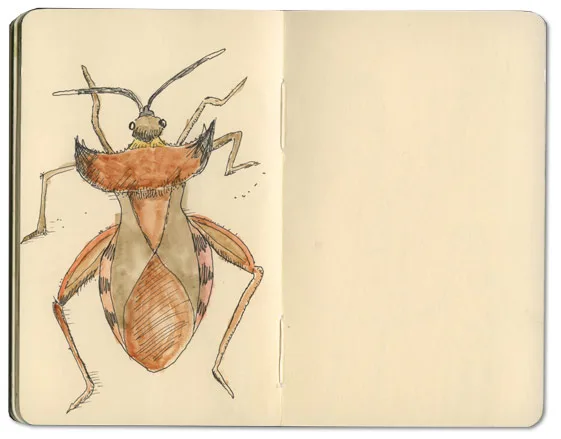
A true bug in rust and ochre, drawn large across a single page.
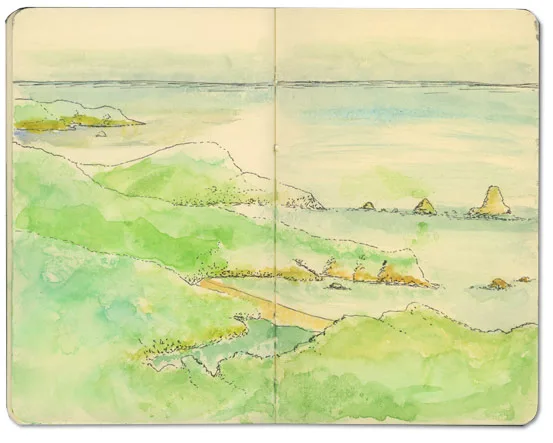
The Pacific coast at Morgan’s Rock, green headlands and small rock islands in a pale sea.
Granada on the Lake
Granada sits on the shore of Lake Nicaragua in the shadow of Mombacho. Founded by the Spanish in 1524, it is one of the oldest colonial cities in the Americas. William Walker’s men burned much of it when they fled in 1856, and it was rebuilt in the lime, rose and yellow that still color its streets.
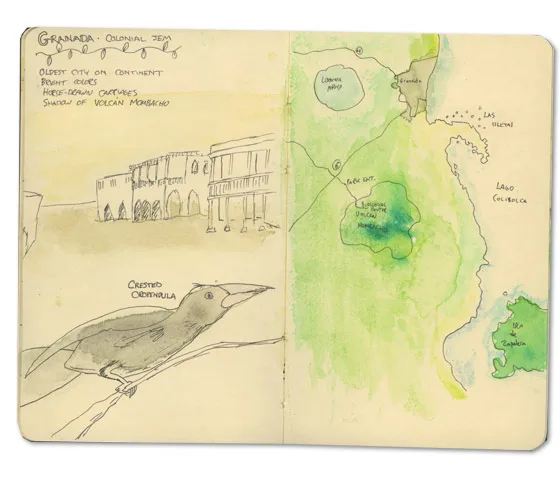
Granada, the colonial gem, with a crested oropendola, facing a map of Volcán Mombacho, Laguna de Apoyo, Las Isletas and Isla Zapatera on Lake Cocibolca.
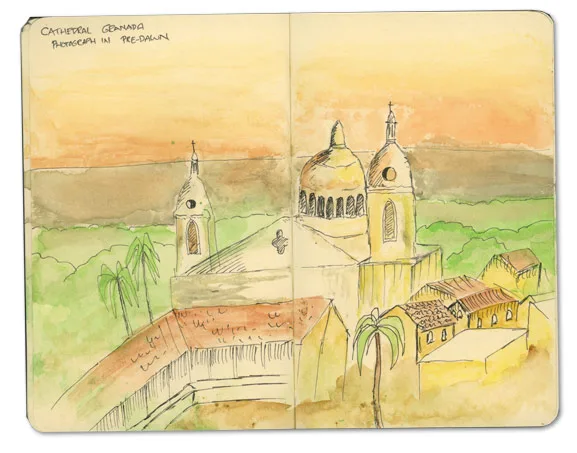
The cathedral of Granada before dawn, its domes and bell towers rising above the tiled roofs.
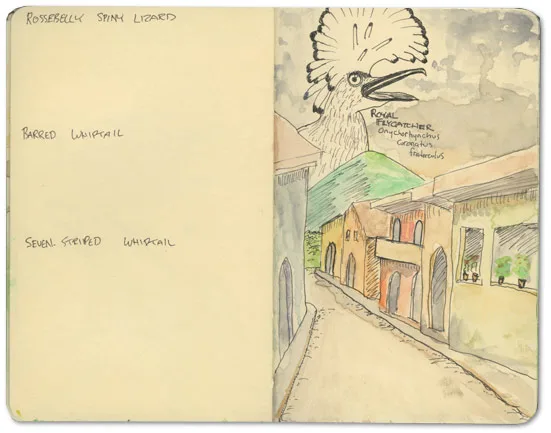
A royal flycatcher, its crest raised, over a street in Granada, beside the names of a rosebelly spiny lizard and two whiptails.
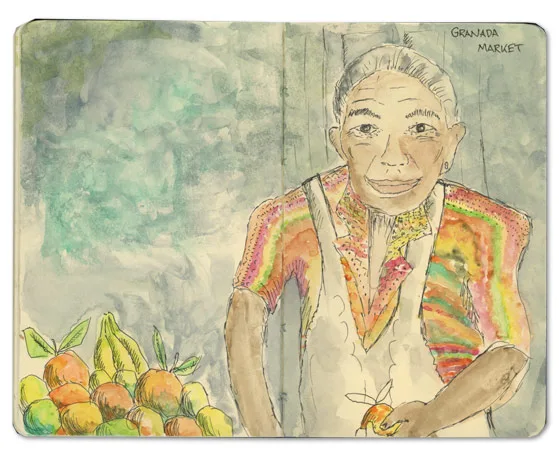
A woman selling fruit in the Granada market.
The Cloud Forest on Mombacho
Mombacho rises out of the dry lowlands into cloud forest, an island of cool, wet jungle above the savanna. There was no ride to the top, so Jane, Ramón and I walked the steep road up. The journal notes a salamander and a butterfly that live nowhere else, and a summit plain of flowers ringed by forest stunted by the wind.
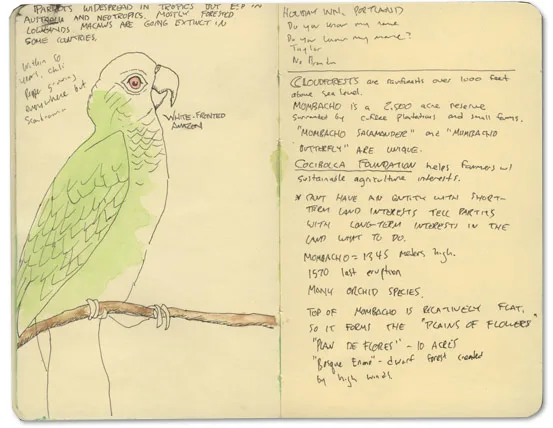
A white-fronted amazon, facing notes on Mombacho: its cloud forest, the flat summit called the plain of flowers and the dwarf forest shaped by high winds.
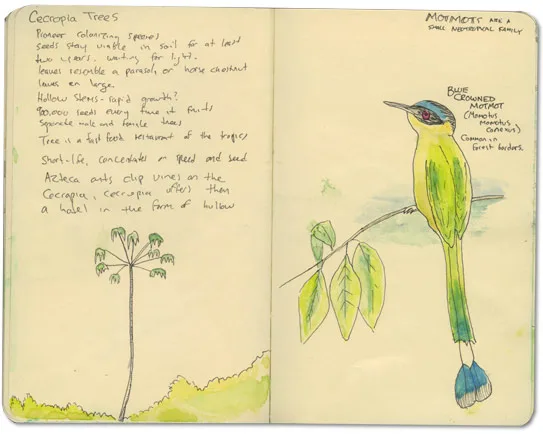
Notes on the cecropia, the fast-growing pioneer tree of the tropics, with a blue-crowned motmot on a branch.