
Great Basin
What Creatures Will Roam
Glen Canyon?
The Utah-Arizona border, north of the Grand Canyon and east of Las Vegas, is a weird sort of biological zone. Some creatures exist here that exist nowhere else in the world.
When I stop at a gas station to stretch my legs under a blue sky, I notice some homes, wooden fences and a few trees. I ask the blonde teenage attendant what town I am in. Her expression and reply make the question feel somehow forbidden. "Hildale,"” she mutters, looking away.
The town name doesn't immediately ring a bell, but the presence of trees, shrubs, those fences - might make this a good spot to check for any new species of birds I had never seen before. The Utah-Arizona border, north of the Grand Canyon and east of Las Vegas, is a weird sort of biological zone. Some creatures exist here that exist nowhere else in the world. More likely though, a little town with its trees and fence-posts amidst all this dry scrub and red earth might attract some migrating birds, moving south to Mexico in the fall.
I get in the Jeep, cross the border into Arizona a few hundred feet later, and pull into the small town. I find a dry wash with some trees and scrub, where I park the Jeep and focus my binoculars.
In the distance are a number of homes. I can't place my finger on it, but something seems wrong about these homes. For one, several of them are very large, like hotels almost. But they do not have the tell-tale signs of American wealth - these homes have no manicured yard. Many are unpainted, bare concrete. Junk lies scattered around the properties, the roads and driveways are dirt. There is no activity in the streets. No cars drive past mine. No one is walking outside, although the day is pleasant enough.
I try to resume back to my binoculars and the rocky wash - after all, I am on vacation, and all I want to do is go out into Utah on a thousand mile journey, looking for lizards and squirrels, a sort of American safari. Then I notice a curtain rise, and quickly close, in one of the odd, cold, dark houses behind the wash. I glance at my binoculars? Should I?
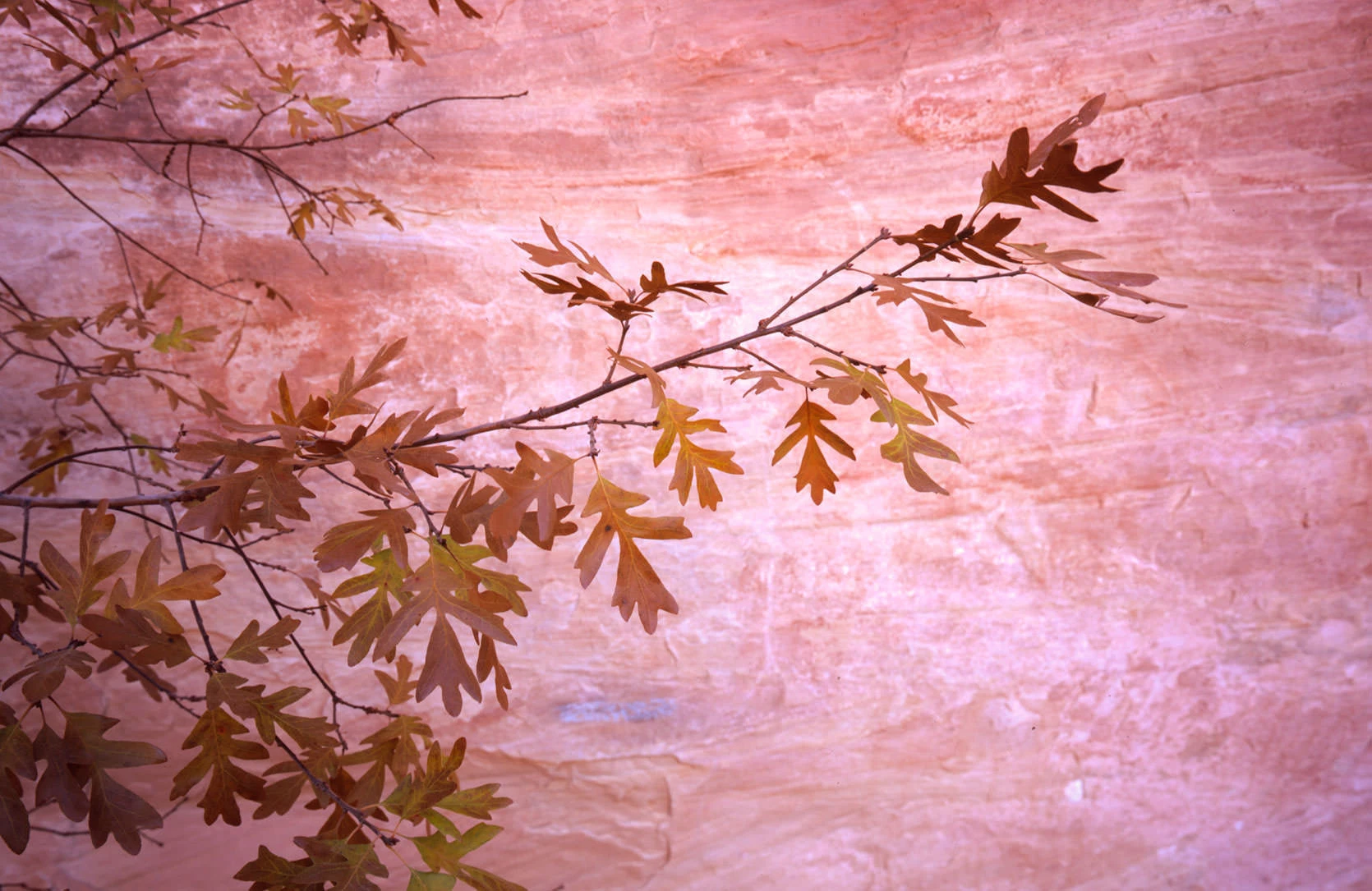
Oak growing on an overhang in the Glen Canyon area.
And then I realize suddenly where I am. The name Hildale comes back to me. I am parked between the twin communities of Colorado City, on the Arizona side, and Hildale, on the Utah side, both of which are, on this very day, embroiled in international controversy. Even in Europe and Asia, these two communities are making headline news. These towns are ranking right next to the Iraq war and the Presidential campaigns in news coverage.
And yet, where is the press? Then, I realize, in my white rented Jeep, I must appear that journalist dumb enough to try- flown in from some news agency that doesn't know any better.
These twin communities are a stronghold of Mormon fundamentalism- polygamy, cruel social conservatism, absurd laws, a radically literal interpretation of the Book of Mormon. The community's 'absolute ruler', Warren Jeffs, is on trial after being arrested last year, and the trial is revealing a story of a nightmarish place, like a little slice of Taliban Afghanistan, right in our backyard.
That these communities engage in forced incest, that teenage girls are regularly raped and forced into odd polygamist marriages with old men, has never been a secret. That this community must keep the proportion of men to women unnaturally low- to keep the stock of women high - is also no secret.
For years, the media has reported stories of young men excommunicated from their community. The idea is to keep more women for the inner circle of polygamist leaders, by dishing the young, buff men out into the real world. The excommunicated Mormon youth, with no knowledge or understanding of the world outside Hildale and Colorado City, are quick prey for drug dealers in roadside towns like Hurricane, a roadside gas-stop near Zion Canyon.
The pattern for these boys is so often the same- a burger-flipping job, an addiction, a brain fried months after being blindfolded and thrown out on the side of a road.
That Hildale and Colorado City have the highest incidence of a certain form of mental retardation in the world (too many are related to just two polygamists) also does these American refugees little good.
But why America turned their shoulders to this sad practice is beyond me, and so the arrest of Warren Jeffs, his trial, the press attention- it's a bitter sweet victory in a country still blind to the effects of growing fundamentalism permeating our culture, our politics, our foreign policy.
Warren Jeffs enforced strict rules about keeping these communities shielded from the rest of America. This might explain why all the television sets have been dumped in the wash. No internet, no Big Love, and as for communicating with outsiders - stay away from them. Jeffs would explain: If outsiders approach you, act with hostility.
And I was just hoping for a gnatcatcher.
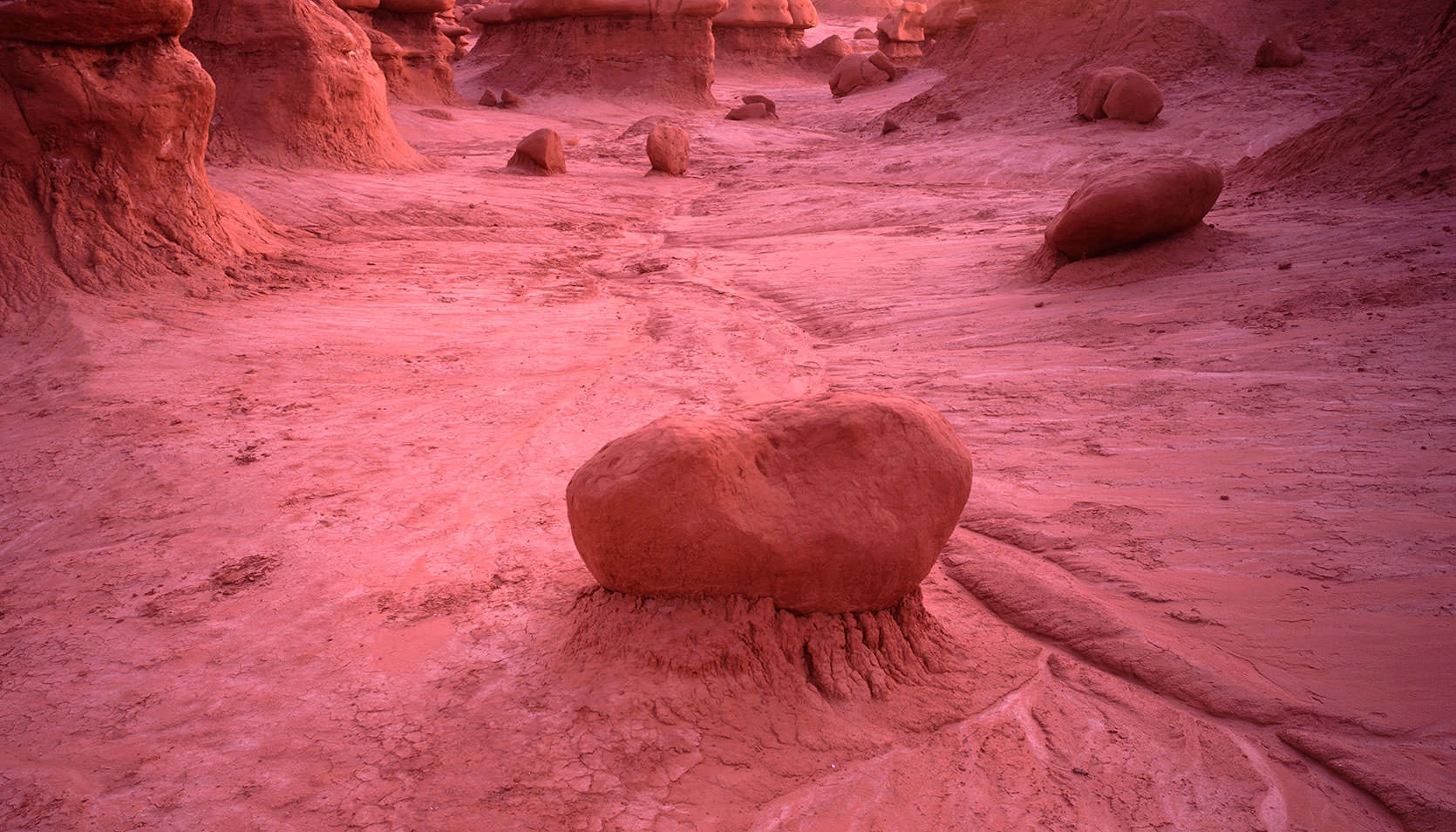
As the light fades, the Goblin Valley appears Mars-like.
I leave Colorado City a bit haunted. I drive towards the magical Glen Canyon region, across the southern half of the state, through a patchwork of national parks and public land. This route - through Bryce Canyon National Park, Grand Staircase-Escalante National Monument, Highway 12, through Capitol Reef National Park, and then, Highway 95, tells so much about this country's natural history. The increasing patchwork of public land itself, tells another story, however. It tells the story of what may become the world's biggest story of the twenty-first century. It is the story that led me to ask a question, What Creatures will roam Glen Canyon?
I notice a couple has just parked their car, and walked off the road into the ditch. I find this behavior enticing, and so I park the Jeep behind them. They have matching grayish hair, and matching field vests. "What are you looking for?"” I ask. I know they're friendly before they even say it. "Lizards!"” as if to say "“ duh, what else?
The pair are what you call herpers "“ amateur herpetologists. "It was always Eddie chasing after them,"” says the lady, removing her sunglasses. "But I caught on after a while."”
Eddie explains they are looking for some sort of a horned lizard. I point to a small shape, camouflaged in the red sand. "Side-blotched lizard,"” Eddie remarks. "It's late in the season, most everything has packed it up for the season. But these fellas are so small, they can warm themselves fast enough on a sunny day to stay out through October."”
I tell them about my experience yesterday in Colorado City, to which Eddie says, "They're all leaving. That's why you didn't see anybody out in the streets. They say they are starting up again somewhere in Texas."” His wife adds, "Yeah, now that they have a tv show about them too."”
Eddie looked around on the ground for a lizard, then said, "Used to be you could pass by and see them with their hats on."”
It's sort of strange saying goodbye to two people in a ditch, them looking up at you and squinting in the sun like children about to get dirty. I was awash with the strangest sort of giddiness, just driving through Southern Utah. I stopped along the side of the road whenever I could.
In Hanksville, I order up a hotel room for a few days. Twice, the lady at the register says, "You sure you still want to book that many nights?"”
At the nearby diner, folks are equally skeptical of my deciding to stick around for a few days. But I find Hanksville inviting and its people cheerful. After a short chat with the waitress, I ask, "What kind of beer?"”
"Bud","” she pauses for a while, "Bud Light""”
"Anything else?"” I ask.
"We have lots of beers."”
I notice a sign on the wall for a "˜Polygamy Porter. ' The sign says, "˜Why just have one? '
Finally, she says, "There is the green bottle with a funny name."”
"Heineken?"”
She says as if she's been through this before, "˜I'll get you one of those."”
What she mustn't realize is that her conversations in the kitchen with the cook, and with the girl who is siphoning the soft-serve machine with her mouth, is that I can hear everything they are saying loud and clear.
"Sorta strange. All he wants is a salad and one of those green beers."”
"That's all he wants?"”
"He'll be in town for a few days."”
"That right?"”
"He's on vacation."”
The cook swears, "Damn, we're out of ranch dressing. Ask him if he wants something else."”
The waitress, "Okay, tell me what we do have so I don't have to go through this again."”
She mumbles a list, and the waitress comes out, and I tell her that any dressing will do just fine. As I do this, I hear the cook curse at the girl in the kitchen. . "Get your mouth off that!"”
After my salad comes out, the waitress sits at the table next to mine, and we talk about the Mars Desert Research Station, which is a collection of 3 buildings six miles north of here. The idea is to duplicate an environment similar to Mars "“ red rocks "“ and prepare for the eventual habitation of the red planet.
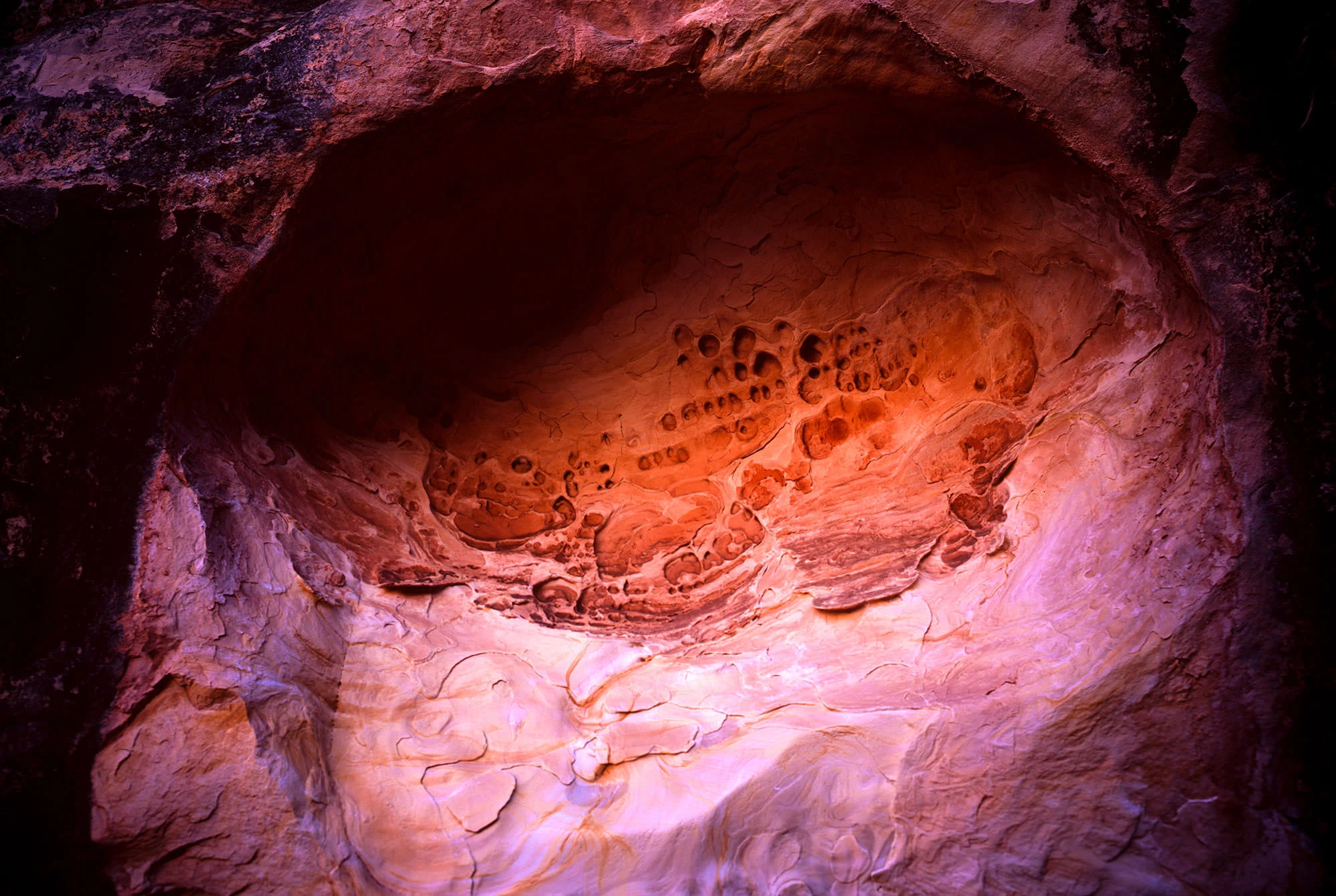
Shapes and color of a canyon wall near Sipapu Bridge, Natural Bridges National Monument
Astronauts play house with biologists and engineers in a three-domed structure in a place that physically resembles Mars. Some residents of Hanksville hold odd jobs out at the space station, so stories of astronauts climbing over red boulders in full space gear are common here.
I tell her about my vacation, how I am out looking for animals. She asks, and I tell her: Ground squirrels. The ferruginous hawk. Some endangered subspecies of pupfish. When I leave the diner, though, I am thinking about those astronauts, awkward in their space suits. Introduced species.
Some people believe that this great region will someday be connected to a series of unbroken lands - extending perhaps into Canada and Mexico. It will be like a giant research laboratory, but not for Mars, for Earth. And talk will be about how this land once was.
Already, people are talking about how condors will again soar above these skies. Others, still, talk about when jaguars will again roam the southern reaches of these canyons. And others, they are talking about elephants on the mesas, and camels in the canyons.
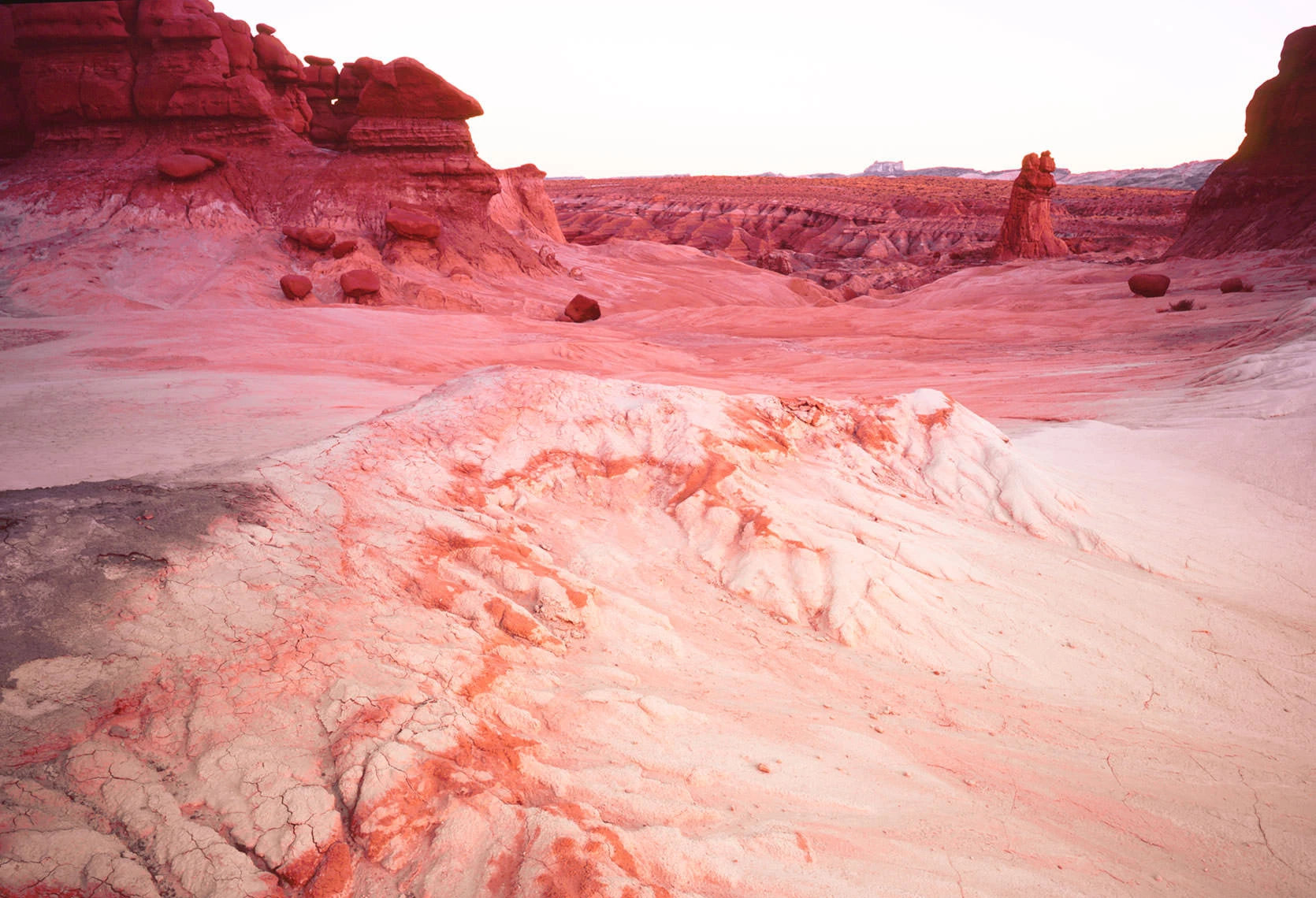
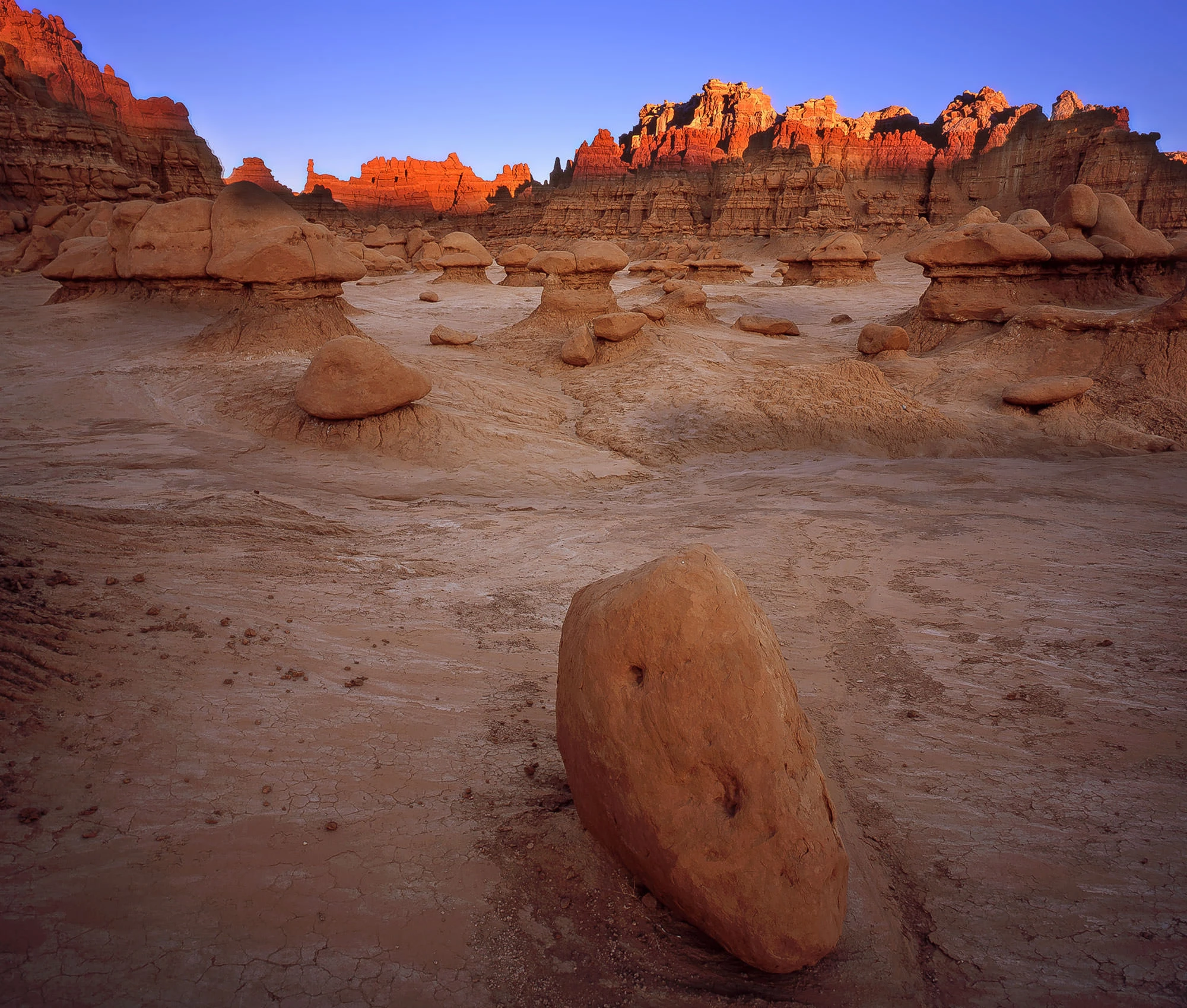
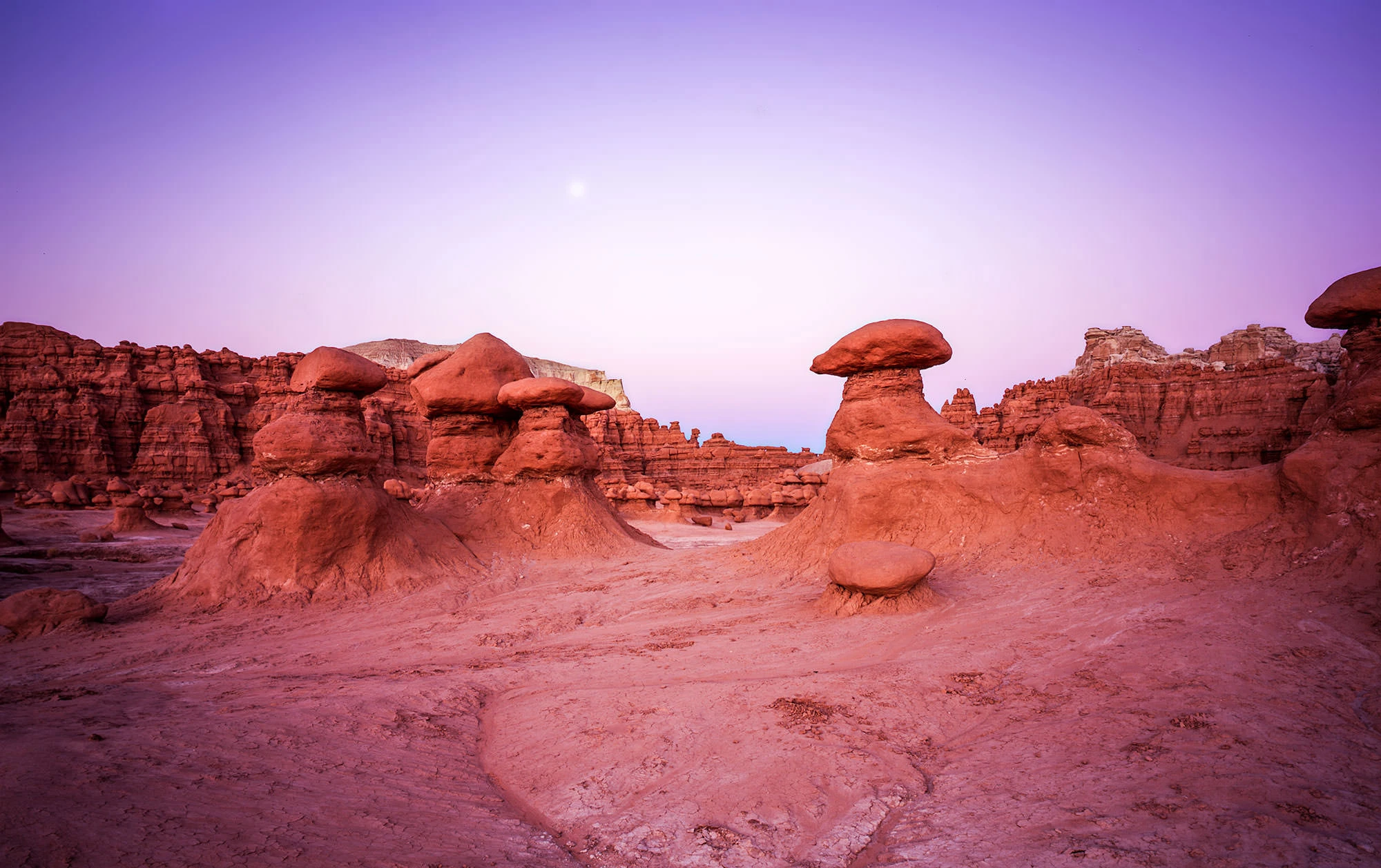
I drove north from Hanksville, past the entrance to the remote Mars Desert Research Station, to the Goblin Valley, a little known public landscape in Southern Utah. Goblin Valley is three miles of sandstone hoodoos, oddly shaped, like ten foot mushrooms, or an army of smurfs. I walk out into the hoodoos, looking for life.
Life here, approaching night, is a plethora of bats and a scattering of lizards. When I walk in the woods back home and I find the summer trails dotted with the little dead bodies of shrews dead and defenseless - I can see and understand the bat. I can understand the unimaginably slight shrew of the sky.
The white-furred western pipistrelle bat fluttering above me weighs less than a nickel. Its shape resembles the tiny animals from which it evolved, but, it found a way.
Bats remind me of why mammals are the Earth's canvas of biological creativity. In places where no other mammals survive, the bat flourishes. In the long mammalian history of Utah, so many different mammal forms have dominated one time or another go back in time, and Utah's mammals are mammoth sloths, aquatic wolves, horned beasts, tusked invaders.
When the last bit of light fades from Goblin Valley, I find my way back to the Jeep with a headlamp; the enchanting structures now cold and unpresentable-looking. Tomorrow, I start heading south.
Some people think the bicentennial highway is America's perfect road. Two lanes, twisting and winding through a uniquely American landscape. In the autumn, the trees that line each canyon are bright yellow. The reeds and grasses match in shades of gold and orange.
I stop to take a walk in a canyon. Near its entrance, I meet a man in a cap, who looks to be about sixty years old.
He had travelled this road thirty years before, by bike, €œbefore people did that sort of thing. €” I told him he was welcome to join me up the trail. No, he said, he was in a hurry. Odd place to be in a hurry, I thought. Odd way to memorialize a trip of your youth.
Despite his hurry, he chooses to stay and talk a while as I show him everything creeping and crawling at the edge of the canyon. More bats. A golden eagle above. A desert cottontail. A hopi chipmunk. I genuinely sense he wants to join me up the canyon. But I can relate to his hurry. That is the way of our world these days. We are spending less time outdoors. The industries for outdoor sports are worried. We are spending less time hiking, less time walking, less time traveling. We don't play ball as much as the old days.
There is something changing in our modern culture. Americans are not the same people we used to be. Those fundamentalists in Colorado City, you can't altogether blame them. The roots of fundamentalism, in Utah, in America's south, or in Saudi Arabia, they are all born from the same thing: a reaction to our modern world, a strong desire to hold onto the fundamentals of our culture and civilization in a brave new world of disconnection.
I think about this when I shake hands with the man, leaving him to look at his watch. The canyon I am entering is somewhat preserved as the Glen Canyon National Recreation Area. For the past week, I have been moving through a series of interconnected protected patches of public land. Almost all of them fit together to make this unimaginable brilliant land a single whole.
When President Clinton signed the controversial Grand-Staircase Escalante region into a national monument, he completed a giant puzzle piece, a plot larger than Delaware which nearly connects Zion, Bryce, Glen Canyon NRA, Capitol Reef National Park, and the arch parks nearer Moab into a much more cohesive unit.
He did so for general reasons, to satisfy the interests of a variety of western conservation movements, to win votes, to save a rich piece of America. But some of the people behind such a land protection, the people who lobbied its creation, had a much grander outcome in mind. They were imagining the prospect of returning big sections of land back to their original state. Not all of them are thinking just southern Utah. The Escalante monument was created partially because of efforts to connect public land in Chihuahua, in Sonora, in Arizona, in Utah, in Idaho, Montana, Wyoming, Alberta - by people who imagine a long continental green corridor, a sort of environmental fundamentalism.
A tortured landscape rises above the Dirty Devil River near Hite Marina.
I drive to Hite Marina the next morning. Here, I am expecting something. I am expecting people. Apparently, I hadn't done my research, Hite Marina's closure means everything is closed, the entire place. I am like Chevy Chase at Wally World - except now I'm a hundred miles from lunch.
I stop at the ranger station, which is also closed. I call Las Vegas from the dusty pay phone. I tell Jane about the furry white bat. But then she says that my four-month old boy just slept through his first night. A monumental moment.
Hite Marina was created as a boating center at the far northern edge of Lake Powell. For decades, Americans dropped their boats in the water here, and sped through the flooded canyon alleys of the lake. But now, the water level at Hite Marina is so low, the whole place has become abandoned.
Thankfully for my belly, I have plenty of food in the Jeep. That food is part of an experiment in reducing expenses on the road. Back in Las Vegas, I packed a single grocery bag with enough food for a week. My only road expense has been a green salad, and a beer. A few loaves of bread, cheese, apples, salami, peanut butter will be my best friends for the days to come. Weary from hours on the road, and many walks in the sun, simpler food simply tastes better anyways. When I most curse myself for carrying too much stuff while traveling, I always come back to the paper grocery bag. When I most curse myself for all the unnecessary stuff I carry with me, I ask myself if I could challenge myself to travel my continent only carrying a grocery bag of belongings?
I walk down the gentle slopes that once were the banks of the river. Caked in the mud is all the sins of a thousand boaters - Clorox bottles, engine parts, broken-apart coolers.
As I draw nearer the water's edge, the cracks between the mud grow wider. I keep walking, but conscious that a misstep could mean a twisted ankle or a broken leg. A few minutes later, I realize I am jumping between mud-cracks. I can no longer see the mud-crack bottoms. When I measure the cracks with my extended tripod, I realize they are seven feet deep. Then, I am jumping from mud tower to mud tower, like a giant across the Manhattan skyline.
When I emerge on the other end of this cracked landscape, nearer the waterline, I enter a buffer zone of plant life. When I emerge at the waterline, I realize that the river water isn't even a river. It's a big puddle of still water, slowly seeping into the Earth.
Hite Marina is like an allegory for North America in the 21st century. Man made this once flourishing Lake Powell marina possible, by damning the Colorado River in the 20th century. We damned it along with all our other rivers - only about 42 of America's largest 3,000 rivers are undamned.
When we blocked up the Colorado River, much of Glen Canyon - the enormous canyon system of southeastern Utah created by the confluence of the Colorado and San Juan rivers - went underwater. Lost were thousands of archeological treasures and unspoiled American habitat. Now, through a changing climate, the water levels are lowering again - it's a brave new world, even out here in the middle of nowhere.
I decide to head further south into the evening. On the road, I imagine Jane's expression at waking to find she slept uninterrupted through the whole night. What a moment I missed. Why, then, am I here, by myself, once again?
But that is a question I consider only momentarily, as light slips off a thousand sandstone faces and moonlight floods the canyons. Driving in such solitude is exhilarating and transformative. There is no traffic, and it is unlikely I will see any headlights tonight. There is only a road ahead of me, a soft moonlit palette on which to ride, and consider, and to paint thoughts about tomorrow.
The next morning, I continue driving early. When I surprise a prairie falcon off its post-fence perch, he launches in the same direction as me. For a few hundred yards, his flight approximates my speed and direction. From the open windows of the Jeep, I see this magnificent raptor up close; it's helmet face, brilliant beak, those eyes.
He reminds me that, once, just five hundred years ago, the skies of the southwest were filled with a gigantic bird - the California condor. They were among the largest animals of the North American deserts, with wingspans nine feet.
Five hundred years ago, the condor was not alone. Jaguars, the same noble cats we associate with the Amazon, prowled along the southern rim of the Grand Canyon. Bears were common. Smaller cats ranged through the Southwest, like the ocelot and jaguarundi. Wolves roamed the plains. The cougar's range extended well to the east of here. Smaller predators, like the Marten and Fisher and the wolverine ranged into the Glen Canyon area. River otters swam Utah's rivers. And perhaps most importantly, American bison crowded the mesas in migration.
The Southwest, although arid, was alive with large animals. But, as with all such stories, habitat encroachment squeezed the big animals out. Condors were shot out of the sky, jaguars were poached, bears couldn't compete with man. The story is familiar, but here is the question:
Should we bring them back?
The question is gaining traction, not just here, but everywhere. When I began writing Notes from the Road in 1999, we were living in a world that was decidedly impoverished of good information about mainstream environmental issues. We were ignorant, unimpressed, skeptical. Nine years later, we are witnessing a complete turnaround - everybody is doing green.
The green we run into in cities is still unpolished. It's still about reducing our personal carbon usage, and screwing in snaky-looking lightbulbs. While we still see environmental issues as a question of values, the folks who have understood what is really happening in our brave new world, are imagining ideas and envisioning plans that seem at once amazing, absurd, fantastical.
As more of us open ourselves to the evidence of climate change, we will begin to view it as the only issue. But that too, will be a mistake.
Several conservationists believe the issues we talk about most, need to be seen as a part of, not all-consuming of, the big changes we will begin to make in this century. They are starting to talk about habitat restoration as the issue of the twenty-first century. At first, I found this hard to believe.
But habitat restoration - restoring habitats to some original previous state - is being discussed as an inevitability, and for reasons covering nearly every concern of the conservation movements - from extinctions to invasive species concerns to reversing climate change and pollution.
This is how I entertain myself on this long road, by imagining condors soaring above, and Jaguars on the mesa.
In the afternoon, I arrive at Natural Bridges National Monument, and take lunch out to a cliff overhang near an intact Puebloan home, built crudely of stones seven hundred years ago.
The Pueblans, who we often call the Anasazi, inspire our imaginations because their archeological story is a sad tale, a mystery, but ultimately, a mystery that keeps leading back to a man-made environmental collapse. Recently, as discussed in Jared Diamond's Collapse, scientists have been able to paint a much clearer story of what happened to this great Southwestern civilization. They cut down all their trees, which created a set of conditions: loss of storable staples like pinyon nuts and erosion of the valley floors, which eliminated their forageable food sources.
When the Pueblo world began to collapse, warfare broke out, and to survive, small bands of Pueblans would hide themselves into fortified structures, high in the cliffs, in places so remote, nobody, under normal circumstances would consider them.
I ponder whether the structure next to me is such a place. Was it a beautiful spot for a family home, next to a lush valley below? Or was it the last resort for a terrified family, defending their meager stock of food?
As I think about this, a hiker notices me and invites herself to chat. She remarks on how well the small structure is preserved. I realize she knows quite a bit about the area, so I invite her into my thoughts. I am a hiker-trap, whenever my large format camera is unfolded. Hikers love to talk to people with big cameras.
We talk about the condors that have already been reintroduced to this region. Their numbers still precarious, they are the symbol of a subset of habitat restoration called rewilding.
I ask the hiker, who says she is part of a Sierra Club chapter in Arizona, what she thinks about the idea of rewilding Southern Utah - bringing back the bison, the big cats, the brown bears.
She is familiar with these ideas, and in fact, is familiar with an effort called the Yellowstone to Yukon Initiative, the most successful alliance to create a migration corridor for the big animals of North America.
Out loud, I wonder how important rewilding would be to restoring habitats - to, "not making the same mistakes as those guys," pointing to the Pueblo ruin. "What good are condors to habitat restoration?"
The hiker, who has a sort of middle-age lesbian gestalt to her, positions her arms like a teacher, constructing thoughts with her waving movements. She puts her big boot up on a rock, and says, "The big animals have more of an impact on the environment than we think. But we just don't know everything. Some people think we don't need to know everything about something's importance, to restore it."
I tell her about a book I read called, '1491', which looks at the Americas before Christopher Columbus. Archeologists are piecing together a much more complex idea of what native America was like. Again and again, we are learning that the Indians controlled, changed, and sometimes destroyed their environment much more than we had ever imagined.
"Why do we want to restore America's wilderness to the way it was before Columbus?" I said, asking her a question I had been thinking about for weeks, again looking at the stone home next to us. "Why not restore it to the way it was before they got here?"
I tell the hiker about the the idea of pleistocene rewilding, where, instead of restoring habitats to a pre-Columbian state, you take it all the way, to 11,000 years ago.
She says, "Okay, that's absurd."
I say, "There are people who think we need to do that."
She says, "The animals that existed here when the Indians came over are extinct."
"The Indians killed them."
"Sort of, yes," she says. The biggest ones. The mammoths."
We talk a while. The whole time, I wonder if she is imagining big animals running across the mesas in the distance, as I am.
When the hiker bids farewell, I stay out on the cliff, watching the skyline, the arch below, the nutcrackers squabbling from their roosts. Not just mammoths, I thought, but giant sloths, sabertooths, mastodons, llamas, peccaries, dire wolves, stag moose and giant beavers.
It is hard to imagine that the first Americans actually lived among such animals.But some people - a growing movement - imagine it every day. Pleistocene rewilding groups believe that in some cases, we should move the benchmark for our habitat restoration from before 1492, to before 11,000 years ago.
Since the megafauna of that age are extinct, they say, and at our hands at that, why not import them from Africa, and South America, and recreate, as best we can, a corridor of North America before man.
Pleistocene rewilders argue that the flora and habitats of North America are designed for the megafauna from which they evolved. The discussion about how to restore habitats should include the case for the pleistocene rewilding. After all, they say, the absence of megafauna creates a domino effect on habitats - the rest of the habitat cannot thrive without them.
In the imagination of the pleistocene rewilders, elephants may roam the mesas, camels (camels in Texas) may roam the canyons, Zebras may roam along the rivers. All of these are approximations of the types of animals that once managed the ecosystem of this region.
To consider such a possibility is fascinating. Something in it smacks of a bit of environmental fundamentalism. Everybody is looking for a pure connection to the past. I'll look to the future however, and I'll await the great debate over how best to restore our habitats with an open ear.
As I leave the cold canyon in the evening, I spot a mouse. Just a tiny one. I don't even glimpse him long enough to identify him.
Five hundred years ago, the condor was not alone. Jaguars, the same noble cats we associate with the Amazon, prowled along the southern rim of the Grand Canyon. Bears were common. Smaller cats ranged through the Southwest, like the ocelot and jaguarundi. Wolves roamed the plains. The cougar's range extended well to the east of here. Smaller predators, like the Marten and Fisher and the wolverine ranged into the Glen Canyon area. River otters swam Utah's rivers. And perhaps most importantly, American bison crowded the mesas in migration.
The Southwest, although arid, was alive with large animals. But, as with all such stories, habitat encroachment squeezed the big animals out. Condors were shot out of the sky, jaguars were poached, bears couldn't compete with man. The story is familiar, but here is the question:
Should we bring them back?
The question is gaining traction, not just here, but everywhere. When I began writing Notes from the Road in 1999, we were living in a world that was decidedly impoverished of good information about mainstream environmental issues. We were ignorant, unimpressed, skeptical. Nine years later, we are witnessing a complete turnaround - everybody is doing green.
The green we run into in cities is still unpolished. It's still about reducing our personal carbon usage, and screwing in snaky-looking lightbulbs. While we still see environmental issues as a question of values, the folks who have understood what is really happening in our brave new world, are imagining ideas and envisioning plans that seem at once amazing, absurd, fantastical.
As more of us open ourselves to the evidence of climate change, we will begin to view it as the only issue. But that too, will be a mistake.
Several conservationists believe the issues we talk about most, need to be seen as a part of, not all-consuming of, the big changes we will begin to make in this century. They are starting to talk about habitat restoration as the issue of the twenty-first century. At first, I found this hard to believe.
But habitat restoration - restoring habitats to some original previous state - is being discussed as an inevitability, and for reasons covering nearly every concern of the conservation movements - from extinctions to invasive species concerns to reversing climate change and pollution.
This is how I entertain myself on this long road, by imagining condors soaring above, and Jaguars on the mesa.
In the afternoon, I arrive at Natural Bridges National Monument, and take lunch out to a cliff overhang near an intact Puebloan home, built crudely of stones seven hundred years ago.
The Pueblans, who we often call the Anasazi, inspire our imaginations because their archeological story is a sad tale, a mystery, but ultimately, a mystery that keeps leading back to a man-made environmental collapse. Recently, as discussed in Jared Diamond's Collapse, scientists have been able to paint a much clearer story of what happened to this great Southwestern civilization. They cut down all their trees, which created a set of conditions: loss of storable staples like pinyon nuts and erosion of the valley floors, which eliminated their forageable food sources.
When the Pueblo world began to collapse, warfare broke out, and to survive, small bands of Pueblans would hide themselves into fortified structures, high in the cliffs, in places so remote, nobody, under normal circumstances would consider them.
I ponder whether the structure next to me is such a place. Was it a beautiful spot for a family home, next to a lush valley below? Or was it the last resort for a terrified family, defending their meager stock of food?
As I think about this, a hiker notices me and invites herself to chat. She remarks on how well the small structure is preserved. I realize she knows quite a bit about the area, so I invite her into my thoughts. I am a hiker-trap, whenever my large format camera is unfolded. Hikers love to talk to people with big cameras.
We talk about the condors that have already been reintroduced to this region. Their numbers still precarious, they are the symbol of a subset of habitat restoration called rewilding.
I ask the hiker, who says she is part of a Sierra Club chapter in Arizona, what she thinks about the idea of rewilding Southern Utah - bringing back the bison, the big cats, the brown bears.
She is familiar with these ideas, and in fact, is familiar with an effort called the Yellowstone to Yukon Initiative, the most successful alliance to create a migration corridor for the big animals of North America.
Out loud, I wonder how important rewilding would be to restoring habitats - to, "not making the same mistakes as those guys," pointing to the Pueblo ruin. "What good are condors to habitat restoration?"
The hiker, who has a sort of middle-age lesbian gestalt to her, positions her arms like a teacher, constructing thoughts with her waving movements. She puts her big boot up on a rock, and says, "The big animals have more of an impact on the environment than we think. But we just don't know everything. Some people think we don't need to know everything about something's importance, to restore it."
I tell her about a book I read called, '1491', which looks at the Americas before Christopher Columbus. Archeologists are piecing together a much more complex idea of what native America was like. Again and again, we are learning that the Indians controlled, changed, and sometimes destroyed their environment much more than we had ever imagined.
"Why do we want to restore America's wilderness to the way it was before Columbus?" I said, asking her a question I had been thinking about for weeks, again looking at the stone home next to us. "Why not restore it to the way it was before they got here?"
I tell the hiker about the the idea of pleistocene rewilding, where, instead of restoring habitats to a pre-Columbian state, you take it all the way, to 11,000 years ago.
She says, "Okay, that's absurd."
I say, "There are people who think we need to do that."
She says, "The animals that existed here when the Indians came over are extinct."
"The Indians killed them."
"Sort of, yes," she says. The biggest ones. The mammoths."
We talk a while. The whole time, I wonder if she is imagining big animals running across the mesas in the distance, as I am.
When the hiker bids farewell, I stay out on the cliff, watching the skyline, the arch below, the nutcrackers squabbling from their roosts. Not just mammoths, I thought, but giant sloths, sabertooths, mastodons, llamas, peccaries, dire wolves, stag moose and giant beavers.
It is hard to imagine that the first Americans actually lived among such animals.But some people - a growing movement - imagine it every day. Pleistocene rewilding groups believe that in some cases, we should move the benchmark for our habitat restoration from before 1492, to before 11,000 years ago.
Since the megafauna of that age are extinct, they say, and at our hands at that, why not import them from Africa, and South America, and recreate, as best we can, a corridor of North America before man.
Pleistocene rewilders argue that the flora and habitats of North America are designed for the megafauna from which they evolved. The discussion about how to restore habitats should include the case for the pleistocene rewilding. After all, they say, the absence of megafauna creates a domino effect on habitats - the rest of the habitat cannot thrive without them.
In the imagination of the pleistocene rewilders, elephants may roam the mesas, camels may roam the canyons, Zebras may roam along the rivers. All of these are approximations of the types of animals that once managed the ecosystem of this region.
To consider such a possibility is fascinating. Something in it smacks of a bit of environmental fundamentalism. Everybody is looking for a pure connection to the past. I'll look to the future however, and I'll await the great debate over how best to restore our habitats with an open ear.
As I leave the cold canyon in the evening, I spot a mouse. Just a tiny one. I don't even glimpse him long enough to identify him.