
Great Basin

Mono Basin
An Economy of Ecology
Road trip to California's surreal saline lake.
The alarm rings at three in the morning, for which I curse having shared whiskeys with drinkers and jokers in Lee Vining the night before. I have coffee to make, and a walk along a lake, here from a perch in the dirt under my truck, under the shadow of the Sierra Nevadas. I am not quite sure why I am here, but sometimes that is the way travel goes. No answers, at least not yet.
Wilson's Phalaropes - migratory shorebirds - and the Kutzadika'a shared in common a palette for a particular fly. The Alkali fly - Ephedra hyans - dislodges his head and inflates a large sac between his head and neck to pop his pupa shell. A natural scuba diver; small hairs on the body of Ephedra hyans create for his small black body a droplet of air which can keep him underwater for quite some time.

Brine flies at Mono Lake
Before they assimilated, the Kutzadika'a, relatives of the Paiute tribes of Central California, harvested the alkali fly pupae for breakfast. Pretty unpleasant, I thought when I poked at the soupy legions of fly eggs. But then again how bad can California desert kaviar be after seeing a head cheese, or pickled pigs feet? I consulted Leviticus, on any biblical rationale against pupae fly, but couldn't find it.
While the Kutzadika'a feed on the pupae of the fly, the fly and freshwater brine shrimp - six trillion of brine shrimp feed on seasonal algae, which feed off the desert bacteria of this lake, Lake Mono, which fits on the western edge of the Great Basin Desert, under Yosemite and the Sierra Nevada Mountain range.
The brine shrimp, of the species Artemia monica are unique to the lake. Up close, they look like space aliens. The fact that they can lie dormant for years caused one clever company to sell them to children, as sea monkeys.
The algae blooms, the shrimp and the flies feed on the algae, the phalaropes - shorebirds - feed on the shrimp and the flies on their way to South America. The ones that don't make it, the ones that plop dead in the lake, well they turn to stone, but more on that later. It is a simple ecosystem; and though we often call ecosystems fragile, it is hardly that, for it has lasted millennia, pretty much this way, in a so-called free market of biology, unencumbered by the influence of external pressure.
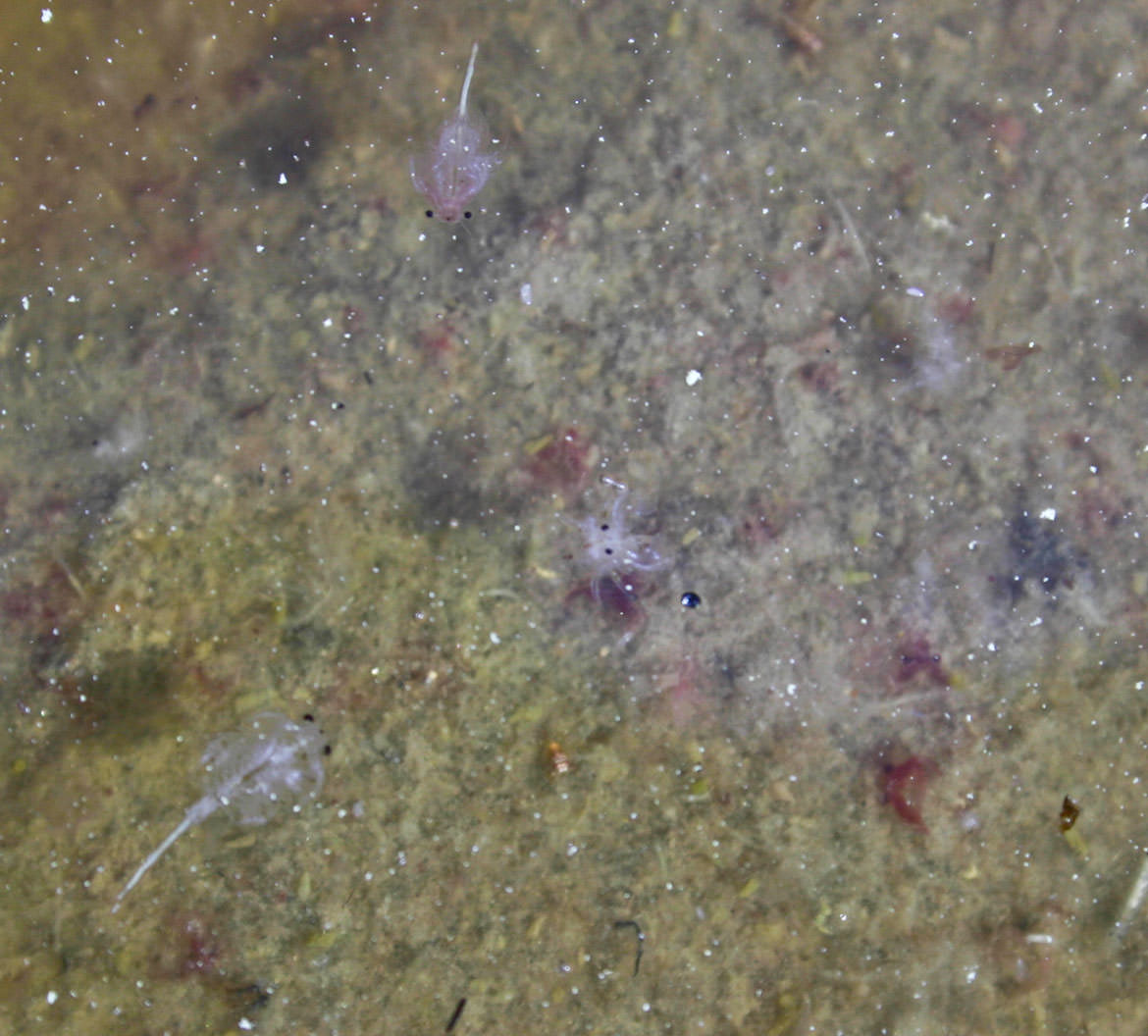
The water of Mono Lake is filled with the black eyes of brine shrimp.
Although the Mono Basin itself comprises fourteen unique ecosystems, the lake itself is one in and of itself, one of North America's oldest lakes. Many of its species - the flies and shrimp for example, are unique in the world.
It is for all purposes a simple economy of an ecosystem; few places in the world harbor such a simplicity of balance; so few players, like a macroeconomic graph on a University chalkboard. Guns and butter, flies and shrimp.
A pipeline runs through it, and dumps into the California Waterway; a vast manmade barrier which propels in pretty much a straight line toward Los Angeles, to feed grass in the desert.
Twenty years ago, Mono Lake was imperiled by the theft of its water. A hearty ecosystem had lost its air to breathe, the lake had lowered to half its size. Salt content was rising, choking the ecosystem like a harsh tax.
I have always found it strange that the armchair proponents of free markets and healthy economies are the first to poo-poo the free market of ecology. Economics and ecology are the same. If we define economy like Milton Friedman or Alan Greenspan, economics is just the practice and study of infinite wants in a world of limited resources.

Lorem ipsum dolor sit amet, consectetur adipiscing elit.
The fear of environmentalists is a world biology which will one day need to be micromanaged, like East Germany's factory outputs, like North Korea's rations. Saving swarms of Tuna despite a hundred species of wrasses; cows at the expense of the lily. If the Mono Lakes of the world need to be regulated, who has the balls to say we will be able to master the balance of ecology with the precision of its creator?
All
that dies in Mono Lake ends up like the calcified tufa columns; the Phalaropes
who die here plunge into the depth, and slowly, like everything else,
are consumed by calcification.
I finally reach the famed Tufas of Mono Lake; the monoliths which one day were preserved under water. They are twisted, trollish, ungodly, like a woman turned to stone at Gomorrah. They are beautiful and obscure; the pale gray-white of un-uniform columns springing out of the shore, out of the lake. Monolithic calcification brought into the dry world by the California Pipeline. I can only see them with my head-lamp, and from the light of the stars, which makes them appear much larger than they are.
All this death and stoning, what does it matter? After twenty years of negotiations, the city of Los Angeles agreed to curtail its water use. Today, although the population has grown by over thirty percent, water usage in LA has remained at the same level as in the nineteen-seventies. Somebody believed in conservation, and mandated the change of a city's water habits. Somewhere, somebody else is fighting for another lake. But most are already too late. The Salton Sea, the dried up Sierra Nevada lakes - gone or almost there. Most, like the Aral Sea, the Black Sea, Lake Tanganyika or the Salt Lakes of Utah, don't have California's dual sense of destruction and protection - they don't have conservation's best friend - wealth and leisure.
All lakes share a role in a system, and lakes are among the first to fall to human abuse. But the answer to protecting lakes may just fall in the hands of environmentalism's alleged enemy - the economy. Conservation saved Mono Lake, but an economy that understands the nature of the ecological processes realizes that the two are one in the same. That a dying sea will end local irrigation, advance desertification, and expand the decline of resources. An economist's nightmare.