
Neotropics

Granada Libre
In one of the Americas' most enchanting old cities, tourism, imperial memory, and foreign ambition mingle in the tropical heat.
There are only nine rooms at the Casa San Francisco, but that means nine stories passing through.
A hotel can say a lot about a city. And a lot can be said about a city by the type of tourist it attracts. This thought has been on my mind for eight years now; I'm old enough to have seen places change dramatically. Now, as we roll into Granada, fresh from Nicaragua's pacific coast, this thought is on my mind more than ever.
Granada, Nicaragua is the oldest occupied colonial city in the New World. Its buildings reveal five hundred years of chipped paint. It is among a small handful of America’s most enchanting cities.
Those old paint-strokes are the hues of Central America: lime, rose, mango, deep yellow. The city sits aside Lake Nicaragua, known for its large size, for its numerous islands populated by tasteless homes or unruly monkeys, for smoky volcanoes protruding from its mid-section, for its sharks. Scientists believed these sharks had long been isolated from the ocean by this lake, transformed by time into a freshwater species. But no, these are bull sharks, inland-waterway breeders, visiting from the Caribbean. They make the trek along the riverine border of Nicaragua and Costa Rica into this lake.
When we arrive at the hotel, we are informed that Terry, the hotel's co-owner, wants to meet us right away. We are mistaken for being famous, or important. 'No,' I tell the hotel manager, 'we're not with Moon Handbooks. You've got the wrong people.' The hotel manager says, 'Oh, just tell people you are, it works around here.'

We cross the street and go down the way for pizza. The hotel had called Terry to meet up with us. "You're with Granada Department of Tourism?" she says. "Or something to do with Moon Guides?" I say, no, that isn't us. She shrugs, 'oh well, don't tell anybody. Just pretend.'
Terry and her sister Nancy live unusually splendid lives. Both were Peace Corps volunteers, but on opposite sides of the globe. Terry fell into the life of public service, living as an expat in Chad, Sierra Leone, Pakistan. She was stationed in Afghanistan just after the war, and in Iraq, just before.
Talking about being an American hotel owner in Granada, Nicaragua, Terry says, "You have to be socially responsible." Terry has lived that other life - the American who understands the world from street level, in all its poverty and moments of injustice. Terry has involved the hotel in a kind of community activism.
"It's wonderful the way they just live among everybody else," Terry says. She is referring to the dozens of handicapped children who live in a shabby building not so far from the hotel. There, they form a kind of commune - making and selling artwork and clothing, their elaborate crafts. "But the owner wants to sell the building, so we are trying to find a new place for them."

I ask her about what she thinks about the influx of foreigners into Nicaragua. By foreigners, I mean North Americans. In Nicaragua, ‘North Americans’ refer to people north of Mexico City. Nicaraguans call themselves Americans – nobody in North America ever knows that North America ends in the plush jungle of the Darien gap.
"I heard this wonderful story," Terry says. "A woman was getting old and almost time to face that big question; which retirement home to settle into. But this one old woman, she was ninety years old; she told her children she wanted an adventure. They moved her to an apartment here in Granada. What, it's the right climate, they can hire a woman to take care of her, much better prices than in the states. This community, they'll take her in."
In the hotel’s small courtyard, there's these two age-ripened Canadians feeding the hotel's pet parakeets. They had lifted them onto their table, to let them peck at their butter and jam. Margaret, who was wearing a medic-alert bracelet, lit up a cigarette.
Is it rude to smoke in front of parakeets?
She says that Toronto, where they are from, "is all gone bad." She says, "First it was the West Indians. Now its the Orientals with their gangs."
"That's why we live part of the year in Costa Rica," the husband says.
"What brought you up here to Nicaragua?" Jane asks.

"Just to have a look around. Talk to the agents. Go on vacation, you know? And Costa Rica, anyway, it's spoiled. There are too many big mega-resorts there. Too many golf courses. Who wants that?"
Being curious about this statement, I prod them to continue. With the parakeet licking butter off his fingers, the husband says, "They make Costa Rica look like California!"
Granada's unfortunate recent past has saved it from Club Med and the Hilton. Since the city is relatively poor, it is foreigners, many whom are Americans, who have slowly been rebuilding the city, remodeling Granada with new coats of paint. But these Americans paint for Granada, in the historical style of Granada, and in tune with the people of Nicaragua.
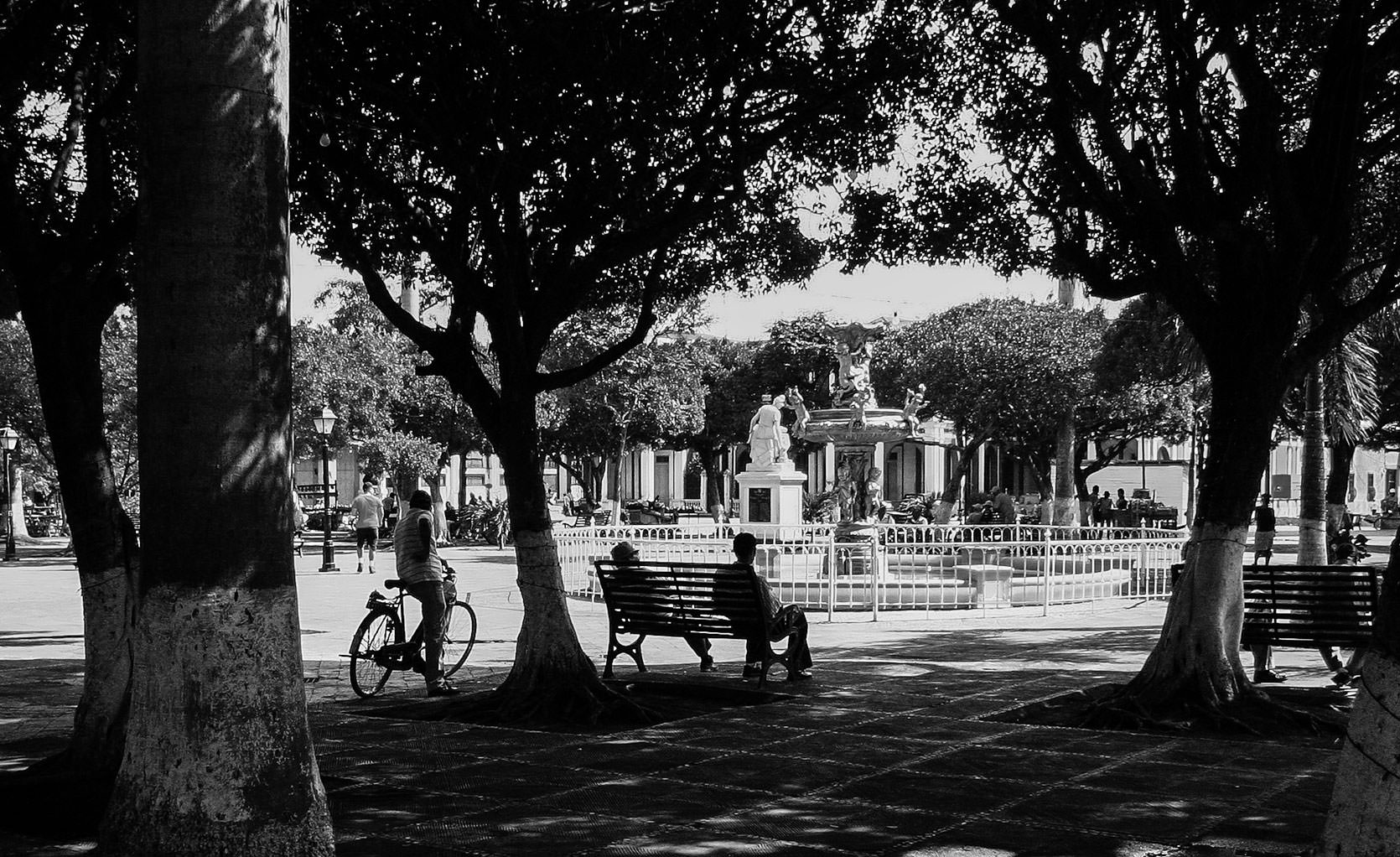
In the afternoon, a great silver cloud rolls around and over the volcano, awakening Granada's humidity furiously. Granadans evacuate to the awnings in these downpours; I take the cue to set my tripod in the empty city square, perhaps knowing a thousand eyes watching.
I pull my dark cloth over my head and wait for my eyes to readjust to the darkness. But I feel sun on my back, and then voices, breath and foot-stomping. I uncloak myself and am surrounded. "Buenas!" I say.
They are all around me - actually there 13 of them. "Just like having your picture taken at Disney World!" says a middle-aged man with receding hair and striped collared shirt.
As if at a formal ball, I take each of their introductions, starting with the adults. Fernando, originally from Costa Rica. His wife, Paraiso - they live in Managua now. Her dress is blue, sandals beaded. Grandfather is there too, with a pipe in his pocket. But Nicaragua is a country of children, and so each child in this large family introduces themselves to me; their eyes and demeanor imply a respect for adult strangers that might have existed in the States once.

Granada Cathedral
Camille, Paloma, and then I come to the last one, who is darker than the rest, and his hair shaggy. He is shorter than the children, but just as curious, so I say, "And you're name is? But I imagine you don't belong to this family?"
The family laughs at this, and so he does too, after looking at them. They ask him his name in Spanish, and he responds with a smile. All 13 of them take turns looking at the upside-down image under the dark cloth. They recount their visit to Disney World, where they dressed up as a frontier family, coon-skin caps, and a Disney employee took a sepia-tone of them from behind a wooden Ansel Adams camera. "Do you like Granada?" they ask. "Why did you choose to come here?" they ask. "Do you think our country is beautiful?"
The way they are dressed, this family on vacation from Managua; their English-speaking, the implied wealth: isn't it possible this family were Sandinistas twenty years ago? Brought into good fortune by the corruption that ensued when the Sandinistas redistributed land ownership? And this little man, more Mayan blood than Spanish, is it not possible he is a displaced campesino, a rural farmhand driven to the big city? His profile is one of a counter-revolutionary. A contra. These rural farmers - it was in many ways for them that the revolution took place for equality after nearly a century of Saddam Hussein Somozas.
I wonder what compels these Nicaraguans, both types, to be so forgiving of people from the United States, our fingers always puppeteering in their bloody messes. Even the revolution itself was influenced by layers of American imperialism. The very word 'Sandinista' is a derivative of that Nicaraguan national hero, Augusto C. Sandino, who traipsed across the country fighting U.S. imperialism in all its forms.
His strange story resonates closely with many Nicaraguans. Even in Granada, the burn marks of imperialism are still visible. William Walker, the American who installed himself President of the country in 1853 and declared English the official language of Nicaragua, operated here in Granada. He was preparing Nicaragua towards its destiny - a great slave state supplying the U.S. south with farm laborers.
Central American countries came together to attack Walker. As he and his men fled Granada, they razed it, sending much of the place into flames. Americans razing cities wasn’t limited to just William Walker. A U.S. Navy commander was sent to a Nicaraguan city in order to get a British diplomat to apologize for an insult. The diplomat could not be found, so the U.S. marines bombarded the city into smithereens.
After this 1853 event, the marines would land or invade Nicaragua countless times, always under reasons whose sensibility is now largely lost on history. Military puppeteering in Nicaragua would continue through the 1980’s.
It is a great irony then, that the Americans in Central America, certainly the Americans who pass through Nicaragua, are this country’s great hope.

Everywhere Jane and I walk, everyone we meet, every Nicaraguan believes in the inevitability of tourism rescuing their country. It becomes a part of almost every conversation. Tourism has now surpassed coffee as the country’s number one industry. In their politicians, Nicaraguans now seek men who understand the industry, what drives people here, how to work the infrastructure along the way. Aspiring university students seek out hotel management degrees.
The American who builds a small hotel in a Nicaraguan city, who learns its language and its customs, brings capital and wealth to that city. He builds upon the city’s traditions and its beauty.
These Americans are already rescuing Nicaragua from its poverty. I know too well that Nicaragua now has a choice: to rely on these expats and a budding tourism industry, or to fall for the temptation of the hedge fund tourism developers who want to recreate a slice of California or Arizona on their coasts, in their rainforests and mountains.
Jamaica’s coral reefs have been destroyed by mega-developments; St. Lucia’s culture is broken by cruise-ship tourism. In other countries, its casinos and drugs and big money and trashy tourists with dollars and steep expectations. Natives become aliens in their own land. Often, they shed their agriculture-based economy for a single hope: tourism. Their entire GDP, focused on one industry.
In the April/May 2006 issue of Islands Magazine, an advertisement by the country of Turks & Caicos appears to follow the new model. The ad states, “Today, (our country) is quickly evolving into the world’s most sought after destination by celebrities and the world’s elite. A multi-billion dollar investment in new amenities includes a casino, deep-water marinas, championship golf courses, exotic resorts, and world-class dining and shopping…”
It is up to Nicaragua to distinguish between the American in the gardening gloves, and the American in the shiny black shoes.
Terry invites us to her home; it is newly rebuilt in an old colonial style. The house is open to the sky, so that her kitchen and living room surround an open courtyard. The weather never changes here. Her walls are adorned in the stories of her storied life; African masks given to her by heads of state, portraits of humanitarian political leaders from the Balkans, a Central Asian statuette. From the outside, her home looks like the rest of Granada. She lives on an ordinary street, and when we leave, a number of Granadans greet her.
We ask an American ex-pat to help find us a guide. Later, we see her at the hotel and she shows us an apple. Alison holds a small thing, a dainty little green apple that’s really yellowish-brown. "You know," she says, "somebody gave me this apple today. I'm really happy whenever I get an apple. You know, they don't really grow here."
She explains that apples cost between 6 to 12 cordobas, which is about 30 to 60 cents. "Wages are different here, so you have to adjust the way you live, you can't just buy apples. They are a fortune."
Alison moved to Granada from Connecticut, to work on her master's thesis in tourism management.
"Would you ever consider staying here?" I ask. I meant forever. "I don't know," she says. "I love it here. I mean look at this place." She kind of rolls the tiny apple around in her hand, looking at it. Out the door, horse-drawn carriages on the street, gliding fork-tailed flycatchers in the air. The smell of dinner, the perfect air.

Alison openly ponders her ability to accept the culture here, for good. And for this culture to accept her.
"It's different here. The men - there is a lot of machismo - see, I have lots of male friends here, but they are just friends. Back in the states, we have friends of the opposite sex. That doesn't exist the same way in this country. So guys view me suspiciously. They will say, 'what are you doing hanging around him.' I will say, 'he's just a friend.' If I would marry a Nicaraguan, everything would change. I had to teach a Nicaraguan how to use a washing machine the other day. They don't know how to do it. If I would live here, I would have to learn how to do it by hand. Can I imagine myself doing that? I don't know."
She recounts working as a real estate translator. "Americans will come down here and buy up property, some of them don't want to learn the language. They say, why do I have to learn the language to buy property. It’s just a hassle to them." She talks about the type of American who ends up staying down here, who fits in. “They become the culture.”
Alison finds a young guide to travel with us. We shake his hand. He says, “So you’re with Moon Guides, huh?”