
Neotropics

Mombacho Volcano:
Jungle in the Sky
Exploring the Mombacho Volcano along Lake Nicaragua, including the rugged, steep Puma Trail.
He’s left Jane, Ramón and I at the guard station that regulates visitors to the peak of Volcan Mombacho. This volcano is one of many that follow the curve of the isthmus up its spine.
The guards say that today, citizens are not allowed up on Mombacho, today is just biologists and the sort. Ramón takes his cue: Jane and I are from Moon Handbooks, and on official business. Ramón has no idea, about the mess he's just gotten himself into.
Being that we are on official business with Moon Handbooks, the guards allow an exception. The only problem is transportation. There will be no driving us to the peak.

Spectacular jungle light shows off orchids, tree ferns, vines and cecropias under the canopy on the Puma Trail, Mombacho Volcano, Nicaragua.
Ramón suggests that we try walking. “I walk all the time, it is no problem for me,” he says. We stare past the sunny pastures at the swirling clouds several miles away; the eternally clouded twin peaks of Mombacho. Although the road to the top is steeply pitched, we have no idea how many miles. In fact, as a guide, Ramón has no idea about this area at all. He is young at 24, and has only been to Mombacho as a tourist himself, and hasn’t an inkling of its natural history, or even the fact the volcano is closed.
The lower two-thirds of this mountain is reserved for agriculture. But higher up the peak - traditionally too steep and dense for entry - the protected ecology switches to old growth cloud forest. Cloud forests are technically rainforests higher than a thousand feet. Rainforests are typically lowland ecologies; elevation sets new conditions of temperature and soil composition.
Because southwestern Nicaragua is largely savannah ecology, places like Mombacho have become land islands; lonely lost worlds above the clouds.
I am all for the walk, and Jane, she's game for anything. What a great way to enter a Central American cloud forest; by foot, feeling the layers of growth changing.
At this low elevation on the volcano, the flora is a mix of dry forest and savannah trees. Fields of grain are stitched into the flatter areas. Cattle ramble along the small cobblestone road, and among them, like angels, are the green and blue and red butterflies. The sense of it all is overwhelming; that sense of going somewhere magical, but forbidden.
Most people are disappointed when they enter a rainforest for the first time. They expect, like at zoos, to see animals, color, possibly large cats and green snakes. All of those things exist at the peak of Mombacho, and three species of monkey too. A salamander and a butterfly exist nowhere else in the world. They all exist up there, but certainly invisible to the one-day walker. Any glimpse will be fleeting and unrewarding.
Enjoyment of the rainforest comes from literature, science and natural history. Without books, the rainforest is just green and overgrown. But books decode it; they unfold a world only familiar to field biologists and native gatherers.
I notice that Ramón is unfamiliar with the names of many of the species. I tell him I'll send him some books. "We have a literature deficiency here. We'll take anything."
The humidity works its way into Jane and me within minutes of walking. In twenty minutes, my white shirt is nearly see-through. Ramón, who doesn’t break a sweat, says, “Central Americans work like the negro and sweat like the white man.”
Ramón, who works six days a week, also attends church six nights a week. Somehow, he squeezes in University. “Tourism management,” he says. “It’s the best career path in Nicaragua.”
He says, “Money, money. That’s what I’m good at.” And, “The future of Nicaragua is tourism.”

Steps on the Puma Trail
Like anyone we talked to his age, Ramón believes in the inevitability of dollars delivering his country into prosperity. “Daniel Ortega doesn’t understand that at all,” he says, referring to the former leader of the Sandinistas, the upcoming elections.
”Isn’t Ortega out of the picture these days?” I ask.
”No way,” Ramón says. “They made this special law so that he can’t get elected again, but he says, ‘I will rule the country anyway through my influence.’”
”But why the Sandinistas?”
“They pretend they aren’t the Sandinistas anymore, they try to separate themselves from that. But really, they are the party of Daniel Ortega, that’s really what they are. The Ortegas!”
“And this other guy?”
”I don’t like him either very much. For Ortega, it’s always about the Socialismus, you know. To the other guy, it’s all about capitalism. I like this new moderate party, because they understand capitalism, the socialism and tourism.”
We pause on the road; I’m huffing and puffing. We spot a blue-crowned motmot, which is blue. And green, and lime, and black, and yellow and red, with a very long tail. The bird is Nicaragua’s national bird, which seems fitting. This reminds Ramón of a joke that he says is a Nicaraguan favorite.
“A Nicaraguan and a Jew are walking along the street. The Nicaraguan suddenly starts beating at the Jewish man. 'You killed Jesus!’ he said while he was pounding on the Jewish man." Ramón enacts the pounding, for effect, and then delivers the punch line.
"But then the Jewish man said, 'No, stop! That was many years ago. I did not kill Jesus!'”
When our laughs appeared insincere, Ramón says the joke is funny to Nicaraguans, because, “as a country we are very ignorant about our religion. Nicaraguans know the book, but they don’t know about Israel and the Middle East.”
We clamber up to a flat surface in the road, where an old man without front teeth is sleeping under a tree. He wakes and greets us, and offers us each a PowerAde energy drink. We ask him if he’d be willing to drive us to the top of the volcano.
Of course he will, he tells Ramón. We are relieved, and the cold drink makes life momentarily much better. The old man starts to close up his facilities, when a young woman appears on the road above us. She is short, and her skirt is short too. Her shoes maybe not appropriate for the steep cobblestone.
The old man stops in his footprints, and tells Ramón that he can no longer drive us to the top of the volcano. You see, he says, that young woman is his girlfriend, and he intends to sleep with her.
We thank him for the drinks, and he waves us off.
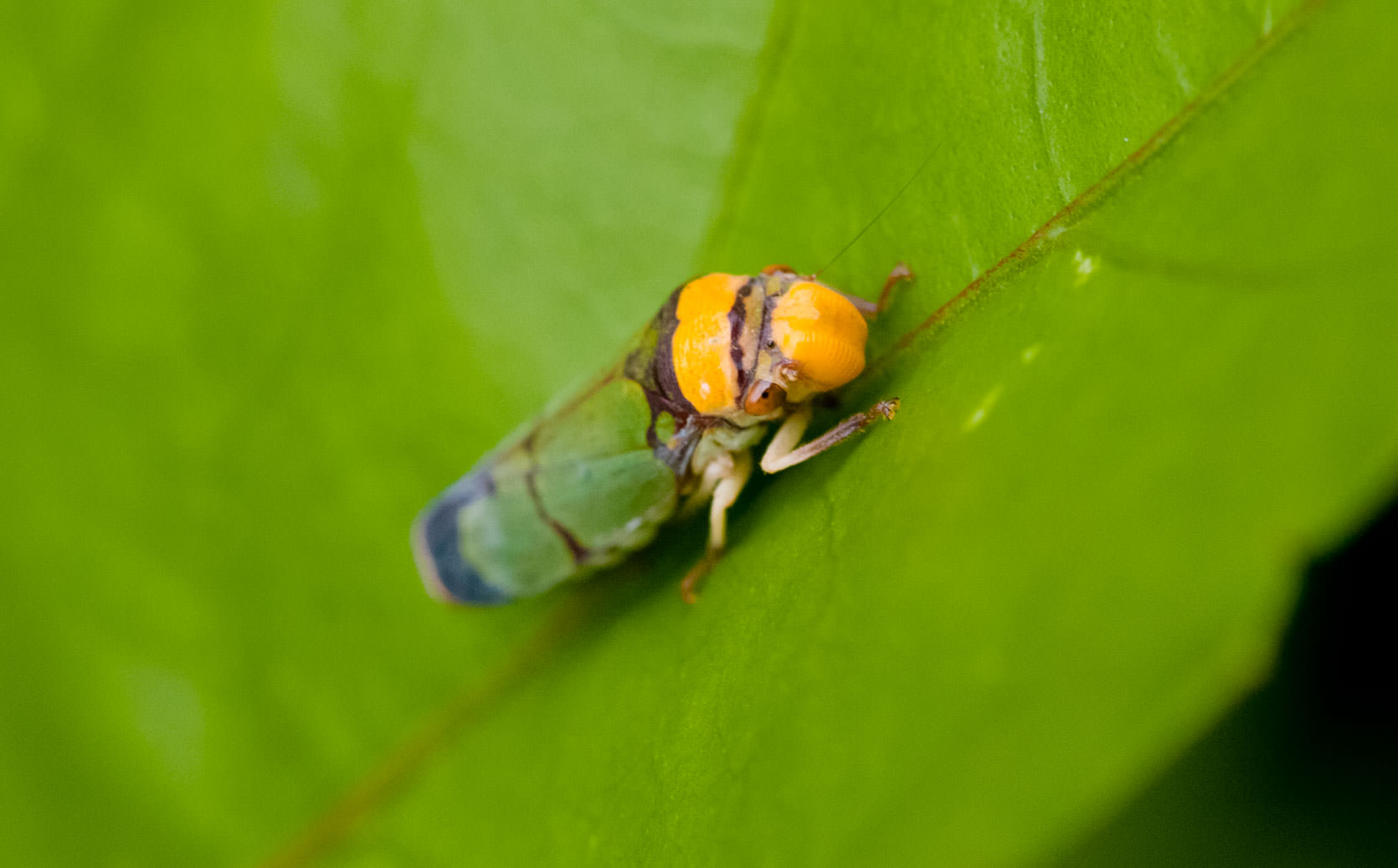
Unidentified leaf hopper: Stunning diversity in the cloud forests of Latin America.
The country is about ninety-percent Catholic; a few years ago Protestantism was almost non-existent. But they are growing; there are now over 130 denominations, all specialized to fill in some sort of conversion niche.
Ramón says, “I was a, how do you say – a crack-head. I smoked crack and cocaine. I did all kinds of drugs and I slept like an animal on the streets. But the Pentecostal people found me and recovered me.”
He is the only one in his family who works; he is also the only non-Catholic. Unemployment in Nicaragua is sometimes quoted at 70%. Our conversation turns to CAFTA – the trade agreement between the United States and some Central American and Caribbean countries.
“I think it is very bad for our country.”
“People in the states are very suspicious of it too,” I tell him.
“How can a little country like us compete against an Empire like that?” he says.
I tell him that I actually favor CAFTA, but I struggle with a way to explain why. “Forget Nicaragua for a second. Imagine the fifty states in the United States. All these states have no tariffs or import duties. Trade flows through each of these states with almost no regulations whatsoever. Now imagine our poorest state, what, maybe Arkansas? Imagine Arkansas no longer has free trade with the rest of the states. Its economy will collapse in months!"
I tell him we're all on the same continent after all.
The discussion gets most interesting, when I try to explain the altruism, or rather the lack of a direct attempt at economic domination, in the U.S. interests in CAFTA. I try to explain that CAFTA was a bipartisan priority in the states. I tell him that Nicaragua got the best package of any other country, one of the best trade agreements any country has ever negotiated. The policy, which protects Nicaraguan farmers from American farm-goods, actually stipulates that the United States has to import more Nicaraguan goods.
But then I remember, even our meddling in the two most recent elections in Nicaragua was bipartisan too.
Thankfully, our conversation is interrupted when the old toothless man appears from a side road. How did he out-distance us? He waves us over to the side road. He tells Ramón that he’ll take us after all, and to follow him.
We follow him on a dirt path. We are high enough up on the volcano now that coffee plantations become more common. The toothless man apologizes to Ramón. That girl back there, she is 23 years old, he explains. He tells Ramón that she loves him and they make love behind everybody’s back.
Ramón says, “He says that his wife would kill him if she found out.”
I imagine a big toothless lady with a frying pan.

Brilliantly colored beetle in the Nicaraguan jungle.
We follow the old man as he talks about the short young woman. We hear the sound of a hundred underwater trains tooting liquid French horns. Crested Oropendola’s keep in touch this way; these black and yellow birds, gliding among the trees.
We come out to a clearing, and the old man explains that he has decided not to drive us to the top of the volcano, but he’d love to show us this view. We walk out onto a grassy ledge. Below is Granada, and Lake Nicaragua. Hundreds of tiny islands dot the lakeshore around the city. Those islands, the molten hiccups of Mombacho.
The distance between the giant Lake Nicaragua and the Pacific coast of Southern Nicaragua is quite slim; 12 miles at one point. Because a river flows from Lake Nicaragua into the Caribbean, it is possible to navigate upstream, into the lake, and then cross to the Pacific quickly. This created both canal dream, and, during California's gold rush, a popular route to California. Hopeful miners from the east sailed up the Rio San Juan, through this lake, to the Pacific, which, when the clouds break, also reveals itself.
While the old toothless man describes the view, Ramón explains that to him, the old man sounds funny. He looks at him and laughs, and then looks back at us and whispers, “He is a country man, and his accent is very stupid to us city people.”
The old toothless man tells us to stay off the main cobblestone road, and stick to a smaller footpath through the coffee plantations. He tells Ramón he must get back to his young woman.
Again, we wave our goodbyes and continue upwards the volcano.
We cross through some plantation estates, and reconnect with the small footpath, and then our progress is halted by a large gate surrounded by a handful of buildings. We inquire with some people sitting under the shade about the meaning of this gate.
Here, the main cobblestone road traverses the property of a coffee estate; and in turn they must manually man traffic through their property.
The property manager greets us and offers us some export-grade coffee. You would think that Jane and I, soaking in the humidity, would refuse such a hot drink. But the idea of liquid coaxes us, and we sit lazily on the plantation porch, sipping coffee with the estate’s property manager
By this elevation, the clouds and the sun interchange freely. The property manager joins us, and mentions that in an hour or so, a Mombacho volcano truck will be coming through. We agree to stay, and sip coffee, test our luck with the worker truck.
An old truck with a covered back arrives at the gate. We hustle aboard and wave goodbye to the property manager. The truck makes noises, lurches forward. "Soviet-made," Ramón says, hitting its metal. "Sandinista truck."
”Why do Nicaraguans forgive Americans so easily?” I ask Ramon, referring to our fueling their war. He smiles at this. “You know, the truth is, most Nicaraguans do not know about Iran-Contra. But yes, there is hatred still. Nicaraguans are learning that Americans are very much like them, and we like tourism dollars.”
We talk about how Americans and Nicaraguans still see the war in a very different way. Most Nicaraguans came into the war not because of political ideologies, but through their religion. So while much of the world discusses right-wing religious violence, the fundamentalists and evangelists of America, and the insane question of whether Islam’s fundamentalists speak for all of Islam, we forget that the Catholic Church, not so long ago, directly guided many Central Americans to bloodshed. Jesus as martyr. The religious left.
The truck navigates the steep cobblestone, knocking at branches, which evermore seem to come in every direction. Now, the mist and clouds are thick.
We reach the wooden field station at top, which is encrusted in moss and small ferns. Jane says to Ramón, "Erik likes trees." I don't know about that, I think, urging them out the truck, onto the path.
I think, have I ever brought up trees in a conversation? Have I ever licked a tree? What does it mean to like trees anyway?

Unidentifed Jumping Spider Species
Ramón's company is refreshing, because he sees no need to guide us, to educate us with over-talk. He's mostly interested in what a couple from the states thinks about male-female relationships. When we pass through a great stone chasm, he says, "Do you think women or men are more conscious of the other's desires?"
When we pass through a great forest of peculiar dwarf trees, dripping with brilliant green and orange bromeliads, he says, "I think that by age fifteen, women are eighty percent more responsible than men, but at age twenty-five, that starts to even out."
In the age of dinosaurs, North America was tropical; perhaps somewhat like this; rich and dense, wet. Perhaps it was filled with creepers and climbers, dense vegetation, a dark understory, dense clouds. That was 180 million years ago, and although the dinosaurs ruled, birds first spread their wings. Small mammals appeared. The first flowering plants bloomed.
Down a harrowing set of wooden steps, Ramón says, "the birth rate is out of control here."
here was no isthmus back then; North America was split in two by a great sea. North America and South America each split from the two opposing super-continents, and even North America's two halves had originated from different places.
Ramón says, "It's the Catholic bishops; they don't want sex education, they don't want birth control."
The eastern half was a stable island that existed in relative isolation for thousands of years. The west was associated with Asia, often banging back into it, letting the animals and plants of Asia step aboard.
These halves of North America, and that chunk of South America - all distinct, bizarre places that we can only half imagine. But then something fell from the sky, at an angle, around about where the Yucatan is now. A chunk of old planet, long gone. A different trajectory, and maybe it would have ended all life on earth.
Instead, its angle of impact - facing towards North America, tore the biological membrane of the continent apart; causing massive fires, near complete destruction. Within days, the globe looked from space like a ball of smoke, and most of the world was dead.
Ramón tells Jane, "You need sex education in this country, too many kids are born out of wedlock."
This was 65 million years ago, the beginning of the age of mammals. Mammals survived on both North and South America, but separated, they evolved in very different ways. In South America, the fauna included two-story sloths and massive, angry-looking beasts with teeth and tusks coming out of everywhere.
North America continued to connect off and on with Asia, and so Asia's creatures flooded North America: camels, deer, large cats, dogs and bears.
Plates shifted again, and the Isthmus arose from the ocean, temporarily connecting the two continents. Animals and plants from both poured in. But as it goes, Central America would slip under the ocean again and again, each time leaving only its mountaintops above.
Even before the connection between continents was fastened, each was already beginning to seed each other: South American birds began to head north, seeking new feeding grounds. Bats and seeds in the wind went south.
But each time Central America sank, its life was forced to creep up the slowly sinking mountains. These mountains; these great volcanoes, they each became arks of life, hosting new immigrants from two formerly unfamiliar continents.
It is a rule of geography that when a larger continent bashes into a smaller continent, the life of the larger continent overtakes that of its smaller neighbor. For reasons still unknown to science, when Panama and Costa Rica and Nicaragua attached themselves to Honduras and Guatemala and the floodgates opened, this never happened. If anything, Central America's South American immigrants prospered in the new land most.
But despite this, by the time Central America became for once solid land, it had produced its own distinct life; ages of animals and plants trapped on isolated, lonely jungles in the sky. Certainly such wonders as the resplendent quetzal, a bird with a thirty inch long tail, or the blue poison dart frog; such ornate wonders are the production of these isolated mountains of before.
The completion of the isthmus meant the craziest sorts of things; like floods of great two-storied sloths into Mexico and Texas. It meant great cats learning to hunt them down. But most of all, to people like you and I, the story behind the formation of the isthmus helps us understand the story of all those rainforest treasures that we use everyday, perhaps in our morining coffee. Chocolate and vanilla, so much richer when we remember the jungles in the sky that formed them.
Ramón says, "Do you think women or men are more up to no good?"
By this time, it is getting dark, and we are heading back for the Sandinista truck, which is leaving the mountain soon. Ramón hands the driver a bribe in dollars, and slowly, we creep out of the clouds. The taxi driver, who we arranged to meet at the guard station, never arrives.
"What do we do now?" I ask. If Ramón were leading a regular guided tour, this day would have been the worst kind of flop. Here we are again, among the cattle, stranded. Ramón, he realizes its no sweat with us. We are having a blast. Ramón says, "Why don’t we walk to Granada."