Europa

Gdansk
and the Pomeranian Feast
Celebrating a family feast in the strange, modern setting of fabled Pomerania, Poland, land of my ancestors.

Kids play at the family mill in Pomerania.
This cod, salted and served with the bones and skin on, is quite close to the traditional basque style of preparation. They are known to have salted the fish and then buried it on the Newfoundland coast for preservation. Regardless, its creamy and salty flavor go well with a good German beer.
German beer gets characterized a lot of different ways. German beers, in general, are not strong, are not dark, nor unusual. German beers, rather than being novel, on a whole are simply well refined. Not refined as in snooty; refined as in the taste is perfected.
Beer was not invented in Germany - it has existed for almost as long as man became agrarian, and is thought to have preceded the making of bread. But Germans are noted for making the most progress. The Baltic Germans were producing beer of such high-quality by 1200 A.D. that an early gigantic export industry was forming in port towns like Bremen. Ships were setting sail for England, Scandinavia, the Baltic towns of the Rus. But so too then, were pirates, thirsty for loot and beer.
Piracy in the Baltic was rampant. The response to this was key for the development of the Baltic cities. It gave them reason to protect their wares in the form of merchant associations called the Hanseatic League. Initially, to protect the land routes between the salt-producing towns and the herring-fishing towns, the two commodities were tied by their function in preserving herring. But the Hanseatic League expanded to as far East as the Rus and as far west as Holland. Ship merchants would band together on their routes, forming armed sea caravans to thwart the constant threat.
In 1489, Baltic Germans created the world’s first brewing guild. In the middle ages, Northern Europeans; men, women, children, drank on average two six-packs a day. One middle age temperance group in Germany called for a limit of seven drinks per meal.
In the morning, we crossed by caravan into the Polish state of Western Pomerania over the Oder River just south of Szczecin. Polish Pomerania is a view of agriculture fifty years removed from the free market. The wheat fields are all poppys and lavender, the barley fields have gone to pine seedlings. The after-effects of communism can be disquietingly pleasing, but also a shame. The first thing you wonder about Polish Pomerania is what’s up with those prostitutes hanging out in the woods?
They wear all white, and their hair is bleached white too, so that, against the green of the second-growth pines on the side of the otherwise empty road, they look like bad Shakespearean nymphs.
But there are more than just hookers here on the road through the woods. Mushroom hunters too. In between the shade of the trees you can catch their diminutive Polish cars discreetly parked on logging-roads or simply under a tree.
I wondered about if the hookers were strutting their white skirts for the mushroom hunters. Like some mushroom guy is walking along looking for some chanterelles and then all of a sudden a damsel in white appears. So the mushroom hunter holds up his bag of mushrooms for trade and points to the nearest blueberry patch.
They say that prostitution is the oldest profession in the world, but we all know that gathering is the egg to prostitution's chicken. Picking mushrooms came first. What else would early man have to offer the woman? Chanterelles are a distinctive mushroom, looking more like an upside-down gas-funnel than a Smurf house. Their color ranges from pale to bright orange, and even draped in cheese or gravy, their wild flavor abounds.
As over-hunting eliminated most of Pomerania’s game, the mushroom would fill in for its meatiness. Present-day Poland is home to 1,500 fungi; wet Baltic air, moist woodland, rich soil.
There are no freeways in Polish Pomerania. It's all two-lane. The roads are the same size as when Frederick the Great of Prussia planted limes, oaks, and chestnut trees along their side. I ask dad about those trees. "They got rid of them in West Germany," he said.
Those trees planted to keep the soldiers and traders cool in the bright sun are the most consistently endearing and beautiful characteristic of Pomerania.
Those roads march haphazardly, above marshes and over hills, and through woodland. Always there is an old steeple or an unkempt palace in the distance, and always the ultra-weird concrete of communism's beehive dwellings.

Forest in Słowiński National Park, in the far north of Pomerania.
But the roads have defied convention and modernism. Still they go, carrying along, adding continuity and warmth to seas of grain and forgotten farms.
The roads remind me of the stark contrast to American roads, where we have neo-glo road signs for everything. Like how you have fifty signs with arrows that say its time to turn right. In Poland, as in all of Europe, signs are understated and lend a certain regard for the intelligence of its citizens. The trees, occasionally, because they are near the road, kill a drunk driver. But trees don't really actually kill people, people do.
In overlawyered countries, you can imagine how oversafety turns the aesthetic of your countryside into a dump. I am no humanist, I'll keep the roadside trees.
There is an adage in the world of economics that goes like this: If you want to save more drunk drivers from death, do you cover your driver's cockpit with airbags? And external panelling of your car with safety mechanisms? Or do you regulate that every car bears spikes brimming preciously close to the driver's body? The economist might argue that the spikes, like the trees, may discourage the drunk from driving, and that oversafety, and overregulation actually make us dangerously carefree.
We arrive in Maszewo. The Maszewo Palace lies thirty miles east of Scezin on a lake in the woods. It is a former hunting palace of the Von Fleming family, the provincial nobility, for whom, in many cases, my relatives were the farmland administrators.
Like other historical buildings, this palace has been carved into a state-subsidized hotel, much like the state-run Paradors of Spain and Portugal. This one features a menagerie of old Polish carvings, a dusty collection of aging European and African taxidermy, and dank halls. An aviary lies on the property; the collection is of old world pigeons, peacocks and Asian wild chickens. It’s unadvertised, but if you wander far enough into the woods, you'll find the hotel has built a giant climbing wall.
The noise of the birds is constant enough that by evening, isolated and encroached upon by scouring trees, the palace emits a sound itself; the constant cry of caged fowl. The Maszewo Palace; another reminder that the traveler's life does not begin and end with Hilton Rewards Points.
Our Pomeranian family were immigrants, according to Uncle. They originated in what is now perhaps Holland and Belgium. We know this only because of our last name, which if you follow its tracks, seems to have gone Germanic as the name migrated west to east.
Uncle says that the spotty recollection of our family history is due to the Thirty Years War, which, he says, was as devastating as World War II for Pomerania. The Catholics and Lutherans and Calvinists and Austrians and Spanish and French - they were all frothing at the mouth, and regardless, the German states had fallen into this chaos, and therefore also into civil war. Families and records were destroyed. Our family history will forever remain a book with most of the pages torn.
According to uncle, a certain Mr. Martin Gauger 'paid himself out of bondage', and married a woman called Eva Bliesener in 1687. Forty years later, another Bliesener married another Martin Gauger. A grain mill had existed in Regenwalde since at least the fourteenth century. But it burned during the thirty years war, and was later rebuilt. The Bliesener family took over this mill's lease and handed its administration to this same Martin Gauger. From then on until 1945, Gauger's would stick close to the milling industry. Even today, of my generation's six Gauger's, half of us earn our keep through agriculture.
For lunch, I order duck liver with peach and orange sauce, herring, onion soup, cabbage stuffed with meat and rice. I order Golabki - cabbage leaves stuffed with rice and pork, served with tomato sauce. These cabbage dishes are as old as populated Northern Europe itself. Cabbage never initially existed in the traditional civilized lands of the Middle East, and so in the west, has always been connected with early Northern Europe. Its ancestral relation - wild cabbage, still grows wild on the Baltic coasts. Traders found that, like herring, the cabbage could be preserved in brine. Instead of protein, it yielded vitamins. And so the cabbage, like the herring, would cross seas in barrels. This preserved cabbage, the Germans called sauerkraut. The Poles took sauerkraut and added it to their dishes. Sauerkraut to Scandinavia and Poland on Hanseatic ships.

Details from the Palace
We are on the Palace veranda with brothers and cousins, and I'm trying to order a glass of water for Hans and Jane. A glass of water, in America this is free. In Europe ordering water is expensive and nearly impossible. And when you get it, it's like a teacup, a mouthful. If you drink your teacup in a single sip, as Americans do with water, you are fucked. It will be another fifteen minutes before your waiter comes by to fetch you another bottle of overpriced water. What you do is you say you want your water in a beer glass, what you do is you say no gasienko – that’s Polish for give me some water without those euro-bubbles. What you do is you order three waters at a time.
Dinner is uncle's 70th birthday. That means Germans and Poles and Spaniards and English and French and Dutch. It also means salmon with a mustard sauce, red cabbage, and wild boar in a chanterelle gravy.
The star game of the Von Fleming, who inhabited this palace only as a vacation hunting grounds, had to have been the wild boar. In Northern Europe, it was considered the most dangerous animal - wild, gigantic, prone to charge. The giant head, the very centerpiece of Macjewo’s game room, is evidence of the ancestral boar’s size. These Northern European boars are considered the largest in the world; but their truly wild ancestors are thought to have gone extinct 300 years ago; the same time when Europe literally lost the majority of its animals to overhunting. Whether the living boar is truly the original native animal is not yet known; it is perhaps a result of cross-breeding with domesticated pigs.
The boar is one of Earth’s most far-reaching animals – historically it stretched from Africa to Europe to Asia, including Japan. As with Japan, it crossed into places like England and Scandinavia when Ice Age water levels meant land bridges. Even in the Americas, a set of distant evolutionary cousins thrive from the deserts of Southern Arizona to South America. The rare explorer of Panama’s Darien wilderness is always wary of a potential attack from a hoard of Peccaries.
The domesticated pig, one of the primary sources of protein in nearly every corner of the globe, was actually domesticated independently from continent to continent. The different progressions of domestication varied widely in places like Europe and China, both of which began as early as 3000 B.C. Today, like any domesticated species or cultivated plant – those ecological distinctions have amalgamized by cross-breeding and the roar of modernization. The importance – however, of maintaining the various regional evolutionary traits of domesticated pigs is not lost on countries like Italy, Spain and Germany – which rely on distinct ancestral pigs to create their various delicacies – proscuitto serrano, westphalian.
Pro-pig environmental groups have been forming around the globe for the last twenty years in various attempts to maintain the traits of these ancestral subspecies.
The Polish eat pork liberally. One of the most enjoyable foods I found in Pomerania was a home-made smoked pork sausage.
But nothing represents to me the southern Baltic states more than the wild boar. I grew up on the French cartoon, 'Asterix', about low-country Gauls lusty for the meat of the pig's wild ancestor. In Northern Asia, the boar is a symbol of the violent side of nature. Celts, French and British all considered the boar supernatural. Even the bestselling movie in Japan, Princess Mononoke stars a race of giant supernatural boars, which symbolize the country before modernism. The Celts wore a symbol of the boar on their helmets, and the British featured them on their coins.
But I had never had boar until now.
The taste, like the mushroom, is distinctly wild, like the smell of a Baltic forest. It’s no wonder then, that the fact they are commonly broiled with mushrooms is no coincidence. For much of the year, like a pre-civilized Pomeranian, the wild boar subsists on the chanterelle.

Riverfront in Gdansk, Poland
From the old palace of Macjewo, we drive a short distance to Regenwalde. On the gray walls of the old Communist buildings is a bounty of graffiti, written almost exclusively in English. In Tschew, the Graffiti says, "Mushroom Sweat!" Another, here in Regenwalde says, "Dig it Octopus."
We knock on the door of the lady Denuta. Her home is small, and sits adjacent to a river, facing a now vacant flour mill. When she answers the door, she erupts into a welcoming smile. She speaks little German, and understands nobody. But she has made a berry cake and a berry-alcohol, which she distilled herself, from her own garden, on her lot in the middle of a place I had never before considered. And uncle, without the benefit of Polish, is managing to make her laugh.
Her home is formerly my grandparents, along with Uncle and dad, before the Polish ousted all Germans from the now Polish section Pomerania following World War II.
She has never married. On the wall hangs a photo of her standing next to the Pope in Israel. Her professional hospitality probably means she has an active life in the Catholic Church. But this – all these foreign faces – has to phase even the veteran entertainer.
Few things have changed in her home. There is some element of the 1970’s in her furniture, sure, and the walls have been painted. But this house is essentially the same as where Uncle spent his earliest years. She shows us her garden, which is alive with peaches, cherry trees, strawberries, blackberries, lettuce, rhubarb, carrots and celery. There is an organized display of cabbages, all sorts of them, and plums hanging above.
That vacant mill – that was great grandfather’s flourmill. And, like my grandmother’s father’s own mill, which stood in a nearby town, it was a vast construction.
The next morning, we drive further east through woodland and farmland. Our goal is Slowinski National Park, one of Poland’s natural crown jewels. It encapsulates the giant Lake Lebsko, a long coastline, and a series of coastal dunes which stretch for miles. The dunes, the largest in Europe, are constantly moving, so that every year they overtake new forest and swamp. This murky water-covered forest is a hint of the wildness of old Pomerania. Even stepping a few feet from the dunes into swamp, my feet go swollen with the bite of ants. In minutes, they harbor even the bellows of my camera.
This is the northern route to Gdansk, a Polish city-state on the eastern edge of Pomerania that has changed history as much as it has changed hands.
The next morning, the summer sunrise in Gdansk is three-thirty. The post-communist smog is thick with purple, and so am I. I have been suffering a constant state of jetlag. A constant state of Pink Floyd’s Comfortably Numb for the last eight days. I walk to the Maritime Museum, where, I gathered, my camera could capture Gdansk in the nordic morning light.
But the museum was gated, and when I fiddled with the gate latch, the guard woke and yelled at me from the premises, like the eternal café-bound European and his pigeons. But when the sun broke, and that odd Gdansk light covered water and land in haunting violet, I went under the gate, camera and all, and set camp.
One shot, two shots, and the guard was again awake. He came to me with a vengeance, but my bags were already packed, and comfortably numb, I was on the other side of the gate.
The rain in Gdansk today is unrelenting. So much so that there seems nothing better to do than take refuge in a small café on the expansive baroque Dlugi Targ Street with wife Jane and brother Hans. We are sipping on Bitburger, watching the swarms of people under their umbrellas: a man with a monkey on the leash is hurrying, an elder woman is selling lavender bouquets and a trio of female teens are sucking on wet gummi bears, laughing and chatting under their hoods. Hans says that this is how he imagined Hemingway’s ‘A Moveable Feast,’ only in Pomerania.
“What exactly did he mean by moveable feast?” I asked, thinking that Hemingway was referring to a big picnic. "This is how Paris was in the early days when we were very poor and very happy," Hemingway wrote, but Hans says, “A Moveable Feast was about being able to take your Parisian experience with you, to wherever you go.”
“I apologize,” I said to the two of them, “we have to find a piece for my tripod, I hate to drag you into this, but this will not be easy in this town...”
What I meant is this would mean we would have to walk all over the city in the rain, on a hopeless venture that could result in nothing more than an expansive exploration of Pomerania's greatest city.
“Call it a dragable feast,” Hans says. Yes, a Pomeranian Feast.
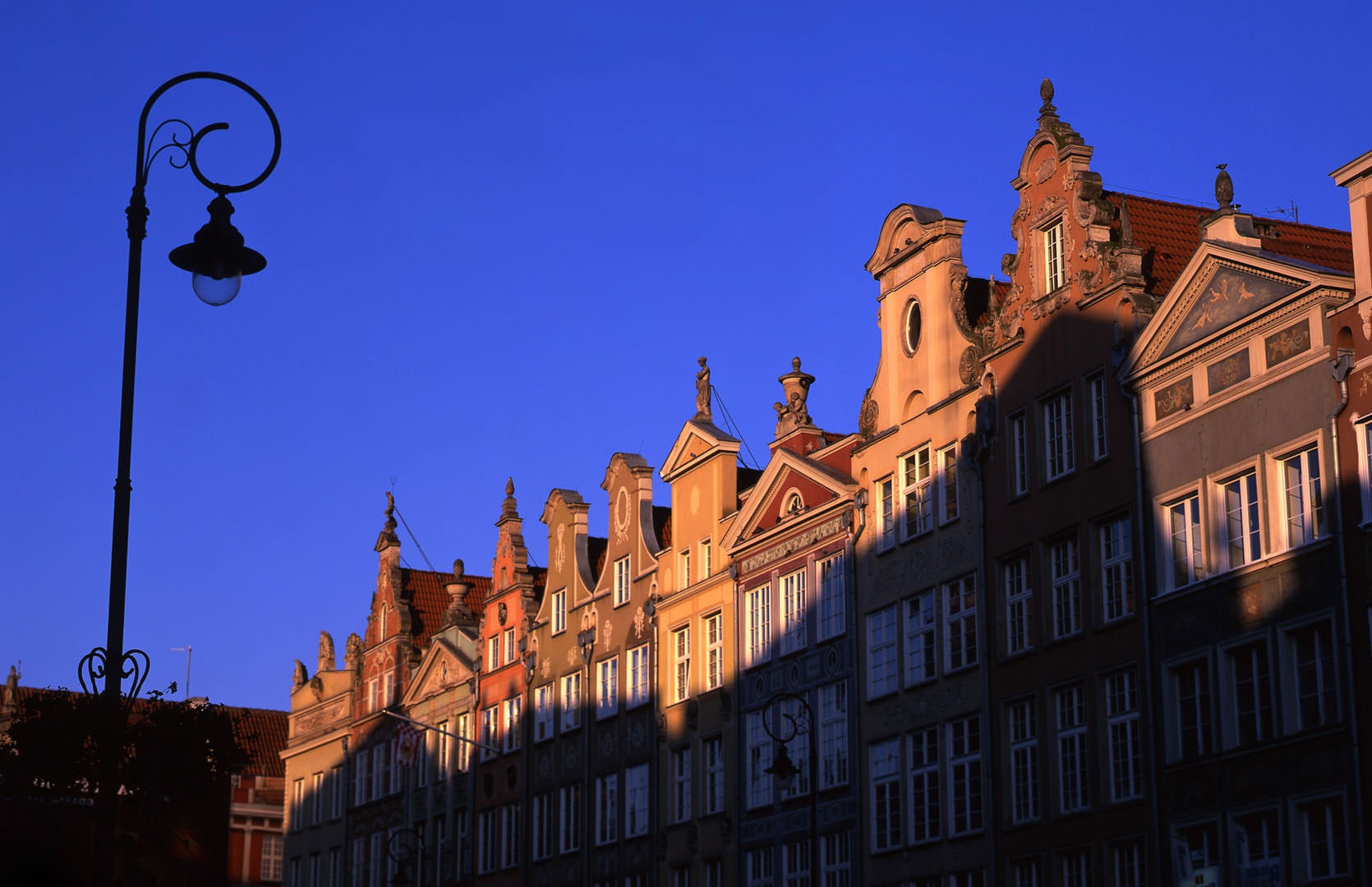
Gdansk Old Town
Gdansk, often remembered as being an independent city-state between the great wars, was also an early participant in the Hanseatic League – a constant maritime presence in the Baltic and a center for grain, timber and shipbuilding. Jewelry and amber trade flourished, and so did the arts. It lies between the Baltic and the delta of the Vistula River, which connects almost all of Poland by water.
But so much more happened here, and you can almost feel that weight. One of Hitler’s first international demands was that Gdansk be returned to Germany. It’s no wonder then, that the first battle of World War II happened here, and also the first Polish revolt against communism. Lech Walesa’s solidarity movement began as an outspoken trade union in Gdansk’s shipyard.
Uncle says that during the war, Hitler declared Gdansk be defended at all costs. The Russian answer to this was to simply level the city. And they did, blitzing one of Europe's most astounding cities into a heap of rubble. Only two of the ornate homes on the Dlugi Targ survived the bombing.
The communists, sensitive in their early idealism, ordered the most historical and stunning components of the city rebuilt, as much as possible, down to the last brick. The Polish, always starkly at odds with the Soviets, maintained a respect for their religious and cultural backgrounds in the second half of the twentieth century. Rather than mow over the German culture - the churches, the castles, the old cities as the Soviets did with cities like Konigsberg, the Poles sought to integrate it into their own. Because of that, Polish Pomerania is still Pomerania. They respect their heritage, even the historical German side of it.
More importantly, as a part of a country that is more comfortable with home-cooked meals than going out, Gdansk has one of Poland’s best markets for good restaurants.
In the evening, (where the graffiti says 'Lucky You All Coppers are Bad,)' we meet up with relatives at a canal-side restaurant. I am wondering if there is a correlation between all this strange North European graffiti and their bad taste in music. Maybe it's the bubbles they put in the water.
I order a Polish dish called Pierogi; ravioli pasta stuffed with pork, sauerkraut, mushrooms and fruit. My Italian cousin balks at this, because, of course – you order ravioli in Italy. Cristiano is no snob of Italian cuisine. He does wonders with olive oil and pasta and whatever is in the kitchen. And, he always affirms that ‘some of the best pizza is from New York.’ But there is something suspect about pasta from Poland.
There is no doubt that Italians, like Germans with beer, perfected pasta. And for staking claim, the Italians do so with most vengeance. But like the Basques and the New World, there are a group of food historians who believe pasta was invented, well, here in Northern Europe. The common wisdom says that Koreans invented pasta and passed it on to the Chinese, who introduced it to Marco Polo. Like beer, which was invented in several regions in prehistory, pasta may have been invented in multiple regions.
One admittedly unlikely theory holds that pasta was invented in German lands. And introduced to Italy long before the age of Marco Polo. Pomerania, which has been called the ‘corn granary’ of the historical state of Prussia, was likely a center for grain storage – one of the most vital of northern states’ interests was its ability to stock grains for cold winters.
Italian food historians have traditionally always been up in arms about this, especially because of the claims of American food writers, who seem to stretch old world history myths for the benefit of 'color.' In one instance, in a movie called “The Adventures of Marco Polo”, actor Gary Cooper points to a dish of noodles in Asia and asks what it is. “Spa Get!,” the man answers.
More likely, in Germany as in all the other places that have claimed to invent pasta – Persia, the ArabMediterranean, France – these places probably simply found ways to preserve grains for bad times, cold winters and droughts.
Making something from grain became increasingly important in Germany and Poland that by the seventeenth century, grains had a similar status to the potato in Ireland.
The continuous migration of Germans into Slavic Pomerania was welcomed during this time, because the Germans were viewed as master farmers – hundreds of years more technologically advanced, and at the cutting edge of mill technology, they became kind of like a farming class.
But Pierogi is it’s own deal. Mushrooms, pork and sauerkraut and it’s all Polish, despite how it’s wrapped. And delicious, especially down with a good German beer, overlooking history itself.
We left Gdansk following the southern Pomeranian roads. In lands south of Wacja, dad and Hans and Jane and I stop in thepines to pick wild blueberries and look for chanterelles. We collect a handful each, and up the road in a small town, we buy cherries and smoked sausages. I can think of no better way to spend an afternoon, eating as you go, dad talking about the advance of the Russians on Berlin in World War II.
Dad has said that picking berries is one of his favorite past-times. In the field, he says, it's no coincidence that it's often Germans doing the same. That my parents spend long August hours picking their own crop of Minnesota berries - despite the mosquitoes and humidity - is probably also no coincidence. This modern act of gathering seems almost a Northern Seas trait.
Jane is looking forward to Berlin. They say there is a Prada super-store there. Out the window, the brick wall enclosing a field of garden gnomes is sprayed in red. "Bucky Luckball breaks the Chocolate Order!"

St. Mary's Church and Royal Chapel in Gdansk.
We cross the Oder River and up a hill called Seelow Heights. This is both the border and the setting for the final months of World War II, when the Russians had advanced to within miles of Berlin. The Germans were stationed on this hill, and western border of Pomerania with 9,000 pieces of artillery. Because of rain, the heavy Russian infantry became bogged down in the muddy Oder wetlands, making easy pickings for the German’s above. But the battle waged, with the Russians having shear numbers on their side. And Pomerania’s borders would change again. Nazism to communism.
Grandfather had been asked by the Nazis to operate the flourmills of the Ukraine region. His instructions to Grandmother - if things went bad - were to flee Pomerania for a town called Einbeck. In his jail-time letters to Grandmother, he wrote of his post-war dream to build a chain of bakeries across Northern Germany.
Grandfather’s decision for the family to flee to Einbeck was a lucky one – Einbeck was west enough not to make the cut of East Germany. Although Grandfather’s bakeries never came to be, he stuck to grains. Grandfather retired the manager of a flourmill. He never returned to Pomerania until forty years later.

Mom and dad had brought me to Berlin when it was still communist. Dad would park the car on empty stretches of West Germany, near the border - the places where 'The Wall' was just fences and minefields and mud trenches. He would throw rocks at the minefields, and say, "look at the towers, they are all turning to us." I asked if the dark figures in the distant towers would shoot at us, but dad said they couldn't, because we were West Germans.
That is how I learned about the world, dad saying, "look, that's where they let the dogs out to kill you if you try to escape."
My childhood fantasies about the dark world behind the iron curtain, about ‘Red Dawn’ and the nuclear siren warnings in Minnesota, are shattered by the reality of communist Europe. It was far worse. East Berlin was perfumed with gasoline and waste, and the city-dwellers appeared to have constipation - their faces gray with sweat. East Berlin, the crown jewel of western communism, was a place you awoke from in a cold sweat. It wasn’t until after all this that we found our ‘behind the wall’ relatives were just like us. Although, too much Metallica and not enough English. These cousins, who once met me for a meal of Korean bulgogi in Los Angeles, spent their post-communist youth traveling. One cousin’s family once gave him up for lost, when he disappeared traveling across Africa, by bicycle.

Gdansk Street Scene
Today's Berlin pulsates with life. Museums, there are way too many of them. But every building itself is a museum, being shed of its World War II bullet-holes and its bizarre ultra-commie facades. Berlin seems to be moving at a frantic pace; like the West Berlin I visited years ago, the whole Berlin today is both modern and aware of its past. Old buildings and new ideas. Berlin is known in Europe for its vegetarian restaurants.
Where Europe has hoped to bury its dirty past, the American vegetarian has declared war on Hitler. The problem that the political vegetarian always faces is the image of their movement, because far too often vegetarianism seeks to assert itself as a lifestyle; it becomes political and religious, and sometimes the healthfulness of it gets sided by self-righteousness. But what if, the political vegetarian believes, ‘our movement becomes tied with Adolf Hitler, the most hated man in the world?’
By all means, Hitler was a vegetarian, or like most vegetarians, he strove to be a vegetarian. Hitler wrote in Table Top Hitler, an unfinished sequel to Mein Kampf, “…there's one thing I can predict to eaters of meat, that the world of the future will be vegetarian!”
Hitler believed that man was ancestrally tied to vegetarianism. He said, "At the time when I ate meat, I used to sweat a lot. I used to drink four pots of beer and six bottles of water during a meeting…when I became a vegetarian, a mouthful of water was enough."
He believed the future of the Aryan race would be bound by vegetarianism. When he attempted to make this part of the Third Reich creed, his staff objected, for the reason that it would diminish their popularity in the eyes of the German populace. He continually noted that children have an “extraordinary antipathy…to meat." He believed that meat was unnatural to the human race. And that our cultural enlightenment would veer away from it during the thousand-year reign of the Reich.
But Hitler always had everything wrong, including history. The Aryans, who Hitler curiously depicted as people from Western Europe, were just the ancestral precursors to both Germans and the Slavs he persecuted – a people tied linguistically to their dispersion point in present-day India. The starkly blonde-haired, blue-eyed European – he was an immigrant to Germany; also from India but distantly removed from the Germanic and Slavic tribes. He was more recently Scandinavian, less traceable to Aryan roots - and his pigmentation was an evolutionary trait thirteen thousand years old. A trait he developed perhaps hunting large game on the ice floes of yesterday. An animal trait, which made him blend into the snow of the receding Baltic glacial ice.
He was a meat-eater at times, and a vegetarian at times. He dug on mushrooms, he lavished the wild boar.
It is just us in Berlin now. Dad drags us to a feast at the oldest restaurant in Berlin. Mom and I order a piquant venison goulash with forest mushrooms, apple on red cabbage, leek and bacon dumplings. Jane orders the smoked and braised loin of pork breaded with pumpernickel, stuffed with prunes, served with a claret sauce, and herb-flavored potatoes. Dad orders a large pickled knuckle of pork with wine-flavored sauerkraut, pea puree, pickled cucumbers and mustard. And what they call a Berliner Weisse, a green beer.
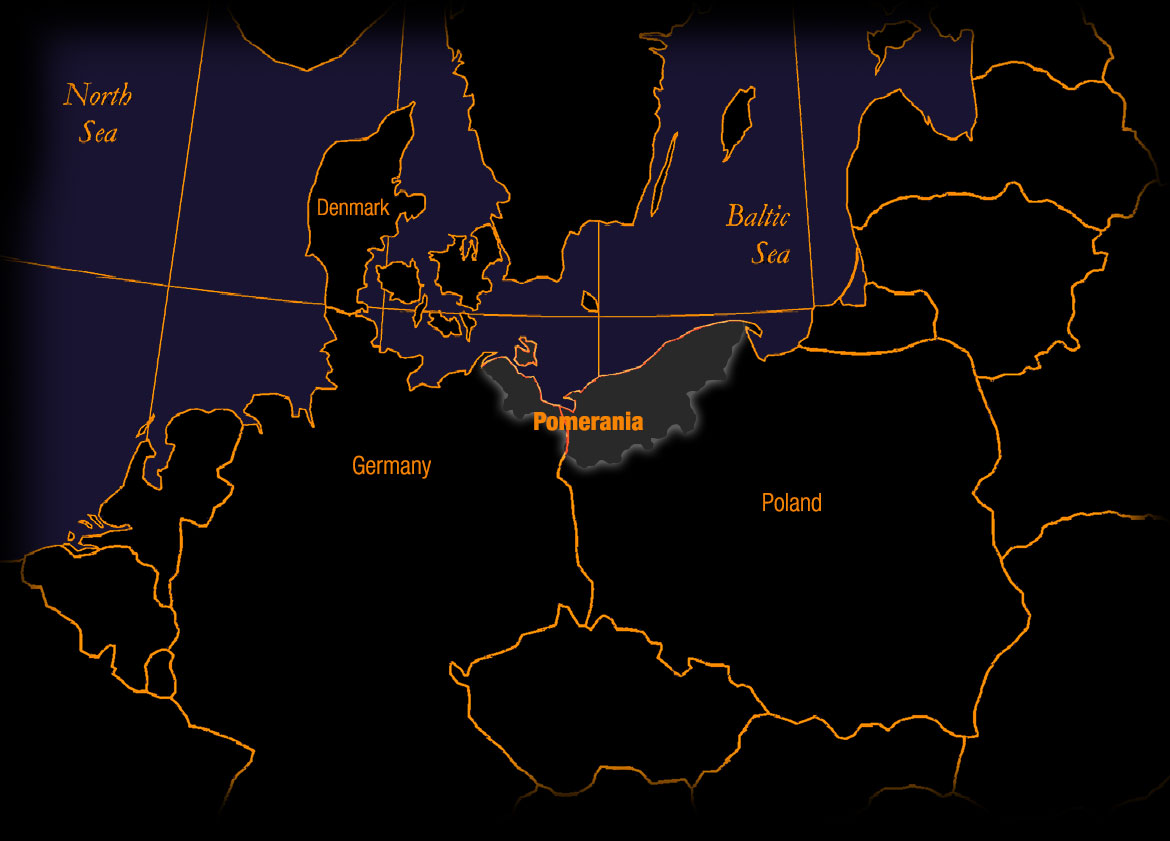
Where is Pomerania?
Pomerania, slavic for 'near the sea', is a historical region of the southern coast of the Baltic Sea, now split between Germany and Poland. It includes several Baltic islands as well as the city of Gdansk.
Map of Pomerania
Here is a map of the Pomerania region inlaid with modern-day countries.