Cascadia
Foraging Nehalem Valley
Glowing Mushrooms, deer-meat, stone and a Portland underworld creating a world based on old ways.
In the last weeks of a long Oregon winter, everybody must be imagining last year’s summertime. I am remembering fondly a particular day. It was the end of that long Oregon summer, when the evenings just dabbled with early darkness.
Jane and I were walking down a dirt road between Douglas firs. We passed a whale made of aluminum, and a small room, of earth. Bonsai trees, small succulents and ferns in tiny pots; then into a garden of tall corn stalks and rows of lettuce, chickens and goats, and an occasional wanderer, enjoying the flowers. The garden edges off into fields, and then the forest, rising everywhere around it.
So much has changed here at Tryon Farm, since a small group convinced Portland to let them build a learning center for sustainable living in place of a sprawling condominium development, which would have hung awkwardly over the city’s second largest urban wilderness park.
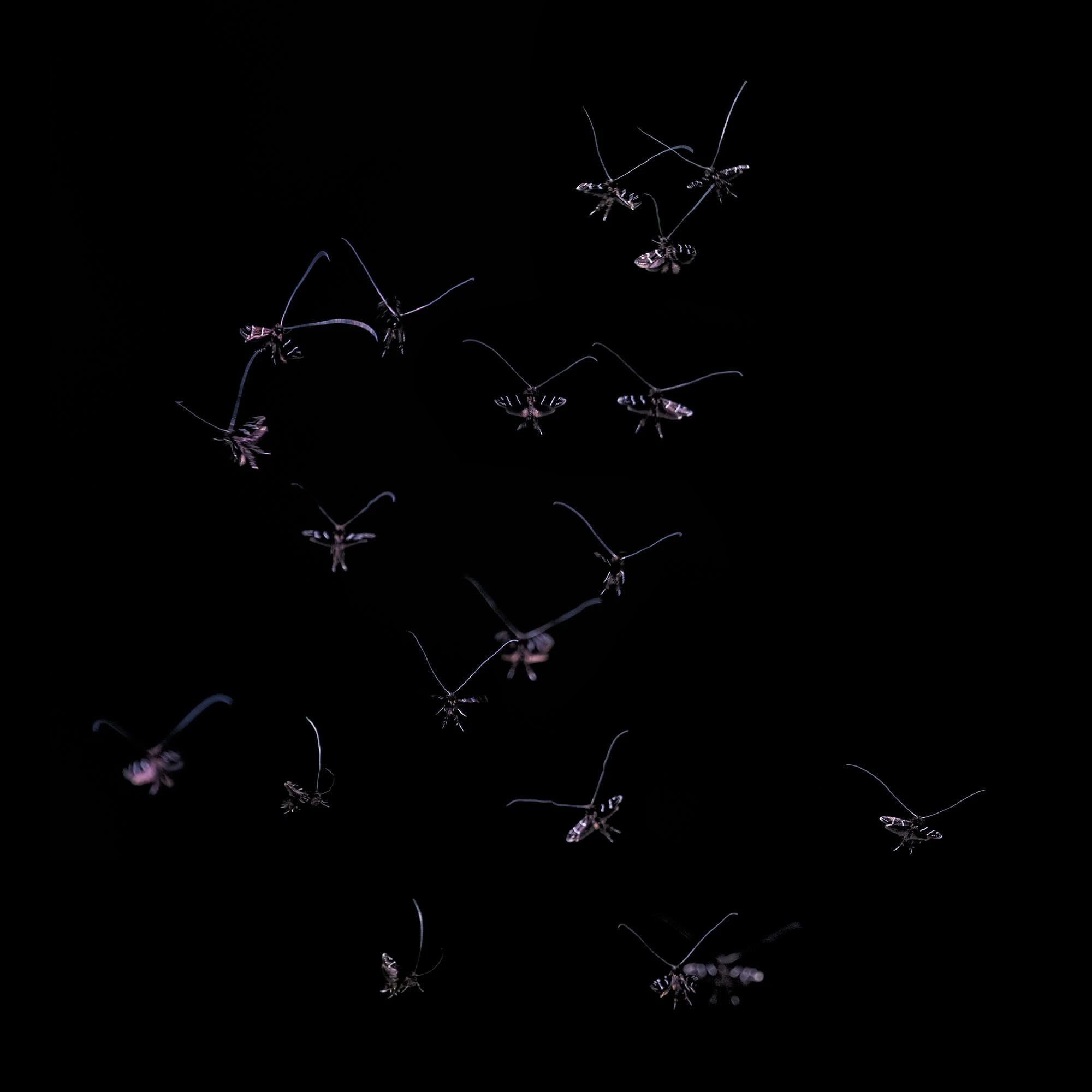
Fairy moths dance in damp western Oregon woodlands. Read more about this fairy moth photo in the Roam section.
Brenna invited us to dinner, so that we could tap into their vast Oregon network of people who know people who might be able to help me find answers.
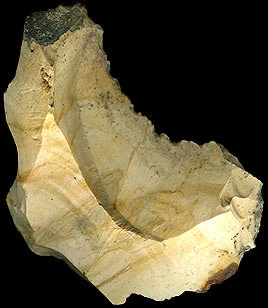
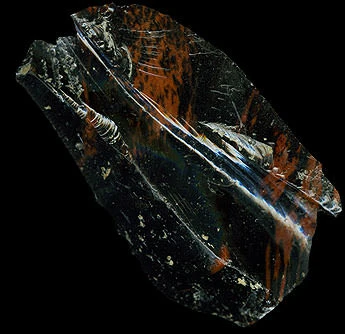
Jane and I walk up into the living room of the old house at Tryon Farm, where the residents are slowly gathering in for dinner. Everybody is immediately helpful, asking me questions and how they might help. Earlier in the year, I explain, my brother and I stumbled on an Indian site and uncovered a small stone tool in the southeastern corner of the state. Now, I explain, I want to fall into the world of Oregon’s prehistory – to find answers about the stone tool the slow way, by peeling back layers of history through experience and travel.
I write notes and email addresses and first names, or last names, of people who might be able help. The chatter flows easily between talk of the Makah Indians of Washington, or about the ‘hippie dust’ that flavors the lasagna. We ask questions about their lives here; 18 adults and three babies experimenting with growing their own crops, teaching school children about sustainable living.
Brenna says, “Even as we sit around here, it’s clear that there are very few people that know about Indian history. I mean even we are sitting here debating some pretty basic things.”
What Brenna means is, even the folks who know the most about Oregon’s native past, don’t have a complete picture; knowledge is fractured, the textbook is missing.
I brought my Northwest plant guide along; we talk about foraging – how this book will be my bible – and the importance of learning the plant families.
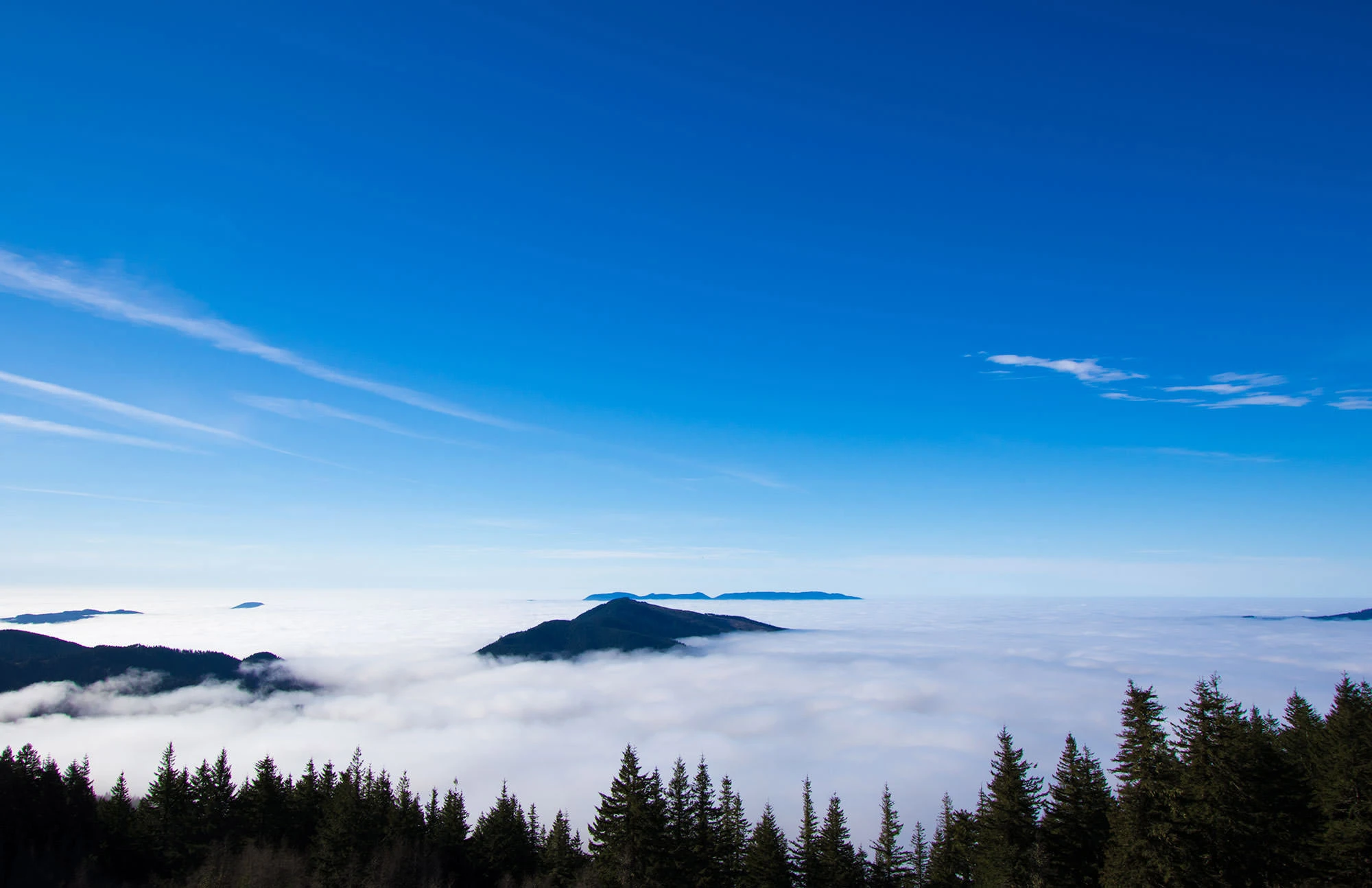
A view from Mary's Peak, the tallest mountain on the Oregon coast range.
A week later, Jane has agreed to hunt mushrooms with me. Because mushroom hunters are so secretive about the whereabouts of their hunting grounds, I have no guide and no clue about where to start. All I know is that chanterelles fruit in September, after warm rains. I know that they exist both in the Cascades, to the east of Portland, and the west, within the coastal range. I know that they prefer mixed woodlands, and I know that mushroom hunters will have collected any relatively easy-to-get to place long before I would likely chance by.
We take off on a brilliant autumn day with the goal of losing ourselves in the windy roads between the main routes to the coast.
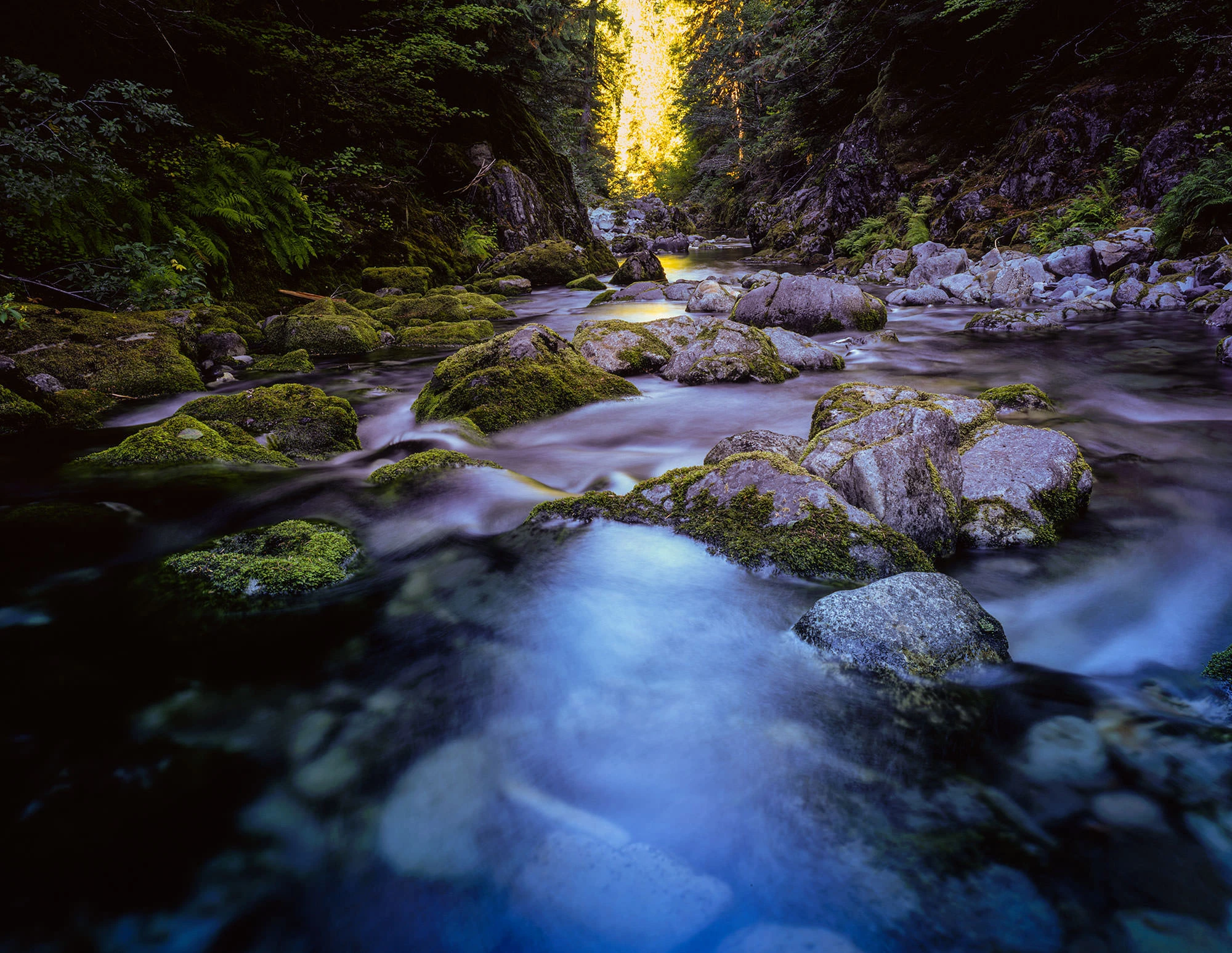
This place is all Douglas firs and leftover oaks from ages of Spanish ships and coonskin caps. We follow the banks of a dimly lit forest river, small fish dart underneath the black surface, ferns and moss and fallen trees lunge at the water and shore.
A crayfish in the stream, bright and pink. This is the first Pacific Crayfish I have ever seen. It is an incredibly important find for me, because I know that coastal Indians traveled upriver to harvest these crayfish. I put my hand in the water, and I touch the crayfish. Technically, because I have a crustacean permit, I can take him. But part of my Oregon Testament project rules are that I must adapt old world culture to Oregon; I am unclear on how to interpret the Old Testament laws against crustaceans. I leave the beautiful clawed animal and we continue in the woods.
Along the riverbank, I find a hefty mushroom hidden under ferns. Its exterior is a brownish-gray, but its underside is bright milky yellow. I think it is edible, so I remove it and put it in my pack.
Jane finds a large mushroom, white and tall, under the leaf litter. We sift for more; and if they look possibly edible, we put them in our sacks.
With a few specimens in the backpacks, we move on and find ourselves in the Nehalem Valley, which features a river between coastal ranges northwest of Portland. We are intentionally driving to get lost; a disorganized way to get somewhere the mushroom hunters would never have thought to go.
We stop along the road where a tree-stump is covered in a thick display of bright mushroom shelves; brilliant orange on their tops and citrus yellow underneath. With my elbow, I break a pound and a half of the rubbery meat off the stump, and place it in the sack.
We continue up a dirt road, and park in some lot for horse-riders. From here, we walk on a horse path through a parched wood. Almost immediately, we spot these golden trumpets shooting through the dark brown earth.
The excitement of our first chanterelles is overwhelming. Jane remains skeptical, insisting these are no chanterelles. I am ecstatic at how quickly we have achieved success. I put a few mushrooms in my knapsack and we hustle along. The idea is to get off trails and to walk in a direction no other human would think to walk. The idea is that the chanterelle lives in a certain sort of place; and part of being a mushroom hunter is to instinctively learn what that place is.
Under some majestic burly conifers, we find more mushrooms; gray, white, brown. Satisfied, we return home.
I need to identify the mushrooms, so I drop Jane off at home, and race up to try to meet Kil’iii.
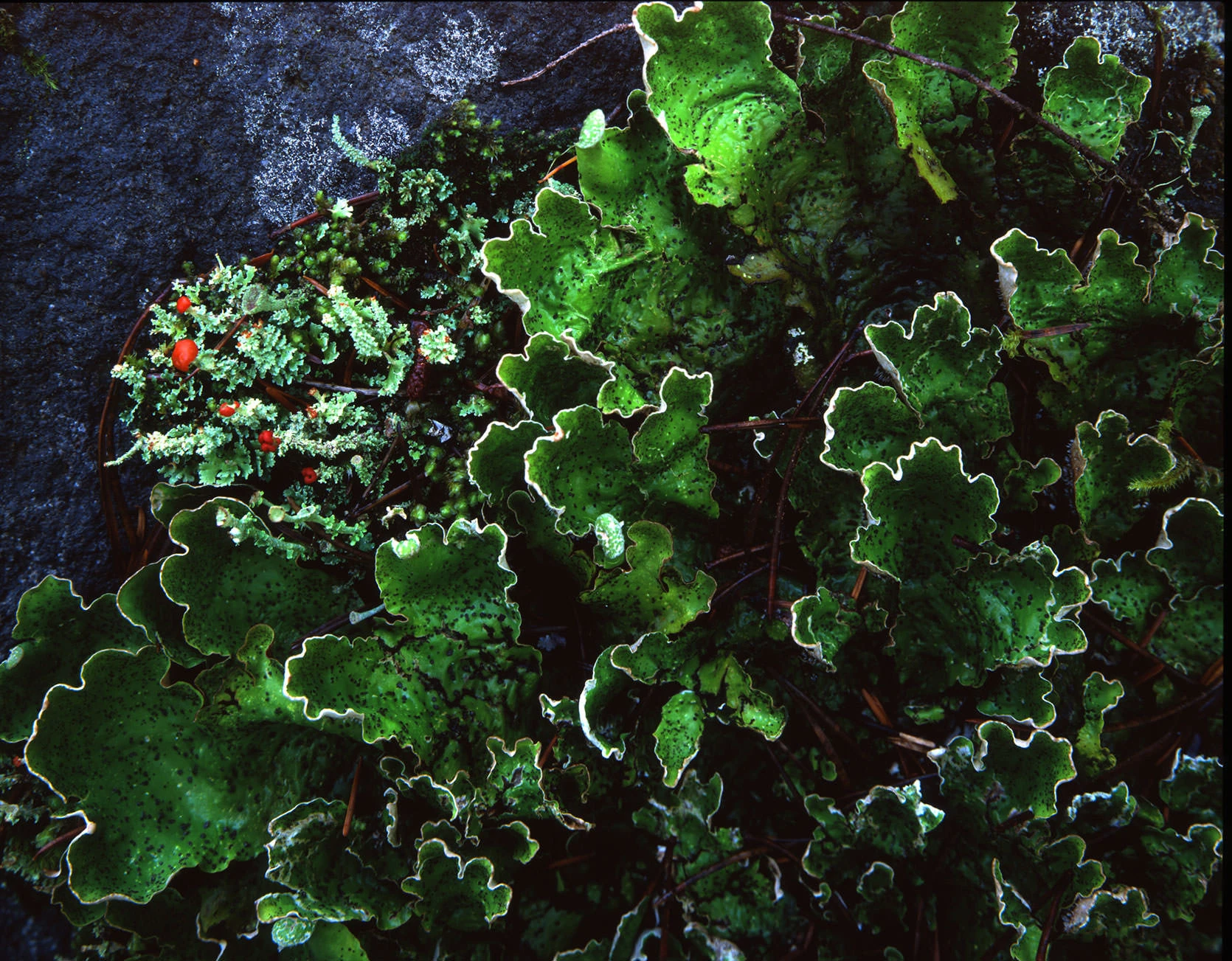
Lichen, liverworts and brilliant-colored fungi on the slopes of Mount Hood, Oregon.
Kil’iii is one of the West Coast’s ‘300 or so’ primitivists. His name – Kil’iii, was a name given to him later in life.
"I am Northern Chinese and Nanai. My grandmother was Nanai, who are indigenous to the Amur river bordering northern China and Siberia, and are related to the Ainu of Japan. The film Dersu Usula by Akira Kurosawa is a film about a man who was Ulchi, very very closely related to the Nanai. Sometimes I am pretty sure that I do what I do because my ancestry is speaking through my blood. I hunt salmon the same way my grandmother's people did, and I'm sure it's no coincidence!"
He has gathered a collection of people on a rocky beach of the Portland section of the Willamette River. It is his birthday, and so he has gathered his friends together to help him christen his new boat. He is building a Greenland Baidarka out of driftwood he found on the Oregon coast. Today, his friends are helping him sew the skin. “Land Walrus,” he says, explaining the skin he is using to cover the driftwood shell.
Land Walrus means cow.
Meeting Kil’iii is important; you could almost say that there are very few people in Oregon who have the experience he does; the array of Pacific Northwest Indian skills. In our first meeting, I admit to him that I need to tap him for his experience. I was surprised by his excitement for my project, and his instant willingness to help.
He is sort of at the center of a group of people with incredibly varied interests and skills; all of which center around the loose ideas of native skills in progressive community. Some of his friends here are part of a group called ‘Trackers Northwest’ –which advocates and teaches hunting and foraging within the city limits of urban environments.
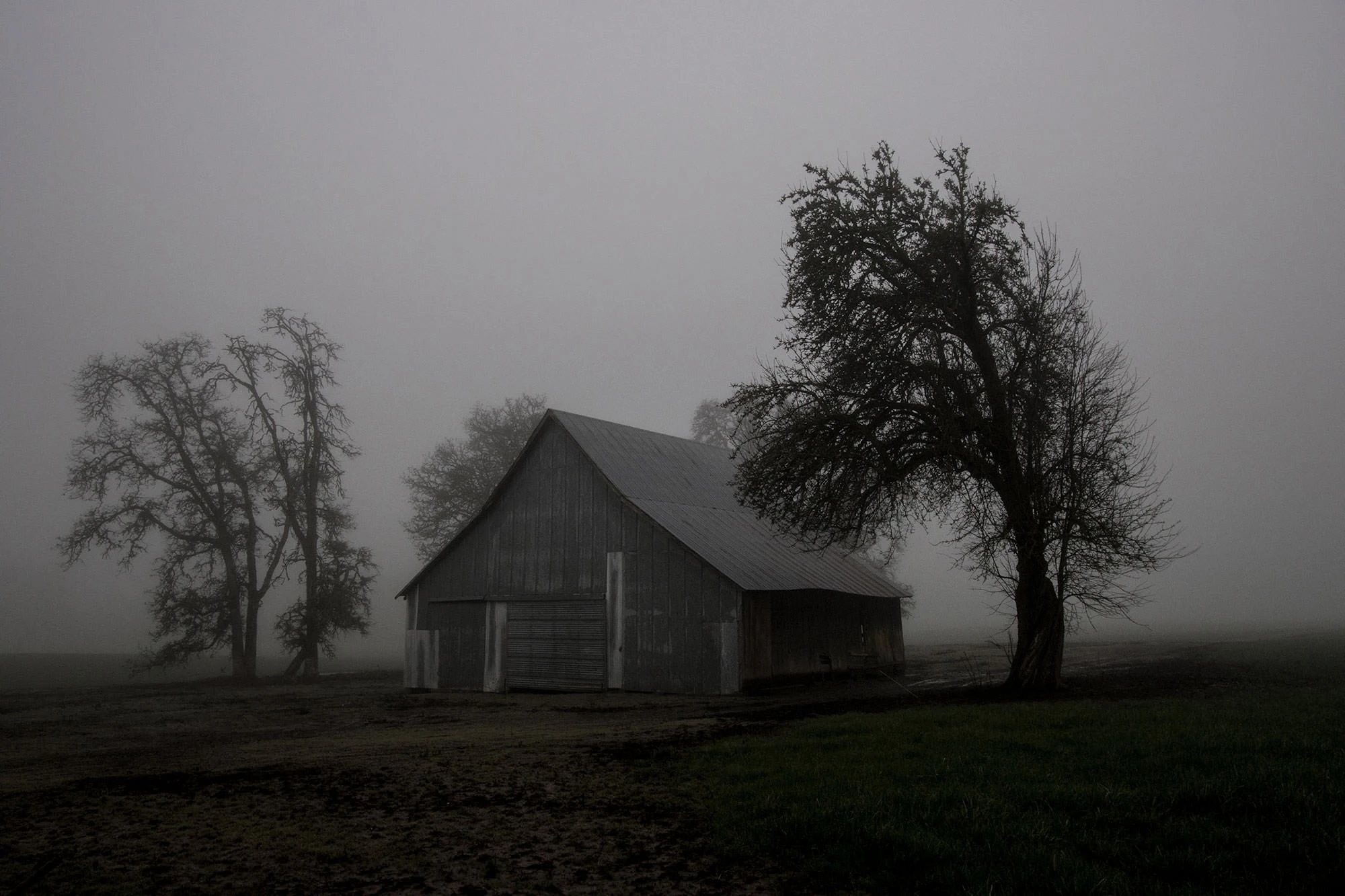
Roadside barn near Philomath, Oregon
One young man here has started a program to teach Portland’s homeless how to build and operate their own propane stove; to allow them more independence. Others are amateur ethnobotanists, and one man is part of a group that wants to reintroduce the California condor to Oregon.
In an email, I ask Kil’iii about the boat. He says, “The kayak was a huge community effort and to me the boat represents that human community coming together and also a connection to our ancestors and coming children. Ahnkuttie Alta Alki was started from driftwood collected on the bay at Nehalem. Brian Schulz of Cape Falcon Kayak and I spent four days in the salt marsh at the spit and collected driftwood, scraps, and built the frame there.”
I tell him that I have been reading about the history of the Indian migrations to North America; ultimately, about the mystery of how the Americas, and particular Oregon, were populated. I ask him if the type of boat he is building here might be similar to the boats that may have been used in the migrations to the Americas.
He says,
“Now, the boat as compared to the Pacific Northwest boats…There were no skin boats in the coastal regions here. Moose-hide boats were common farther inland in Idaho and Montana, but they were open canoes, and not kayaks certainly. Kayaks were made with a very specific set of needs-- to catch seals and deal with a very dangerous open ocean in the North. Down here, we had huge red cedar trees and dugout canoes were the common occurrence. Although exceptionally heavy, the beautiful Northwest coast dugouts were much better for fighting, being impenetrable to arrows, which was constant. The Northwest coast dugout canoes were also quite seaworthy.
Now 12,000 years ago is a different story. Although kayaks were paddled by the Aleut during the sea otter trade, being enslaved by Russian Fur traders and made to hunt out all the sea otters down the pacific coast in only a few years, kayaks were not used down here. Kayaks are also only historically dated back about 4,000 years.
12,000 years ago, I'm not certain what craft were used down here. It is quite likely dugout canoes were used, but the technology of the period was much less sophisticated. I speculate that common watercraft would have been stitched plank canoes and simple dugouts used to ferry people on rivers and bays, and not as much the open ocean.
There has been much talk of skin umiaks crossing the Bering strait. Umiaks were the precursors to skin kayaks, and were canoe shaped, and carried up to 120 people per journey. They are very, very seaworthy, and have been known to cross regions of up to 150 miles in a single journey, and the Bering Strait is considerably less distant.”
I show Kil’iii’s Trackers Northwest friends my mushrooms. “No, no, that is definitely not a chanterelle,” one says, looking at it carefully. “It’s the ridges, they are uniform.” I show him the white mushroom. “Not a white chanterelle, I’m pretty sure,” he says. And the gray mushroom? “Not familiar with this one. Wouldn’t eat it.”
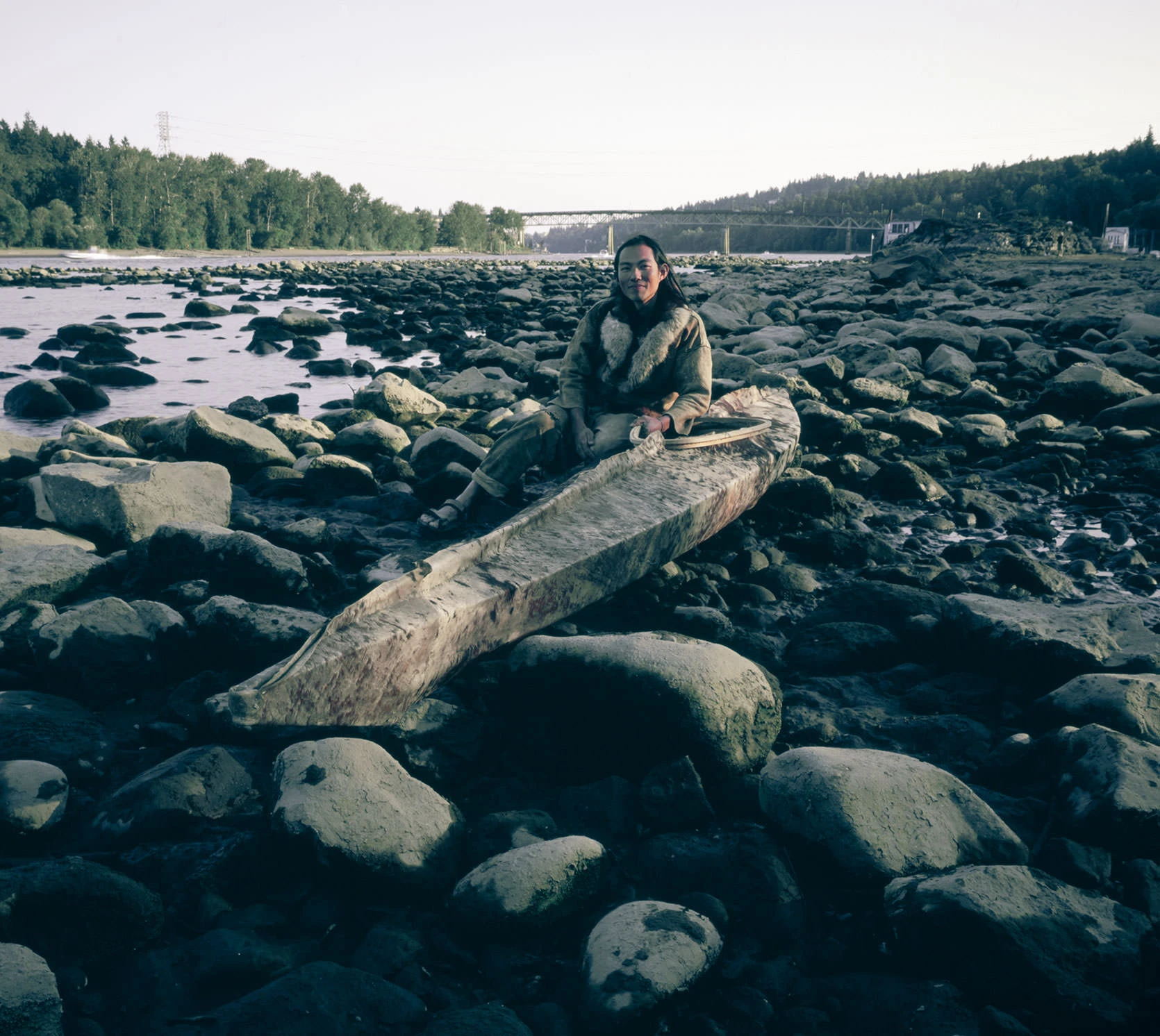
Kiliii on the Willamette with one of his skin kayaks.
When I show him the orange meat, he says, “Oh yes, Chicken-of-the-woods. Sulphur shelf. Delicious.”
At home that evening, it,s almost dinner time. My cousin Anja, interested in the medicinal properties of Northwest mushrooms, sent me three separate field guides to mushrooms. The total page volume of all three books combined is over 2,000 pages. I must be able to identify these yellow mushrooms with all those pages.
After paging through each book, I announce to Jane that indeed these were not chanterelles!
I tell her they are Jack-O-Lanterns. “In fact, they glow in the dark.” I tell her it’s a good thing we didn’t eat them, because they are extremely poisonous. “They won’t kill you,” the guides say. But in their own literary styles, they list all the things the mushroom will do to you. After I tell her this, I ask her if she wants to sit in a dark closet with me. “It takes about 10 minutes in pure darkness,” I tell her. “After that, the book says you can look at the mushrooms, and see them glow.”
Jane declines my offer, so I sit in the closet on my own. It is not such an easy thing to do, to sit there in pure darkness and wait, with nothing to do. So I let myself drift into thought. And some time later, I open my eyes and, a faint green glow? Maybe. Or have these mushrooms been dead too long anyways?
Nobody really knows why these mushrooms are bioluminescent. However, some mycologists ponder the notion that mushrooms may be more connected to the nocturnal world than the day world. So fitting to their reputation as organisms of death and mystery, some wonder whether mushrooms feed not on the energy of the sun, but on the energy of the moon.
When I emerge from the closet, it’s dinner time. While Jane cooks up something conventional, I am slicing up the sulphur shelf mushrooms. I sauté them in olive oil and garlic and a dash of salt.
The sulphur shelf is a burlesque orange up-top, and a goldfinch yellow underneath. The sulphur shelf is not sold commercially, for one reason that fifty percent of the human population is allergic to it.
Amateur mycologists like to get a little bit sick sometimes, they like to say: hunting the thousands of edible mushrooms in this world is a practice of independence, wit, and folk biology.
In a small enough dose, nothing is ‘toxic’, and with mushrooms, ‘toxic’ at a lower dose may simply mean mind-altering. Exploratory.
But Northwest Indians are not known to have used mushrooms for psychedelia, nor did they consume alcohol or any sort of drugs. In fact, little is recorded about their consumption of mushrooms. Let’s put it this way; mushrooms were an available source of food in almost any season; especially on the wet, emerald coasts.
12,000 years ago, 5,000 years ago, 400 years ago, anybody, everybody…everybody pretty much anywhere in the world was a folk biologist. Distinguishing between the hundreds of varieties common to anybody here in the Northwest would have been a skill developed at the earliest stages of life.
In today’s modern West, identification of species for the purpose of edibility seems completely foreign. But it’s not. As a species, we are not really that separated from our not so distant past. A European American just 150 years ago would himself be familiar with hundreds of plants, fungi, animals. He tested, he relied on the knowledge of his community, he ate. Sometimes he got sick.
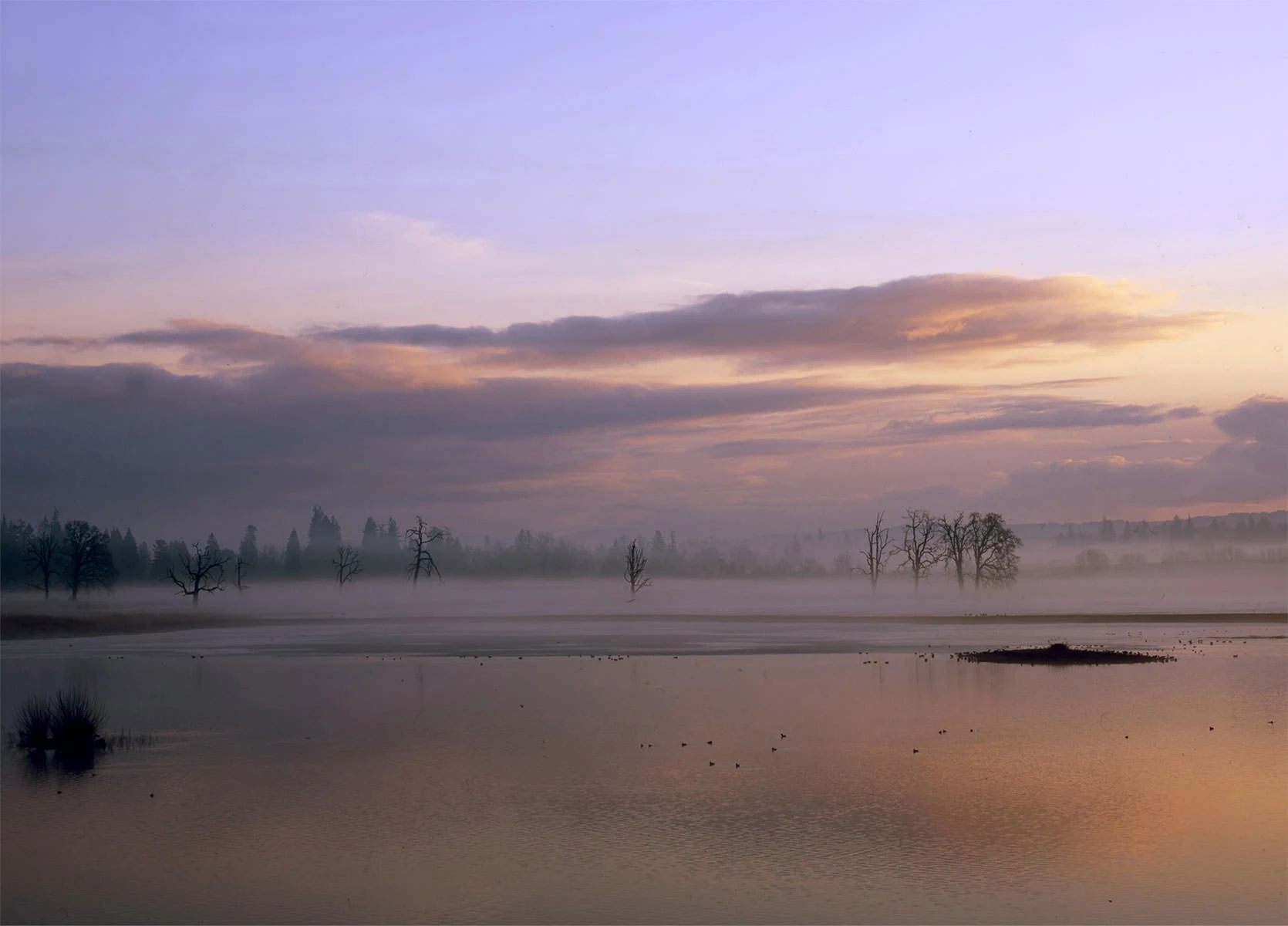
Early morning mist over wetlands at Tualatin River National Wildlife Refuge.
And humans evolved this way. Our brains were built on the African plains because our species was a generalist species. We evolved out of the biological niches of our ancestors to a migratory species that traveled from savannah to ocean and needed to differentiate between a myriad of plants, bulbs, roots, tubers, insects, shellfish and small game that either nourished or caused sickness.
This is why people collect wine; discussing the variations of grapes. This is why people hunt, or birdwatch. This is why they fish. And why they garden. Even the finest cosmopolitan passions; the most sophisticated urbane desires, seem to be connected to this idea that our psychology isn’t very removed from our evolutionary history.
A human, in ninety-nine percent of human history, excelled at breaking apart the natural world into its subcomponents. A modern-day botanist may be able to knock off the scientific names of a few thousand plants; but in our past, a ten year-old could do the folk biologist equivalent to his entire environment; intuitive about edibility and medicinal uses or thousands of species.
And so, all of Kil’iii’s friends, learning to flintknap, or becoming expert native basket-makers, are their passions really that unusual; or are they just maybe more tapped into the human psychology? Regardless, I recognize I will never match their primitive skill sets. Nor do I need to.
But I do want to replicate ‘the matrix’ achieved by our ancestors as best as I can; to learn about the sophisticated civilizations and cultures that may have made my stone tool, I need to first see Oregon through their eyes.
Maybe because an earwig crawled out of the mushroom heap on the kitchen counter, I eat my sulphur shelf mushrooms alone. They say that this mushroom tastes like chicken. I’d say my sulphur shelf mushrooms taste like too much olive oil. Too light on the salt. Maybe some more garlic next time.
A week later, a friend of my brother’s calls me. Trey is half-Indian, and a native of the foothills of Mount St. Helens, where as a youngster, he built up a deep interest in native Northwest skills, language and culture.
He says on the phone, he was out in his truck in Southern Washington early in the morning, and a buck was crossing the road. He stopped the truck, pulled his shotgun out, kneeled down, aimed, and fired.
Trey makes good venison sausage.
Trey says I should come up to Cougar, Washington next weekend. And to bring my stone tool.
I have no stomach for blood, so I am openly nervous. But when I notice Trey’s fiancé in the truck with him, I am relieved. If a girl can do this, what am I to complain?
Trey grew up next door to a man who built a hobby butcher-house in his backyard. Only thing, the butcher-house looks twice the size of his own house. It’s gigantic, it’s clean, it has the stuffed heads of moose and bears from places like the Yukon and Russia. The butcher-house has hosted famous hunters. Rule is, if you use it, put a six pack in the fridge as an offering to the owner. And clean up after yourself.