
West Indies

Disney's Big Red Boat
and the Travesty of Treasure Island
Stranded on the north end of Great Guana, I see the side of Disney's abandoned Big Red Boat cruise-ship stop I was never meant to see.
The following travel notes are from a visit to the Disney Treasure Island property at Bakers Bay, Great Guana Cay, Bahamas after the resort was abandoned and the Disney-themed The Big Red Boat ceased its visits. Since I wrote this piece in 2003, versions of this story have been cited by various travel and Disney bloggers. The story below sets the facts straight by a travel writer who has visited this area before, during and after the Disney era.
Treasure Island Before Disney
When I was a child in the 1970s and 1980s, the north end of the island of Great Guana Cay was a quiet wilderness, surrounded by turquoise water. This was land set aside by the Queen of England for the benefit of the Bahamian people.
For the locals of Great Guana Cay, this crown land was far from the island's settlement, but locals would navigate rough, wet trails to hunt land crabs by night. Sailors would put up anchor in the pristine Bakers Bay. For many boaters sailing through the Caribbean Sea, the beauty of this pristine bay was a highlight.
I would visit this land with my family as a child, occasionally creeping into the dense, tangled woodland.
There was nowhere else in the Bahamas quite like this wilderness, and even as a child I sensed that it was special, not just for the Bahamas but for the whole world.
The Big Red Boat Arrives
By the end of the 1980s, things had changed on the north side of Great Guana Cay. While going through my SCUBA certification lessons, I would take the ferry from the Abaco mainland to Great Guana Cay, waiting at a dock for a smaller boat to cross to the Atlantic side of the island.
From the dock, you could see it coming. The Big Red Boat spat a cloud of smoke, and I could see people leaning over the guard rails. A hat flew into the water.
Cruise ships are awful polluters: In the deep sea, they shit the poisonous excrement of potato-chip-eaters and Mountain Dew drinkers, and dump their wastes into the water streams that follow the same route as the plankton, the jellyfish, and the birds on their way to the shallows of places like the barrier reef between the Atlantic and the Caribbean
Premier Cruiselines, under contract with Disney, originally quarantined this beautiful side of Guana Cay, and set loose a carnival of tractors to tear apart pines, replace them with expensive palm trees from the Middle East and the Pacific, and cut a road through the middle of the wilderness.
Barges came in and began one of the largest dredging projects in history; removing sand from the ocean floor and silting the tidal highways between the cays to make way for The Big Red Boat cruiseliner. That dredge is still clearly visible from satellite images of the area: a line of deep blue through the sandy shallows.

Water off the coast of Great Guana Cay where a channel for The Big Red Boat was dredged.
The dredging failed, because tidal highways between the Atlantic and Caribbean kept filling up the dredged depths. This silt movement helped to damage, destroy, or just flat out bury most of the coral structures on the Abaco Sound side of the island.
Tracts of the barrier reef between the two oceans were also disturbed by the silt, which at the same time was being hit by a white band disease outbreak which had been affecting reefs in Florida, the Bahamas and other parts of the Caribbean, later putting Elkhorn and Staghorn corals on the U.S. Endangered List.
The Guana Cay reef, part of the Great Abaco Barrier Reef, is magnificent, and one of the last relatively untouched reef systems on the Caribbean.
But back then, marine and coral sciences were in their infancy, and nobody took notice what was happening underwater.
The dredging was happening on top of a trend at the time of 'bleach' fishing, where you dump bleach canisters into the reef system to instantly kill, and catch, tomorrow's market fish or lobster.
While Caterpillar machines and garbage trucks and men with blow-torches were turning a pine-forest into a Disney Treasure Island', the shallow-water corals that wrapped around the Sea of Abaco side of the island were disappearing.
Employees were asked not to refer to the island by its native name, 'Guana Cay', and to act the part of the pirate-ship laden paradise that had been built of plastic and spare parts from California and Mexico.
Disney's contracted cruiseline bought dolphins, brutalized them into submission, and built a small net enclosure for them that jutted into the silty shallows of the ocean.
Bottlenose dolphin rides was at the time a trending tourist attraction, and when The Big Red Boat came, there would be hundreds of impatient tourists ready to grasp on the dolphin backs.
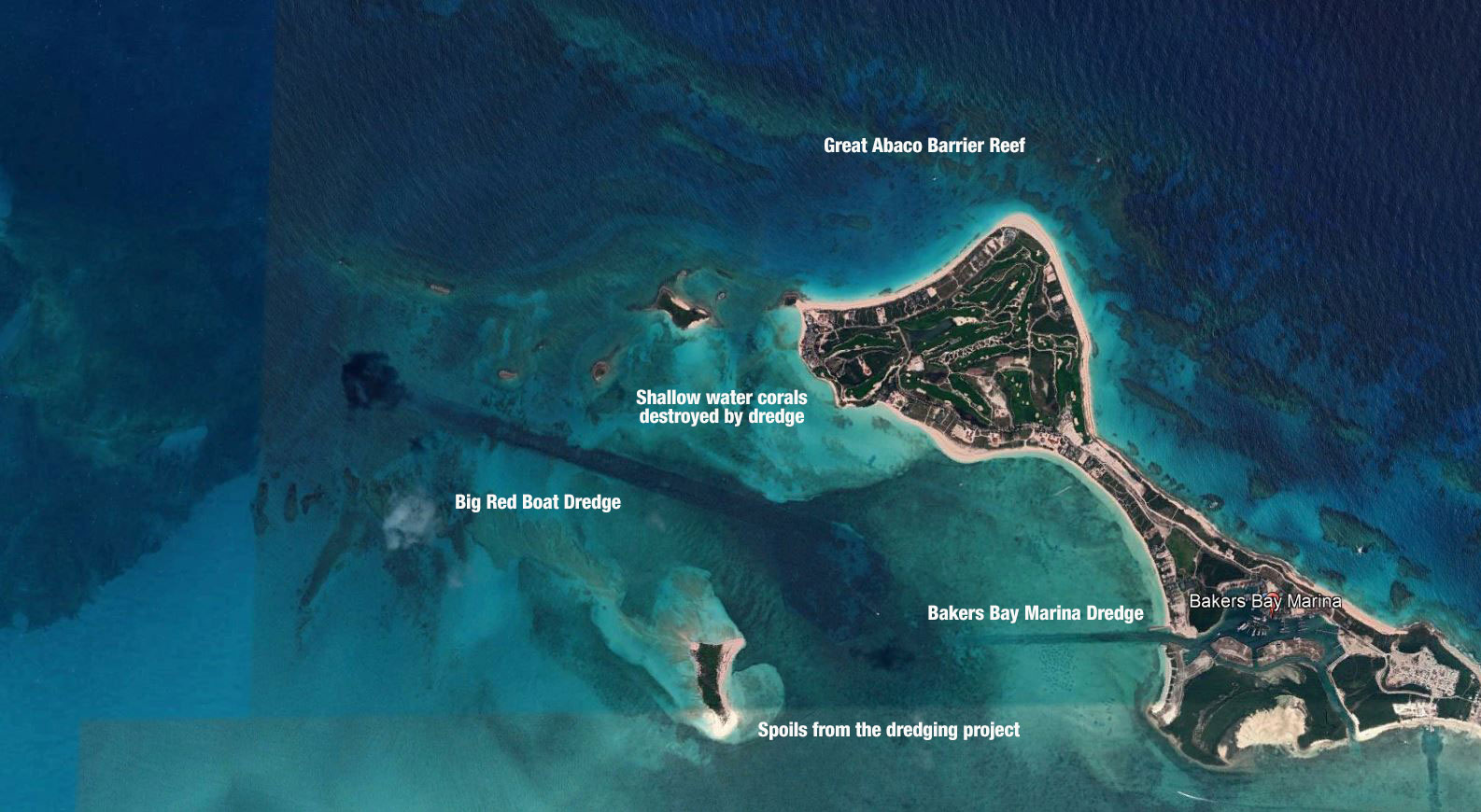
The deepwater dredge project, designed to allow The Big Red Boat access to Treasure Island, is a broad scar, visible from space. The small island directly south of the dredge line is the spoils. It is now an island in its own right, and is visited by tourists looking for shells. The turquoise water surrounding this island helps explain how much this dredging project altered this coral reef critical area.
Abandoned by Disney
Some claimed the dolphins were well treated, but anybody who saw their plight after the Big Red Boat left knew that lines had been crossed and budgets cut.
Disney did leave. They gave up because the dredge just didn't cut it, the narrow deepwater channel through the channels remained too narrow, too shallow, for the safety of the massive Big Red Boat.
When they left, they left everything behind.
They left the thatched bar area, and the bathrooms, and the basketball court. They left the amphitheatre and dock. They left cans of oil, and metal garbage.
They also left the dolphins.
In my teens, I motored out to the north end of Great Guana Cay with my mom and a buddy who took SCUBA certification lessons with me years ago. We planned to do some snorkeling on the reef, but the motor gave out, and we had to drift to the beach on the quiet, remote Atlantic side of the island's north end.
The Abaco native who was hired to watch after the abandoned property shook his head when I asked about the dolphins. He squinted in the sun and told me not to look at them.
Soon, Disney leased a nearby island and scrapped paradise for a former cocaine-runner pit stop, and they renamed it Castaway Cay.
The dolphins were beaten by the sun, bruised, and finally quarantined to loneliness in tiny enclosures in the baking sun of shallow, dredge-silt water.
Some lived, and were eventually shipped off to Freeport or Nassau. But nobody noticed, because the plastic and spare parts of Treasure Island, abandoned, had already begun to break apart, and collapse as the native Caribbean pines and Australian casurianas overtook the Middle Eastern palms.
The Bahama Islands is associated with a kind of post-slave culture, which is true, in part. But the Bahamas is settled by blacks, and loyalists - those American Brits who sided with the Empire and then fled, and a fair number of Haitians, and other assorted Caribbean Latinos. The shame in all this is, of course, that there once existed another people. Enslaved, driven to extinction, the Lucayans were a brown race whose traditions and peculiarities are all but lost to history. At one time, they were Mongols, moving north through China, through Russia, and into Alaska. They settled in the Tundra and disbanded for New Mexico. They passed through the Isthmus, into South America, settled the Amazon Basin, and then rowed up the Atlantic and Caribbean coasts. They populated islands like Saint Lucia and Martinique until Carib Indians chased them north, to the much less hospitable Bahamas.
No other race, imagine an inception in the Rift Valley of Africa, to Mongolia, to Alaska, to the Amazon, to the Bahamas, in the history of humanity, had traveled so far.
This is the puzzle of the West Indies, because its culture is lost. What remains are people who never intended to be there. The blacks had been forced, or were freemen who pondered their political fate, the loyalists pushed out of America, the Haitians were escapees. The Lucayans themselves never wanted to be there. They were pushed into the northern Caribbean islands because of the ferocity of the Caribs, who wanted to eat them. The Spanish, upon asking them about scars on their bodies, received a reply that indicated they had been constantly attacked by the Caribs.
The Spanish, of course, decided to enslave the Lucayans and sell them. But this practice didn't last long. The Lucayans, so adverse to enslavement, just died, or committed suicide, or fell prey to European diseases. Always eating light; a mix of cassava and fish, the foodless holds of the ships to Florida were enough to kill them and their already empty stomachs. One Spaniard noted that you could find your way from the Bahamas to Florida by the multitude of jettisoned Lucayan bodies floating in the sea. It was said that Lucayans, chained by their neck in a long column, would be decapitated when they began to tire, leaving a lifeless head attached to a column of people already committed to their own deaths.
The extinction of the race was quick. There is no Lucayan blood in any living human. Just a small footnote in the sorry-excuse-for-a-conquistador Spanish massacre of the entire Caribbean, which was said to have eliminated between 500,000 to 13 million people.
This is an awful shame, considering the Bahamas is the center of the Earth.I have heard many places named the center of the Earth. New York, London, Paris, Beijing, Tokyo. But only the Bahamas is the actual geological center. This is precisely where Pangaea - the original sole super-continent, broke apart into the seven continents. The Bahamas is the unlikely beginning of land.
Tourists in Bahamian hotspots - you know, Nassau, Freeport - seem to come back with the same story; 'the service is horrible, Bahamians are assholes, everything was forced on us.' I cringe at this, since I spent two years of my life here, and consider Bahamians like anybody else, anywhere in the world.
Tourist centers, in the Bahamas, in Mexico, wherever, are all the same. Bad service, poor manners, all that, is hardly a reflection on the people. It is a reflection on the tourists themselves. Through their rudeness, their willingness to over-tip, or become enamored with something commercial and unrepresentative, bring a place starving for business to a worse fate - a scavenger's fate.
But tourism doesn't need to be a bad thing. That poor American - two weeks of vacation and no obligation to the in-laws in Delaware - needs a place to relax, to kick back. He's worked his whole year for something like Nassau or Freeport. A clean beach, somebody to bring his wife a drink.

Laughing Gulls in flight in the Abaco Islands.
Travel writers like to distinguish themselves from tourists. They call themselves travelers, and insist they be classified in a higher light than Mr. Jones and his sun-hat. They balk at the meaninglessness of a tourist's relaxation. They laugh at the alcoholic concoctions that sell for ten dollars a piece. They insist that the traveler respects a culture, but that the tourist degrades it, makes it a pale and colorful imitation of their wealthier suburb.
But this is as nonsense as the tourist who brings down a Nassau or Freeport into a pale imitation of itself. Being a tourist does not make you wrong. It makes you in need of a bit of relaxation, end of story. There are rules which tourists should follow; among them respect, reservation, a good ear, a head enough to obey the ecological rules for a fragile place. These are the rules which preserve a place's cultural and ecological dignity - not the rules of Mr. Travel Writer, and his ego.
Jane and I are here for just that sort of thing. An empty place without other people, without anything much but ourselves. That is what makes the out-island Bahamas weird. In all of its brutal history, we can forget all that and enjoy a piney marsh of a place for what it is today - a blank slate with a lean-to infrastructure. There is nothing to do here; one over-priced restaurant, no gambling, no night-life, no gatherings, no parties. Just random people, local and not. But that brutal history - a history which Abaco fanatics easily forget - is essential to its future. Without precedent, how easy would it be to turn your head - like so many locals did when the dredging operation came to town.
Jane settles the wheel of the boat, throttle and trim, until the wake is cut tight, and the unreal aqua underneath a blur; the black spots - sea turtles, mackeral, barracuda, melt into the speed. We are cruising to Guana Cay, several miles from the Abaco mainland.

Threatened beauty in the Abaco Islands.
Now it's the year 2003, and Bakers Bay, once the dredging grounds of the Big Red Boat, looks somewhat like it once did. The Middle-Eastern palms are almost all gone. Those that remain are being choked by native plants and the ubiquituous casuarinas. The steel girders of Pirate Castle are leaning, as if about to fall over.
Around the north end of Guana, which faces its own barrier reef against the Atlantic, we motor hesitantly around the ravaged reef-heads and anchor in the sand. Anchoring means a mask, snorkel and thirty pounds of weight, which pulls you thirty feet down, to the sandy-edge of the reef-head. Jane is about to see the majesty of Guana Cay; the bounty of balloonfish and pipefish and parrotfish, corals, sea fans and rays. I am about to see the majesty of a reef a few years removed from a dredging operation gone bad.
Many of the corals are still dead - it will take a hundred more without Disney to get things back in line. But like proper justice, where the Big Red Boat failed, the reef has begun to flirt with its own resurrection. This is just a piece of the worldwide puzzle - a quarter of the world's reefs have already been destroyed by similar carelessness.
We had known each other our entire adult lives. We wrote letters - but friend's letters - just two lost people in different ends of America, with some sort of connection that never made sense. I first noticed her in German class twelve years ago. I was fascinated by her, and was surprised to find all those years later at a noisy dinner in Sacramento, and despite a dozen attempts from friends and mothers to get us on a date, that Jane was made for me. Or I was made for her.
Everybody has that one day in their life that symbolizes everything - your past and your future; your greatest accomplishment. For other people, it is not necessarily a day like this, in the drench-humid air of Abaco. That morning with the sun beating down, I asked Jane to spend the rest of her life with me.
What Happened to the Dolphins?
Nobody knows exactly what happened to Disney's dolphins at Treasure Island, but the best information I have is that they were eventually shipped off to Freeport of Nassau, and were in such bad shape that they died shortly after arriving.
There is a story recounted in Steve Dodge's Cruising Guide to the Abacos. Locals on Great Guana Cay actually released the dolphins from their enclosure, apparently in the cover of darkness. The dolphins, already habituated to enclosures, were later found and recovered in nearby Marsh Harbour.
Ransacked: The Sad Fate of the Treasure Island Property
The notes above were originally written in 2003. However, the following year, a U.S. golf course developer purchased the land and developed the entire Bakers Bay property.
Disney and Premiere's role in Treasure Island were used by the developer to claim that they were cleaning up the mess made by the former tenants. For the next 10 years, I argued here at Notes from the Road and in other publications that the claims made by the developer were a case of greenwashing, and that their development would cause much worse environmental degradation than Disney's relatively small footprint.
You can read about more about the Bakers Bay issue at my Guana Cay blog. This case study helps explain and debunk the claims the developer made about Disney's role in the island's fate.
Today, the Treasure Island property, now known as Bakers Bay Golf & Ocean Club, has:
- Replaced countless acres of vital mangroves with a golf course and marina.
- Terraformed the entire property into a densely-packed megadevelopment for the rich and famous.
- Poured years of fertilizer and nutrients into the ocean, further degrading the stressed reef.
Addendum: Notes on Disney's Abandoned Treasure Island
You've probably heard people talk about conservation...the natural resources of our vast continent are not inexaustible. But if we will use our riches wisely, if we will protect our wildlife and protect our wildlife and preserve our lakes and streams, these things will last us for generations to come.
- Walt Disney

Abandoned bar space, once used for cruise ship tourists aboard The Big Red Boat. Photo courtesy Ron Marvel.
Premier Cruiselines became the official Disney cruise line between 1983 and 2000. The company was formed from Greyhound Bus Company, and concentrated primarily on cruises to the Bahamas.
In 1995, Disney severed the relationship with Premier, and so Premier formed a relationship with the Looney Tunes characters, but without Disney, they quickly began to suffer.
The famous 'Big Red Boat' or 'Disney's Big Red Boat', was operated by Premier until 1993.
Both versions of The Big Red Boat (I and II) have been sold for scrap and no longer exist.
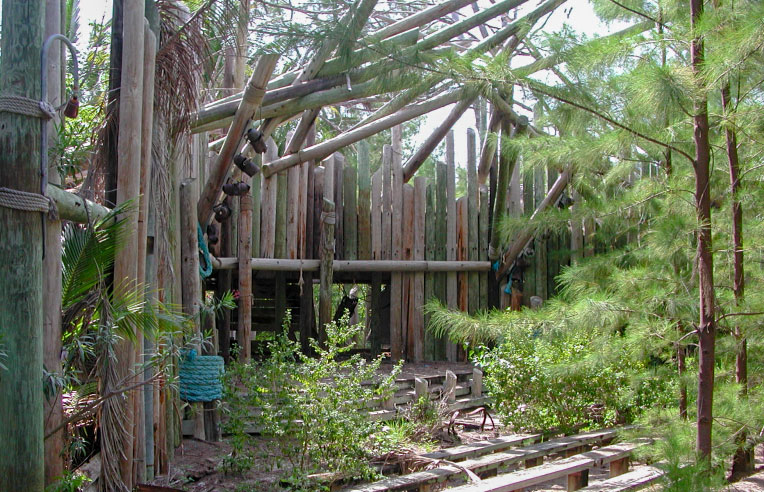
Abandoned theatre space at Disney's Treasure Island, now Bakers Bay Golf & Ocean Club. Photo courtesy Ron Marvel.
Notes on The Big Red Boat and the Dredge Project
Premier collapsed in September 2000.
Premier and Disney had a relationship which brought both of them to Great Guana Cay. The relationship caused environmental damage, but the story has largely remained untold. Disney seems to believe they are not responsible for what happened during this time. This page attempts to recreate the entire history of what happened on Great Guana Cay during the Premier and Disney days, so that researchers interested in this subject have a starting point.
When Premier came to Great Guana Cay in 1989, it was the first project in Abaco that met genuine resistance. Dave Ralph writes for the Abaconian, "The first development which generated some resistance was the arrival of the Premier Cruise Line to Baker’s Bay on the north end of Guana Cay in 1989. "
He continues, "Preparations included the dredging of a channel and a turning basin for the cruise boat. The world’s second largest dredge arrived in 1988 and began work. A small group of dissidents attempted to stop the dredge but were frustrated in their small boats by its massiveness. The discharge pipe extended a half a mile out the back and was immune to their picket line. A cutting head on the front extended 30 feet into the water quietly cutting the rock below. Court action to stop an operation of this magnitude was unheard of...As forecast by those with a knowledge of the area, the operation closed when the lease expired, and the company reviewed the lost days when weather closed the Whale Cay Channel."