

Mesa to Canyon along the Colorado Plateau
Twenty-nine hours, 1,348 miles and one copy of Heart of Darkness, on a frantic road trip across the desert plateaus of Utah and Arizona.
I left Los Angeles in the afternoon. I kept a copy of Joseph Conrad's Heart of Darkness on the dashboard, and occasionally, I read passages. Conrad's madness interested me.
I played the Doors song, 'The End', which I often play when I am on the road. It is Marlon Brando's theme song from "Apocalypse Now", Coppola's adaptation of Heart of Darkness. During the course of the song, Martin Sheen, as Willard, the film's Marlow, slays Marlon Brando's Colonel Kurtz. "The killer awoke before dawn, he put his boots on He took a face from the ancient gallery And he walked on down the hall." Somehow, however, I felt that Conrad's novel had led the public into some wild misconception about madness; of being from people who lived in far away places, in the woods; of Kaczynski and Jonestown and Waco and Wyoming.
I've seen people go mad. And they are no Mr. Kurtz. To me, it happens to ordinary city people, and it happens quietly. People live out their lives, going about their tasks, and one day they may even have a moment of consciousness. Their brain shuts down — part of it — as a way to protect themselves from their own miserable life. Madness, therefore, is a luxury; the ultimate Prozac pill to free yourself from the misery of your own reality.
The traffic on the way to Las Vegas was maddening. Seven hours in what should have been four. But like every other Friday night, Los Angelenos are saying, "Hey I know, let's go to Las Vegas!" Someone else will invariably yell out, "Veigas Bei-bee!" I despise the strip for its oily-faced latesleepers who smell of sour milk, and the ching-ching-ching of the smoky casinos, and the purple carpets and the stale gasoline-smelling air that just kind of hangs there. And I despise that unimaginativeness in Angelenos who could go anywhere in a five hour drive: San Jose. Rosarito. Phoenix. But every time, it's "Oh I broke even" and "They fed us free beer all night" and "Veigas Bei-bee!"
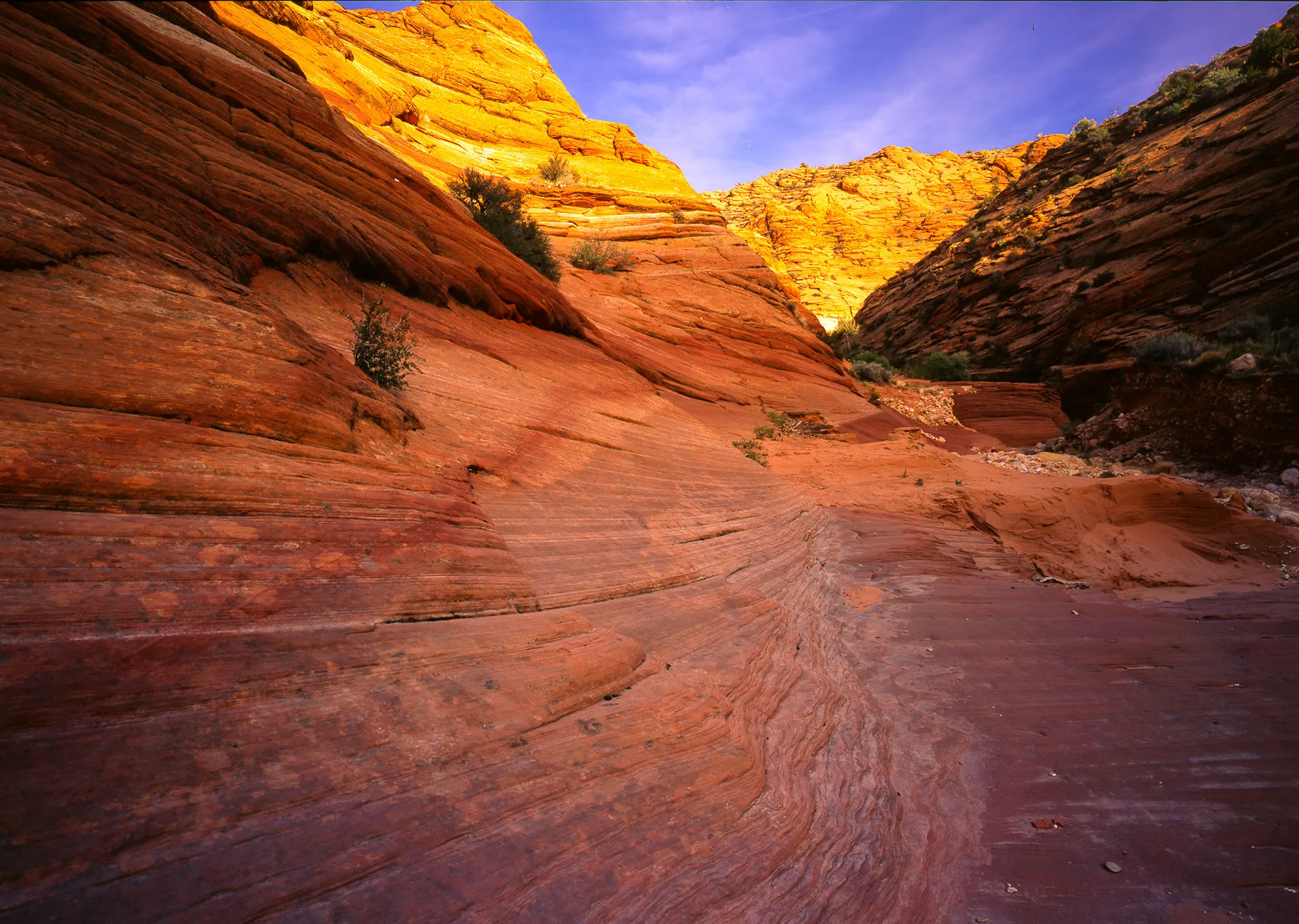
Buckskin Gulch
Drinking or Climbing
I sped through that wretched place, and stopped well past midnight in Mesquite, on the Arizona-Nevada border. I stayed in a quiet casino, and went for the bar.
A drunken chap stumbled in, and being that there were only two of us in the bar, we exchanged 'where are you from's?' and 'where are you going's?'
"Oh
so you are off to do some climbing," he said.
"Sort of. Do you climb?"
"Oh yeah. I used to climb all the time. Moab.
Moabi. Red Rock. Everywhere."
"You don't climb anymore?"
"I had to give up one or the other, drinking or climbing."
"Why?"
"Because I had some bad falls, almost killed myself."
"You
mean you drank and climbed at the same time?"
"Fuck
yeah. We all did. We grew up that way."
"So you chose to stick with drinking, huh?"
And he raised his glass, "Yeah, my friends still climb. John was climbing this cliff and he just passed out and it took two guys on the belay to hold him up."
"Why'd he pass out?"
"He was fuckin' crazy man; mixing pot and alcohol and other shit. Yeah, and my other climbing buddy was doing this ice face without ropes. He was all drugged out and he fell a hundred thirty feet and nearly broke every bone in his body."
"Did he live?"
"Yeah, he's living out of garbage cans in California just so he can climb
all day."
"So why are you here?"
"My brother-in-law. I'm helping him out. He's a horse jockey. Little guy.
We're on our way to a race."
"And all these people in this casino, are they from Utah too?"
"Yeah, most of them."
"And any mormons here?"
"About half of these people are mormons. They act all good and shit but they're just as bad as the rest of us." "And speaking of mormons, what happened last night?"
"Oh yeah, it was the genealogy center in Salt Lake. Some schizophrenic seventy year old went berserk and killed and wounded all these people. And the funny thing is, some guy drove all the way down from Alaska to bitch about how they fucked up his genealogy records and the SWAT team blew a hole through his truck thinking he might be the man. You know what he said to the TV camera? 'I ain't never come back to Salt Lake again!' But you know, Salt Lake gets a bad rap for this shit, man. We got the good outdoor stuff. L.A.'s got the good clubs and bars, but we got the good outdoors, and our women are twice as good looking."
"In Utah?"
"Yeah, man. Maybe its all the inbreeding, but I swear to god."
"Then what
does it matter if our bars are better?"
"Yeah, I guess so."
The River Paria Called
I parted and in the morning I was driving through the northern tip of Arizona; this section was always my favorite from Jesse and my trips back and forth between California and Minnesota. One early morning, maybe 4:30 AM, I was half asleep in the passenger seat; I looked out and saw two beautiful long-tailed blue birds with intricate markings. "Jesse, look at those birds!" I said and fell back asleep. 40 miles later, at a rest stop, Jesse said, "Erik, hey you better come take a look at your grill." And there they were, two blue birds cropped — splatted maybe — in perfect harmony against my grill, wings still spread. We argued for some minutes about who would take them off. "It's your car!" "You were driving."
After a while, we found a 10 foot stick and scraped them off. Plop, plop. Soon, I was in Zion Canyon; steep cliffs and deep canyons and twisted pines and rivers and striated buttes. It was — maybe — the most beautiful place I had ever been, ever. But I didn't stop.
The river Paria called, and I remember Conrad droning on about the lure of the Congo. I drove on past the Coral Pink Sand Dunes and into our newest national monument; the gigantic Grand Staircase-Escalante. The Grand Staircase is actually a term referring to the northern steps of the Colorado Plateau. Over millions of years, the iron in its ancient sands and muds rusted, staining the rocks of the Triassic and Jurassic in varying shades of red. The Colorado Plateau is an uplifted plain from Zion to the Rockies. The layers from those red ages tilt gently north, and erosion has worn their edges back into steps, the harder rocks standing as cliffs.
The top step of the Plateau is Bryce Canyon, carved from the Pink Cliffs. After that come the Grey Cliffs, and then the White Cliffs of Zion Canyon. After that it's the Vermilion Cliffs and the Chocolate Cliffs before, finally, the Grand Canyon. In the middle of all this chaos is the Paria River, at the heart of the Bureau of Land Management's Paria Canyon-Vermilion Cliffs Wilderness, which straddles Utah and Arizona beside the Grand Staircase-Escalante National Monument. Really, it's a free-range cattle country, and from the road, doesn't look like much.
For some time however, I had looked at the topo-maps of the Colorado Plateau; following the long snake-like route of the Paria. Twisting, writhing and lashing until finally it settles and meets the Colorado at Lee's Ferry, where Glen Canyon ends and the Grand Canyon begins.
I had read about it and studied the different types of lizards and rattlers and scorpions who thrived in it, and about the people who had died there; trapped in slot canyons to face a wall of flash flood water — 50 feet high, and how the cattle fell into its canyons, and drowned in its quicksand.
I drove on, miles from nowhere and when the land was scorched with toppled boulders and balancing hoodoos and mushroomed cliffs in pink and mustard and orange, Paria made itself known — a rather insubstantial trickle of a river. A creek really.

Lower Antelope Canyon, a quarter mile of contorted, smoothed rock shaped by thousands of years of flash floods.
A Log Fifty Feet Up
Five miles from there and I pulled off on an unmarked red dirt road and followed it for an hour as it followed a valley floor; a hundred foot cloud of dust following in my trail. I stopped at a small clearing. 'Wire Pass', was written on the BLM post, so I knew I had landed. I read a passage from Conrad and marked it,
"Watching a coast as it slips by the ship is like thinking about an enigma. There it is before you — smiling, frowning, inviting, grand, mean, insipid, or savage, and always mute with an air of whispering, 'Come and find out.' This one was almost featureless, as if still in the making, with an aspect of monotonous grimness. The edge of a colossal jungle, so dark-green as to be almost black, fringed with white surf, ran straight, like a ruled line, far, far away along a blue sea whose glitter was blurred by a creeping mist. The sun was fierce, the land seemed to glisten and drip with steam."
My backpack was heavy, my tripod and equipment bag were heavy too, and it was hot, blistering hot, and I walked down a desert wash, with cactuses and junipers rising above me, and as the floor descended the two miles toward a mess of rocks and cliffs, the insects thickened. Flying black beetles, moths, deer flies. Buzzing. Buzzing. And some crawled, like the lizards. In the stillness of the air, you didn't only see the lizards, you could hear them pulling their tails along the red sand. Thhhh. Thhhhhh. Thhhhhhh. In time, the wash narrowed until small ledges of red stone, sandwiched it, and soon the stone was overhead, a hundred feet overhead.
The temperature dropped by twenty degrees and it became dark. Soon, as I continued down this dark slot canyon, there was no direct light, only the amber cast of warm tones on the grey and pink walls. These walls became narrower, as I descended. Soon, I was removing my backpack and squeezing myself and equipment through, or walking sideways, tiptoeing. When the tight corners gave way, I found myself on a 10 foot ledge, and I said "Forget this." but the Canyon echoed back, "Forget this, forget this, forget this." And it made me think; well maybe there is a way back up that 10 foot wall? And I said, "Screw it." And the canyon echoed back and I threw my pack and followed with a jump and a fall. Oh the Sweet Paria.
I edged around another dark corner, now wearing my flashlight. I saw a giant log wedged between the canyon walls — 50 feet above me. That made me realize that I was now miles from escape. If it rained, even 50 miles from here, those same floods that crammed that tree 50 feet above me would come roaring down. In time, I crossed into the sunlight; a triangular trough and the convergence between the Wire Pass and the Gulch; the two slots that wind into the Paria. Although the convergence was enclosed by 200 foot cliffs, it was sunny here, and there were green trees.
I drank water on a grassy plateau, and entered the gulch. This slot descended to 500 feet under its cliffs, and it was narrow. Soon, there were patches of water. When they became impassable I took off my boots and waded through them at knee length. The water stank of dead animals, and was a sinewy brown, so I was glad to be on sand. My feet, however, began to sink, and I realized that this was the quicksand the rangers had warned about.
It was mild, and slow moving, so I was able to pull myself out with little problem, and continued on. The Buckskin Gulch was a beautiful slot canyon of changing colors and striated lines and waves.
I turned around in the early evening, tired and dreading the weight on my back. My nose was bleeding as I climbed back through the slot canyons. I stopped frequently for water, changing the angle of the pack on my back. 6 miles to the Wire Pass trailhead and I remembered Mr. Kurtz, dying, "The horror. The horror." Out of the bug-infested slots, I dropped on the sand, I had known I was unfit for this. "Experienced Canyoneers Only" said the outfitting guides. My nosebleed dripping in the sand.
But I also knew that I would do it, and I would make it. So I sat there, drinking water and chewing on my last bagel. When I returned to the jeep, there were two cars parked next to mine. Hikers were there drinking beer, and I talked with them about tripods and dust and then I was off, south, and then east along the edge of Utah's southern border, to Arizona, and across the Colorado River to Page, where I stayed overnight.
A Ladder into the Dark
In the morning, I awoke well before the 5:45 alarm, and left for Navajo country, to the East, and made my way up some district roads to a small turnoff, with a view of Lake Powell to the North, and a vast expanse of nothing to the South. Here it was, Lower Antelope Canyon, the most notorious of the slots.
I parked along the road, there were no signs to indicate this was Antelope Canyon, but I could see the fissure in the distance. There was a red Jeep parked there, and a man reading a map. I knocked on his window and introduced myself. "It looks like the Navajo Guide decided to sleep in this morning," he said. "It's still early." We waited some time. I liked this man right away. He was a photographer in his 50's, had driven here from Georgia on a month-long trek across the West. We talked maps, and places, and then we saw a trail of red dust in the distance, the Navajo Guide driving across the sand in a blue truck.
We followed him a ways and introduced ourselves, paid him the fee, and he listened to the weather, and pointed to the fissure.
I knew why he listened. Two summers before, on a sunny August afternoon in 1997, a guide named Pancho Quintana led a handful of tourists down into this same canyon. Other visitors went in too, twelve people in all. Somewhere out on the plateau, miles away, a thunderstorm was dropping heavy rain, and the Weather Service had a severe storm warning out. People still argue over whether anyone at the entrance warned them clearly enough.
A little after four o’clock, the water came: a wall of mud, logs and brush, by some accounts more than ten feet high, pouring through a slot with nowhere to climb. Eleven people died, seven from France, one from Britain, one from Sweden and two who lived in the United States. The flood carried some of them miles, toward Lake Powell. Searchers dug through the debris at the canyon mouth for a week. Two were never found.
Quintana was the only one who came out alive. The water stripped him and beat him against the rock, and then, somehow, it let him go.
Standing there on the sand that morning, under a clear sky, I looked at that thin crack in the earth and understood why our guide had listened to the weather.
We walked up to it; it was a one foot slit in the earth — and below, blackness. I said, "Where do we enter?" and the photographer said, "Obviously not here." A better inspection and I found a ladder hanging off the edge of the fissure. "Here it is," I said, looking into the darkness. "You first," said the photographer. He followed me in, and we descended. Lower Antelope Canyon was a wonder; although dark and cold, it was also a tangled display of contorted, smoothed rock angling in every direction; every foot a composition of anarchy, of thousands of years of flash floods.
We climbed its quarter mile length, walking parts, dropping or climbing others. In an hour, we were at the end. We stayed there for hours, and met up near the entrance. I said, "You want to do the Upper?" He said, "Absolutely." While he cleaned his gear by our Jeeps, I wandered the area, looking at desert wildflowers.

Upper Antelope Canyon, much smaller than the Lower canyon at about 200 meters, and a testing ground for photographers taking half-hour exposures.
"Thanks for all the tips on the Gulch," he said, and soon we were sitting in the open back of a truck as it pulled along a sand valley. The Navajo guide dropped us off at the Canyon entrance, chatted with us a while, and then left. Upper Antelope was much smaller — about 200 meters, but it was beautiful. There were 4 or 5 photographers already in the canyon. Antelope, it seems, has become the landscape photographer's ultimate exposure challenge. Half hour exposure times in dark variable light. A good testing ground, I guess.
The Turtle Means Nothing
In an hour, the Navajo guide returned for us, and shuttled us to our Jeeps, showing us pictures and talking about schools and cooking and canyons. I parted ways with the photographer, having spent hours talking about Utah and Oregon and Greece and the Virgin Islands, exchanging business cards, and I headed south from the Glen Canyon Dam along the Echo Cliffs, stopping at a roadside stand of Navajo jewelers to look at jewelry for a friend. There were dozens of carved animals. "This one means eternal life" she said. "And this one is peace and lightness"
"And this one here is courage," she said, explaining Navajo religion.
I pointed to the turtle. "What does that one mean?"
"Nothing," she said.
"I'll take it."
I liked the Navajo people from my brief meetings, not because you are supposed to like Indians, but because they had that Midwestern joviality, and they were listeners, too, and seemed interested in other places and different people and liked to tell stories. When this Navajo lady tried to sell me jewelry with her knowledge of mysticism, I thought back about all those travel writers talking about Navajo spiritualism, and I couldn't help but get angry. I thought: They fell for the jewelry lady's bullshit. I crossed the Colorado on a grand bridge, and drove the way to Lee's Ferry; and hiked the confluence point of the Paria and the Colorado. Then I travelled on, to the Balancing Rocks, I hiked into a wide canyon, watching the Vermilion Cliffs shining in the afternoon light.
I heard a noise, like a droning city sound as I kneeled by a thicket of flowers. I looked up. In the absence of wind, it was the wingbeats of a raven echoing across the canyon. I continued along the Vermilion Cliffs, and drove up into the Kaibab Forest, nearly 8,000 feet high, looking back over the whole Grand Staircase toward Bryce, and I hiked down a cliff, looking at cacti and Indian Paintbrush and gnarled pines. Soon, I was in Fredonia and at 5:30 the next morning, I was up and on my way to Zion Canyon, where I hiked the rocky mesas and plateaus after sunrise; traversing the lower portion of Checkerboard Mesa, and into the canyon itself.
By evening, I was doing the last length of the 1348 miles and 29 hours of driving. It made no sense really; not my water temperature gauge or the 'Notes from the Road' or why my back wasn't sore. It was, at best, random, all this. People live out their lives, going about their tasks, and one day they may even have a moment of consciousness. Their brain shuts down — part of it — as a way to protect themselves against 'Melrose Place' at 9:00 PM and the alarm at 7:00 AM and the drone of the dishwasher, and their own misery and I knew that I was not mad. I drove into Manhattan Beach with its green grass, salt air, the smell of grilled food and the radio playing.
Since Then
I made this trip in April 1999. A few things have changed since.
The Grand Staircase-Escalante is no longer our newest national monument, and it may not survive as one. In 2017, President Trump cut it nearly in half, along with Bears Ears, created the year before on the other side of the Colorado. In 2021, President Biden restored both. Then, in July 2026, in his second term, Trump cut them again, this time by about ninety percent: the Grand Staircase from 1.87 million acres to about 181,500, and Bears Ears from 1.36 million to about 121,000. In September, the land taken out of the monuments opened to new mining claims and to oil, gas and mineral leasing, and the proclamation moved to dissolve the Bears Ears Commission, which had given five tribes a formal role in managing that monument. Conservation groups and tribal organizations went back to federal court that same month.
The year after my trip, the Paria Plateau and the Vermilion Cliffs south of the Utah line became Vermilion Cliffs National Monument.
Wire Pass and Buckskin Gulch now charge a day-use fee of $6 a person, and an overnight trip into the Paria needs a permit.
You can no longer knock on a stranger’s window at Lower Antelope Canyon and wait for the guide to wake up. Both Antelope canyons are now visited only on tours with authorized Navajo guides, most tours ban tripods, and steep metal stairs now lead down into the Lower canyon.