
Desert Southwest Sketch Journal
Field sketches and illustrations from the American desert—an ongoing sketch journal.
Cuban Cafe from New Mexico
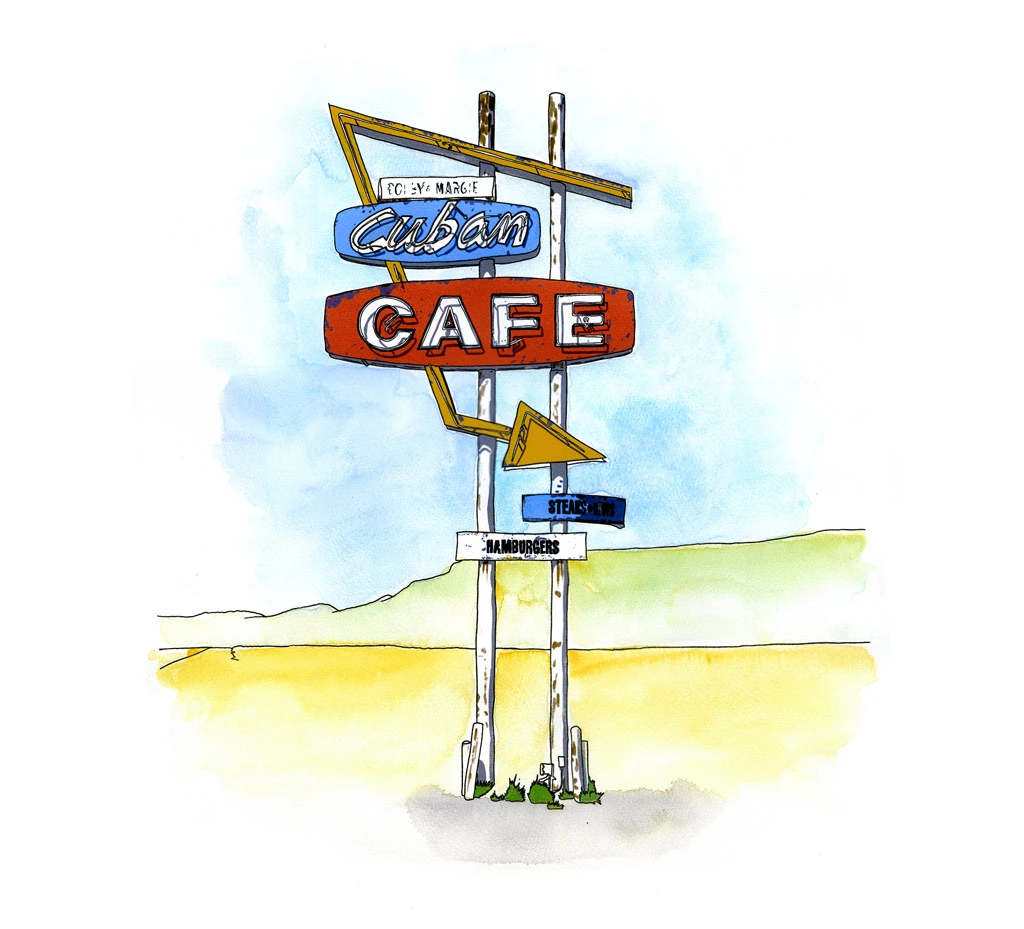
Cuba, New Mexico sits along U.S. Route 550 between Monument Valley and Farmington — a high desert village of maybe 600 people, with the San Pedro Mountains on one side and the Navajo Nation on the other. I noticed this Cuban Cafe sign there while traveling from Monument Valley to Farmington, and pulled over.
The sign dates to the mid-20th century. It was part of a wave of primary-colors roadside architecture that followed the expansion of paved highways across the American West. It was probably created in the late 1950s and is an exemplar of the Southwestern Googie style of the time.
Cuban Cafe operated for decades as a stopover for travelers heading between Albuquerque and Farmington, serving a mix of locals, oil field workers, and long-distance drivers. It is now called Ed’s Cuban Cafe. And like the original owners, the new cafe owners serve Cuban and Miami specialties like Cubanos. The sign remains, outlasting the original business it once advertised, and continuing to mark the roadside in a way that newer construction rarely does.
Sky Ranch Motel in Las Vegas
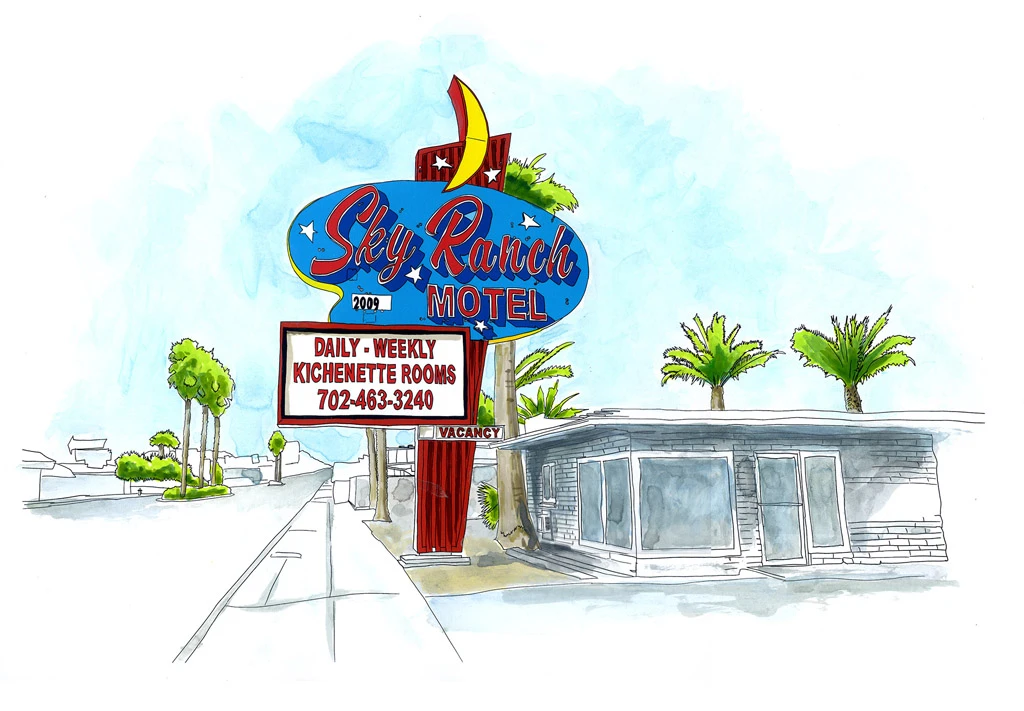
I sketched this lovely example of a midcentury Googie-style roadside sign a few years ago. At the time, I didn’t realize that it would soon be gone, and that these Atomic Age icons of speed, futurism and spectacle are disappearing across the southwest.
Shortly after I made this sketch, the property was rebranded by Rodeway Inn, and the sign was replaced with a simple, functional Rodway Inn sign. Across the desert Southwest, this is happening again and again. Midcentury neon signs, many rooted in Googie and Atomic Age design, are being removed, replaced, or flattened into uniform branding. What disappears in that process is the very character that has defined the southwest. These signs were part of the roadside itself, shaped by distance, light, and speed. As they are replaced, the Southwest becomes more uniform.
El Porto Motel Sign from Beatty, Nevada
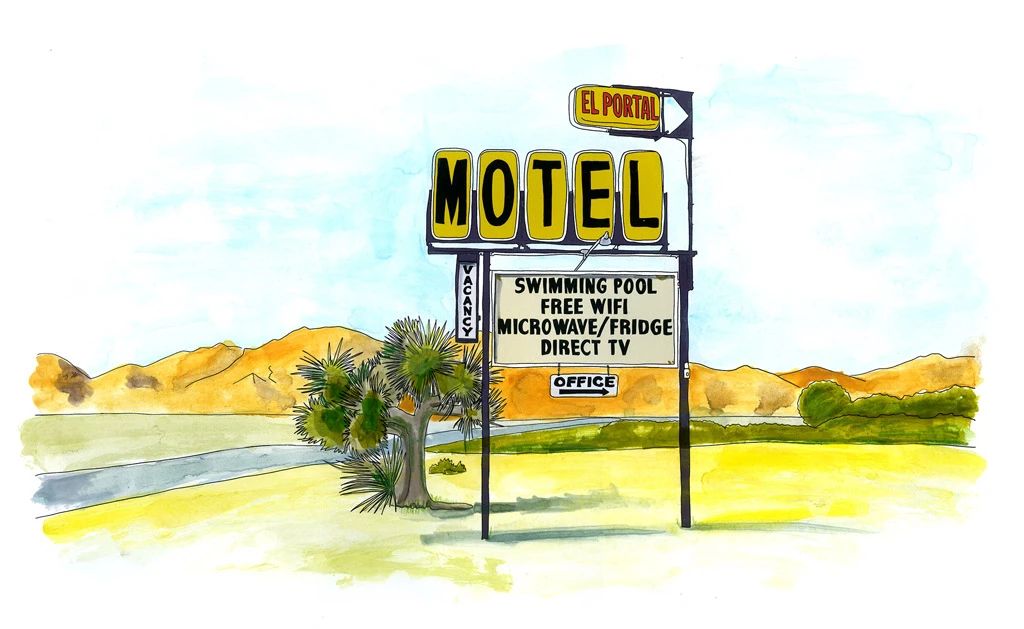
The El Portal Motel sign in Beatty, Nevada belongs to a later phase of roadside design, when the expressive forms of midcentury neon began giving way to something more practical. The stacked "MOTEL" panels, the changeable reader board, the stripped-down pole — these weren't built to impress. They were built to last, to be swapped out panel by panel, letter by letter, by whoever was around with a ladder.
Beatty itself is a gateway town at the edge of the desert, where traffic comes and goes with the seasons. Motels like El Portal were built to serve that flow, rather than stand out. Despite that, this later era of desert signage has its own weathered charm. Still, it marks a transition, perhaps of the uniformity and commercialization of the 1980s. In other words, it's the kind that defines the landscape once the more stunning Atomic Age ones begin to disappear.
Siesta Motel from Durango
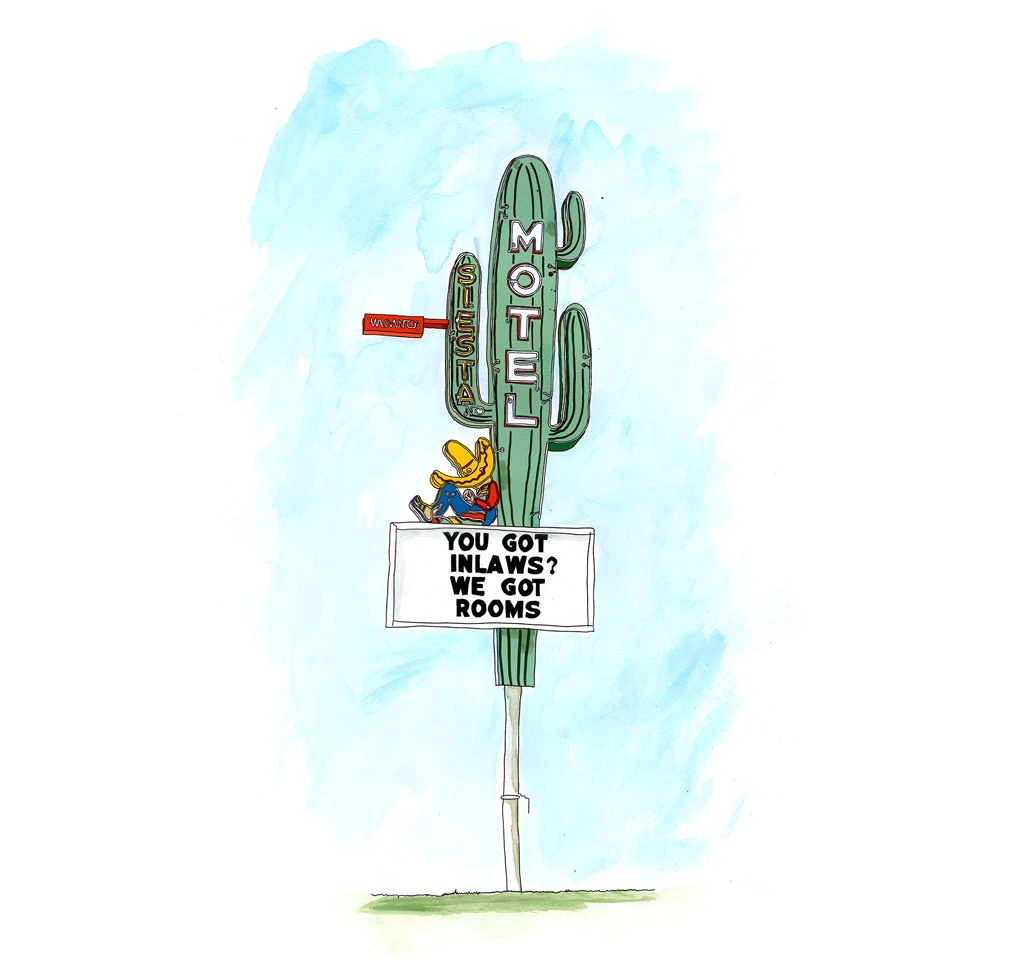
The Siesta Motel sign in Durango, Colorado is one of those midcentury roadside survivors you don't expect to find still standing. The motel dates to the 1950s, and its cactus-shaped neon sign speaks the same Atomic Age, Googie-inflected language that's been quietly disappearing across the Southwest for decades — the bold forms, the playful exaggeration, the conviction that a sign could be a kind of sculpture. That vocabulary is nearly gone now. The Siesta is one of the last places you can still read it in full.
What kept it alive was probably the simplest thing: the property stayed locally owned, and somebody kept caring. The sign wasn't swapped out during a rebranding, wasn't simplified down to a backlit rectangle when the old tubes started going. It was maintained, and when it needed more than that, restored. It still does what it was built to do — mark a place, pull a traveler off the road — and it still looks like itself doing it.
That's rarer than it sounds. Most signs from this era ended up in one of two places: the dumpster or the museum. The Neon Graveyards of Las Vegas and Tucson are full of signs that were saved by being removed — protected, but cut off from the roadside life that made them legible. The Siesta never got relocated to a gravel lot with interpretive placards. It stayed put, still attached to the business it was built for, still earning its place on the strip. That's not preservation in the archival sense. It's something harder to pull off — continuation.
Strip 91 Motel Sign from North Las Vegas
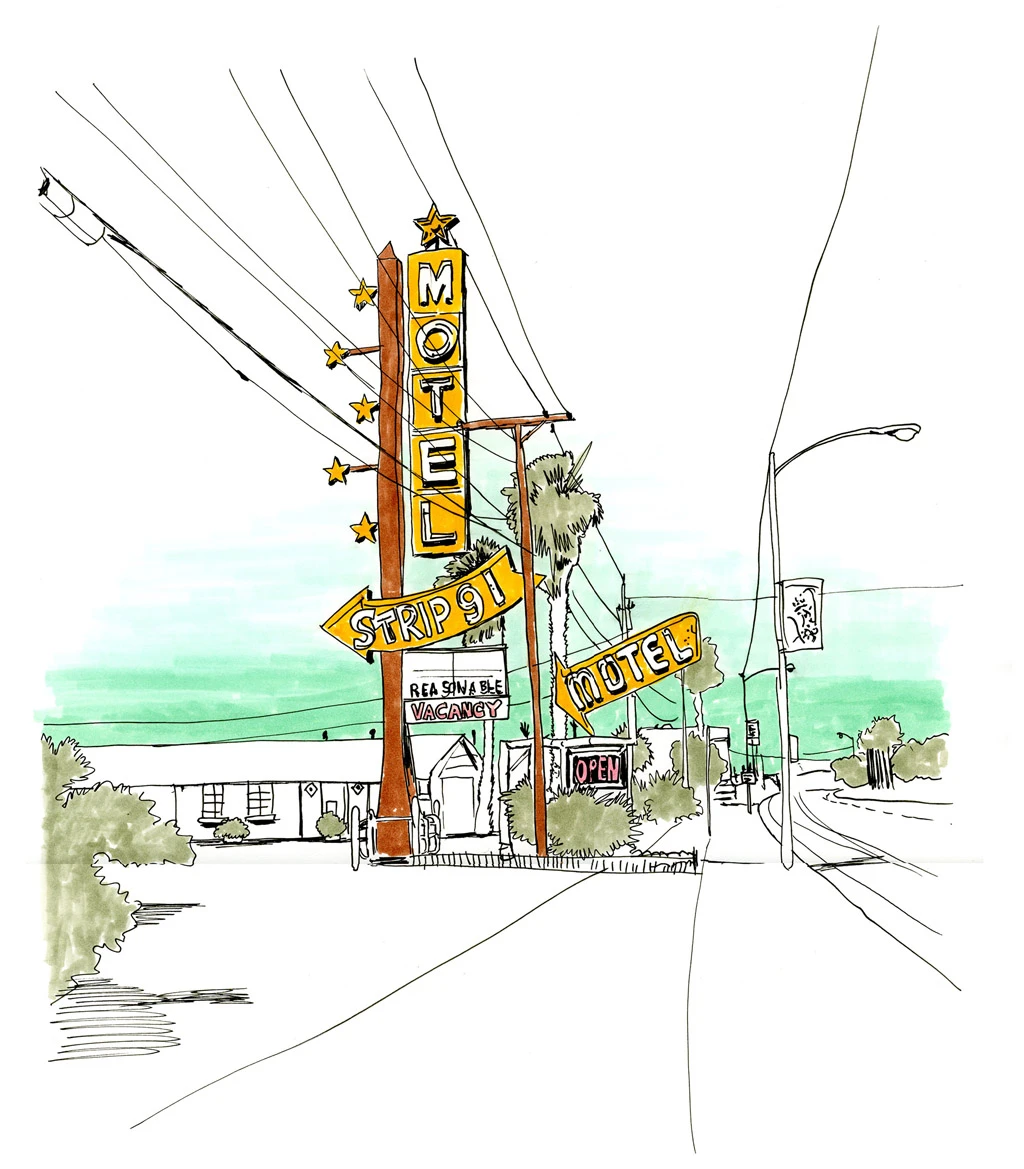
The Strip 91 Motel was part of an earlier Las Vegas, before the Boulevard became what it is now. Built in the 1960s during the city's northward push along Las Vegas Boulevard, it sat at 2091 North Las Vegas — outside the formalized Strip corridor, in the stretch where the road was still just a road. The travelers it served weren't casino-bound tourists. They were long-haul drivers, workers, people moving through the edges of the city with somewhere else to be. The sign knew its audience: vertical lettering, starbursts, angled arrows pointing toward vacancy, everything calibrated to be readable at speed from a moving car.
It wasn't trying to compete with the casinos downtown. The design drew from the same midcentury visual vocabulary — the starburst accents, the stacked "MOTEL" panels, the directional signage angled just so — but worn down to essentials, stripped of the extravagance. What it had instead was a quality you see in a lot of these smaller roadside properties: the look of something assembled rather than designed, added to over the years as the business shifted, each piece doing its job without much ceremony. Signs like this weren't built all at once. They accreted.
The motel was demolished in 2014, absorbed into the ongoing redevelopment of Las Vegas. The sign went with it. What's left is the record — photographs, fragments, and in this case a sketch — of a type of place that once lined every road into the city. These weren't landmarks in any formal sense. Nobody put them on the register. But they formed a continuous layer of the landscape, the texture of an approach, and as they come down one by one, that layer gets harder to see — not lost all at once, but thinned out, until one day you're driving in and the road looks like it was always this way.