
Four Seasons of Joshua Tree
From downtown L.A. to a desert where nothing seems to change, and everything has.
Updated October 3, 2026
We drove down Grand Avenue on Bunker Hill in downtown Los Angeles. Just a week before, it was reported that a new fault line crossed directly below. I suspect this news to have little impact on the city.
We drove under a movie set; the same sterile gray and silver stretch filmed in the movie Heat. We left for La Verne. People here wear plaid; and at the lunchtable across from us, a group of fortysomethings talked art and science. A sign that we are no longer in L.A. In a few hours, we were in the Mojave; Joshua Tree National Park.
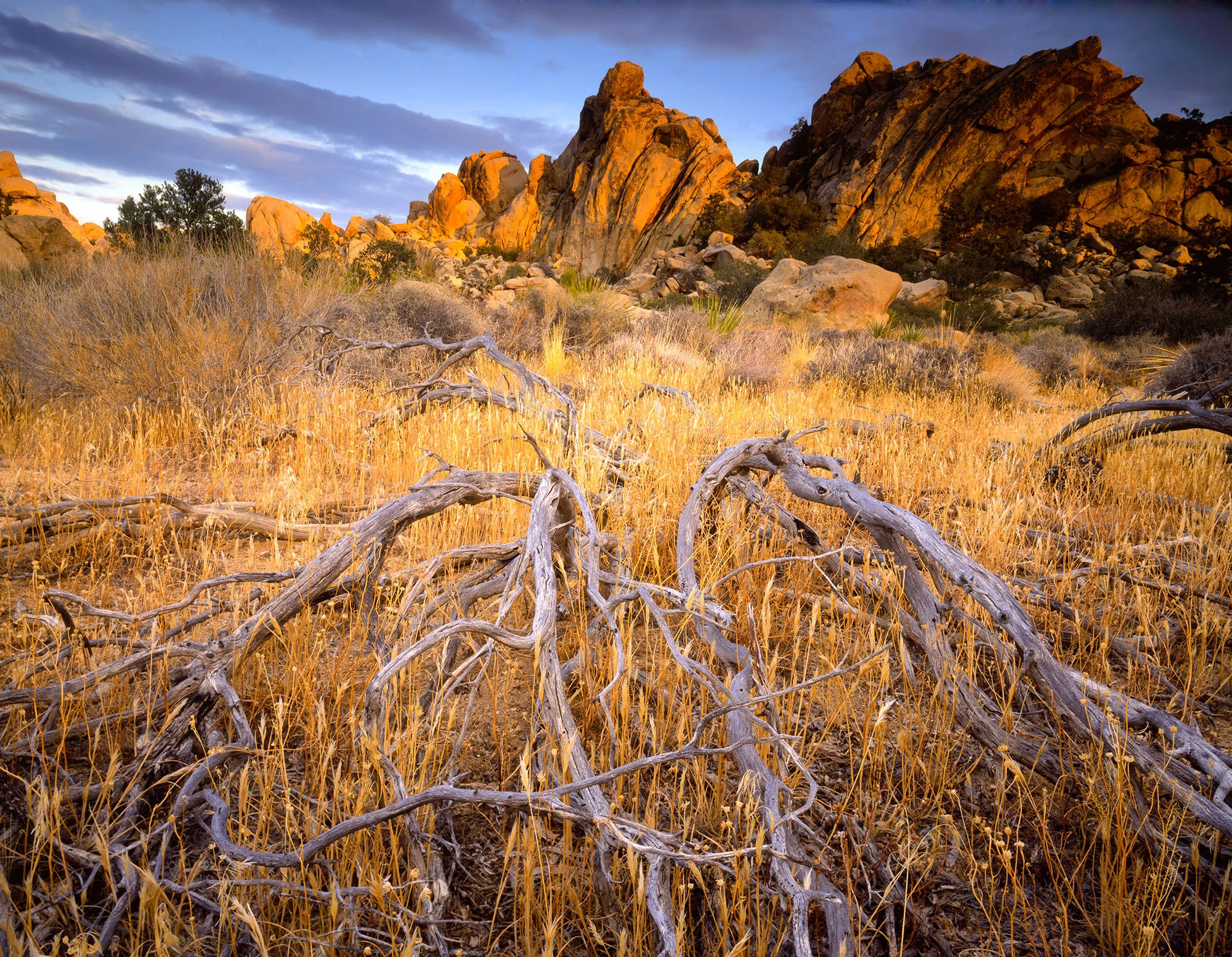
We played Vivaldi's "The Four Seasons." Perhaps this was inappropriate. There are no seasons here. In fact, nothing seems to ever change in Joshua Tree. Everything here has the feeling of a lost relic from the prehistoric. Granite monoliths piled awkwardly, every plant gnarled or brown. In the case of the Mojave Yucca, or its cousin, the Joshua Tree, perennially green, but twisted and contorted and cartoonish. Dr. Seuss has gone mad.
But the feeling that nothing has changed here is hardly true. Eight thousand years ago, people camped along a slow river that wound through the Pinto Basin, grinding seeds and hunting where there is now only sand; their ancestors had walked out of Asia, across the land bridge, thousands of years before that. Before them, in the last ice age, mammoths, camels and horses grazed a cooler, greener Mojave, and their bones still turn up in the washes.
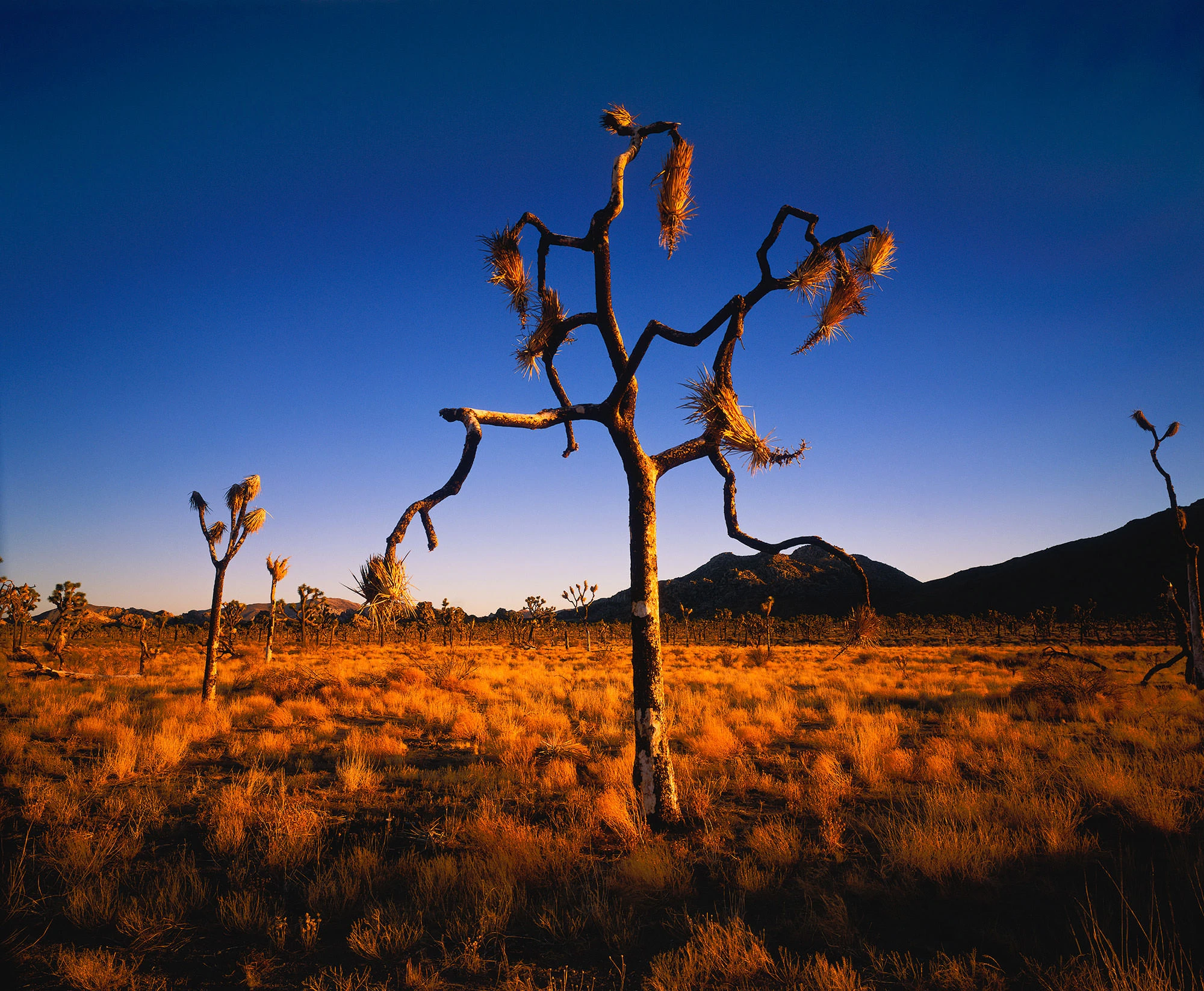
Dead Joshua Trees in Joshua Tree National Park.
Long before any of that, a hundred million years ago, magma pushed up beneath layers of older rock and cooled slowly into granite, miles underground. Time shifted the top-layers away and left these strange structures beaming in the wind. The feeling that I get of unchanging land is, I recognize, nearsighted.
The Last Fortieth of a Second
As a species, we tend to see history in terms of 5 generations, with a heavy concentration on the one in the middle. But if you take the story of creation as a parable for the history of the world — Monday and Tuesday are what God used up to get the world going. Life began Tuesday, around noon.
The anarchic beauty of it all unfolded over the next four days. At one-fortieth of a second before midnight, the industrial revolution began. So quick to elect ourselves God's rightful heir and master of all living creatures; it's strange how we view our existence as a natural establishment of Darwin's theory. In fact, there have been five great extinctions over the history of the world; the worst of them wiped out more than ninety percent of all species.
But those unfolded over thousands or millions of years. The sixth is happening in that last fortieth of a second. We have cleared, plowed or paved somewhere between a third and a half of the Earth's land, and cut Brazil's Atlantic Forest down to less than a tenth of what it was. We take a quarter or more of everything the world's plants grow each year, and more than half of the freshwater we can reach. Species, in fact, are dying between a hundred and a thousand times faster than normal. A little respect for God's creation, some common sense and some sound economics can reverse all this.
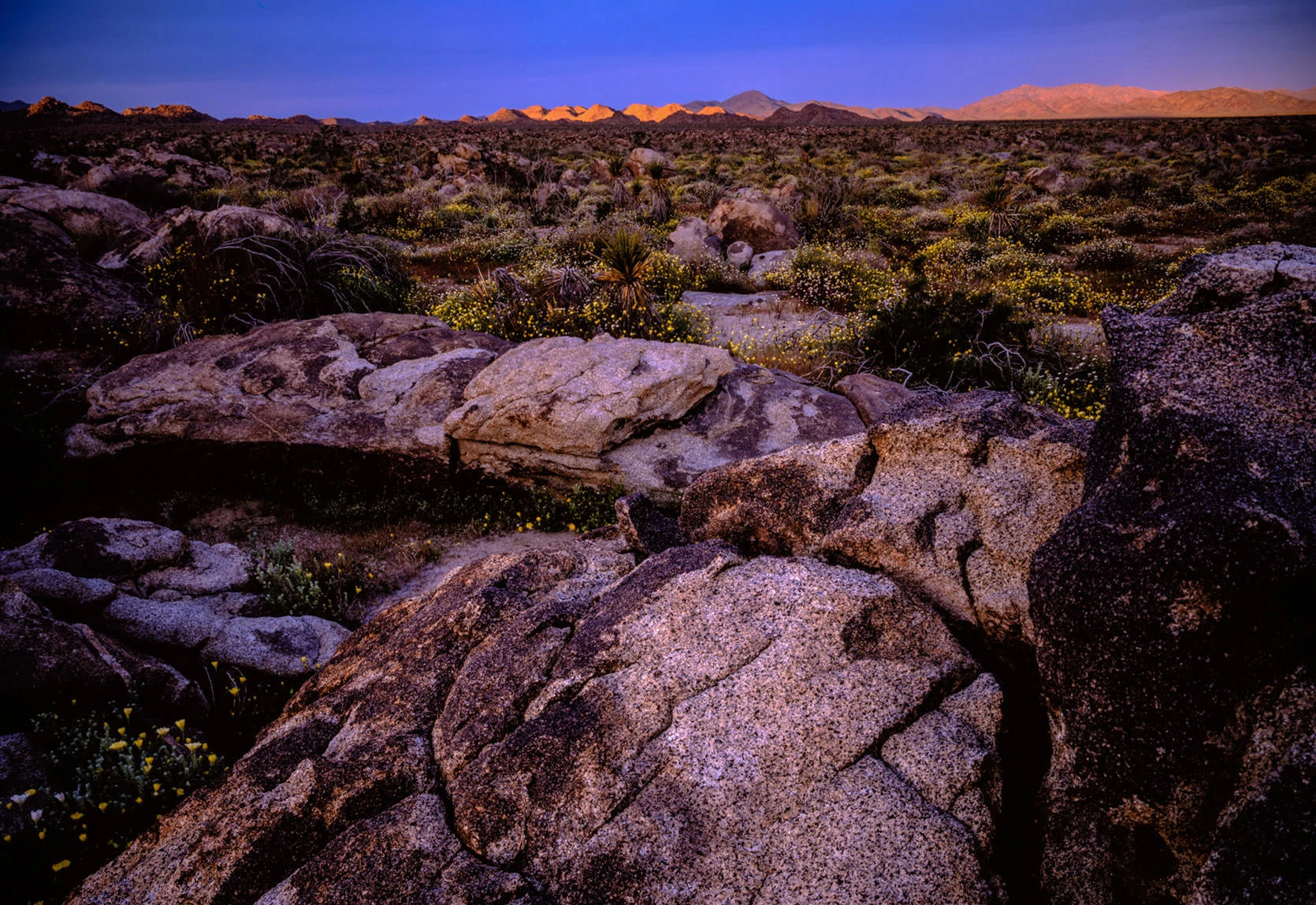
But that's a story for another time and place; for we are leaving the Prehistoric Mojave for the rugged desolation of the Colorado Desert; a subset of the Sonoran, and a very hot, dry and unforgiving place.
A Garden of Cholla
We end up in a ten-acre garden of cholla an hour before sunset. Last time I was here, the heat ran us off before the light turned. This time we have come prepared: boots, pliers and a full gallon of water.
Wandering among the cactus, a cholla barrel lodges itself in my leg. Cholla spines are an inch and a half long and barbed like fishhooks; Lily's cholla injury from last year still hasn't healed. I remove twenty spines from my leg with a pliers and in vengeance I kick another barrel as hard as I can with impenetrable waterproof boots — the barrel goes nowhere except through my boot; 20 spines in my big toe and the arch of my foot. I may do stupid things in life. But in Joshua Tree I excel at it. Last year, I left my pack, and everything in it — off a stretch of road 20 miles from any significant marking. "Where did you leave it?" the ranger asked.
"Between West Entrance and Quail Springs."
"Which side of the road?"
"I don't remember."
Two weeks later, it was found.
With all the pain and blood and unremoved spines, I looked up at the sun — ten minutes until the cholla would catch fire in the last light, the reason we had driven all this way. So I hobbled toward a clear patch of sand; another cactus barrel. I was not going to miss it again. I sat down to pull the new spines before the show began.
Good god, there were more than I thought. One in the heel, three in the arch, a cluster in the big toe that the pliers could not reach. I worked at them for eight minutes, head down, cursing. Stood up. Looked west. And just then, the sun went down, and the majesty of the Sonoran faded. I had watched the whole sunset in my own foot.
Next time.
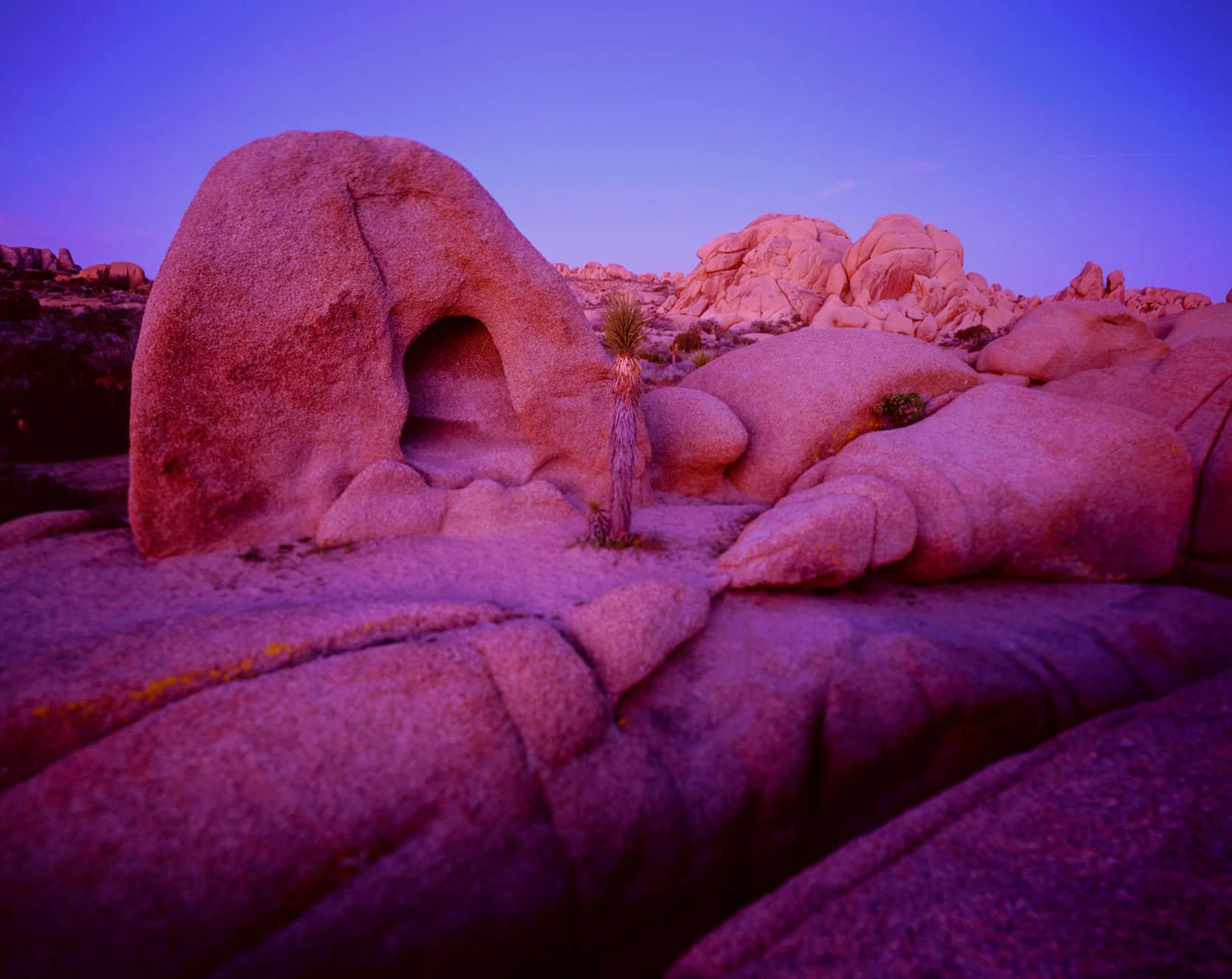
Jumbo Rocks area, Joshua Tree National Park. This granite formed underground from magma, and time stripped away the layers above.
Hidden Valley at Dawn
At five in the morning we were racing across the desert to Hidden Valley. The white sands of Joshua are purple in pre-dawn; the trees arch and hang over the road, and become visible one by one, twisted and wraithlike; straight out of Sleepy Hollow or Stephen King. We pull up along the road, and I walk underneath boulders, and through them, and eventually, on top of them.
From here I can see five miles of trees, and a Jack Rabbit, the size of a small dog ditching his Chuparosa hideout. I find a Prickly Pear Cactus, and examine some lichen through my loupe — lime, aqua, red-orange and pitch. When dawn broke, we walked through Hidden Valley, a windless, completely rock enclosed valley.
A coyote had been following us.
I heard him, but couldn’t see him. When Lily sat down for water, he made himself known beside a creosote — he was the most vividly rust coyote I have ever seen, beautiful and well fed, nothing like the thin ones that sit by the park roads waiting for tourists to throw them some bread. Lily never seems to be bothered by large mammals.
I urged us to keep distance, and soon, we were driving in the remotest of the Joshua Tree National Park roads, along the Geology Tour Road and the Lost Horse Mine trail and up to Keys View, where the whole Coachella Valley opens below, the San Andreas Fault running along its floor and the Salton Sea shining far to the south. Another fault line; this one nobody had to discover. We identified new species: desert mallow, beavertail cactus, lupine and silver cholla. French bread. Gouda. Water. And we were on our way back to Los Angeles.