
Hurricanes and the Art of Denial: Debunking Miltimore
Notes from the Road revisits Jon Miltimore's climate change hurricane denial and finds a familiar refuge in numbers and omission
January 20, 2026
The article "The Myth That Hurricanes Are Getting Worse Because of Climate Change," by Jon Miltimore, relies on a familiar rhetorical move common to climate-contrarian commentary: it narrows the definition of "worse" to the one metric least likely to show a clear trend...raw hurricane counts...and then declares the broader scientific conclusion a myth. This is selective framing designed to manufacture doubt where none meaningfully exists.
The dishonesty begins before the first paragraph. Miltimore's headline and dek promise to debunk claims that hurricanes are becoming "more powerful (and deadly)." But the article itself does not test that claim. Instead, it quietly shifts the question to whether hurricanes are becoming more frequent. These are not the same thing. Frequency is the weakest and most contested signal in hurricane climatology; intensity, rainfall, and rapid intensification are where the evidence is strongest. By advertising one claim and arguing another, the piece manufactures doubt without ever engaging the science readers were told would be examined.
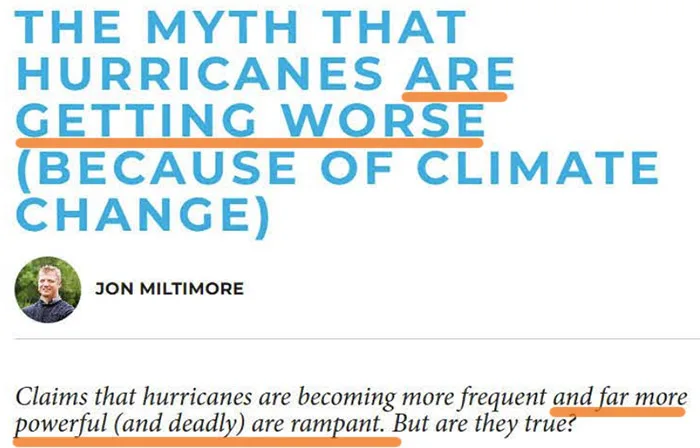
Miltimore opens by claiming that popular media are exaggerating climate impacts, quoting a Washington Post sentence that states: Climate change has turbocharged severe storms, fires, hurricanes, coastal storms and floods — threatening millions. He sets this up as if it were a typical example of journalistic overreach and claims it is a theme routinely trotted out after hurricanes.

I photographed this abandoned home in 2024, five years after Hurricane Dorian. Dorian destroyed my childhood family home and killed friends. Damage from thie climate-change intensified hurricane still effects the Abaconian economy.
Miltimore's framing itself is a sleight of hand. The Washington Post's larger claim that Miltimore quoted about extreme weather is completely correct. This includes the part about hurricanes, which indeed have become turbocharged. Fires, floods, heat-driven storms, and coastal flooding have all increased measurably. That is a conclusion we do not rest on via journalism. It rests on peer-reviewed science.
The IPCC has stated again and again with high confidence that anthropogenic climate change has increased the frequency and intensity of heatwaves, heavy precipitation events, agricultural and ecological droughts, and fire weather in many regions. IPCC on Weather and Climate Extreme Events
Wildfire risk has worsened sharply. A major Proceedings of the National Academy of Sciences study concluded that anthropogenic climate change has doubled the cumulative forest fire area in the western United States since 1984. Impact of anthropogenic climate change on wildfire across western US forests
Extreme rainfall and flooding have also increased. The IPCC finds that the frequency and intensity of heavy precipitation events have increased since the 1950s over most land areas. IPCC Report on Water Cycle Changes
Coastal flooding has become worse due to steady sea level rise. NOAA documents that high-tide flooding is occurring more frequently due to rising sea levels. NOAA on Sea Level Rise
Against this backdrop, attacking a newspaper quote is not a scientific argument. If Miltimore wishes to dispute climate conclusions, the relevant standard is peer-reviewed research, not selective media framing.
Why Hurricane Counts Were Never the Metric
Miltimore's central claim, that because hurricane frequency has not increased, climate change is therefore not making hurricanes worse, is a gross and negligent error. Climate science has never rested on the assertion that the total number of hurricanes would steadily rise. For decades, researchers have been explicit that storm counts are dominated by natural variability and are a weak indicator of climate influence.
But despite Miltimore's claims, The IPCC shows that scientists have low confidence in any long-term trends in the frequency of hurricanes and tropical cyclones. NOAA on Weather and Climate Extreme Events in a Changing Climate

I photographed this laundry room for a condominium development 5 years after Hurricane Dorian.
To focus on frequency alone is to ignore what scientists actually measure when assessing risk: intensity, rainfall, rapid intensification, storm surge, and the physical conditions that govern destructiveness.
What the Science Actually Measures: and What It Shows
On the metrics that matter, the evidence is not ambiguous.
The IPCC finds high confidence that the proportion of tropical cyclones that reach major hurricane intensity has increased over the last four decades. NOAA on Weather and Climate Extreme Events in a Changing Climate
Observed rainfall increases are equally well established. A major attribution study examining Hurricane Harvey concluded that anthropogenic climate change increased the likelihood of an event like Harvey by a factor of at least three and increased rainfall totals by approximately fifteen percent.
Rapid intensification, one of the most dangerous hurricane characteristics, has also increased. A global analysis published in PNAS found that the probability of rapid intensification has increased significantly over the past four decades. Relative interfacial cleavage energetics of protein complexes revealed by surface collisions
Rapid intensification is becoming more common
I created this chart using IBTrACS global counts by year (1980–2024). This shows not only Northern Atlantic storms, but global storms with at least one ≥30 kt (≈35 mph) wind increase within 24 hours.
Sea level rise means that storm surges cause a lot more flooding today versus the equivelent storm in the past. According to NOAA, higher sea levels mean higher storm surges reach farther inland, which leads to more flooding and damage. NOAA on higher storm surges
None of the examples I gave above are projections. They are observed physical consequences of warming.
The Landfall Fallacy: Why U.S.-Only Data Is Misleading
A particularly deceptive element of Miltimore's argument is his reliance on U.S. hurricane landfall data as the primary evidentiary basis for dismissing climate influence.
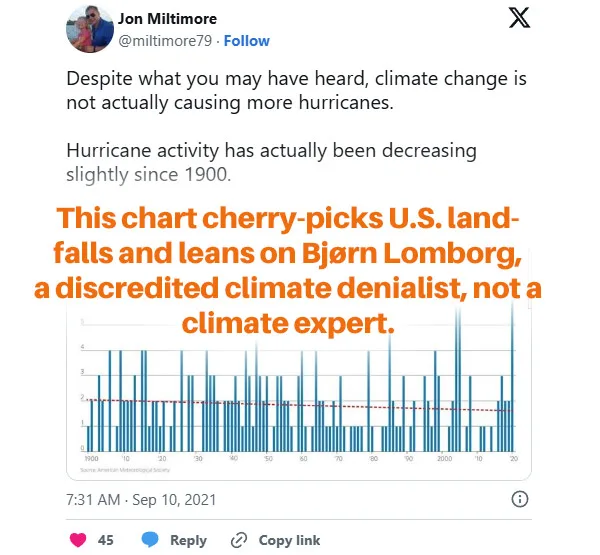
Hurricanes are a global phenomenon. Most tropical cyclones never strike the continental United States at all. Whether a storm intersects a specific coastline is largely a matter of atmospheric steering patterns, not storm strength. Landfall is geography and luck, not physics.
The IPCC explicitly warns that tropical cyclone landfall statistics are strongly affected by natural variability and are not reliable indicators of long-term changes. IPCC on Weather and Climate Extreme Events
This is why serious hurricane science relies on global and basin-wide datasets. Climate change alters the planet's energy balance, not national borders.
| What changes | Trend signal | What we observe | Why it matters | Key sources |
|---|---|---|---|---|
| Hurricane frequency (global count) | Noisy | Counts dominated by natural variability | Weakest place to look for climate signal | IPCC AR6 report |
| Major hurricanes (Category 3–5) | Increasing | Higher proportion of strongest storms | Damage scales nonlinearly with wind speed | Nature study |
| Rapid intensification | Increasing | Storms intensify faster than in past decades | Shortens warning and evacuation windows | PNAS study |
| Hurricane rainfall | Increasing | Higher rainfall totals and rates | Flooding drives fatalities and losses | PNAS study |
| Storm surge impacts | Increasing baseline | Sea level rise amplifies surge | Same storms cause worse flooding today | NOAA on sea level rise |
| U.S. landfall counts | Not a climate signal | Small and unrepresentative subset | Hides global and oceanic trends | AMS journal article |
Death Counts Are Not Storm Metrics
Equally misleading is Miltimore's invocation of declining hurricane deaths as evidence that danger is overstated. This confuses human vulnerability with storm behavior.
The IPCC states that trends in disaster losses and fatalities are strongly influenced by exposure and vulnerability and should not be interpreted as trends in hazard. IPCC on Climate-related Health
Fewer deaths today reflect better forecasting, earlier warnings, evacuation protocols, and infrastructure, not weaker storms.
Miltimore's Methodological Errors
The flaws in this article follow a consistent pattern. Hurricane frequency is substituted for hurricane risk. U.S. landfalls are treated as global indicators. Exposure is conflated with hazard. Media criticism replaces engagement with peer-reviewed science. Uncertainty is treated as refutation rather than as a bounded condition within which strong conclusions are still possible.
These approaches would not be acceptable in a scientific analysis. Together, they produce an argument that appears data-driven while systematically avoiding the data that matter.
The Actual Scientific Consensus
The scientific consensus has been clear about this very key and well known fact. Climate change is not making hurricanes more common, but rather more dangerous.
These tropical cyclones mean stronger winds, heavier rainfall, faster intensification, and higher storm surges. These are the characteristics that destroy infrastructure and strain emergency systems. Fixating on storm counts is not an honest disagreement with climate science. It is a tell that Miltimore is not willing to engage directly with the actual science.
Crisis, Libertarianism, and the Misreading of Climate Risk
Miltimore's hurricane argument is driven by ideology rather than science and evidence. As a libertarian writer without a background in economics or science, he falsely views climate change through the lens of state power rather than physical risk. This is why he reaches for the framework popularized by Robert Higgs in Crisis and Leviathan who argued that governments require perpetual emergencies to justify expansion and government control. In that worldview, climate change cannot be a genuine physical threat: it must be a manufactured crisis. Like with Miltimore's polar bear article, the assumption comes first, and the data are bent towards his assumption afterward.
What this framing misses is that climate change has been driven forward by free markets responding to physical reality. Everybody in the free marketplace is already reacting to the climate change, as renewable energy is becoming cheaper and more reliable while entrepreneurs and nimble companies are finding new innovative solutions to the complex threats of climate. Where adaptation and mitigation have lagged, it has most often been due to political resistance, not the free market.
Miltimore just doesn't understand the science between climate change and how its danger lies in compounded and cascading ecological damage, factors that interact nonlinearly and overwhelm systems designed for a different climate baseline.
Treating climate change as a political narrative rather than a physical system leads directly to arguments like Miltimore's, arguments that confuse skepticism with ideology and mistake selective metrics for insight. The storms do not care about political theory. They respond to physics.
Hurricane Dorian and the Cost of Denial
All of this can sound abstract: metrics, trends, probabilities, competing interpretations of charts. But the consequences are not abstract.
Hurricane Dorian is the most intense hurricane to ever hit the Bahamas since such hurricanes began being measured in 1850. Dorian destroyed my childhood home in the Abaco Islands and killed friends I knew since I was young. in 2019, Hurricane Dorian stalled over Abaco for an entire day while at full catastrophic force, producing sustained winds near the top of the Saffir–Simpson scale, turning entire neighborhoods into debris fields.
The duration of peak intensity, not merely the peak itself, is what made the storm so lethal.
Even to this day, much of the Abaco Islands have been denuded of trees. Buildings are crumbled. When I drive south from Central Abaco, trees no longer exist. Only when you pass into deep southern Great Abaco can you see stands of trees. The clean line where Dorian missed.
Dorian was unusual in ways climate science has warned about for years. It intensified rapidly over exceptionally warm water, reached extreme strength, and then slowed to a crawl, allowing destruction to compound hour after hour. Storm surge overtopped entire islands. Homes were erased, not damaged. Escape routes vanished. The line between land and sea dissolved. Some of my friends were stuck in basements, their ribs cracked. Some islands in the Abacos had no relief for months.

A destroyed home in Great Abaco, Bahamas. I photographed this house 5 years after it was destroyed by Hurricane Dorian.
What is often left out of these climate denier arguments is that hurricanes are not just destroying buildings. They also degrade the biosphere that supports island life. Dorian damaged coral reefs that buffer shorelines from wave energy. This is important because the Abaco Islands are one of the last Caribbean basin bastions of relatively healthy corals, where the rest of the Caribbean has seen 80% of all coral reefs destroyed. Dorian uprooted mangroves that stabilize coasts, shelter juvenile fish, and absorb storm surge in one of the last places where healthy reefs remain. Saltwater inundation poisoned freshwater soils. Habitats that take decades to form were damaged or erased in hours.
These ecological losses are essential, and they are also cumulative. Coral reefs, mangrove forests and native Bahamian coppice and pine habitats are living infrastructure. When they are damaged, islands become more vulnerable to the next storm, and the biodiversity which is the foundation that underpins human society erodes. Each extreme hurricane leaves behind a more fragile system, biologically, economically, and socially, even before another storm forms.
This is the part of the story that hurricane denial never accounts for. Counting storms does not measure what storms do. It does not capture duration, surge, stalling behavior, ecological collapse, or irreversible loss. It does not measure the way extreme hurricanes compound damage across human and natural systems alike.
Arguments like Miltimore's treat hurricanes as abstract entries in a dataset. But as I remember friends I have lost to a climate-fueled megastorm, I know that hurricanes are not numbers. They are places erased, ecosystems broken, and communities altered permanently. This is what "more dangerous" actually means.
Jon Miltimore's article does not debunk a myth. It manufactures one: that because one carefully chosen metric has not changed decisively, the threat itself is overstated.
Hurricanes do not need to be more frequent to be more destructive. Measured globally, across the world's oceans, they already are.