
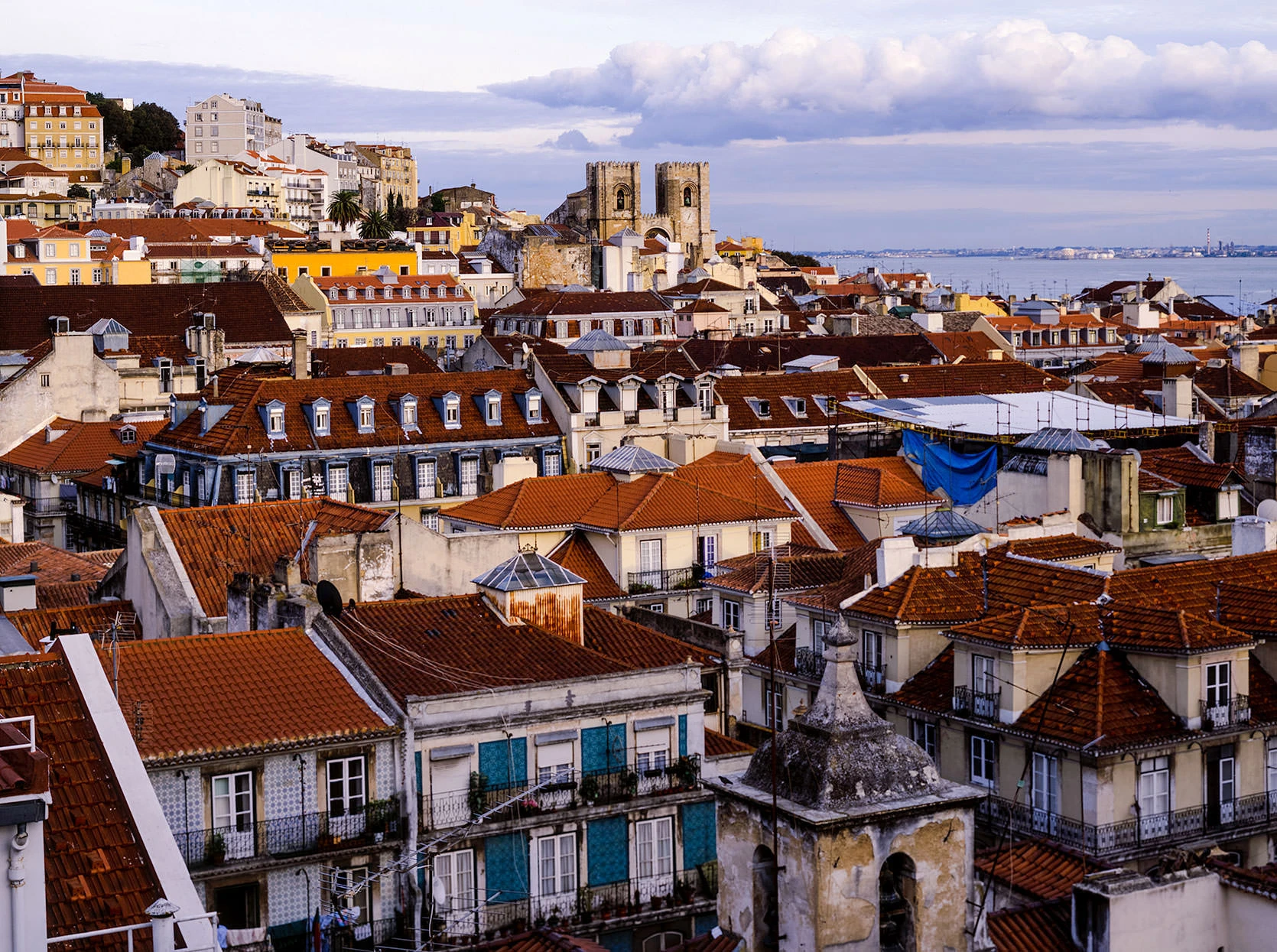
Faded Majesty The Alfama, Lisbon
Rain, fado and a thousand years of paint in Lisbon’s oldest neighborhood.
Updated October 4, 2026
Paris had ruined all my romantic notions of the western European city. A single city — littered, rude, cheap and crass — had long ago come to symbolize all of Europe for me. Overrated and overpriced, and so I had gone on imagining the rest of urban Europe to be much the same. That is until Lisbon.
Lisbon feels tropical and connected to Africa, even on a biting cold day; in its southern sun it looks like a mix and match of its neighbors’ architectures. It is colored in a smudgy gray, festooned with pinks and canaries and aquas and limes. Its inhabitants dress like their country cousins, just in tighter weaves.
Over lunch a long time ago with a Portuguese friend, I came up with the idea of hosting a Portuguese Empire party; literally a party themed on Portugal's historical colonial empire. I’ll get to the party itself. I came up with this idea with only the faintest notion of what Portugal is, or was. Perhaps it was subconsciously strategic that the two food critics at my old school newspaper were both Portuguese, and that, sure, they'd love to help with the cooking.
My Portugal, the one I imagined in preparing for my party, turned from a whim into a dream. Portugal was a place whose territories occupied the strangest realms of the world: places other powers had overlooked, or would soon fight over. As the sea race to control trade with India and the Spice Islands heated up over the centuries, Portugal's early dominance of the seas dwindled, and it became a secondary power, and yet they still coaxed a fair portion of the world into their grasp. The Portuguese world was a sleepy backwater; multilingual, steamy, a dozen lands and a thousand islands.
The Earthquake of 1755
On the morning of November 1, 1755, All Saints’ Day, an earthquake struck from the floor of the Atlantic, southwest of Portugal’s southern cape. Fire and a tsunami followed. Some 85 percent of Lisbon’s buildings were destroyed, and between 30,000 and 40,000 people died in the city. Much of Lisbon’s history fell with the earthquake. One neighborhood mostly held.
Under the Moors, the Alfama was the whole city, and its name comes from the Arabic al-hamma, the hot springs. By 1755, the wealthy had long since moved west, and it had become a neighborhood of fishermen, sailors and the poor, still laid out on its Moorish street plan.
Roman, Moorish and Portuguese Lisbon are built on top of one another, making the whole place a mash of centuries.
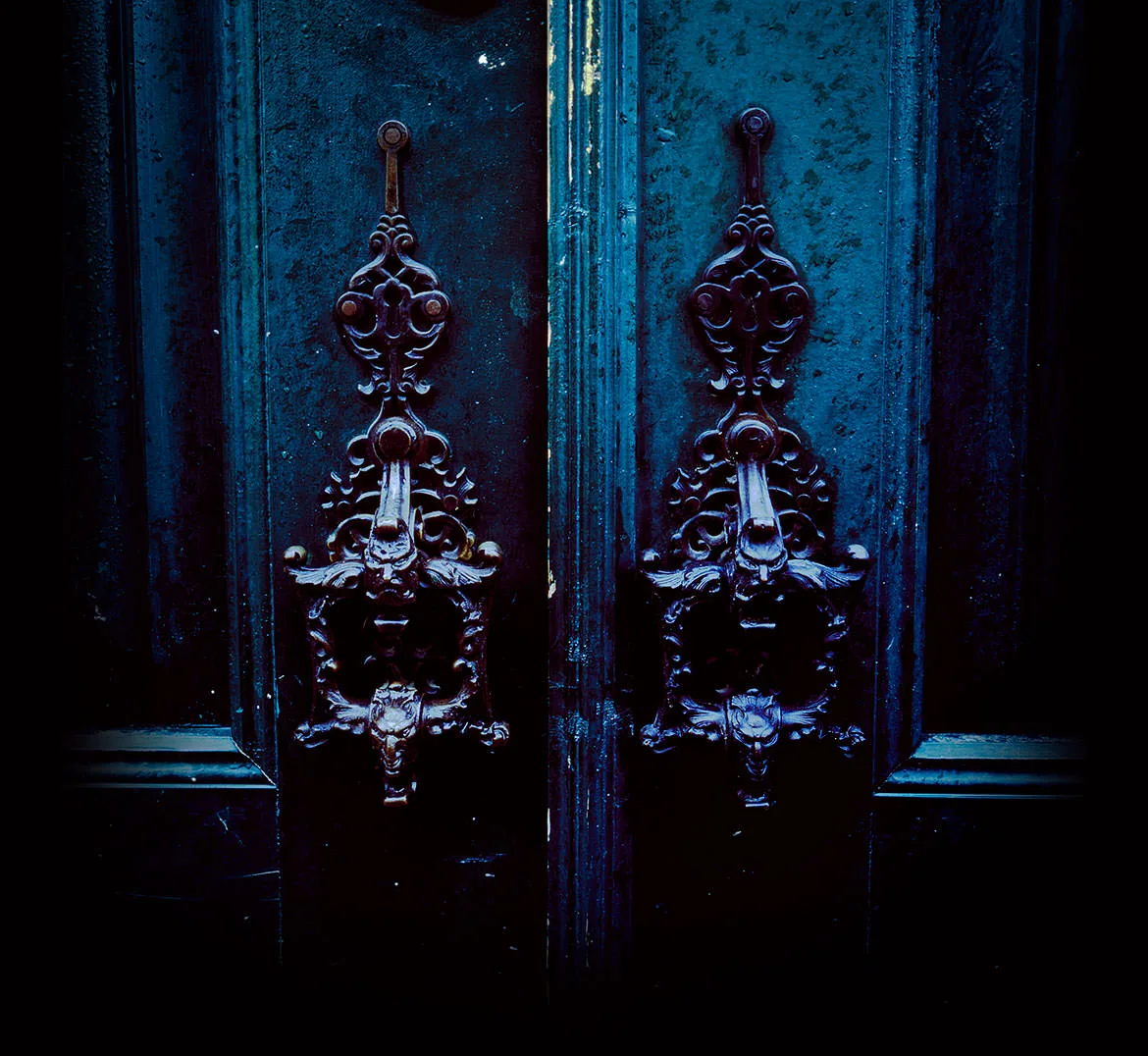
Details from a door in the Alfama, the district of old Lisbon that largely survived the Earthquake of 1755.
My Portuguese Empire myth came from music: Cesária Évora and Jobim and others. Music that was a dialogue of other times. It is a surprise then to learn that the Alfama also continues to be a center for that old Portuguese-style blues: the fado. And even with the pattering of rain, you can hear some old man crooning or a Portuguese guitar picking, behind some alley or courtyard.
The rain is pouring heavily now as we tread down into the Alfama.
We stop in a small cafe — there seem to be thousands of such cafes in this city — and we share a coffee and a bowl of fruit.
When Jane and I stepped into Lisbon, I stepped into my Portuguese Empire. Lisbon really is that cobbled city of my imagination, and the Alfama, being the last of old Lisbon still largely standing, is the epitome of my imagined Portuguese Empire.
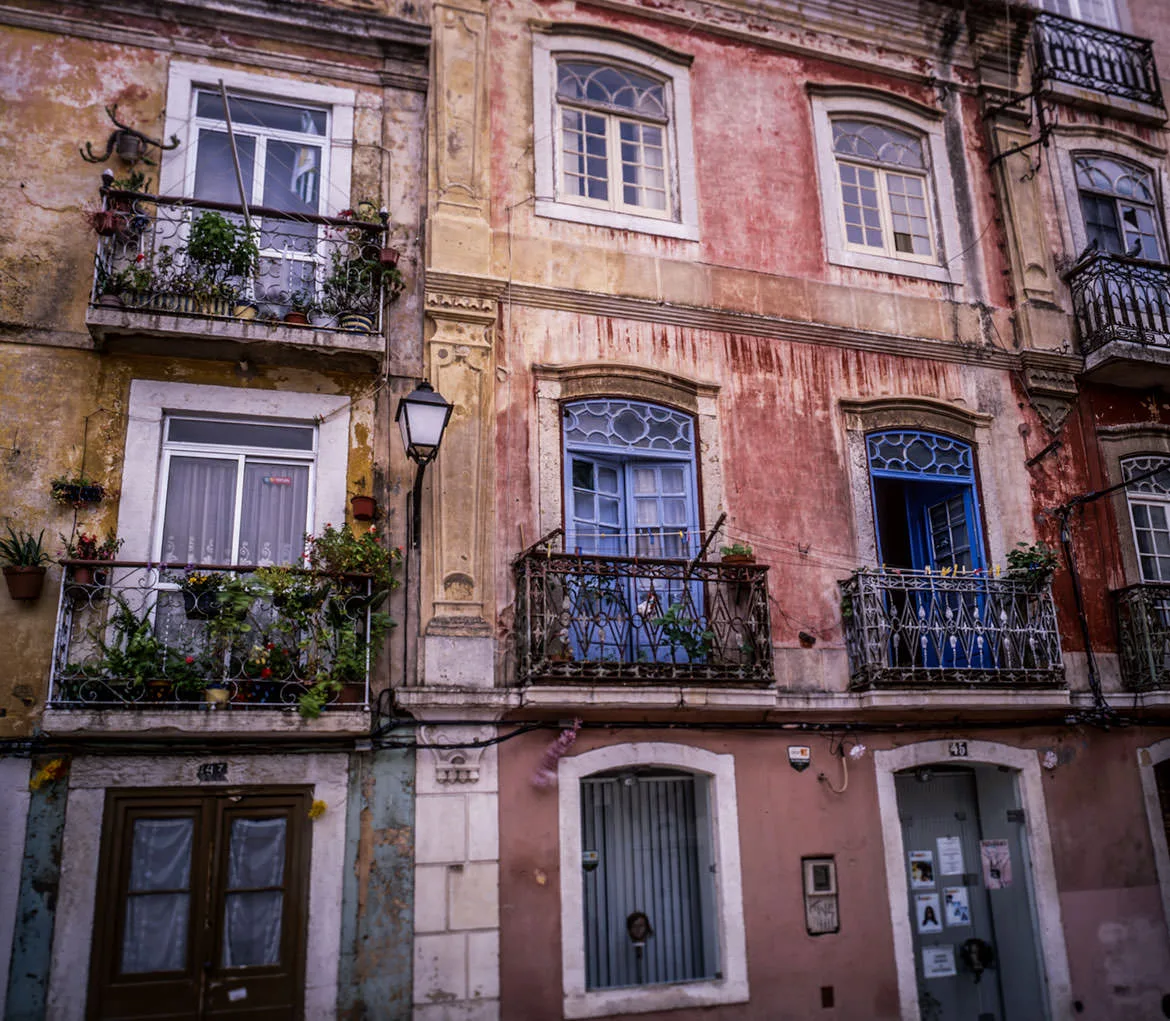
Apartments in the Alfama. The district is residential, with few specific tourist stops
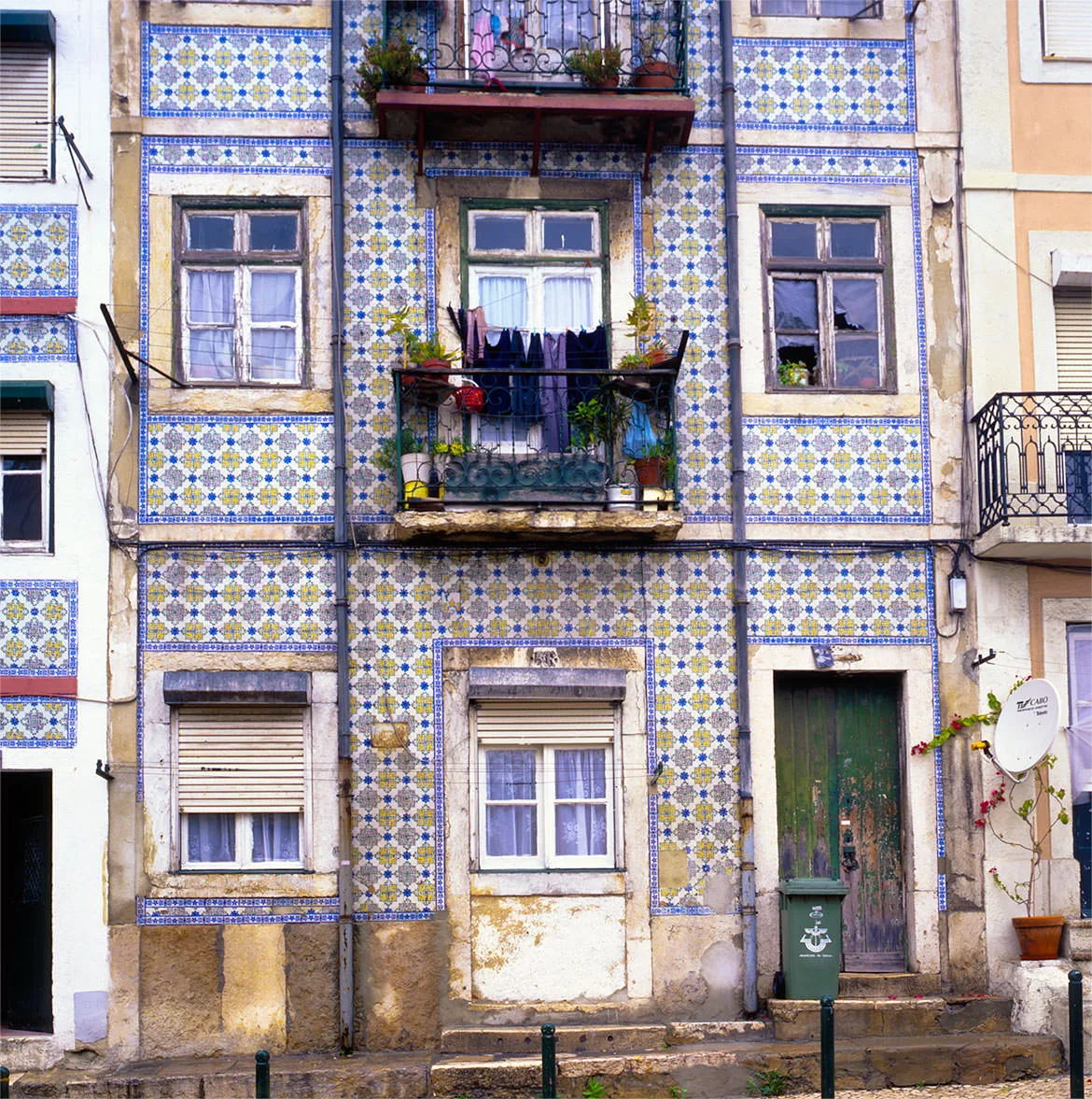
The Alfama is a hard place to pin down; nobody can say exactly what it is. For what it's worth, the Alfama is a labyrinth of dark, wet alleys. Of old, richly embellished tiles that face entire exteriors. It is most of all a labyrinth of Lisbon's history, set upon a glimpse of urban Lisbon lifestyles.
We walk slowly. The doors of apartments feature old bronzework of dragons and beasts. Scratched paint shows dozens of layers beneath each wall. For people who like history without walking through old churches and museums, the Alfama is a mood piece of a hundred eras. A glimpse of the faded majesty of the Portuguese Empire.
A Portuguese Empire Party
The first problem in planning this party was finding out what the Portuguese Empire was, and how to cook in the styles of each of Portugal's colonial territories.
The islands of Cape Verde, off the coast of Western Africa. Goa, in Western India. Ceylon, now Sri Lanka. Brazil. Mozambique. Macau.
We threw it in Redondo Beach, a few blocks from the ocean, where I was living in a cheap rental with an unusually big backyard. My roommates and our friends spent months getting ready.
The backyard did half the work. A giant banana tree and a giant heliconia towered over it, and at the party it could pass for a courtyard in Goa or a veranda in Mozambique. That was the Portuguese Empire I had in my head, and for one party it was in Redondo Beach.
The kitchen ran on the markets around Inglewood and the South Bay, the Asian, Southeast Asian and Indian grocery stores where we hunted down spices and leaves no ordinary supermarket carried. Our two Portuguese food critics took charge. There was Portuguese cheese, and laulau, pork wrapped in taro and ti leaves and steamed slow. There was a pot of Cape Verdean cachupa, a Goan pork vindaloo, a Brazilian feijoada, and a tray of pastéis de nata for dessert.
The laulau was for our Hawaiian friends, and it belonged. Starting in 1878, Portuguese families from Madeira and the Azores sailed to Hawaii to work the sugar plantations, nearly 16,000 of them by 1911. They brought the braguinha, the little Madeiran guitar that became the ukulele, and malasadas and sweet bread with it. Hawaii was part of the Portuguese world, too. It was the closest I had come to Portugal, and I hadn’t left Los Angeles.
The one ingredient most of those kitchens share arrived on Portuguese ships: the chili pepper. In the 1500s, Portuguese traders carried American chilies to Africa and India and on to Asia. Goa’s vindaloo began as a Portuguese dish of meat in wine and garlic, carne de vinha d’alhos, and Goan cooks set it on fire. Piri-piri grew up in Portugal’s African colonies. My party menu was a map of those trade routes.
Portugal turned its expansion to the Atlantic in the fifteenth century, taking Ceuta in 1415 and settling Madeira and the Azores soon after; the Portuguese were among the earliest masters of the high seas, and used that mastery to their benefit. From Vasco da Gama to Ferdinand Magellan, a Portuguese captain who sailed for Spain, Portuguese sailors literally connected the world by sea.
They also built the Atlantic slave trade. Ships under the Portuguese and Brazilian flags carried nearly half of the roughly 12.5 million Africans forced across the Atlantic, more than any other nation’s. The faded majesty I came looking for has that underneath it, too, and any honest party for the Portuguese Empire has to leave room for it.
The empire really ended in 1974, when a nearly bloodless coup in Lisbon, the Carnation Revolution, brought down the dictatorship and its long colonial wars in Africa. By the end of 1975, Angola, Mozambique, Cape Verde, Guinea-Bissau and São Tomé and Príncipe were independent. In 1999, Portugal handed its last far-flung colony, Macau, to China.
All of the shapes and colors of old Portugal seem to still exist here. And the colors of places from the other side of the world. As if I would know. Perhaps, it is my imagination — created all those years ago in a cheap rental in Redondo Beach.
Since Then
The Alfama I walked through was a neighborhood of people who lived there. It changed fast. By the end of 2016, researchers found that a quarter of the homes in the heart of the Alfama had become short-term tourist rentals, nearly all of them whole apartments owned by investors, and they documented tenants being evicted. In 2018, Lisbon stopped issuing new holiday-rental licenses in the Alfama and four other old neighborhoods.
Fado, at least, is protected. In 2011, UNESCO added it to its list of the world’s intangible cultural heritage.