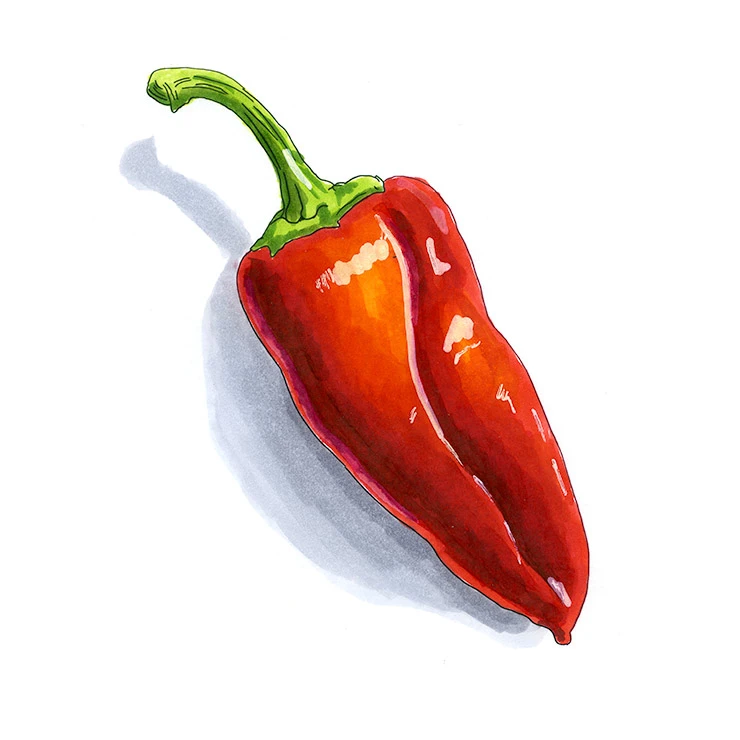
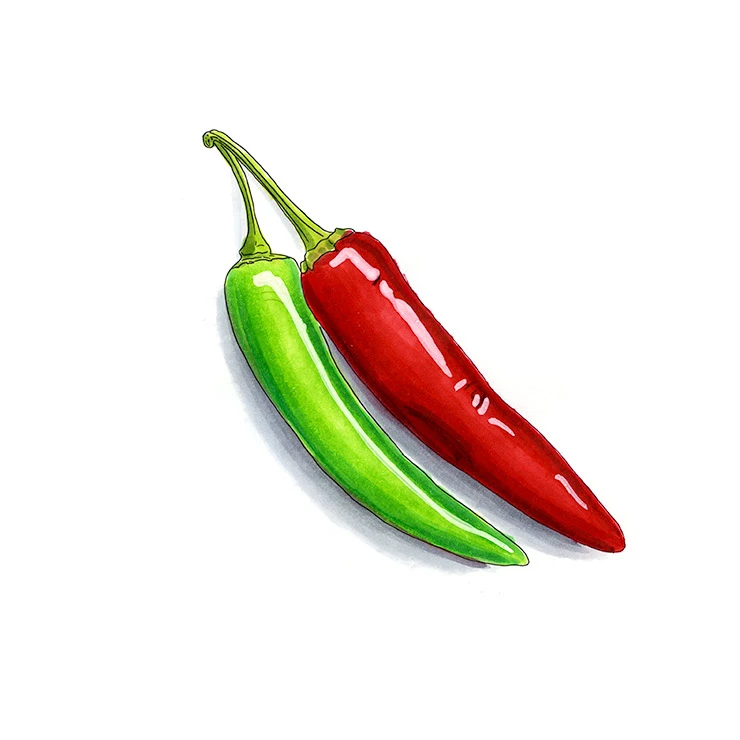
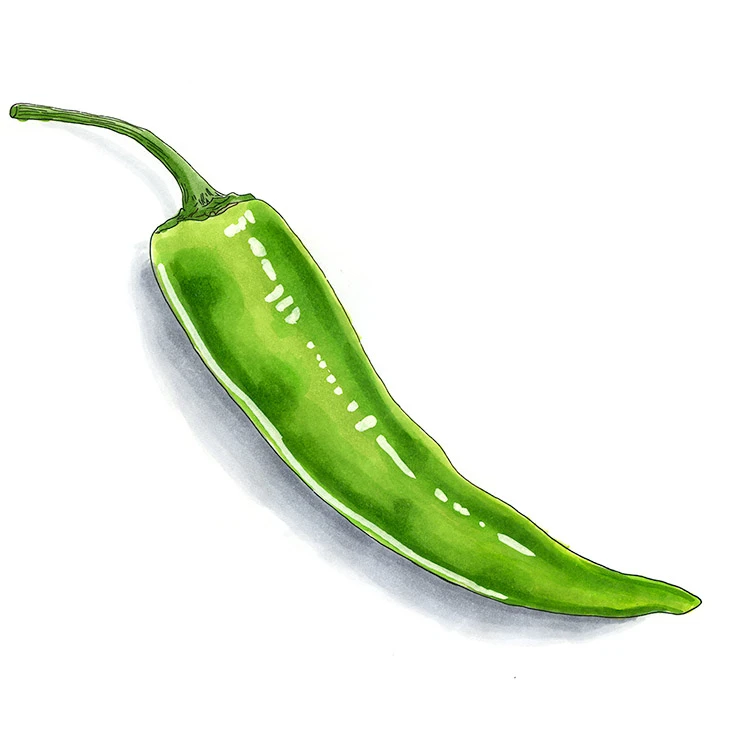
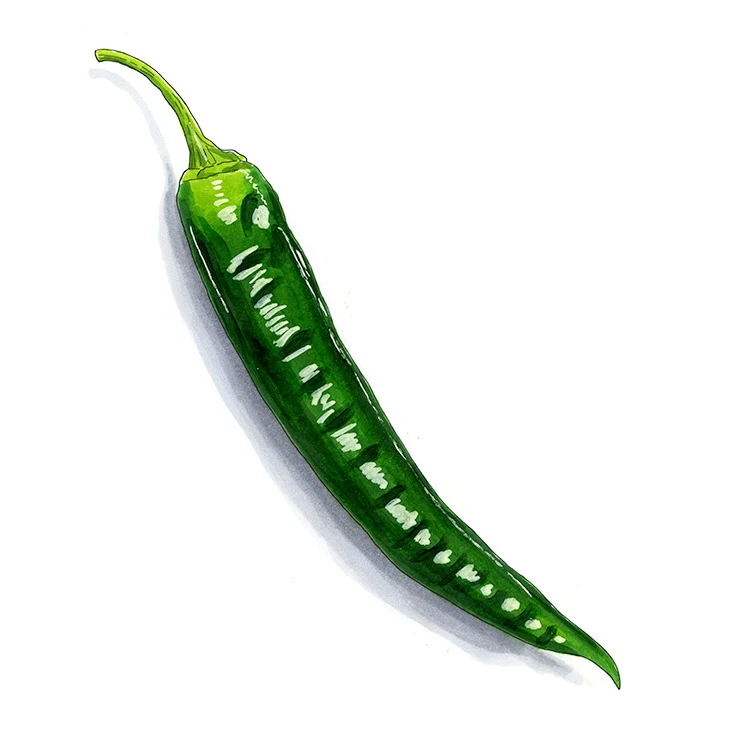
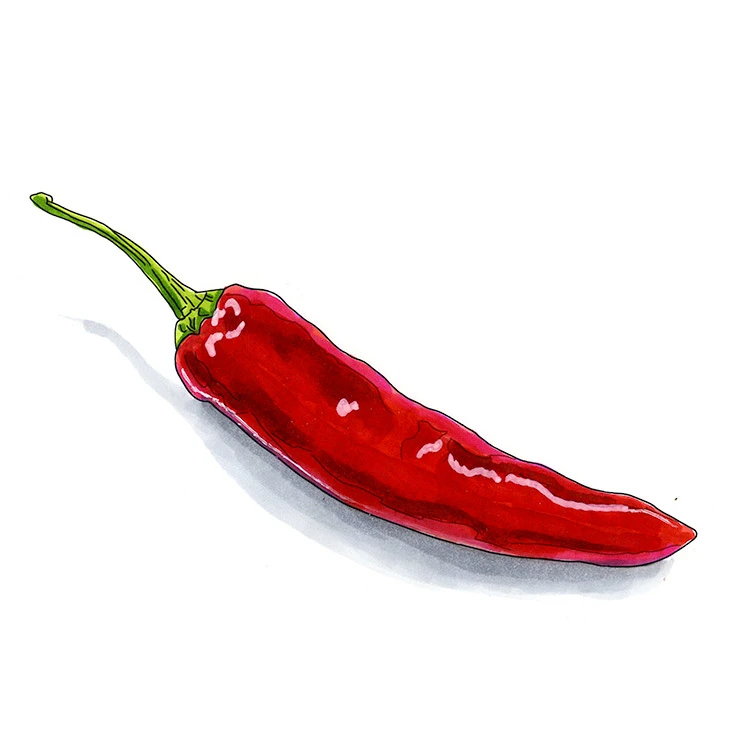
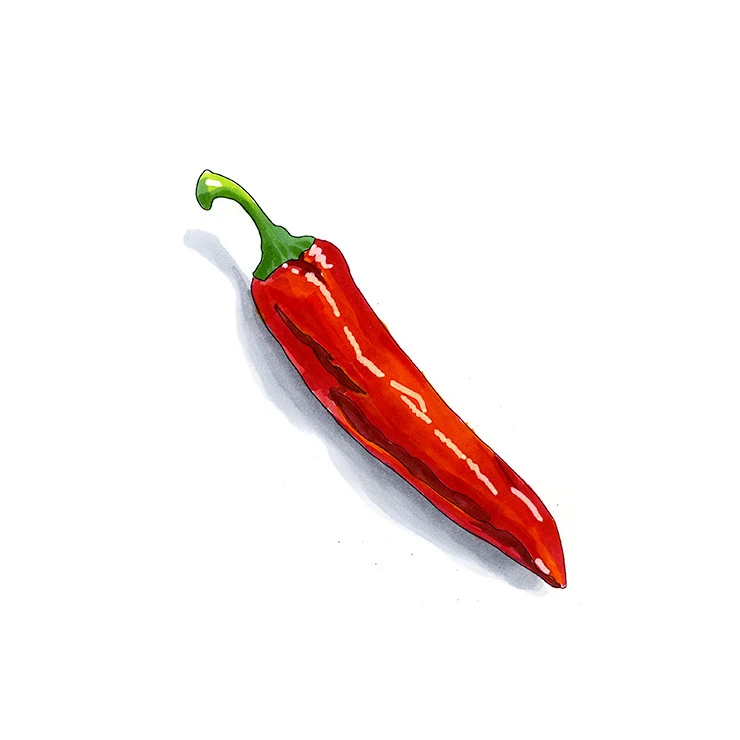
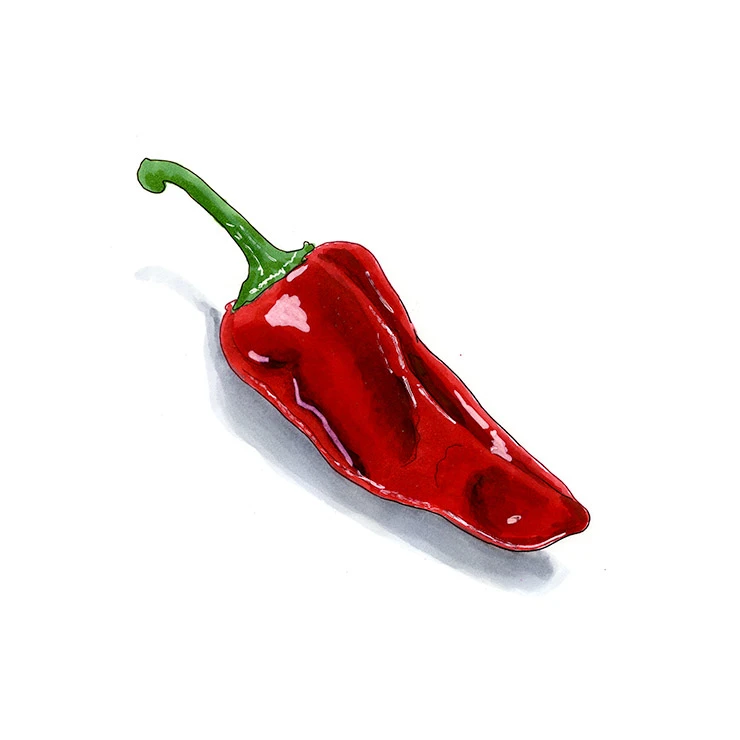
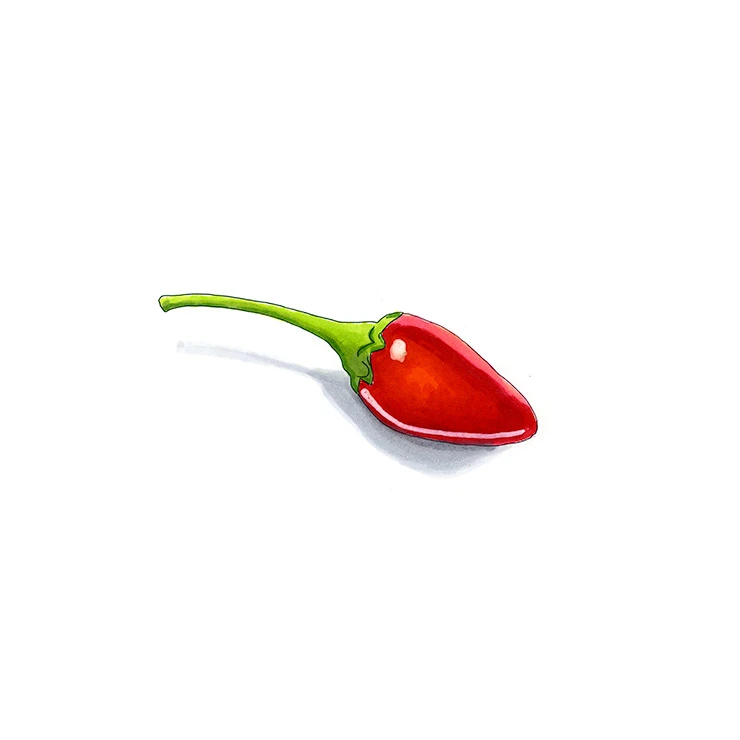
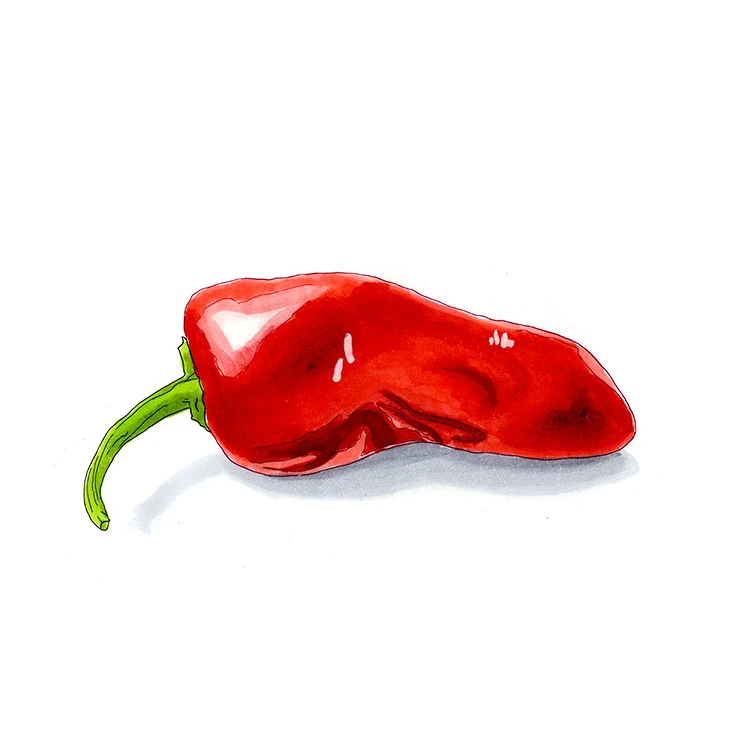
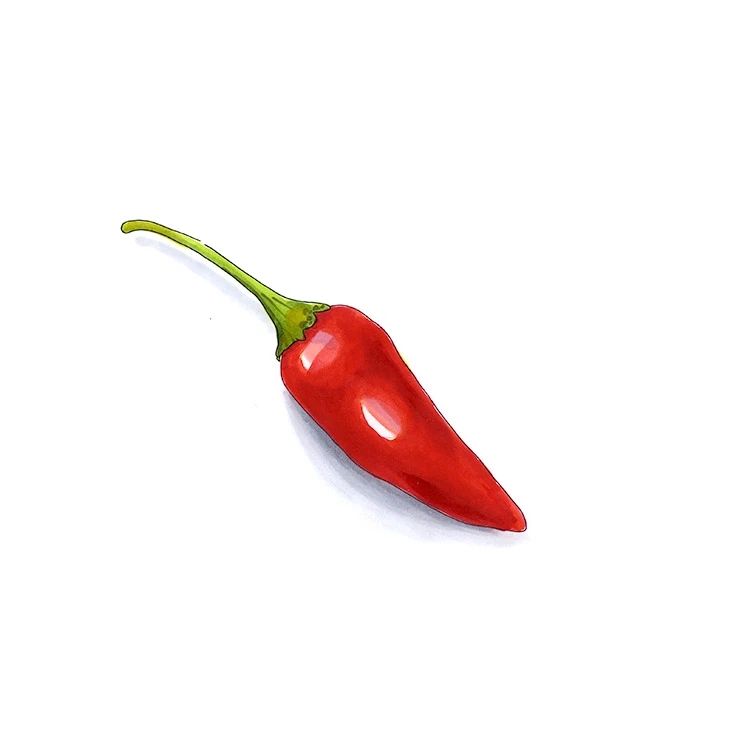
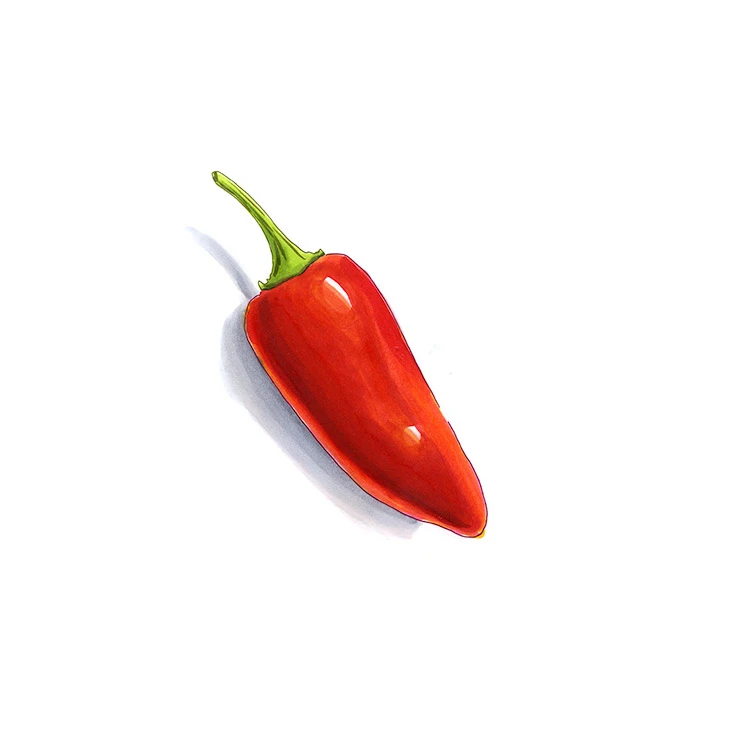
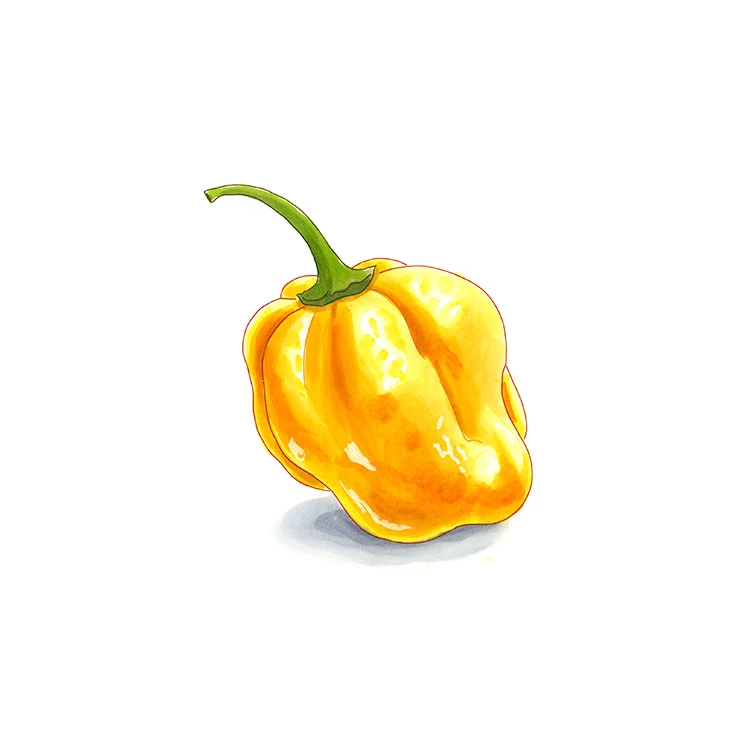
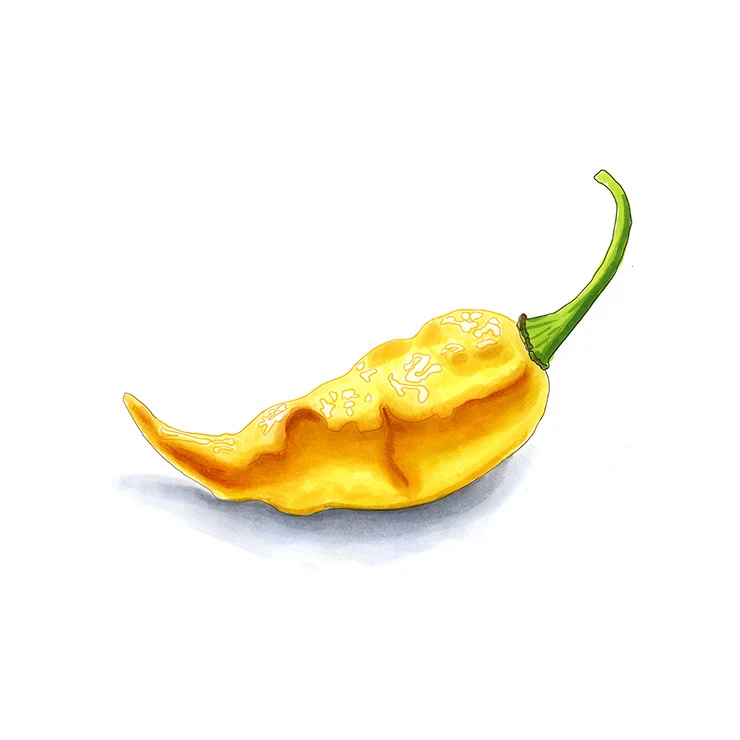
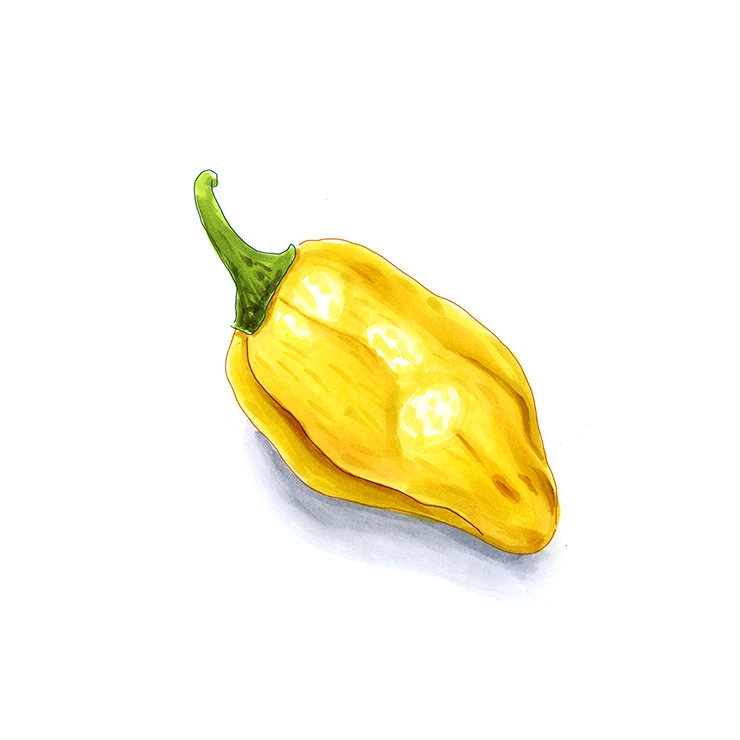
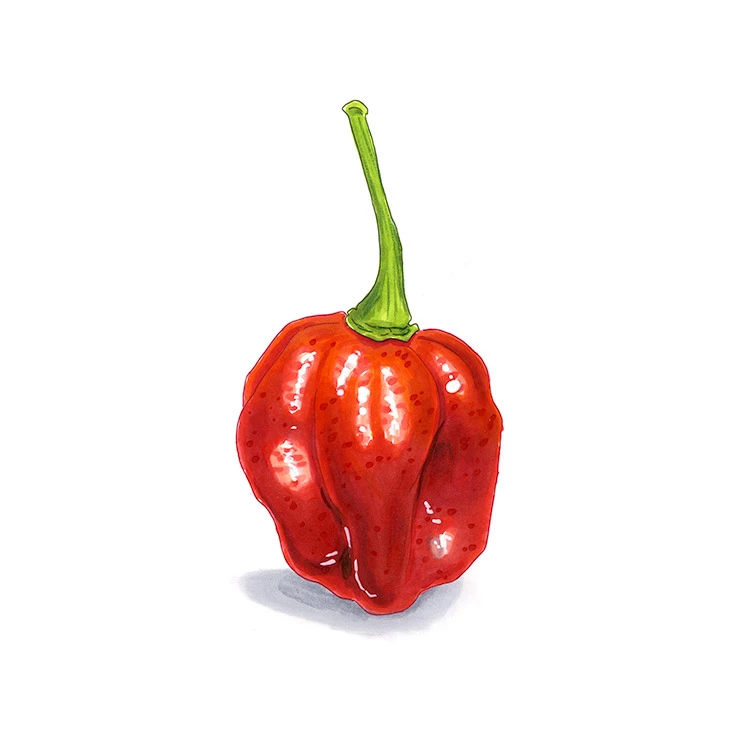
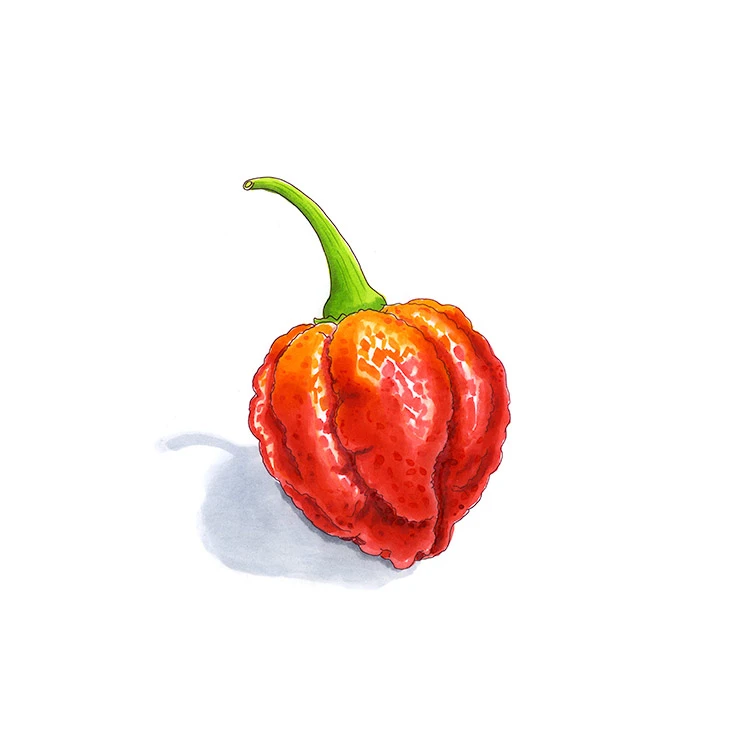
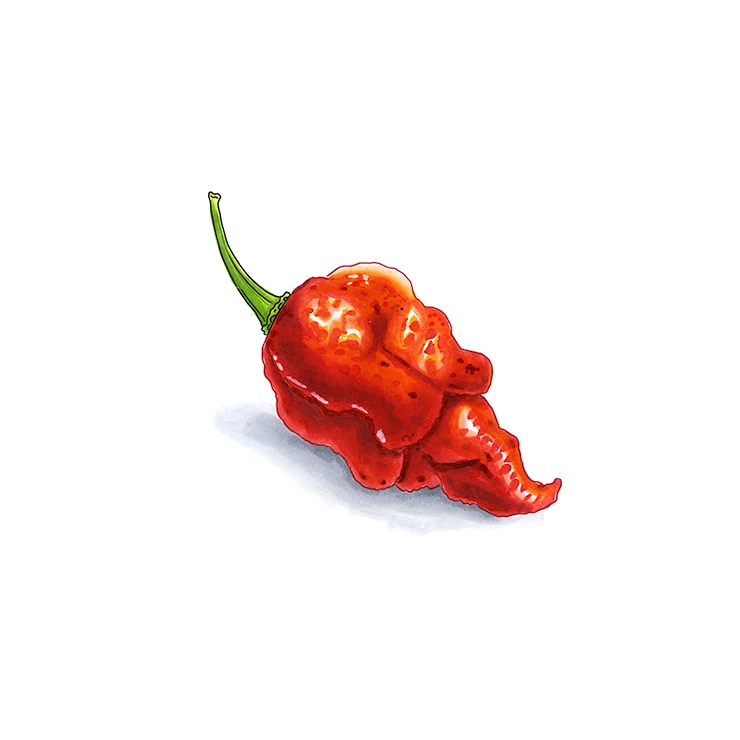
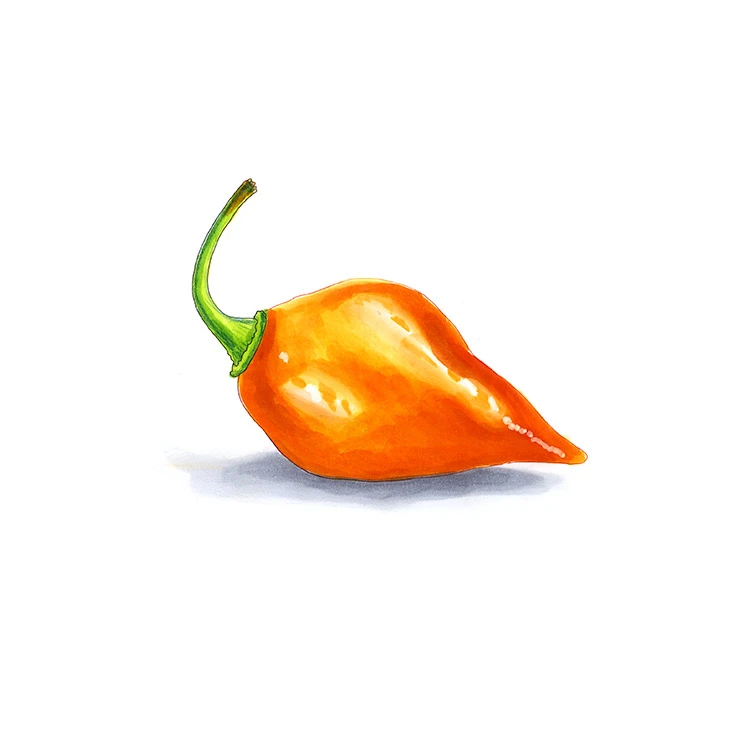
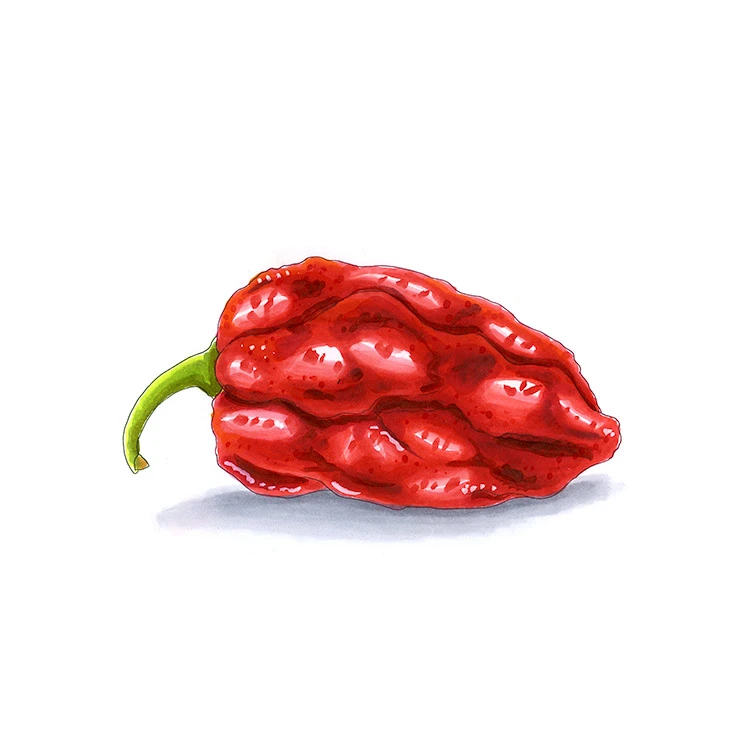
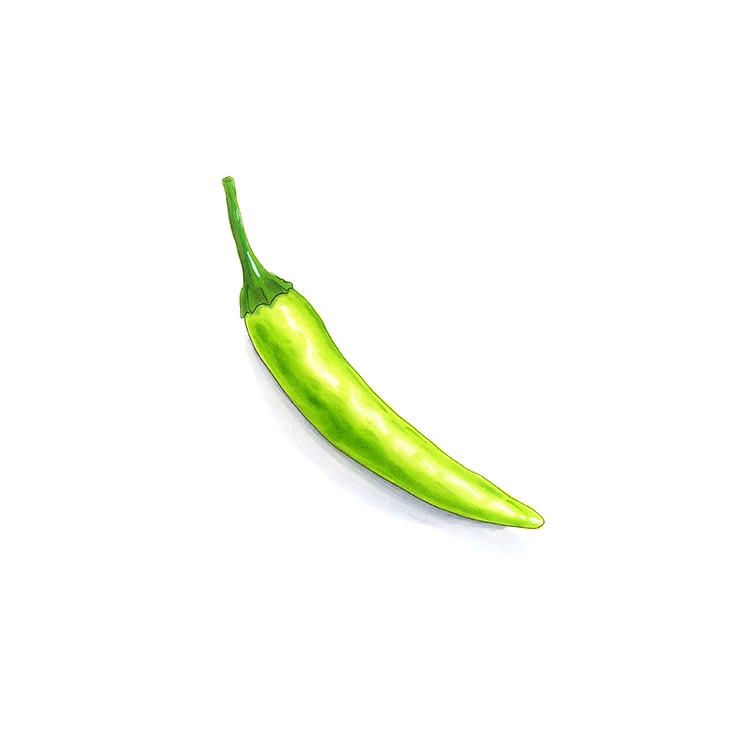
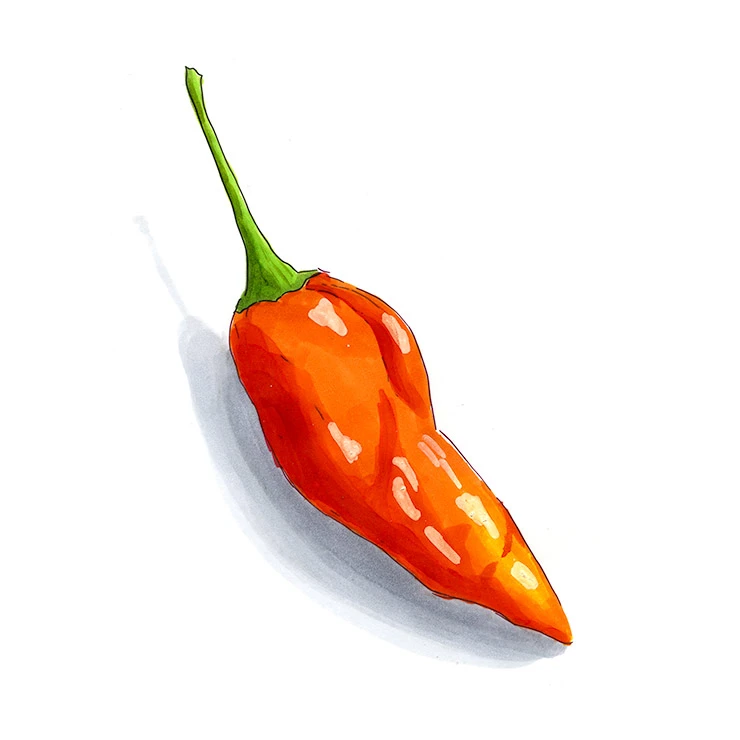
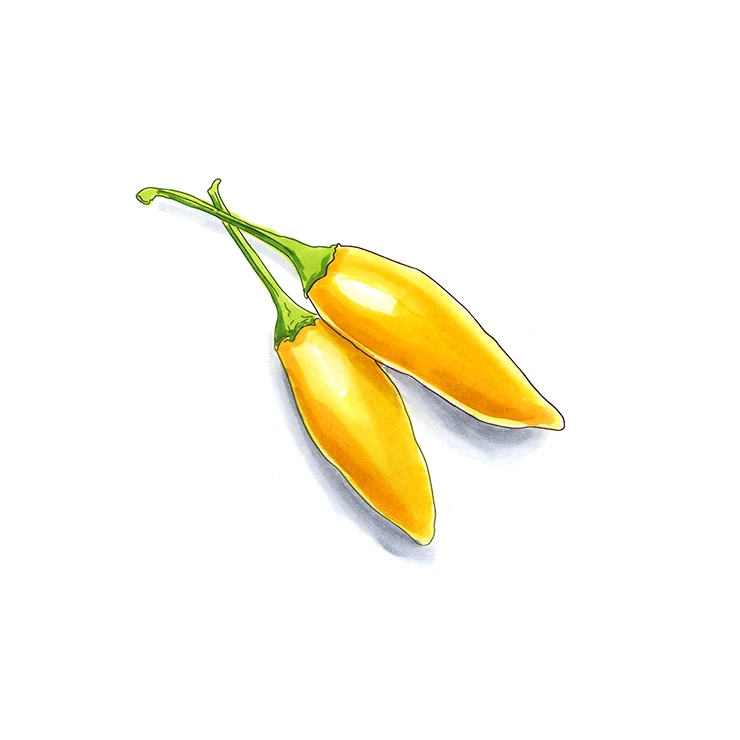
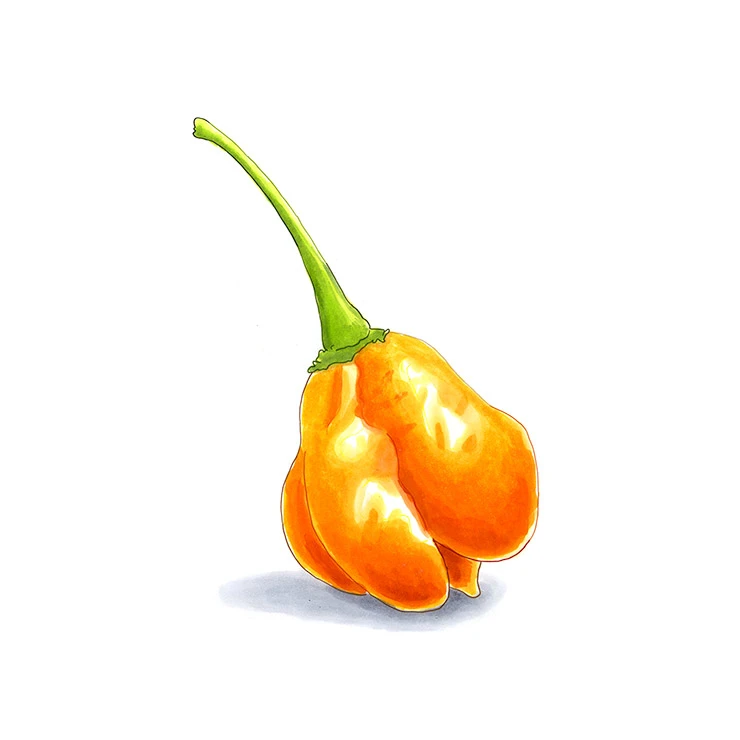
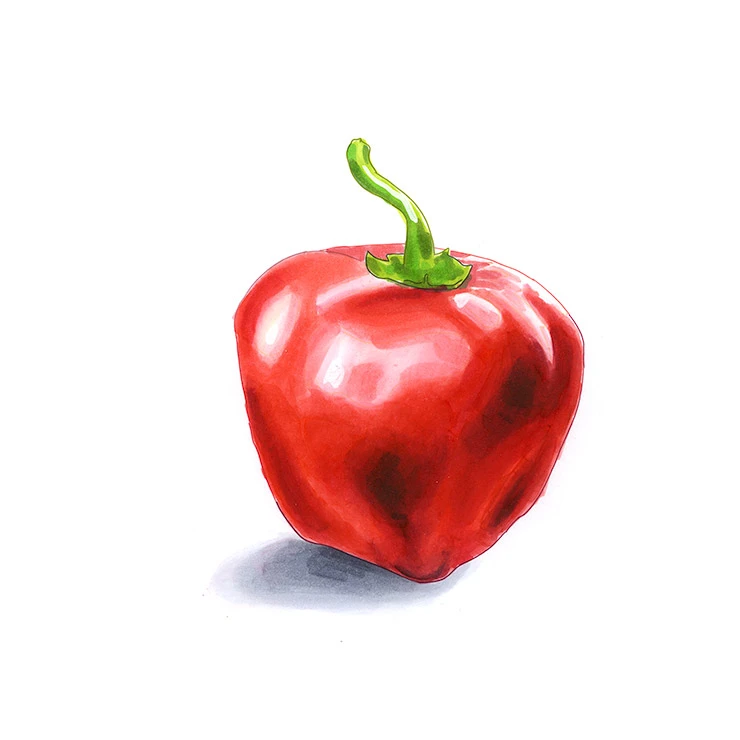
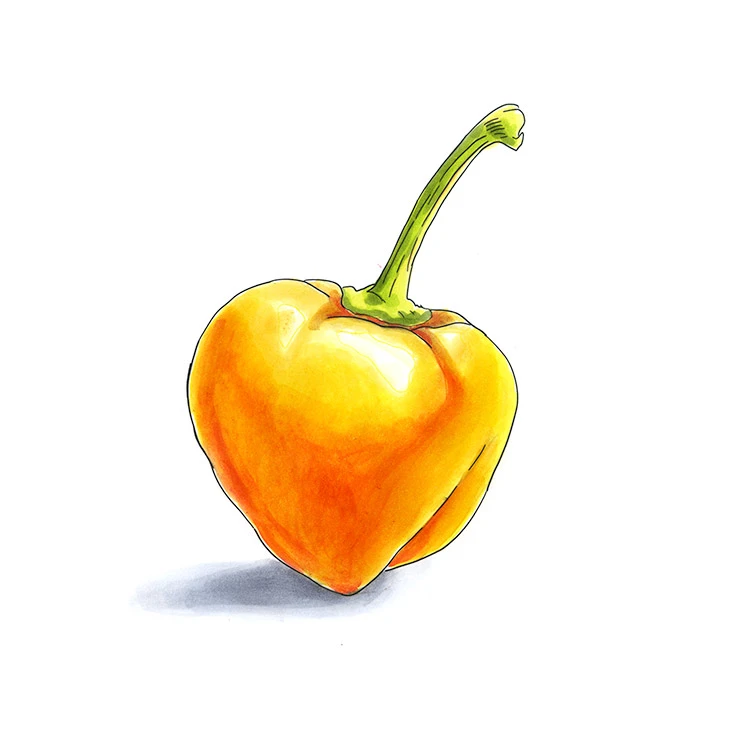
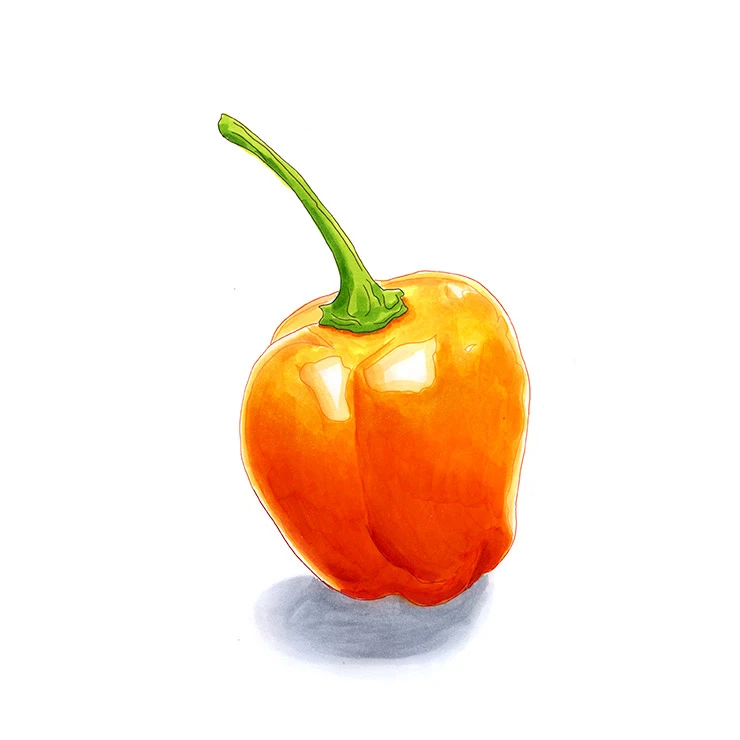
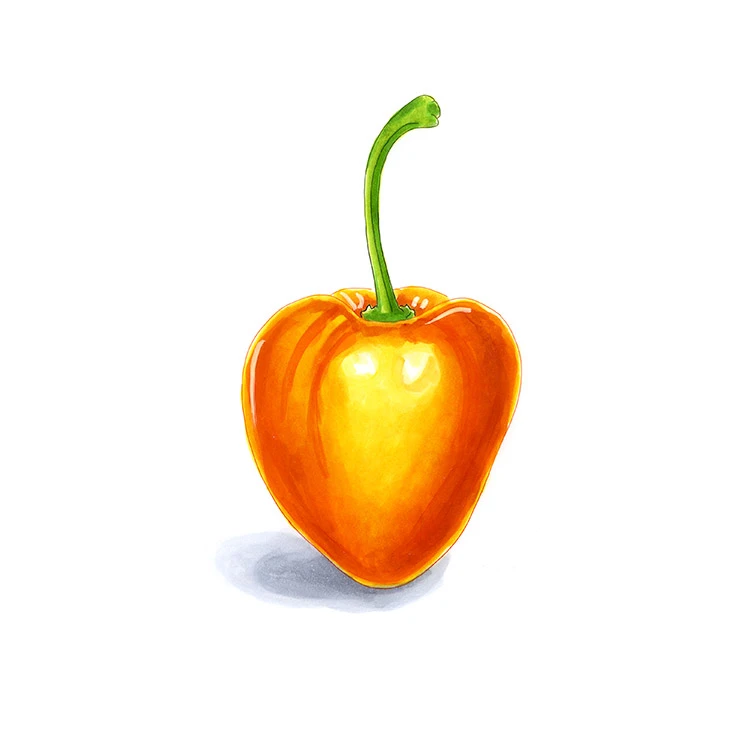
Chili Peppers
of the World

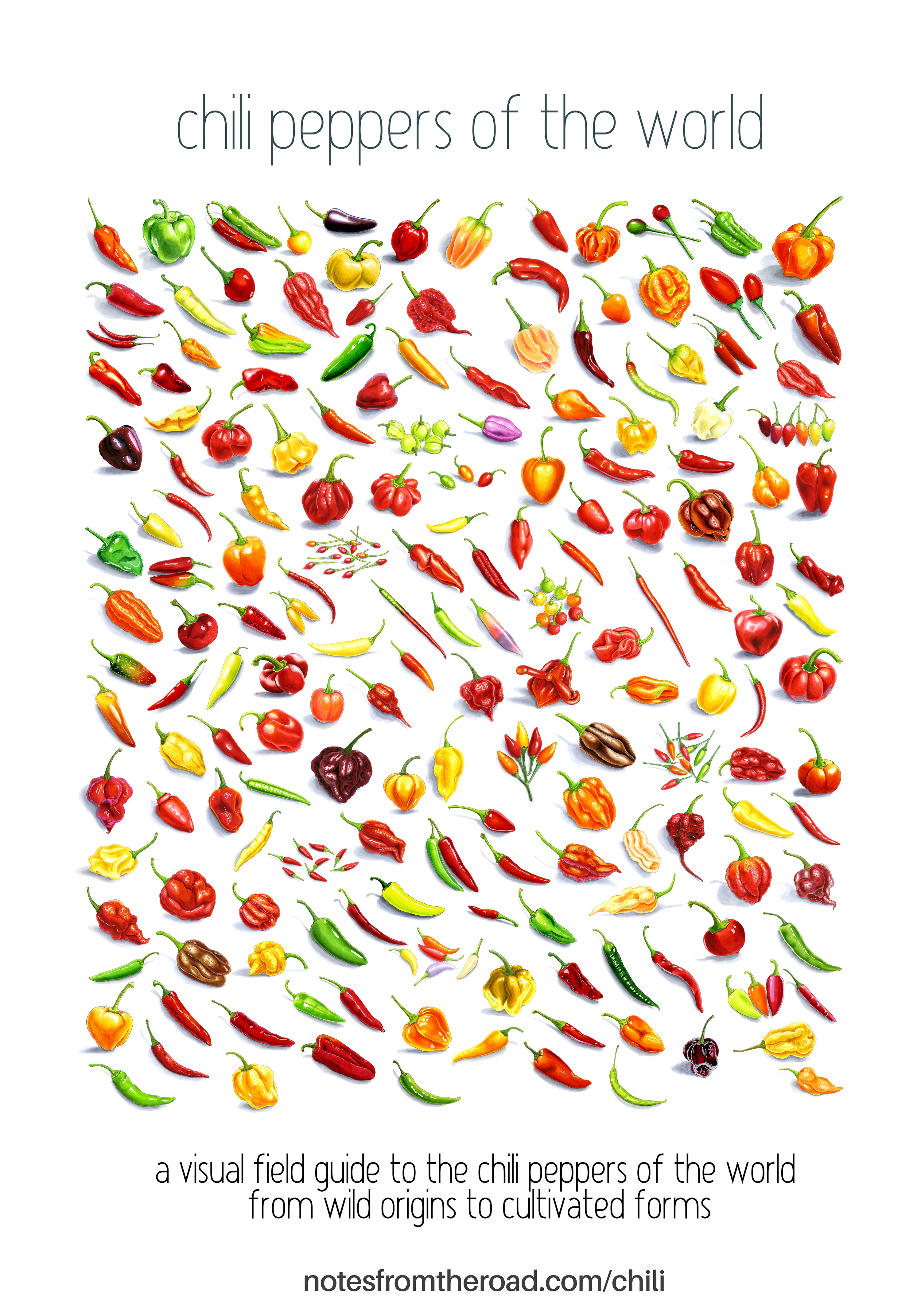
A visual field guide to the chili peppers of the world, from wild origins to cultivated forms, illustrated with 176 hand-drawn peppers.

Field sketch of a bird perched on a branch with bright red wild chili berries, illustrating the evolutionary relationship between birds and early Capsicum species
The Original Wild Chili Pepper Was Designed for Birds

Long before humans cultivated chili peppers, wild species such as Capsicum annuum var. glabriusculum—often called the chiltepin—existed as small, bright berries scattered across tropical and subtropical landscapes. These fruits were part of an ancient ecological exchange between plants and birds. The defining trait of chili peppers, capsaicin, did not evolve for human taste. It evolved to deter mammals, whose teeth would destroy the seeds, while allowing birds to consume the fruit and disperse those seeds intact across forests, deserts, and valleys.
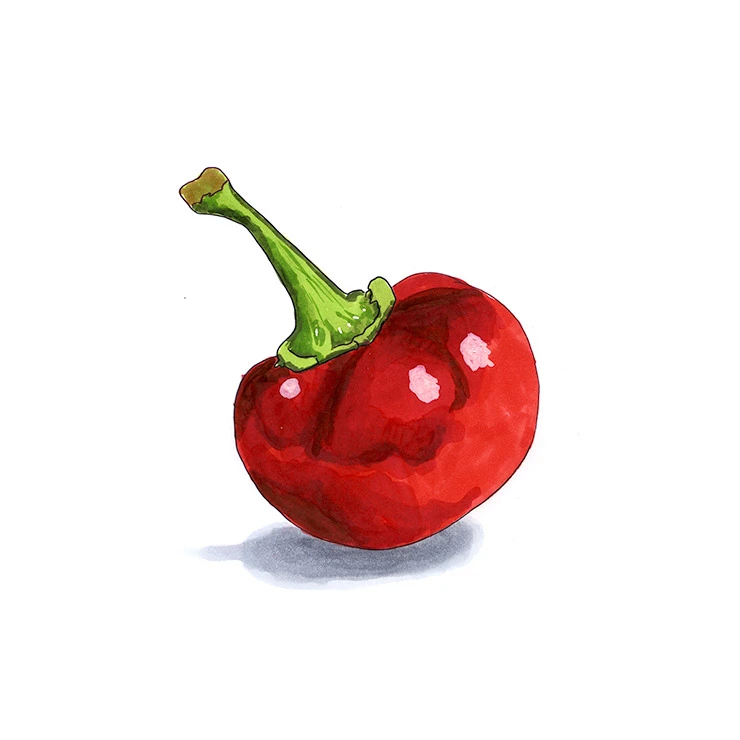
 

What we now recognize as chili peppers are the result of that deep evolutionary system meeting human selection. From a bird-dispersed berry, they became one of the most widely cultivated and culturally important plants in the world—shaped by farmers, cuisines, and trade. Yet the original logic of the plant remains embedded in every pepper: a signal to some animals, a warning to others, and a legacy of a world in which humans were never the intended audience.

From the Americas to the World

Long before chili peppers reached Europe, Africa, or Asia, wild and early cultivated Capsicum spread through the tropical and subtropical Americas. Over time, Indigenous farmers in different regions selected peppers for size, shape, flavor, color, and heat, transforming a small bird-dispersed fruit into a remarkable range of cultivated forms. Out of that long process came the five domesticated species that anchor the history of chili peppers today: Capsicum annuum, Capsicum baccatum, Capsicum chinense, Capsicum frutescens, and Capsicum pubescens.
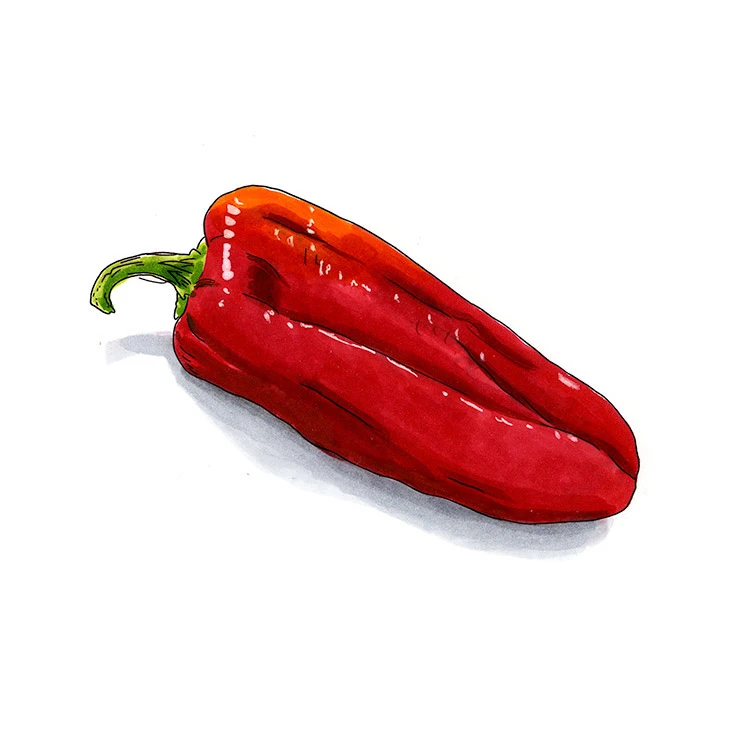
 

After 1492, chili peppers spread with extraordinary speed around the world, moving through imperial trade routes, local markets, and kitchen gardens into Europe, Africa, Asia, and beyond. Few plants were adopted so quickly or so completely. The peppers below trace that story through the major domesticated species and the important cultivars that emerged from them—some ancient, some regional, some modern, but all rooted in an American plant that became global.
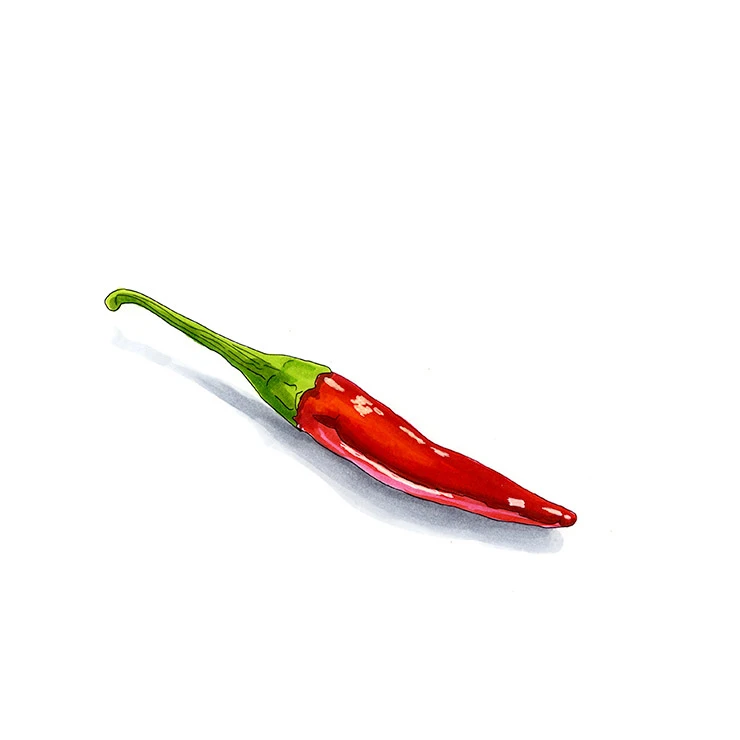
Capsicum annuum

Capsicum annuum is the most widespread and diverse domesticated chili species in the world — and it began in Mexico, somewhere in the arc between Tamaulipas on the Gulf Coast and the highland valleys of Oaxaca, where archaeological evidence places its domestication at least 6,000 years ago. The people who first cultivated it were the ancestors of the civilizations that would become the Olmec, the Maya, and the Aztec — cultures that didn't just eat chiles but organized agriculture, trade, and ritual around them. The Aztecs alone maintained a marketplace in Tenochtitlán where dozens of chile varieties were bought and sold, a sophistication of breeding that the Spanish encountered in the 1500s and carried back across the Atlantic before most of Europe had any idea what a pepper was. Today it ranges from sweet bells to jalapeños, poblanos, cayennes, and nearly all of the dried red chiles that define Mexican regional cooking — the legacy of millennia of indigenous selection, carried forward by farmers who knew exactly what they were doing.
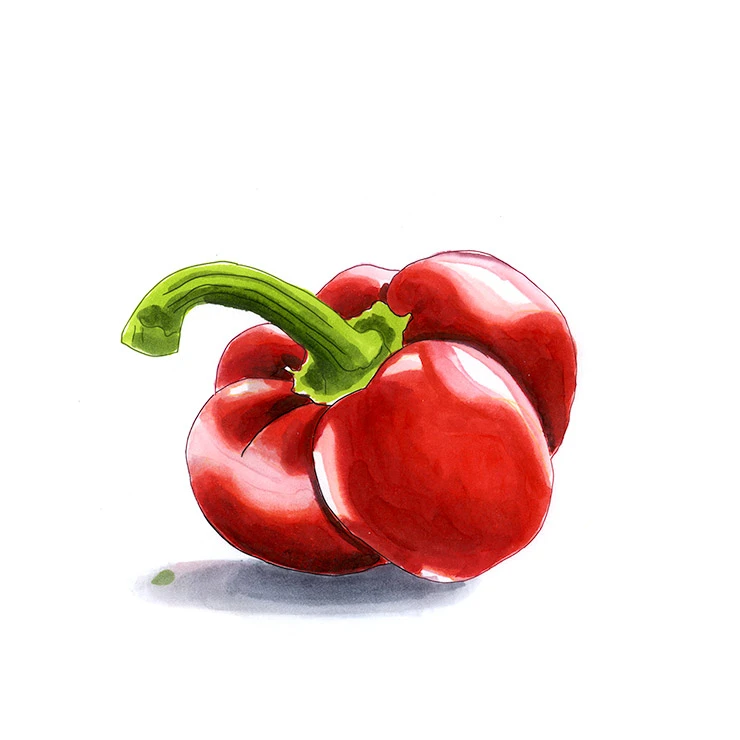
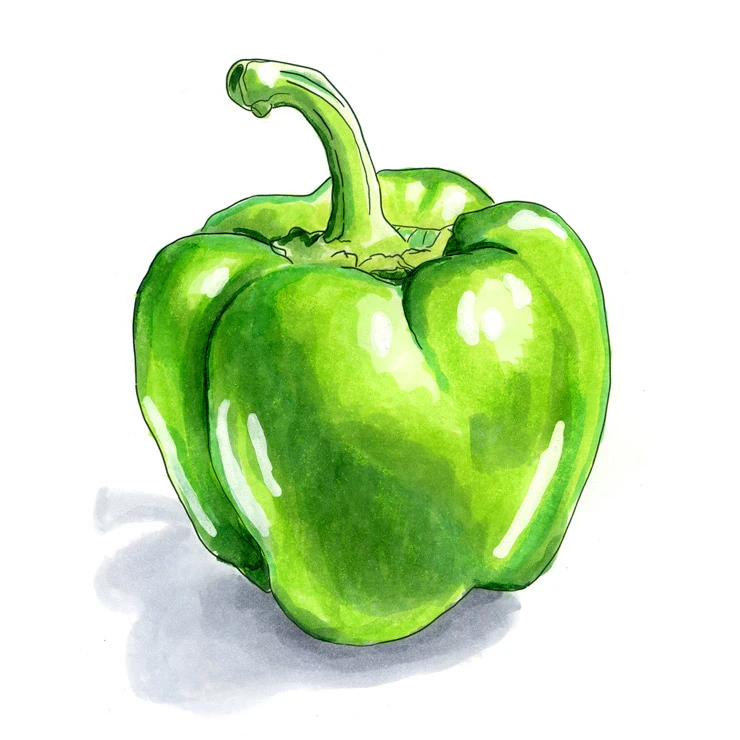
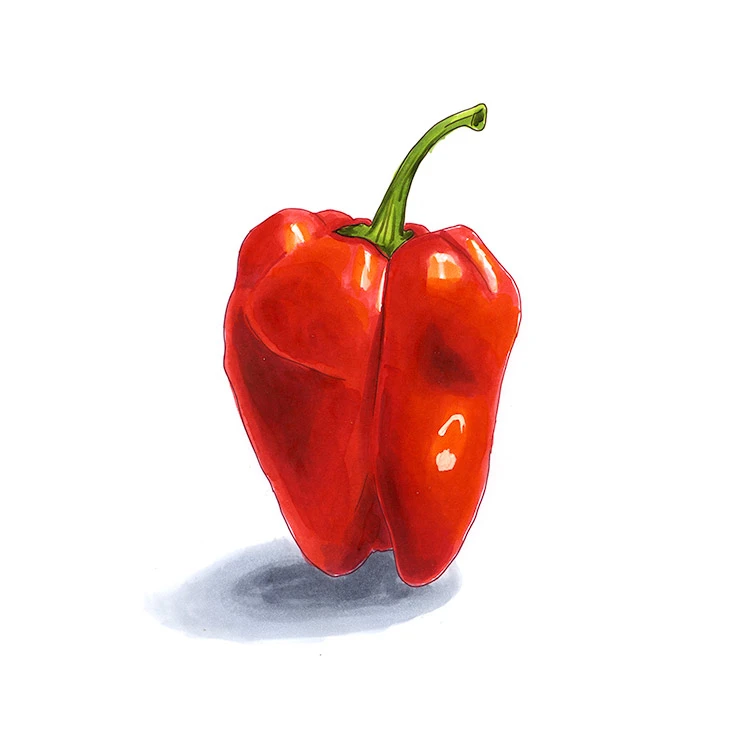
Bell pepper illustrated in watercolor and ink on a white background

Bell Pepper

Breeders selected the heat out entirely: what's left is crunch, sweetness, and color. The breeding of large, capsaicin-free peppers predates the age of Columbus, probably by hundreds of years. Green bells are just unripe; red, orange, and yellow are the same fruit left on the plant longer, sweeter, higher in vitamin C. My wife spent years avoiding the green ones for exactly that reason, until one day she bit into a fresh one and something clicked: that raw, grassy crunch, that sharp brightness the ripe ones don't have. The most widely planted pepper on earth, mild enough for everyone, and capable, apparently, of surprise.

Heat: 0 SHU.
Origin: Mesoamerica, later developed widely in Europe and North America.

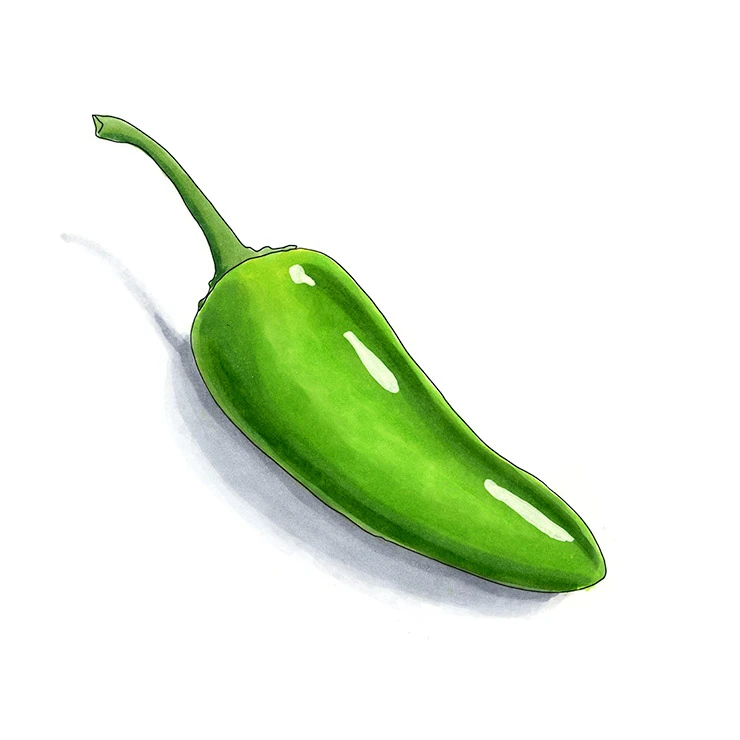
Jalapeño pepper illustrated in watercolor and ink on a white background

Jalapeño Pepper

Mexico's most exported chili, probably the most recognized pepper on earth, coming from Veracruz, where it was traditionally smoked and dried into what we now call chipotle, a preparation so widely commercialized that most people encounter it backwards, learning chipotle first. Fresh, it shows up in salsas and guacamole; smoked, it turns up in everything from taco sauces to BBQ rubs. When I lived in Los Angeles, I used the Angeleno pronunciation for this pepper: "halla-pen-yo", and unwittingly kept saying it the same way when I moved to Portland, where people say “hallapeeno”. Ordered a pizza, rattled it off at the counter, and the Mexican-American man taking my order stopped, looked up, and said: "Sir, are you making fun of me?"

Heat: 2,500-8,000 SHU.
Origin: Veracruz, Mexico.
Dried: Chipotle

Featured sauce: Hella Hot Jalapeño Cucumber Hot Sauce

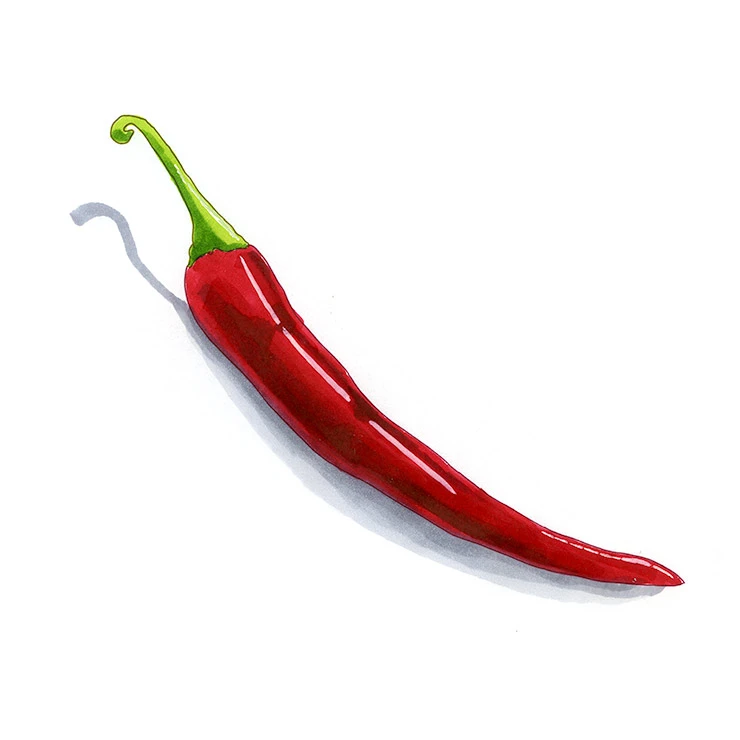
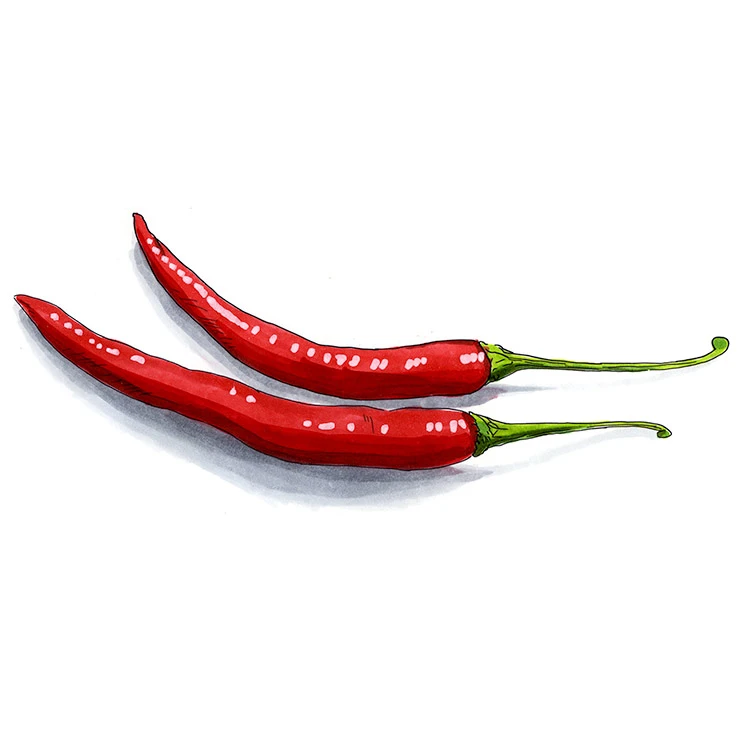
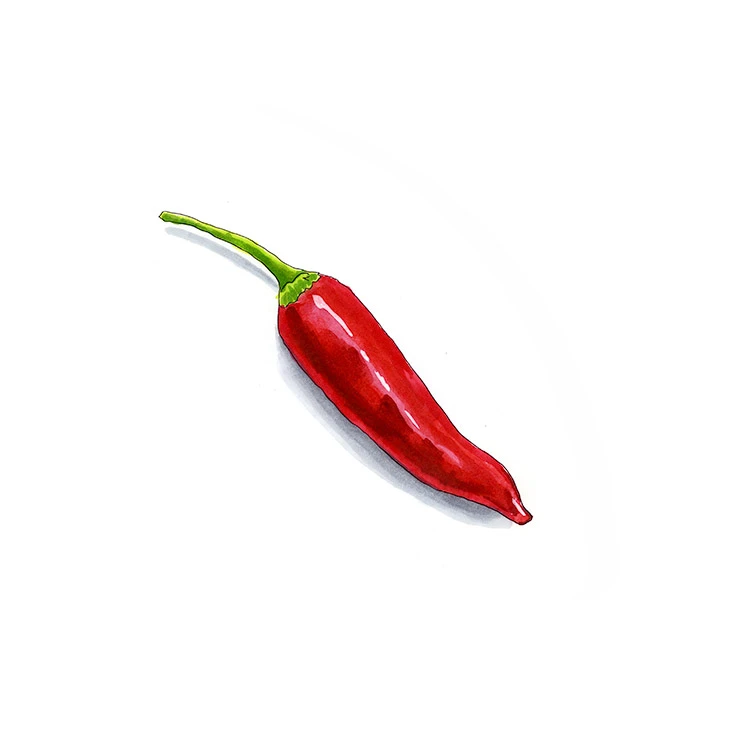
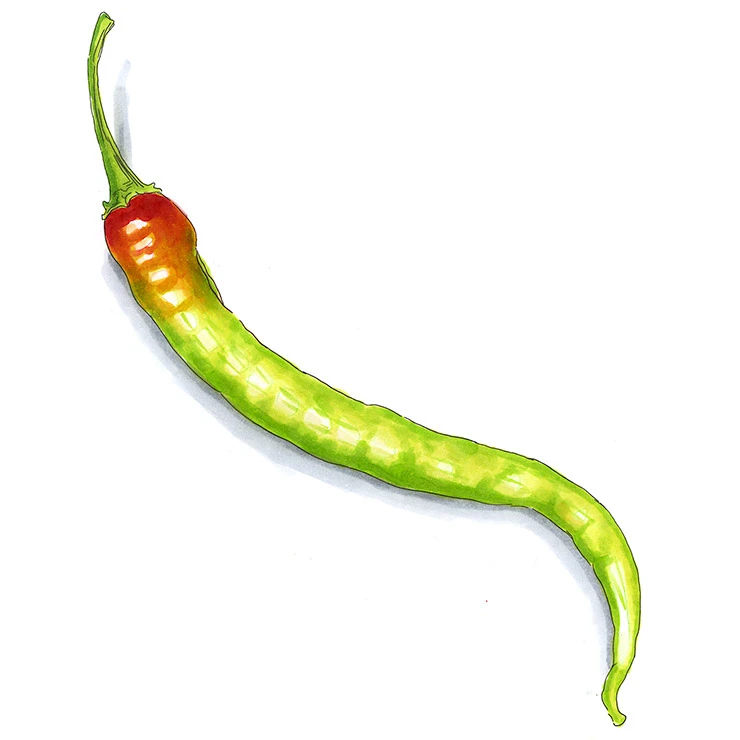
Cayenne pepper illustrated in watercolor and ink on a white background

Cayenne Pepper

Cayenne is the pepper that conquered the world by being useful rather than interesting. Slender, cooperative, dries into a clean red powder without complaint, and Portuguese traders moved it through West Africa and India in the 1500s and it just kept going, embedding itself in cuisines that now can't imagine life before it. Louisiana eventually claimed it for hot sauce. The spice rack claimed it for everything else. It's named after the capital of French Guiana, a jungle-wrapped French territory most people couldn't place on a map, which is fine because the pepper doesn't need the publicity.

Heat: 30,000-50,000 SHU.
Origin: French Guiana (named for the city of Cayenne); spread globally through Portuguese and Spanish trade.
Dried: Cayenne powder

Featured sauce: Frank's RedHot Cayenne Pepper Sauce

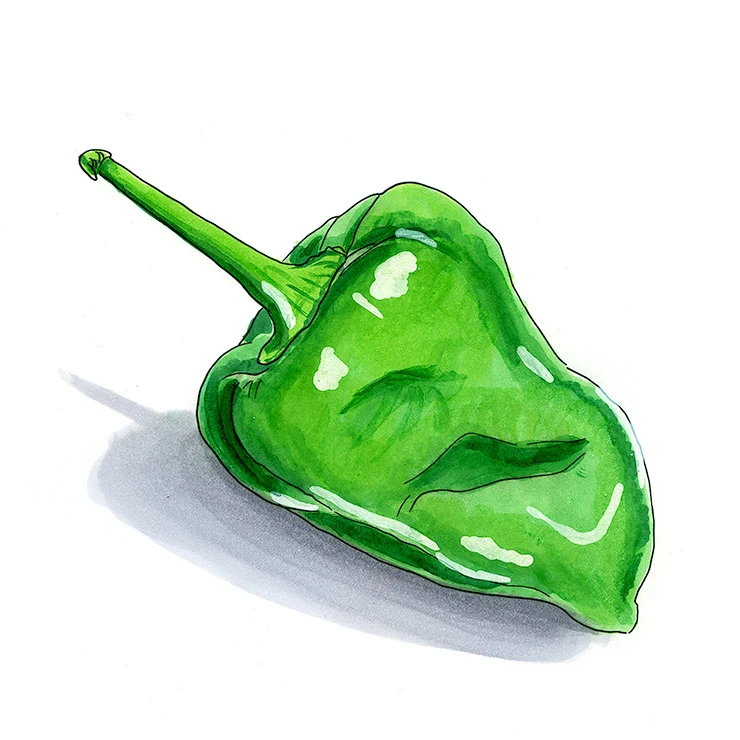
Poblano pepper illustrated in watercolor and ink on a white background

Poblano Pepper

The pepper of Puebla. Poblano peppers are known as both fresh and dry peppers. Dry it and it becomes an ancho, or a mulato. These dried forms create mole negro, mole poblano, sauces that take days and smell like a whole city cooking. Keep it fresh they become chile rellenos: thick walls, lots of smokiness, but also mild enough that you can eat three before you notice. I'm not much of a cook, but chopped poblano simmered in garlic and oil until just soft, then folded into scrambled eggs. That I can manage.

Heat: 1,000-2,000 SHU.
Origin: Puebla, Mexico.
Dried: Ancho / Mulato

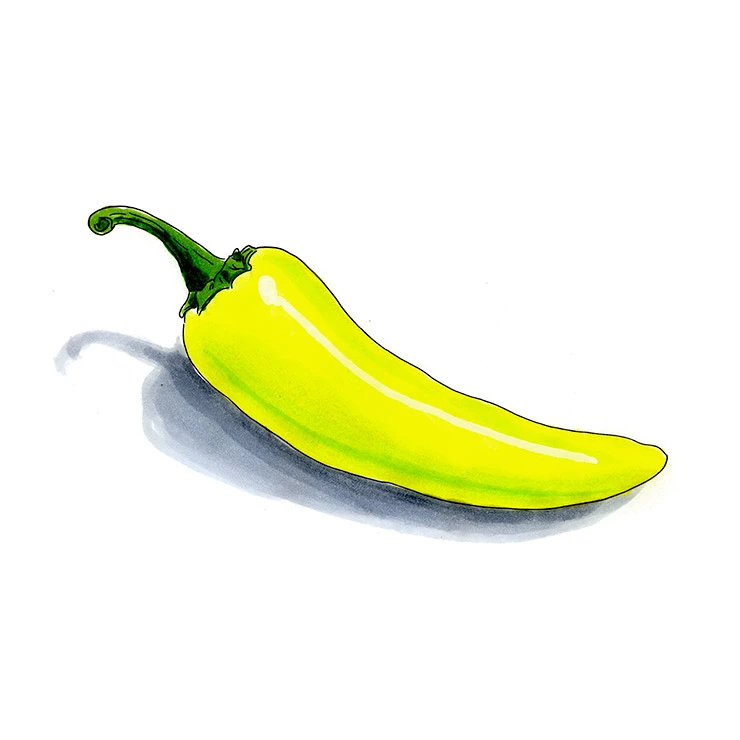
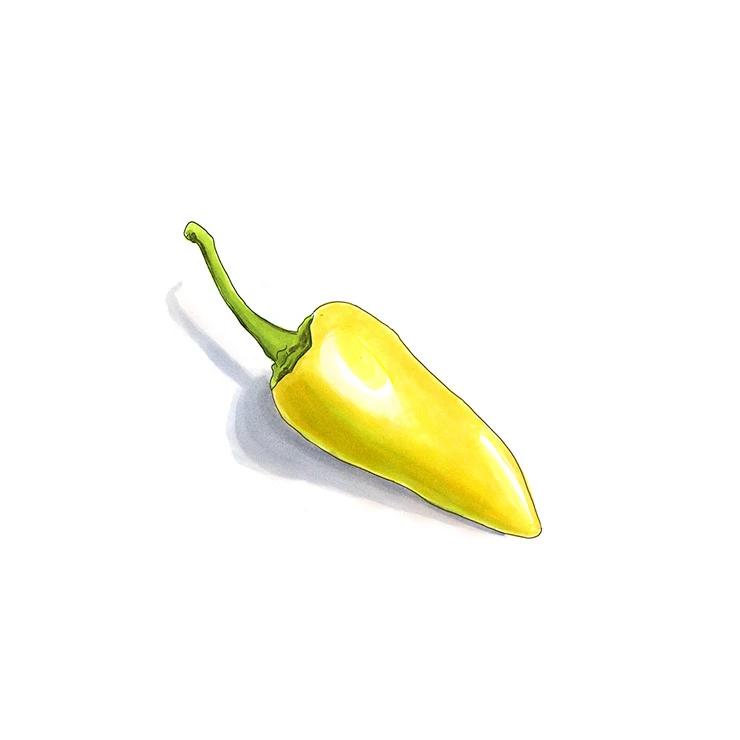
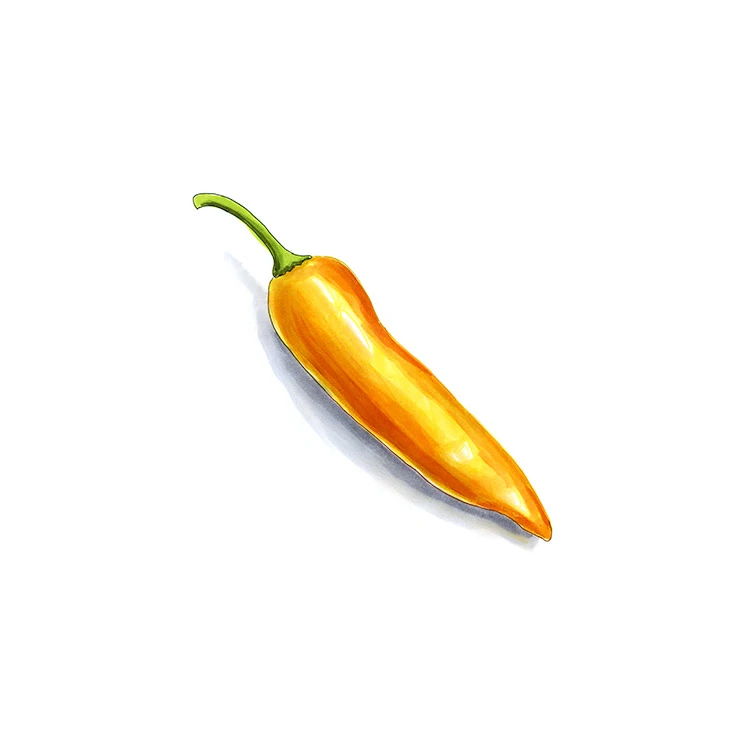
Banana pepper illustrated in watercolor and ink on a white background

Banana Pepper

The banana pepper is a pepper in permanent adolescence: mild, bright yellow, and almost always encountered pickled in a jar next to the olive bar. It has found its niche not in great cuisines but in everyday sandwiches, hoagies, and antipasto plates, where its pickled vinegary tang does more heavy lifting than its heat ever could.

Heat: 0-500 SHU.
Origin: Developed in the United States from Capsicum annuum lines.

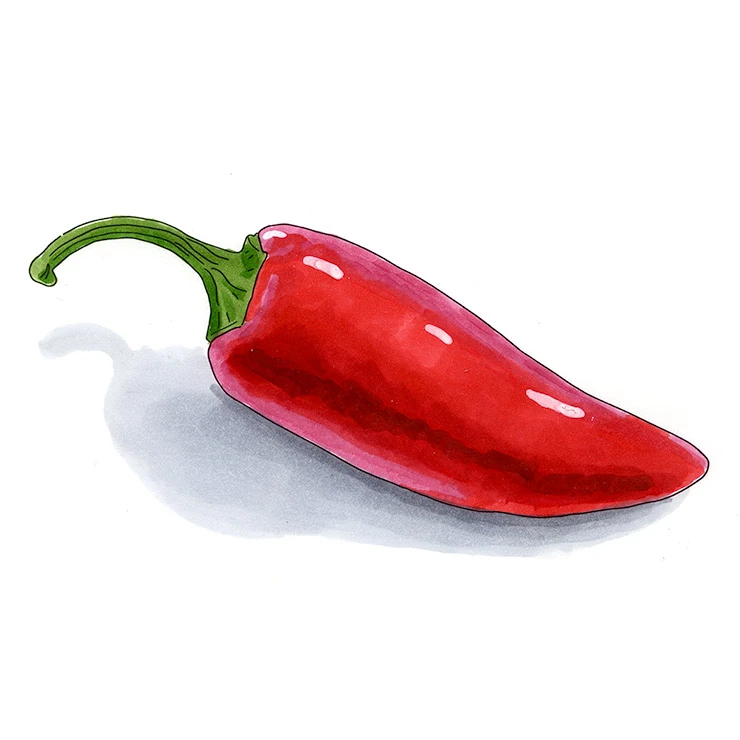
Fresno pepper illustrated in watercolor and ink on a white background

Fresno Pepper

Clarence Brown Hamlin bred it in 1952 and named it for the California city where it first went into the ground. Ripe and red, it runs fruitier and a little brighter than a jalapeño, not just hotter, but different in character, which is why it shows up in salsas and hot sauces that want flavor doing as much work as the heat. Bartenders figured this out, and so they use fresnos when they need more heat and more color. Think: spicy margaritas, chili-infused syrups and spirits that need heat with color.

Heat: 2,500-10,000 SHU.
Origin: California, United States.

Featured sauce: Pulp Chili Fresno Chili Hot Sauce

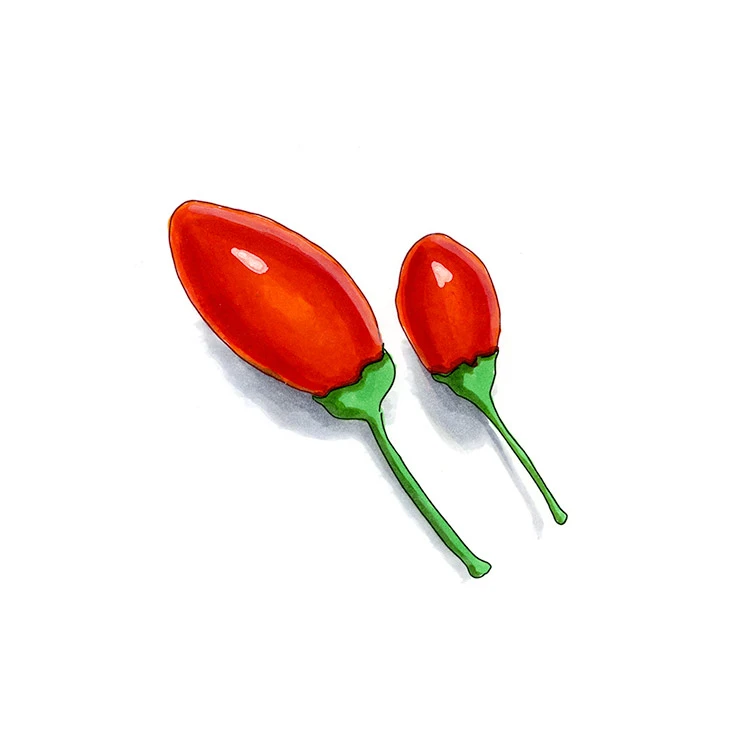
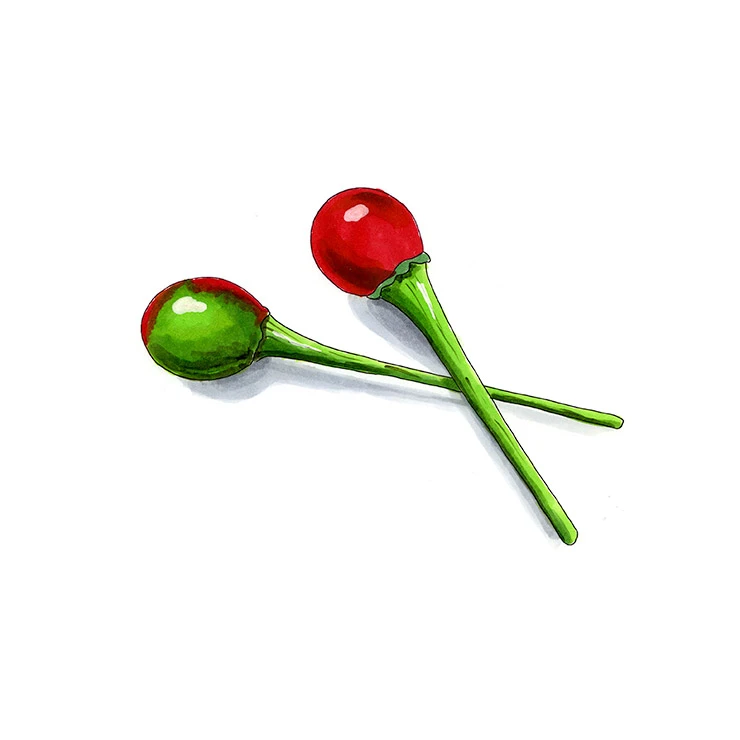
Chiltepin pepper illustrated in watercolor and ink on a white background

Chiltepin Pepper

The chiltepin is the mother of all Mexican chiles. Wild, undomesticated, and still dispersed by birds across the Sonoran Desert, Mexico, Central America and northern South America just as it was thousands of years ago. Indigenous peoples have harvested it from desert scrub for millennia; the Tohono O'odham called it tepin, the Aztec used it in medicine and cooking both. It is legally protected in the United States, and in Mexico, its conservation is becoming more of a priority, which makes the fact that it's hotter than a jalapeño by a factor of twenty very, very cool.

Heat: 50,000-100,000 SHU.
Origin: Northern Mexico and the Desert Southwest.

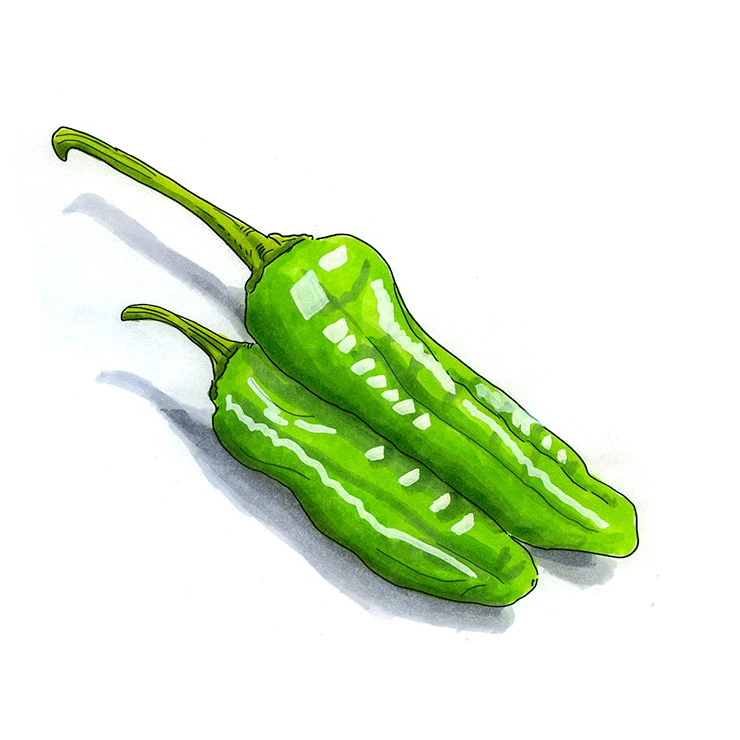
Shishito pepper illustrated in watercolor and ink on a white background

Shishito Pepper

The shishito arrived in American restaurants around 2010 and almost immediately became a fixture on every small-plates menu from Brooklyn to Portland. In Japan, it's been blistered in oil and salted as a snack for much longer. The name comes from the Japanese for lion's head, a reference to the wrinkled tip. One in ten is hot. Regulars argue whether that ratio has changed. It probably hasn't. Grilling shishitos in olive oil and salt is one of my favorite moments of summertime.

Heat: 50-200 SHU.
Origin: Japan, from East Asian Capsicum annuum cultivation.

Paprika pepper illustrated in watercolor and ink on a white background

Paprika Pepper

My older brother makes his own smoked paprika from local peppers. The difference from the tin is not subtle: it smells like something actually happened to it, and the flavor hits in a way that store-bought just doesn't. Paprika peppers are mild, thick-fleshed, bred for drying and grinding rather than eating fresh. Hungary and Spain turned them into culinary traditions, goulash, chorizo, pimentón, but the pepper itself is older than either of those cuisines, an American plant that found its second life in European hands. Making it yourself, as my brother figured out, is a reminder of this chili’s incredible power on cuisine.

Heat: 250-1,000 SHU, often lower.
Origin: New World origins, later strongly developed in Hungary and Spain.

Serrano pepper illustrated in watercolor and ink on a white background

Serrano Pepper

The serrano is what the jalapeño thinks it is. Smaller, hotter, and it stays crisp when you eat it raw, which matters, because this is a fresh chile, not a dried one. It goes into pico de gallo and guacamole and anywhere else you want heat that bites clean rather than builds slow. Named for the mountain ridges of Puebla and Hidalgo where it came from, it's still one of the most grown chiles in Mexico. The jalapeño gets the fame. The serrano gets used.

Heat: 10,000-23,000 SHU.
Origin: The Mexican highlands, especially Puebla and Hidalgo.

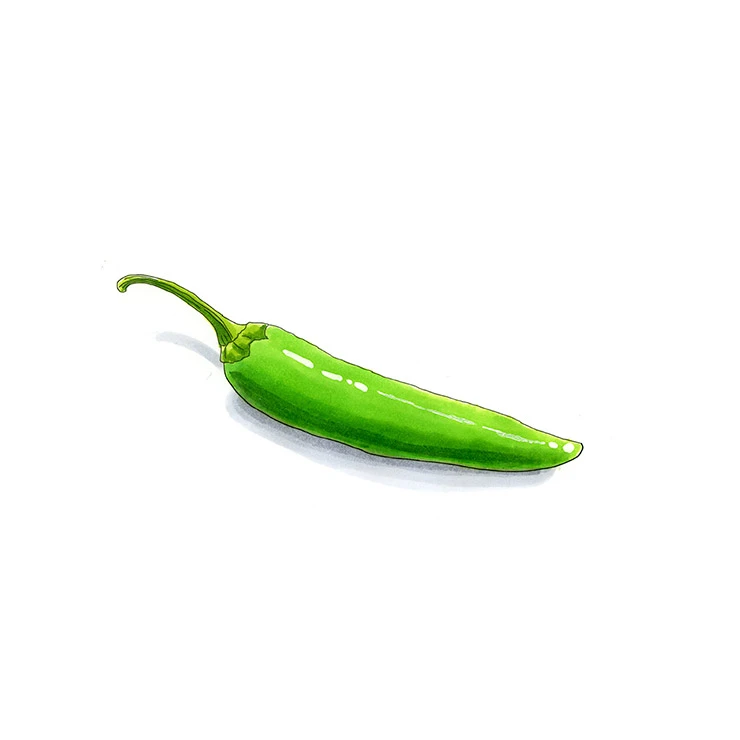
Anaheim pepper illustrated in watercolor and ink on a white background

Anaheim Pepper

Anaheim peppers go back to a New Mexico chile strain which were brought to Southern California around 1900 by Emilio Ortega, the same man whose name is seen on chili products across North America. He founded one of the first Mexican food companies in the United States. The name stuck to the California-grown version, while the same plant dried red became the Colorado chile. It remains the go-to pepper for roasting in the Southwestern kitchen: it’s mild enough for a crowd, substantial enough to carry a dish.

Heat: 500-2,500 SHU.
Origin: New Mexico stock later developed in California, United States.
Dried: Colorado

Mirasol pepper illustrated in watercolor and ink on a white background

Mirasol Pepper

You probably recognize the mirasol pepper for its fruits which grow facing upwards, which is exactly what its name means. Once dried, it becomes ‘guajillo’, and at that point it's practically everywhere: enchilada sauces, adobos, mole rojo, things you've eaten a hundred times. Mild heat, fruity, not complicated. It's not the chile anyone gets excited about, which is maybe the point. Some ingredients just hold things together without making a fuss about it.

Heat: 2,500-5,000 SHU.
Origin: Zacatecas and Durango, Mexico.
Dried: Guajillo

Chilaca pepper illustrated in watercolor and ink on a white background

Chilaca Pepper

The chilaca is the fresh form that most people never see, because almost all of them become pasilla. Dried and dark, the pasilla (little raisin) earns its name from the wrinkled skin it develops in drying. It's one of the three dried chiles, along with ancho and mulato, that form the backbone of classic mole negro, a sauce with a recipe list so long it became a test of a cook's patience and skill.

Heat: 1,000-2,500 SHU.
Origin: Michoacán and Guerrero, Mexico.
Dried: Pasilla

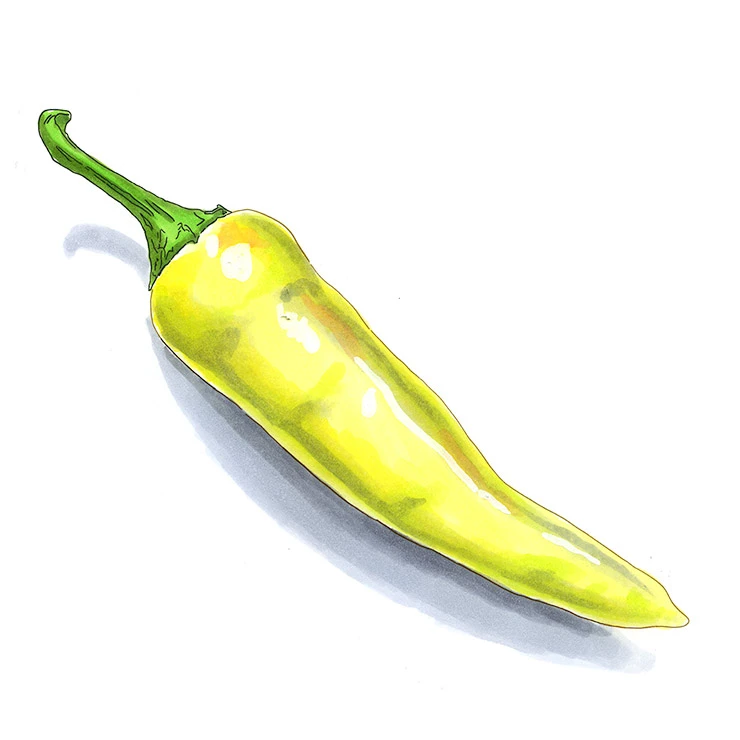
Hungarian wax pepper illustrated in watercolor and ink on a white background

Hungarian Wax Pepper

The Hungarian wax looks like it should be mild, that pale yellow waxy skin suggesting a banana pepper, but it can carry real heat, sometimes running hotter than it has any business doing at that color stage. In Central European kitchens it's a standard pickling pepper, the kind that ends up in jars on a shelf without much fanfare, doing quiet useful work. In Hungarian cooking it gets stuffed with meat and rice and simmered in tomato sauce, which is a preparation that has been feeding people through long winters for generations and which takes on a certain extra dimension when the pepper you chose turns out to be one of the hot ones. You find out halfway through the bowl. There are worse surprises.

Heat: 5,000-15,000 SHU.
Origin: Hungary.

Featured sauce: Búfalo Salsa Clasica Mexican Hot Sauce

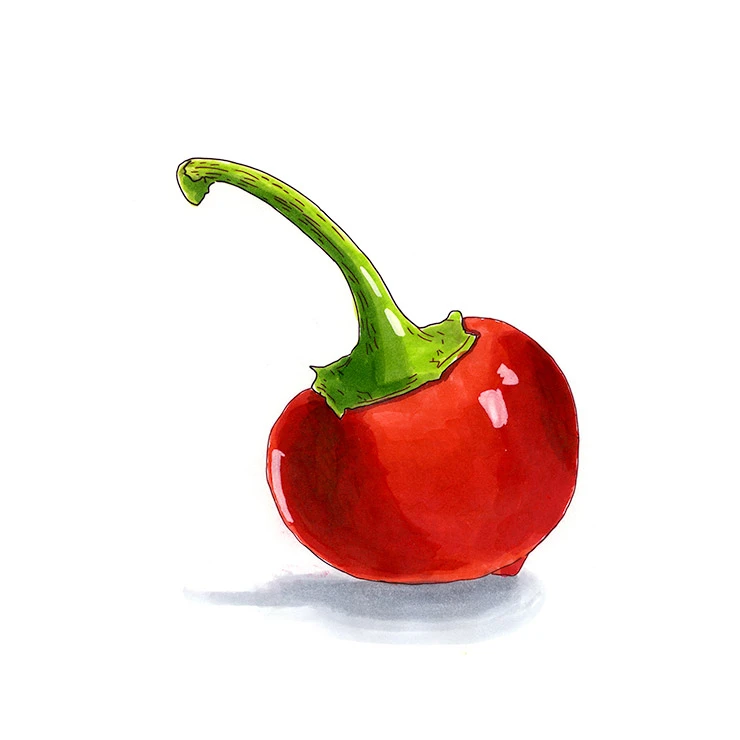
Cherry pepper illustrated in watercolor and ink on a white background

Cherry Pepper

Cherry peppers are among the oldest cultivated forms of annuum in Europe, where their round, compact shape made them natural candidates for pickling and stuffing. In Italian-American deli culture they became beloved as part of the antipasto spread, and as the invisible ingredient in the iconic sweet-and-hot stuffed cherry sold at Italian groceries everywhere. The range from sweet to genuinely hot varies by cultivar, which keeps things interesting.

Heat: 100-3,500 SHU.
Origin: Europe and North America from earlier New World pepper lines.

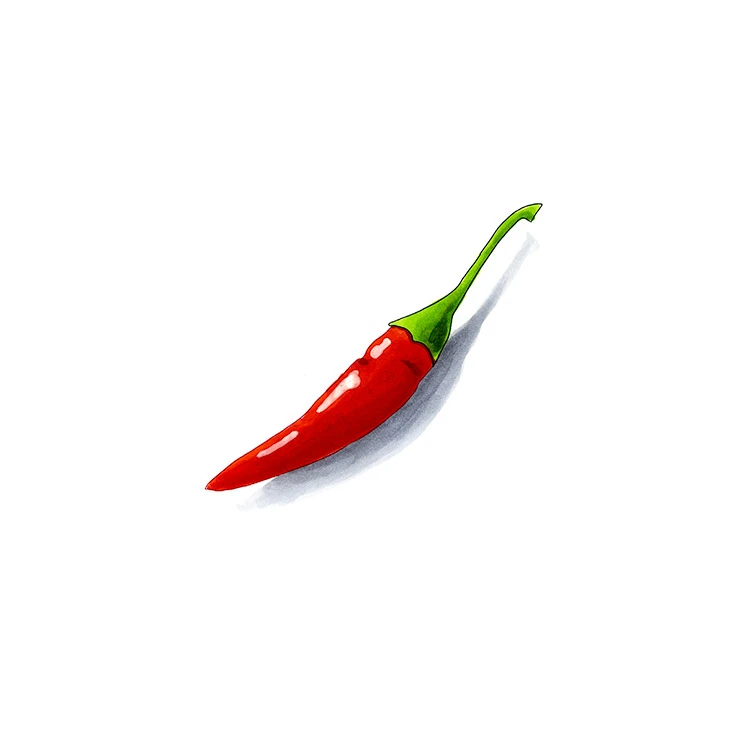
De árbol pepper illustrated in watercolor and ink on a white background

De Árbol Pepper

De árbolpeppers are the chilis of Mexican street heat. Everybody knows them as the dried chilis hung on strings and hanging in kitchen doorways. It is also the pepper that makes those table salsas that make you sweat through your shirt. The translation, "Tree chili" refers to the shrubby plant it grows on, but the peppers themselves are the opposite of sturdy. They are slender, brittle when dry, and bright with a clean capsaicin burn that hits fast. It's the chile inside chile de árbol salsa. That’s the hot one at Mexican restaurants that makes the chef know you’re legit.

Heat: 15,000-30,000 SHU.
Origin: Jalisco and Nayarit, Mexico.

Featured sauce: Cholula Hot Sauce

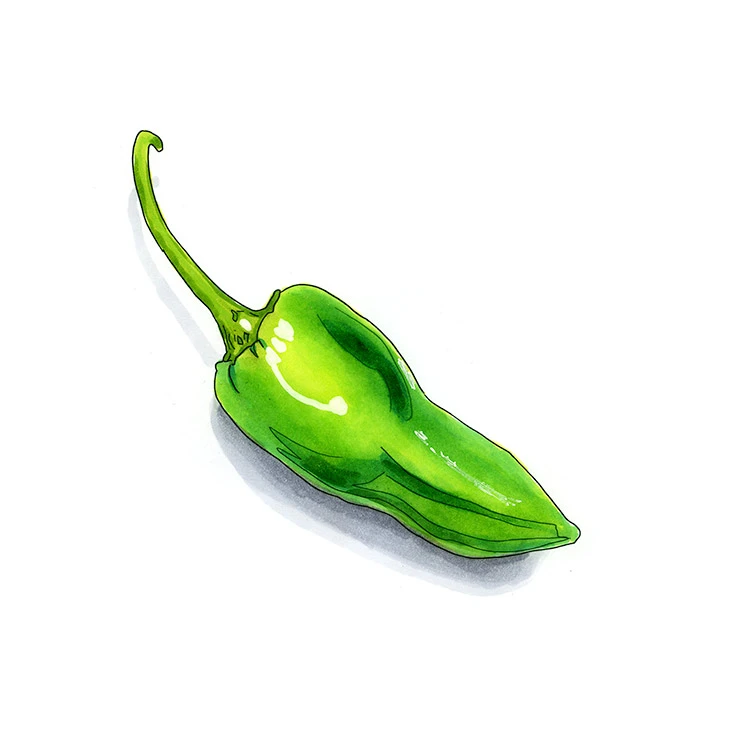
Padrón pepper illustrated in watercolor and ink on a white background

Padrón Pepper

Padrón peppers come from a small municipality in Galicia, in the wet, green, emphatically un-Mediterranean northwest corner of Spain, which is already an interesting origin story for something so associated with summer eating. For most of the season they're mild and sweet, blistered in olive oil, finished with coarse salt, eaten straight from the pan with a drink in the other hand, they're one of the great simple pleasures of the Spanish table. But as summer grinds on and the heat builds, something shifts, and a certain percentage of the crop turns hot without any outward warning. You cannot tell by looking. You find out when you bite. This is the source of the Galician saying that every menu in Spain has felt obligated to print ever since: os pementos de Padrón, uns pican e outros non. Some are hot, some are not. The roulette aspect of these peppers is inseparable from their pleasure. I had my first grilled Padróns while visiting my Spanish cousin in Madrid. It was the dish that made me fall in love with tapas.

Heat: 500-2,500 SHU, occasionally higher.
Origin: Padrón, Galicia, Spain.

Italian frying pepper illustrated in watercolor and ink on a white background

Italian Frying Pepper

You've eaten these without knowing their name. They're the peppers in sausage and peppers, in peperonata, in whatever came out of the pan at your Italian grandmother's that made the whole kitchen smell different. Cooked in olive oil they go soft and sweet, sometimes with onions and tomatoes, sometimes on their own. The heat is basically nothing. What they have instead is flavor that gets better the longer you leave them alone in the pan.

Heat: 0-500 SHU.
Origin: Mediterranean cultivation from New World pepper ancestry.

New Mexico chile pepper illustrated in watercolor and ink on a white background

New Mexico Chile Pepper

The New Mexico chile has one of the clearest regional identities of any American pepper, tied to a cuisine, a landscape, and a question that New Mexicans ask every fall as seriously as they mean it: red or green? Both come from this plant. When New Mexico peppers are fresh and roasted, they become what New Mexicans call “green chile”. This is the base of the green chile stew and green chile cheeseburger that is known across the state. Left to ripen and dry, they become the “red chile” of ristras and enchilada sauce. They are also a pepper that shares a culinary culture with roots in Indigenous and Spanish colonial life that goes back centuries. When I traveled to Farmington with my friend Brian, he ordered his Enchiladas as “Christmas” - both red and green.

Heat: 1,000-5,000 SHU.
Origin: New Mexico, United States, from earlier Mexican chile lines.
Dried: Red chile

Hatch chile pepper illustrated in watercolor and ink on a white background

Hatch Chile Pepper

Hatch is not a variety — it's an address. The peppers grown in the Hatch Valley of southern New Mexico come out of alkaline soil at high altitude with long hot days, and growers elsewhere have been trying to match that combination for decades without quite getting there. Every fall the Hatch Chile Festival pulls in tens of thousands of people, and across the Southwest you start smelling roasting peppers in wire drums in grocery parking lots before you even see the signs. New Mexicans don't treat this as a regional specialty. It's more like a fact about who they are. Jane and I visited the Hatch Chili Festival in the early days of Notes from the Road, when global chili culture was top of my mind (White Sands), and Barbur World Foods here in Portland has Hatch Chili Pepper roasting days in the summer.

Heat: 1,000-8,000 SHU.
Origin: Hatch Valley, New Mexico, United States.

Numex Big Jim pepper illustrated in watercolor and ink on a white background

Numex Big Jim Pepper

Big Jim was developed at New Mexico State University in 1975 by Dr. Roy Nakayama and named for James Lytle, a local grower who helped fund the research. It holds the Guinness World Record for longest chile pepper variety and remains the most widely grown cultivar in the Hatch Valley. Its large size makes it the standard choice for roasting and stuffing, and in a chile-growing culture where yields and performance matter as much as flavor, Big Jim has defined the modern New Mexico industry for half a century.

Heat: 2,500-3,000 SHU.
Origin: New Mexico State University breeding program, United States.

Santa Fe Grande pepper illustrated in watercolor and ink on a white background

Santa Fe Grande Pepper

The Santa Fe Grande is one of those cheerful utility peppers that earns its place through sheer adaptability, pickled in jars at Southwestern restaurants, eaten fresh as a medium-heat snack, or roasted when mature and red. It was developed in New Mexico and went national before most specialty peppers did, showing up in commercial pickling operations and home gardens both. The heat range is all over the place, which is part of the fun and keeps everybody honest.

Heat: 500-7,000 SHU.
Origin: Southwestern United States.

Corno di Toro pepper illustrated in watercolor and ink on a white background

Corno di Toro Pepper

The Corno di Toro, bull’s horn, is a southern Italian heirloom that reaches lengths most peppers don't bother with. Grown in Calabria, Campania, and Basilicata, it's a sweet frying pepper of the simplest ambitions: oil, heat, maybe a little garlic. It's the pepper of late August markets in Naples, hanging in bunches, still warm from the field, next to jars of peperoni cruschi, the crumbled dried version that shows up in pasta and legume dishes across the south.

Heat: 0-500 SHU.
Origin: Italy.

Jimmy Nardello pepper illustrated in watercolor and ink on a white background

Jimmy Nardello Pepper

Giuseppe Nardello left Ruoti in southern Italy in 1887 and brought this pepper to Connecticut with him. His son Jimmy kept growing it. For a while that was enough, until it wasn't, and the Seed Savers Exchange is the reason it still exists. Now it has a dedicated following among chefs and gardeners who prize it for the way it fries: thin skin, sweet dense flesh, no heat, quick to collapse into something almost jammy in the pan. One of the great rescued flavors in American gardening.

Heat: 0-100 SHU.
Origin: Italian heirloom, preserved and grown in the United States.

Guindilla pepper illustrated in watercolor and ink on a white background

Guindilla Pepper

The guindilla pepper is the pickled pepper of the Basque Country. It’s thin and pale green, always served in brine, and always served alongside anchovies and olives in pintxos bars. It has a gentle heat, and its key is actually its acidity. It’s so common in Basque country that a table without it would be unusual. Outside the Basque kitchen, few people know about guindillas. But that’s part of their charm; an entirely local pepper.

Heat: 1,000-2,500 SHU.
Origin: Spain.

Puya pepper illustrated in watercolor and ink on a white background

Puya Pepper

Puya peppers are basically smaller guajillos that kick it up a notch. They have the same fruity flavor profile, but the heat is higher and the finish has some heavy ouch to it. Where guajillo blends into a sauce without announcing itself, puya pushes a little. Dried, it’s used in northern Spain’s salsas and adobos, often alongside guajillo, which is where the combination makes sense. One brings the color and body, the other brings the bite.

Heat: 5,000-8,000 SHU.
Origin: Jalisco, Mexico.

Aleppo pepper illustrated in watercolor and ink on a white background

Aleppo Pepper

Aleppo pepper was the spice of Syria's greatest city. It is ground into dark red flakes and used in everything from lamb kebabs to labneh to za'atar blends across the Levant. Since Aleppo itself was largely destroyed in the Syrian war, much of what's now sold as Aleppo pepper is grown in southern Turkey. The flavor is a moderate heat with slight tartness and notes of sun-dried tomato and dried cherry. It is one of the most istinctive spices in the world, and its full story is inseparable from one of the great culinary cultures now scattered in diaspora. When we try Dry World recipes at home, they often call specifically for this pepper.

Heat: 10,000 SHU, variable.
Origin: Syria and the Eastern Mediterranean.

Featured sauce: Mina Mild Harissa

Pequin pepper illustrated in watercolor and ink on a white background

Pequin Pepper

Pequin peppers grow wild along the US-Mexico borderlands and are found in arroyos and desert scrub anywhere from Texas to Sonora. This pepper is technically cultivated, but just barely. Actually, most wild harvesting still happens by hand, which partly explains why it commands a higher price than its size suggests. The heat arrives faster than almost any other small chile and dissipates cleanly, and has a nice citrusy finish. Cooks on both sides of the border like to use pequins in table salsas and vinegar sauces. That’ll turn an ordinary plate of beans into something quite badass.

Heat: 30,000-60,000 SHU.
Origin: Mexico and the Texas borderlands.

Tepin pepper illustrated in watercolor and ink on a white background

Tepin Pepper

The tepin is likely the direct ancestor of all cultivated Mexican chiles, still growing wild across the Sonoran desert in a form close to what existed before domestication began. Birds eat the berries and disperse the seeds; mammals are supposed to hate them. Which would have been the end of the human relationship with tepins, except that we are not, as a species, great at being told what we're supposed to dislike. The Tohono O'odham and other desert peoples of the Americas built the tepin into their foodways so thoroughly that the drying methods being used today would be recognizable to someone doing the same work a thousand years ago. It's the beginning of the whole story, still available in the wild, still being harvested by hand, still exactly itself.

Heat: 50,000-100,000 SHU.
Origin: Northern Mexico and the Desert Southwest.

Pico de Pajaro pepper illustrated in watercolor and ink on a white background

Pico de Pajaro Pepper

Pico de pajaro, which translates as "bird's beak", is a small, tapered Mexican chili pepper whose name reminds us of the chili’s own evolutionary history. This pepper is used fresh and dried in northern Mexican markets, but it actually belongs to the cluster of semi-wild annuum peppers that aren’t quite fully cultivated and often foraged. The pointed tip is the giveaway; it’s a semi-natural shape less about any selective breeding than by the evolutionary pressures of bird-dispersal that drove the original wild pepper. Where most chilis are named for what they taste like or where they come from, this one was named for what it looks like eating you.

Heat: 30,000-60,000 SHU, variable.
Origin: Oaxaca and Chiapas, Mexico.

Chile Serranito pepper illustrated in watercolor and ink on a white background

Chile Serranito Pepper

The chile serranito is essentially a serrano that never quite hit a growth spurt. The name itself is a diminutive, which in Mexican Spanish is less an insult than a term of affection, the culinary equivalent of calling someone el güero or el gordo with a wink. Small, regional, and not especially famous outside the markets where it's sold, the serranito occupies that interesting category of pepper that doesn't have a formal variety card but absolutely has a loyal following. What you're usually dealing with is a local strain or small-fruited selection of Capsicum annuum, the same sprawling species responsible for everything from bell peppers to cayennes, that growers in central and southern Mexico have selected and maintained because it works for them, tastes right to them, and sells at their market stalls whether or not anyone in a food magazine has ever photographed it. That's actually a good sign. Peppers with PR departments are not always the best peppers.

Heat: 10,000-25,000 SHU, variable.
Origin: Central and southern Mexico.

Chile Bolita pepper illustrated in watercolor and ink on a white background

Chile Bolita Pepper

Chile bolita, "little ball chile," is a small, round pepper from Oaxaca, one of the regional annuum types that Oaxacan cooks prize for their flavor rather than their heat. It's used primarily in table salsas and as a minor ingredient in the complex spice combinations that go into Oaxacan moles, where its mild fruitiness adds body without drama. The shape itself is almost implausibly compact, which makes it distinctive in dried markets alongside the longer, tapered chiles that dominate. It's a reminder that within Mexican pepper culture, round isn’t unusual: it’s a whole category.

Heat: 15,000-30,000 SHU, variable.
Origin: Oaxaca, Mexico.

Tien Tsin pepper illustrated in watercolor and ink on a white background

Tien Tsin Pepper

These peppers are named for the northern Chinese city of Tianjin. They are the small dried chiles that show up in kung pao chicken and mapo tofu. Oh, and nearly every Sichuan-style stir fry that earns its heat or your torture when you accidentally swallow one whole. They're used whole and left uneaten (ideally), serving as flavor vehicles that impart their capsaicin into oil before you pull them aside. This pepper has a clean and direct heat without a lot of fruity complexity, which is exactly what that Sichuan style cuisine wants: spice that's integrated into the dish, not placed on top of it.

Heat: 30,000-50,000 SHU.
Origin: Northern China.

Chile Rayado pepper illustrated in watercolor and ink on a white background

Chile Rayado Pepper

Chile rayado, "striped chile," is one of the more visually distinctive regional Mexican peppers, named for the longitudinal streaks that develop as the fruit matures. It comes out of the landrace tradition of northern and central Mexico, where farmers kept seeds from plants that looked good as much as plants that tasted good. The stripes aren't the result of anyone engineering for appearance, they’re just how pigment behaves in this pepper, inconsistently, depending on soil and sun and whatever else the season brings. Same seeds, different plants, different patterns. That's part of why it never scaled. Commercial supply chains don't do well with inconsistency.

Heat: 5,000–15,000 SHU.
Origin: Central Mexico, especially Veracruz and Puebla.

Cascabel pepper illustrated in watercolor and ink on a white background

Cascabel Pepper

Shake a dried cascabel and you hear it, seeds loose inside a round pod, which is exactly how it got named after a rattlesnake. The shape alone sets it apart from most dried Mexican chiles. It is smooth and almost spherical, satisfying in the hand in a way that's hard to explain. The flavor is mild and nutty with a little smoke. It works in soups and salsas where the goal is depth rather than heat. Not a showy pepper. The kind of thing a careful cook reaches for.

Heat: 1,000-3,000 SHU.
Origin: Jalisco and Durango, Mexico.

Featured sauce: Valentina Salsa Picante

Urfa biber pepper illustrated in watercolor and ink on a white background

Urfa Biber (Isot) Pepper

Urfa biber comes from Şanlıurfa in southeastern Turkey, and it is processed with a level of care that most peppers never receive and frankly don't deserve. After harvest, the red fruits are sun-dried by day, then wrapped to sweat overnight, then partially fermented, a cycle repeated until the pepper becomes something that no longer resembles its starting point in any meaningful way. The heat more or less vanishes, which turns out to be fine, because what moves in to replace it is a deep, dark, slightly oily flake that carries chocolate and raisins and tobacco and a low warmth that shows up late, like a guest who arrives after dinner and somehow becomes the most interesting person in the room. Urfa biber gets used in kebabs and eggs and braised meats and anywhere else you want complexity without confrontation, which, depending on the day, is everywhere.

Heat: 10,000-30,000 SHU.
Origin: Şanlıurfa region, Turkey.

Thai Dragon pepper illustrated in watercolor and ink on a white background

Thai Dragon Pepper

The Thai Dragon is a slender, upright little chile that has probably been responsible for more kitchen incidents than any pepper its size deserves. It travels through international grocery stores in unlabeled bags or under vague signage, Thai chiles, hot, which is technically accurate the way water, wet is technically accurate. Whoever grabs three of them and uses them like jalapeños is about to have a formative experience. This is the nature of the Thai Dragon and its many close cousins, a loose family of small, upright-fruiting chiles that are essentially heat delivery systems disguised as garnishes. The chili is almost comically modest in appearance. The capsaicin content is not. Thai cooking has always understood this pepper correctly: heat here is structural. Pull the Thai Dragon out of a bowl of tom yum or a proper green curry and something essential collapses. The dish becomes polite. Polite is not what you were after.

Heat: 50,000-100,000 SHU.
Origin: Thai-type annuum selection, associated with Southeast Asia.

Pimiento pepper illustrated in watercolor and ink on a white background

Pimiento Pepper

Most people know the pimiento as that small red thing inside a green olive, where its sweetness does quiet diplomatic work against the brine, a supporting role it has played so reliably that most people eating it have never thought to ask what it actually is. The other version is pimento cheese, the Southern spread that occupies a category somewhere between condiment and conviction, depending on which part of the South you're in and whose recipe you're defending. Spanish pimentón, or smoked pimiento, became one of the transformative flavors in global cooking, and the word itself gave English the generic term "pepper" via Portuguese. The humble little heart-shaped chile has had an outsized effect on language and food both.

Heat: 0 SHU.
Origin: Spain, widely cultivated in Europe and the United States.

Santaka pepper illustrated in watercolor and ink on a white background

Santaka Pepper

Santaka is a Japanese frutescens-type chile with no real interest in being eaten fresh. Dried is where it belongs, where thin walls and low moisture make it perfect for stringing, grinding, and vanishing into hot oil with minimal drama and maximum effect. It's part of the togarashi family, the dried Japanese chiles that give shichimi togarashi its heat, that seven-spice blend in the small ceramic jar on every noodle-shop table in Japan, which has surprised more than one person who shook it without paying attention. The flavor is direct and unadorned, pure capsaicin with nothing softening the approach, and the form matches: a clean tapered line of red that looks less like something that grew and more like something that was made.

Heat: 10,000-30,000 SHU.
Origin: Japan.

Takanotsume pepper illustrated in watercolor and ink on a white background

Takanotsume Pepper

Takanotsume means "hawk's claw," which is one of the better pepper names in the world, and the pepper earns it: the tip curves with enough consistency across generations that whoever named it clearly felt no need to overthink it. It's one of Japan's oldest cultivated chiles, dried and used in spice blends and infused oils in the same togarashi tradition as Santaka, bringing clean direct heat without much else getting in the way. But the shape is what people keep coming back to. Most dried chiles hang straight or crinkle passively. This one bends at the tip with something that looks, if you're in the right mood, almost deliberate, like it’s reaching for something just out of frame. Japanese woodblock artists noticed it too. Takanotsume turns up occasionally as a still-life element, which is not something that happens to peppers that haven't been around long enough to mean something beyond dinner.

Heat: 15,000-30,000 SHU.
Origin: Japan.

Chao Tian Jiao pepper illustrated in watercolor and ink on a white background

Chao Tian Jiao Pepper

Chao Tian Jiao, "facing heaven pepper," grows with its fruits pointed skyward, which gives the plant a different visual grammar than most downward-hanging varieties. Drop one into hot oil and you're already most of the way to Sichuan cooking: this is the pepper that shows up dried and whole in the base of a wok, in doubanjiang, in the fermented chile pastes that give that regional cuisine its particular kind of heat, the kind that doesn't just burn but keeps a low insistent conversation going long after the meal is over.

Heat: 30,000-50,000 SHU.
Origin: Sichuan and Hunan, China.

Prik Kee Noo pepper illustrated in watercolor and ink on a white background

Prik Kee Noo Pepper

Prik Kee Noo translates, with some delicacy, as "mouse dropping pepper," which accurately describes the size, if not the experience. It's the baseline heat of Thai home cooking: used whole in curries, crushed into nam prik dipping sauces, or dropped raw into a bowl of noodle soup where it slowly releases enough heat to redefine the meal. In Thailand, complaining that a dish is too spicy is often met with a polite suggestion that you might prefer something else entirely.

Heat: 50,000-100,000 SHU.
Origin: Thailand.

Featured sauce: Crying Thaiger Sriracha Hot Chilli Sauce

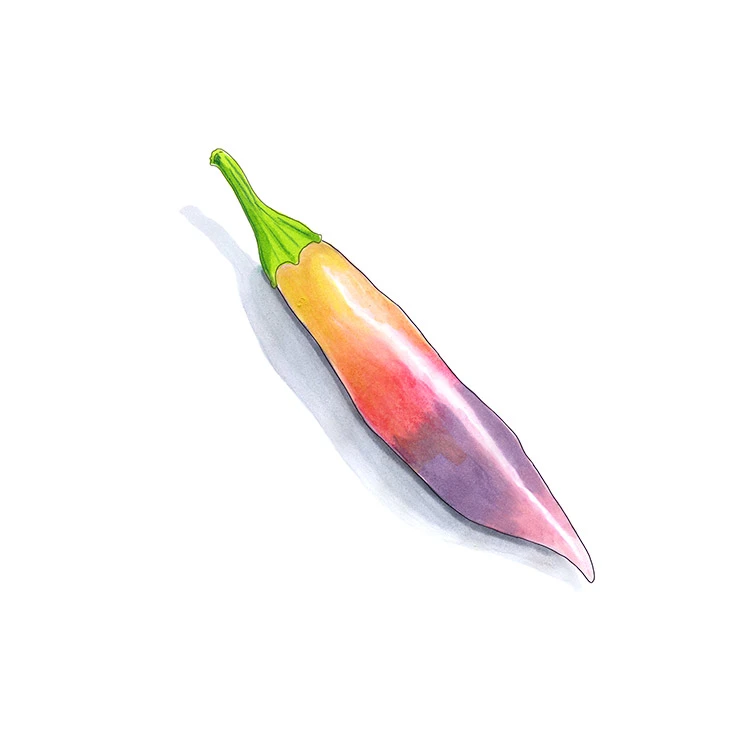
Numex Twilight pepper illustrated in watercolor and ink on a white background

Numex Twilight Pepper

New Mexico State University has been breeding peppers in Las Cruces since the early 1900s and has never shown much interest in separating beauty from function. The NuMex Twilight is the ornamental end of that tradition: compact, container-friendly, ripening through purple, yellow, orange, and red in a sequence that frequently produces all four colors on the same plant at the same time, which stops people at farmers markets and requires an explanation. The explanation is that it's a real pepper with real heat and real flavor that happens to also look like someone made a decision about color theory. Most ornamental peppers make you choose. NMSU declined to.

Heat: 30,000-50,000 SHU.
Origin: New Mexico State University breeding program, United States.

Vietnamese bird's eye pepper illustrated in watercolor and ink on a white background

Vietnamese Bird's Eye Pepper

The Vietnamese bird’s eye, ớt chỉ thiên, is one of those ingredients that shows up everywhere once you start looking: fresh in bún bò Huế, crushed into nước chấm, dried in chili oil, pickled alongside pho. Portuguese traders brought the New World pepper to Vietnam in the sixteenth century and the country has been enthusiastically compensating for the delay ever since. The central and southern regions developed the most chile-intensive traditions, producing cuisines where heat isn't a finishing touch or a side condiment but a load-bearing element, present from the first ingredient in the pot to the fresh chiles on the table that arrive in case the cook showed restraint, which they usually didn't.

Heat: 50,000-100,000 SHU.
Origin: Vietnam.

Korean Cheongyang pepper illustrated in watercolor and ink on a white background

Korean Cheongyang Pepper

The Cheongyang was developed in the 1980s by crossing Thai and Jeju Island pepper varieties, and quickly became Korea's standard for "actually hot," the chile you specify when you want more than the mild gochu. It runs several times hotter than the standard Korean green pepper and earns its place in dishes where heat needs to do actual work: dakgalbi sauce, spicy fish stews, the tteokbokki variants that have colonized Korean street food and refuse to apologize for it. Korean cooking already operates at a baseline heat level that other cuisines would consider a destination. The Cheongyang is for when that isn't enough. My mother in law makes these peppers for us when we visit. You actually dip them into Ssamjang, which is made largely from the other notable Korean pepper.

Heat: 10,000-30,000 SHU, variable.
Origin: South Korea.

Hungarian paprika pepper illustrated in watercolor and ink on a white background

Hungarian Paprika Pepper

Hungarian paprika is one of the better second-act stories in food history: a New World pepper arrives in Ottoman-controlled Hungary sometime in the sixteenth century, gets largely ignored, and then spends the next few centuries quietly becoming the defining flavor of an entire national cuisine. By the nineteenth century it was in gulyás, it was in paprikás, it was in everything, and Hungary had claimed it with the conviction of a country that had always had it. The Nobel Prize-winning chemist Albert Szent-Györgyi, who discovered vitamin C, did much of his research on Hungarian paprika, which turned out to contain more of it than citrus fruit, a finding that must have pleased the Hungarians enormously and confused the oranges.

Heat: 250-1,000 SHU, often lower.
Origin: Hungary, from American Capsicum annuum ancestry.

Fehér Ozon paprika pepper illustrated in watercolor and ink on a white background

Fehér Ozon Paprika Pepper

Fehér Ozon means roughly "white ozone," which is an evocative name for a pepper that earns it: the fruits ripen to an almost luminous yellow-white before blushing red at full maturity, the kind of color that looks deliberate in a garden. It belongs to the Hungarian paprika breeding tradition that took serious shape in the nineteenth century around Kalocsa and Szeged, where growers selected with the focused intensity of people who had decided that paprika was worth getting exactly right. Fehér Ozon is mild enough to eat raw in quantity and sweet enough to produce a dried powder with a clean, aromatic character, the kind of paprika that reminds you there's a wide distance between what comes in a tin at the grocery store and what the Hungarians were actually after.

Heat: 0-1,000 SHU.
Origin: Hungary.

Featured sauce: Erős Pista Multi-Purpose Paprika Paste

Alma paprika pepper illustrated in watercolor and ink on a white background

Alma Paprika Pepper

Alma means "apple" in Hungarian, and the pepper makes good on it: round, deeply lobed, thick-walled, and nothing like the long drying peppers that define the paprika image most people carry around. It's a fresh and pickling pepper, stuffed with spiced meat or put up whole in brine the way households around Kalocsa have been doing for generations, treating it less as a spice source and more as a vegetable worth preserving in its own right. That roundness is also why it dries differently, slower, less efficiently, which is why it rarely ends up as powder and stays instead a pepper you eat rather than grind. A reminder that paprika culture is wider than its most famous product.

Heat: 0-1,000 SHU.
Origin: Hungary and Central Europe.

Bulgarian carrot pepper illustrated in watercolor and ink on a white background

Bulgarian Carrot Pepper

The Bulgarian Carrot pepper looks exactly like a small orange carrot, which is either clever branding or a warning nobody reads. The flavor is bright and clean with a touch of sweetness, and then the heat arrives, more than the color or the name prepares you for, which is more or less the whole point. It's an Eastern European heirloom used fresh, roasted, and pickled in Bulgarian and Romanian cooking, and in a late-summer garden it's one of the better-looking things growing. The surprise is built in and the surprise is the appeal.

Heat: 5,000-30,000 SHU.
Origin: Bulgaria and Eastern European cultivation.

Kapia pepper illustrated in watercolor and ink on a white background

Kapia Pepper

Kapia peppers exist, culinarily speaking, for one reason: ajvar. The Balkan roasted red pepper relish that every family in Serbia, Bulgaria, and North Macedonia makes in enormous, slightly competitive quantities each autumn, filling enough jars to survive a siege. Or at least a winter, which in the Balkans can feel like the same thing. The pepper itself is mild, thick-walled, and sweet, bred for roasting, essentially. Heat it until the skin blisters, peel it, blend it with garlic and oil, and you get something that occupies the ambiguous and wonderful category of condiment that is also just a food you eat. Spread on bread. Next to grilled meat. Directly from the jar at midnight. All defensible. The autumn ajvar-making ritual is serious business in the region: it has its own vocabulary, its own inter-generational arguments about technique, and family recipes treated with the gravity of legal documents. Everyone's grandmother made it differently. Everyone's grandmother was right.

Heat: 0–1,000 SHU (typically sweet).
Origin: Bulgaria and the Balkan region, annuum type.

Caloro pepper illustrated in watercolor and ink on a white background

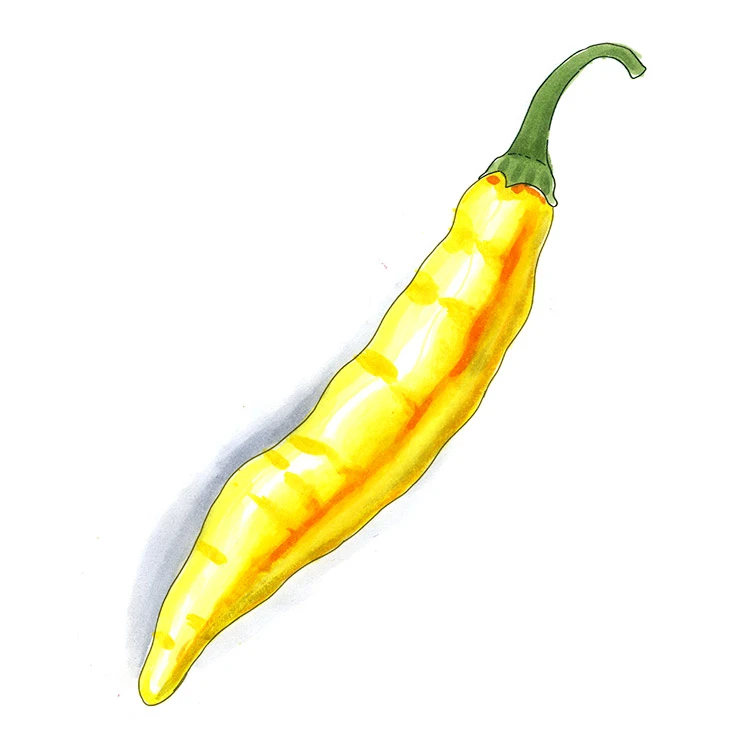
Caloro Pepper

The Caloro is a golden yellow wax pepper developed in California, bred for consistent size, smooth skin, and bright color in a market that increasingly valued visual uniformity alongside flavor. It's a jalapeño-type in heat and form, but the yellow color shifts how people approach it, it looks milder than it is, which gives it a slight advantage in produce displays where buyers are making snap decisions. Used fresh in salsas, pickled for sandwiches and antipasto, or roasted alongside red peppers where the color contrast does half the work. A workhorse dressed in market clothes.

Heat: 1,000-4,000 SHU.
Origin: California, United States (Harris Seed Company).

Cubanelle pepper illustrated in watercolor and ink on a white background

Cubanelle Pepper

The Cubanelle goes by "Italian frying pepper" in American supermarkets, a name that manages to erase both its Cuban nomenclature and its Mediterranean heritage in one tidy stroke, which is very on-brand for how America handles immigrant food history. What it actually is, is the pepper of the Italian-American kitchen, the one frying in olive oil next to the sausages at every street fair you've ever attended, the one in the pepper-and-egg sandwich that Catholic households across New Jersey treated as a Friday religion, the one stuffed and baked for Sunday dinner by someone's grandmother who did not need capsaicin to command respect at a table. It traveled through Caribbean and Mediterranean cooking traditions before landing hard in New York, New Jersey, and Chicago, where it became less a vegetable than a borough identity, the kind of ingredient that, if you grew up around it, you don't really think of as a "pepper variety" so much as just the pepper, the one that tastes like a specific kitchen, a specific decade, a specific person who is no longer around to make it.

Heat: 0-1,000 SHU.
Origin: Caribbean and Mediterranean cultivation from American annuum stock.

Gypsy pepper illustrated in watercolor and ink on a white background

Gypsy Pepper

Nobody names a pepper "Gypsy" because it stays in one place, and this one doesn’t, it moves through yellow, orange, and red on its own schedule, indifferent to what the other peppers on the plant are doing, so a full planting always looks like a argument in progress. It's a 1981 hybrid out of Southern California, bell pepper crossed with sweet Italian bullhorn, All-America Selections winner, zero heat, heavy yields, and the kind of garden presence that makes people stop and ask what it is before they've thought about eating it.

Heat: 0-500 SHU.
Origin: Southern California.

Aconcagua pepper illustrated in watercolor and ink on a white background

Aconcagua Pepper

Named for the highest peak in the Andes, the Aconcagua is a South American sweet pepper of unusual size, with fruits reaching ten or twelve inches are common, with thick walls, a mild sweetness, and the kind of flesh density that makes it useful for roasting, stuffing, or eating raw in slabs. It came to North American gardeners partly through the efforts of seed savers who found it in Argentine markets and recognized that its scale and flavor had no real equivalent in the standard sweet pepper lineup. In Argentina it's eaten fresh, often with nothing more than olive oil and salt. The size is the point; the flavor earns it.

Heat: 0-500 SHU.
Origin: South American-associated sweet annuum cultivation.

Early Jalapeño pepper illustrated in watercolor and ink on a white background

Early Jalapeño Pepper

The Early Jalapeño is exactly what the name says: a selection bred to ripen two to three weeks faster than standard jalapeño varieties, giving gardeners in short-season climates a window that the standard Veracruz types wouldn't fit. It was developed partly for the northern US market, where a jalapeño that doesn't have time to ripen red before frost is a jalapeño that never quite becomes what it was supposed to be. The heat and flavor are standard jalapeño territory, no surprises, but the timing means it reaches markets and gardens where its parent couldn't reliably follow. Breeding as logistics.

Heat: 2,500-8,000 SHU.
Origin: Veracruz, Mexico (selected from standard jalapeño stock).

Mucho Nacho Jalapeño pepper illustrated in watercolor and ink on a white background

Mucho Nacho Jalapeño Pepper

The Mucho Nacho was bred in the 1990s specifically to meet commercial demand for a larger jalapeño, because restaurant nachos require a chile big enough to sit on a chip without getting lost. It's a pepper shaped almost entirely by the economics of the food service industry, which is either depressing or fascinating depending on how you think about domestication. The flavor is standard jalapeño; the size is the point.

Heat: 2,500-8,000 SHU.
Origin: United States (modern cultivated jalapeño-type selection).

Purple Jalapeño pepper illustrated in watercolor and ink on a white background

Purple Jalapeño Pepper

The Purple Jalapeño starts deep violet, almost eggplant, then darkens to near-black before finally arriving at red, which means a single plant in full production is running three color stages simultaneously and looks like it's doing something far more complicated than growing peppers. The purple comes from anthocyanins, which means sun exposure determines intensity, which means two plants side by side can look noticeably different depending on where the light hits. Heat and flavor are standard jalapeño, no surprises there, but nobody is growing this one for surprises. They're growing it because it's beautiful, and then using it exactly like any other jalapeño once it comes off the plant.

Heat: 2,500-8,000 SHU.
Origin: United States.

Ring of Fire Cayenne pepper illustrated in watercolor and ink on a white background

Ring of Fire Cayenne Pepper

Ring of Fire was developed by Petoseed in the 1980s as a high-yield, early-maturing cayenne suited to short growing seasons in the northern US. The name is marketing as much as botany, and it worked: it became one of the most widely grown cayenne varieties in American home gardens. Long, thin, and dependably hot, it dries easily and makes a clean-flavored crushed pepper. The sort of variety that never gets famous but quietly shows up in millions of gardens every year.

Heat: 50,000-100,000 SHU.
Origin: United States.

Joe's Long Cayenne pepper illustrated in watercolor and ink on a white background

Joe's Long Cayenne Pepper

Somebody in an Italian kitchen garden decided at some point that a foot-long cayenne was a reasonable thing to grow, and they were right. Joe's Long Cayenne is an Italian-American heirloom that drapes and twists rather than hangs, thin-walled, deeply curved, doing what it wants. It came over from Italy, lived in family gardens for generations, nearly disappeared when the family stopped growing it, and got rescued by seed savers who have a weakness for peppers with personalities. The heat is standard cayenne. The length is the point: good for drying in long ristras, better for slow-roasting until the skin loosens and the flesh collapses into something sweet and concentrated that tastes like it took all afternoon, because it did.

Heat: 30,000-50,000 SHU.
Origin: Heirloom cayenne-type selection, United States.

Super Chili pepper illustrated in watercolor and ink on a white background

Super Chili Pepper

The Super Chili is a compact hybrid that produces upright fruits in so many simultaneous stages of ripening: green, yellow, orange, red, all at once, all pointing skyward , it looks less like something you grew and more like something you ordered. It belongs to that useful middle ground between ornamental and edible, which more peppers should aspire to: pretty enough for the patio, hot enough for the pan. The fruits are small but the heat is genuine, enough to do real work in a stir-fry or salsa without requiring any kind of advance warning to your guests.

Heat: 30,000-50,000 SHU.
Origin: Israel and the United States (commercial hybrid).

Red Missile pepper illustrated in watercolor and ink on a white background

Red Missile Pepper

Red Missile is a modern ornamental-culinary annuum bred for uniformly upright fruit production and a clean, pointed form, the kind of pepper that plant breeders develop with container gardening and visual presentation in mind as much as kitchen use. The fruits come in tight upward clusters, green to red, pointed and uniform enough that they look less cultivated than manufactured, little rows of identical chiles standing at attention, which is either impressive plant breeding or slightly unnerving depending on your feelings about conformity in vegetables. The heat is genuine and worth using. The name, it's safe to say, was not inspired by the flavor profile.

Heat: 30,000-50,000 SHU.
Origin: Israel and the United States (commercial hybrid).

Goat Horn pepper illustrated in watercolor and ink on a white background

Goat Horn Pepper

Goat Horn peppers, known as boynuzu in Turkish, where the type is most associated, are long, curved chiles grown across the Eastern Mediterranean and Balkans for both fresh and dried use. The curve isn't ornamental; it's just what this class of pepper does as it grows, the tip bending away from the stem end with increasing weight. In Turkey and Bulgaria it's roasted and pickled, used in mixed vegetable dishes and as a table condiment alongside cheese and bread. The heat lands in the middle and stays there, without the citrus and tropical notes that run through Mexican and Caribbean varieties. What the Goat Horn has instead is flesh: thick, substantial, the kind of pepper where the wall itself is the point rather than a vehicle for capsaicin delivery. Turkish and Bulgarian cooking has always treated it this way, as something you roast and eat rather than something you use to make a point, and the pepper obliges by being genuinely good at that without being much interested in anything else.

Heat: 5,000-15,000 SHU.
Origin: Mediterranean and Balkan cultivation traditions.

Marconi Red pepper illustrated in watercolor and ink on a white background

Marconi Red Pepper

The Marconi arrived in Northeastern kitchen gardens the same way a lot of good things did, in the pockets of Italian immigrants who weren't about to leave their pepper seeds behind. That was the early twentieth century. It has been grown there with minimal fanfare and considerable loyalty ever since, passed around as saved seed among people who didn't need to explain the reasoning because the pepper explained itself. Long, thin-walled, sweet enough to eat standing over the cutting board, fast to blister under heat. Roast it and the flesh collapses into something sweet and smoky that bears little resemblance to the raw pepper, which is already good, bright, slightly grassy, the kind of thing you eat a piece of while you're supposed to be cooking. It's a fixture of Italian-American antipasto, the kind of pepper that ends up on the table before dinner is ready and somehow never makes it to the actual meal.

Heat: 0-500 SHU.
Origin: Italy.

Marconi Golden pepper illustrated in watercolor and ink on a white background

Marconi Golden Pepper

Yellow and red Marconis on the same plate is an Italian cooking move that works for practical reasons, not decorative ones. The golden form tastes different from the red, less sweet, more herbaceous, cleaner finish, which is why the combination exists rather than just being a color choice. Under heat the two stay visually separate instead of collapsing into the same tone, giving a roasted pepper dish definition that holds. The Golden Marconi also ripens earlier in the season, which in a northern garden is not a small thing, and preserves in oil without the color fade that plagues orange types. Novelty gets a pepper into the catalog. Usefulness keeps it there.

Heat: 0-500 SHU.
Origin: Italy.

Corbaci pepper illustrated in watercolor and ink on a white background

Corbaci Pepper

Corbaci, "whip" in Turkish, is one of the longest and most dramatically tapered peppers in cultivation, with fruits that can reach sixteen inches or more, curling and twisting as they grow. It comes from the Black Sea and Mediterranean regions of Turkey, where growing a pepper this long is unremarkable because people have been doing it for generations. Mild enough that the full length of it can be eaten as a snack without planning around the heat, thin-walled, low in moisture, useful for drying but most at home raw: sliced into salads, blistered whole in a pan with olive oil until the skin bubbles and chars, pickled in vinegar and set out next to grilled meat. Sixteen inches of pepper, none of it trying to impress anyone.

Heat: 0-1,000 SHU.
Origin: Turkey.

Korean gochu pepper illustrated in watercolor and ink on a white background

Korean Gochu Pepper

Portuguese traders brought the gochu to Korea around the sixteenth century and the country did something unusual with it: absorbed it completely. Within a few generations it had moved from foreign novelty to the backbone of the cuisine, dried and ground into gochugaru for kimchi, fermented into gochujang, responsible for the red that runs through bibimbap, tteokbokki, and most of what makes Korean food look the way it does. No other pepper was adopted into a national cuisine so completely and so quickly, or transformed that cuisine so thoroughly that its presence is now simply assumed. When we visit my Korean mother in law, gochujang paste (gochujang) is abundant, and she likes to taunt us with her taste for the heat.

Heat: 1,500–10,000 SHU, variable.
Origin: Korea, from post-Columbian Capsicum annuum selection.
Dried: Gochugaru (Korean chili flakes)

Featured sauce: CJ Haechandle Gochujang

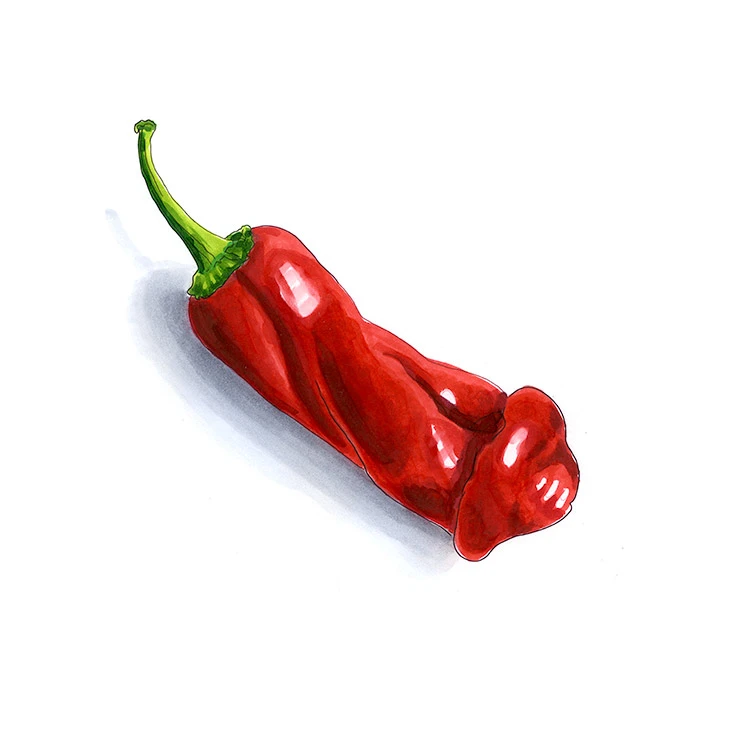
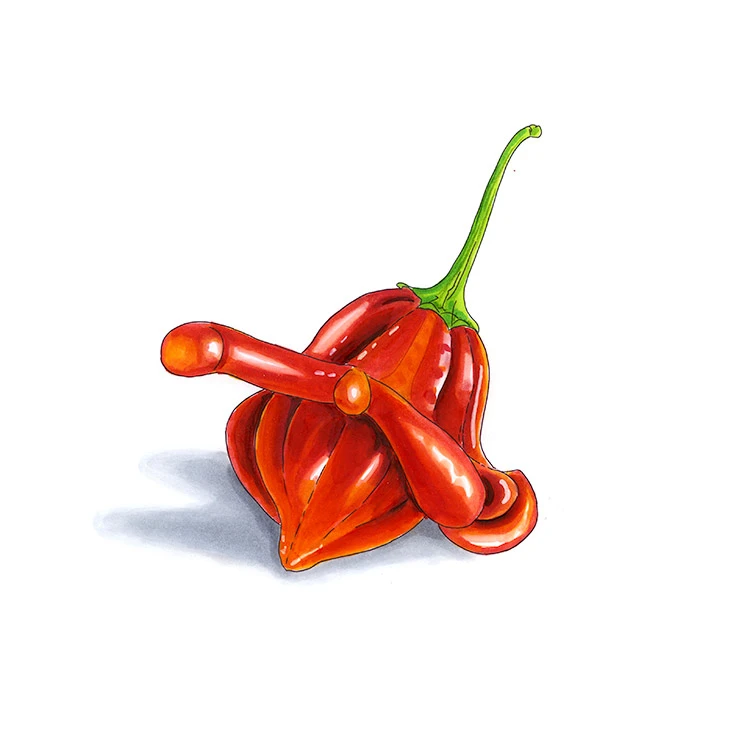
Peter pepper illustrated in watercolor and ink on a white background

Peter Pepper

Peter Pepper is a genuine heirloom, documented in American seed catalogs going back to at least the 1800s, with an unusual form: deeply constricted at the stem end, lobed and irregular, unmistakably suggestive, has kept it in circulation long past when it might otherwise have vanished into obscurity. The heat runs from medium to fairly hot, the flavor is standard annuum, and the plant is genuinely productive. Its notoriety sometimes overshadows the fact that it works as an actual pepper, though most people who grow it are not primarily focused on the cooking. It also makes excellent dried ornamental wreaths, which is a use case the seed catalogs have promoted without apparent irony for over a century.

Heat: 10,000-23,000 SHU.
Origin: United States heirloom and novelty cultivation.

Costeño Amarillo pepper illustrated in watercolor and ink on a white background

Costeño Amarillo Pepper

The Costeño Amarillo is a yellow-ripening chile from the Pacific Coast of Oaxaca, used primarily dried in the regional cooking of the Cañada and Costa Chica. Dried and blended it builds the base of coastal amarillo mole, which is not the mole most people think of when they think of Oaxaca. Lighter, brighter, built for fish and shellfish rather than pork and fowl, it's the sauce of the coast rather than the valley. The heat is clean with a slight fruitiness and the golden color doesn’t disappear into the pot, it carries through into the finished sauce, which is how you can tell a coastal Oaxacan mole from the darker, earthier versions coming out of the valleys. Same state, different world. One of the peppers where you really can taste the coast.

Heat: 5,000–10,000 SHU.
Origin: Coastal Mexico.

Costeño Rojo pepper illustrated in watercolor and ink on a white background

Costeño Rojo Pepper

The Costeño Rojo is the red-ripening counterpart from the same Oaxacan coastal tradition, slightly hotter and more assertive than its yellow sibling and more versatile across the range of coastal Mexican cooking. Dried and ground, it goes into salsas, marinades, and the tamale fillings of the Coast that differ substantially from highland Oaxacan tamales, looser, soupier, wrapped in banana leaf rather than corn husk. The two costeños together anchor a regional cuisine that gets far less international attention than the valley-centered Oaxacan cooking that fills cookbooks, which is a reasonable argument for paying more attention to the coast.

Heat: 8,000–15,000 SHU.
Origin: Coastal Mexico.

Ancho San Luis pepper illustrated in watercolor and ink on a white background

Ancho San Luis Pepper

Ancho San Luis Pepper extends the poblano-ancho world into a more regionally specific form, tying the broad, dark fresh chile to one of Mexico's great dried-pepper traditions. It has that same deep, weighty presence that makes ancho-types feel almost architectural.

Heat: 1,000-2,500 SHU.
Origin: San Luis Potosí, Mexico.

Thai Ornamental Cluster pepper illustrated in watercolor and ink on a white background

Thai Ornamental Cluster Pepper

Compact enough for a windowsill, covered in small upright fruits that cluster at the branch tips like they're trying to be noticed, the Thai Ornamental Cluster Pepper is the kind of plant that ends up in garden centers next to the marigolds and then surprises everyone who tries one. The heat is not decorative. In Southeast Asian markets these same clustered chiles go straight into cooking, fresh, dried, no ceremony, and the ornamental varieties grown elsewhere bring identical capsaicin to the party regardless of why they were planted. It is, in the end, still a Thai chile. It simply also looks good on a patio.

Heat: 30,000-50,000 SHU, variable.
Origin: Thailand.

Chilhuacle Negro pepper illustrated in watercolor and ink on a white background

Chilhuacle Negro Pepper

In the 1980s Frank Garcia noticed a habanero plant in his California crop doing something unusual and had the presence of mind to save its seed. What he'd found became the Red Savina, which Guinness certified as the world's hottest pepper in 1994 and which held that record for twelve years. At the time, 577,000 SHU seemed almost theoretical — far beyond what food could reasonably contain. The peppers that eventually broke it, and kept breaking it, exist partly because the Red Savina demonstrated that heat was a thing you could breed toward deliberately, measure officially, and put in a record book. Garcia took his growing methods to the grave, which gave the pepper a mystique that outlasted the record itself.

Heat: 1,000-2,000 SHU.
Origin: Oaxaca, Mexico.
Dried: Mole negro chile

Chilhuacle Rojo pepper illustrated in watercolor and ink on a white background

Chilhuacle Rojo Pepper

The chilhuacle rojo has two careers and manages both without apology. In the morning it’s in chilaquiles rojos, fried tortilla chips pulled into a red chile sauce until they soften into something that sits at the exact intersection of crispy and collapsed, a breakfast that spread from Oaxaca to the rest of Mexico because it was too good to stay regional. By evening the same pepper is anchoring red mole, simmering for hours into something considerably more serious. Brighter and a touch hotter than the negro, it's the most versatile of the Oaxacan chilhuacle trio, which in a region with this many good dried chiles is saying something.

Heat: 1,000-2,500 SHU.
Origin: Oaxaca, Mexico.

Chilhuacle Amarillo pepper illustrated in watercolor and ink on a white background

Chilhuacle Amarillo Pepper

The chilhuacle amarillo is the most herbaceous of the three, the one that gets paired with tomatillo and hierba santa, the anise-scented leaf that southern Mexican cooking uses freely and almost no other cuisine has figured out what to do with. The result is amarillo mole, a yellow-orange sauce with a brightness and complexity that sits apart from its negro and rojo siblings the way a different instrument sits in the same ensemble. The three chilhuacles together map onto three distinct sauce traditions, three distinct flavor profiles, three distinct colors, which is the kind of culinary specificity that makes you realize Oaxacan cooking isn't just regional cuisine so much as a fully developed system that happened to stay in one place.

Heat: 1,000-2,500 SHU.
Origin: Oaxaca, Mexico.

Er Jing Tiao pepper illustrated in watercolor and ink on a white background

Er Jing Tiao Pepper

The Er Jing Tiao is the pepper that makes Sichuan cooking taste like itself. Long, moderately hot, grown in and around Chengdu for centuries, it’s less a heat source than a flavor engine, the chile that goes into doubanjiang, the fermented bean paste that anchors a significant portion of the regional canon, and the chile oil that sits at the bottom of every hot pot quietly doing more work than anything else in the pot. The heat is moderate by design: Sichuan cooks use this pepper in quantities that would be alarming with a hotter chile, building depth through fermentation and slow infusion rather than through capsaicin alone. It's the difference between a cuisine built on heat and a cuisine built on flavor that happens to be hot, which is the whole point of Sichuan cooking and the whole point of this pepper.

Heat: 10,000–20,000 SHU.
Origin: Sichuan, China.

Featured sauce: Fly By Jing Sichuan Chili Sauce

Bydagi pepper illustrated in watercolor and ink on a white background

Bydagi Pepper

The Byadagi chile comes from the town of Byadgi in Karnataka and is one of India's most important commercial peppers, prized almost entirely for its deep crimson color rather than its heat. It's the pepper that makes tandoori dishes red, the base of many commercial spice blends, and the reason Indian grocery stores carry ground chile with a color that seems almost too vivid to be natural. Mild enough to use in quantity, rich enough to stain anything it touches permanently.

Heat: 1,000–2,000 SHU.
Origin: Karnataka, India.

Guntur Sannam pepper illustrated in watercolor and ink on a white background

Guntur Sannam Pepper

Guntur is a city in Andhra Pradesh where the air smells like drying chiles for a good portion of the year and the annual pepper auction moves prices on the global spice market, not a metaphor, an actual market force operating out of a mid-sized Indian city that most people outside the industry have never heard of. The Sannam is what Guntur exports to the world: hot, flavorful, the pepper behind Telugu cuisine's reputation for heat that is not theoretical. Andhra Pradesh sits at or near the top of every ranking of India's spiciest regional cooking, which in a country with serious competition for that title is an achievement. The Sannam is a large part of how it got there and stays there.

Heat: 35,000–40,000 SHU.
Origin: Andhra Pradesh, India.

Kashmiri Mirch pepper illustrated in watercolor and ink on a white background

Kashmiri Mirch Pepper

The Kashmir Valley grows a chile that prioritizes color over heat, which in most pepper cultures would be considered a tradeoff and in Indian cooking is considered a solution. Kashmiri Mirch is mild enough to use in quantities that would be reckless with a hotter chile, brilliant enough in color to turn a gravy deeply, convincingly red, and aromatic enough that anyone who has cooked with the real thing notices immediately when they're working with a substitute, which is often, since genuine Kashmiri Mirch is expensive and frequently blended with cheaper varieties before it reaches the market. It makes rogan josh red. It makes butter chicken what it looks like. It is, quietly, one of the more important chiles in the world.

Heat: 1,000–2,000 SHU.
Origin: Kashmir, India.

Bhavnagri pepper illustrated in watercolor and ink on a white background

Bhavnagri Pepper

The Bhavnagri comes from Bhavnagar in Gujarat and has made a sensible decision that most chiles haven't: it would rather be dinner than a condiment. Large, thick-walled, and mild enough to eat as a vegetable, it’s the pepper you stuff: with spiced lentils, with potato, with whatever the cook has decided belongs inside it, and serve as the main event rather than the heat source. Gujarati cooking runs sweeter and milder than most Indian regional traditions, which surprises people whose introduction to Indian food came from restaurants representing other parts of the subcontinent, which is most restaurants outside India. The Bhavnagri fits that flavor logic exactly: a large mild pepper from a cuisine that treats heat as one option among many rather than the default setting, stuffed with spiced lentils or potato and served as the point of the meal rather than the backdrop.

Heat: 1,000–3,000 SHU.
Origin: Gujarat, India.

Capsicum chinense

Capsicum chinense — despite the name, which is a 18th-century taxonomic error that has stuck ever since — has nothing to do with China. It was domesticated in the Amazon basin, most likely in what is now western Brazil or eastern Peru, and spread north through the Caribbean and into Central America carried by indigenous peoples long before any European set foot in the Western Hemisphere. The Arawak people of the Caribbean were already growing sophisticated forms when Columbus arrived; the Taíno of Hispaniola used it in cooking so central to their culture that the Spanish word for pepper — ají — comes directly from their language. The habanero's deep cultivation in the Yucatán reflects centuries of Maya agriculture; the Scotch Bonnet's dominance in Jamaica and Trinidad is the story of the African diaspora carrying and adapting New World crops through the trauma of the slave trade. These peppers are notable not only for heat, but for their floral, fruity, and tropical flavor profiles — a character shaped by thousands of years of selection by people who understood that heat and flavor were not the same thing.

Habanero pepper illustrated in watercolor and ink on a white background

Habanero Pepper

For about ten years the habanero was the scariest pepper most people had ever heard of, which overshadowed the more interesting fact that it's also one of the best-tasting. Floral, citrusy, tropical, it has a flavor profile that food scientists describe as genuinely complex and that anyone who's eaten in the Yucatán would recognize immediately from the orange table sauce that shows up with every meal and sits there looking cheerful until you use too much. Then the superhot era started, the ghost peppers and scorpions arrived, and the habanero quietly went back to being a cooking pepper. A demotion that suited it perfectly.

Heat: 100,000-350,000 SHU.
Origin: Yucatán Peninsula and the Caribbean.

Featured sauce: Marie Sharp's Habanero Pepper Sauce

Scotch Bonnet pepper illustrated in watercolor and ink on a white background

Scotch Bonnet Pepper

Technically the Scotch Bonnet and the habanero are cousins. In Jamaica this is the kind of fact that nobody asked for. The Scotch Bonnet is the pepper of jerk seasoning and escovitch fish and the roadside pepper sauce that arrives without warning and without apology, and it has been doing this work long enough that suggesting a substitute would be treated as a personality flaw. The name comes from the tam o'shanter cap, which the pepper’s squashed, lobed shape genuinely resembles, a botanical coincidence that turned into centuries of consistent branding across the English-speaking Caribbean. Some things just fit.

Heat: 100,000-350,000 SHU.
Origin: Caribbean, especially Jamaica.

Featured sauce: Scotch Bonnet Mustard Pepper Sauce

Red Savina Habanero pepper illustrated in watercolor and ink on a white background

Red Savina Habanero Pepper

Frank Garcia found the Red Savina as a chance mutation in a habanero crop in California sometime in the 1980s, a single plant doing something the others weren't, which he noticed and selected and eventually turned into a Guinness record. From 1994 to 2006 it was the hottest pepper in the world, certified and official. At the time, 577,000 SHU seemed almost theoretical — far beyond what food could reasonably contain. The record is gone now, lapped many times over by the scorpions and reapers and various peppers with alarming names that the Red Savina's fame helped inspire. What it kept is the distinction of being the pepper that made heat a competition in the first place. Garcia never disclosed his growing methods, which was either careful trade protection or an instinct for mythology. Either way it worked.

Heat: 350,000-580,000 SHU.
Origin: Walnut, California, United States (selected by Frank Garcia of GNS Spices).

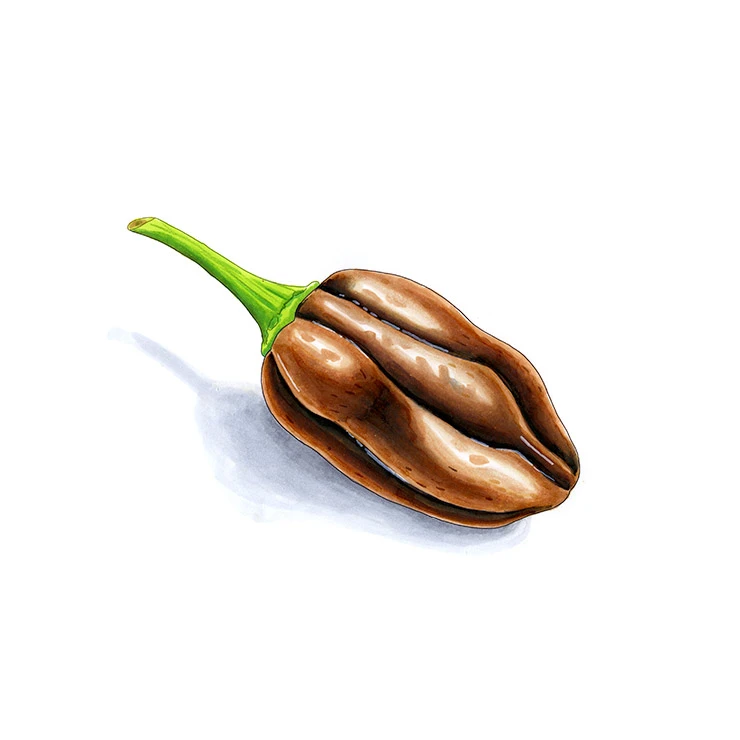
Chocolate Habanero pepper illustrated in watercolor and ink on a white background

Chocolate Habanero Pepper

The Chocolate Habanero is a Caribbean landrace rather than a modern breeding project, with the brown color is the result of natural variation in pigment expression that local growers selected and maintained over generations. It's consistently hotter than the standard orange habanero, often reaching the upper end of the range, and the flavor carries a heavier, earthier note that some people describe as darker fruit rather than citrus. In Jamaica it's used interchangeably with the Scotch Bonnet in some preparations, though purists will disagree. The color deepens further after drying, which makes it useful for spice pastes and moles where the darker tones reinforce the other flavors going in.

Heat: 300,000-450,000 SHU.
Origin: Caribbean and Central America.

Bahamian Goat pepper illustrated in watercolor and ink on a white background

Bahamian Goat Pepper

The Bahamian Goat Pepper is a wrinkled, irregularly shaped chinense that's been grown across the Bahamian islands for generations, where it functions as the primary hot chile in local cooking, used in fish stew, conch preparations, and the pepper sauces that arrive on every table in small bottles throughout the archipelago. The "goat" name appears across several Caribbean peppers and likely refers to the twisted, unpredictable form rather than any connection to the animal's flavor. It is intensely aromatic in the way most Caribbean chinense are, with a fruitiness that precedes the heat rather than following it. Local and largely unknown outside the islands, which is its own form of culinary integrity.

Heat: 100,000-300,000 SHU.
Origin: The Bahamas.

Datil pepper illustrated in watercolor and ink on a white background

Datil Pepper

In 1768, Minorcan settlers arrived in St. Augustine by way of Cuba, and they apparently brought their pepper with them, because the Datil has been growing in and around that city ever since. Two and a half centuries is enough time to build an identity: St. Augustine now has a Datil hot sauce industry, a Datil Pepper Festival, and the kind of fierce local protectiveness over a regional ingredient that elsewhere gets called a geographical designation and here just gets called civic pride. The heat is real, up to 300,000 SHU, but the flavor is sweet and fruity and distinctly its own thing, a chinense that tastes like Florida by way of the Caribbean by way of the Mediterranean, which is a more interesting biography than most peppers have.

Heat: 100,000-300,000 SHU.
Origin: St. Augustine, Florida, from Caribbean ancestry.

Madame Jeanette pepper illustrated in watercolor and ink on a white background

Madame Jeanette Pepper

The Madame Jeanette is named, by most accounts, after a sex worker in Paramaribo, which is either a colorful origin story or a straightforward explanation of how peppers get named in Suriname, probably both. The pepper itself is intensely aromatic, fruity and almost floral in a way that arrives before the heat does, giving you a moment to appreciate it before the chinense half of the experience takes over. It's central to Surinamese cooking and particularly to the Indo-Surinamese dishes that developed after South Asian laborers arrived in the nineteenth century, brought over by the Dutch after emancipation to replace the workforce slavery had provided. The pepper ended up in those kitchens, adapted into a new culinary tradition, and stayed. A biography as layered as anything it goes into.

Heat: 125,000-300,000 SHU.
Origin: Suriname.

Adjuma pepper illustrated in watercolor and ink on a white background

Adjuma Pepper

The Adjuma gets called a habanero variant by people who haven't cooked with it, and Surinamese cooks let it go because correcting pepper taxonomy at the market gets old. It's flattened where a habanero is round, thick-walled enough to eat fresh without feeling like you're just delivering capsaicin, and the aroma runs more floral than fruity, close enough to its relatives to cause confusion, different enough that substituting one for the other in a Surinamese pepper paste produces a result the cook will notice. It shares the table with Madame Jeanette in the sauces and pastes that run through the cuisine, and the two are not interchangeable. Ask a Surinamese cook which one and you'll get a specific answer.

Heat: 100,000-350,000 SHU.
Origin: Suriname and the Guianas.

Fatalii pepper illustrated in watercolor and ink on a white background

Fatalii Pepper

The Fatalii is believed to have developed in Central Africa, possibly the Democratic Republic of Congo, from Caribbean chinense stock introduced by Portuguese traders centuries ago, then selected by local growers over generations until it became its own distinct thing. Its citrus-forward heat is unusually clean: bright and sharp, arriving fast and without the slow-building complexity of a habanero. In the superhot enthusiast world it's considered one of the better-tasting extreme peppers, which is a backhanded compliment the plant would probably accept.

Heat: 125,000-400,000 SHU.
Origin: Central African cultivation from Caribbean chinense ancestry.

Congo pepper illustrated in watercolor and ink on a white background

Congo Pepper

A large-fruited chinense type from the Caribbean and Central America, grown for both heat and visual presence, the substantial size makes it one of the more imposing fresh chiles in the family. It has the characteristic tropical aroma of Caribbean chinense, with a heat that lands somewhere between standard habanero and the upper-range varieties. In local cooking it's used fresh in pepper sauces and marinades, where the volume of flesh it provides is as useful as the capsaicin. A pepper valued for abundance as much as intensity.

Heat: 150,000-300,000 SHU.
Origin: Caribbean and Central America.

Hainan yellow lantern chili pepper illustrated in watercolor and ink on a white background

Hainan Yellow Lantern Chili Pepper

Hainan Island sits in the South China Sea with a tropical climate, volcanic soil, and a pepper that the Chinese government has seen fit to protect as a geographical designation, meaning you can't call it a Yellow Lantern unless it actually came from there, which is the kind of official recognition that only happens when the thing being protected is genuinely irreplaceable. It's the hottest commercially grown pepper in China, which in a country with serious pepper culture is not a casual distinction, and it tastes like somewhere specific: fruity, intensely aromatic, the heat arriving with a tropical character that mainland Chinese peppers don't replicate. Wenchang chicken, Hainan’s most famous dish, is served with it. Local cooks notice when it's been substituted. The substitution is never considered acceptable.

Heat: 100,000–300,000 SHU.
Origin: Hainan Island, China ( Capsicum chinense ).

Aji Dulce pepper illustrated in watercolor and ink on a white background

Aji Dulce Pepper

Ají dulce has the look of a habanero and the aroma of one and none of the heat, which in the Caribbean is not considered false advertising. It's been growing in Puerto Rico, Venezuela, and the Dominican Republic long enough that its primary job is sofrito, the aromatic paste that opens virtually every savory dish worth making in those cuisines. Onion, garlic, tomato, ají dulce, then everything else. The pepper provides the floral chinense depth without the part that would make sofrito difficult to eat by the spoonful, which people do. You can make sofrito without it. People will know.

Heat: 0-1,000 SHU.
Origin: Venezuela and Colombia, with spread to Puerto Rico and the wider Caribbean.

Caribbean Red pepper illustrated in watercolor and ink on a white background

Caribbean Red Pepper

The Caribbean Red is a habanero selection pushed deliberately toward the extreme end of what the type can do, deeper color, higher heat, more of everything that makes a habanero a habanero. It tests hotter than standard orange habaneros with enough regularity that the difference isn't incidental, and it got that way through Caribbean growing traditions where breeders were selecting across the full spectrum at once rather than optimizing for any single quality. The flavor stayed: tropical, faintly floral, the signature chinense character intact even as the heat climbed.

Heat: 300,000-450,000 SHU.
Origin: Yucatán Peninsula, Mexico and the Caribbean.

Bonda Ma Jacques pepper illustrated in watercolor and ink on a white background

Bonda Ma Jacques Pepper

The Bonda Ma Jacques is a Surinamese chinense that local cooks keep firmly separate from generic habanero, and the aroma is why: intensely perfumed, fruity in a way that leads the whole experience before the heat gets a word in, persistent enough to announce itself from across the kitchen while the sauce is still on the stove. It grows alongside Madame Jeanette in Suriname and the Dutch Caribbean, turns up in pepper pastes and table sauces, and has generated the kind of strong local opinions about when each one is appropriate that only develop around ingredients people actually care about. Call it a habanero substitute and someone will correct you.

Heat: 100,000-350,000 SHU.
Origin: Suriname.

Tobago Seasoning pepper illustrated in watercolor and ink on a white background

Tobago Seasoning Pepper

A low-heat chinense grown in Trinidad and Tobago for its rich, fragrant aroma rather than its burn, which makes it the conceptual opposite of most peppers in this section. Like ají dulce in the Caribbean, it's used to build the aromatic base of cooking: in the seasoning pastes and marinades that flavor meat before it's cooked, in the fresh green seasonings mixed with herbs and garlic that anchor Trinidadian home cooking. The heat is present but inconsequential. What you're really after is the perfume, that deep, layered chinense scent that no other species in the genus quite matches.

Heat: 0-1,000 SHU.
Origin: Trinidad and Tobago.

Jamaican Mushroom pepper illustrated in watercolor and ink on a white background

Jamaican Mushroom Pepper

In Jamaica, the Mushroom pepper occupies the same flavor territory as the Scotch Bonnet, same fruity, intensely aromatic chinense character, same presence in jerk marinades and pepper sauces, but with a heat level that doesn't require a disclaimer. The shape is what sets it apart: flattened and deeply lobed, a squat cap form distinct enough that once you know it you won't mistake it for anything else, even if the market vendor occasionally does. It's the Caribbean chinense experience with the volume turned down just enough to let the flavor lead.

Heat: 5,000-50,000 SHU.
Origin: Jamaica.

Mustard Habanero pepper illustrated in watercolor and ink on a white background

Mustard Habanero Pepper

The Mustard Habanero is a color variant that ripens to a greenish-yellow close enough to English mustard that the name requires no explanation. The color does something useful: it reads as mild to people unfamiliar with it, which means the heat, standard habanero, fully present, not interested in being underestimated, tends to arrive as a surprise. The flavor stays true to the chinense type, fruity and floral with the tropical aromatics that make habaneros worth the trouble. It's grown in the Caribbean and used in local hot sauces where the color is the point, and has developed a following among growers and sauce-makers who want the habanero character without the habanero's familiar orange face.

Heat: 150,000-325,000 SHU.
Origin: Cuba and the wider Caribbean.

White Habanero pepper illustrated in watercolor and ink on a white background

White Habanero Pepper

The White Habanero is the most visually misleading pepper on this list, pale ivory, almost translucent when fresh, the kind of color that suggests something mild and polite and possibly decorative. It is none of those things. The heat matches a standard orange habanero fully, the flavor carries the same fruity floral character the chinense type is known for, and the only thing that's actually different is the color, which does an enormous amount of work creating expectations the pepper has no intention of meeting. Grown in Peru, where white and cream chinense types have a long cultivation history, and increasingly popular internationally among growers who appreciate what happens when something dangerous looks completely harmless.

Heat: 100,000-300,000 SHU.
Origin: Peru (white and cream forms originate in Peruvian highland cultivation).

Bhut Jolokia Ghost pepper illustrated in watercolor and ink on a white background

Bhut Jolokia (Ghost Pepper)

In 2007 a pepper from Nagaland broke a million Scoville and the Guinness people showed up, which was not something northeastern India had been anticipating. The Bhut Jolokia had been growing there for generations, used in fresh chutneys, in pork dishes, in the kind of cooking where heat is a variable you manage through technique rather than something you reduce by using less pepper. The certification made it briefly the most famous chile on earth and Nagaland briefly the most interesting place in the hot sauce world, neither of which had been the point. The Indian Defense Research Laboratory had meanwhile been studying it for years as a potential crowd-control agent, which is either a logical application or a sign that someone in the Indian military had very strong feelings about pepper spray. The Guinness record didn’t last, the arms race it helped ignite eventually produced peppers that make the Ghost look polite, but it was the one that started it.

Heat: 800,000-1,100,000 SHU.
Origin: Northeast India.

Featured sauce: CaJohn's Lethal Ingestion Bhut Jolokia Hot Sauce

Naga Morich pepper illustrated in watercolor and ink on a white background

Naga Morich Pepper

The Naga Morich, "serpent chile" in Bengali, is a Bangladeshi and Sylheti variety closely related to the Ghost Pepper but distinct in form and flavor emphasis. It was being grown in Bangladesh and northeastern India long before any of the superhot records began, important to local cooking in ways that have little to do with competitive heat. In Sylheti cooking it goes into fresh chutneys and fish dishes in quantities that make sense only if you grew up with it, which most of the people using it did. The heat is fast and clean rather than the slow-building delayed onset of the Ghost Pepper, a distinction that matters when you're cooking rather than competing and need the heat to behave predictably. The form is distinctive too: wrinkled, conical, looking slightly agitated even when fresh off the plant. It is not a challenge pepper that happens to be edible. It is an ingredient that happens to be extreme.

Heat: 800,000-1,000,000 SHU.
Origin: Bangladesh and Northeast India.

Dorset Naga pepper illustrated in watercolor and ink on a white background

Dorset Naga Pepper

Joy and Michael Michaud ran Peppers by Post in Dorset and got their hands on Naga seeds from a Bangladeshi market in Bournemouth around 2001, which is not the origin story the superhot world was expecting. They selected for heat and earliness over several growing seasons in a British kitchen garden, and by 2006 had produced something Guinness certified as one of the hottest peppers on earth. The climate in Dorset is not tropical. It rains. The Michauds grew a record-breaking superhot anyway, which established early that serious pepper breeding could happen anywhere someone was paying close enough attention. The UK's interest in superhot peppers has been consistent since then, partly climate challenge, partly serious horticultural curiosity, and the Dorset Naga is the founding text of that tradition, proof that the genetics travel even when the climate doesn't cooperate.

Heat: 800,000-1,000,000 SHU.
Origin: United Kingdom, from Bangladeshi Naga stock.

Trinidad Scorpion pepper illustrated in watercolor and ink on a white background

Trinidad Scorpion Pepper

The Trinidad Scorpion gets its name from the pointed tail at the base of the fruit, a feature that the plant did not develop with branding in mind, but which chile cultivators immediately recognized as marketable. Trinidad has become one of the world's most productive sources of superhot pepper genetics, partly because of favorable growing conditions and partly because local breeders took the work seriously as both agriculture and identity. The Scorpion is the island's most famous chile export, which is remarkable given that it's also one of the things most likely to end you at a dinner table.

Heat: 1,000,000-2,000,000 SHU.
Origin: Trinidad.

Featured sauce: Matouk's Trinidad Scorpion Pepper Hot Sauce

Trinidad Moruga Scorpion pepper illustrated in watercolor and ink on a white background

Trinidad Moruga Scorpion Pepper

The Moruga Scorpion held the Guinness record briefly in 2012 when New Mexico State University testing recorded individual specimens above two million Scoville units, the highest reading for a naturally occurring pepper at that point. It comes from the Moruga district of southern Trinidad, where farmers had been growing it long before anyone was measuring it. The fruit is deeply wrinkled and irregular, the surface almost churning, and the heat has the delayed-onset character of many high-capsaicin chiles: mild for a few seconds after contact, then arriving with the kind of escalating intensity that makes people reconsider their recent decisions. In Trinidad it's used in traditional pepper sauces and passed down as part of a broader chinense culture that extends well beyond record-chasing.

Heat: 1,200,000-2,000,000+ SHU.
Origin: Moruga region, Trinidad.

Featured sauce: Matouk's Trinidad Scorpion Pepper Hot Sauce

7 Pot chili pepper illustrated in watercolor and ink on a white background

7 Pot Chili Pepper

The 7 Pot name comes from the Caribbean claim that one pepper could heat seven pots of stew, which is less a recipe and more a warning. Trinidad developed several varieties under the 7 Pot name, each representing different local selections from communities across the island. Before the superhot arms race standardized around laboratory measurements, this was the ordinary way peppers got named: by what they did in the kitchen and what people said about them in the market.

Heat: 1,000,000-1,800,000 SHU.
Origin: Trinidad.

7 Pot Douglah pepper illustrated in watercolor and ink on a white background

7 Pot Douglah Pepper

The Douglah is named for the Dougla people of Trinidad, of mixed African and South Asian heritage, which connects it to the same diverse agricultural culture that produced the island's other superhot varieties. The dark brown to near-black exterior is the visual signature, and among serious chile enthusiasts it has a reputation for combining extreme heat with more flavor complexity than most superhots manage: a faint chocolate-coffee quality that survives long enough to register before the heat settles in. That combination, looks ominous, delivers on flavor before the burn, has made it one of the more respected varieties in the superhot world, which is a category not generally known for nuance.

Heat: 1,000,000-1,800,000 SHU.
Origin: Trinidad.

7 Pot Primo pepper illustrated in watercolor and ink on a white background

7 Pot Primo Pepper

The 7 Pot Primo was developed by Troy Primeaux, "Primo," a horticulturist in Louisiana who crossed a 7 Pot with a Naga Morich and then spent years selecting for the exaggerated stinger tail that became the variety's signature. The tail is not decorative; it's an outgrowth of the placenta, the tissue that produces capsaicin, which means the stinger tip is often the hottest part of the already extremely hot fruit. In photos it looks almost satirical, a pepper that has taken the scorpion concept and pushed it past the point where nature would normally stop. It belongs to the era when American amateur breeders were actively competing with professional programs and occasionally beating them.

Heat: 1,200,000-2,200,000 SHU.
Origin: Louisiana, United States (developed by Troy Primeaux).

Carolina Reaper pepper illustrated in watercolor and ink on a white background

Carolina Reaper Pepper

Ed Curlin spent years crossing a Pakistani Naga with a red habanero at his operation in Rock Hill, South Carolina, and in 2013 Guinness made it official. The Carolina Reaper was the hottest pepper in the world. It lost the title briefly, then reclaimed it in 2023 when Pepper X took the record, also a Curlin pepper, which means he beat himself, which is one way to stay on top. The Reaper became a phenomenon: featured in competitive eating challenges, challenge videos, novelty foods, and at least one documented trip to the emergency room. It launched an entire genre of content that may or may not be good for humanity.

Heat: 1,500,000-2,200,000+ SHU.
Origin: South Carolina, United States.

Featured sauce: Don Hulyo Infierno Black Reaper Hot Sauce

Dragon's Breath pepper illustrated in watercolor and ink on a white background

Dragon's Breath Pepper

Dragon's Breath arrived in 2017 claiming to be hotter than the Carolina Reaper, which at the time was the kind of statement that required either extraordinary evidence or extraordinary confidence. The pepper, developed by a Welsh grower in collaboration with Nottingham Trent University, was originally proposed as a medical tool, with the capsaicin concentration high enough to potentially work as a topical anesthetic in parts of the world where conventional anesthetics aren't available. This is the point at which a pepper stops being food and starts being a research proposal. Whether the heat claims fully survive rigorous testing depends on who you ask, but Dragon's Breath occupies a useful position at the outer edge of the superhot world: a chile that exists less to be eaten than to mark how far the whole enterprise has gone.

Heat: Claimed over 2,000,000 SHU.
Origin: Wales, United Kingdom (developed by Neal Price with Nottingham Trent University).

Komodo Dragon pepper illustrated in watercolor and ink on a white background

Komodo Dragon Pepper

Komodo Dragon Pepper carries a name as aggressive as its heat, part of the modern tendency to frame superhot peppers as creatures or forces rather than plants. But the Komodo Dragon isn't mere marketing theater. Booths, a British supermarket chain, launched it around 2015 after working with growers to push the heat ceiling toward 1.4 to 2.2 million SHU — putting it in genuine competition with the Carolina Reaper. What makes it distinctive is the burn's behavior: slow-building and wave-like rather than immediate, which many tasters find more disorienting than a pepper that hits hard and fades clean. Underneath the fire sits the fruity, citrus-edged sweetness typical of C. chinense, where pleasure and punishment arrive together. The name invokes the Komodo dragon's reputation for a delayed, relentless strike — and there's an accidental aptness to that: the pepper, like the animal, is more interesting than the simple monster narrative suggests.

Heat: 1,400,000-2,200,000 SHU.
Origin: Nottinghamshire, England (developed by Salvatore Genovese with the University of Nottingham).

Infinity chili pepper illustrated in watercolor and ink on a white background

Infinity Chili Pepper

The Infinity held the Guinness record for exactly two weeks in 2011, surpassed almost immediately by the Naga Viper grown by the same British breeder, Nick Woods of Fire Foods. Its moment of fame was so brief that it functions now mainly as a timestamp, a marker in the rapid escalation sequence of the early superhot era when records were being broken seasonally rather than annually. Woods did the breeding work in the UK through selective cultivation, which remains one of the stranger footnotes in pepper history. Britain is not a country anyone associates with extreme heat, the national cuisine runs more toward things that are beige and comforting, and yet it produced some of the most serious superhot breeders of the early 2010s, growers with the particular kind of patient, slightly obsessive horticultural focus that turns a kitchen garden in Lincolnshire into a legitimate competitor with pepper programs in Trinidad and South Carolina. The climate was wrong. The dedication was apparently sufficient.

Heat: 1,000,000-1,200,000 SHU.
Origin: Grantham, Lincolnshire, England (Nick Woods, Fire Foods).

Brain Strain pepper illustrated in watercolor and ink on a white background

Brain Strain Pepper

Brain Strain Pepper earns its name from its deeply wrinkled, convoluted surface — less like fruit, more like something anatomical, making it one of the more visually unsettling entries in the superhot world. It's a variant of the Trinidad Moruga Scorpion, selected by grower David Capiello through careful pod-saving for maximum wrinkling, and it kept the heat: 1.1 to 1.3 million SHU, with some samples pushing higher. The burn is sustained and full-body rather than peaking and fading, which chili competitors value for endurance events. Underneath is the rich, fruity depth typical of Moruga varieties — though most people encounter it only briefly before the heat takes over entirely.

Heat: 1,000,000-1,500,000 SHU.
Origin: Selected in the United States from Trinidad chinense stock by grower David Capiello.

Carolina Reaper Chocolate pepper illustrated in watercolor and ink on a white background

Carolina Reaper Chocolate Pepper

The standard Carolina Reaper looks like a warning. The chocolate version looks like the warning was serious. Same contorted form, same scorpion tail, same heat that sits at the extreme end of what a pepper can biologically produce, but ripening into deep brown tones that add a visual gravity the red form doesn't have. There's a slightly earthier flavor note in the darker pigment, real enough that people who've eaten both will mention it, though in a pepper this hot the window for flavor assessment is brief. Ed Curlin bred the original. Someone looked at it and decided it needed to be darker, which says something about the kind of people the superhot world attracts.

Heat: 1,500,000-2,200,000+ SHU.
Origin: United States breeding.

Naga Viper pepper illustrated in watercolor and ink on a white background

Naga Viper Pepper

The Naga Viper is a three-way cross, Ghost Pepper, Trinidad Scorpion, Naga Morich, bred by Nick Woods of Fire Foods in the English Midlands with the specific goal of producing something hotter than any of its parents. It worked well enough to take the Guinness record in 2011, briefly, before the record kept moving as it had been doing all decade. The pepper is genetically unstable, meaning it doesn't reliably reproduce its own characteristics from seed, which makes it less a cultivar and more a proof of concept: evidence that crossing extreme genetics produces something more extreme, and that someone in Britain was willing to spend years finding out.

Heat: 1,300,000-1,500,000 SHU.
Origin: Cumbria, England (Gerald Fowler, The Chilli Pepper Company).

Jay's Ghost Scorpion pepper illustrated in watercolor and ink on a white background

Jay's Ghost Scorpion Pepper

Jay's Ghost Scorpion was developed by Jay Weiner of Cross Country Nurseries in New Jersey through crosses between Ghost Pepper and Trinidad Scorpion lines, producing an elongated, irregular fruit that combines the delayed-build heat profile of Ghost Pepper genetics with the sheer intensity of the scorpion family. Weiner ran Cross Country Nurseries as a serious pepper breeding operation at a time when most extreme heat work was happening either in university programs or Caribbean backyards, and his crosses had real influence on the American hobby-breeding community that was just finding its footing in the early 2000s.

Heat: 800,000-1,200,000 SHU.
Origin: Louisiana, United States.

Apocalypse Scorpion pepper illustrated in watercolor and ink on a white background

Apocalypse Scorpion Pepper

There was a period in superhot breeding when naming a pepper after a natural disaster or end-times event was considered straightforward product description rather than hyperbole, and the Apocalypse Scorpion arrived squarely in that window. The heat justifies the name. The shape, irregular, contorted, looking less like something that grew and more like something that escaped, supports it. Whether the apocalypse in question refers to the pepper's effect on the person eating it or on the broader project of enjoying food is left as an exercise for the taster.

Heat: 1,400,000-2,000,000 SHU.
Origin: Sicily, Italy (developed by grower Gianluca Militello).

Habanero Maya Red pepper illustrated in watercolor and ink on a white background

Habanero Maya Red Pepper

The Maya Red is what a habanero looks like when it hasn't been optimized for anything except tasting good in the Yucatán, which is where the chinense species has been growing longer than almost anywhere else. It's fruitier and more distinctly itself than the commercial habanero types that ended up in hot sauces everywhere, shaped by local soil and Maya agricultural tradition rather than by what ships and supply chains required.

Heat: 100,000-300,000 SHU.
Origin: Yucatán Peninsula, Mexico.

Orange Habanada pepper illustrated in watercolor and ink on a white background

Orange Habanada Pepper

The Orange Habanada was bred by plant breeder Michael Mazourek at Cornell University to answer a question nobody had thought to ask out loud: what does a habanero actually taste like when your mouth isn't on fire? The answer, it turns out, is extraordinary. All the floral, tropical, intensely aromatic chinense character comes through without the capsaicin getting in the way, which sounds like a consolation prize and is actually closer to a revelation. It looks exactly like a habanero, which confuses people at farmers markets and causes problems at parties. The heat is essentially zero. The flavor is the whole point, undiluted and uninterrupted, which is not something you can say about many peppers in this guide.

Heat: 0 SHU.
Origin: Modern breeding selection, United States.

Trinidad Perfume pepper illustrated in watercolor and ink on a white background

Trinidad Perfume Pepper

Trinidad produced the Moruga Scorpion, the Seven Pod, and several other peppers that are less like food and more like a dare. It also produced the Trinidad Perfume, which went in the opposite direction entirely. Nearly heatless, intensely aromatic, carrying the full floral and tropical scent profile of the chinense species without the part that makes your eyes water: it’s the pepper you reach for when you want the flavor of a habanero in a dish that isn't supposed to hurt anyone. Trinidadian cooks use it exactly this way, in preparations where the aroma is the whole point and heat would just be noise. The same island, two completely different philosophies about what a pepper is for.

Heat: 0-500 SHU.
Origin: Trinidad.

Caribbean Seasoning pepper illustrated in watercolor and ink on a white background

Caribbean Seasoning Pepper

Not every Caribbean cook is trying to test anyone. The seasoning pepper exists for the cooks who want the deep floral aroma that the chinense species does better than anything else without committing the entire dish to a heat level that requires warning guests. It's a category rather than a single variety, mild chinense types grown across the islands specifically for flavor building, used whole or crushed early in cooking to release their scent into the pot. The Scotch Bonnet gets the attention. The seasoning pepper does a different kind of work, quieter and arguably more fundamental, the aromatic foundation that Caribbean cooking is built on before anyone decides how hot it's going to be.

Heat: 0-1,000 SHU.
Origin: Trinidad and the wider Caribbean.

Big Sun Habanero pepper illustrated in watercolor and ink on a white background

Big Sun Habanero Pepper

Most habaneros are compact, intense, and somewhat aggressive about it. The Big Sun is larger, golden-yellow, and carries itself differently, same chinense aromatic depth, same genuine heat, but with a fruitier, more expansive flavor that the extra fruit size seems to allow. The color alone earns it a place in fresh preparations where a standard orange habanero would work but a golden one looks considerably better. It is, in the way of certain larger pepper varieties, evidence that the habanero didn't have to be small and concentrated to be interesting. That was just one direction the species went.

Heat: 100,000-300,000 SHU.
Origin: Caribbean chinense selection.

Peach Habanero pepper illustrated in watercolor and ink on a white background

Peach Habanero Pepper

The Peach Habanero looks like it was bred for a kitchen counter aesthetic and delivers habanero heat anyway, which is either a design flaw or the whole point. The color is genuinely beautiful, soft peach fading toward cream, pastel in a way that nothing else in the chinense family quite manages, and the flavor carries a slightly mellower fruit note than the orange and red forms, subtle enough that serious heat people will tell you you're imagining it. The heat itself is not subtle. It arrives with the same speed and intensity as any other habanero, wrapped in a pepper that had the audacity to look decorative about it.

Heat: 150,000-350,000 SHU.
Origin: Caribbean and Central America.

Chocolate Scotch Bonnet pepper illustrated in watercolor and ink on a white background

Chocolate Scotch Bonnet Pepper

The Scotch Bonnet built its reputation in orange and red, turning up on every table from Kingston to Port of Spain as one of the most recognizable chili peppers in the world. The chocolate form took that reputation and made it stranger. Same bonnet shape, same intense chinense heat, but ripening into deep brown tones that carry a slightly earthier flavor note and a visual presence that feels less like a condiment and more like a warning. In Caribbean markets it’s a rarity, the standard orange and red forms do the commercial work and the chocolate stays largely with dedicated growers who wanted it for reasons beyond availability. There's a certain kind of pepper that exists because gardeners are curious rather than because supply chains are efficient, and the Chocolate Scotch Bonnet is that pepper. It has a following exactly as large as the number of people who went looking for it.

Heat: 100,000-350,000 SHU.
Origin: Jamaica and the Caribbean.

Orange Lantern pepper illustrated in watercolor and ink on a white background

Orange Lantern Pepper

The Orange Lantern takes its name from its shape and earns it: round, ribbed at the shoulder, the kind of pepper that looks like it belongs on a string of festival lights until you cut one open and find out it means business. It grows in Yunnan and Sichuan, which puts it in interesting company, pepper culture in that part of China runs a long way, from the mild aromatic end of Cantonese cooking to the facing-heaven chile's unambiguous heat, and the Orange Lantern lands somewhere in the middle without apologizing for either direction. Enough fire to register, enough actual pepper flavor to be the reason you reached for it. In everyday Yunnan kitchens it goes in fresh and pickled, used the way cooks use peppers when they're not trying to make a point about pain, as an ingredient, same as ginger or garlic, something the dish would miss.

Heat: 150,000-300,000 SHU.
Origin: Yunnan Province, China.

Red Congo pepper illustrated in watercolor and ink on a white background

Red Congo Pepper

The Red Congo Pepper is big, red, and apparently grows throughout the Caribbean and Central America specifically to be fermented into something your houseguests will describe as "interesting" before quietly putting down their forks. It's a large-fruited chinense with the aromatic tropical heat the species is known for, and its size is genuinely useful, more flesh per fruit means more to work with whether you're making fresh pepper sauce, a dried spice blend, or one of the fermented pastes that are a Caribbean pantry staple and an acquired taste that, once acquired, tends to become non-negotiable. Start a jar. Give it a month. Don't say you weren't warned.

Heat: 150,000-300,000 SHU.
Origin: Caribbean and Central America.

Congo Black pepper illustrated in watercolor and ink on a white background

Congo Black Pepper

At full maturity the Congo Black Pepper turns a deep brown-black that is technically the result of dense anthocyanin accumulation in the fruit wall and practically the result of a pepper that wanted to be taken more seriously. The same pigment chemistry produces chocolate habaneros and black poblanos, a whole genre of dark-ripening capsicums that the hot sauce industry has discovered and the Instagram algorithm rewards. Behind the visual drama is a straightforward Caribbean chinense: fruity, aromatic, genuinely hot. The darkness does add something real though, a slightly richer, earthier note that shows up in pastes and marinades and justifies growing it even if you couldn't care less what it looks like.

Heat: 150,000-300,000 SHU.
Origin: Caribbean and Central American chinense lines.

Kpakpo Shito pepper illustrated in watercolor and ink on a white background

Kpakpo Shito Pepper

Kpakpo Shito is the fresh chile of Ghanaian cooking, distinct from the dried peppers used in the country's famous shito sauce. It's squat, lobed, and mild enough to eat raw alongside grilled fish or kenkey (the fermented corn dumpling that anchors Ga cooking on the coast). The name itself is Ga, and the pepper has the kind of local specificity that doesn’t translate easily to outside markets, a chile that makes sense entirely within its own culinary context, which is enough.

Heat: 50,000-100,000 SHU, often lower in culinary use.
Origin: Ghana, West Africa.

Featured sauce: Ukuva Africa Hot Drops Chili Sauce

Yellow Brain Strain pepper illustrated in watercolor and ink on a white background

Yellow Brain Strain Pepper

A yellow color variant of the Brain Strain, itself a selection from Trinidad Scorpion genetics developed by US grower David Capiello. The Brain Strain name refers to the deeply convoluted surface of the fruit, a texture so irregular it looks almost inflated, with ridges and folds that make it unlike any standard pepper shape. The yellow version carries the same extraordinary heat as the red original, with a slightly brighter, fruitier front note before the capsaicin takes over. It arrived during the years when superhot breeding had become a two-front competition, heat on one side, appearance on the other, and the Brain Strain Yellow satisfied both requirements simultaneously. The Scoville numbers were serious. The shape looked like something that had opinions about its own existence. Breeders in that era understood that a pepper nobody wanted to photograph wasn't going to move, and the Brain Strain, in any color, was never going to have that problem.

Heat: 1,000,000-1,500,000 SHU.
Origin: Selected in the United States from Trinidad chinense stock.

Chocolate Bhut Jolokia pepper illustrated in watercolor and ink on a white background

Chocolate Bhut Jolokia Pepper

Brown Ghost Peppers exist because someone in Nagaland noticed one and kept saving its seeds. The chocolate coloration comes from an anthocyanin-carotenoid interaction in the fruit wall, the same chemistry behind other dark-ripening chinense variants, and enough growers in Nagaland and Assam have maintained it as a distinct selection that it's now reliably its own thing rather than an occasional mutation you might find at the bottom of a harvest basket. The heat is comparable to the red Ghost Pepper; the flavor carries a slightly earthier, less citrusy note that some cooks prefer in cooked preparations. In the superhot world it sits slightly outside the competitive heat record conversation, the Ghost Pepper’s era for that has passed, which has returned it to something closer to its original context: an agricultural crop from a specific place with a specific culinary use.

Heat: 800,000-1,200,000 SHU.
Origin: Nagaland and Assam, India.

Peach Bhut Jolokia pepper illustrated in watercolor and ink on a white background

Peach Bhut Jolokia Pepper

A soft peach-to-salmon color variant of the Ghost Pepper, produced by a recessive gene that reduces red pigmentation while leaving the capsaicin content unchanged. The visual effect is disarming in a way the chocolate and red versions aren’t, it genuinely looks mild, almost delicate, closer to an ornamental than a weapon. Grown from northeastern India stock and selected by breeders who recognized the value of the color contrast, it's found a following in the same enthusiast community that drove the superhot era, where the combination of extreme heat in an unexpected package has its own category of appeal. The heat is identical to the standard Bhut Jolokia regardless of what the color implies.

Heat: 800,000-1,100,000 SHU.
Origin: Nagaland and Assam, India (color variant selected from standard Bhut Jolokia stock).

Trinidad 7 Pot Barrackpore pepper illustrated in watercolor and ink on a white background

Trinidad 7 Pot Barrackpore Pepper

One of the original 7 Pot varieties from Trinidad, named for Barrackpore in the island's southern interior, where many of Trinidad's most important chinense landraces were developed. The "7 Pot" name refers to a Trinidadian folk claim that one pepper could season seven pots of stew, not a heat warning but a flavor endorsement. The Barrackpore is considered one of the more aromatic of the 7 Pot family, with a tropical fruitiness that comes through even at its extreme heat level, and it was one of the varieties that attracted the attention of competitive breeders in the early 2010s who used Trinidadian genetics as the foundation for many subsequent record-breaking cultivars. The original growers were ahead of the curve by decades.

Heat: 1,000,000-1,300,000 SHU.
Origin: Barrackpore, Trinidad.

Aji Chombo pepper illustrated in watercolor and ink on a white background

Aji Chombo Pepper

Ask a Panamanian cook what goes in sancocho and Ají Chombo comes up fast: it’s the heat in the stew, in the ceviche, in the sauce bottles that appear on tables across the country with the same taken-for-granted presence as salt. Panama's national chile doesn't get used with restraint. It gets used like it lives there. Nobody measures it out carefully. The name is Panamanian slang with a complicated history, which suits a pepper that has spent enough time in Panamanian soil and Panamanian kitchens to have developed its own personality.

Heat: 100,000–350,000 SHU.
Origin: Panama and the Caribbean.

Featured sauce: D'elidas Chombo Picante Habanero Hot Sauce

Habanero Gigante pepper illustrated in watercolor and ink on a white background

Habanero Gigante Pepper

A large-fruited habanero selection grown in Mexico and Central America, where bigger chinense types have been cultivated alongside the standard small habanero for generations. The size comes from selective pressure on fruit weight rather than capsaicin content, the heat is comparable to a standard habanero, the flavor is the same tropical, floral character, but the fruit itself can reach two to three times the normal size. In Yucatecan and Caribbean markets, larger habaneros are used for stuffing, for fresh salsas where volume matters, and occasionally as the base of fresh pepper pastes where you want the aromatic character concentrated in quantity. A reminder that in any given species, someone was always selecting for bigness.

Heat: 100,000-250,000 SHU.
Origin: Yucatán Peninsula, Mexico and the Caribbean.

Aji Charapita pepper illustrated in watercolor and ink on a white background

Aji Charapita Pepper

Twenty thousand dollars a kilogram is the kind of price that makes you want to understand a pepper better, and the Ají Charapita rewards the curiosity. It grows semi-wild in the Peruvian Amazon, harvested by hand from plants that have never been fully domesticated, the tiny yellow fruits so small and labor-intensive that the cost is less a luxury markup than an honest accounting of what it takes to get them out of the jungle and into a European specialty market. The flavor is extraordinary, concentrated, fruity, almost more aroma than heat, and it’s irreplaceable in Peruvian ceviches and tiraditos, where it contributes something that no cultivated substitute has managed to replicate. Some peppers taste like where they come from. This one tastes like nothing else on earth.

Heat: 30,000-50,000 SHU.
Origin: Peruvian Amazon.

Wiri Wiri pepper illustrated in watercolor and ink on a white background

Wiri Wiri Pepper

The Wiri Wiri was in Guyana before anyone brought anything to Guyana. It grows wild across the country and into the northern Amazon basin, used by Indigenous communities long before the waves of African and Indian migration that turned Guyanese cuisine into one of the most layered and genuinely hybrid food cultures in the hemisphere. Each tradition that arrived found it already there and reached the same conclusion about it. All three traditions looked at this pea-sized pepper and reached the same conclusion. It looks like a garnish. It is not a garnish. The heat is intense, fast-arriving, and classically chinense, and the pepper sauce made from wiri wiri and mustard has become a Guyanese diaspora calling card: yellow, thick, and calibrated to a heat level that its fans consider reasonable and everyone else considers a personal attack. There is no moderate relationship with it. You either have a jar in the fridge or you've been warned.

Heat: 100,000-350,000 SHU.
Origin: Guyana and the northern Amazon basin.

Featured sauce: Guyanese Pride Lime Aachar

Capsicum frutescens

Capsicum frutescens was domesticated in the lowland tropics of Central America and northern South America — likely in the region that spans modern-day Panama, Colombia, and Venezuela — and then carried outward by indigenous peoples and later by Portuguese and Spanish traders along routes that would reshape the food of three continents. It was already established across the Caribbean when Europeans arrived, and the Portuguese took it to West Africa and coastal Asia in the 1500s with such speed and enthusiasm that within a generation it had become indispensable in cuisines that had never known the New World. In Southeast Asia, in the river deltas of Vietnam and the streets of Bangkok, in the pepper farms of Uganda and the stews of Ethiopia, what people reach for today is a plant that began in the hands of Indigenous farmers in the tropical Americas. Small, upright, and intensely hot, these peppers were valued from the beginning for their efficiency and adaptability — qualities that made them easy to grow everywhere and impossible to give up once you'd tasted them.

Tabasco pepper illustrated in watercolor and ink on a white background

Tabasco Pepper

Avery Island is a salt dome off the Louisiana coast, which is an unusual place to build a pepper sauce empire, but McIlhenny started bottling there in 1869 and named his product after a Mexican state and the rest is condiment history. The pepper he used is a thin-fleshed frutescens that had been traveling the Gulf Coast long before anyone put it in a bottle, suited by biology rather than intention to the mash-and-barrel fermentation process that ages in white oak and produces a sauce thin enough to pour from a tiny hole in a diamond-shaped bottle.

Heat: 30,000-50,000 SHU.
Origin: Mexico, later commercialized in Louisiana, United States.

Featured sauce: Tabasco Red Pepper Hot Sauce

Malagueta pepper illustrated in watercolor and ink on a white background

Malagueta Pepper

The Malagueta is the pepper on the table at every Brazilian churrascaria, in the molho de pimenta of Bahian cooking, infused into cachaça, stirred into moqueca, present at the beginning of meals and the end of bottles in a way that makes it less an ingredient and more a fixture. The name is borrowed from grains of paradise, an African spice Portuguese traders decided was similar enough in heat to share a word with, which is either a reasonable shorthand or a colonial naming habit depending on your patience for that era's approach to taxonomy. What the name confusion maps is the pepper's actual route: out of the Americas, into West Africa via Portuguese trade, into Brazil through the slave trade, and back across the Atlantic as something that now belongs equally to both cuisines. The same pepper, two entirely different claims on it, both legitimate.

Heat: 50,000-100,000 SHU.
Origin: Brazil, with spread to West Africa.

Featured sauce: Anita's Classic Hot Sauce

Surinam Red pepper illustrated in watercolor and ink on a white background

Surinam Red Pepper

Suriname has one of the most genuinely complicated food cultures in the world, Indigenous, African, Dutch, Javanese, Indian, Chinese, and Creole traditions that ended up in the same country through a history that was mostly not voluntary and produced a cuisine that is entirely its own. The Surinam Red is the everyday pepper running through all of it: a small upright frutescens that doesn't have the floral drama of the Madame Jeanette or the reputation of the Adjuma but shows up in the background of most things anyway, providing clean straightforward heat to kitchens that have other peppers for the occasions that call for something more interesting.

Heat: 50,000-100,000 SHU.
Origin: Suriname.

Filipino Siling Labuyo pepper illustrated in watercolor and ink on a white background

Filipino Siling Labuyo Pepper

Siling labuyo, "wild chile" in Filipino, is a frutescens that’s been growing in the Philippines since Portuguese traders introduced Capsicum in the sixteenth century, and in that time it became as central to Filipino cooking as the fish sauce and vinegar it's often served alongside. Used in sawsawan dipping sauces, in sukang pinakurat spiced vinegar, and in sinamak (the Visayan coconut vinegar infusion), it defines the heat of a cuisine that tends toward the sour and bright rather than the rich and heavy. Small enough to overlook, important enough that its absence is immediately noticed.

Heat: 80,000-100,000 SHU.
Origin: Philippines.

Featured sauce: Buyo Fermented Labuyo Chili Hot Sauce

Thai Bird's Eye pepper illustrated in watercolor and ink on a white background

Thai Bird's Eye Pepper

The prik kee noo is the pepper Thai cooking thinks in. Two varieties, fai and kaset, cover most of the ground, and between them they show up minced into pad kra pao, dropped whole into tom yum, and sliced into the small sauce dishes that arrive at the table before anyone has decided what to order. Heat in Thai cooking is not measured in abstract units. It is measured in how many of these went into the pot and how recently the cook was paying attention. The entire spectrum negotiates around this one small fruit.

Heat: 50,000-100,000 SHU.
Origin: Southeast Asia.

Featured sauce: Huy Fong Foods Sriracha Chile Sauce

Piri-Piri pepper illustrated in watercolor and ink on a white background

Piri-Piri Pepper

In the sixteenth century Portuguese sailors took a Brazilian pepper to West Africa and left. What grew out of that, in Mozambican soil, in Angolan kitchens, across generations of cooking that had nothing to do with Portugal, is piri piri as a real culinary tradition. Portugal came back later, found what had developed, and decided it was Portuguese, a conclusion that Mozambique and Angola have been disputing ever since with the patience of people who know they're right and the frustration of people who keep having to explain it. Nando's showed up in the 1990s, turned the whole argument into a fast food category, and guaranteed that most people on earth would form their opinion about piri piri from a mall restaurant in a country that had no part in any of this.

Heat: 50,000-100,000 SHU.
Origin: Angola and Mozambique (the wild form was introduced from South America via Portugal; the cultivated East African form developed primarily in Angola and Mozambique).

Featured sauce: Nali Hot Peri Peri Sauce

Kambuzi pepper illustrated in watercolor and ink on a white background

Kambuzi Pepper

Kambuzi means something specific along the shores of Lake Malawi, where this small round chile has been part of the daily cooking long enough that nobody thinks of it as unusual. The name is Chichewa, Malawi's most widely spoken language, and the pepper shows up in fish and vegetable dishes not because of its heat but because of what it does aromatically, a floral, fruity quality that lifts whatever it enters. It has a floral, slightly fruity character more typical of Caribbean chinense than African bird peppers, which suggests a different dispersal pathway than the frutescens types that dominate much of sub-Saharan African cooking. Most of the heat in sub-Saharan African cooking comes from frutescens varieties that arrived via straightforward colonial trade routes. The Kambuzi got there differently, by a route that plant geneticists are still working out, and settled into Malawian cooking so completely that its foreign origin is now beside the point.

Heat: 50,000-100,000 SHU.
Origin: Malawi.

Indonesian Cabe Rawit pepper illustrated in watercolor and ink on a white background

Indonesian Cabe Rawit Pepper

Cabe rawit means "small chile" in Indonesian, which is accurate and undersells it completely. This is the pepper in sambal, the condiment that Indonesians treat less as an optional addition and more as a baseline condition of eating: sambal terasi with shrimp paste in Java, sambal matah with raw shallots in Bali, sambal dabu-dabu with fresh tomatoes in Manado, and dozens of regional variations beyond those that each claim to be the real one. Indonesia has built some of the most elaborate chile sauce traditions anywhere in the world and the cabe rawit is the small frutescens running through nearly all of them, providing heat that ranges from background warmth to a fairly serious commitment depending on who made it and how much they like you.

Heat: 50,000-100,000 SHU.
Origin: Indonesia.

Featured sauce: Indofood Sambal Pedas Hot Sauce

Mozambique Bird Pepper illustrated in watercolor and ink on a white background

Mozambique Bird Pepper

Along the East African coast it anchored the piri piri tradition that Portuguese trade and colonial movement pushed through Mozambique, Zimbabwe, and South Africa, the same pepper, grown in African soil, intensified by local conditions into something distinct from what the Portuguese had originally brought over. In Mozambican cooking it shows up fresh in peri peri sauces, dried in spice blends, and in matapa, the cassava leaf stew with coconut and peanuts that is one of the quietly great dishes of the region. The grilled prawn marinades it goes into have made Mozambican coastal food the envy of its neighbors for reasons that have everything to do with this pepper and the cooks who understood what to do with it. The same small pepper that traveled to Europe on Portuguese ships, reinterpreted and intensified by African growing conditions, came back to the world as peri peri chicken.

Heat: 50,000–100,000 SHU.
Origin: Mozambique and southeastern Africa.

Featured sauce: Mazi Piri Piri Sauce

Guinea pepper illustrated in watercolor and ink on a white background

Guinea Pepper

The post-Columbian trade brought it to West Africa early enough that it had time to settle in without anyone marking the transition. The culinary ground had been prepared by grains of paradise and other indigenous spices, and the Guinea Pepper fit into it without friction, same heat function, cleaner delivery, no aromatic complexity to negotiate around. Long-cooked stews took it in and held it. Spice pastes absorbed it completely. It became one of those ingredients that defines a cuisine's background flavor without ever appearing by name in the recipe, present in every bowl and invisible in every list of what went into it.

Heat: 50,000-100,000 SHU.
Origin: Guinea and Sierra Leone.

Japanese Hontaka pepper illustrated in watercolor and ink on a white background

Japanese Hontaka Pepper

Hontaka is a slender, upright Japanese frutescens used almost exclusively dried, strung, ground, or infused into oil in the way that Japanese cooking uses heat as a structural element rather than a dominant flavor. It appears in togarashi spice blends, in ramen spice sachets, and in the oil-based condiments that arrive alongside gyoza in Japanese and Japanese-American restaurants. The heat is moderate by global standards, clean and direct, without the residual warmth that some dried chiles build. It's been grown in Japan long enough to be considered a traditional variety, which is notable given that Capsicum arrived in Japan from the Portuguese in the sixteenth century and had barely four centuries to become traditional at all.

Heat: 30,000-50,000 SHU.
Origin: Japan.

Capsicum baccatum

Capsicum baccatum is a South American species domesticated at least 6,500 years ago in the coastal river valleys and highland plateaus of what is now Peru — making it one of the oldest domesticated crops in the Americas, older than many civilizations that would eventually use it. The people who first cultivated it were the ancestors of the Moche, the Wari, and ultimately the Inca, who incorporated the ají into an agricultural system of extraordinary complexity and turned the pepper into a dietary staple, a trade good, and a ritual offering. When the Inca Empire stretched from what is now southern Colombia to northern Chile and Argentina, ají traveled with it, and the regional diversity of baccatum cultivars today — the Peruvian coastal ajis, the Bolivian highland forms, the Brazilian varieties — reflects the diversity of the cultures that developed them. The flavor is unmistakably its own: bright, citrusy, fruity in a way that no annuum or chinense quite replicates. That character didn't emerge by accident. It was selected over hundreds of generations by farmers who knew their valleys, their soils, and exactly what they wanted a pepper to taste like.

Aji Amarillo pepper illustrated in watercolor and ink on a white background

Aji Amarillo Pepper

The ají amarillo is to Peru what the jalapeño is to Mexico, except that Peruvian cooks would argue there's no real comparison, because the ají amarillo is irreplaceable in a way that even the jalapeño isn't. Papa a la huancaína doesn't work without it. Neither does ají de gallina, the shredded chicken in bread-thickened yellow sauce that shows up at every Peruvian table eventually. In ceviche it runs alongside rocoto as the secondary heat, fruity and bright where the rocoto is blunt. Gastón Acurio, who has done more than anyone to put Peruvian cooking on the international map, has said flatly that without the ají amarillo there is no Peruvian cuisine. He's not being dramatic.

Heat: 30,000-50,000 SHU.
Origin: Peru.
Dried: Aji seco

Aji Limo pepper illustrated in watercolor and ink on a white background

Aji Limo Pepper

The ají limo is the pepper in leche de tigre, which means it's the pepper in ceviche, which means it's the pepper in one of the genuinely great dishes of the world. On the northern Peruvian coast where ceviche is taken most seriously, it goes in raw and minced, bringing a citrus volatility to the acid-marinated liquid that cures the fish and then gets drunk separately as both an appetizer and a hangover remedy, sometimes simultaneously. Heat it and the volatility disappears, which is why almost nobody does. The ají limo is not widely known outside Peru. The dish it makes possible is.

Heat: 30,000-50,000 SHU.
Origin: Coastal Peru.

Featured sauce: Hellicious Aji Amarillo Puree

Aji Lemon Drop pepper illustrated in watercolor and ink on a white background

Aji Lemon Drop Pepper

The Aji Lemon Drop is a Peruvian baccatum whose flavor is one of the more accurate examples of citrus-chile overlap: genuinely lemony, bright, with an acidity that functions almost as a seasoning rather than just a heat source. In Peru it goes into ceviches and marinades fresh, where the citrus quality stacks on top of the lime rather than competing with it, two kinds of acid doing different things in the same dish. Dried, the lemon character pulls back, which is why anyone who's cooked with it seriously tends to keep it fresh or pickled. It's been showing up in US specialty markets as home cooks work through the baccatum species and realize the fruitiness isn't decorative. With the Lemon Drop it's the whole argument.

Heat: 15,000-30,000 SHU.
Origin: Peru.

Aji Cristal pepper illustrated in watercolor and ink on a white background

Aji Cristal Pepper

Chile the country has never had much of a reputation for heat, pebre, the fresh herb and pepper condiment that shows up alongside most meals, is mild enough that Peruvians find it polite. The Ají Cristal has been working against this reputation from the Valle Central, ripening through pale green to orange to red and turning up fresh, pickled, and in the artisanal hot sauces that Chilean producers have started making for a domestic market that is, somewhat belatedly, getting interested in what its own native chiles can do. The Cristal has a devoted following in the valley. The country's relationship with heat is still being negotiated.

Heat: 10,000-30,000 SHU.
Origin: Chile.

Aji Pineapple pepper illustrated in watercolor and ink on a white background

Aji Pineapple Pepper

The Aji Pineapple is a Peruvian baccatum that takes the species' characteristic fruitiness and pushes it somewhere specific: genuinely tropical, sweet in a way that makes the heat feel like a footnote rather than the headline. It ripens to warm yellow-orange, juicy enough to matter fresh, and goes into ceviches and fruit-based salsas where the citrus brightness of baccatum amplifies the acid without fighting it. Outside South America it's still mostly a gardener's pepper, grown by people who have worked through the annuum and chinense sections of the seed catalog and arrived at baccatum with the slightly evangelical enthusiasm of someone who has discovered something the mainstream hasn't caught up to yet. They're not wrong.

Heat: 10,000-20,000 SHU.
Origin: Peru.

Aji Fantasy pepper illustrated in watercolor and ink on a white background

Aji Fantasy Pepper

The Aji Fantasy is a modern baccatum selection that does what it says: compact enough for a pot, colorful enough to earn a place on the patio, and flavorful enough that bringing it inside to cook with isn't a consolation prize. The form sits between the elongated Peruvian ajis and the rounder chinense types, not quite either, recognizably baccatum. The flavor is the species at its most straightforward: bright, citrus-forward, clean fruitiness without complication. It ripens through green to yellow to orange in the way that makes home growers happy and the heat stays mild enough that it can go into everyday cooking without requiring a plan. A pepper that was designed for the garden and turned out to also be good in the kitchen, which is a better outcome than most ornamental selections manage.

Heat: 5,000-10,000 SHU.
Origin: Peru, bred from Peruvian baccatum stock.

Aji Panca pepper illustrated in watercolor and ink on a white background

Aji Panca Pepper

Peru has its showpiece peppers, the ají amarillo with its famous flavor, the rocoto with its mountain heat, and then it has the ají panca, which does the unglamorous work that makes everything else taste like itself. Dark red to brown when dried, low in heat, carrying a sweet smoky depth that functions as a flavor foundation rather than a feature, it goes into anticuchos, the grilled beef heart skewers that are Lima street food at its most essential, into adobo marinades, into the long-cooked highland stews where it provides the background note that holds everything together. It is not a pepper that gets talked about. It is a pepper that gets used, every day, in more Peruvian kitchens than any flashier variety, and noticed mainly when someone forgets to add it.

Heat: 1,000-1,500 SHU.
Origin: Peru.
Dried: Panca seco

Aji Omnicolor pepper illustrated in watercolor and ink on a white background

Aji Omnicolor Pepper

A South American baccatum selected specifically for its multi-stage color display, fruits ripening through cream, yellow, orange, and red, often with all colors present on the plant simultaneously. The color display is what sells it, but the pepper underneath the spectacle is genuinely good, fruity, moderately hot, the citrus brightness baccatum delivers reliably across the species. It's edible at every stage, cream through red, with the flavor moving gradually toward sweetness as the fruit deepens. The NuMex Twilight did something similar on the annuum side: peppers selected as much for what they do in a garden as for what they do in a pan, which turns out to be a legitimate category. Some peppers earn their place by tasting extraordinary. Others earn it by making the garden look like someone planned it. The Rainbow does both well enough that the question stops being interesting.

Heat: 10,000-20,000 SHU.
Origin: Peru.

Aji Mango pepper illustrated in watercolor and ink on a white background

Aji Mango Pepper

A South American baccatum whose name is an accurate flavor description rather than a marketing decision, the fruit has a genuine mango-adjacent sweetness and a tropical warmth that makes it one of the more accessible entries in the species. It ripens to a deep orange-yellow and is used fresh in Peruvian and Bolivian ceviches and fruit salsas, where the baccatum fruitiness plays off citrus acid in a way that annuum peppers can't quite replicate. One of those cultivars that convinces people who thought they didn't like spicy food that they just hadn't met the right pepper yet.

Heat: 10,000-30,000 SHU.
Origin: Peru and Bolivia.

Bishop's Crown pepper illustrated in watercolor and ink on a white background

Bishop's Crown Pepper

Nobody mistakes the Bishop's Crown for anything else. The three broad wings flaring from the base, the narrower tip rising above them, it’s a silhouette so specific that once you've seen one you'll recognize the next one from across a market stall. It's been grown in Brazil and the Caribbean for centuries under various local names, and in Barbados, where it's called the Pimenta Bonanza or Christmas Bell, it goes into local hot sauces and onto plates as a fresh garnish that does most of its work before anyone takes a bite. The wings are thin-walled and mild enough to eat like a snack. The inner pepper around the seeds is where the heat lives. A pepper in two acts.

Heat: 5,000-30,000 SHU.
Origin: Brazil, with widespread cultivation across South America.

Brazilian Starfish pepper illustrated in watercolor and ink on a white background

Brazilian Starfish Pepper

The Starfish pepper, visually my absolute favorite, looks exactly like its name and stops people in their tracks at the farmers market before they've registered what they're looking at. It's a Brazilian baccatum with five distinct lobes radiating from a central point in a flattened, radially symmetrical form that is consistent enough across plants to be clearly deliberate, generations of selection by someone who noticed the shape and decided it was worth keeping. Sliced crosswise it produces a star so clean it looks designed. The flavor is baccatum standard: bright, fruity, moderate heat, citrus edge, genuinely good. But the honest reason this pepper is having a moment in specialty markets and artisanal food photography is that it is one of the most beautiful vegetables in cultivation, and beauty in a pepper, it turns out, travels.

Heat: 10,000-30,000 SHU.
Origin: Brazil.

Aji Cito pepper illustrated in watercolor and ink on a white background

Aji Cito Pepper

A compact Peruvian baccatum, the diminutive suffix in the name signaling the size, with all the citrus brightness of the larger ajis concentrated into a smaller, rounder fruit. It's used fresh in ceviches and salsas in the same way as ají amarillo, but the smaller size makes it easier to use whole and the flavor is slightly more intense by volume. One of many Peruvian baccatum cultivars that demonstrate how much variation the species contains when local farmers have been selecting it for centuries: same species, same basic flavor logic, endlessly different in form.

Heat: 20,000-40,000 SHU.
Origin: Peru.

Aji Mochero pepper illustrated in watercolor and ink on a white background

Aji Mochero Pepper

The Moche civilization farmed the valley that shares its name for centuries, building irrigation systems and ceremonial pyramids and, among other things, growing chiles. The Aji Mochero is a baccatum from that same coastal valley, fragrant, floral, aromatic in the way baccatum types characteristically are, and it goes into the leche de tigre of northern Peruvian ceviches and tiraditos alongside ají amarillo and ají limo, adding a layer of complexity to a preparation that already has strong opinions about what belongs in it. The continuity between ancient and modern cultivation in this valley is one of the quieter remarkable facts in the pepper story: same place, same crop, several thousand years of uninterrupted use.

Heat: 30,000-50,000 SHU.
Origin: Northern Peru.

Aji Guyana pepper illustrated in watercolor and ink on a white background

Aji Guyana Pepper

Most baccatum peppers come from the Andes, which makes the Aji Guyana a geographic outlier, the same species, pushed east into the lowland tropics of Guyana and the northern Amazon basin, adapting to conditions its highland relatives don't encounter. It ended up in one of the more complicated food cultures in the hemisphere: Guyanese cooking draws from African, East Indian, Amerindian, Chinese, Portuguese, and Dutch traditions simultaneously, not as fusion but as the straightforward result of who has been living there and cooking there for the last several centuries. The Aji Guyana sits in that kitchen alongside the wiri wiri and whatever else the dish calls for, bringing the citrus-bright baccatum flavor into a cuisine that didn't develop around it and found a use for it anyway.

Heat: 15,000-30,000 SHU.
Origin: Guyana and Suriname.

Aji Colorado pepper illustrated in watercolor and ink on a white background

Aji Colorado Pepper

A deep-red baccatum from the Andean regions of Peru and Bolivia, used in the same dried and fresh applications as other regional ajis but valued specifically for the color it contributes to dishes, the same instinct that drives paprika culture in Hungary, applied to a different species entirely. It shows up in adobos and slow-cooked preparations where the red deepens further, and in the dried spice blends of highland markets where color and flavor are both part of the transaction. The "colorado" designation simply means red, which in the Andean chile world is a basic descriptive category as much as a cultivar name.

Heat: 10,000-30,000 SHU.
Origin: Peru and Bolivia.

Aji Benito pepper illustrated in watercolor and ink on a white background

Aji Benito Pepper

A South American baccatum cultivar that represents the long tail of regional diversity within the species, less widely known than ají amarillo or ají panca, but part of the same living culture of Andean pepper selection. It has the fruity brightness characteristic of baccatum, used in fresh preparations and local markets in ways that rarely make it beyond its region of origin. The relative obscurity of peppers like this one is not a sign of marginal value but of a distribution system that still hasn't caught up with the depth of South American chile diversity.

Heat: 10,000–20,000 SHU.
Origin: Peru and Bolivia.

Aji Norteno pepper illustrated in watercolor and ink on a white background

Aji Norteño Pepper

Norteño just means northern, which tells you where it's from and nothing else useful. The pepper comes from the Piura and Lambayeque valleys north of Lima, where Mochica Indigenous cooking, Spanish colonialism, and waves of Chinese and Japanese immigration produced something that serious food people call the most complex regional cuisine in Peru, a country where that is genuinely a competitive category. The Aji Norteño is the working baccatum in those kitchens: fresh in ceviche, in seco de res, the slow-braised beef stew with chiles and cilantro that northern Peruvians consider theirs and will tell you about at length if you give them the opening.

Heat: 15,000–30,000 SHU.
Origin: Northern Peru (Piura and Lambayeque valleys).

Aji Rosita pepper illustrated in watercolor and ink on a white background

Aji Rosita Pepper

A South American baccatum with a pale, pinkish-cream coloration at early ripening stages, the "rosita" name is accurate, before shifting to orange or red at full maturity. It has the characteristic baccatum fruitiness in a mild-to-moderate heat range that makes it accessible for fresh eating, stuffing, and use in dishes where the pepper is a primary flavor rather than a background element. One of the many baccatum cultivars developed and maintained by Andean farmers whose plant selection decisions have given the species its breadth, even when the specific varieties never acquire international names.

Heat: 10,000-25,000 SHU.
Origin: Venezuela.

Aji Cochabamba pepper illustrated in watercolor and ink on a white background

Aji Cochabamba Pepper

The Cochabamba Valley is Bolivia's breadbasket, a fertile mid-altitude bowl that produces more of the country's food than anywhere else and has the most satisfying name in Andean geography. Four syllables that feel good in the mouth, round and unhurried, which is why our cat earned the title when he lumbers through the house at his own pace: the Cochabamba Cat, moving like a valley that has nothing to prove. The pepper fits the valley: moderate heat, fresh and fruity, the citrus brightness baccatum is known for without pushing into the intensity of its Peruvian relatives. It goes into salads and soups, in a cuisine that has strong opinions about chiles and enough local cultivars to make those opinions stick. Warm, rounded, more interesting than you expected.

Heat: 5,000–15,000 SHU.
Origin: Cochabamba, Bolivia.

Aji Angelo pepper illustrated in watercolor and ink on a white background

Aji Angelo Pepper

The Aji Angelo is an elongated baccatum with a moderate heat level and the citrus-bright flavor the species is known for, fruity, clean, with an acidity that makes it useful in the acid-forward cooking of Andean and coastal South American traditions rather than just as a heat source. The shape runs closer to the ají amarillo than the rounder baccatum types, the heat sits in the range where you can use the pepper generously without the dish becoming about the pepper, and the flavor does what baccatum flavor does: makes itself useful without making a scene. There are showier members of this species. The Angelo is the one that shows up reliably and does the work.

Heat: 10,000–20,000 SHU.
Origin: Peru.

Aji Ayuyo pepper illustrated in watercolor and ink on a white background

Aji Ayuyo Pepper

The name is Quechua for a type of squash, which is either a botanical observation about the fruit's shape or evidence of how fluidly Indigenous Andean agricultural language moved between crops, naming one plant after another because the people growing both had a vocabulary that connected them. This is a Bolivian baccatum from the highland communities where pepper cultivation has been continuous long enough that the names carry more history than most written records do. It's used in highland Bolivian cooking alongside locoto and other local chiles, and in the fresh salsas and stews of communities where the transition from pre-Columbian to colonial to contemporary cuisine happened without losing the thread of the original ingredients. One of many cultivars that exists primarily in the language and kitchens of the place it came from.

Heat: 10,000–20,000 SHU.
Origin: Bolivia.

Aji Challuaruro pepper illustrated in watercolor and ink on a white background

Aji Challuaruro Pepper

The name comes from Quechua-influenced indigenous languages of the Andes and means something like fish-hook, which is a precise description of what the mature fruit does, curving at the tip in a way that apparently struck the people growing it as worth naming. The Aji Challuaruro is a baccatum cultivar from the highland communities of Peru and Bolivia where local selections like this one exist alongside better-known varieties in seed cultures that have been continuous since long before anyone was writing any of it down. Most peppers in this guide have lost the thread back to their origins. This one still knows exactly where it came from and has a word for the shape of it.

Heat: 10,000–30,000 SHU.
Origin: Peru and Bolivia.

Capsicum pubescens

Capsicum pubescens is the oldest domesticated pepper species of all — archaeological evidence from Guitarrero Cave in the Ancash highlands of Peru places it in human hands more than 10,000 years ago, making it one of the earliest cultivated plants anywhere in the Americas. The people who first grew it were pre-ceramic highland foragers of the Andes, and every culture that came after them in those mountains — the Chavín, the Tiwanaku, the Wari, the Inca — continued to cultivate it. The Inca called it rocoto or locoto depending on the valley, and it was a food of the highlands, suited to the cold and altitude where other pepper species simply won't survive. It is the only domesticated Capsicum species with no known wild ancestor still living, which means the plant we grow today exists solely because indigenous Andean farmers kept growing it, saving its seed, and selecting its forms for ten millennia. Recognizable for its dark seeds, hairy leaves, and thick-walled fruits, it remains deeply tied to Andean uplands — a living artifact of the world's longest unbroken pepper cultivation tradition.

Rocoto Rojo pepper illustrated in watercolor and ink on a white background

Rocoto Rojo Pepper

The Inca were growing it before Columbus arrived, and it is still the pepper of the Peruvian and Bolivian highlands, cold-tolerant in a way that lets it thrive at altitudes where annuum and chinense give up entirely. Thick-walled and juicy, it was built for rocoto relleno, Arequipa's signature dish, where the seed cavity holds a filling of spiced ground meat and the flesh delivers heat that is genuinely fierce and somehow still round at the edges, the kind of burn that builds rather than stabs. The black seeds are the giveaway. No other domesticated pepper has them.

Heat: 30,000-100,000 SHU.
Origin: Andes of Peru and Bolivia.

Rocoto Amarillo pepper illustrated in watercolor and ink on a white background

Rocoto Amarillo Pepper

A yellow-orange ripening variant of the rocoto, grown in the same highland conditions as the red form and used in the same ways. In Peruvian and Bolivian markets the color distinction is functional rather than decorative, yellow rocotos go into fresh eating and certain ceviches where a lighter presentation is part of the dish, while red rocotos go into longer-cooked preparations where color deepens anyway and the starting point matters less. The flavor and heat run parallel across both; what differs is the aromatic register of the fresh fruit, a slightly softer quality in the yellow that experienced cooks factor in and most recipe books don't mention. None of which changes the fundamental nature of what this is: black seeds, thick walls, the cold-tolerant stubbornness of a pepper that was domesticated at altitude and has never seen any reason to apologize for it.

Heat: 30,000-100,000 SHU.
Origin: Andes of Peru and Bolivia.

Rocoto Manzano pepper illustrated in watercolor and ink on a white background

Rocoto Manzano Pepper

Named for its apple-like shape, manzano means apple in Spanish, this is a Mexican pubescens form grown in the cool highland regions of Oaxaca, Michoacán, and Guerrero, where it's known locally as chile manzano or chile perón. That Mexico has its own pubescens tradition, developed independently from the Andean rocoto culture, is one of the less celebrated facts in pepper history, the same cold-adapted species finding its way into highland agriculture on two separate tracks and arriving at something recognizably similar: thick walls, black seeds, heat that doesn't apologize. The manzano stays fresh in Mexican cooking, going into salsas and vinegar pickles where the juiciness of the fruit matters, and at the Oaxaca city market it sits alongside the long dried chiles looking almost improbably solid, like something that belongs in a fruit basket rather than a chile stall.

Heat: 30,000-100,000 SHU.
Origin: Highland Mexico (Oaxaca, Michoacán, and Guerrero); the Mexican form of C. pubescens , distinct from Andean rocotos.

Rocoto Orange pepper illustrated in watercolor and ink on a white background

Rocoto Orange Pepper

The orange rocoto is a color variant within the pubescens species, same black seeds, same thick walls, same cold-tolerance, but ripening to a warm orange rather than the classic red. Color in Andean markets is not decoration: it’s information. Orange signals a ripeness stage that certain regional traditions prefer for fresh eating and specific sauces; full red goes into longer-cooked preparations where the maturity of the fruit changes what the dish becomes. These are distinctions that emerge from centuries of cooking with the same pepper in the same valleys, the kind of granular knowledge that outside markets reduce to "hot pepper, orange" and leave it at that. The heat is identical across colors, which surprises people who expect the orange to be milder, pubescens doesn’t negotiate. Even in warmer color, this is still a mountain pepper that has been deterring unprepared eaters for several thousand years.

Heat: 30,000-100,000 SHU.
Origin: Peru and Bolivia.

Rocoto Cusco pepper illustrated in watercolor and ink on a white background

Rocoto Cusco Pepper

The Sacred Valley sits high enough that most chiles don't make it through the season. The rocoto does, which is the founding fact of its relationship with Cuzqueño cooking, pubescens evolved for altitude and cold in a way that annuum and chinense never did, and the pepper has been growing in the highlands around Cusco at elevations that would finish off most of its relatives without much difficulty. Cuzqueño cuisine is one of Peru's great regional traditions and one of its least traveled, partly because the rocoto at its center is a pepper that doesn't simplify well for outside audiences. The heat is pubescens heat: immediate, deep, not interested in being dialed back. The dishes built around it are local in the way that means something, specific to the place, the altitude, and the cooks who have been working with this pepper for a very long time.

Heat: 30,000-80,000 SHU.
Origin: Cusco, Peru.

Rocoto San Isidro pepper illustrated in watercolor and ink on a white background

Rocoto San Isidro Pepper

A Peruvian pubescens cultivar named for a specific locality, San Isidro designations appear in several Andean agricultural regions, connecting the pepper to the hyperlocal growing traditions that have sustained pubescens cultivation for millennia. It has the species' characteristic traits: thick walls, black seeds, cold-tolerance, and a heat that lands in the upper range of what most fresh chiles can deliver. Used in the highland cooking of its region in the same ways as other rocotos, but maintained as a distinct local selection by growers who know the difference between their pepper and the next valley's. That granularity of local knowledge is what kept the Andean pepper world so diverse for so long.

Heat: 30,000–100,000 SHU.
Origin: Peru.

Rocoto Gigante pepper illustrated in watercolor and ink on a white background

Rocoto Gigante Pepper

An oversized pubescens cultivar selected for fruit weight rather than heat escalation, the size is the point, not the capsaicin. The extra size serves one purpose: rocoto relleno. Thick walls, a large seed cavity, fruit substantial enough to stuff and bake without falling apart, the Rocoto Gigante was selected by Andean cooks who needed a better vessel for the filling tradition and developed one by scaling the fruit up rather than the heat down. The pubescens heat stayed exactly where it was. This is still a mountain pepper in every sense, just with more room inside for the cheese and meat and olives that Arequipa has been putting in there for generations.

Heat: 30,000-100,000 SHU.
Origin: Peru and Bolivia.

Canario pepper illustrated in watercolor and ink on a white background

Canario Pepper

A yellow pubescens from Peru and Bolivia, the canary-yellow color giving it the name, grown at the same high altitudes as other rocotos and used in the same ways. In Bolivian highland cooking it appears in llajwa variants and fresh preparations alongside the more common red locoto, where its slightly milder color is sometimes read as a signal of milder heat (it isn't). The yellow color is the result of carotenoid expression without the red anthocyanins, the same pigment logic that produces yellow bells and yellow habaneros. A mountain pepper in a warm color, still carrying everything the species means: thick walls, black seeds, and heat that doesn't apologize for the altitude.

Heat: 30,000-80,000 SHU.
Origin: Peru and Bolivia.

Locoto pepper illustrated in watercolor and ink on a white background

Locoto Pepper

Locoto is the Aymara word for what Peruvians call rocoto, which is the first thing to know about it: this pepper has an indigenous name in an indigenous language because it was here long before Spanish gave anything in the Andes a new word. In Bolivia it goes into llajwa, the fresh chile sauce that appears alongside almost every meal: locoto and quirquiña, a local herb, ground together on a stone mano and molcajete, uncooked, immediate, made the same way it has always been made because the method is part of what it is. Stone-ground fresh sauce is not a technique that needs improving. Bolivia has not attempted to improve it.

Heat: 30,000-100,000 SHU.
Origin: Bolivia and the central Andes.

Rocoto Arequipa pepper illustrated in watercolor and ink on a white background

Rocoto Arequipa Pepper

Arequipa is rocoto relleno country, and the city knows it. The stuffed pepper dish turns up at every celebration, every family table, every restaurant that wants to prove it’s serving real comida arequipeña, which is most of them. The rocoto grown in the valleys surrounding the city goes into a filling that varies by household and stays consistent by tradition, and the heat runs through the whole thing not as a warning but as the flavor the dish is built around. What makes it Arequipeño isn't just the pepper. It's the specific agreement between the pepper, the place, and the people who decided this was the dish that represented them. A fitting place to close this page, a mountain pepper, still exactly where it has always been.

Heat: 30,000–100,000 SHU.
Origin: Arequipa, Peru.

Chili Peppers of the World Poster

A visual field guide to 176 chili peppers, from wild chiltepins to cultivated superhots. Drawn by hand with pen, Copic markers, and colored pencils.

Chili Peppers of the World poster featuring 176 illustrated chili pepper cultivars from the five domesticated Capsicum species.

Click the poster to view the high-res version.