
Case file · Chapter 9
Wildfires Are Getting Worse. Patrick Moore Says Otherwise.
A Forensic Autopsy of Chapter 9 in Fake Invisible Catastrophes and Threats of Doom
Updated August 24, 2026
Patrick Moore wants you to believe that wildfires are not getting worse because of climate change. They are getting worse because environmentalists stopped logging trees.
That is the core claim of Chapter 9 of Patrick Moore's Fake Invisible Catastrophes and Threats of Doom, a chapter Moore titles with sarcasm: "Forest Fires: Of Course They Are Caused by Climate Change (Not Trees?)"
Read Moore long enough and the rhetorical pattern becomes familiar. He writes as though consensus itself is evidence of delusion — as though the sheer number of people blaming climate change for wildfires proves they stopped thinking and started following. His counter-explanation (too much wood, not enough management) isn't presented as one factor among several. It's presented as the thing everyone else was too ideologically compromised to say.
But Patrick Moore's entire chapter is profoundly misleading. We will dismantle each part.
Examine the chapter closely — the graphs, the captions, and the silences where inconvenient data should be — and a pattern emerges. Moore isn't building a case so much as running a routine. He takes something true, cuts away the context that limits it, and holds up the remainder as though it disproves everything on the other side. Repeated often enough, the trick starts to look like rigor. The result is an illusion designed to mislead readers without a scientific background.
The First Trick: Redefining "Cause"
Moore begins with what he presents as a straightforward observation: "There are three primary causes of wildfires… lightning, fires caused accidentally by humans… and fires caused on purpose by arsonists or by forest managers using controlled burning."
From this, he moves quickly to a broader conclusion: because lightning and people ignite fires, climate change cannot be responsible for them. This is the central misstep in the chapter.
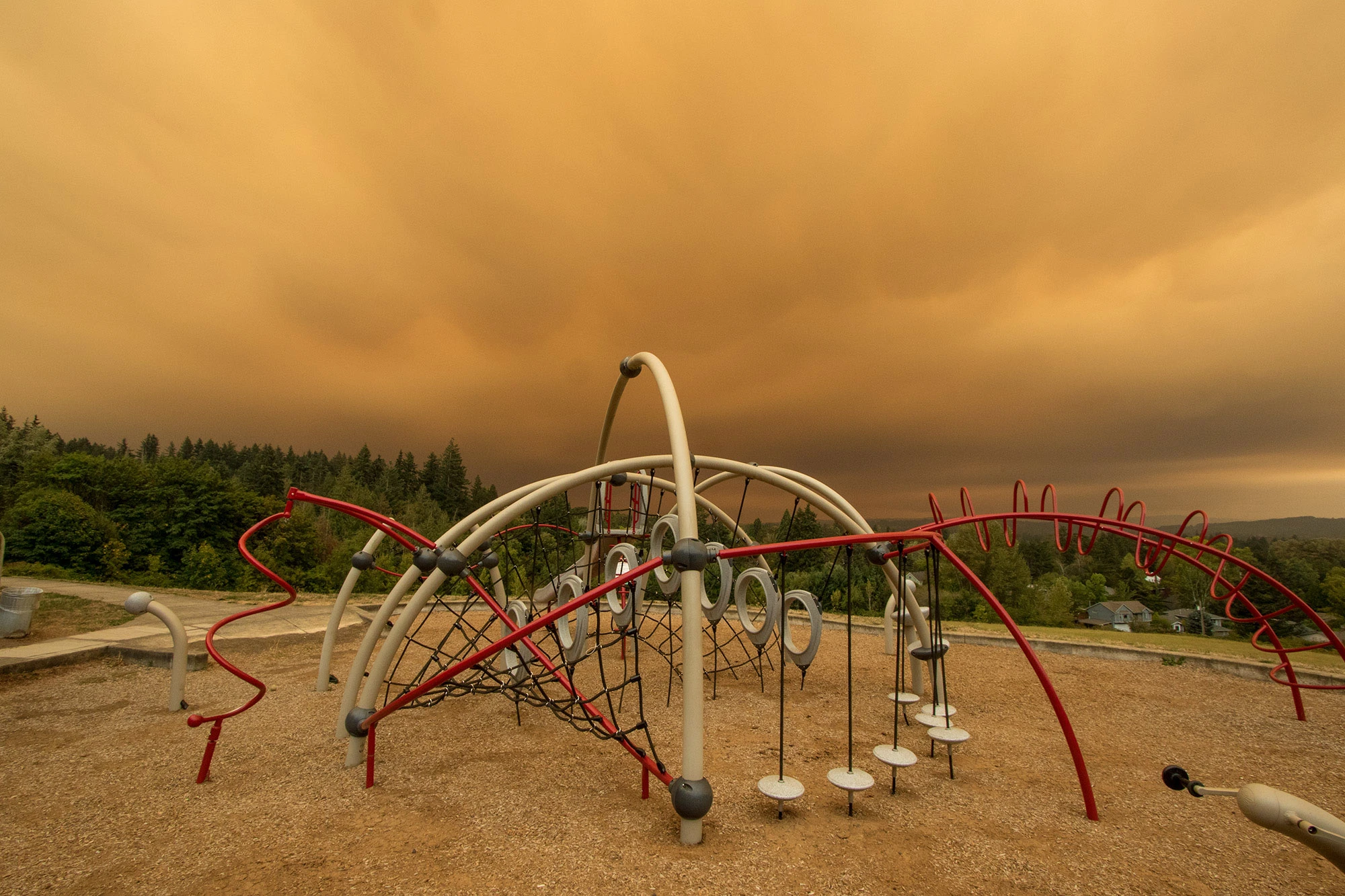
Portland, Oregon, September 2020. For days, the city recorded some of the worst air quality in the world, with AQI levels reaching "hazardous" and smoke so dense that daylight turned orange. The event was not caused by a single ignition, but by multiple large fires combined with extreme heat, drought, and rare east winds—conditions that allowed smoke and fire behavior to escalate far beyond historical norms.
Moore treats ignition as the whole story. But a spark is only a beginning — what the fire does next depends entirely on what surrounds it. Lightning has always existed. What changes over time is the landscape those sparks encounter.
Wet vegetation resists fire. It burns reluctantly, incompletely, and often not at all. Vegetation dried by heat and months without rain behaves differently — the same spark that would have smoldered and died instead takes hold and runs. Calling ignition the cause of that difference sidesteps what actually changed: the climate those fuels have been sitting in.
Reducing wildfire to ignition is like explaining a flood by pointing to a raindrop.
Moore's False Binary
Strip away the sarcasm and the chapter reduces to a familiar list of drivers:
- excessive fuel loads
- lack of thinning or logging
- suppression of natural fires
- expansion into the wildland–urban interface
These are presented as alternatives to climate explanations. In reality, they operate together.
Fuel load tells you what's available. Climate tells you how dangerous that availability actually is on any given day. In dry, fire-adapted forests of the western United States, decades of fire suppression have increased surface fuels. In some of these systems, reducing those fuels can lower fire severity at a local scale—but it does not explain the regional increase in fire size and intensity.
It is also worth noting that the environmental movement Moore is arguing against has not stood still. Early fire suppression policies, shaped by a mix of public attitudes, agency priorities, and mid-century conservation thinking, did contribute to fuel buildup in some fire-adapted forests. That is now widely recognized. Over the past several decades, ecologists, land managers, and Indigenous practitioners have pushed fire science toward prescribed burning, managed wildfire, and more nuanced approaches to fuel treatment.
Moore's argument depends on treating those earlier views as if they still define environmental thinking today. They do not. The science evolved. The policies followed. Moore did not.
Researchers measure atmospheric dryness using vapor pressure deficit — essentially, how much moisture the air can still absorb. Since the 1980s, that figure has risen by approximately 5 to 15 percent across the western United States (Abatzoglou & Williams 2016; Williams et al. 2019), driven by warming temperatures. Soils lose moisture faster. Plants do too. The window during which a landscape can carry fire has grown wider.
This change does not replace the role of fuels. It changes the conditions under which fuels burn.
Moore presents a choice where the science shows an interaction.
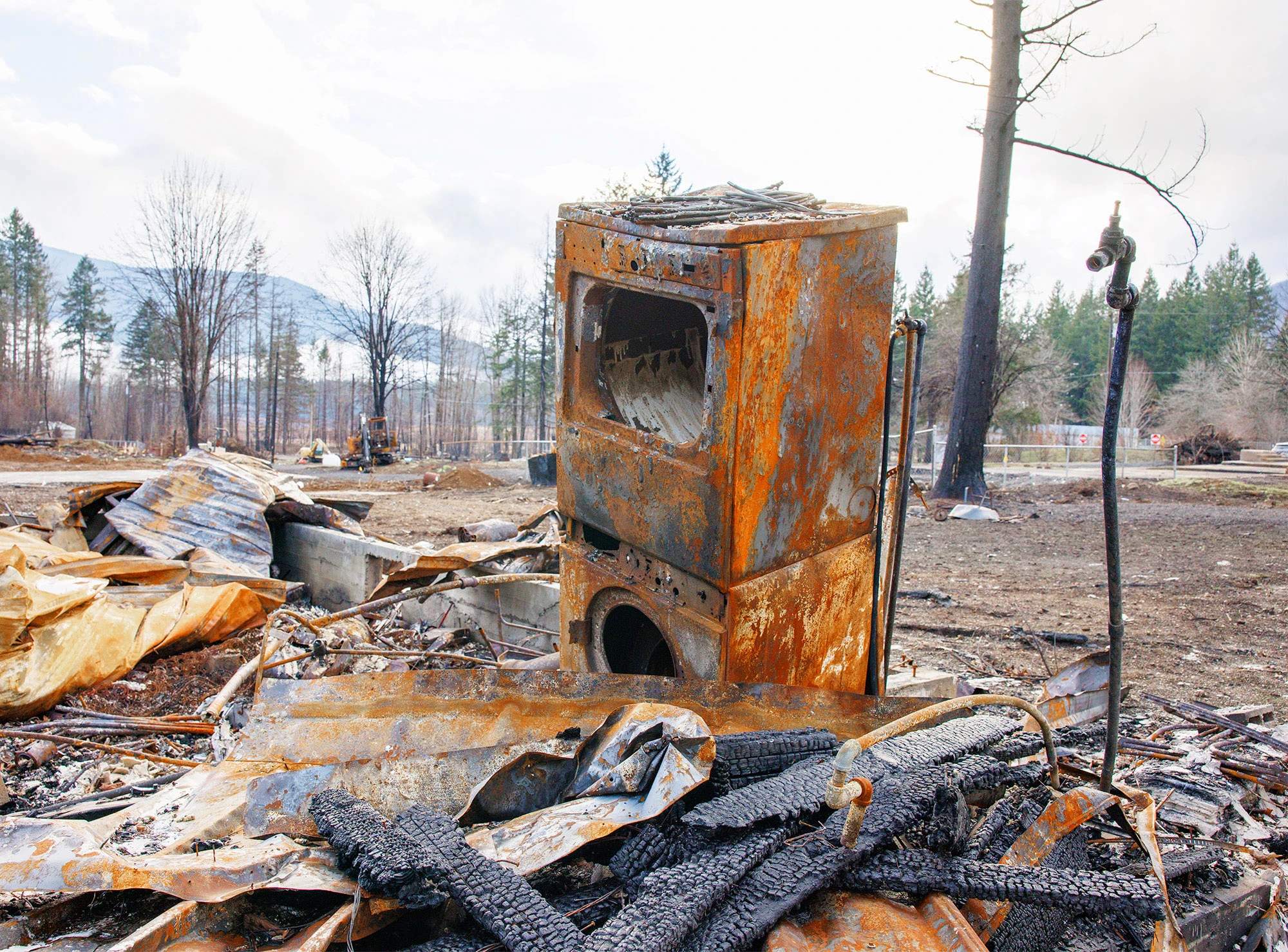
Detroit, Oregon, September 2020. Entire blocks of the town were reduced to ash as the Beachie Creek Fire surged west under extreme wind, heat, and drought. Hundreds of homes and structures were destroyed in a matter of hours, infrastructure was wiped out, and whole neighborhoods simply ceased to exist. This was not a slow-moving forest fire—it was a rapid, wind-driven event that overwhelmed suppression and erased a community, illustrating how modern wildfire behavior is shaped by climate conditions far beyond ignition alone.
Figure 82: The Historical Data Trick
Moore's key visual is a graph titled: "US Forest Area Burned 1926–2017."
Moore's graph appears to settle the question before it's even asked. Fires burned millions of acres in the 1930s and 1940s — decades when atmospheric CO2 was far lower than today. The implication lands without needing to be stated.
What the graph doesn't say is that the early numbers aren't reliable in the way modern figures are. The National Interagency Fire Center has noted that pre-1983 data were gathered through methods that were inconsistent, incomplete, and not directly comparable to what came after. That's not a footnote. It's why the comparison doesn't hold.
That limitation is not disclosed.
The comparison Moore relies on is not just weak. It is invalid.
Set aside the pre-1983 numbers and look only at what the modern record shows:
- Every one of the ten largest wildfire years in United States history has occurred since 2004
- Total area burned each year has grown by roughly four to five times since the 1980s
- The number of fires has stayed broadly the same
The key change is not how often fires start, but how large they become.
Bigger Fires, Not More Fires
Ignition sources have not changed dramatically over time. Lightning still strikes. Human-caused fires still occur at broadly similar rates.
What's changed is the aftermath. The National Interagency Fire Center's data shows wildfire counts in the United States holding fairly steady since the 1980s — roughly between 60,000 and 80,000 per year. The acres those fires consume tell a different story. Total area burned has grown by roughly four to five times over the same period. The number of ignitions is not the signal. The gap between those two trends is.
The fires that define this era aren't numerous — they're enormous. Events that would once have been caught and contained now regularly push beyond any threshold suppression crews can manage, burning hundreds of thousands of acres at intensities that make intervention largely symbolic. These megafires account for a share of total burned area wildly disproportionate to their count, and they've become severalfold more frequent across the western United States since the 1980s — a trend that tracks temperature and atmospheric dryness with uncomfortable precision (Abatzoglou & Williams 2016; Williams et al. 2019).
The physics behind this is not complicated.
Why Heat Turns Small Fires Into Big Ones
Warm air is hungry air. The warmer it gets, the more moisture it can pull from whatever it touches — and vapor pressure deficit, which measures that pulling force, has climbed roughly 5 to 15 percent across western North America since the late twentieth century. Soils give up their water faster. Plants do too. The fuels a fire encounters have been pre-dried by an atmosphere with an ever-larger appetite. They catch more easily, carry flame farther, burn at higher intensity, and no longer respond to suppression the way they once did. What might once have been a contained event becomes something else entirely.
This is why stable ignition rates can coexist with rapidly increasing burned area. Climate does not replace ignition as a factor. It alters the conditions that determine how far a fire travels once it begins.
This is the mechanism Moore's chapter never engages.
Wildfire data, United States
Bigger Fires, Not More Fires
Since 1983, annual wildfire counts have stayed broadly within the same range, while total acres burned have climbed sharply. The gap between those two lines is the story.
What to notice: The number of fires does not surge in parallel with acreage. What grows is the scale of burning once fires begin.
Source: National Interagency Fire Center, annual wildfires and acres burned (1983–2024).
What Climate Change Actually Does to Fire
To understand what fires are doing, you have to look at what the climate around them is doing — how much warmer the air is, how much drier the fuels are, and how many more weeks each year conditions allow fire to spread.
Several mechanisms are well established.
Rising Temperatures and Fuel Drying
As air warms, it pulls harder on everything around it — and vegetation, unable to replace moisture fast enough, spends more of the year in a critically dry state.
Earlier Snowmelt and Longer Fire Seasons
Fire seasons across parts of the western United States have lengthened by two to three months since the 1970s, as snowpack disappears earlier and the dry period stretches further into fall.
Extreme Fire Weather
The most dangerous conditions aren't any single factor but a convergence — heat, drought, low humidity, and wind arriving together in ways that overwhelm both vegetation and the crews sent to protect it.
These are measurable, observed changes — not speculation.
Attribution Studies
Research has quantified the contribution of climate change to observed fire trends. Abatzoglou and Williams (2016) estimate that anthropogenic warming accounts for approximately 55 percent of the increase in burned forest area in the western United States since the 1980s.
This does not mean climate is the only factor. It indicates that it is a major one.
Moore's argument depends on this contribution being negligible. It is not.
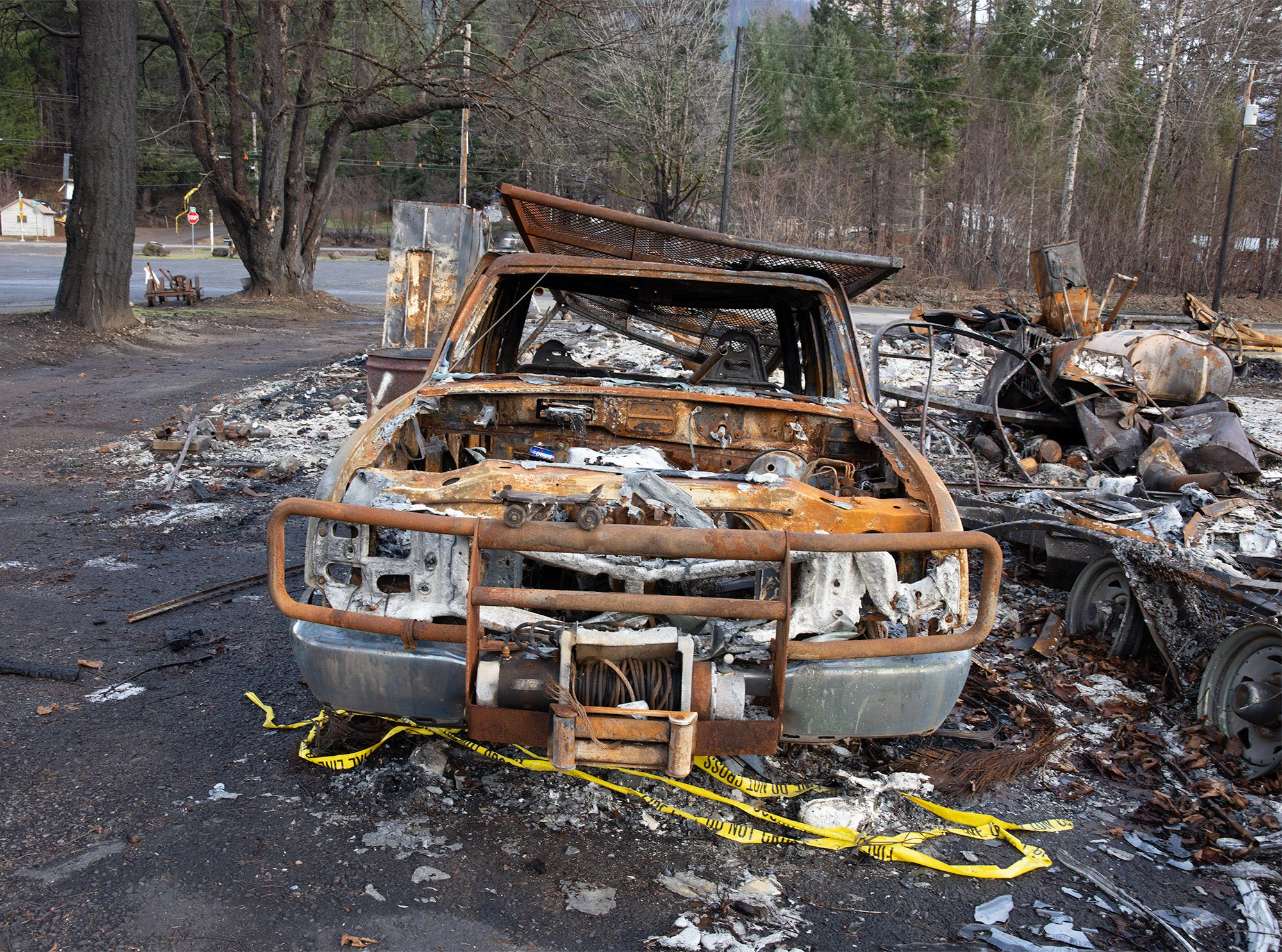
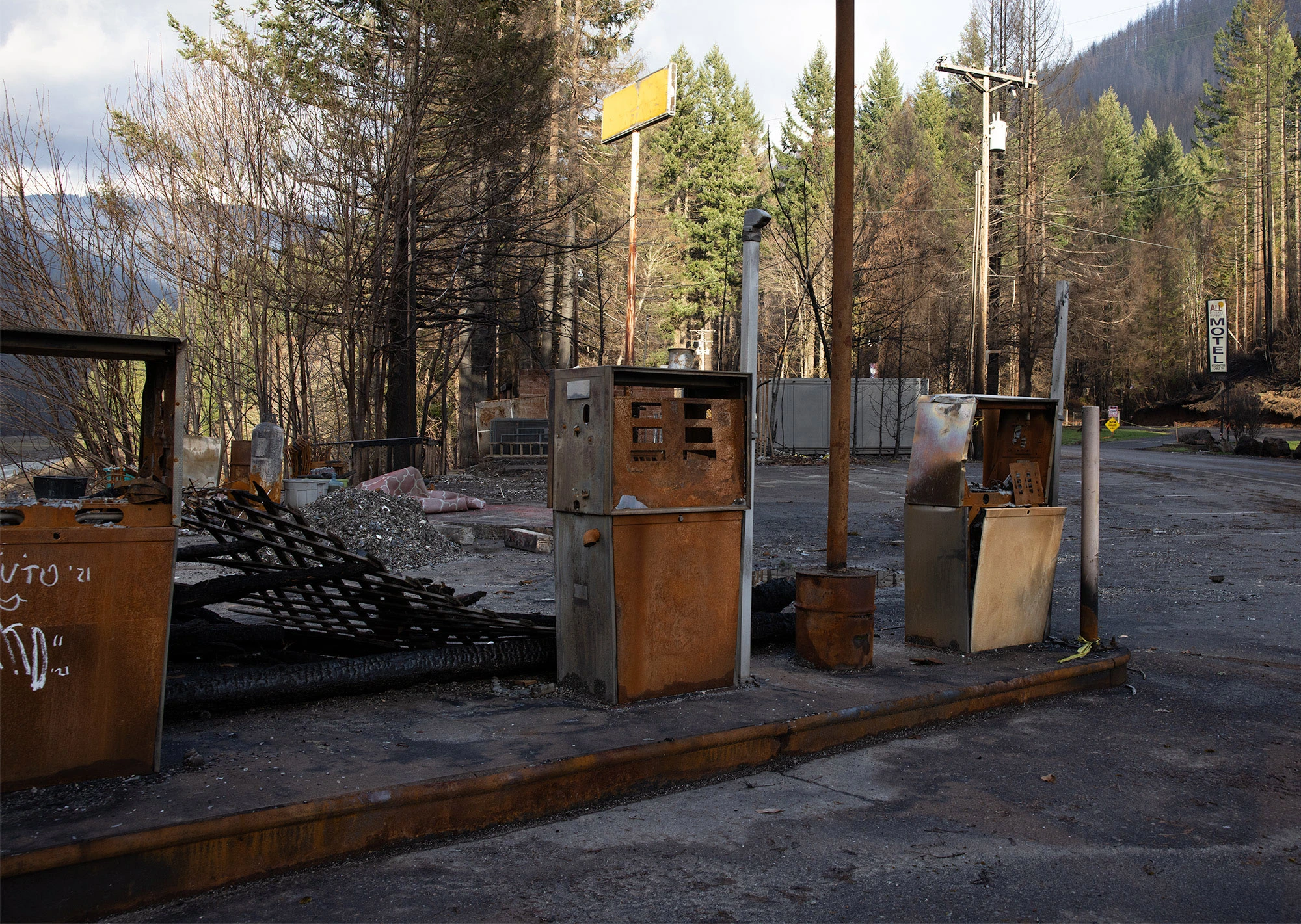
Detroit, Oregon, after the September 2020 Santiam Canyon wildfires. Vehicles, homes, and infrastructure were reduced to charred metal and ash as fire intensity surged beyond what suppression could control. This level of destruction reflects not just ignition, but the extreme heat, drought, and wind conditions that allow modern wildfires to burn hotter, faster, and with far greater impact than in the past.
The Forest Management Myth
Moore's proposed solution—expanded logging and "active management"—rests on a broad generalization about how forests function.
Moore's solution follows from his diagnosis: wildfire is excess fuel, and excess fuel gets removed. In certain dry, fire-adapted western forests, where fire suppression has spent decades building up what should have burned long ago, that logic has grounding — targeted fuel reduction in those systems can change fire behavior locally. The problem is the leap from there to everywhere. Most of the world's forests do not fit that description.
Zoom out and the argument breaks down. Much of the world's increasing fire activity is happening in places where fuel accumulation was never the defining condition — ecosystems that historically burned rarely, or not at all.
- Amazon rainforests barely burned historically; the fires now moving through them track land clearing, extreme drought, and heat — not decades of fuel accumulation
- Boreal forests are burning larger and hotter as warming pulls moisture from deep organic soils and peat, unlocking carbon stored for centuries
- Temperate rainforests of the Pacific Northwest can pass centuries without a major fire — yet drought and heat extremes are now arriving in forests that were never shaped by them
- Mediterranean ecosystems and shrublands are seeing more frequent, fast-moving fires driven by heat and aridity rather than simple fuel buildup
These systems didn't resist fire because they lacked fuel. They resisted it because they were wet. Rising temperatures are changing that equation. As atmospheric demand for water increases, landscapes that once held enough moisture to suppress fire are losing that capacity — burning under conditions they have no evolutionary history with.
Moore's explanation, centered entirely on what accumulates, has nothing to say about what disappears.
Logging cannot meaningfully address drought. It does not reverse heat waves. Fire seasons do not shorten because trees are cut. Atmospheric drying does not reverse. In some cases the cutting accelerates the problem — altering microclimates, exposing soils to sun and wind, and producing conditions drier than the forest it replaced.
A forest is not a warehouse. The fuel-inventory framing treats it like one — tallying what's available, calculating what to remove — and in doing so discards everything that makes a forest function. The climate relationships, the soil structure, and the biological interactions built up over centuries are not recoverable on short timelines. Large trees and intact canopy do not just occupy space. They hold water, shade the ground, and moderate the temperature extremes that determine whether a landscape burns.
Moore's framework reduces this complexity to a single variable and then applies it broadly. The result is a model that fits a subset of forests and fails to explain a growing number of fires outside that context.
It is a theory that explains yesterday's forests and fails on today's fires.
When forests that were not historically shaped by frequent fire begin to burn under extreme heat and drought, the explanation is no longer "too many trees." It is a change in the conditions those forests exist within.
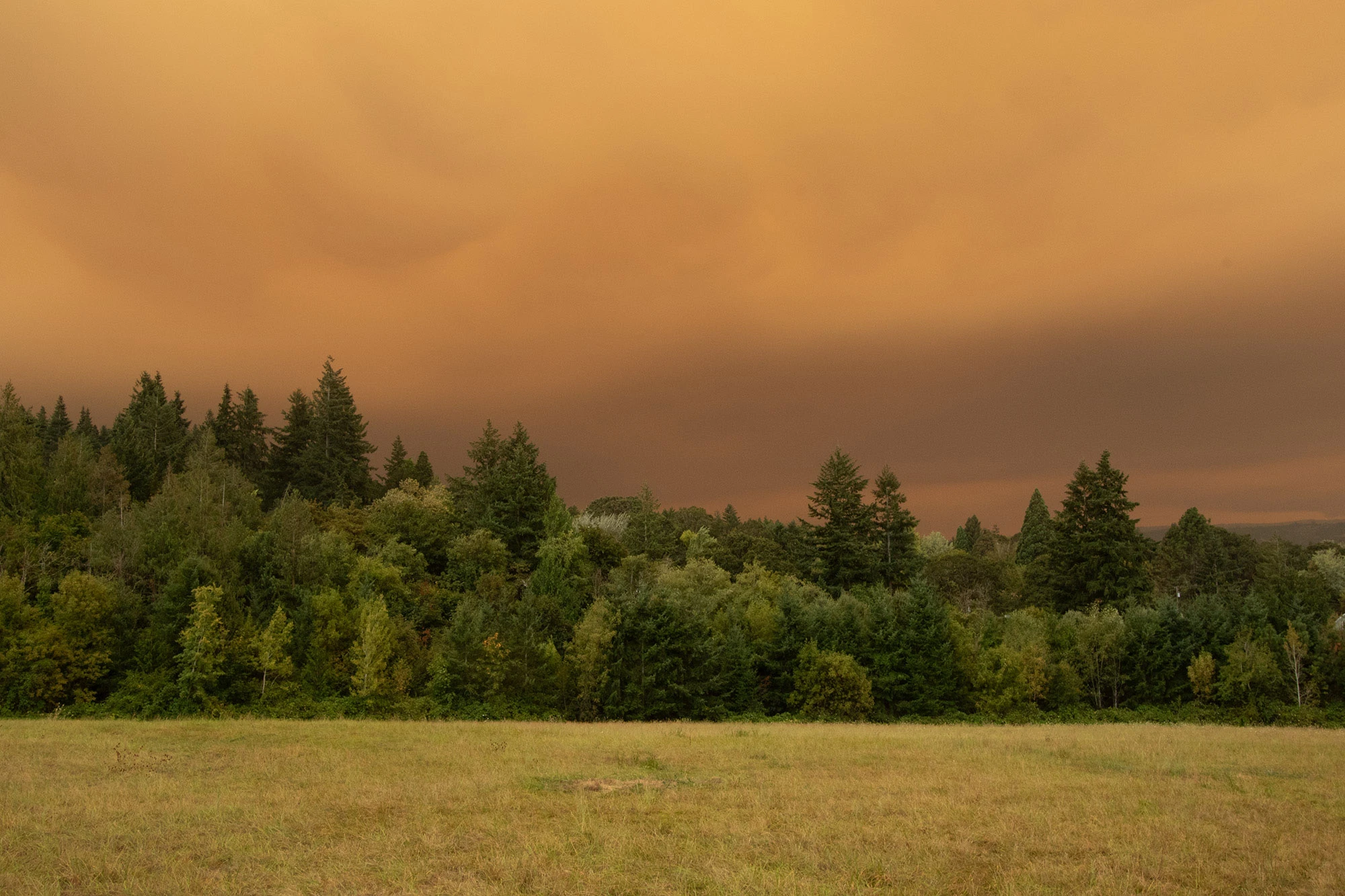
Near Portland, Oregon, September 2020. Before visibility collapsed entirely, the sky turned a deep orange as smoke from multiple wildfires spread across the region. What begins as a distant atmospheric shift quickly becomes a full-scale air quality crisis, as heat, drought, and wind drive smoke into populated areas and hold it there for days. This is how wildfire impacts extend far beyond the burn zone—reshaping entire regions through air, not just flame.
Moore's argument leans heavily on selective visuals—images and charts that appear persuasive until you examine what they leave out.
Figure 83: Turning Disaster into Prescription
To make the case for logging, Moore reaches for an image: Paradise, California in the aftermath of the Camp Fire. The photograph is striking. The argument it's asked to support is something else.
Forest management wasn't what failed that day. What drove the Camp Fire was weather: record heat following a prolonged drought, humidity stripped from the air, winds coming hard off the ridge. Under those conditions the distinction between forest and town largely disappeared — vegetation, structures, and infrastructure had all been drying for weeks and burned accordingly.
The fire entered Paradise through the wildland–urban interface and found no shortage of fuel — houses, fences, utility infrastructure, parked cars. The town burned the way the forest did, and when the winds strengthened there was nothing left to do but watch. Broader logging in the surrounding landscape wouldn't have grounded the wind or put moisture back into what had already spent weeks drying out.
Many of the most destructive fire pathways in Paradise were driven by embers and structure-to-structure ignition, not simply continuous forest fuels.
The image is used to suggest a simple cause—too many trees—and a simple solution—more logging. The event itself reflects a combination of extreme weather, ignition source, and built environment. The conclusion Moore draws does not follow from the evidence he presents.
Figure 84: The Spotted Owl Narrative
For decades the northern spotted owl has served as a symbol of regulatory overreach in western forestry debates — the small bird that stopped the chainsaws. Moore leans into that symbolism.
Timber harvests declined, Moore argues, because environmentalists used a small bird to stop the logging. Forests thickened. Fires followed.
The story has a satisfying internal logic. It also leaves out most of the history.
National forest timber harvests did decline through the late twentieth century, and the northern spotted owl's legal protections were part of why. But only part. Harvest levels were already trending downward — old-growth stocks exhausted by decades of intensive cutting, markets shifting, federal land management moving in new directions across the board. The owl arrived late to a trend already underway.
And the larger claim Moore builds from that decline — that reduced logging translated directly into the fire severity we're now seeing — isn't what the evidence at regional scale actually shows.
Fuel treatments can reduce fire intensity in specific locations, especially near communities. But commercial logging is not equivalent to targeted fuel reduction. Logging often removes large, fire-resistant trees while leaving behind smaller material and slash that can increase surface fuels. Its effects on fire behavior vary widely depending on how, where, and why it is conducted.
The figure Moore presents shows only one variable: declining timber harvest. Temperature trends aren't on the graph. Neither is drought severity, vapor pressure deficit, or any measure of fire weather — all of which have been strongly and repeatedly linked to increasing fire activity across the western United States.
By isolating the one variable that supports his conclusion and leaving out the ones that don't, Moore produces something that looks like evidence while bypassing the actual debate.
The spotted owl becomes a stand-in for a broader narrative: environmental protection reduced logging, and reduced logging caused fires. But the evidence required to support that chain of causation is not presented.
Figure 85: The Biomass Sales Pitch
Moore writes, "Globally, biomass energy produces much more electricity than wind and solar combined."
That claim was debatable when Moore wrote it and is harder to defend now. Wind and solar generate substantially more global electricity than modern biomass, and their share of the mix is growing rapidly in a way biomass is not.
But the deeper problem is how the claim is used.
Biomass is presented as a natural extension of the wildfire argument: forests should be thinned or logged, and the resulting material can be burned for energy. The logic suggests a single solution that addresses wildfire risk and climate concerns at once.
That framing overlooks a central issue in carbon accounting.
There's a timing problem at the center of the biomass argument. Wood burned for energy releases its carbon immediately. The trees needed to reabsorb it won't exist for decades — a carbon debt that accumulates while the atmosphere doesn't wait (Searchinger et al. 2009). Across those timescales, biomass can produce emissions per unit of energy comparable to or higher than the fossil fuels it's meant to replace.
What Moore's figure offers instead is a narrative in which logging, power generation, and climate responsibility all point the same direction. The carbon math runs the other way.
The underlying evidence does not support that alignment.
Ignition Hasn't Changed, but Climate Has
Moore's conclusion rests on a deceptively simple premise: lightning starts fires, people start fires, therefore climate change doesn't start fires.
Ignition has not changed in any fundamental way. The conditions surrounding those ignitions have.
Warmer temperatures, earlier snowmelt, longer dry seasons, and reduced fuel moisture all influence how fires behave once they begin. Under these conditions, similar ignition sources can produce very different outcomes.
The chapter focuses on how fires start while largely overlooking how they spread and intensify. Once that gap is recognized, the central claim loses its foundation.
Moore explains the spark and ignores the inferno.
Sources and Further Reading
Abatzoglou, John T., and A. Park Williams. 2016.
"Impact of Anthropogenic Climate Change on Wildfire Across Western US Forests." PNAS.
Williams, A. Park et al. 2019.
"Observed Impacts of Anthropogenic Climate Change on Wildfire in California." Earth's Future.
Williams, A. Park et al. 2022.
"Rapid intensification of the emerging southwestern North American megadrought in 2020–2021." Nature Climate Change.
National Interagency Fire Center.
Wildfire Statistics.
Note on pre-1983 data limitations.
https://www.nifc.gov/fire-information/statistics/wildfires
EPA.
Climate Change Indicators: Wildfires.
https://www.epa.gov/climate-indicators/climate-change-indicators-wildfires
IPCC. 2021.
Climate Change 2021: The Physical Science Basis.
Sixth Assessment Report, Chapter 11.
NASA Earth Observatory.
Climate Change and Wildfires.
Searchinger, Timothy et al. 2009.
"Fixing a Critical Climate Accounting Error." Science.
Patrick Moore. 2021.
Fake Invisible Catastrophes and Threats of Doom. Chapter 9.