
The Glasswing Butterfly
The transparent-winged butterflies of the rainforest, from Greta oto to the Blushing Phantom, and how they vanish in plain sight.
Updated September 24, 2026
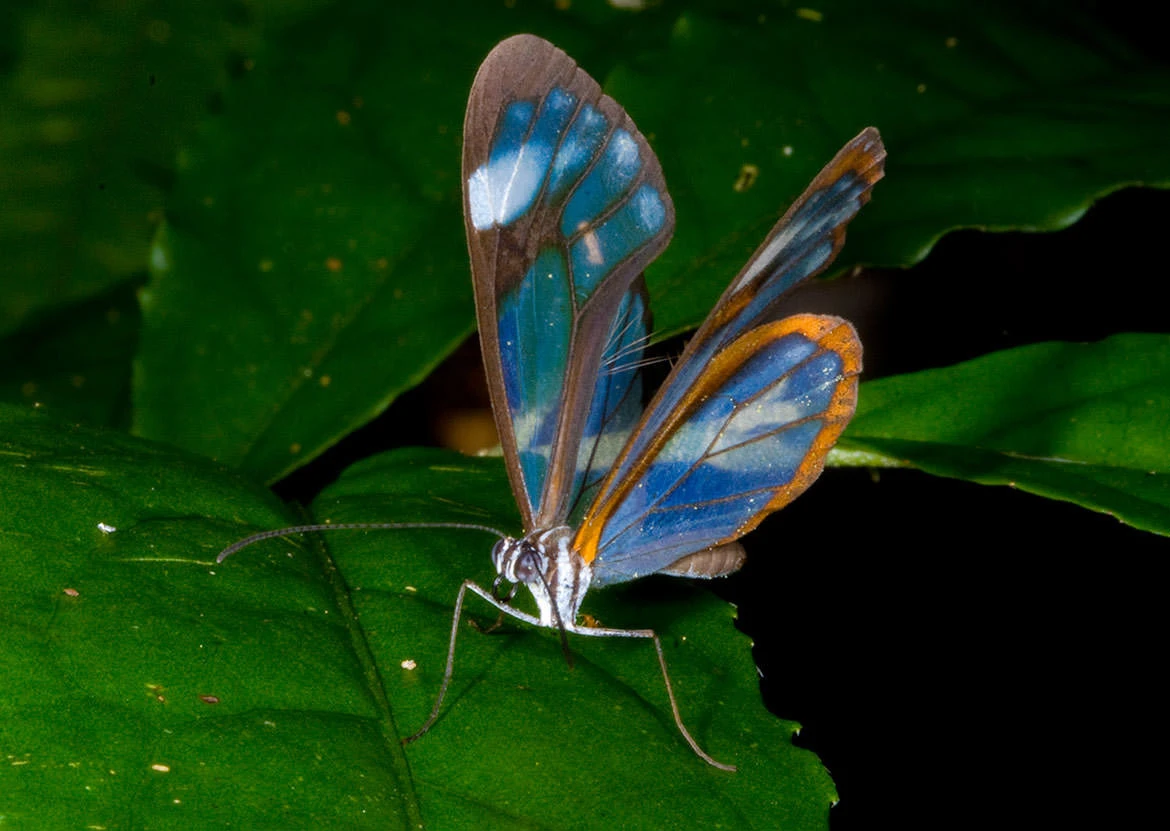
Note the blue wings on this butterfly from the Ithomiini tribe. This butterfly is actually a glasswing butterfly; its wings are as clear as glass. The stained-glass effect you see in this photo is just the effect of my strobe flashes, reflecting off the veins and the thin membrane of the wing.
You can see the vegetation behind these wings. The wings of these delicate jungle butterflies give them an ethereal, elusive quality, and in the dim light of the rainforest understory they are genuinely hard to follow. One moment a glasswing is drifting past your face; the next, it has dissolved into the leaves.
The Clearwings of the Neotropics
Most of the world’s glasswing butterflies belong to a single tribe, the Ithomiini, known simply as the clearwings. There are roughly 370 species in about 43 genera, and they are found only in the Neotropics, in humid forests from Mexico to Argentina and from sea level to about ten thousand feet in the Andes. The cloud forests of the eastern Andes, in Colombia, Ecuador and Peru, hold the greatest variety of all.
These butterflies can afford to be slow, delicate, ethereal jungle dwellers because they are protected by chemistry. Their caterpillars feed mostly on plants in the nightshade family, but the real defense comes later: adult butterflies, especially the males, visit certain flowers and wilting plants in the aster and borage families to collect pyrrolizidine alkaloids, bitter compounds that make them distasteful to birds, lizards and even spiders. The males also use those same alkaloids to make the pheromones they release to court females.
Because so many of them are unpalatable, ithomiines are the center of some of the most elaborate mimicry in nature. Dozens of species, and other butterflies and even day-flying moths, share the same few wing patterns, so that a bird that learns to avoid one learns to avoid them all. The naturalist Henry Walter Bates, working in the Amazon in the 1850s, noticed a whole ‘transparency group’ of unrelated butterflies that had converged on clear wings, one of the observations that led him to his theory of mimicry.
Why Do Glasswing Butterflies Have Transparent Wings?
Scientists believe transparency is an effective form of camouflage in dim light. When a glasswing is at rest, it seems to vanish into the background, and even its thin, non-transparent edges are hard to see. Imagine a bird hunting through the tangled understory of the forest, scanning for the flash of a colorful wing, and you can see the advantage of having no color at all.
It seems strange that a butterfly would need both camouflage and a chemical defense, but the two work together. A predator that never notices a butterfly never has to taste it, and for a butterfly, even being tasted and spat out can be fatal. Transparency, it turns out, has evolved many times in unpalatable butterflies, not just in the palatable species you might expect to need the disguise.
How Transparent Wings Work
A butterfly wing is normally covered in thousands of tiny overlapping scales, which is where its color comes from. Glasswings have far fewer scales on the clear parts of their wings, and those that remain are reduced to thin bristles. But a bare wing membrane would still shine like a window. In 2015, researchers studying Greta oto, the best-known glasswing, found that its clear wing panels are covered in a forest of microscopic pillars, each a few hundred nanometers tall, arranged at random heights. That randomness scatters light so effectively that the wing reflects only about two percent of visible light, even when viewed from a steep angle. Engineers are now copying the structure to design anti-glare screens, camera lenses and more efficient solar cells.
The Blushing Phantom of the Napo
It’s curious why one species of glasswing, Greta oto, tends to get all the attention. In fact, there are many dazzling species, and not all of them are ithomiines. This is the pink glasswing butterfly, Cithaerias pireta, sometimes known as the Blushing Phantom or the Rusted Clearwing-Satyr. It belongs to an entirely different group, the satyrs, which evolved transparent wings independently. The phantoms fly low and slow over the dark floor of lowland rainforests, and their wings are nearly invisible except for a blush of pink or amber on the hindwing. This transparent butterfly simply cannot be photographed the way it looks in life. The effect in real life is of glowing pink matter floating through the dark jungle, one of the great sights of the rainforest to behold.
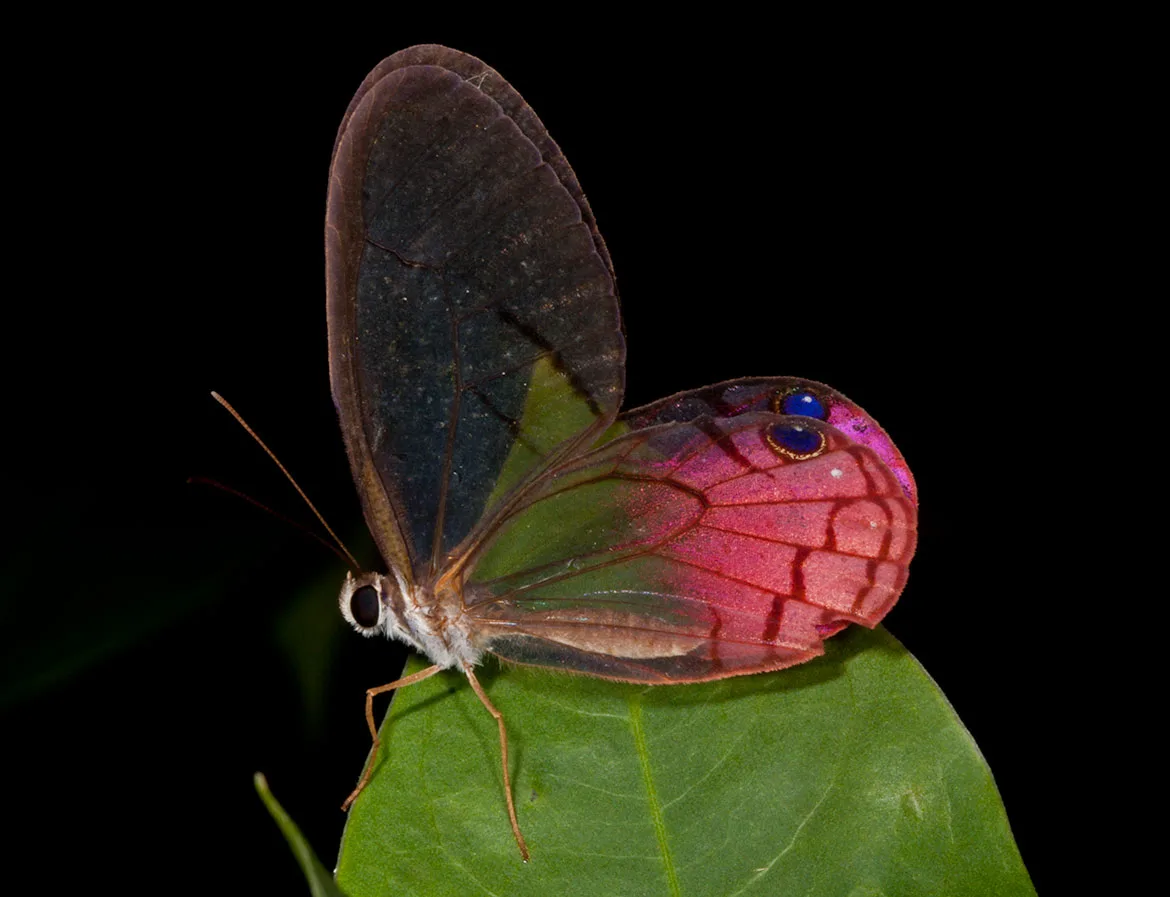
A pink glasswing, or Blushing Phantom (Cithaerias pireta), in the jungle along the Napo River in eastern Ecuador.
Glasswing Butterflies of the World, by Region
Clear or glassy wings have evolved again and again, in unrelated families on different continents. Here are some of the most remarkable glasswing butterflies, and where to look for them.
Mexico and Central America
- Glasswing (Greta oto): the classic glasswing, with clear wings rimmed in dark brown and orange, found from Mexico through Central America. It is common in butterfly houses around the world.
- Blushing Phantom (Cithaerias pireta): a satyr with nearly invisible wings and a pink blush on the hindwing, from Mexico into South America.
- Uncolored Clearwing-Satyr (Dulcedo polita): a ghostly, almost colorless satyr of shaded forest floors from Nicaragua to Colombia, and the only species in its genus.
The Andes and the Amazon
- Ithomiine clearwings: hundreds of species in genera such as Greta, Oleria, Ithomia, Pteronymia, Godyris, Hypoleria and Pseudoscada, many of them restricted to a single Andean valley or cloud forest.
- Amber Phantom (Haetera piera): a satyr with transparent wings washed in amber, found in the Guianas, Venezuela, Brazil, Ecuador, Peru and Bolivia.
- Other phantoms (Cithaerias species): several close relatives of the Blushing Phantom, with pink, violet or blue patches on otherwise clear wings.
- Sylphina Angel (Chorinea sylphina): a metalmark from Ecuador, Peru and Bolivia, with glassy wings and long, delicate tails, flying in full sun.
The Ithomiine Clearwings, Group by Group
Not every ithomiine is transparent. The tribe is divided into several subtribes, and some are dressed in bold orange, yellow and black ‘tiger’ patterns instead, mimicking each other and the equally distasteful longwing butterflies. The truly glass-winged species are concentrated in a few groups. Here are the main genera in each.
| Subtribe | Main genera | Typical wings |
|---|---|---|
| Tithoreina | Tithorea, Aeria, Elzunia | Tiger-striped; the oldest branch, whose caterpillars feed on dogbane vines instead of nightshades |
| Melinaeina | Melinaea | Large tiger-striped butterflies, central to many mimicry rings |
| Mechanitina | Methona, Thyridia, Scada, Sais, Forbestra, Mechanitis | Mixed: Methona and Thyridia are large clearwings with dark bands; Mechanitis are tigers |
| Napeogenina | Napeogenes, Hypothyris, Hyalyris, Epityches, Aremfoxia | Mostly tiger-patterned, some with translucent patches |
| Ithomiina | Ithomia, Placidina | Mostly transparent, often with dark borders and white or orange bars |
| Oleriina | Oleria, Hyposcada, Megoleria | Transparent wings edged in brown or amber; Oleria is among the most species-rich genera in the Andes |
| Dircennina | Dircenna, Pteronymia, Episcada, Hyalenna, Ceratinia, Callithomia, Haenschia | Largely glassy, often yellowish or smoky; Pteronymia is especially diverse in Andean cloud forests |
| Godyridina | Greta, Godyris, Hypoleria, Pseudoscada, Brevioleria, Mcclungia, Heterosais, Velamysta, Veladyris | The classic glasswings, including Greta oto |
New ithomiine species are still being described, especially from the cloud forests of the eastern Andes, and researchers estimate that around one in ten species in the most diverse glassy-winged groups has yet to be formally named.
Australia and New Guinea
- Glasswing or Small Greasy (Acraea andromacha): a common butterfly of northern and eastern Australia and New Guinea, with clear forewings and spotted white hindwings.
- Clearwing Swallowtail or Big Greasy (Cressida cressida): a swallowtail of northern Australia, New Guinea, Maluku and Timor. The males have tough, nearly transparent wings, and the caterpillars feed on poisonous Aristolochia vines.
South and Southeast Asia
- Glassy Tiger (Parantica aglea): a milkweed butterfly with pale, semi-transparent panels in its wings, from India and Sri Lanka across Southeast Asia.
- Blue Glassy Tiger (Ideopsis vulgaris): a glassy, pale blue relative found from India and Sri Lanka through Southeast Asia to Borneo and Palawan.
Europe and North America have no true glasswing butterflies, although the Apollo butterflies of the mountains have glassy, scaleless margins on their wings, and several day-flying moths, such as the hummingbird clearwings and the clearwing moths, have transparent wings and are often mistaken for them.