
Golf Courses Are Incompatible With Coral Reefs
Why a golf course and a coral reef can’t share porous ground: the science, from Bakers Bay to reefs around the world.
Updated September 20, 2026
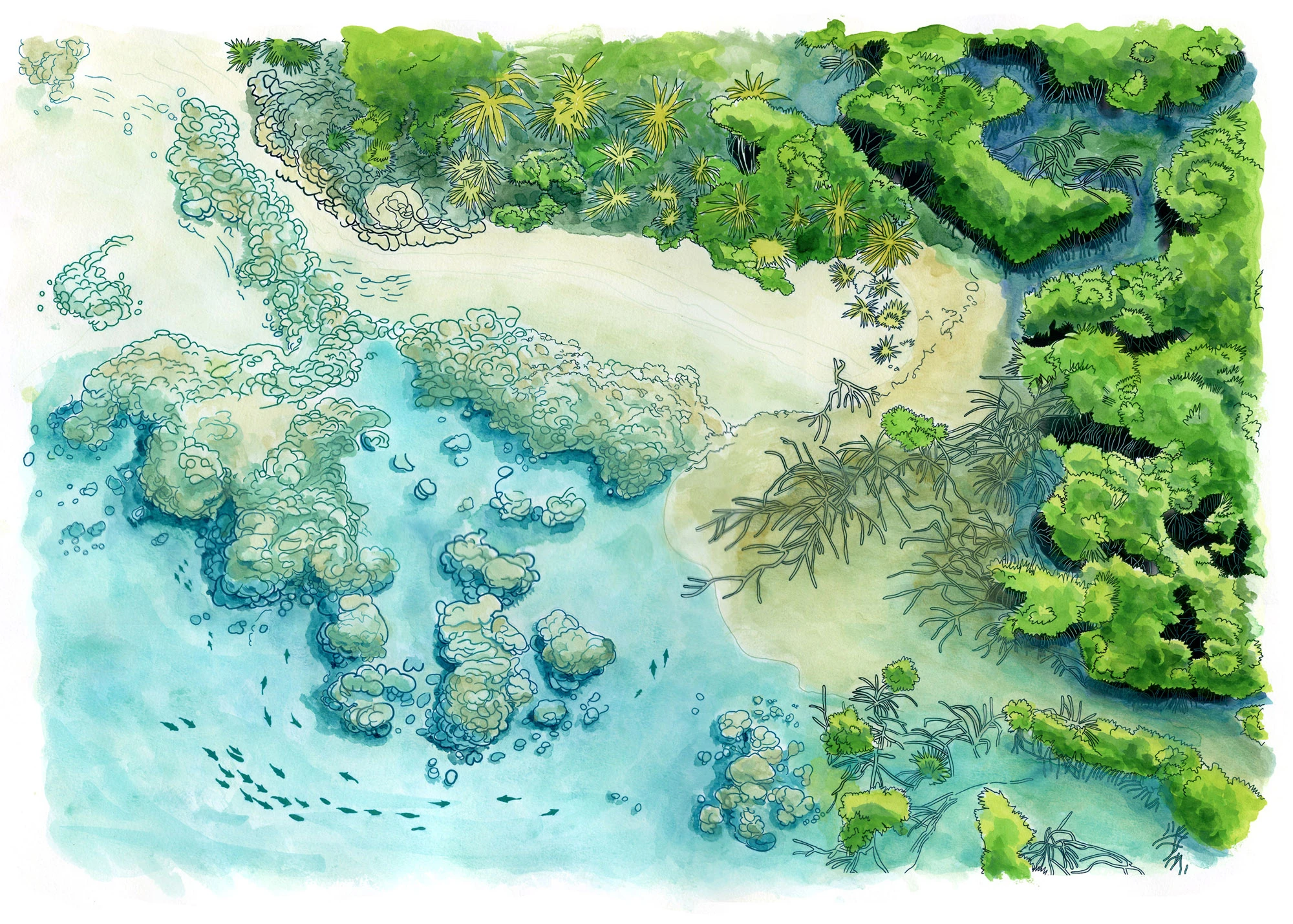
A scientific case, from Bakers Bay to the global reef crisis.
Ten years ago I started writing about Great Guana Cay, a sand-street fishing settlement in the Abacos, and a plan to put an 18-hole golf course, a 250-slip marina, and roughly 450 homes on it. I wasn't trying to become a coral reef writer. I was trying to keep up with a lopsided fight: a community organized as the Save Guana Cay Reef Association, led by a local named Troy Albury, going up against Discovery Land Company, the Arizona-based developer behind what became Bakers Bay Golf & Ocean Club.
In February 2004, before a single fairway was cut, the community brought in Dr. Michael Risk, a marine biogeologist who has spent forty years studying Caribbean reefs and advises the EPA and NOAA on reef monitoring, to do an independent field assessment. His report was blunt: the island's porous limestone geology meant there was no real barrier between the proposed course and the reef sitting just offshore, and golf-course nutrient runoff would likely be, in his words, a "death sentence" for it.
The community lost the legal fight. The course was built. By 2012, coral disease that had been nearly absent before construction had climbed to 17 documented cases, and a video of a thick green algae bloom fanning out near the marina went viral under the caption "sewer-pipe algae." Dr. Thomas Goreau's Global Coral Reef Alliance and Dr. James Cervino kept monitoring the reef. I kept writing it up, on and off, for most of a decade — you can read that reporting in full in the Bakers Bay archive.
Somewhere in there, this page stopped being read mainly by people following the Guana Cay story specifically. Search brings people here now for golf course environmental impact, why golf courses are bad for the environment, environmental impact of golf courses — the general question, not the specific fight. That's a sign Guana Cay was never really a one-off. It's an unusually well-documented example of a mechanism that turns up anywhere a golf course goes in on porous ground near a reef. So I'm updating the page to make that wider case directly: not just what happened at Bakers Bay, but why it was predictable, and why the same pattern keeps recurring elsewhere.
Why Golf Courses Are Bad for the Environment: A Short Answer
Before the mechanism, the plain-language version. Golf courses are, acre for acre, some of the most input-intensive landscapes humans build, and the environmental impact of golf courses near a coastline runs through several channels at once: heavy, repeated fertilizer and pesticide application that leaches into groundwater and surface runoff; large-scale irrigation that draws down freshwater supplies in direct competition with drinking-water and agricultural demand; and, where a course is carved out of wetlands, mangroves, or native coppice, permanent habitat loss layered on top of the ongoing chemical load. Any one of those would be a legitimate environmental concern on its own. Put a golf course carrying all three next to a coral reef, on ground porous enough to carry the runoff there directly, and you get the specific mechanism this page walks through below — which is also why golf courses are bad for the environment in a way that's measurable rather than just aesthetic.
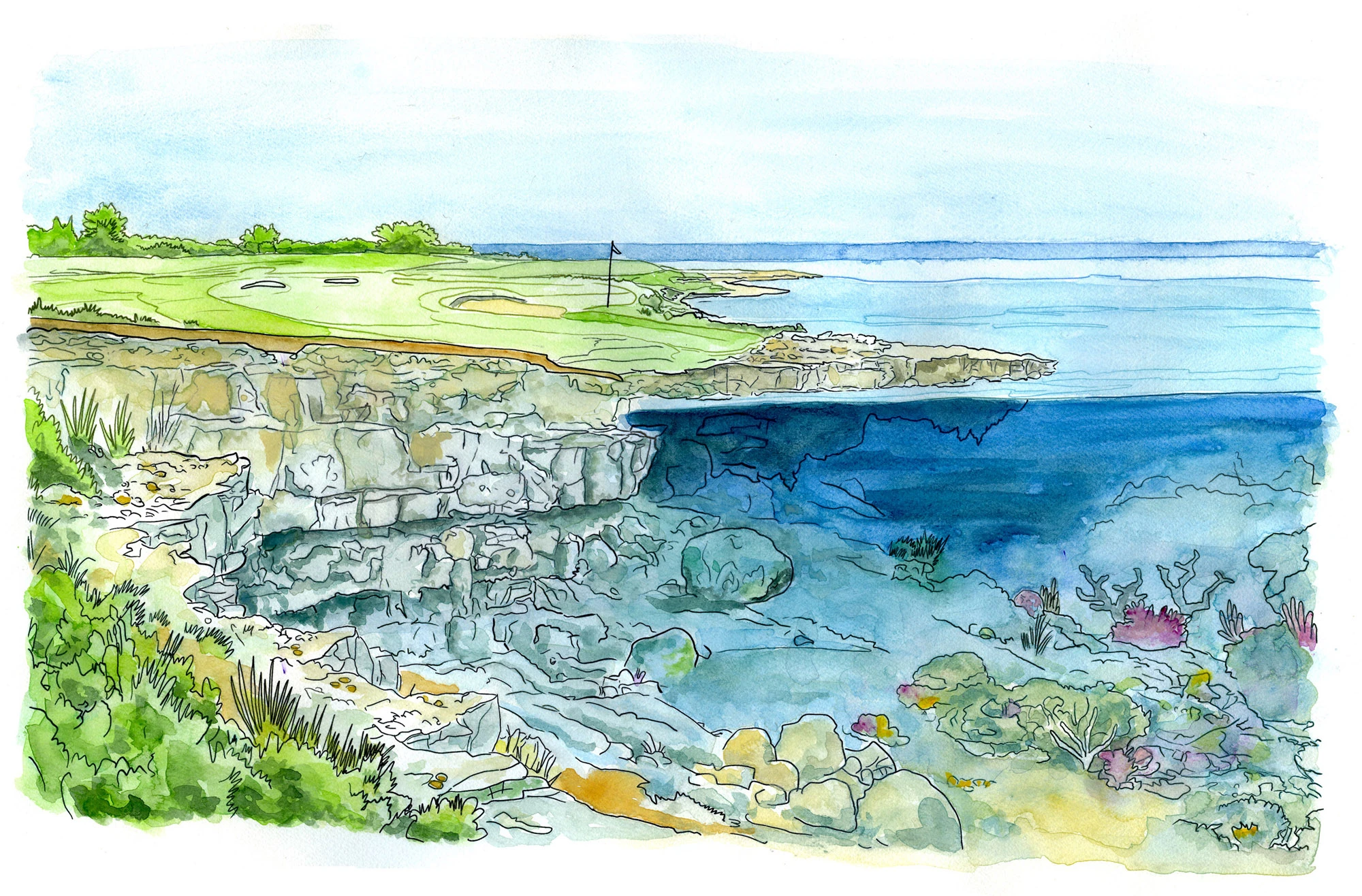
The Core Problem: Reefs Require Scarcity, Golf Courses Require Excess
Coral reefs are not just sensitive ecosystems; they are systems defined by constraint. They evolved in oligotrophic — nutrient-poor — waters, where biological productivity depends on tight internal recycling rather than external input. When nitrogen and phosphorus enter these systems from outside sources, they destabilize the biological equilibrium that makes reefs possible in the first place.
Golf courses are the opposite kind of system. They are engineered landscapes that depend on continuous nutrient input to maintain turf. Nitrogen and phosphorus are applied repeatedly and deliberately, because the system cannot function without them.
The incompatibility isn't philosophical. It's biochemical.
Coral Polyps, Symbiosis, and the Requirement for Nutrient Poverty
At the center of every reef is the coral polyp — a small, soft-bodied animal that builds a calcium carbonate skeleton and hosts symbiotic algae (zooxanthellae) in its tissue. This symbiosis is the engine of reef productivity: the algae supply energy through photosynthesis, the coral supplies protection and access to light, and the whole system stays efficient because nutrients are conserved and recycled internally rather than drawn from outside.
That relationship depends on low ambient nutrient levels. When external nitrogen increases, it disrupts the balance between host and symbiont — the algae proliferate beyond optimal densities, metabolic exchange shifts, and the coral's stress tolerance drops. Elevated nutrients also favor free-living algae and phytoplankton, which compete with corals for light and space and shift microbial communities in ways that increase disease risk.
Corals aren't built to compete in nutrient-rich water. They're built to avoid competition through scarcity. That is the core reason nutrient enrichment correlates so consistently with reef decline across the scientific literature: it undermines the biological partnership the entire system runs on.
Bakers Bay and the Fallacy of Separation
At Bakers Bay, the premise that a golf course can sit next to a reef without affecting it fails immediately under hydrological scrutiny. Great Guana Cay, like most of the Bahamas, is built on porous karst limestone — a substrate that lets water move through it quickly rather than being filtered by it.
There is no functional barrier between land and sea. Water applied to turf infiltrates the ground, dissolves nutrients, and moves laterally toward the coast — not as slow seepage through filtering soil, but as rapid transport through permeable rock. The golf course isn't separate from the reef. It's connected to it through the most efficient delivery system available: groundwater.
Groundwater Is the Dominant Pathway — and It's Continuous
Submarine groundwater discharge is the primary mechanism by which nutrients move from land to reef in porous coastal systems. It's continuous, not episodic — it operates regardless of whether there's visible surface runoff, delivering nutrients directly into nearshore waters day after day.
Research in Hawaii has shown that groundwater-derived nutrients can alter reef metabolism, increase algal growth, and reduce calcification, even when the surface water above looks perfectly clear. At Bakers Bay, groundwater transport isn't incidental — it's the dominant pathway. Nutrients applied to maintain turf reach the reef with minimal filtering and near-constant exposure.
Nutrient Loading Drives Phase Shifts, Not Balance
The ecological response to nutrient enrichment is consistent across reef systems. Elevated nitrogen and phosphorus promote macroalgae, which competes directly with coral for space and light. That competition drives phase shifts — transitions from coral-dominated to algae-dominated reefs — which are often difficult to reverse, because algae actively inhibit new coral from settling and growing.
Golf courses contribute to this process by supplying a continuous nutrient source. The effect compounds over years, not single events.
Mangrove Removal Eliminates a Critical Reef Protection System
On Great Guana Cay, mangroves were cleared to build the marina at Bakers Bay. That's not a peripheral detail — mangroves are a primary defense system for adjacent reefs, performing three functions at once: intercepting nitrogen and phosphorus before they reach coastal water, trapping sediment with their root systems, and slowing water enough for particles and contaminants to settle out or break down.
Removing mangroves eliminates all three functions at once. In a system already vulnerable because of porous geology, losing the mangroves took away one of the only remaining buffers between the golf course and the reef. Mangroves and reefs aren't separate ecosystems — they're functionally linked components of one coastal system, and destabilizing one destabilizes the other. (More on what was actually lost: Bakers Bay and Mangroves.)
Porous Limestone Eliminates Natural Filtration
In most landscapes, soil and vegetation provide at least some nutrient attenuation before water reaches the coast. In karst systems like the Bahamas, that buffering capacity is minimal. Water infiltrates fast, moving through subsurface conduits with little opportunity for microbial processing or plant uptake along the way. The result is close to direct injection: nutrients applied on land arrive efficiently in the water offshore. At Bakers Bay, that isn't a theoretical concern — it's the defining hydrological condition of the site.
Sedimentation and Construction Effects Are Secondary but Significant
Building a golf course means clearing vegetation and reshaping terrain, which increases sediment transport to nearshore water even before the course opens. Sediment reduces light penetration and can physically smother coral polyps. Even though sedimentation is often episodic — tied to storms and construction phases — it compounds nutrient-driven stress by cutting into a coral's photosynthetic capacity right when its metabolic burden is already elevated.
Chemical Inputs Add Chronic Biological Stress
Herbicides, fungicides, and insecticides used in turf management travel the same pathways as nutrients. These compounds interfere with coral biology at multiple levels — photosynthesis, reproduction, immune function — and chronic exposure, even at low concentrations, contributes to long-term degradation.
"Special Turf" Does Not Solve the Problem
Bakers Bay, like many developments of its kind, points to its use of Platinum Paspalum, a salt-tolerant grass variety marketed as needing little or no fertilizer. As Dr. James Cervino testified at the Abaco Science Conference, that grass's ability to absorb nitrogen and phosphorus is limited — it takes up a portion of what's applied, and the rest travels through the porous ground to the reef regardless. In practice, Bakers Bay applies more than 4,000 pounds of fertilizer per acre per year.
"It is, however, impossible to grow grass without water, and impossible to grow golf course grass without fertilizer. No matter how well the use of these two is monitored, some will inevitably escape to the sea. The use of organic fertilizers will delay but not halt the nutrient release." — Dr. Michael Risk
Specialized turf can genuinely lower inputs relative to conventional grass. What it doesn't do is eliminate them. In a hydrologically connected system, that distinction matters more than it sounds like it should: even reduced nutrient application still results in measurable nutrient delivery to the reef. The relationship isn't binary, it's continuous — lower inputs produce lower impacts, not zero impact. Turf still requires ongoing maintenance, so cumulative loading persists over time regardless of how the course was designed at the outset. Specialized turf changes the rate of impact. It doesn't change whether impact happens.
Golf Course Water Conservation Success Stories: What They Actually Show
If you landed here looking for golf course water conservation success stories, they exist — and the first thing to understand is that they answer a different question than the one that decides whether a reef lives or dies. Across the industry, progress on water use has been real: drought-tolerant turf varieties like the Platinum Paspalum above, drip and soil-moisture-sensor irrigation, and the biggest lever, a widespread shift to reclaimed or effluent water for irrigation instead of drawing down potable supply. Reporting from bodies like the USGA and GCSAA has tracked genuine reductions in total freshwater draw per course over two decades. That is an engineering achievement. It is also completely beside the point once the water in question is sitting above coral.
Because conserving water does nothing about the fertilizer. A course irrigated entirely with recycled water applies the same nitrogen and phosphorus to its turf, and on porous limestone that load reaches the reef exactly as it would otherwise. Water use and nutrient loading are separate problems with separate solutions, and solving the first leaves the second untouched. Every reef-killing pound of fertilizer at Bakers Bay could have been applied with the most conservation-minded irrigation in the world, and the coral would be no better off.
This is precisely the confusion Bakers Bay trades on. It advertises reclaimed-water irrigation as if that answered the environmental question, when it answers nothing that reaches the reef — and the "reclaimed water" it markets is treated sewage effluent, cleaned to an irrigation standard and then sprayed across the fairways, carrying whatever nitrogen and phosphorus survives treatment onto the porous ground above the coral. The green credential and the pollution mechanism are the same pipe. The line in nearly every developer's brochure, "salt-tolerant, drought-resistant grass requiring little or no fertilizer," runs the same play in miniature: it borrows the credibility of a genuine water-use gain to wave away a nutrient problem it never touches. A water-conservation talking point is not an environmental credit, and it does not offset a single pound of fertilizer flowing to the reef.
The closest thing to a genuine success story connecting a golf course to reef health isn't a course that avoided runoff in the first place — it's the watershed-scale remediation at Laolao Bay, Saipan, below: an EPA-recognized nonpoint-source success story built on years of restoration work after the damage was already done.
Local Stressors Amplify Global Warming Impacts
Reefs are already under severe pressure from rising ocean temperatures and recurrent bleaching. Local stressors like nutrient enrichment and sedimentation reduce whatever resilience a reef has left to work with. Nutrient-rich reefs bleach more readily and recover more slowly, and algal dominance that follows a bleaching event actively blocks coral regrowth. Land-based pollution doesn't operate independently of climate change — it amplifies it.
The Conclusion Is Structural, Not Conditional
The evidence doesn't support the idea that golf courses and coral reefs can coexist on porous coastal ground through improved management alone. In systems like the Bahamas, where groundwater provides a direct, efficient path from land to sea, nutrient-intensive land uses like golf turf create conditions incompatible with reef survival. In these environments, a golf course next to a reef isn't a manageable risk. It's a predictable outcome.
Case Studies: Golf Courses and Coral Reef Degradation
Bakers Bay Golf & Ocean Club — Great Guana Cay, Bahamas
Bakers Bay didn't develop on a blank landscape — it replaced one of the most ecologically important interfaces in the Caribbean: a functioning mangrove system directly connected to offshore reef. Once that system was cleared for the marina and fairways, the island lost its primary filtration layer, and nutrient-rich runoff has moved largely unimpeded toward the adjacent reef ever since.
Dr. Michael Risk's pre-construction assessment in 2004 documented healthy fringing reef recovering from hurricane damage, and warned specifically that the porous geology and marina design risked turning the site into what he called an "anoxic marina cesspool." Post-construction monitoring by Dr. James Cervino and Dr. Thomas Goreau's Global Coral Reef Alliance documented a rise in coral disease and algal blooms consistent with that warning. The full record, including the developer's own disputed claims and the point-by-point response, is in the Bakers Bay Club Case Study Refuted.
Kapalua Golf Resort — Maui, Hawaiʻi
On the island of Maui, long-term monitoring around Kapalua has shown a clear relationship between coastal development — including golf courses — and elevated nutrient levels in nearshore waters. Kapalua Golf Resort sits upslope from reef systems that have experienced recurring algal blooms, a classic signal of nitrogen enrichment. These blooms outcompete corals for light and space, contributing to phase shifts where reefs transition from coral-dominated to algae-dominated systems.
Scientific studies in West Maui have tied these changes to groundwater transport of nutrients originating from landscaped areas, including golf courses, alongside agriculture and, most prominently, treated wastewater discharged through injection wells (see below). Groundwater inputs are diffuse and persistent, making them harder to regulate than a visible discharge pipe. The result is chronic nutrient loading that slowly degrades reef resilience over time — less dramatic than a single dredging event, but ultimately just as corrosive.
Wailea Golf Club — Maui, Hawaiʻi
Further south in Maui, the Wailea Golf Club occupies porous volcanic substrate that allows rapid infiltration of irrigation water. That water, enriched with fertilizer, doesn't stay on land — it percolates through the subsurface and emerges offshore as submarine groundwater discharge, delivering nutrients directly into reef habitat.
This pathway is particularly hard to manage because it bypasses conventional mitigation like buffer zones or retention ponds. Reefs off Wailea have shown signs of stress consistent with nutrient enrichment: increased macroalgae, reduced coral recruitment, and altered community structure. The mechanism is invisible from the surface, but its ecological signature isn't.
Keauhou and Waikoloa Beach Golf Courses — Hawaiʻi Island
On Hawaiʻi Island, the interaction between golf courses and reef systems runs mostly through groundwater rather than visible runoff — arguably the least intuitive and most consequential pathway. Research near Keauhou and Waikoloa has found that even modest fertilizer application can translate into a meaningful rise in nitrogen and phosphorus reaching coastal water; in some studies, groundwater nitrogen concentrations beneath golf-adjacent land have run on the order of double background levels. Because groundwater discharge is continuous rather than storm-driven, even a fraction of applied fertilizer leaching into the subsurface adds up to a steady, chronic load.
These nutrients surface offshore through submarine springs and diffuse seepage zones, bathing coral reefs directly. The ecological response is the familiar one: increased turf algae, reduced coral recruitment, shifts in reef fish communities. What makes this pathway especially hard to manage is that it bypasses most surface-level mitigation — the land looks stable while the impact unfolds beneath it.
Kāʻanapali Golf Courses — West Maui, Hawaiʻi
In West Maui, the installation of floating treatment wetlands and other stormwater interventions near the Kāʻanapali golf courses — part of an ongoing watershed restoration effort run with groups including Ridge to Reefs — reflects an implicit acknowledgment: without intervention, runoff from these landscapes poses a measurable risk to adjacent reef systems.
These systems are designed to capture and process nutrients before they reach the ocean, using vegetation and microbial activity to reduce nitrogen and phosphorus loads. Their presence is telling — they aren't installed in landscapes where nutrient export is negligible. That said, mitigation systems are inherently partial: they work best under controlled flow and can be overwhelmed during the heavy rainfall events that produce the largest nutrient pulses. The need for this kind of infrastructure underscores the underlying issue — golf courses in coastal tropical environments require ongoing correction for impacts that are structurally built into the land use.
Turtle Bay Resort Golf Courses — Oʻahu, Hawaiʻi
On Oʻahu's North Shore, the Turtle Bay golf courses sit in a landscape prone to episodic sediment runoff during heavy rain. Even a well-maintained course requires grading, soil disturbance, and irrigation — all of which raise erosion risk. When storms hit, fine sediment moves into coastal water, where it can smother coral polyps and cut light penetration.
Corals depend on their symbiotic algae for photosynthesis, so increased turbidity and sediment settling on coral surfaces interferes with both feeding and respiration. Repeated sedimentation events of this kind are associated with partial mortality, slower growth, and greater vulnerability to bleaching elsewhere in the literature on terrestrial runoff — a chronic disturbance layered on top of climate-driven stress.
Laolao Bay Watershed — Saipan, Northern Mariana Islands
Laolao Bay is one of the more directly studied cases of land-based runoff reaching a reef, because the watershed drains a mix of golf course, agricultural, and residential land straight into one of Saipan's most important reef systems. Heavy rainfall mobilizes sediment from maintained turf and exposed soil, raising turbidity and settling on coral surfaces; fertilizer use adds nitrogen and phosphorus through the same runoff and groundwater pathways.
It's also, usefully, a genuine restoration story: an EPA-recognized nonpoint-source success story, with watershed management credited for measurable water-quality improvement over time — remediation working to partially undo the damage, not a course that avoided causing it in the first place.
Onward Mangilao Golf Club — Guam
Coastal golf courses on Guam, including Onward Mangilao, sit atop highly permeable limestone, where water — and anything dissolved in it — moves rapidly from land to sea, eliminating much of the natural buffering that would otherwise slow nutrient transport. Fertilizers and pesticides applied to turfgrass enter the subsurface and reach adjacent reef environments with minimal attenuation, the same mechanism at work in the Bahamas.
Guam's reefs, already under pressure from warming, overfishing, and sedimentation, carry this as an added chronic chemical load. In island systems with limited land area and high coastal connectivity, cumulative impacts from many small sources matter more than any single point of discharge.
Iberostar Bávaro Golf Club — Punta Cana, Dominican Republic
In Punta Cana, rapid resort expansion has put multiple golf courses directly adjacent to sensitive coastal ecosystems. Iberostar Bávaro is part of a broader development footprint that has reshaped the coastline through vegetation removal, soil compaction, and altered hydrology, in a region where researchers have documented declining coral cover alongside rising nutrient concentrations and sedimentation.
The golf course itself is one component of that cumulative load — fertilization, irrigation, and pest control add to the watershed's overall nutrient burden, while land clearing increases erosion. Reefs already stressed by warming water are left with less capacity to recover from the added pressure.
Playa Grande Golf Course — Dominican Republic
At Playa Grande, cliffside fairways overlook coral-rich water below. Rainfall washes fertilizer and soil directly downslope, delivering pulses of nutrients and sediment into the marine environment. Because of the steep topography, there's little opportunity for filtration or retention on the way down — runoff moves quickly and efficiently into the ocean, where it can fuel algal growth and add to reef degradation.
Cancún Golf Club at Pok-Ta-Pok — Nichupté Lagoon, Mexico
The Nichupté Lagoon, hydrologically connected to the Mesoamerican Barrier Reef, is among the more polluted lagoon systems in Mexico — driven primarily by hotel-zone sewage and urban stormwater rather than any single source. Golf courses integrated into that watershed, including Pok-Ta-Pok, are one contributing land use among several feeding the same connected system. The larger point generalizes well beyond Cancún: in lagoon-adjacent development, even golf courses that aren't built directly on a reef can affect one miles away, because the connectivity — not the distance — is what determines the footprint.
Buenavista Golf — Tenerife, Canary Islands
In the Canary Islands, water scarcity adds another dimension to the golf-reef conflict. Courses in this region require substantial irrigation, and developments in water-scarce coastal regions generally lean on reclaimed wastewater for that irrigation, which can carry elevated nutrient levels of its own. The reefs and coastal communities around Tenerife are adapted to low-nutrient conditions, and added nutrient input tends to favor opportunistic algae over the calcifying organisms reef structure depends on.
Mission Hills Haikou Golf Complex — Hainan, China
On Hainan Island, the Mission Hills Haikou complex represents golf development at an industrial scale. Large-scale land conversion of this kind increases runoff, alters hydrology, and introduces substantial nutrient loads into downstream coastal waters, with effects that play out at the level of the whole watershed rather than a single fairway.
Sherwood Hills Golf Club and Coastal Resort Courses — Philippines
In the Philippines, golf courses embedded in coastal watersheds contribute nutrients and sediment that move through rivers and groundwater into reef-rich water. In regions already under pressure from population growth and tourism, these inputs add to nutrient loads that favor algal dominance and suppress coral recovery.
Bali National Golf Club — Nusa Dua, Indonesia
In Bali's Nusa Dua region, golf courses integrated into coastal resort systems contribute to nutrient enrichment through fertilizer use and altered drainage patterns. These inputs interact with the area's existing tourism-driven stressors to push reef systems toward algal dominance.
Red Mountain Golf Club — Phuket, Thailand
In Thailand, monsoon-driven runoff from golf courses like Red Mountain delivers pulses of sediment and nutrients into coastal water during the wet season — the same reservoir that floods in heavy monsoon rain also overflows toward the coast. These episodic events raise turbidity, can smother coral, and fuel algal growth in the weeks after a storm.
Cayman Islands
In the Cayman Islands, golf courses are part of a broader mix of land-based nutrient sources contributing to eutrophication and algal overgrowth on reefs. Marine scientists there have been increasingly vocal about land-based pollution as a threat to reef health, alongside sewage and urban runoff, as reef systems approach the point where nutrient loading outpaces what the ecosystem can absorb.
Baja California and Tropical Development Frontiers
In Baja and similar coastal regions still in earlier stages of resort development, proposed and existing golf courses are consistently flagged by regional conservation groups as sources of nutrient leaching into marine systems. The mechanisms are the same ones documented everywhere else in this list, which is exactly the point — they don't need a site-specific study to be predictable.
The same basic physics — porous or well-connected ground, concentrated fertilizer use, a reef close enough to receive the runoff — shows up wherever golf development meets reef-adjacent coastline. The mechanism doesn't depend on the location. It depends on the geology, and on the ocean being downhill.
Scientific Consensus: Land-Based Nutrients and the Limits of Reef Tolerance
Across decades of coral reef research, one finding holds up consistently: reefs are adapted to extreme nutrient scarcity, and even modest increases in nitrogen and phosphorus can destabilize their structure. Experimental and field studies have repeatedly shown that nutrient enrichment favors macroalgae and turf algae, which outcompete corals for space and light; elevated nitrogen can also disrupt the coral–zooxanthellae symbiosis directly, reducing calcification and increasing susceptibility to bleaching and disease.
Critically, these effects don't require large inputs. Research synthesizing reef responses to land-based pollution has found that relatively small increases in dissolved inorganic nitrogen — well within the range fertilizer runoff produces — are enough to shift the competitive balance away from corals. Combined with sedimentation, which reduces light and physically stresses coral tissue, the effect compounds: reefs become less resilient, slower to recover from disturbance, and more likely to shift permanently toward algae.
Large-scale assessments back this up. The IPCC's ocean and coastal ecosystem assessments identify land-based pollution — nutrient runoff among them — as a key local driver that interacts with climate change to accelerate reef decline. NOAA's Coral Reef Conservation Program has made the same point from the management side: controlling local stressors like nutrient input and sedimentation is essential to keeping reefs resilient in a warming ocean, precisely because climate change sets the background conditions but local stressors determine the outcome.
Within that framework, coastal golf courses aren't an unknown variable. They're a well-understood source of the specific inputs — nitrogen, phosphorus, sediment — that reef science has repeatedly identified as destabilizing. Mitigation strategies like buffer zones, reduced fertilizer application, and constructed wetlands can lower those inputs. They don't eliminate them. And for an ecosystem defined by nutrient scarcity, the gap between "reduced" and "absent" is where the reef lives or doesn't.
None of this makes golf courses uniquely villainous — plenty of coastal land uses stress reefs, and I have no quarrel with the game or the people who play it. What Great Guana Cay actually demonstrates is narrower, and I think more useful: a specific, well-understood biochemical and hydrological mechanism — nutrient-hungry turf on top of nutrient-intolerant reef, connected by porous ground — produces the same outcome with enough regularity that it stopped being a surprise a long time ago. The Bahamas case had a name, a date, and a paper trail before the first fairway was ever mowed. That's what makes it worth writing about ten years later, and worth pointing to the next time someone argues that this reef, this course, will be the exception.
Further Reading: The Original Guana Cay Reporting
- Bakers Bay Golf & Ocean Club: the full archive
- Dr. Michael Risk's 2004 independent assessment
- The developer's case study, refuted
- Sierra Club's amicus brief for Great Guana Cay
- Bakers Bay and Mangroves
- Great Guana Cay Reef: Wings to the Storm
Citations & Scientific Basis
- Paytan, A. et al. (2006). Submarine groundwater discharge: An important source of new inorganic nitrogen to coral reef ecosystems. Limnology and Oceanography, 51(1), 343–348.
- D'Angelo, C. & Wiedenmann, J. (2014). Impacts of nutrient enrichment on coral reefs: new perspectives and implications for coastal management and reef survival. Current Opinion in Environmental Sustainability, 7, 82–93.
- Fabricius, K.E. (2005). Effects of terrestrial runoff on the ecology of corals and coral reefs: review and synthesis. Marine Pollution Bulletin, 50(2), 125–146.
- Dollar, S.J. et al. Effects of nutrient subsidies from groundwater to nearshore marine ecosystems off the island of Hawaiʻi. Estuarine, Coastal and Shelf Science; see also University of Hawaiʻi research on West Hawaiʻi groundwater contamination and Maui coastal groundwater–reef degradation links.
- Glenn, C.R. et al. Tracer-dye and nitrogen studies linking the Lahaina Wastewater Reclamation Facility to reef nitrogen at Kahekili, West Maui — cited in County of Maui v. Hawaii Wildlife Fund, 590 U.S. ___ (2020).
- Lapointe, B.E., Herren, L.W., & Brewton, R.A. (2019). Nitrogen enrichment, altered stoichiometry, and coral reef decline at Looe Key, Florida Keys, USA: a 3-decade study. Marine Biology, 166, 108.
- Bellwood, D.R., Hughes, T.P., Folke, C., & Nyström, M. (2004). Confronting the coral reef crisis. Nature, 429, 827–833.
- Hughes, T.P. et al. (2017). Global warming and recurrent mass bleaching of corals. Nature, 543, 373–377.
- NOAA Coral Reef Conservation Program. Land-based sources of pollution and coral reef decline; IPCC assessments of ocean and coastal ecosystems under climate change.
- Wear, S.L. & Vega Thurber, R. (2015). Sewage pollution: mitigation is key for coral reef stewardship. Annals of the New York Academy of Sciences, 1355(1), 15–30.
- Risk, M.J. (2004). Independent scientific assessment of the proposed "Passerine" development, Great Guana Cay, Bahamas.
- Cervino, J.M. Coral disease research and reef health monitoring, Great Guana Cay, Bahamas (various years); Harmful Algal Blooms Linked to Golf Course Fertilizers, Abaco Science Conference, 2012 & 2014.
- Goreau, T.J. Global Coral Reef Alliance reports on nutrient loading and reef degradation, Great Guana Cay and Bakers Bay, Bahamas.
- U.S. EPA. Nonpoint Source Success Story: Laolao Bay, Commonwealth of the Northern Mariana Islands.
- Reef Resilience Network. Northern Mariana Islands: Land-Based Pollution case study.
- Ridge to Reefs. Kāʻanapali Golf Course watershed restoration project, West Maui — floating treatment wetlands and stormwater mitigation.
- Cayman Compass (2025). "Cayman reefs in peril due to land-based pollution, scientist says."