
Building the Perfect Traveling Toddler Backpack
The small tools in my son’s backpack that turn any trail, beach or airport into a place to explore.
Updated September 24, 2026
About 18 months ago, when my son was about to turn two, I was in the Isthmus and met up with a pair of British twitchers — fanatical U.K. birdwatchers — who told me that by the time my son is two, he should be expected to know the names of at least 20 bird species.
My son is now three and a half, and has spent considerable time on the road with me, and he still doesn't know 20 bird species. Somehow, I think he'll be okay. But, despite my ignoring the advice of the twitchers, I have always thought about my son's backpack, and what he should have in it while we are traveling or walking outdoors.
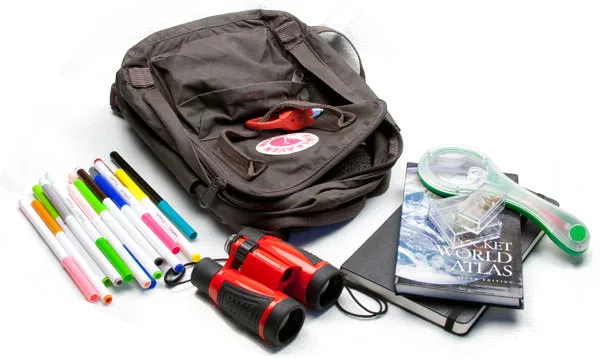
Toddlers won't pick up a magnifying glass, a compass, binoculars or any travel gadgetry willingly. But on the other hand, when you are in the open outdoors or traveling, and they have your full attention, teaching them to pull out their toddler travel tools really helps them engage in their surroundings, and it has become, for me and my son, a simple and fun way to learn about the world. Here are the toddler pack details:
Some links below are Amazon affiliate links. As an Amazon Associate, I earn from qualifying purchases, at no extra cost to you.
Fjallraven Kanken Backpack for Toddlers with:
- Children's Flashlight
- Moleskine journal with Crayola pens
- A Pocket Atlas
- A magnifying glass with attached tweezers
- 4x binoculars
- Small clear boxes to examine creepy-crawlies and dead things.
A Few Things I’d Add
The pack has grown with my son, and a few things have earned a permanent place in it since I first wrote this:
- A laminated, fold-out pocket guide to local birds, tide-pool creatures or wildflowers. Kids love matching the picture to the real thing, and the lamination survives spilled juice.
- A whistle on a lanyard, with one simple rule: if you’re lost, stay put and blow it.
- A small water bottle and a snack. No explorer does good fieldwork on an empty stomach.
- A hat and a small tube of sunscreen, especially on beaches and at altitude.
A Word on Safety
A toddler pack is only as good as the grown-up watching it. Tweezers, small boxes and crayon caps are small enough to swallow, so they belong in the pack only when a child is past the age of putting everything in their mouth, and always with supervision. Teach early that a magnifying glass is for looking at bugs, never at the sun, and never for focusing sunlight onto anything. And keep binocular straps short, or swap them for a breakaway strap, so they can’t catch on a branch or a playground slide.
Look, Then Let It Go
The clear boxes are for looking, not keeping. We scoop up a beetle or a pill bug, watch it in the shade for a few minutes, and put it back exactly where we found it. That habit matters more than any gadget in the pack. Handling wildlife for fun, even small creatures, can hurt them, and it teaches the wrong lesson about what the outdoors is for. I’ve written more about that in Bob, About That Hellbender.
Dead things are fair game for a closer look, but not always for the pack. In national parks, collecting anything, even a pinecone or a shell, is off-limits. And in the United States, it is illegal to keep the feathers of most wild birds under the Migratory Bird Treaty Act, however beautiful the blue jay feather on the trail. A photo or a sketch in the Moleskine makes a better souvenir anyway.