
Guana Cay Moleskine Journal Notes
Moleskine sketches from Great Guana Cay and the Abacos, drawn during my Guana Cay environmental reporting.
Updated September 29, 2026
I kept this Moleskine on Great Guana Cay, a narrow barrier cay off Great Abaco in the northern Bahamas, while I was reporting on the Bakers Bay development and the islanders’ fight to save their coral reef. I had snorkeled that reef for years as a teenager. This time I came back with a notebook, and spent my days in small boats with the people trying to protect it.
The first page records the same morning that opens my essay Bakers Bay and the Eyes of the West Indies: Troy Albury untying lines and pointing out a reef squid sheltering under the dock. The rest of the journal is the island’s natural history, its sharks and reef fish, its seabirds, and the birds of the coppice and pine. The story continues in Wings to the Storm, and you can see the whole island on my hand-painted map of Guana Cay.
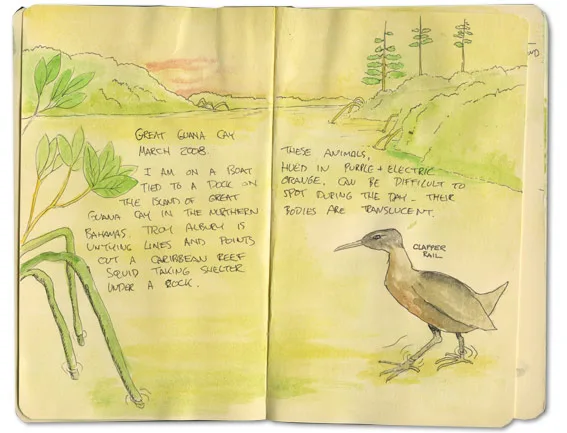
The first page, drawn at the dock, with mangrove leaves, a clapper rail and notes on the Caribbean reef squid, whose translucent bodies are hued in purple and electric orange.
Sharks, Blennies and the Man-of-War Fish
Great Guana Cay is a thin strip of land about seven miles long, with the Sea of Abaco on one side and the Atlantic on the other. Off the ocean side runs a barrier reef, and inside it stand old coral structures large enough for divers to swim beneath. These pages are what lives there, from the sharks of Abaco to the smallest blennies in the weed.
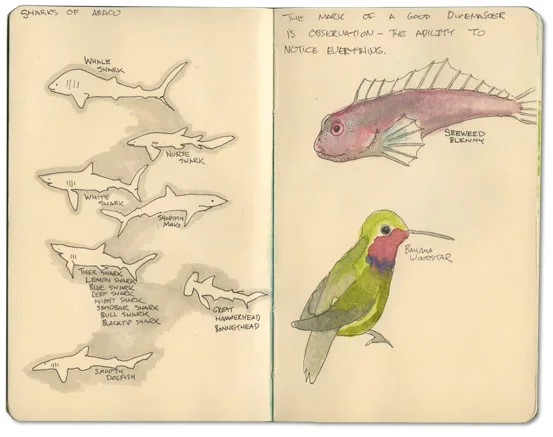
The sharks of Abaco in silhouette, from the whale shark and tiger shark to the great hammerhead and bonnethead, facing a seaweed blenny and a Bahama woodstar, the islands’ own hummingbird.
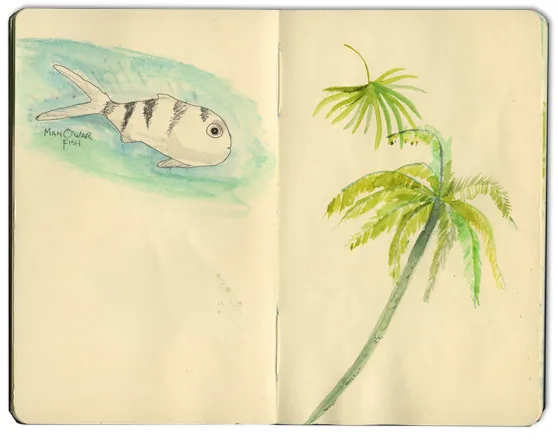
A man-of-war fish, which lives among the stinging tentacles of the Portuguese man-of-war, and a palm leaning out over the page.
Seabirds of the Open Atlantic
Because the cay faces the open Atlantic, many of the birds along its shore are ocean wanderers. Shearwaters and storm petrels feed far offshore and come to land mainly to nest, and a young sooty tern can spend years at sea before it returns to breed. I drew them against the flat blue line of the horizon.
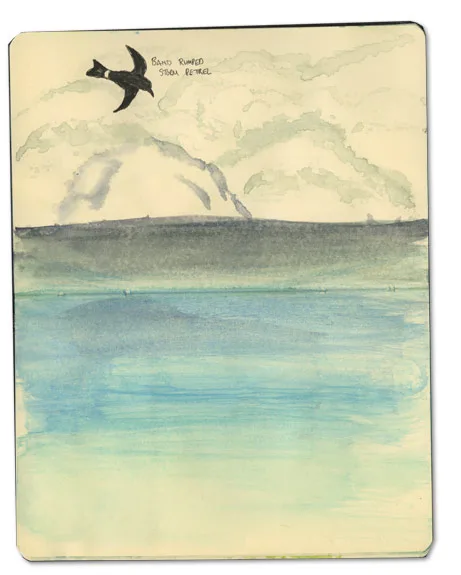
A band-rumped storm petrel over a gray sea, under a sky of broken clouds.
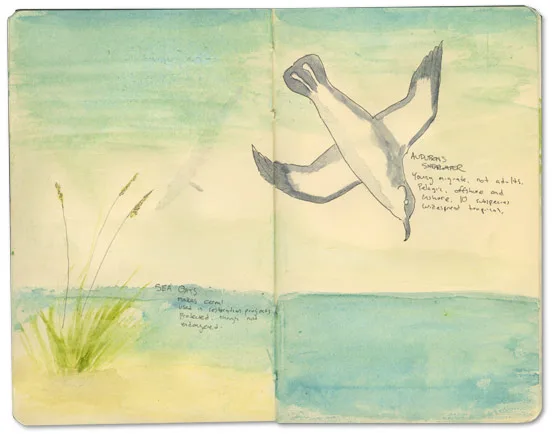
An Audubon’s shearwater banking low over the water, with notes on its range and a clump of sea oats in the dunes.
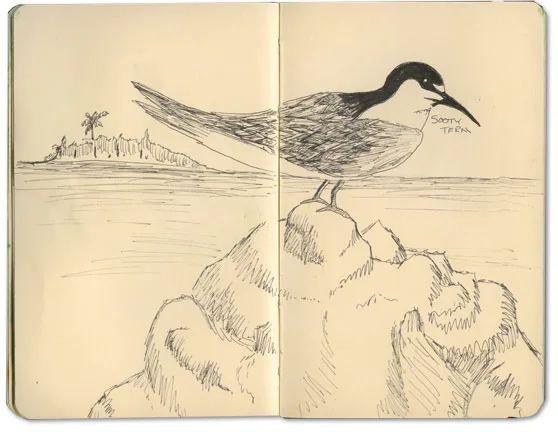
A sooty tern perched on a rock, drawn in ink, with a small cay and a single palm on the horizon.
Poisonwood, Warblers and the Pine Barrens
Inland, the Abacos are covered in coppice, a dense dry forest of tropical hardwoods, and in open barrens of Caribbean pine. In winter these woods fill with warblers from North America, while a few birds found only in the Bahamas, like the Bahama yellowthroat, live here year-round. I went looking for the rarest of those winter visitors in my Bahamas Dry Forest Journal.
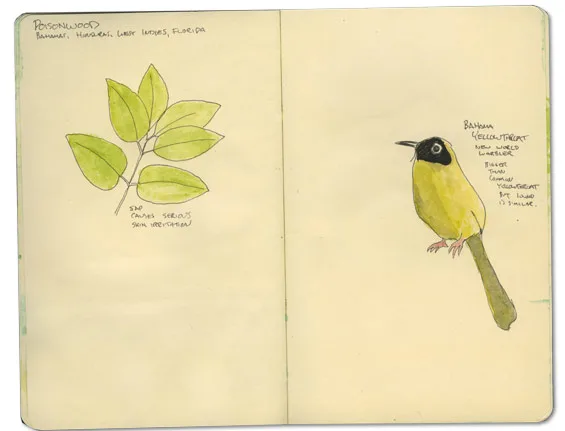
Poisonwood, whose sap causes serious skin irritation, and the Bahama yellowthroat, a warbler larger than the common yellowthroat but similar in look.
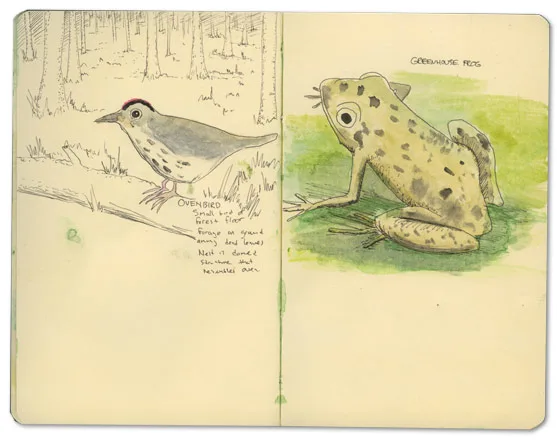
An ovenbird foraging among dead leaves on the forest floor, and a greenhouse frog in watercolor.
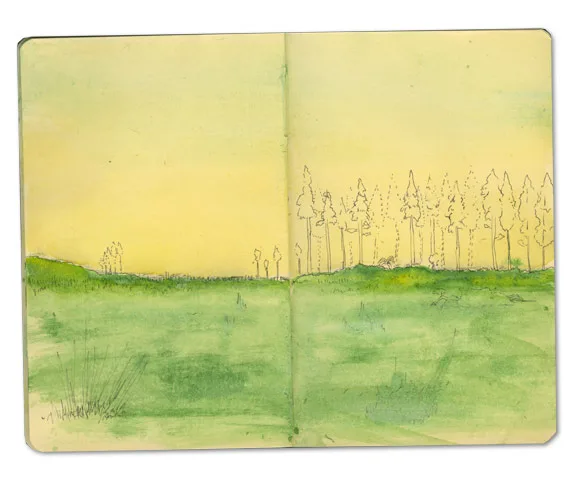
A pine barren, a line of Caribbean pines rising above a flat green understory.