
Tunisia Map
I painted this map of Tunisia for stories in the Dry World.
Updated September 29, 2026
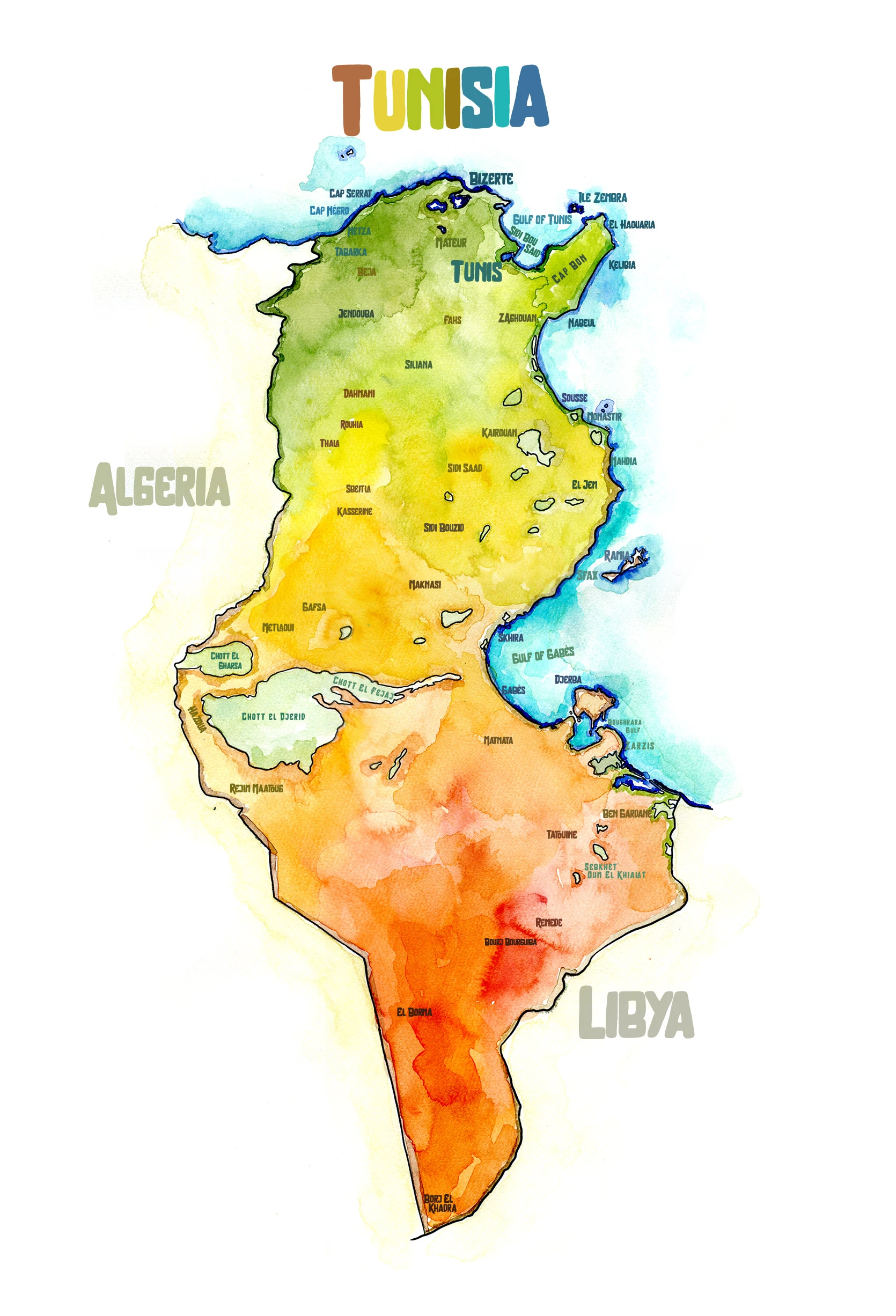
Though small on the map, Tunisia contains a surprising range of landscapes. The country stretches from the humid Mediterranean coast to the edge of the Sahara, where vast tracts of sand dunes and salt flats remain almost entirely empty. Northern Tunisia is green and cultivated, with rolling hills and olive groves, while the center grows drier, giving way to steppe and desert. The Atlas Mountains cross the country's midsection, forming a natural divide between fertile farmland and the arid south.
Stories from Tunisia: Sidi Bou Said · The Tunis medina · Zaghouan
Tunisia is the smallest country of the Maghreb, and on this map it is shaped like a long, bent spine, wide in the north and tapering to a point deep in the desert. The north coast holds Africa’s northernmost point, near Bizerte, and the Cap Bon peninsula, which reaches out toward Sicily, less than a hundred miles away. Behind Tabarka and Nefza are cork oak forests, and near Bizerte lies Lake Ichkeul, a wetland where tens of thousands of ducks and geese spend the winter. The east coast is a long curve of olive country and old ports: Sousse, Monastir, Mahdia and Sfax, and inland Kairouan, one of the holy cities of Islam, and El Jem, whose Roman amphitheater is one of the largest ever built.
South of Gafsa the country changes. Chott el Djerid, with Chott el Fejaj reaching east from it and Chott el Gharsa to the north, is the largest salt pan in the Sahara, a flat white plain that floods thinly in winter and bakes in summer. Below it are the Berber villages of Matmata, where families live in pit homes dug into the soft earth, and Tataouine, which lent its name, slightly changed, to Luke Skywalker’s home planet. Past Remada and El Borma, Tunisia narrows to a wedge of dunes between Algeria and Libya, ending at Borj El Khadra.
Carthage stood on the Gulf of Tunis, and after it came Rome, the Arabs, the Ottomans and the French, but the Amazigh, or Berbers, were here before all of them. The wildlife of the Maghreb is its own: the fennec fox in the southern dunes, and Moussier’s Redstart in the northern hills.
My Travels in Tunisia
I traveled in Tunisia with Jane and Kellan. With Mohamed, an engineer and one of the country’s few dedicated birders, I walked the abandoned Berber village of Zriba Olia and the Roman aqueduct that carried water to Carthage, and watched flamingos on the salt lake at the edge of Tunis, in Zaghouan to Sebkhet Sejoumi. The family’s days in the old city are in Time in the Tunis Medina, and the blue-and-white village above the Gulf of Tunis is in Sidi Bou Said and Fantastical Seaside Villages.