
French Polynesia Sketch Journal
Moleskine Journal Sketches and notes from the Tuamoto Archipelago and the Society Islands.
Updated September 29, 2026
I used a medium-sized Moleskine journal while traveling to French Polynesia. I used waterpens and my waterproof watercolor case to make sketches, and also used this journal as my rough draft for my story, Tikehau in the Tuamotus.
These pages are a messy representation of my writing process and my visual process while traveling. I use these journals to 1) help organize my travel 2) write an outline of my story 3) sketch out ideas for illustrations or photo compositions 4) write down interviews or other details from my travels I may forget and 5) make sketches to help capture something for my final notes.
In Tahiti and Tikehau, I tried to keep a consistent theme, using bold colors while not worrying too much about how watercolors landed on the page.
French Polynesia holds two kinds of island. The Society Islands, Tahiti among them, are high volcanic islands, steep and green, while the Tuamotus to the northeast are low rings of coral around quiet lagoons, only a few feet above the sea. I kept this journal on a trip with Jane and our son, Kellan, most of it on Tikehau, a small, nearly round atoll in the western Tuamotus with one village and one navigable pass into its lagoon. The finished version of the map on the last page is my Tikehau Map.
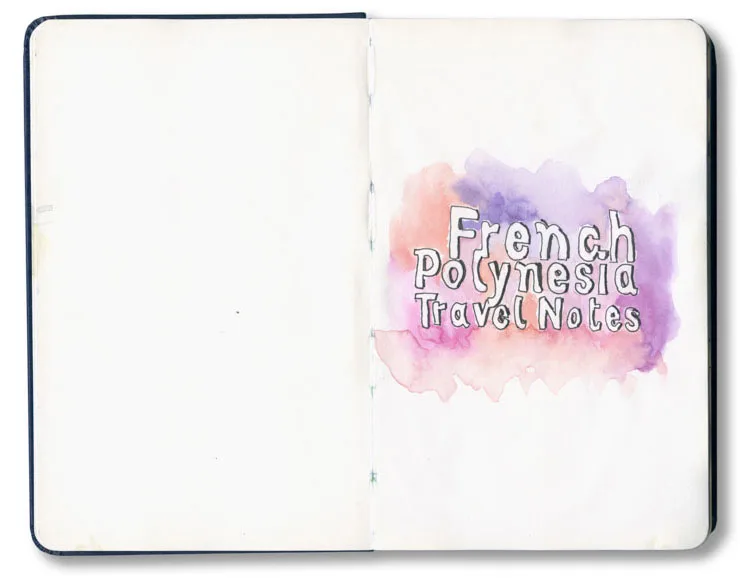
The title page, French Polynesia Travel Notes, lettered over a wash of pink and violet.
Atolls at the Edge of the Map
The Tuamotus are the largest chain of atolls in the world, strung across an expanse of ocean the size of Western Europe. European sailors called them the Dangerous Archipelago for the low reefs that wrecked their ships. Their people have lived on coconut, pandanus, breadfruit and fish for centuries, and today also on copra, cultured black pearls and, still on a small scale, tourism.
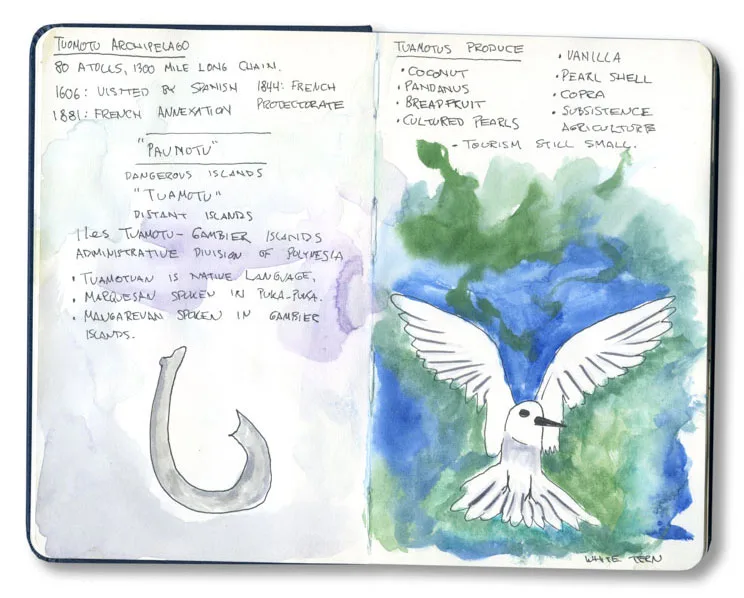
Notes on the history and languages of the Tuamotu Archipelago, a list of what the atolls produce, a Polynesian fishhook, and a white tern over green and blue washes.
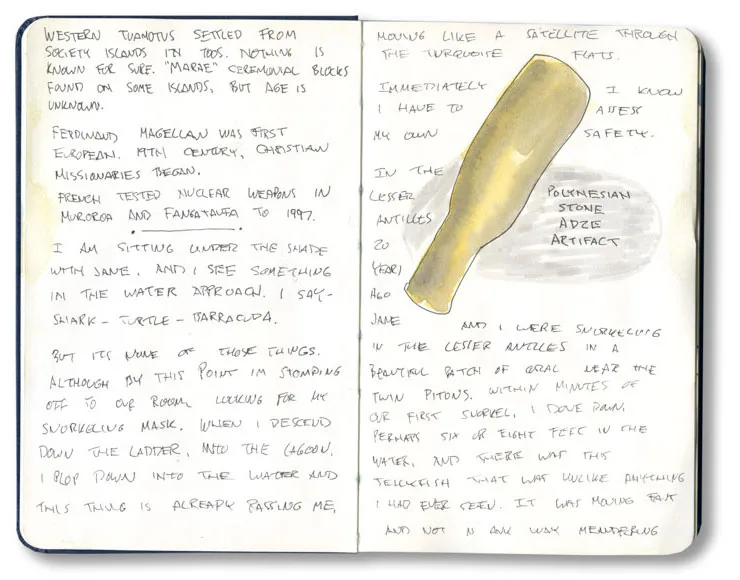
Notes on the settlement of the western Tuamotus and the French nuclear tests at Moruroa and Fangataufa, beside a stone adze and the first lines of the jellyfish story.
A Jellyfish in the Lagoon
Much of this journal is the rough draft of a single encounter. Sitting in the shade with Jane, I saw something large crossing the lagoon flats, climbed down the ladder into the water, and followed a mosaic jellyfish, Thysanostoma thysanura, with a crew of small fish swimming in formation around it. Writing about it brought back two older jellyfish stories, the box jelly that stung Jane in St. Lucia, and the by-the-wind sailors that washed up on the Oregon coast.
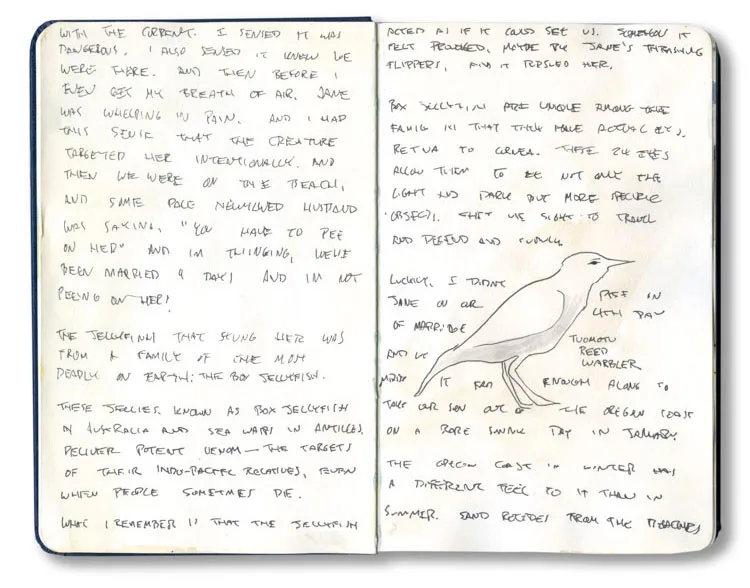
The story of the box jellyfish that stung Jane in St. Lucia, four days into our marriage, with a Tuamotu reed warbler.
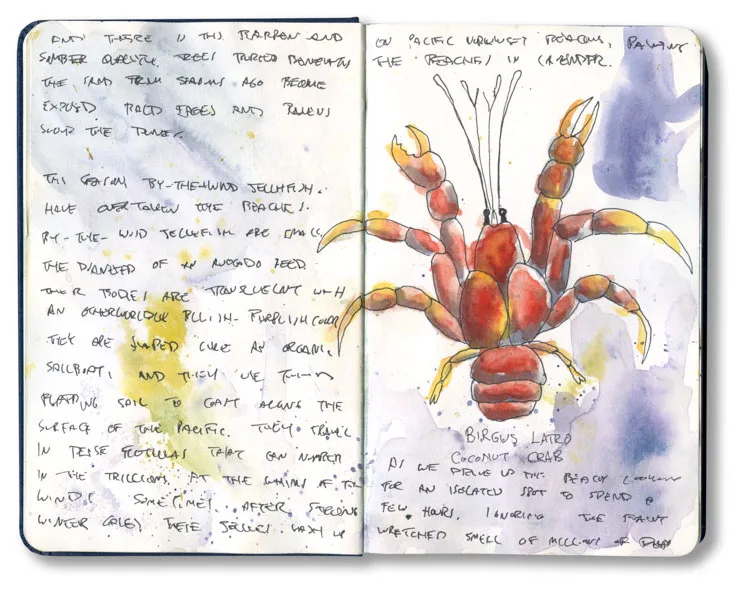
By-the-wind sailors washed up on the Oregon coast in winter, and a coconut crab, Birgus latro, the largest crab that lives on land.
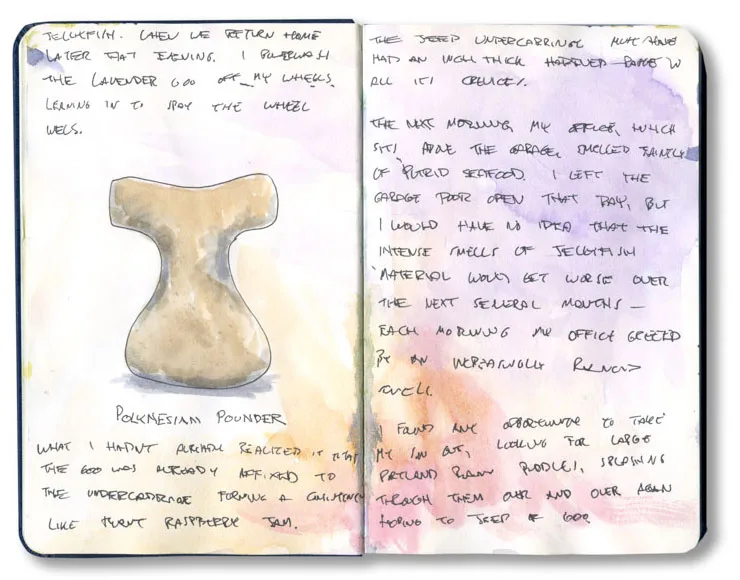
A Polynesian pounder, and the end of the by-the-wind sailor story, the lavender goo that stayed in my Jeep for months.
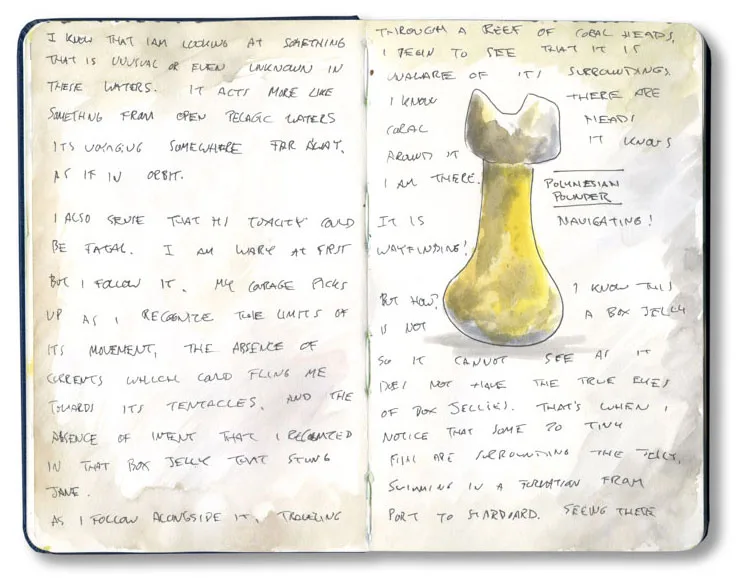
Following the mosaic jellyfish through the coral heads and wondering how it could navigate without eyes, beside a Polynesian pounder.
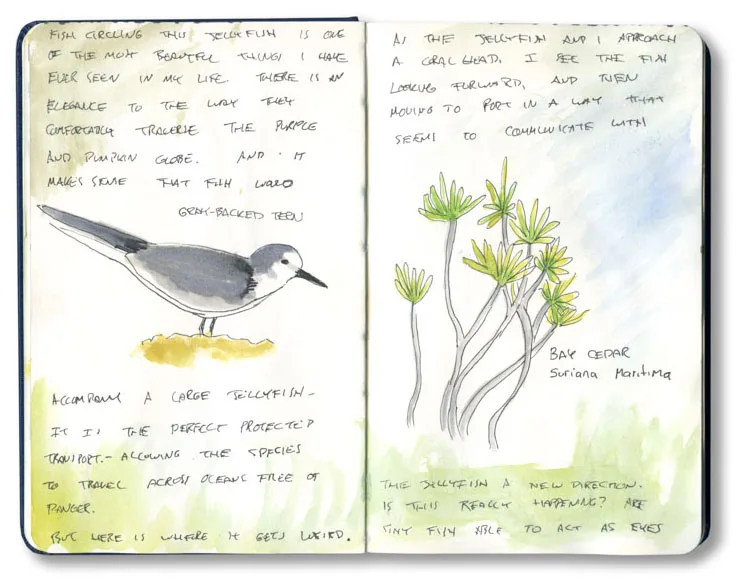
The small fish that escorted the jellyfish, with a gray-backed tern and bay cedar, Suriana maritima.
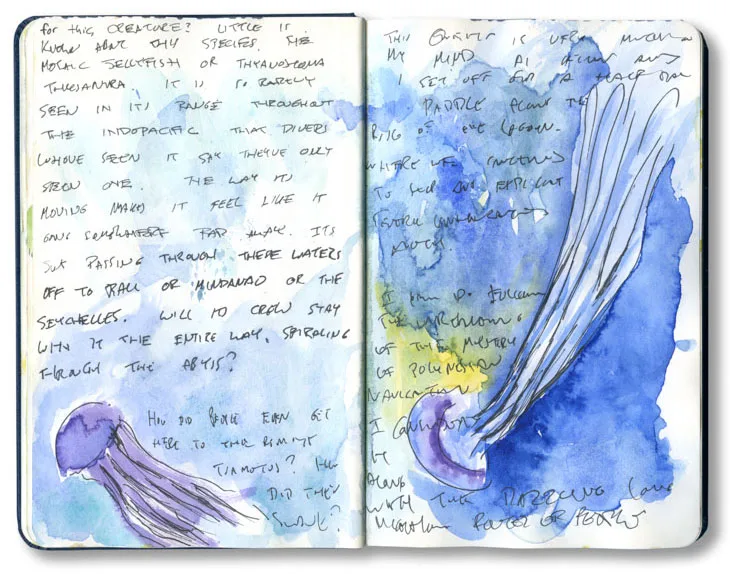
The mosaic jellyfish in purple and blue, with notes on how rarely divers ever see one.
Pounders, Adzes and the Puzzle of Polynesia
Polynesian stone pounders, used to mash cooked breadfruit and taro, turn up again and again in these pages, along with a hafted stone adze. They stand in for the question under the whole trip: how people reached the most remote islands on Earth, and how they survived there. I was reading Christina Thompson’s Sea People: The Puzzle of Polynesia, and my notes on it grew into the second half of the story.
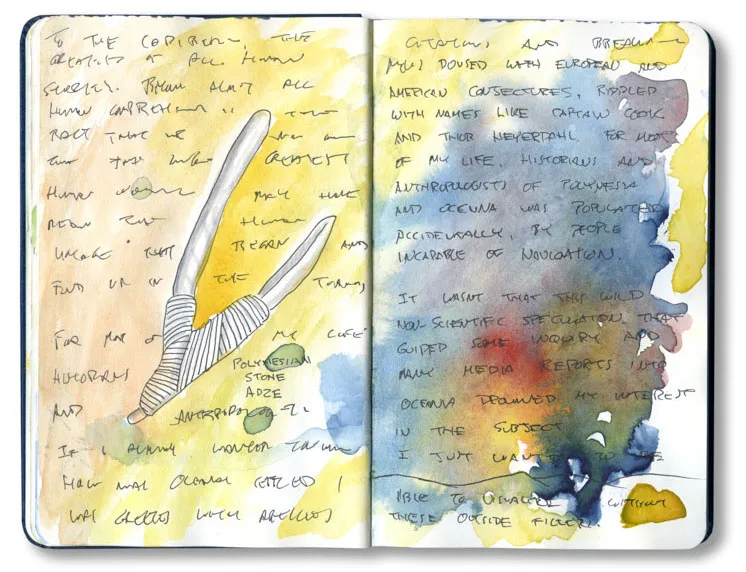
A hafted stone adze, with notes on a lifetime of reading about the settlement of Oceania through outsiders like Captain Cook and Thor Heyerdahl.
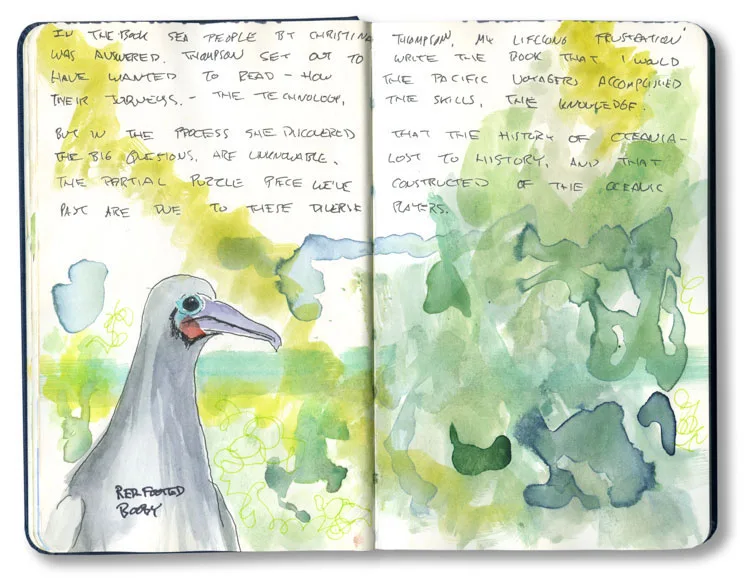
Notes on Christina Thompson’s Sea People, with a red-footed booby over green washes.
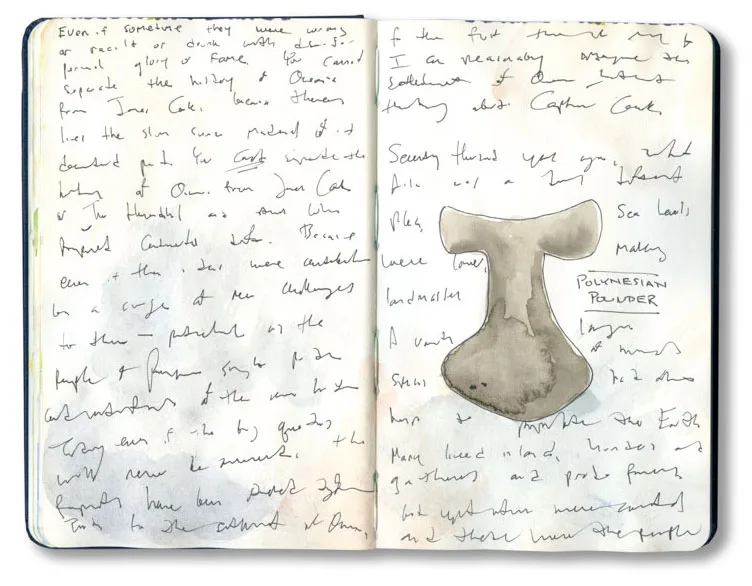
Notes on why the history of Oceania cannot be separated from Captain Cook, beside a gray Polynesian pounder.
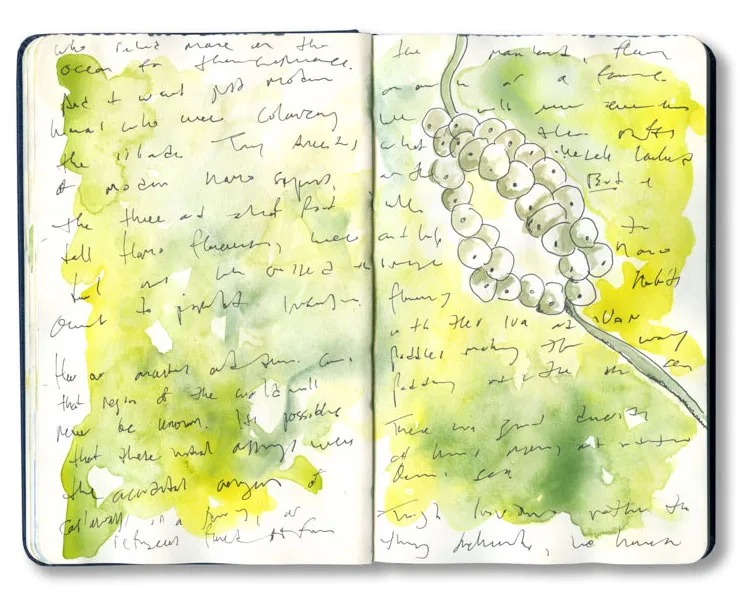
Notes on the first people to cross the seas of Southeast Asia, beside a hanging strand of pale berries.
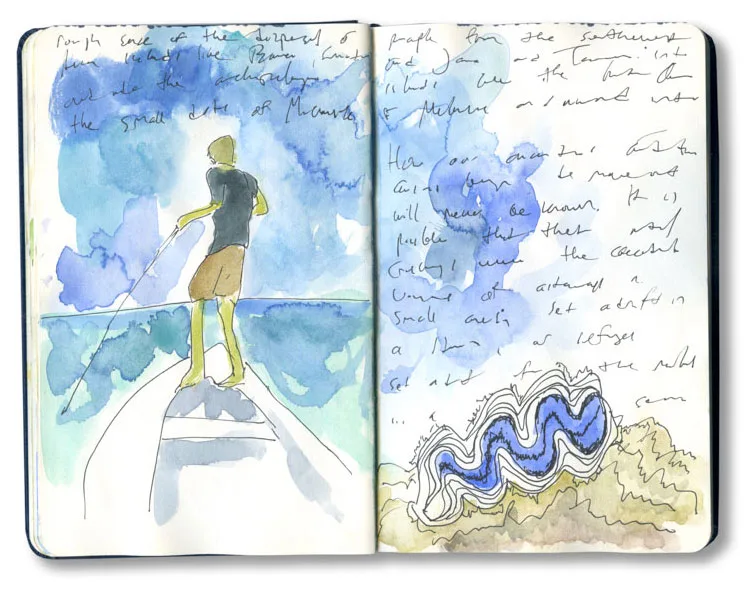
A figure setting anchor from the bow of our boat, a giant clam in the coral, and notes on the dispersal of people from Java and Taiwan toward Melanesia.
Canoe Plants and the Empty Motus
Polynesian voyagers carried their gardens with them, the canoe plants: coconut, breadfruit, taro and noni, Morinda citrifolia, a pungent famine fruit that now grows across the Pacific. On the uninhabited motus, the rest of the life is whatever could fly or float there, terns and boobies, reef herons, and salt-tolerant beach shrubs like bay cedar.
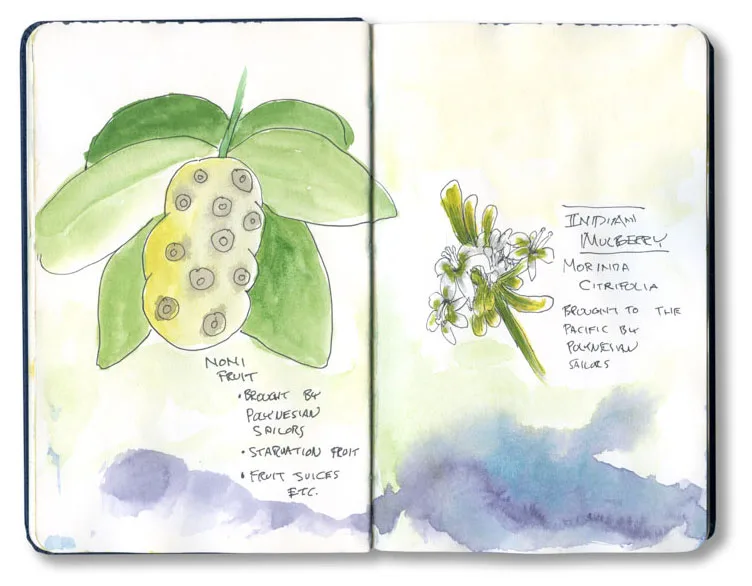
Noni fruit, brought by Polynesian sailors and eaten in times of starvation, and the flowers of the same plant, the Indian mulberry.
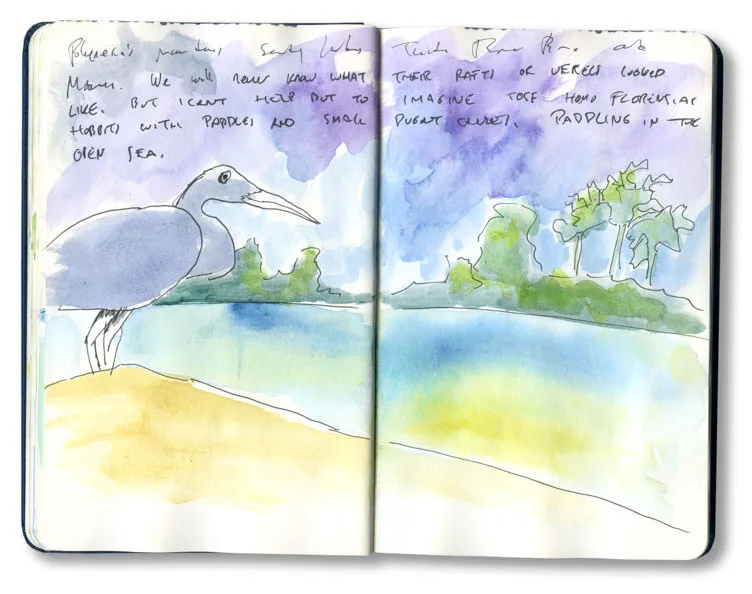
A Pacific reef heron on the sand between motus and the empty shore across the channel, under notes imagining Homo floresiensis paddling small canoes in the open sea.
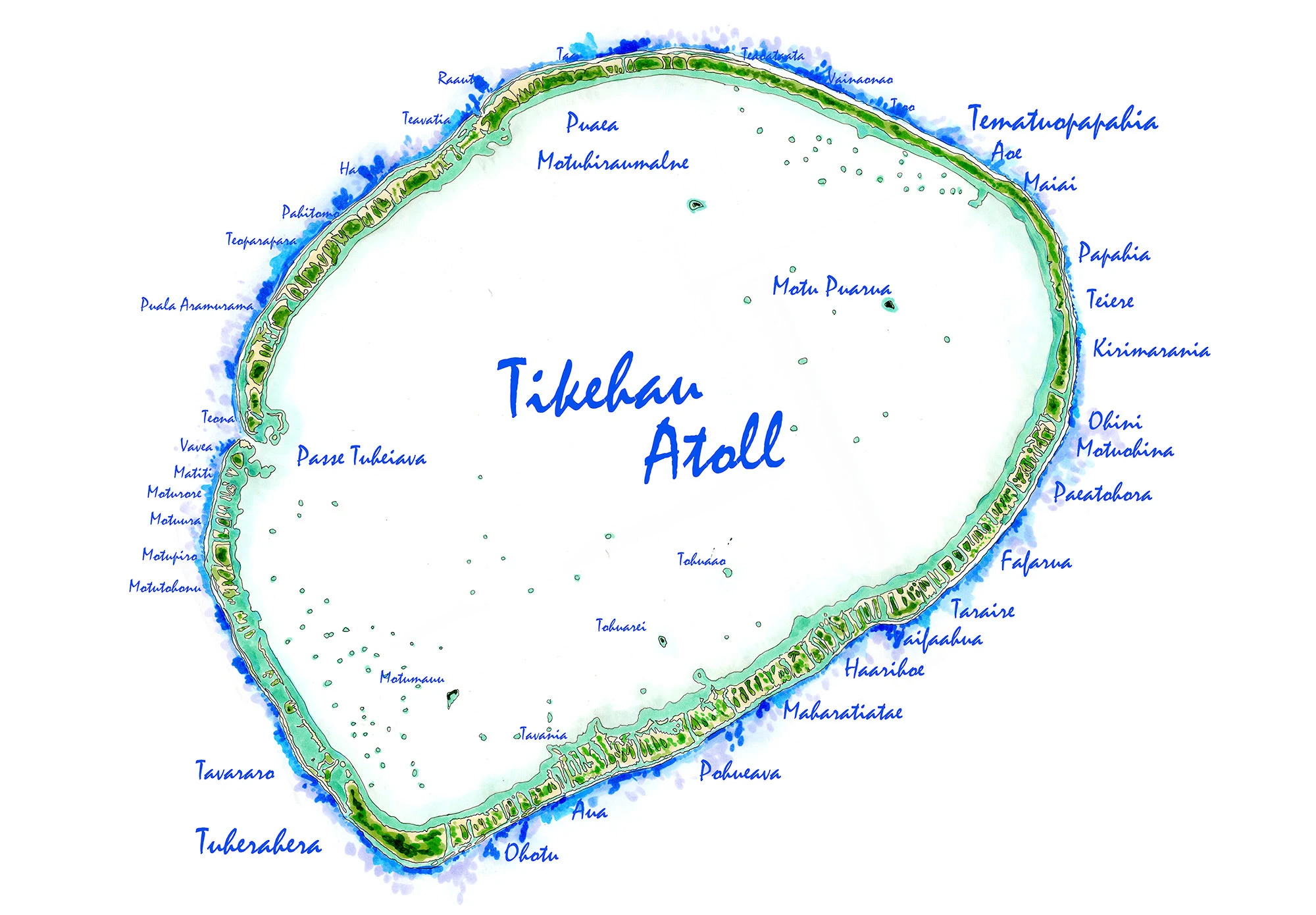
The page closes with my map of Tikehau Atoll, its ring of named motus, the village of Tuherahera in the southwest, and Passe Tuheiava, the only navigable pass into the lagoon.