
Kauai Moleskine Journal
Nut-brown ink sketches of nene, stilts, seabirds, reef fishes and banyan trees from Hawaii’s Garden Isle.
Updated September 29, 2026
I used a large-sized Moleskine while traveling on the island of Kauai. I also swapped out my usual watercolor palette for a single ink: nut brown ink by Winsor-Newton. The nut brown ink comes in a small glass container, which fit nicely in a small pouch for pens and brushes. I experimented with gouache, watercolors and markers as well, but after I returned.
Kauai is the oldest and northernmost of the main Hawaiian Islands, some five million years of rain worn into Waimea Canyon, the Alakaʻi Swamp and the fluted cliffs of the Nā Pali Coast. I filled these pages on the North Shore and around Waimea with the island’s birds and reef fishes, pressed ferns and leaves, and long notes on how Polynesian navigators found these islands at all.
Kauai never had an established population of mongooses, and its forests and wetlands still hold native birds found on no other island. That is where most of these pages went. The journal also carries notes on the white cyanobacterial growth spreading across the corals of Hanalei, the subject of my essay Roundup and Runoff in the Hanalei Valley. For the island’s street life, its fruit stands and surf wagons, see my Kauai Sketch Journal, drawn in color, and for the whole chain, my Hawaiian Islands Map.
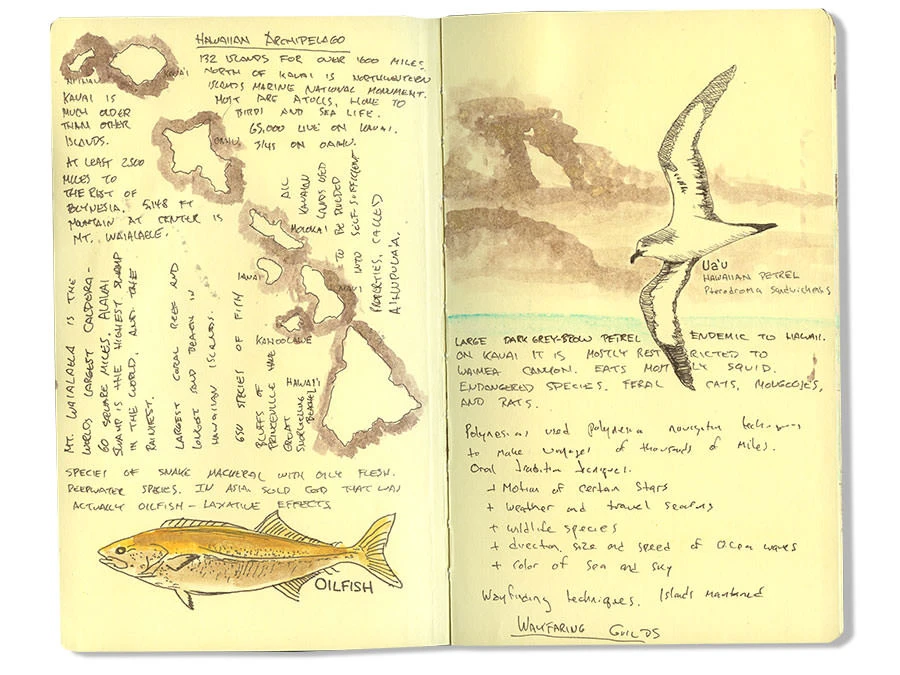
The journal opens with the Hawaiian archipelago and notes on Kauai, an oilfish, and the ʻuaʻu, or Hawaiian petrel, over the cliffs, with a list of the signs Polynesian wayfinders read in stars, swells, wildlife and the color of the sea.
Canoes, Castaways and Ukuleles
Hawaii was among the last places on Earth reached by people. Polynesian voyagers, reading the stars, the swells and the flight of seabirds, settled the islands roughly a thousand years ago, and Captain Cook made his first Hawaiian landfall at Waimea, on Kauai’s southwest coast, in 1778. Between the birds I copied out what I was reading about wayfaring, the Lapita potters who came before the Polynesians, and the canoes that carried them. The ukulele came much later, a descendant of the little machete that Portuguese immigrants brought from Madeira.
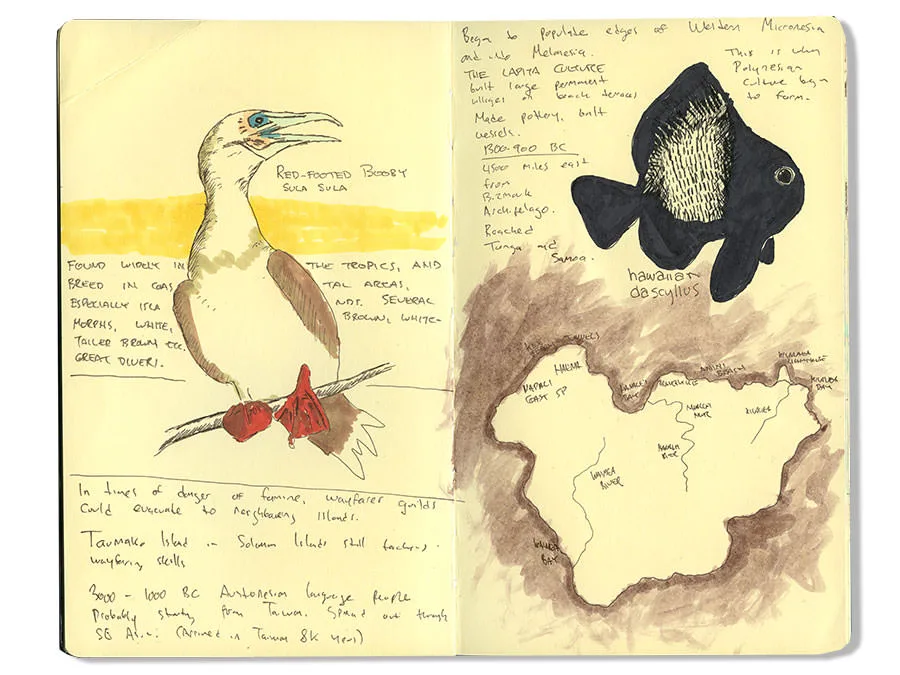
A red-footed booby, a Hawaiian dascyllus and notes on the Lapita culture and the wayfarer guilds, with a map of Kauai from the Nā Pali Coast to Hanalei and Waimea.
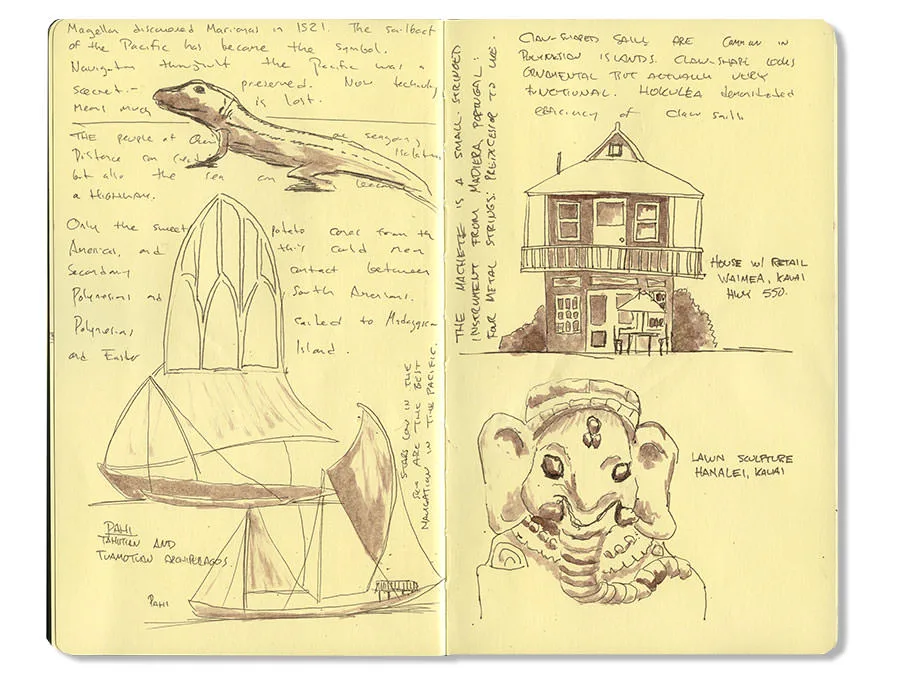
A lizard and notes on Polynesian navigation, pahi canoes of the Tahitian and Tuamotuan archipelagos with their claw-shaped sails, a house with a shop on Highway 550 in Waimea, and a lawn sculpture of Ganesha in Hanalei.
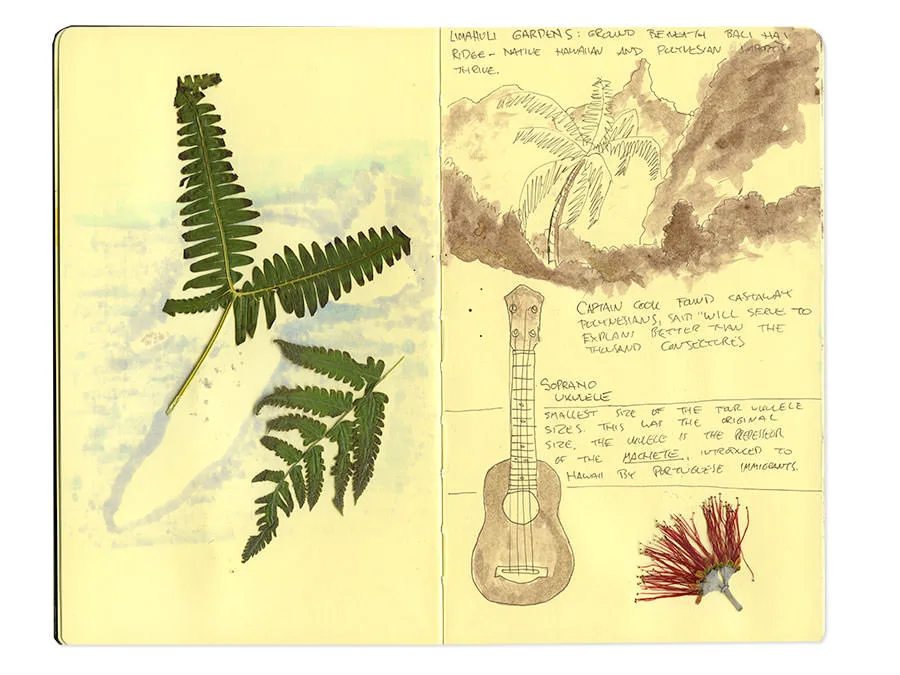
Pressed ferns beside the ridges above Limahuli Garden, where native Hawaiian and Polynesian plants grow, with a note on Captain Cook, a soprano ukulele and a pressed red blossom.
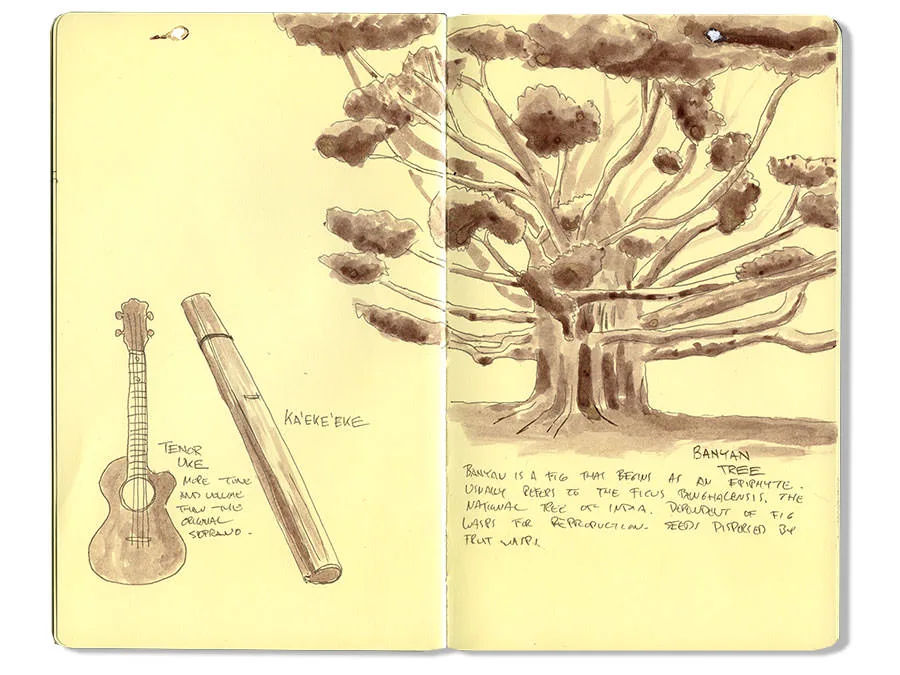
A tenor ukulele and a bamboo kaʻekeʻeke, and a banyan tree, with notes on the fig wasps it depends on to reproduce.
Birds Found Nowhere Else
The Alakaʻi Swamp and the upland forests of Kōkeʻe still hold birds that live only on Kauai, among them the ʻanianiau and the Kauaʻi ʻelepaio, and the ʻuaʻu, the Hawaiian petrel, still nests in burrows in the island’s mountains. Down in the taro ponds of the Hanalei Valley, the aeʻo, the Hawaiian stilt, wades on long pink legs. The nene, the state bird, is the islands’ own goose, descended from Canada geese that strayed here long ago.
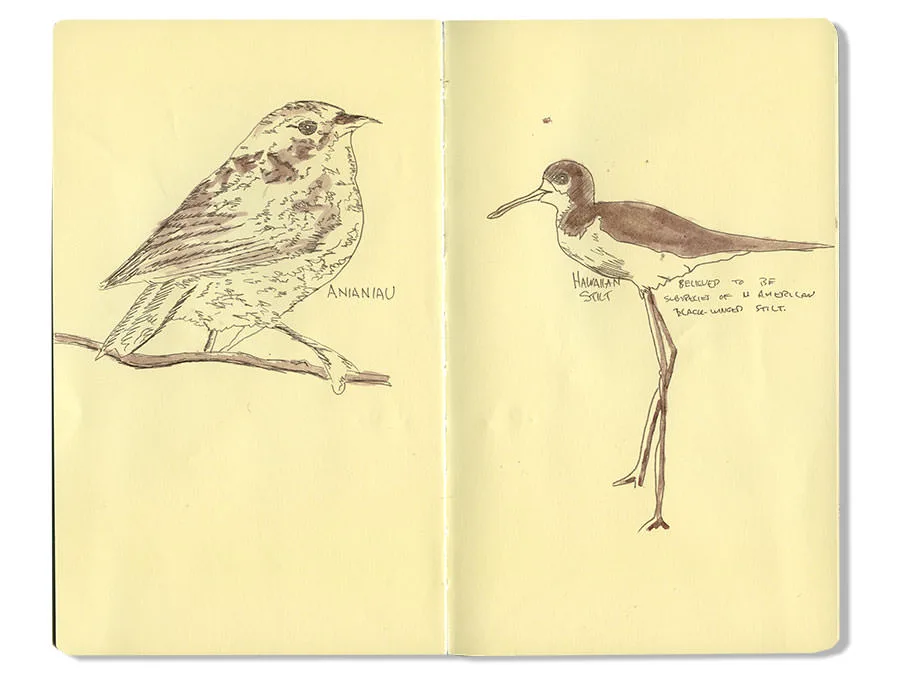
An ʻanianiau, a small honeycreeper found only on Kauai, and a Hawaiian stilt, noted as a subspecies of the black-necked stilt.
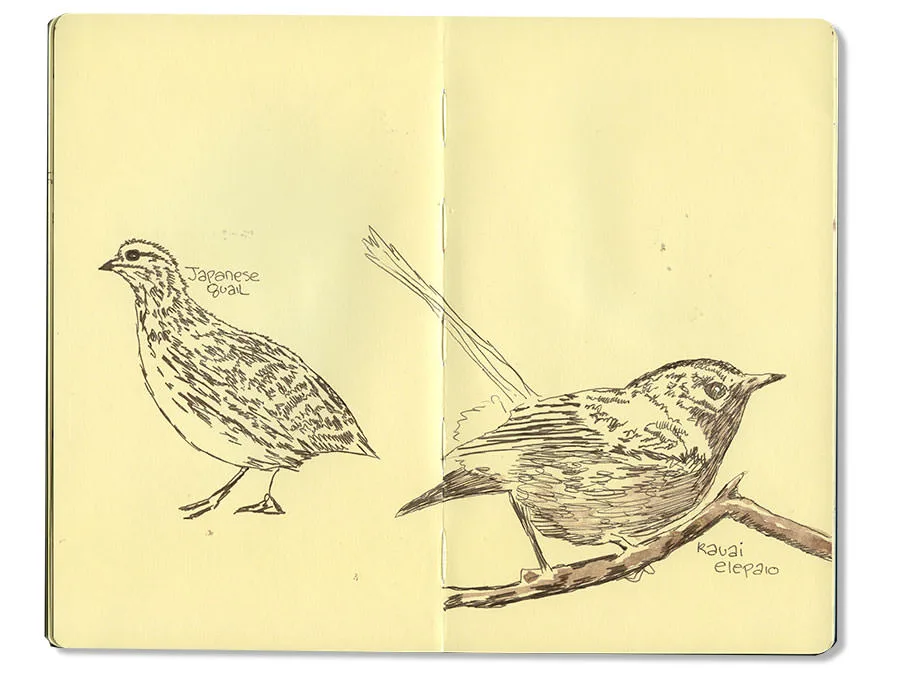
A Japanese quail and a Kauaʻi ʻelepaio perched on a branch with its tail cocked.
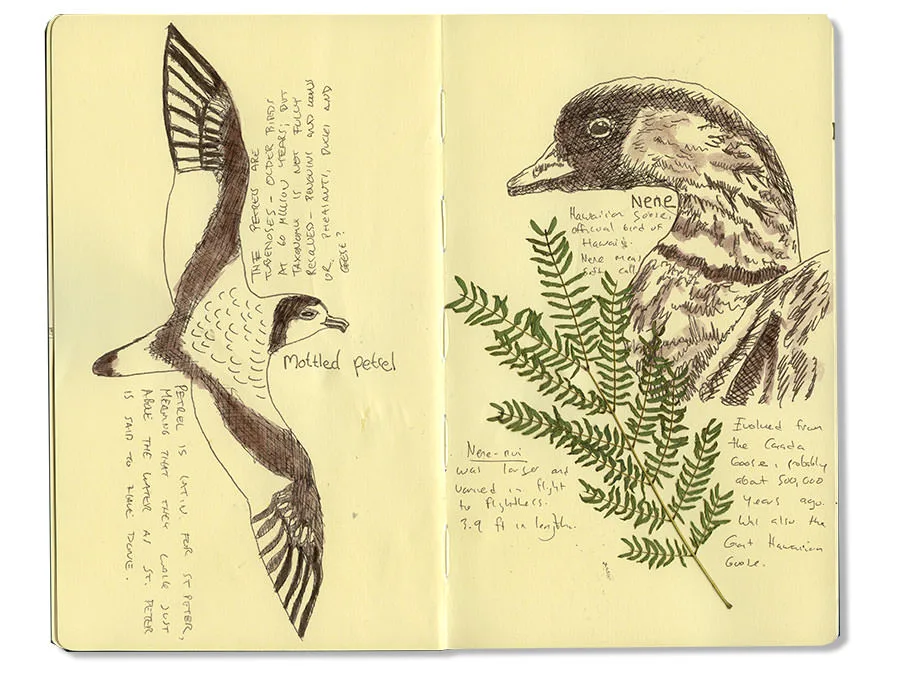
A mottled petrel in flight, with a note that petrels are named for St. Peter walking on the water, and a nene, the Hawaiian goose, over a pressed fern.
The Newcomers
Much of what flies around a Kauai parking lot arrived in the last century and a half: zebra doves from Southeast Asia, Japanese white-eyes, Erckel’s francolins from northeast Africa, red-crested cardinals from South America. I drew them as carefully as the natives, with notes on where each came from and why it was brought.
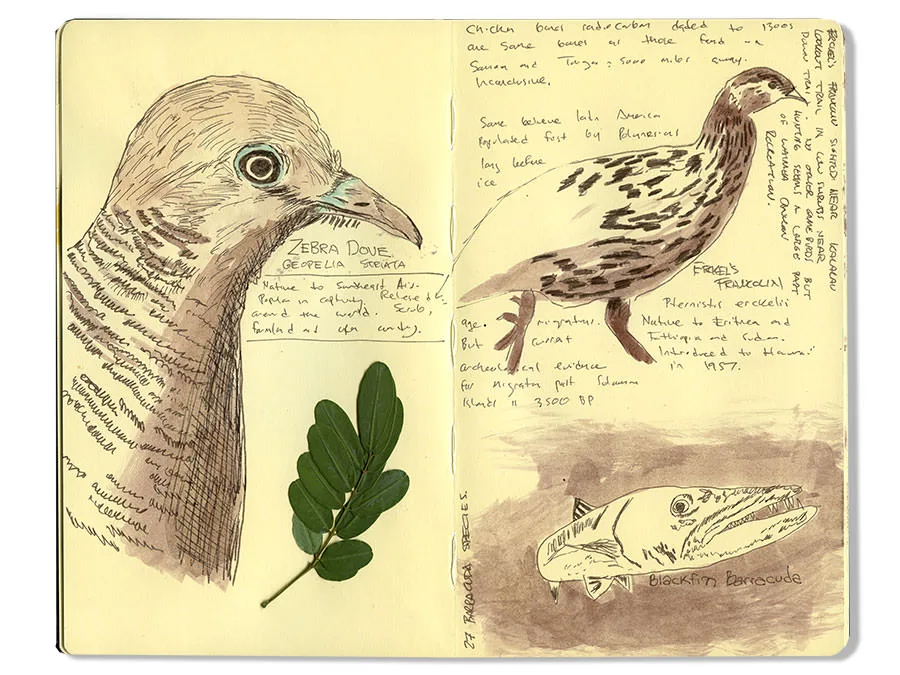
A zebra dove beside a pressed sprig of leaves, an Erckel’s francolin, a blackfin barracuda and notes on chicken bones that may link Polynesia to South America.
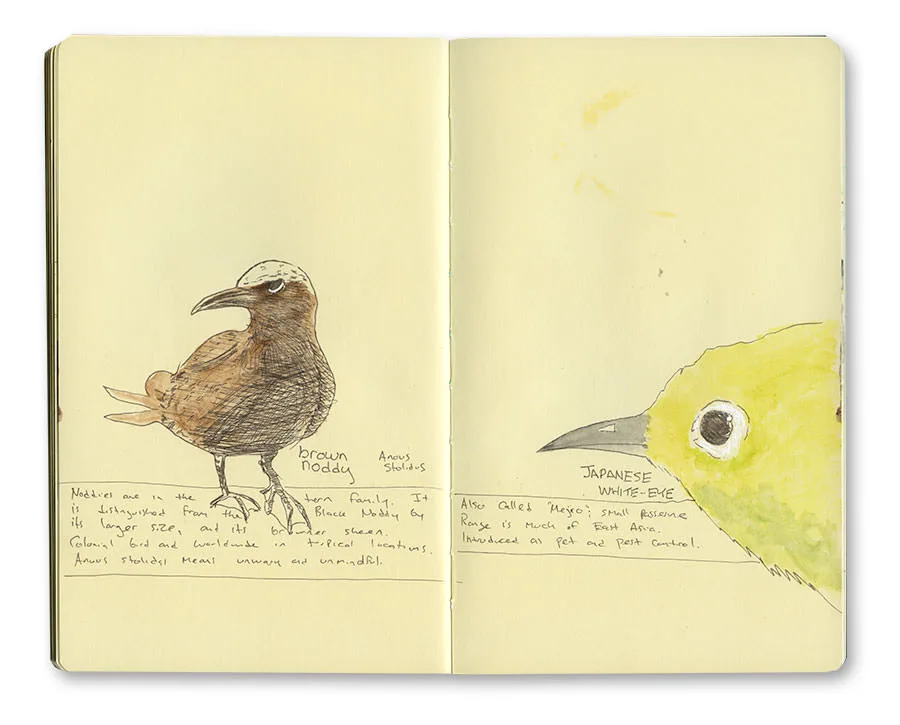
A brown noddy, larger and browner than its cousin the black noddy, and the bright green head of a Japanese white-eye, or mejiro.
Seabirds and the Reef
Hawaiian reefs are unlike those of the Caribbean. The islands are so isolated that roughly a quarter of their reef fishes live nowhere else, and the seabirds that feed over them range across the whole Pacific. These last pages move from the open ocean, with its tropicbirds and storm petrels, down to the reef itself, and to the coral disease spreading through the reefs of Hanalei.
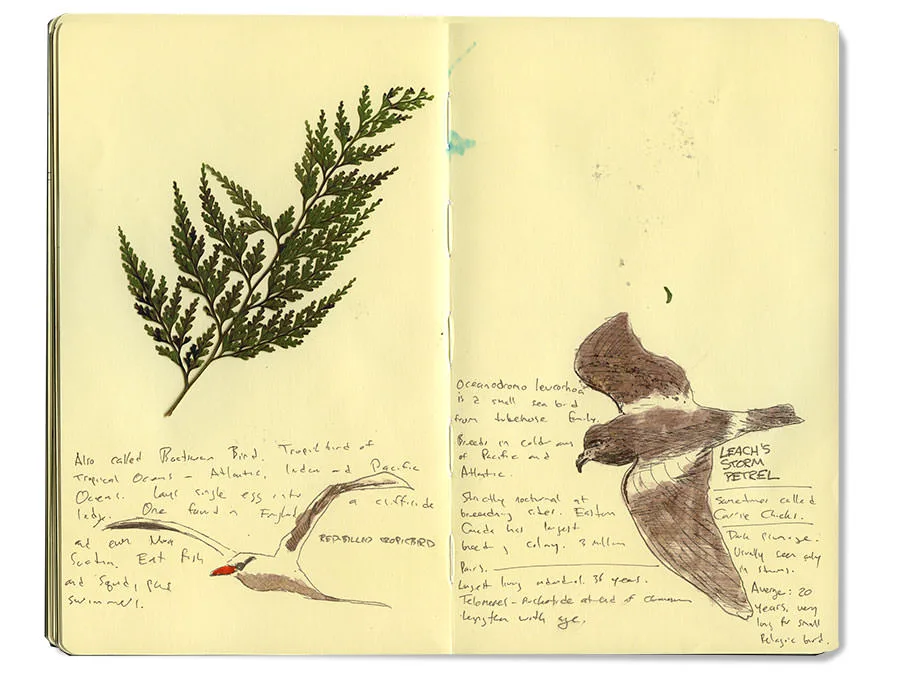
A pressed fern, a red-billed tropicbird, or boatswain bird, and a Leach’s storm petrel, a small tubenose that visits its nesting colonies only at night.
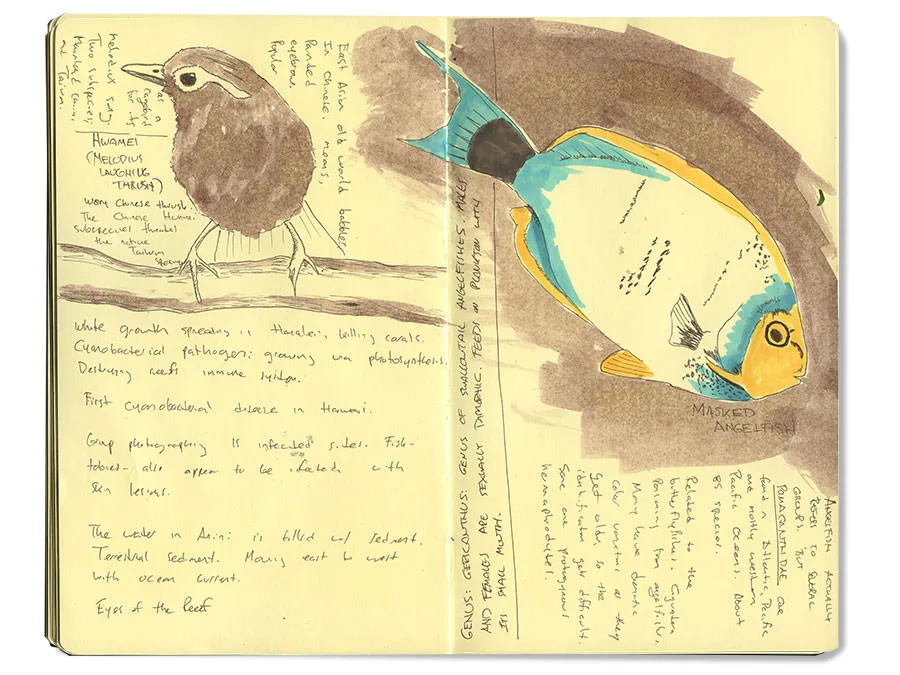
A hwamei, the melodious laughing thrush brought from China, notes on the cyanobacterial disease killing corals at Hanalei, and a masked angelfish, a swallowtail angelfish of deep Hawaiian reefs.
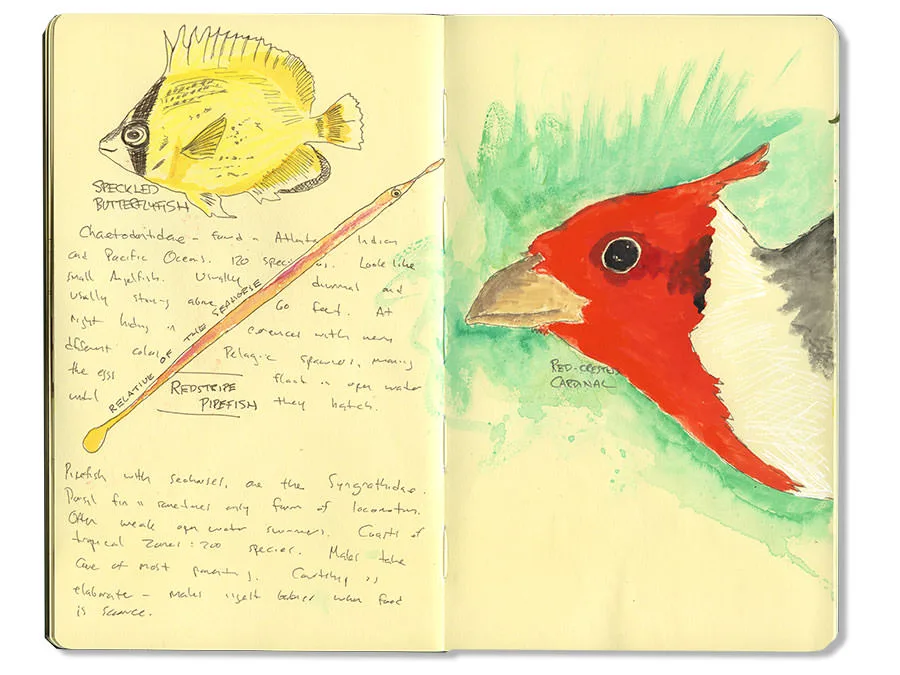
A speckled butterflyfish and a redstripe pipefish, a relative of the seahorse, with the head of a red-crested cardinal.