
Abaco, BahamasMoleskine Journal Notes
A homemade guidebook to the shells, fishes, recipes and Lucayan history of the Abaco Islands.
Updated September 29, 2026
This is my Moleskine journal from the Abaco Islands, Bahamas. This was one of my first journals, which I created to consolidate notes from several different sources into one small custom-made guidebook. At the time, I was trying to learn as many Caribbean shell types as possible. The problem with this is that there really is no comprehensive guide to the shells of the region. I was learning that I could put together all the information I needed from different sources and build my own guide to the Abaco Islands.
In the case of the Bahamas, it was helpful in getting me to think of these islands in my own way, and on my own terms.
I very much suggest to anyone considering traveling more, to build your own guidebook.
This moleskine journal, which I filled before, during and after my trip, includes notes about the Lucayan people, plenty of recipes and sketches of shells, fishes and seashore creatures.
The great thing about creating your own trip journal is that it keeps well as a permanent record of your trip and your priorities from that time. Opening up an old travel journal is a great personal record of your past.
When I visit the Abaco Islands, I still take this journal with as my sole guide to the islands, and sometimes add new notes along the way.
I have been coming to the Abaco Islands since I was young, and this journal became my own field guide to them. Much of it was compiled from other sources before I ever drew a line: the year the Loyalists landed, the traces the Lucayans left behind, the myths behind the stars, and a long run of shells and fishes. Later trips turned into stories, about the old settlement at Hopetown, the wreckers and pirates of Green Turtle Cay and the lonely roads of the Abaco interior. You can see the islands whole on my map of the Abaco Islands, and more of my island pages in my Guana Cay Moleskine.
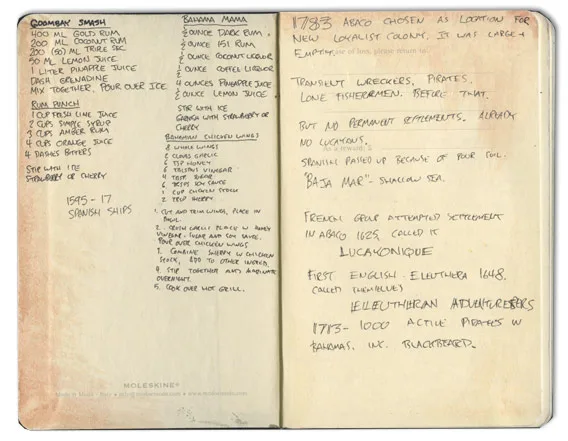
Recipes for a Goombay Smash, a Bahama Mama, rum punch and Bahamian chicken wings, facing notes on 1783, the year Abaco was chosen for a new Loyalist colony.
Lucayans and Loyalists
Long before the Loyalists, the Lucayans, a Taíno people, fished and farmed these cays. They were the first people Columbus met in 1492, and within a generation the Spanish had carried them off as slaves. What survives of them is a handful of objects, a paddle and a ceremonial vessel among them, and perhaps a name: the journal records the idea that Abaco means land of swaying pines.
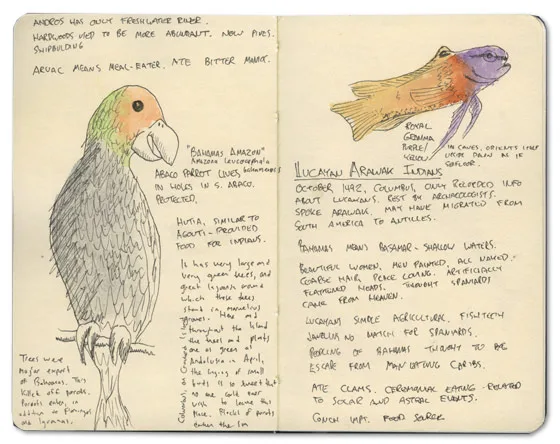
The Abaco parrot, which nests in holes in the limestone of southern Abaco, with a hutia, a royal gramma and notes on the Lucayan Arawak Indians.
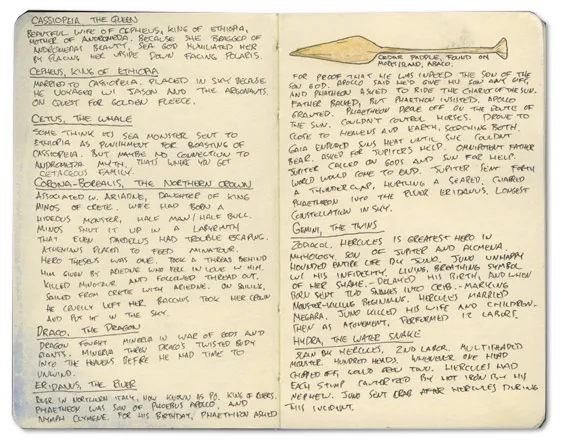
A cedar paddle found on Moore’s Island, Abaco, above the myths of Cassiopeia, Cepheus, Cetus, Corona Borealis, Draco, Eridanus, Gemini and Hydra.
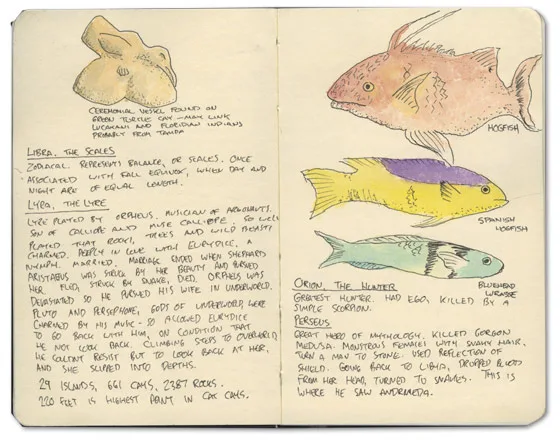
A ceremonial vessel found on Green Turtle Cay that may link the Lucayans to the Indians of Florida, with a hogfish, a Spanish hogfish, a bluehead wrasse and the constellations Libra, Lyra, Orion and Perseus.
A Sky Full of Myths
On the outer cays there is little light at night, and the stars reach all the way down to the water. I copied the stories behind the constellations across several pages: Andromeda chained to her rock, Orion and the scorpion, Callisto turned into a bear. The same pages hold notes on how the islands were built, from the opening of the Atlantic to the coral and windblown dunes of the Pleistocene.
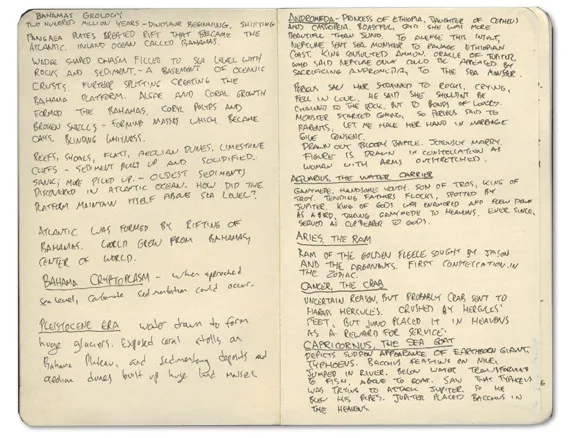
Notes on the geology of the Bahamas, from the rifting of Pangaea to the Pleistocene dunes, facing Andromeda, Aquarius, Aries, Cancer and Capricornus.
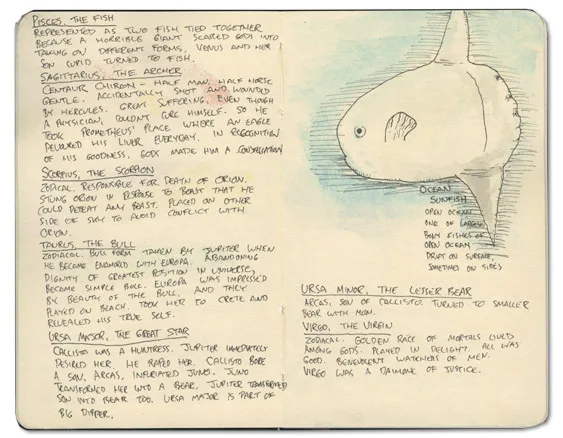
An ocean sunfish, one of the largest bony fishes, among the myths of Pisces, Sagittarius, Scorpius, Taurus, Ursa Major, Ursa Minor and Virgo.
Fishes of the Sea of Abaco
The Sea of Abaco, the shallow sound between Great Abaco and its string of outer cays, is where this journal was meant to be used. I drew the reef fish, sharks, crabs and limpets I was learning to recognize, each with a short note on where it lives or what it eats, so the book could come with me to the water.
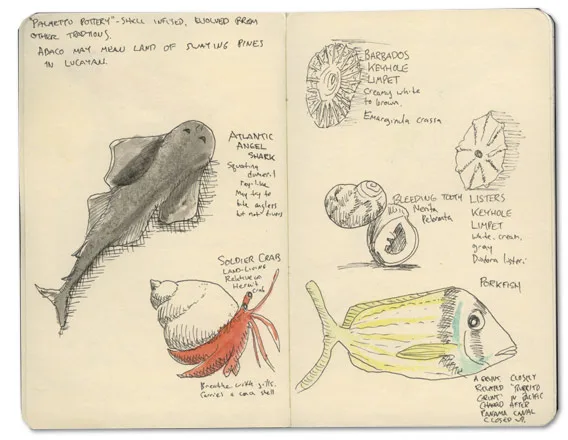
An Atlantic angel shark, a soldier crab in a borrowed shell, Barbados and Lister’s keyhole limpets, a bleeding tooth nerite and a porkfish.
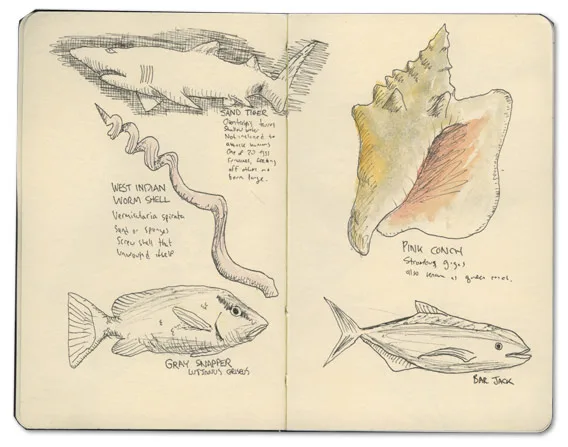
A sand tiger shark, a West Indian worm shell, a pink conch, a gray snapper and a bar jack.
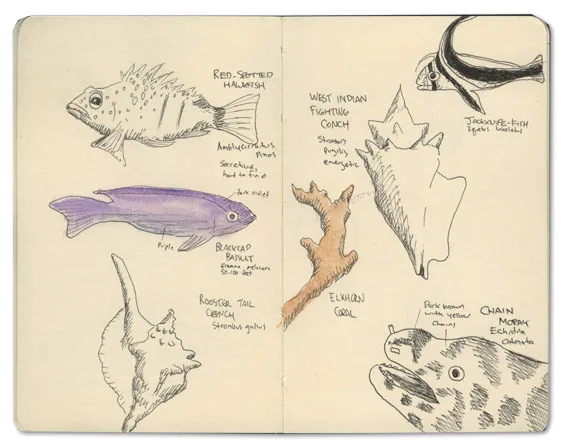
A red-spotted hawkfish, a blackcap basslet, a jackknife-fish and a chain moray, with a West Indian fighting conch, a rooster tail conch and a branch of elkhorn coral.
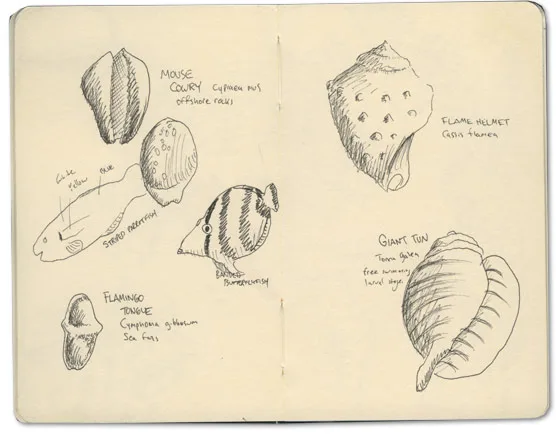
A mouse cowry, a flame helmet, a giant tun and a flamingo tongue, with a striped parrotfish and a banded butterflyfish.
A Guide to the Shells
The last pages are the reason I started the journal. There was no single guide to the shells of the region, so I built my own, drawing each one in pen with its Latin name, from tritons and murexes to the little dove shells, along with the old legend of the sand dollar.
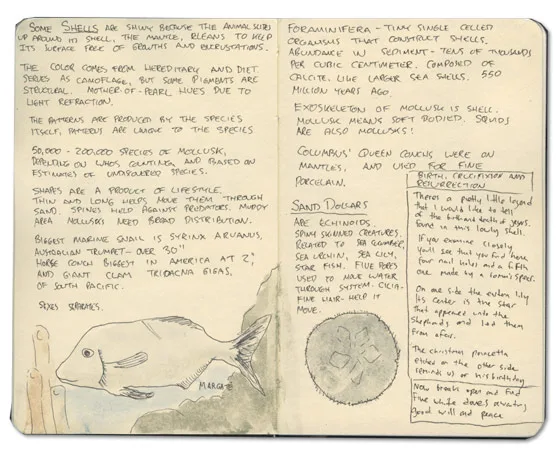
Notes on how shells get their colors and shapes, a margate, and a sand dollar with the Christmas legend told of the markings on its shell.
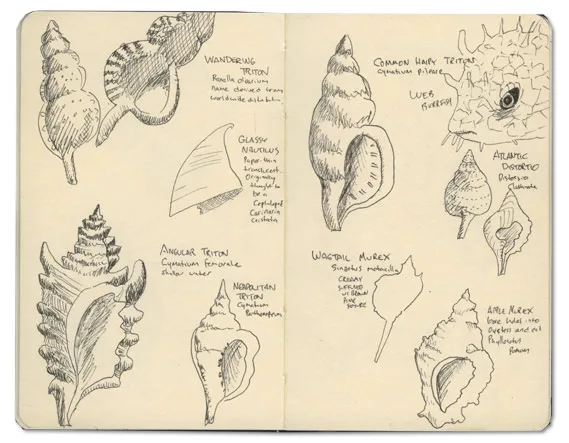
The common hairy, wandering, angular and Neapolitan tritons, the wagtail and apple murexes, a glassy nautilus, an Atlantic distorsio and a web burrfish.
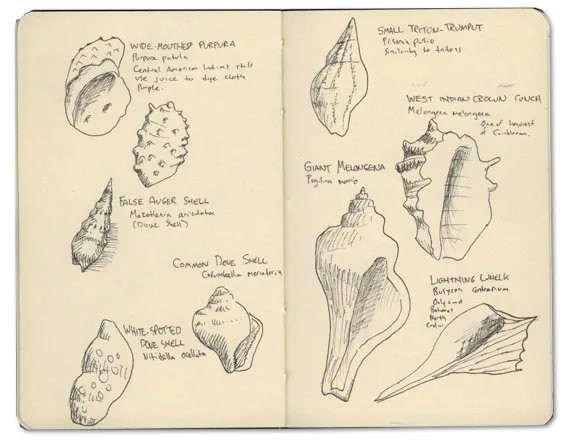
A wide-mouthed purpura, whose juice was once used to dye cloth purple, with dove shells, a false auger, a giant melongena, a West Indian crown conch and a lightning whelk.
The Newsletter
A homemade guidebook.
Field sketches and notes from the road, free by email.
Almost there. Check your inbox to confirm your subscription.