
Amazon Jungle Moleskine Journal
Updated September 29, 2026
Journaling and sketching is one of the great joys of travel. It helps you slow down, observe more closely, and keep track of the small things—ideas, notes, directions, and conversations. A sketchbook becomes part map, part diary, and part record of things you might forget if you didn't write them down. These pages come from my travels in the Ecuadorian Amazon, known in South America as the Oriente. These are notes from that time—quick drawings, observations, and thoughts from the Oriente.
The trip began in the river town of Coca, the old gateway to the Amazon, where I arrived on my German passport after a near-disaster at the airport, the story I tell in Dual Citizen in Coca. From there I went down the Napo River to Sacha Lodge, where two guides, Carlos and Pablo, paddled me into the flooded forest before dawn and took me island-hopping on the river. Several of these pages are first drafts of Black Flooded Forest and Tropical River Island Pioneers. The rest is birds, butterflies, ferns pressed in Yasuní and a long, numbered list of everything we saw. The whole region is laid out on my painted map of Ecuador.
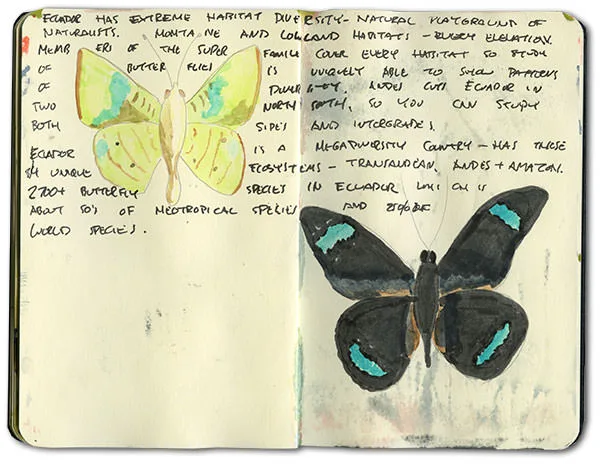
Two butterflies, a pale green one and a black one banded in turquoise, beside notes on Ecuador as one of the world’s megadiverse countries and the share of the world’s butterflies that live there.
Down the Napo
The Napo is Ecuador’s great contribution to the Amazon. It gathers its water on the eastern slope of the Andes, meets the Coca River at the town of Coca and carries its load of Andean mud east into Peru. That mud builds the sandbanks and river islands these pages keep returning to, temporary ground that floods scour away and rebuild, where a handful of birds live almost nowhere else.
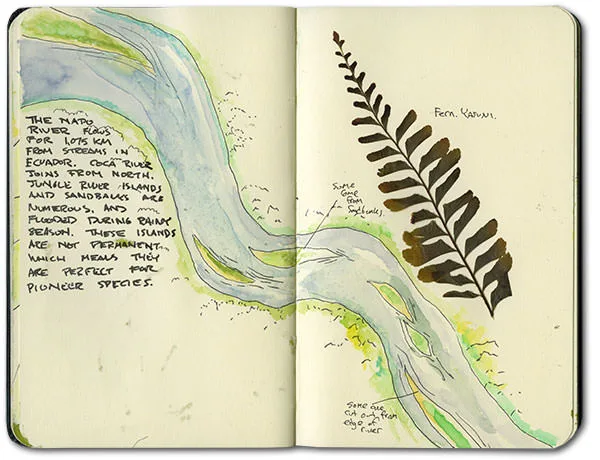
The Napo River winding through its islands and sandbanks, with notes on how the islands form and a fern pressed in Yasuní.
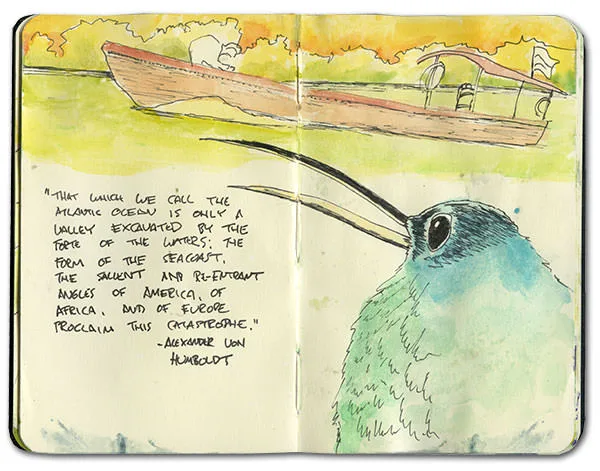
A motorized canoe on the river, a long-billed hummingbird and a passage from Alexander von Humboldt on the Atlantic as a valley carved by the waters.
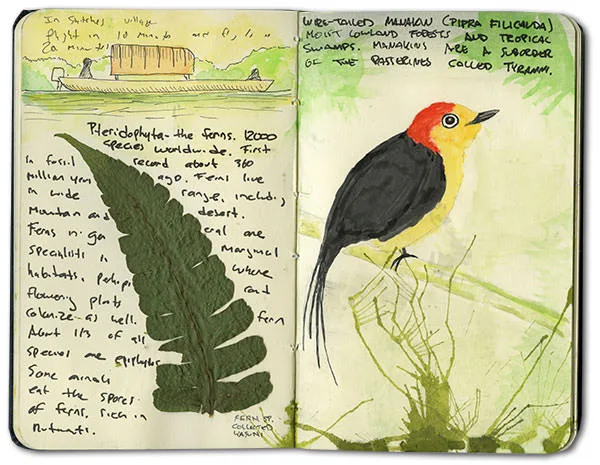
A thatched house and canoe at a riverside village, a pressed fern with notes on the ferns, and a wire-tailed manakin, Pipra filicauda.
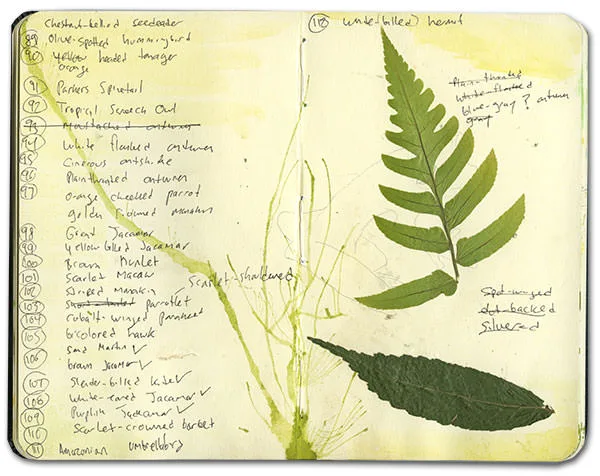
The bird list reaches the river islands, with Parker’s spinetail, the olive-spotted hummingbird, a tropical screech owl and a scarlet macaw, beside a pressed fern and leaf.
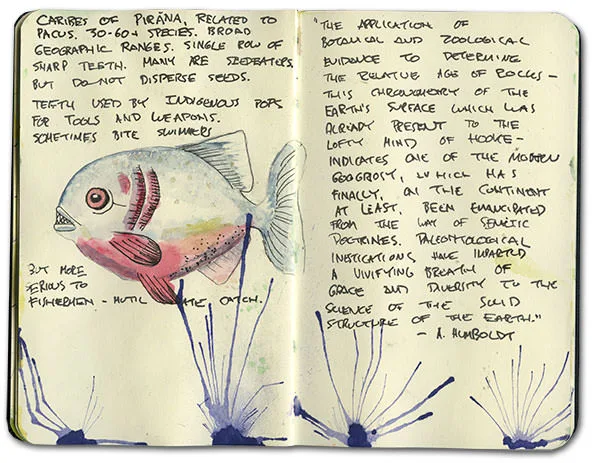
A piranha, with notes on its teeth and its cousins the pacus, and Humboldt on how the study of fossils changed the science of the Earth.
Before Light on the Black Lake
The lodge sits on a blackwater lake, its water stained the color of tea by the tannins of rotting leaves and ringed by flooded forest. A few miles away is Yasuní National Park, one of the handful of places with a claim to being the most biodiverse on Earth. These pages hold my first attempts to write about it, with the frog eggs, mushrooms and quotations that collected around them.
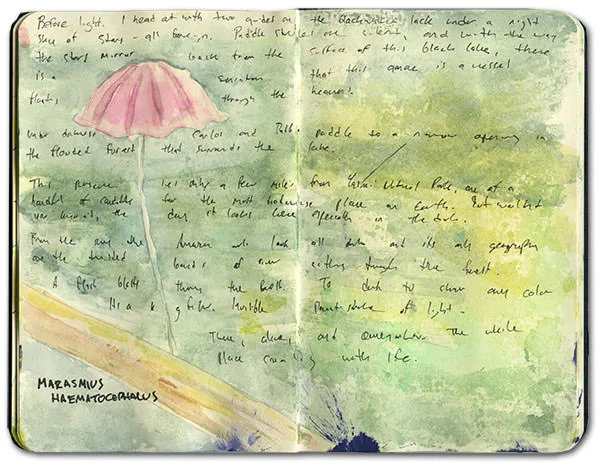
A pink parasol mushroom, Marasmius haematocephalus, painted over the first draft of my dawn paddle across the black lake.
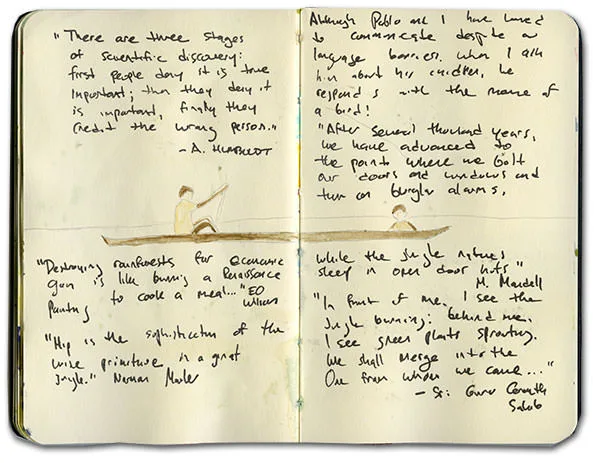
Two paddlers in a canoe, surrounded by quotations from Humboldt, E. O. Wilson and Norman Mailer, and a note on how Pablo answers questions about his family with the name of a bird.
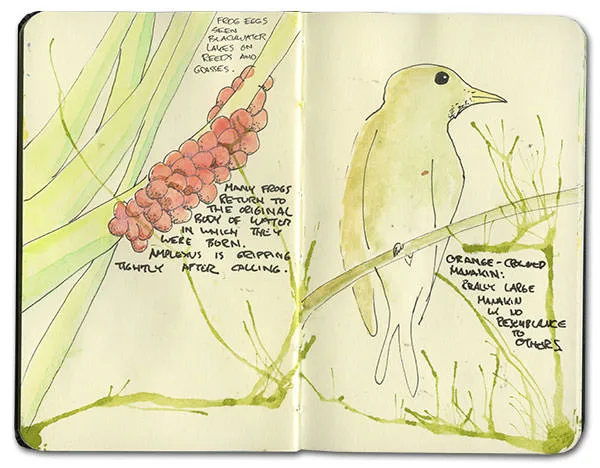
Frog eggs clinging to reeds on the blackwater lake, with a note on amplexus, and an orange-crested manakin.
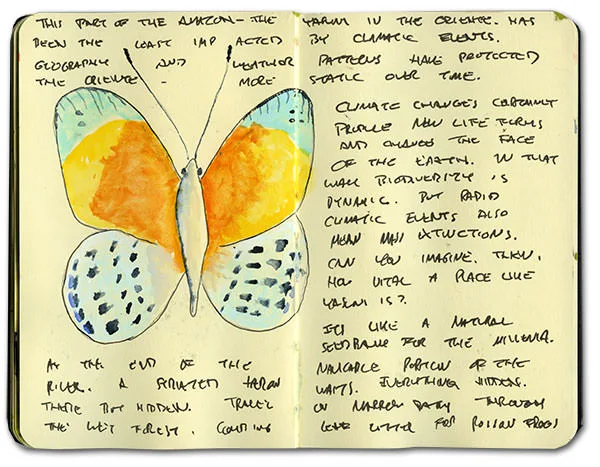
A butterfly in orange and pale blue, beside notes on why the Oriente may have served as a seedbank for the rest of the Amazon.
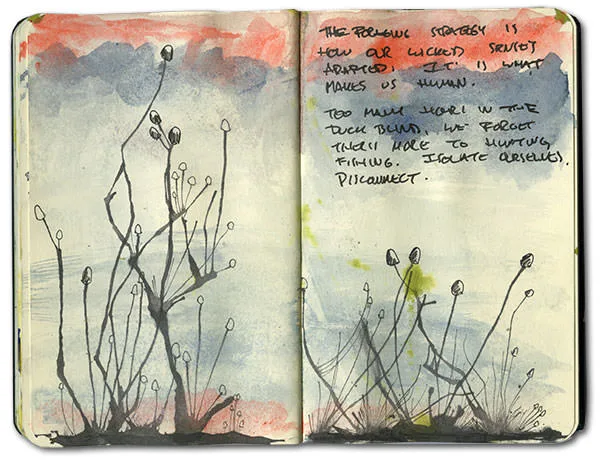
Seed heads in ink against a watercolor dusk, with a note on foraging as the strategy that made us human.
Painted Warnings
Most of the Oriente’s life hides in plain sight, which makes the exceptions startling: a poison frog painted red and turquoise on the forest floor, a red-capped cardinal at the water’s edge, a band of aracaris crossing the canopy. I drew them as I found them, with whatever I had pressed that day.
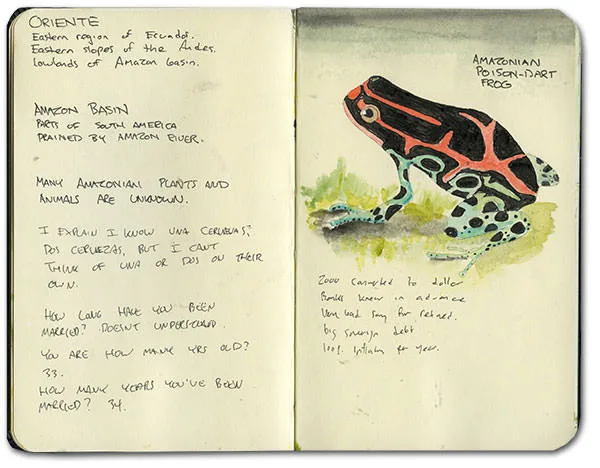
An Amazonian poison dart frog in red, black and turquoise, with notes defining the Oriente and scraps of a conversation in Spanish.
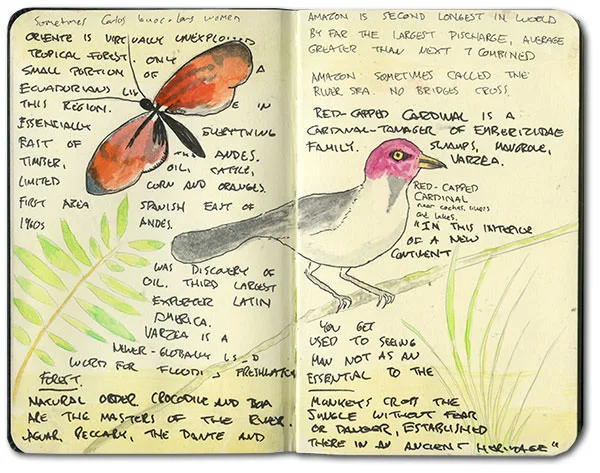
A red-capped cardinal and an orange-and-black butterfly, with notes on oil in the Oriente, the várzea forests and the Amazon’s enormous discharge.
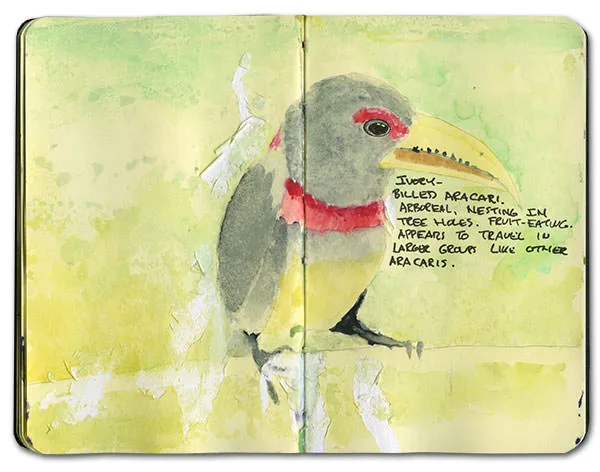
An ivory-billed aracari, a small toucan that nests in tree holes and travels in groups.
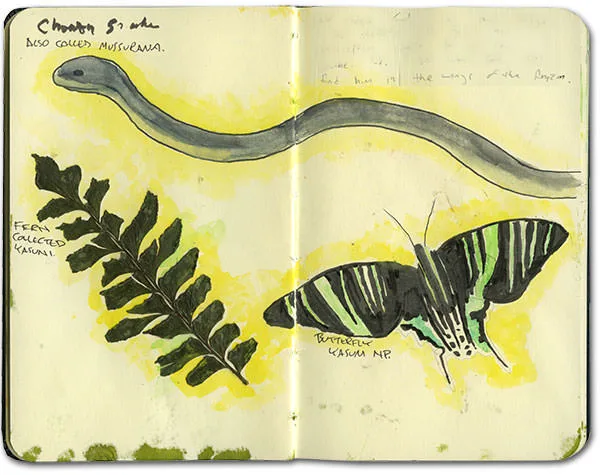
A chonta snake, also called the mussurana, with a fern and a black-and-green butterfly, both from Yasuní.
The Running List
Every naturalist’s journal ends up with a list. Mine runs past a hundred numbered birds, from hoatzins and blue-and-yellow macaws to the spinetails of the river islands, with the mammals and reptiles tallied in the margins: tamarins, a kinkajou, howler monkeys, a three-toed sloth and a coral snake.
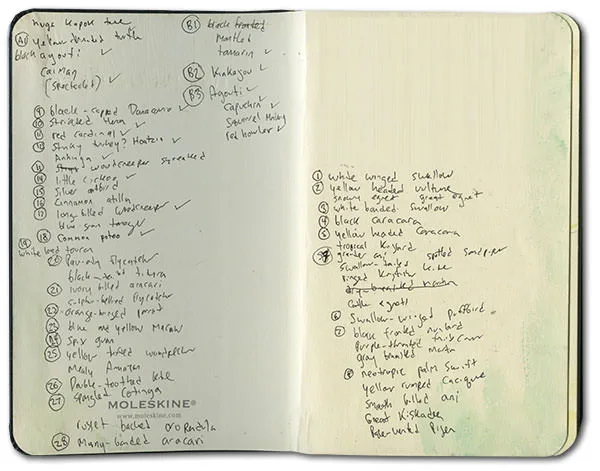
The first pages of the checklist, with the black-capped donacobius, hoatzin, white-throated toucan and blue-and-yellow macaw, and in the margin a tamarin, a kinkajou, capuchins, squirrel monkeys and a red howler.
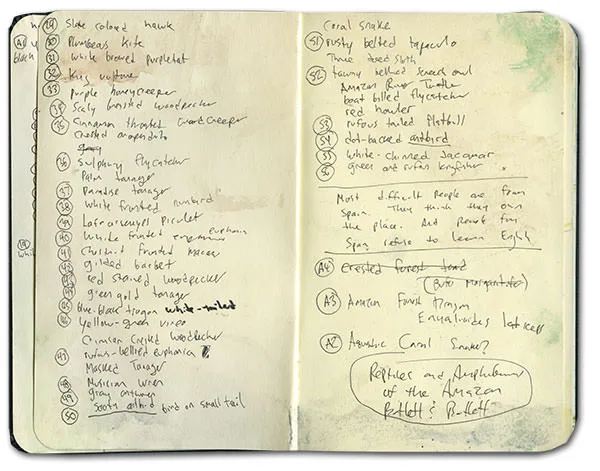
More birds, from a king vulture to a paradise tanager, with a three-toed sloth, an Amazon river turtle and the Amazon forest dragon, Enyalioides laticeps.
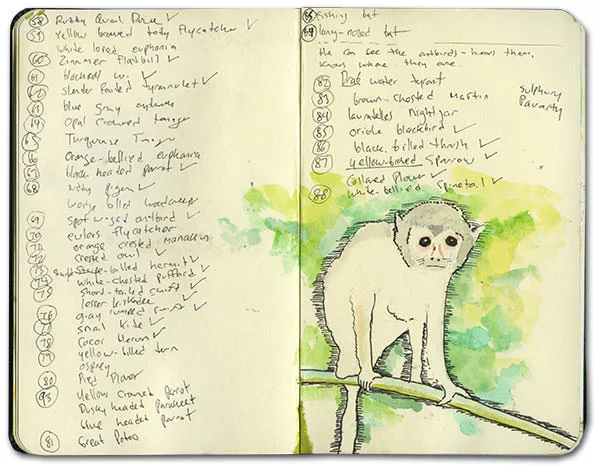
The list runs past eighty species, from a great potoo to a white-bellied spinetail, beside a small monkey on a branch.