
Palermo and the Citrus Kingdom
How a weirdo fruit from the far end of the known world made Palermo the capital of a citrus kingdom.
July 30, 2026
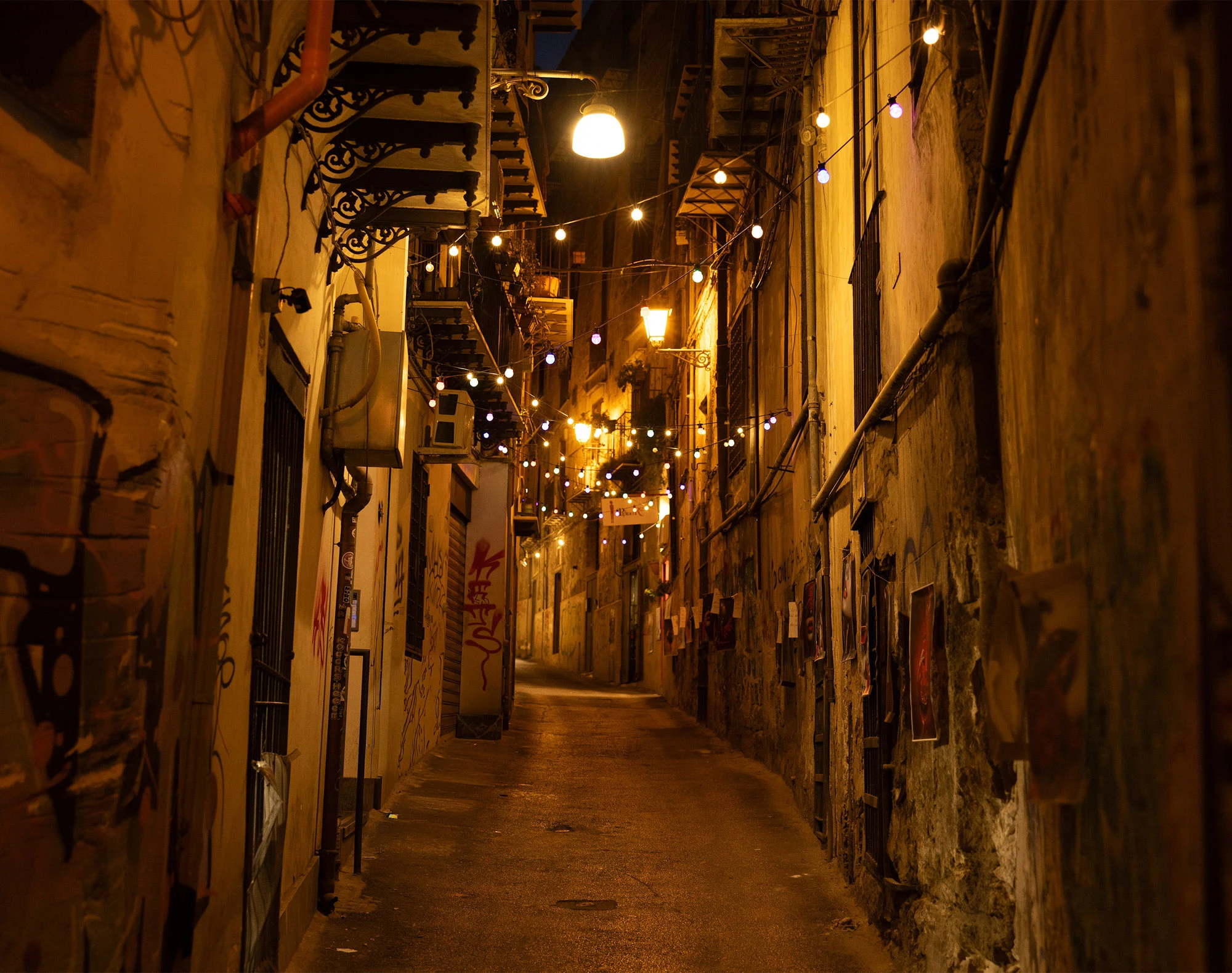
A narrow alley in Palermo’s old quarter. Behind the Baroque facades, the city’s street plan and hidden courtyards still preserve the imprint of the Arab city built a thousand years ago.
When I last visited Sicily, I noticed the citrus the way you notice weather: everywhere, but not yet meaningful. Returning now with Jane and our friends, and with plans to drive east from Palermo, I realize that there is more to Sicily’s love affair with citrus. Perhaps Sicily itself can be best understood by the citrus fruits it cultivated, transformed, and ultimately helped give to the world.
Nutella Naranja
A few years ago, Jane and I were having breakfast in Central Oregon with Iva and Ivan, which of course meant a jar of Nutella and homemade crepes. If I have a lifelong love of oranges and other citrus, then our two Croatian friends have the same passion for Nutella, the creamy Italian cocoa and hazelnut spread. They are so devoted to it that they distinguish it by where it is made. Canadian Nutella is decent. Mexican Nutella is terrible. Nutella manufactured in Italy is the best.
Knowing our Croatian friends, I announced that I wanted to pitch parent company Ferrero on a new Nutella flavor. It would be orange-flavored Nutella, built around that balance you get when chocolate and nut spreads meet citrus. I would call it Nutella Naranja.
Iva slowly put down her knife and fork. Suddenly she was no longer relaxed. The sound of the silverware hitting the table let me know I’d crossed a line. You could even say she looked disgusted.
“Nutella is Nutella,” she said. “You can’t mix it with something else. I find that idea so ridiculous.”
Of course, I had only brought it up because I knew it would provoke exactly that reaction. But somewhere along the way the joke turned into a project. I began experimenting with different orange products, mixing them with our favorite alternative to Nutella, a palm-oil-free hazelnut spread.
After months of experimentation, I discovered that a blend of sixty-percent hazelnut spread and forty-percent orange curd produced something genuinely amazing: sweet, rich, and bright. I even started designing Nutella Naranja artwork, making sure to keep Iva and Ivan updated, hoping to elicit that not so sweet and bright expression from Iva each time.
Sicily is branded around the world as a place that is pure, ancient, and unchanging. It is as old as the sinister melody of The Godfather; frozen in Greek columns and the distant sails of Syracusan triremes. Iva and Ivan, who grew up in a heavily Italian-influenced part of Croatia, expect the Mediterranean to remain exactly as they imagine it: timeless, familiar, and reassuring. Like Nutella, it shouldn’t change. Then, just days before we land in Palermo, Ferrero announced the first new Nutella flavor in the brand’s history—Peanut Nutella.
Sicily is not a story of purity. It’s a story of invention. The citrus fruits that would land on these shores over the next thousand years would not stay what they used to be. Somebody grafted them, or crossed them with something else, or figured out how to keep them watered through an August that should have killed them. Sometimes, one tree would just mutate enough to change it, and somebody noticed. Nearly everything that makes Sicilian citrus famous today exists because someone was willing to mess with it.
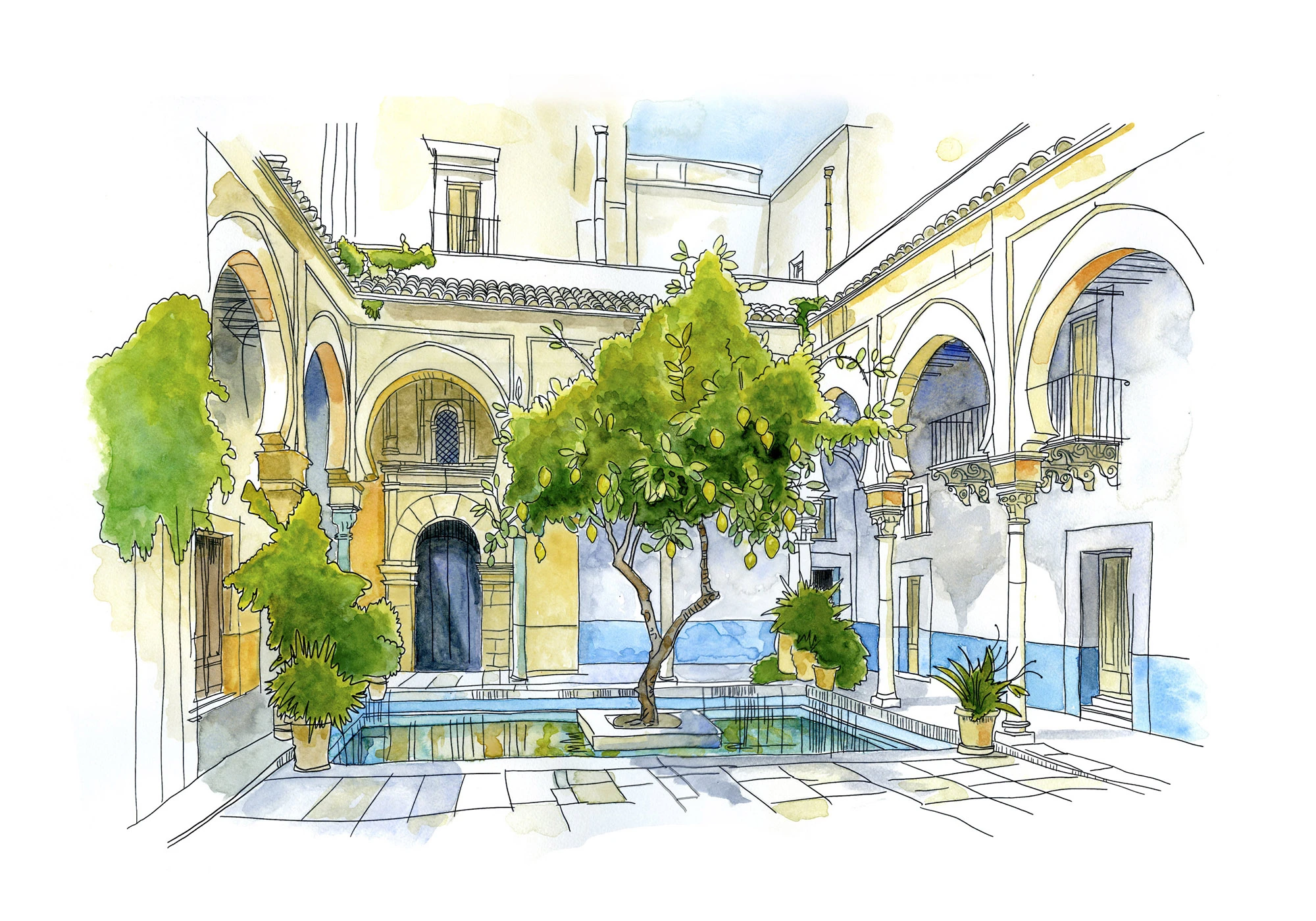
A thousand years ago, courtyard gardens like this held wells, fountains, and a carefully tended tree. Watercolor and liner pen.
Vito and the Blue Škoda
We exit Palermo’s airport and hail a cab van. Our driver, whose real name eludes us but who we later call Vito, is young, thin, bug-eyed, and driving as though the highway owes him money. He immediately begins weaving through traffic, tailgating cars, and throwing his hands in the air.
But one car, a blue Škoda Favorit, and one very elderly man driving that Czech hatchback, has thrown Vito into an absolute tizzy of anger. He guns the taxi van engine and rides the tail of the tiny car. The elderly driver isn’t actually driving slowly. Vito seems enraged simply because the old man looks like someone who should.
While Vito is swerving left and right, Ivan dismisses the action, “This is just the way it is in Sicily. Everybody does this.” This is Ivan’s first time in Sicily.
At the first opening, Vito cuts through an S-curve between lanes and dives in front of the little Škoda, braking hard behind a tanker.
I’m sitting shotgun, and I turn around to look at Jane and our fellow travelers.
I look in my sideview mirror, and Sicilian Grandpa is now behind us. An absolute Pixar character sketch. A defeated old man!
He pulls up alongside us and looks at me as if to ask whose side I’m on. I give him a subtle Hawaiian shaka. Then he threads the Škoda between a Fiat Panda and a Dacia Duster, surging past us, and reclaiming his place ahead of the tanker. From his rolled-down window, he gives us a sustained middle finger. Ivan says again, “This is the way they do things in Sicily.”
Courtyards of the Arab City
The next day, I leave Jane and our friends and head toward the waterfront in search of Palermo’s feral cat colony. I had already covered eight miles in sandals today, and I want to catch the seaside cats at sunset when they begin emerging from their daytime bunkers. The walk takes longer than expected, carrying me through quiet alleys where people sit on their front steps escaping the heat, while laundry hangs four stories overhead.
Most of the buildings that I see are Spanish and Baroque. They are built atop much older Arabic foundations. Very few of Palermo’s residential buildings from around 1000 AD survive today, but later builders would preserve the inward-facing footprints from that time, so that today’s buildings imitate yesterday’s. Every so often I catch a glimpse through an open gate into one of those hidden courtyards. Some are quite large, their purpose changing over the centuries into garages, workshops, or stables.
As I walk, I keep trying to subtract a thousand years from these courtyards. Strip out the parked Vespas and the propane tanks, and what’s left is an open-air garden. There would have been a well, or a cistern for catching winter rain—rain matters here, there isn’t much of it. A fountain, if the family could afford one. Vines going up the walls, herbs in pots, maybe a loggia for sitting out the afternoon heat. And at the center, I’d like to think, a tree somebody fussed over.
Across the Islamic world, these private gardens were built as glimpses of paradise. In a hot, dusty, crowded city, paradise meant something quite specific. It meant water you could hear, shade you could sit in, and a plant nobody else on your street possessed.
What tree would a wealthy Arab family in Palermo have chosen to complete that vision?
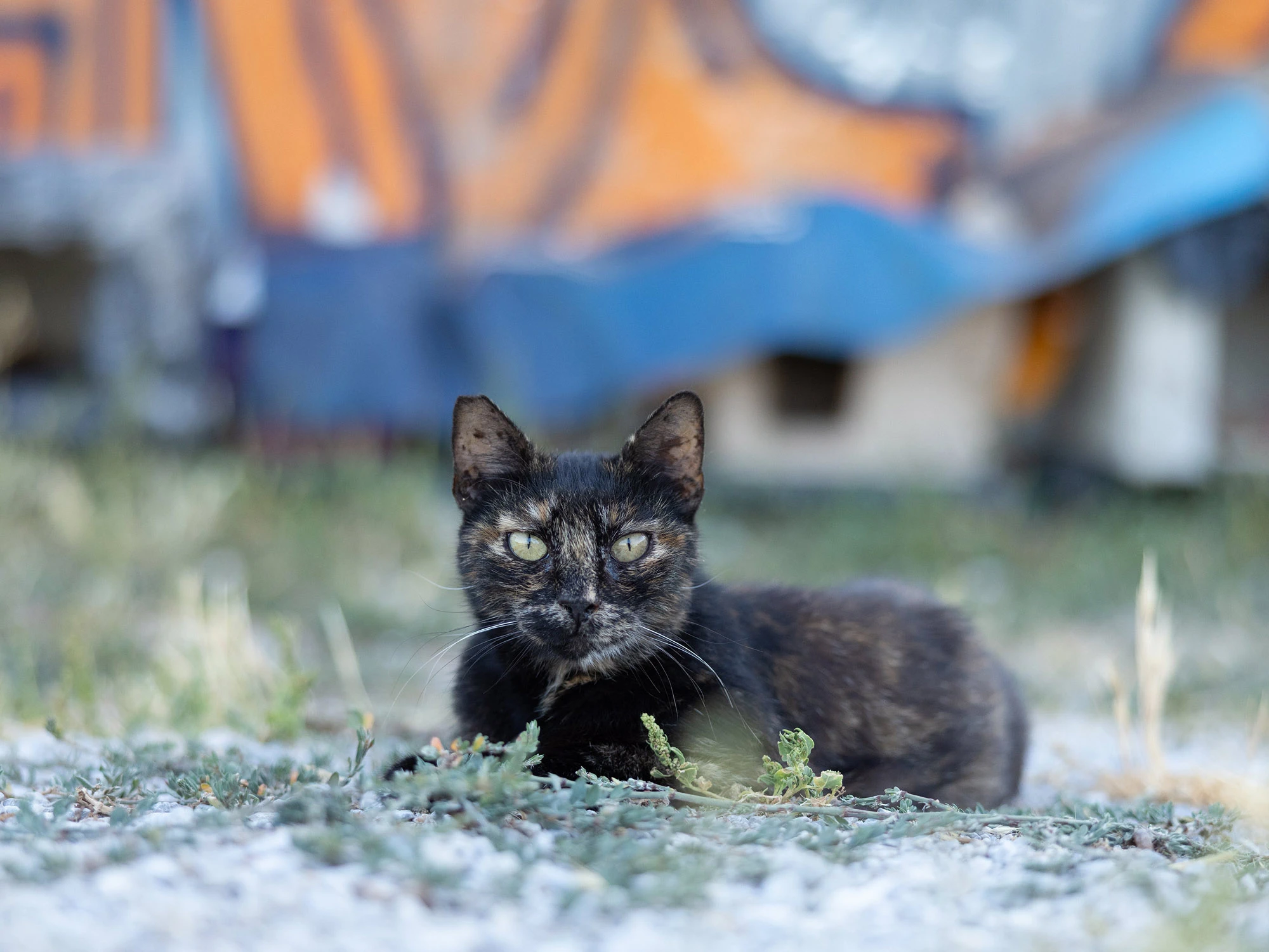
An alley cat along the Palermo waterfront, where the seaside colony emerges from its daytime bunkers at sunset.
A Bottle of Cedrata
After finding the colony cats wandering along the rocky Mediterranean quay, masters of improvising in a human world, I am completely parched. And I still have another two miles to walk before meeting Jane and our friends.
I stop at a fruit stand along the waterfront, looking for something cold to drink. In the freezer is a bright acid-green soda, and on the label, a woman whose dress is in the shape of an alien citrus fruit—lumpy, like an overgrown lemon with a skin disease. The label calls it Cedrata, which translates as Citron soda. Cedro is the Italian word for citron. This is confusing, because in many European languages, citron translates as lemon. But citrons are not lemons!
I know immediately that this is my kind of citrus. It’s not orange soda or lemonade adjacent. It tastes botanical, not fruity. Imagine if someone carbonated the aroma of a citrus grove. It’s a perfume made of citrus zest, pine resin and grapefruit. It makes me stop walking so I can concentrate on what I am actually tasting.
Citron did not first arrive in Sicily to become a beverage or dessert. It produces remarkably little juice; its value lies almost entirely in its thick aromatic rind. It first arrived because it was something altogether different: an exotic tree. A tree from paradise.
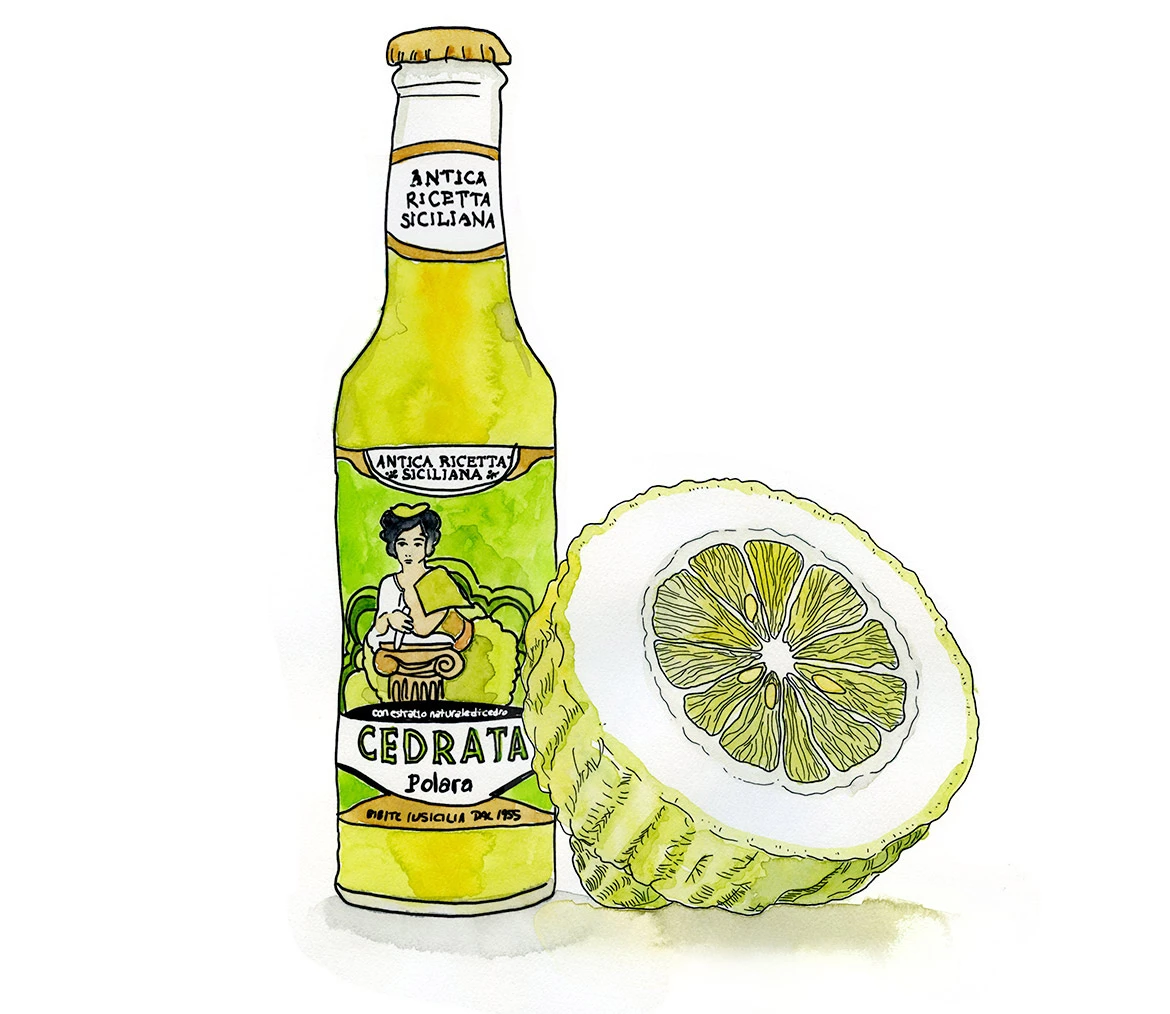
Watercolor and liner pen sketch of Sicilian Cedrata soda and a cross-section of a citron citrus. Note the heavy rind, which is why citron is known for its rind, not its juice.
Paradise as a Garden
The citron’s migration to the Mediterranean started long before Palermo became an Arab city. Centuries before, it had crept westward through Persia and the Levant. In small doses, it would have appeared in Greek and Roman gardens; an exotic curiosity. It is possible that citrons existed in Sicily before the arrival of the Arabs.
As I walk along Palermo’s waterfront, I can’t stop imagining great sailing ships making their way into port. And now I want to imagine how those oversized weirdo fruits made their way here.
A thousand years ago, Palermo was under Arabic rule, and the Islamic world at the time was obsessed with gardens, irrigation, grafting and tinkering with plants. I wrote about this era of agriculture and science in Malta and Gozo.
A thousand years ago, if you lived under Arab rule, you knew about the Persian-Indian worlds because those cultures meant so many things—luxury, science, novelty and sophistication. The Islamic east had a strong influence in the Arab world. But Persia itself was so far away that as a place it was legendary, even mythical. Palermo was connected to the far east by a vast trading world, but nobody working the docks on either end would ever see the other side, and Sicilians understood these places only through the filter of the Middle East.
For us living in the twenty-first century, it is difficult to imagine the cultural birthplace of the citron as it would have been for a Sicilian Arab to imagine the place that inspired many of their ideals, scholarship and gardens. In Islamic culture, the concept of paradise is much more of a vivid and sensory place than concepts of heaven more common in the West. In fact, the way Sicilians of the time imagined paradise was itself imported from Persia. Even the word paradise is derived from old Persian pairidaeza, which literally means, “walled garden.”
Paradise, which the Qur’an often imagines as a garden beneath which rivers flow, is a place of shade, fruit trees and water dripping everywhere. The concept of paradise intermingled with the science and engineering advancement of irrigation. Rulers invested heavily in irrigation, prioritized in part because they carried enormous religious prestige.
Lateen Sails in the Gulf of Palermo
Holding my bottle of cedrata, I look out again at the Tyrrhenian Sea; that western sea off Italy, and I want to imagine the ships.
It was the large Arab merchant ships I would be paying the most attention to, as they hauled into the Gulf of Palermo. They would have been long and lean, and ran unusually fast for the time with their huge triangular lateen sails.
Their hulls were heavy, with pegged planking and elements of old Roman ingenuity. Their captain was likely an Arab speaker, but the sailors were Berber, the navigator was Greek, the merchant was Jewish, the trader was Egyptian and of course the dockworkers awaiting their arrival were Sicilian.
My dad has always been a collector of wooden model boats and ships, so even as a toddler, I had dhows and outriggers and merchant ships to stare at, and somehow all those miniature sails and fishing nets turned me into a sucker for maritime non-fiction. Naval battles, castaways, paleolithic navigators. But can my intrigue lead me to imagine the route of the citron tree?
Unlike most citrus, citron is a wild species, and before there were humans, it grew in the western Himalayan foothills, high-elevation Bhutan forests and the rocky slopes of southwestern Indian mountains. While its three native ranges were separated by over a thousand miles, they were the same habitat: rainy and mountainous, with rocky-fast-draining soil.
The first citron that mattered may have arrived as a handful of seeds wrapped in cloth and packed away in the breast pocket of a trader, or maybe it was a graft, wax-sealed in damp moss, awaiting a horticulturist. I imagine it as a small, unremarkable sapling.
Generations before, the maritime journey of its ancestors might have begun in Gujarat, the Indian epicenter of trade, on a sewn-plank ship made of coconut fiber. It had two large triangular lateen sails, and its captain would have been intimate with the monsoon winds. He traveled west when the monsoon winds went west, and his crew waited for the winds to reverse course back to India.
Perhaps that citron found a garden in Muscat, and its descendants—grafts from that tree—ended up in Sohar, further up on the Omani coast, and generations later a sapling found its way onto a fifty-foot sewn-plank dhow, built from Indian teak and rigged with a single ochre-dyed sail. The sapling may have been placed safely among the geometric grid of amphorae as the dhow sailed north through the Persian Gulf. It would pass through the estuary created by the Tigris and Euphrates and head upriver to Basra, among the busiest ports of the Islamic world.
Perhaps from here, a descendant of that sapling would again find its way on a shallow-draft mashoof, bound for Baghdad by oar and pole.
Descendants of this tree would again find themselves being traded westward, to Damascus and Alexandria, and then to Kairouan or Tunis. The journey that ended in Palermo may have taken centuries.
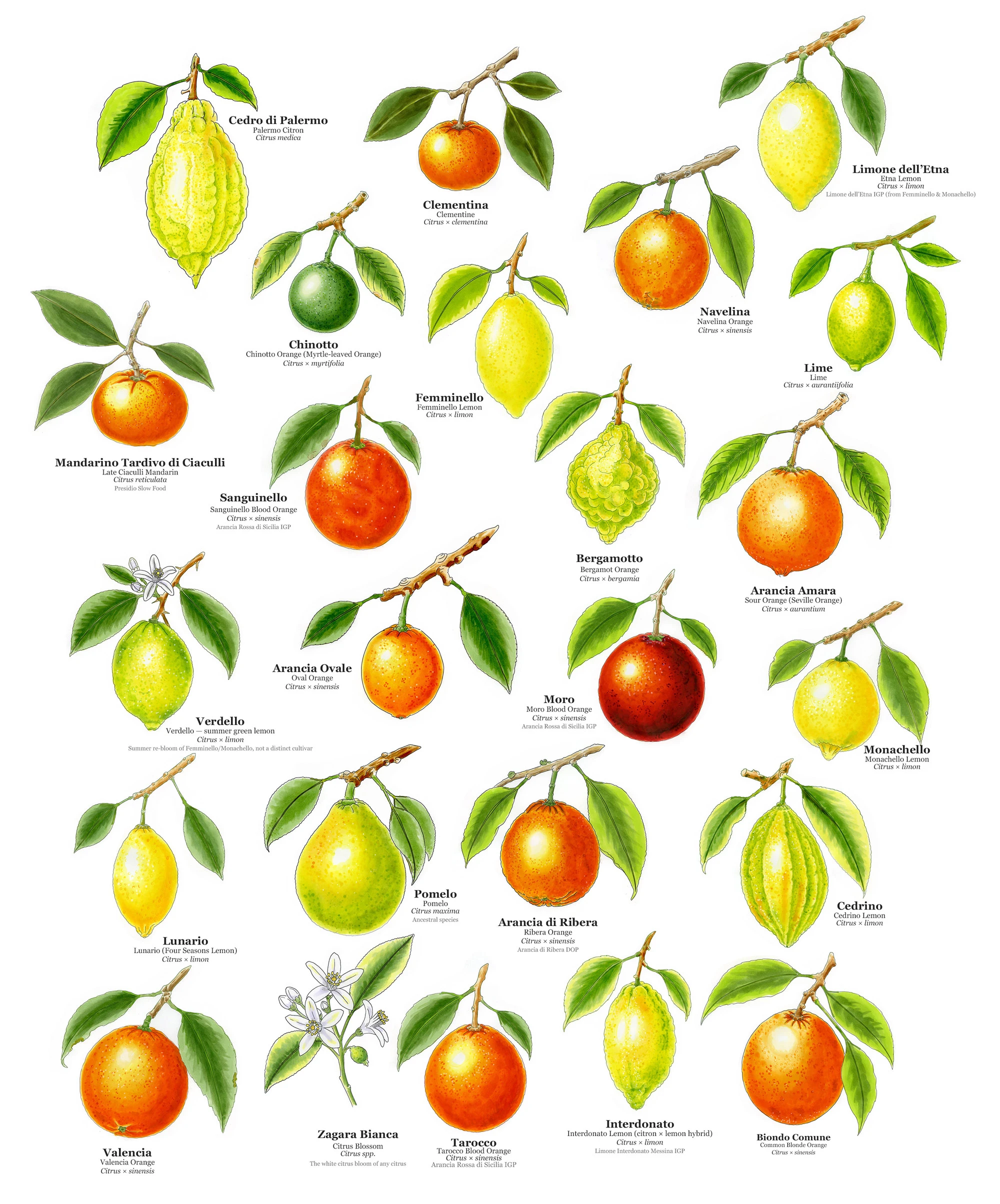
My Copic, liner pen and pencil drawing of the key citrus players in Sicily’s history—some are Sicilian icons, others the ancestral species that made them possible.
The Tree in the Courtyard
Imagine a well-dressed man at the docks. A merchant, or a judge. Maybe a physician or an emir. He purchases that young tree from one of the harbor traders. It was probably nothing more than a slender green sapling, its roots wrapped in damp cloth. Servants followed behind with jars of water as the little tree disappeared through Palermo’s narrow streets, behind a plain wooden door, into one of those shaded courtyards I had glimpsed on my walk to the cat colony.
Someone in a shaded courtyard planted it. It may have sat in the very center of the courtyard, perhaps surrounded by a pool or fountain. When it grew, and large acid-green fruits hung from its branches, visitors would ask, “What is that? Where did it come from?”
The truth is, it was always more than the mountains of India. It was monsoon seas. It was camel caravans. It was botanical gardens. It was lifetimes of handoffs, via scholars and gardeners, across empires and time.
There were no mandarins or blood oranges in Sicily. No bergamot, no lemons. There was only the citron.
What was important was that under the Arabs, the citrons became more than just an exotic curiosity. They became an idea. In Palermo’s gardens, bolstered by new irrigation systems and generations of agronomist knowledge, gardeners began to understand that these trees from the farthest ends of Asia could thrive in sun-parched Sicily.
And the tree lived.
The Golden Shell
The key to the citron’s future—a future that links nearly every aspect of Sicily’s cultural, political and culinary history—lies just outside of urban Palermo. It’s a flat plain that was well watered by three rivers. The Arabs turned it into a fantasyland of fertile agriculture. They dug reservoirs and sank new wells and ran canals out across the valley. They began to see it as paradise—the literal version they knew from Persia. They called it the Conca d’Oro. The Golden Basin.
Today, mention of Sicily’s Conca d’Oro symbolizes endless citrus groves. But before miles of orange and lemon trees, it was the citron that proved an Asian mountain fruit could survive a Sicilian August. The answer? Yes, as long as the water keeps moving.
Somewhere in one of those shaded Palermo courtyards, a gardener planted a skinny sapling from a land Sicilians would never see. He was just keeping a tree alive. He had no way of knowing he was starting a kingdom.
 Part II: CefalùThe fruit nobody ever bought⟶