Part VII of The Citrus Kingdom
Modica and the Femminello Night Bandits
From a balcony in Modica, a journey back to a lemon grove in 1859.
I awake in Modica knowing that I need to wash my clothes in the sink and get them out into the morning sun to dry. I plod up from the basement to find Iva in the living room, holding a bottle of nail polish up to the window and frowning at it.
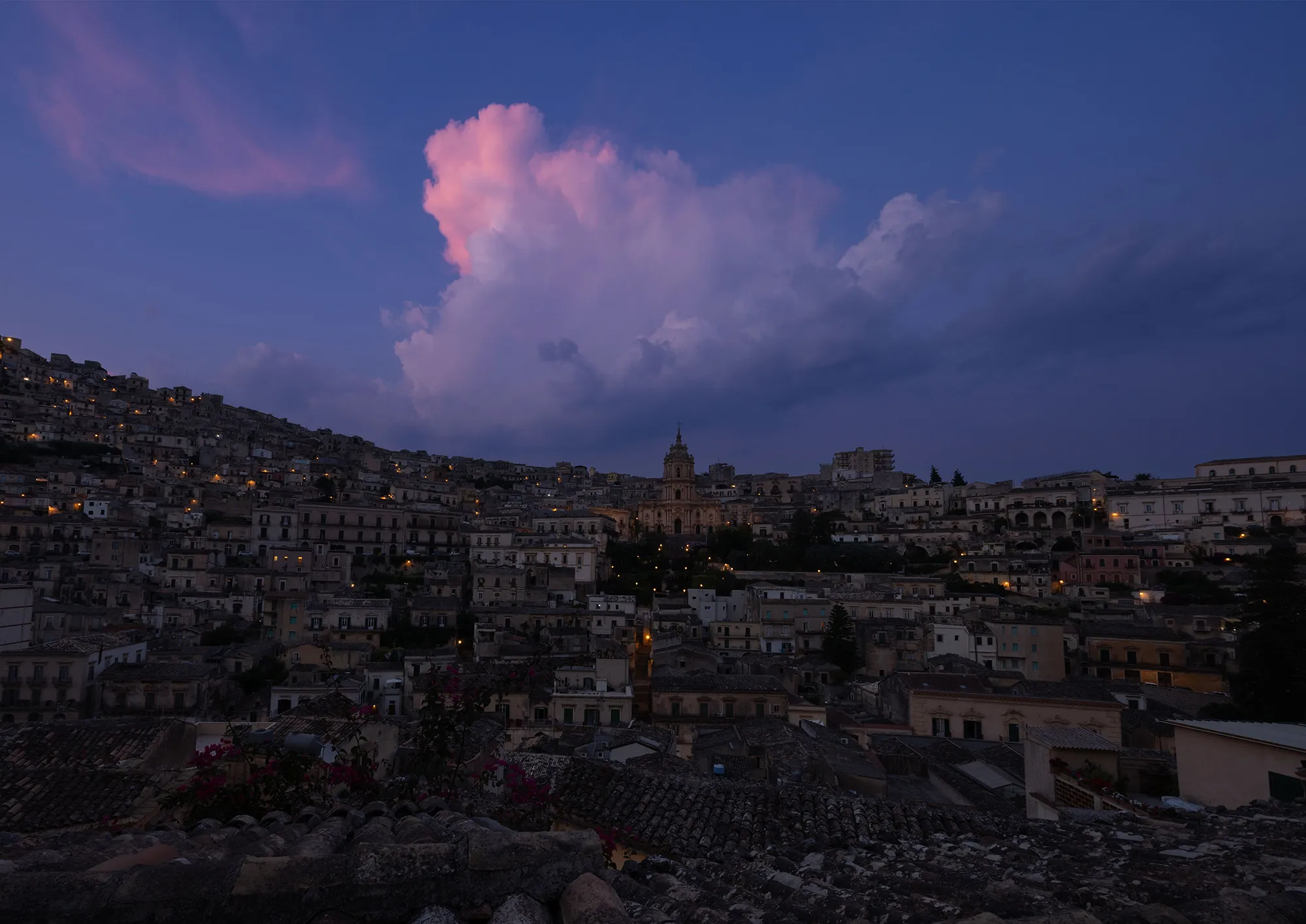
I open the doors to the balcony and the city beyond. Sicily has some of the world’s most beautiful villages, Cefalù and Erice among them, but Modica is not a village. Modica is an entire city, built on the steep sides of a ravine. It is houses stacked on houses, staircases everywhere leading under arches and between balconies. Modica has an entirely different relationship with gravity.
I ask Iva what she’s up to. She discreetly puts the nail polish away and casually mentions that she’ll need to buy a couple of bottles in the city today.
Four days earlier, when we entered the Val di Noto, the countryside began to resemble the Sicily that people around the world imagine. Golden grasses, great open agricultural spaces, lonely and abandoned farmsteads, prickly pear cactuses growing between ancient dry-stone walls. It was a great stretch of open horizontal space, broken by old carob trees and old limestone walls.
Modica is an extension of that landscape, although here the horizontal world has suddenly turned vertical. Instead of stands of thatching grass and giant fennel rising from the limestone, there are houses and churches. Instead of dry-stone walls dividing the fields, there are retaining walls holding up entire neighborhoods.
Modica was built by water. Two streams, the Ianni Mauro and the Pozzo dei Pruni, cut into this gorge, and so the city built up on either side. Modica was once called the Venice of the South, because bridges cut across the creeks at every chance.
Then, on September 26, 1902, a storm sent both rivers roaring through the lower town, emptying ground floors and carrying away more than a hundred people. Afterward, the rivers were buried. Corso Umberto, the main street below me, runs where they used to. Modica’s water is still down there, out of sight, beneath the cafés and the chocolate shops.
The story I want to tell happened on the other side of Sicily, in the lemon groves outside Palermo. But there’s a reason I want to tell it here.
The lemon at the center of it all grows here too. If you drive down from Modica toward Syracuse, you’ll see the groves running in a dark green band between the limestone and the sea. These are Femminellos, the most common lemon in Italy, on an island that grows nearly all of Italy’s lemons. In this corner of Sicily, the Femminello has been the backbone of the farm economy for generations. Syracuse lemons made fortunes in foreign markets, as far away as the United States, and today the Limone di Siracusa is protected by the European Union, the fruit of one Femminello strain grown along a coastal strip of ten towns.
Its name means something like “little female,” for its fertility. As we saw in Ortigia, the Femminello flowers again and again, and a grower who knows how to coax it can pick lemons nearly all year.
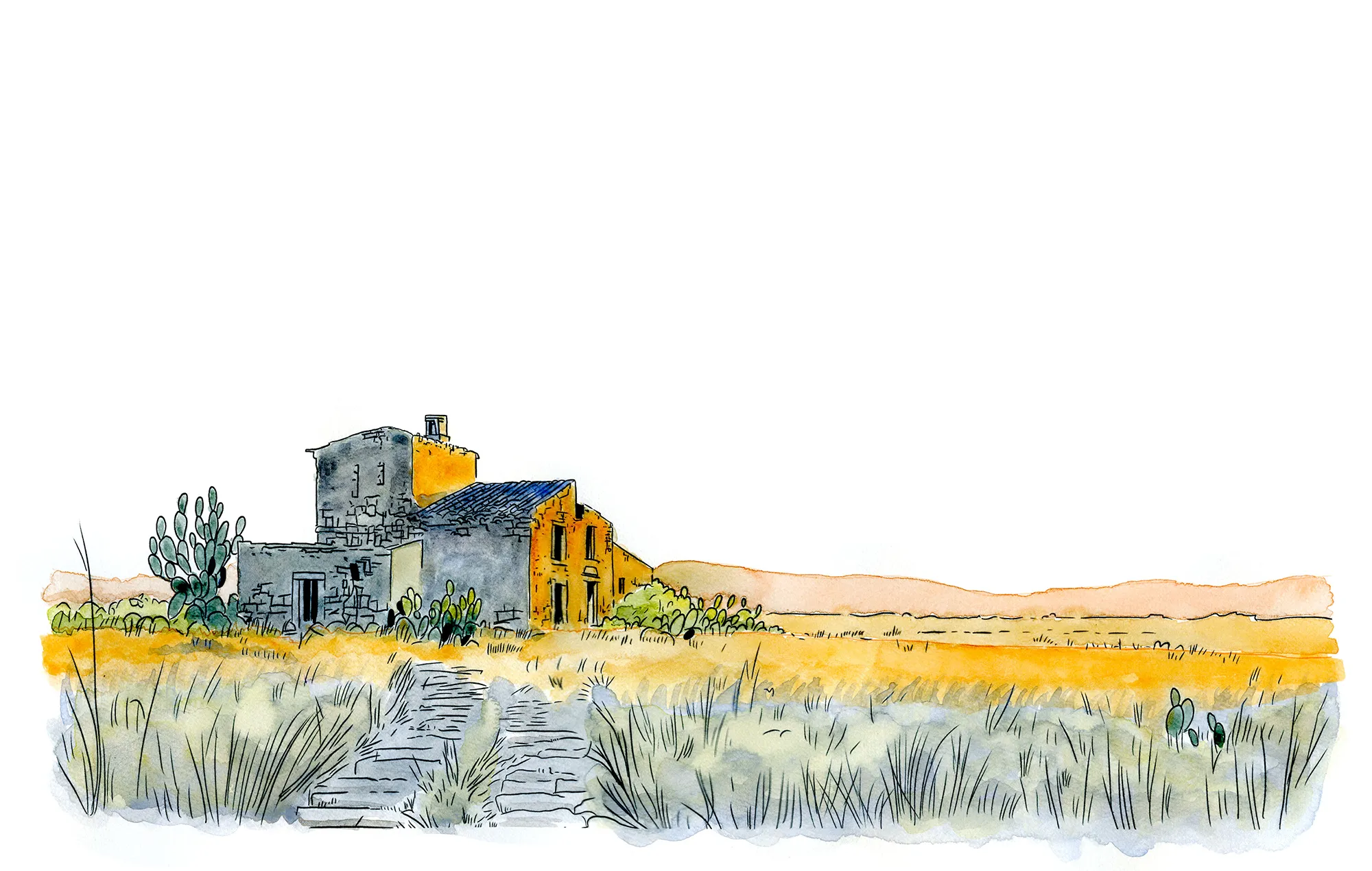
The Noto Valley at sunset, on the road to Modica, its fields gone gold in the last light around an old stone farmhouse and its prickly pears. Liner pen and watercolor washes.
I’ve asked you to travel back in time with me before: aboard a dhow carrying a citron sapling toward Palermo, onto a Portuguese nau rounding the Cape of Good Hope, and millions of years back to the forests of Yunnan, where citrus evolved.
Will you come with me once more?
This time we don’t have to go nearly as far. I’m not taking you to Asia or the Miocene, only to the other side of Sicily.
I’m going to introduce you to a family that lived a century and a half ago. While they are my invention, the world they lived in is not.
The Golden Basin
It’s summertime, and it’s 1859. Sicily is still a kingdom that is ruled from Naples. There is no such thing as Italy. In the Conca d’Oro, the lush golden basin just outside Palermo, a man named Antonino Sclafani is walking among his lemon trees at dawn, as he does each morning.
His trees are wet from last night’s watering. Antonino knows his trees so well that he knows which ones drink the most and which ones droop when you feed them too much. He knows the old tree by the cistern as the one that always flowers first, and the young one near the wall that has never forgiven him for the transplanting.
You and I are standing on the roof of the Sclafanis’ farmhouse, and below, we can see the family mule, walking in circles around a wheel and a well. That contraption, the senia, sends a bucket down into the well and then up to be tipped into the gebbia, a large stone tank the size of a small room. This technology is almost identical to what the Arabs brought to Sicily ten centuries ago.
We can see a series of clay channels leading out from the tank and into the trees. The mule and the senia are not actually responsible for quenching the trees’ thirst. This is just a backup, especially on these hot August days, leading up to the most important time of the week: Thursday night.
On Thursday night, a man who is known as the water guardian, or the fontaniere, opens a sluice at the water reservoir, and the Sclafanis’ share of the valley’s water comes rushing into their gebbia.
The Sclafani farmhouse is built low to the ground. Capers grow out of the cracks where the stone shows through the whitewash. It is built around a modest courtyard that’s floored with river rocks. There is a grapevine covering half the courtyard, and beneath it is a simple farm table.
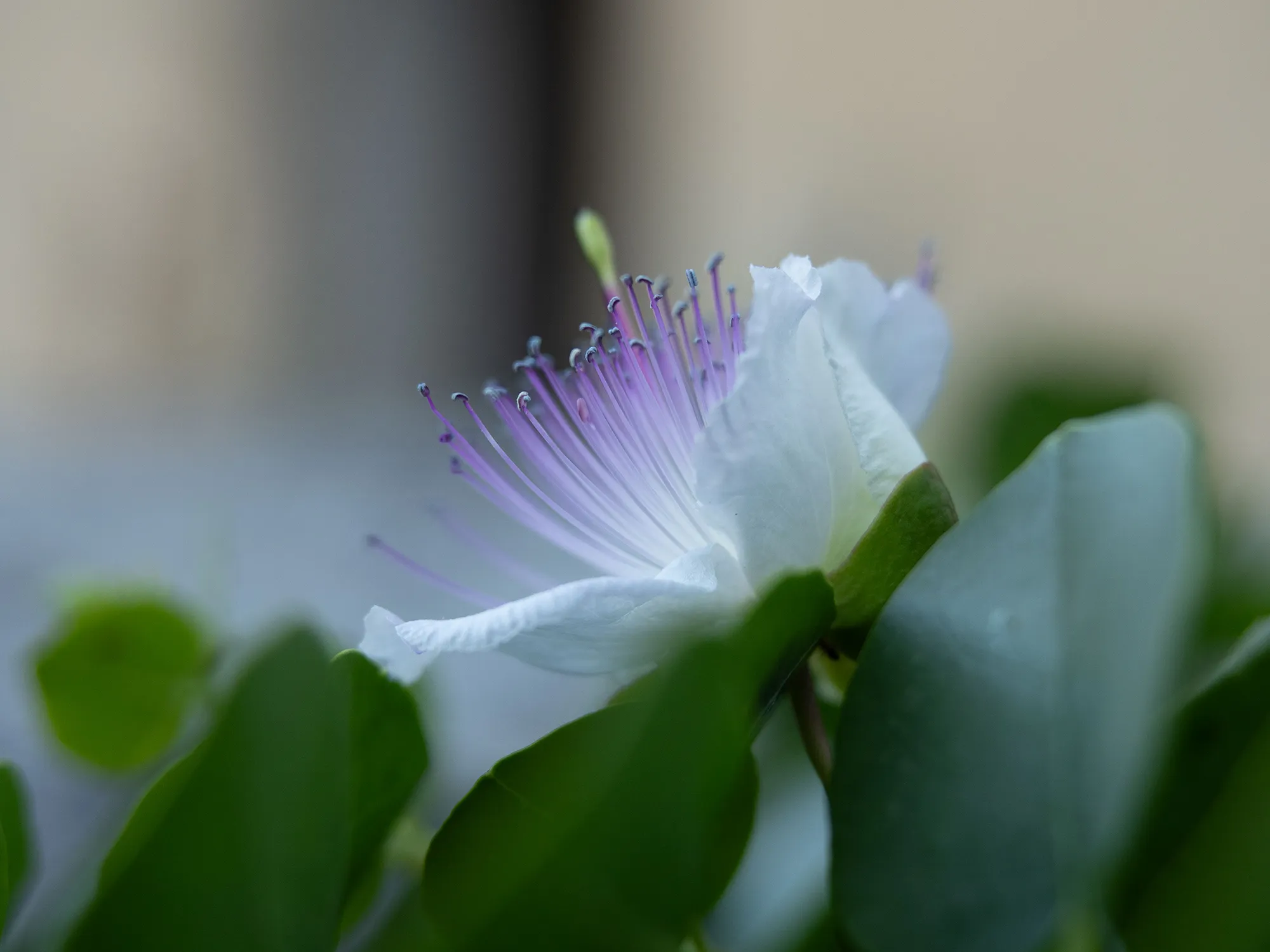
A caper flower in bloom.
The kitchen window is directly beneath us. Climb down with me into the courtyard, and let’s peer into the house. There, against the kitchen wall, is a wooden chest, painted long ago with blue flowers and red saints and now well faded. It’s Rosalia’s dowry. Inside are her linens, folded in a mix of dried lemon peel and lavender. She worked on those linens every winter night, every year, embroidering up to the year of their wedding. Nobody ever uses them.
Oh, and there she is, Rosalia, out in the garden. Like Antonino, she is active well before the sun rises above the mountains. She’s wearing a dark wool skirt, and her cotton kerchief, tied over her hair, is printed with small red flowers. She wears a tiny branch of red coral on a cord. Her mother did this, to ward off the evil eye. We can see her picking basil from the pots next to the kitchen door. She checks the tomatoes. Then she pulls a handful of wild fennel from the edge of the courtyard. That’s for tonight’s pasta.
It looks like the boys are coming. That one there, the one carrying an old double-barreled gun over his shoulder and a couple of rabbits by their hind legs, that’s Salvatore. He’s the oldest son. His gun used to belong to his grandfather. Ahead of him is his lean Cirneco, copper-colored, his big ears pricked up as he runs, fired up by the hunt.
Oh, and behind them is sixteen-year-old Pietro. He’s obsessed with rumors from the mainland. The same rumors Antonino pretends not to hear. And little Nino is already in the cistern up to his knees, chasing frogs.
Rosalia has made rabbit stewed with wine, and is serving it out on the old farm table under the grapevine. Follow me to the edge of their courtyard so you can see their dinner. The olives, the rustic bread, the fennel pasta, and those lemons cut in quarters and passed around the table. Everybody squeezes lemons on everything. It’s nights like this, when the dog is asleep under Antonino’s chair, and the air smells like orange blossoms from a neighbor’s grove, and when you can smell the damp earth from Thursday’s water, that are pure magic. Family. Now, as nighttime creeps in, the frogs begin to sing from the gebbia.
The first lemons go missing from the edge of the road.
Look at Antonino out on his morning walk. Because he knows his trees, he knows right away that three lemons near the farmhouse gate are missing. A twig is snapped. Antonino stands there for a while, observing. He knows hungry men walk this road. Laborers between jobs and boys in from the city for summer work. He doesn’t mind a hungry man needing a lemon. He fixes the gap in the stone wall where some stones have spilled over. He doesn’t mention it to Rosalia.
But a week later, Antonino finds a whole tree has been stripped up to the height a man can reach. And on the same morning, he finds two more trees, completely stripped. Whoever is stealing his lemons isn’t hungry, because hungry men don’t carry sacks.
The family discusses it at the old farmhouse table. Pietro says it’s time to go to the police. Antonino laughs at this. But it’s not a kind laugh. The police are loyal to the king in Naples. Police come out to the country to collect taxes or arrest somebody’s son.
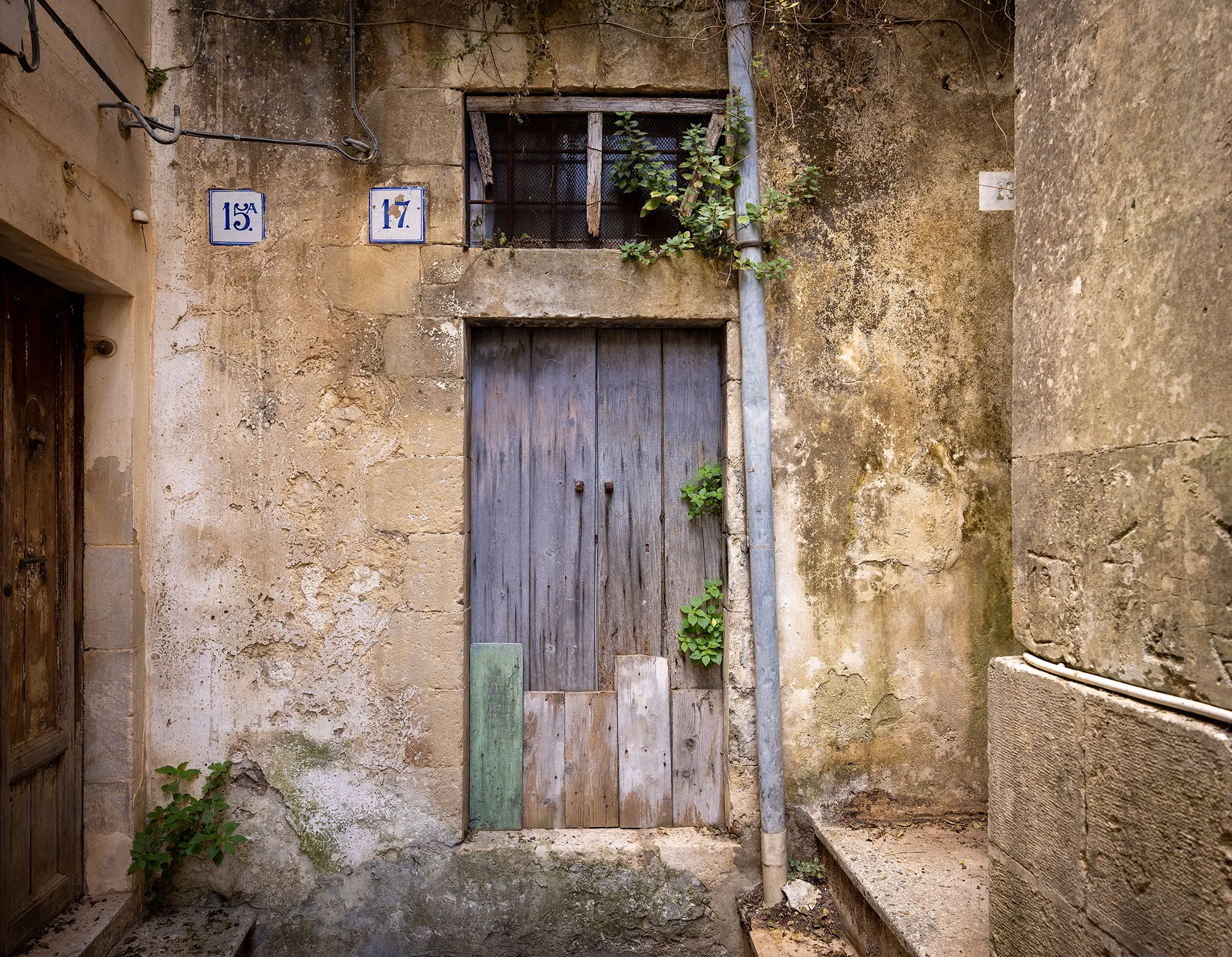
An old patched door in the back lanes of Modica Bassa.
Night Watch
They decide to keep watch.
There they are, Antonino and his three boys, sitting silently at the bottom of the grove in the dark. The old double-barreled gun is propped up against a tree, and they are sharing a jug of wine, some bread and cheese. From my vantage point here it looks like they are enjoying it. The dog is curled up between them, Antonino scratching his ears.
A lemon orchard at night is a different kind of place. The trees are black shapes against the clear summer sky. The mule has retired and the water channels go silent.
The frogs are singing as they always do, and then they stop.
And they start again, and if you’re listening closely enough, if you’re listening the way Eric Gangloff spots lizards, you’ll notice the sound one just made in the dry leaves. A scops owl is calling from the mountains. A fig drops.
An entire week goes by. Nothing happens.
And then, a couple of watches later, the dog stands up.
Its big ears forward. Absolutely still, and staring at the road. Salvatore puts his hand on the dog’s back. He feels it trembling.
Then they hear it. The crack of a branch. A whisper. Antonino stands up and shouts in the dark.
A flash and a crack — a pistol shot.
Nino is screaming. Pietro is on the ground.
All Salvatore remembers is a shape moving in the dark, and his gun kicking up against his shoulder, and every lemon and tree bright as noon.
Silence. Running feet. Pietro gets up. Nobody is hit. For one long breath, the terror is over.
But then they hear the breathing.
A man is lying under the third tree from the wall. Antonino lights the lantern and leans down by the man. Birdshot, at close range like that, does not make small holes. It’s in his throat and the side of his face, and he is breathing through it all. It’s a wet, bubbling sound that goes on and on.
His eyes are wide open. He’s a young man. In fact, he’s younger than Salvatore. He’s barefoot and a cloth sack is still wrapped around his wrist. He tries to say something to Antonino. He tries again, and then gives up. And then his breathing stops. The frogs at the gebbia, which had gone silent with the shot, begin to sing.
Nobody recognizes the young man. Soon, that will be for the best.
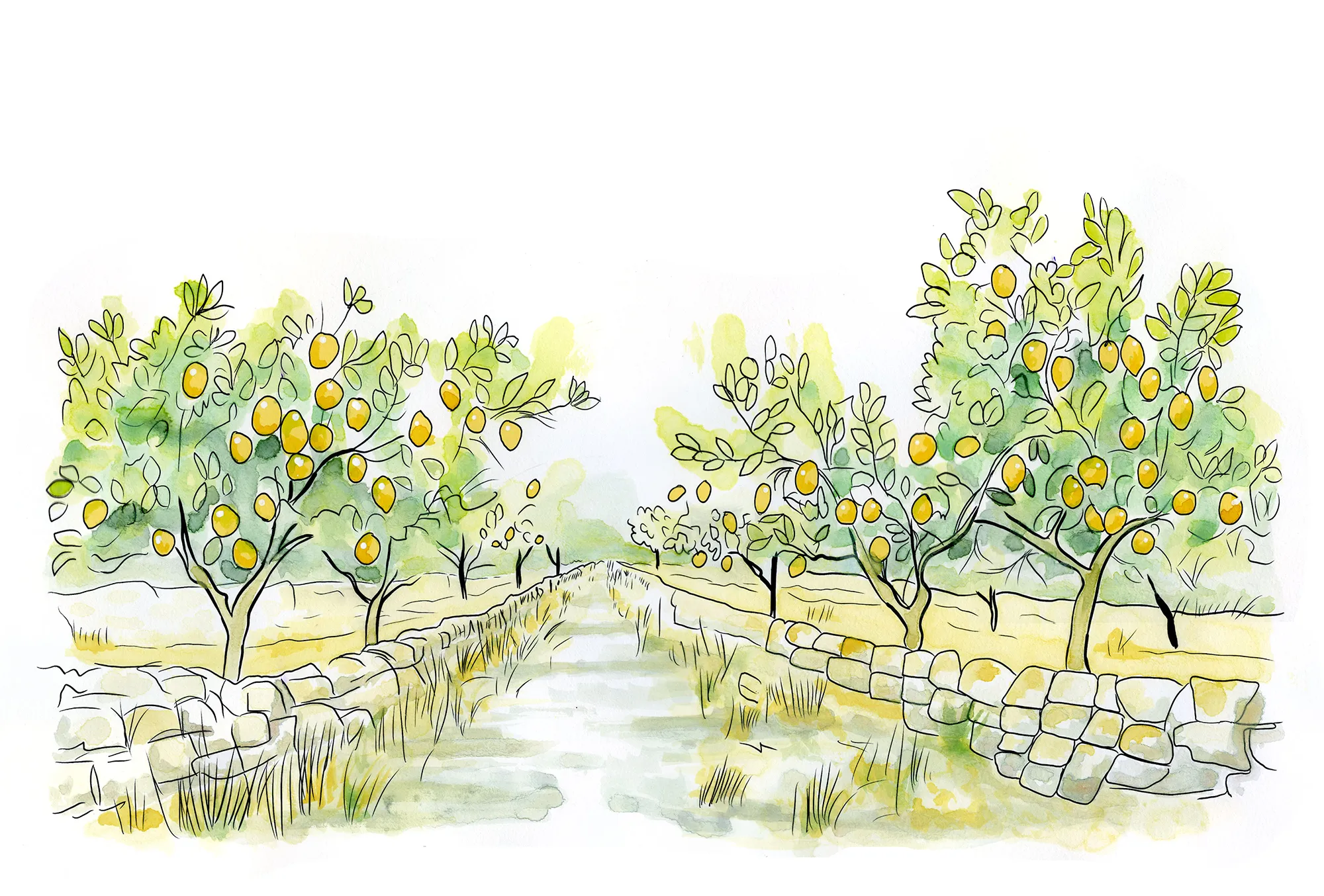
A grove of Femminello lemons in the Noto Valley, the trees hung with fruit between low dry-stone walls. Liner pen, Copic marker and watercolor washes.
All four of them sit with him, arguing in whispers. Antonino wags his finger in the air. Of course, if they go to the police, the police will come for one of them. A son will hang for a few lemons. This man had friends with him. There were others running. Antonino has to make a decision, and the way he makes decisions about water, he makes it quickly, and nobody discusses it any further. Before dawn, they load the mule cart with lemon crates. Under the crates is the man, wrapped in a sack.
Antonino and Salvatore drive the mule cart down to the Oreto, the river that flows through the Conca d’Oro and out to the sea. They put him in the water deep under the leaves. They are on their way to take the lemons to market. It’s market day, and nobody questions a cart of lemons on the way to the market.
When they get back, the pickers are already in the grove, and bees are working the blossoms. Rosalia has hung clothes to dry in the courtyard. Water is running in the channels, and the orchard looks just how it did the day before, although nobody can stand to look at it.
Salvatore stops eating with the others. He takes the dog and the gun into the hills after rabbits and comes back with nothing.
The thefts stop for a while. Then, that winter, the thefts begin again, but on the neighboring farms instead.
The Lo Cascios end up losing their entire lemon harvest. And old Ferrante, wondering why his young orange trees look so thirsty, walks out along his water channel and discovers that a whole section has been smashed to pieces. Those trees were dead two weeks later.
But this doesn’t last long, and one by one, the thefts stop on those farms too.
There are men that stand next to the gates of many of the Sclafanis’ neighbors. They are armed, and very, very polite to everybody. But it’s not clear who they work for.
When Antonino asks Ferrante about it at Mass, the old man looks at his shoes. Then he wags his finger and says, “It costs a lot less than losing your trees.” And he walks away in disgust.
In April 1860, Pietro leaves home to join the volunteer squads in the hills, awaiting the arrival of Garibaldi.
He returns home in the fall. He has fought at Milazzo. He carries a military musket. He doesn’t look at the third tree from the wall in the same way his brother does. To him, the third tree is a lesson.
By then, the Sclafanis are almost the only family on their stretch of road who still guard their own trees. The thefts come back, and this time they come only to the Sclafanis.
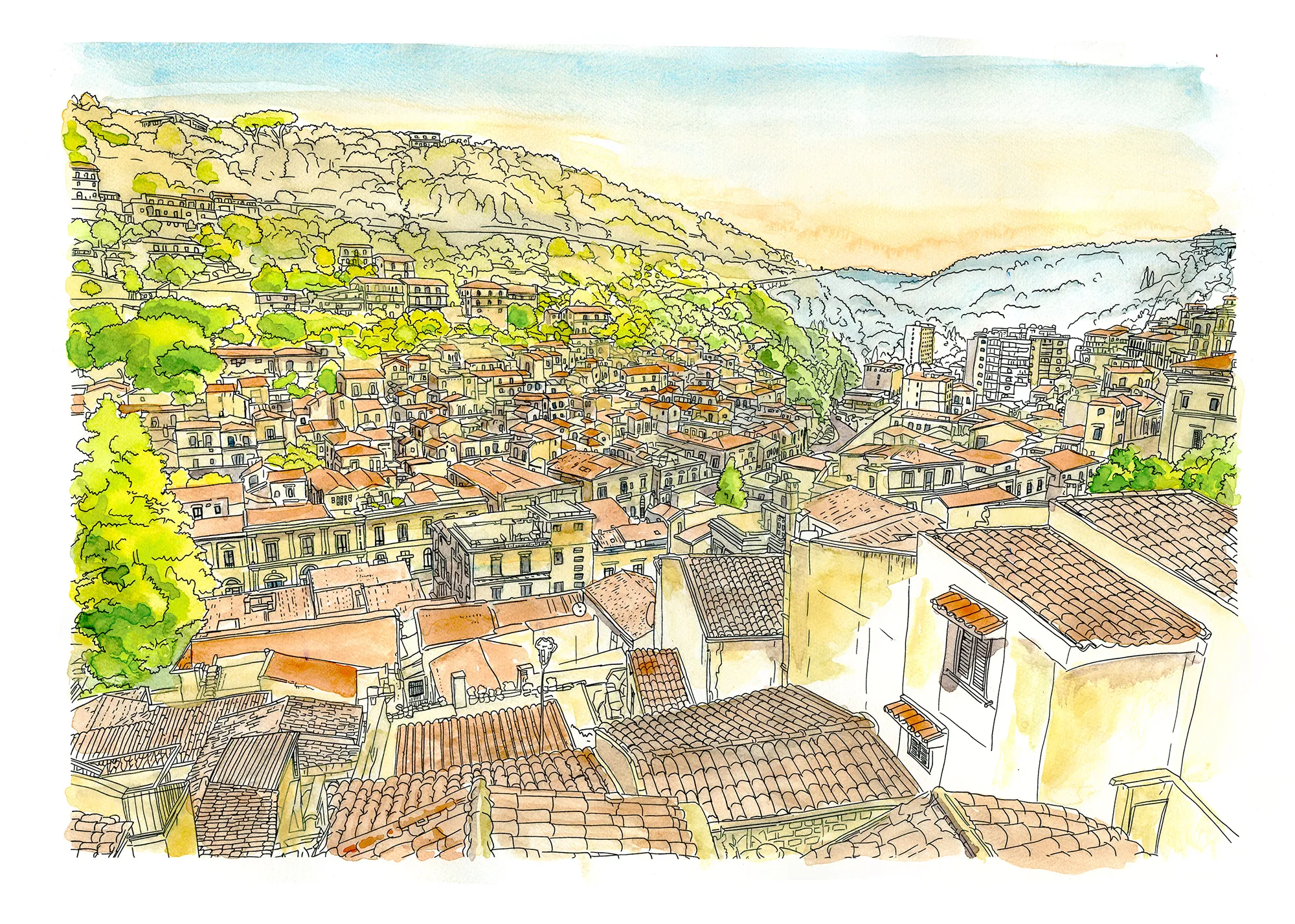
Modica Bassa from above. Black liner pen and watercolor.
Part II
Back in Modica, Iva and Ivan have settled in for breakfast on Corso Umberto, the main street.
They’ve found a cafe that serves fagottini filled with Nutella. A fagottino is a little bundle of puff pastry folded over itself like a letter. Ivan eats one with great seriousness, then a second with less seriousness.
Then we go shopping for nail polish. Iva finds her perfect bottle after testing it on her thumbnail. Then she buys two.
That afternoon we drive to Ragusa.
While Modica drapes itself on the slopes of a gorge, Ragusa goes even further. The old town, Ragusa Ibla, is built up on its own island of limestone. It’s like an ark surrounded by gorges, terraces, stone walls and steep staircases. From the road, all the domes and bell towers seem to float. I don’t think I’ve ever seen a more beautiful small city. I say so out loud.
“It’s like any other European city,” Iva says.
Ivan agrees, and he reminds me again that they grew up among old stone towns, and I have to understand that if you grow up in places like this, there is nothing special about them. He tells me the same thing he told me in Cefalù. If he were to visit the small towns of Minnesota, now that would be interesting to him.
I grew up loving places that aren’t easy to love, and finding beauty where nobody expects it is still the greatest joy I know. When I travel with people, I put all my energy into getting the people I’m with to share that joy. I take friends on what I call “yes trips”. The only rule of a yes trip is that whoever is with me has to say yes to everything I suggest. That may sound like I am trying to coerce them into doing something I want to do, but that is not true. I am working to make memories.
Iva and Ivan would excel at no trips.
Ragusa Ibla is so stunning that I can only sit at dinner through the appetizers. We decide to split up; Jane and I will walk, then take a taxi home. We follow the edge of the old town, the slopes falling away below us, everything lit by a full moon.
It’s hard to believe that the story of the Sclafanis and this evening are happening on the same island. But they are, and when we get back to Modica that night, I start to think about my Conca d’Oro.
A Visitor
The courteous man arrives in the valley in the spring of 1863.
He wears a good coat, and waits at the gate to be invited in. He is about forty years old, clean-shaven and soft-spoken. He compliments Antonino’s lemons, and asks about Rosalia’s health, and he knows about their three boys, including that the middle son fought at Milazzo. “I admire a man who defends what’s his,” he says of Pietro.
He explains that the men who protect all the neighbors could protect the Sclafanis too. It’s pretty simple. It’s pretty affordable. I mean, ask the Lo Cascios and old Ferrante, and any other family on this road. It’s just a small payment, after each harvest. The thieves will go elsewhere.
Antonino tells him that the Sclafanis protect themselves.
The man gives a look that suggests that he appreciates this answer. That it’s the right answer. He thanks Rosalia for the water she brought him. He is thoughtful, and never threatens. He simply leaves. When he closes the gate behind him, he does so with a careful precision, which Salvatore will remember about him.
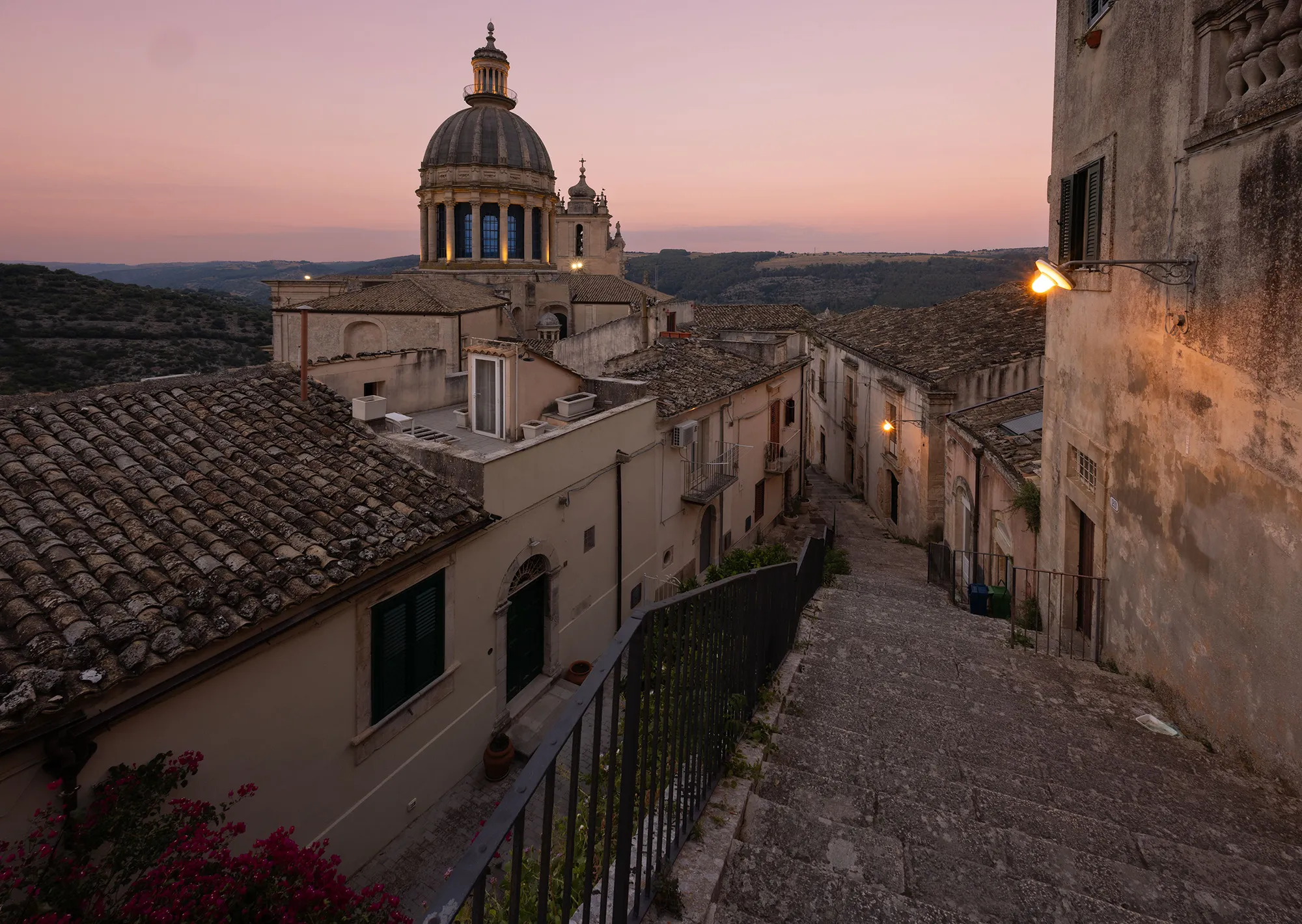
The Duomo di San Giorgio over Ragusa Ibla at dusk.
After that, the thieves come more often, but they take less.
Some nights they take nothing at all. They break branches. They knock the stones off the wall. Once they fire a shot into the farmhouse door and run.
The Sclafanis have three guns now for their night-time watches. Salvatore has his old rabbit gun. Pietro has his military musket. Nino, who is now fifteen, bought a shotgun off a shepherd and sawed it short himself. That way, when he walks in the orchard, the barrel won’t hit the low lemon branches. The shepherds call a gun like this a lupara.
Then the shooting comes. Usually, the night is quiet, just the same as it was that first night. Then a few seconds of noise and light. Pietro fires like a soldier, and Nino’s lupara goes off like a cannon, lighting up the whole grove. Salvatore is still fumbling with his old powder and cap when the men in the dark are already running away.
Nobody ever gets shot, nobody ever gets caught. Every morning after this happens, there are broken branches and lemons on the ground.
The Sclafanis are winning. They’re keeping the bandits at bay. Pietro says it plainly: “Every fight is a win for the Sclafanis.”
But the fights are not where they are losing.
That summer, there are fewer pickers. One of them has a sick mother, and another has found work closer to the city. The carter who has taken the Sclafanis’ lemons to the port for the past eleven years tells Antonino his mule is lame. But the next week, Antonino sees the same mule pulling the Lo Cascios’ crates.
The port merchant doesn’t look Antonino in the eye anymore, and while he still buys from them, it’s not at a good price. The neighbors begin to treat the Sclafanis differently. While they used to call them brave, now it’s stubborn. And at Mass, they no longer sit next to them.
Rosalia doesn’t get much sleep. Sometimes it’s no sleep at all. And the boys begin to fight amongst themselves. Pietro says he wants to shoot the thieves in broad daylight, make them pay. Salvatore is ready to start paying.
Nino sits on the courtyard step in the evenings, the shotgun across his knees, oiling the lock.
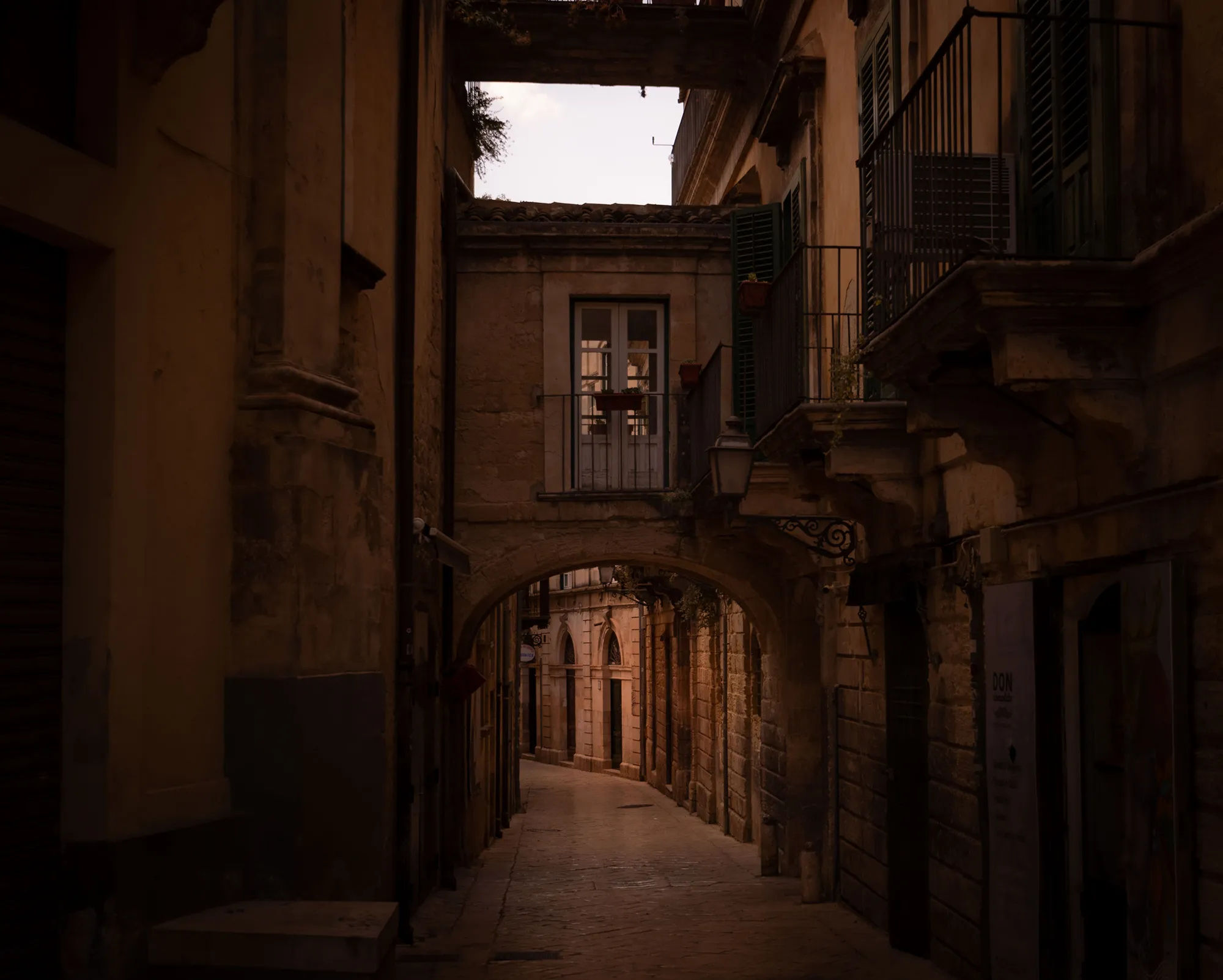
An arch beneath a covered passage in Modica, the lane running on past iron balconies into the old town.
Then, in August, the water stops.
The well and the mule wheel can keep Rosalia’s garden going. Four hundred lemon trees need the Thursday turn. On the first Thursday, Antonino opens his gate to the channel after dark and listens. Frogs. Nothing else. He’s still there at first light. The next Thursday he stays in the courtyard with the door open, and goes to bed at the morning bells without a word to Rosalia, who hasn’t slept either.
He walks up the hill to the fontaniere’s house. “Antò, what can I tell you? The springs are low. Somebody upstream is taking more than his share.” On the way home he passes the Lo Cascios’ grove. Their channels are full.
By the second week the leaves are folding along the midrib in the afternoon. They open again overnight, until one morning on the young trees by the wall they don’t. The old tree by the cistern drops its green fruit into the dry channels. The gebbia is down to cracked mud. The frogs are gone.
The courteous man comes back on a Sunday.
When the courteous man shows up, Antonino wastes no time in inviting him in. The two of them sit in the courtyard and Rosalia brings them wine without sitting down. The courteous man asks about the painted chest against the kitchen wall. It’s lovely, he says, just like the one his mother had.
Antonino and the courteous man never get into a showdown or a shouting match. Or even a disagreement. The man offers a number, and Antonino accepts it.
That Thursday, the water comes. Antonino is there waiting for the sound of a trickle, and then a gurgle. By morning, the grove smells like wet earth again.
The thieves never come back. And there is no reason to keep watch. Salvatore sleeps through the night and Pietro hangs his musket on the wall, and Nino keeps his lupara under the bed.
The Sclafanis make their payments after every harvest.
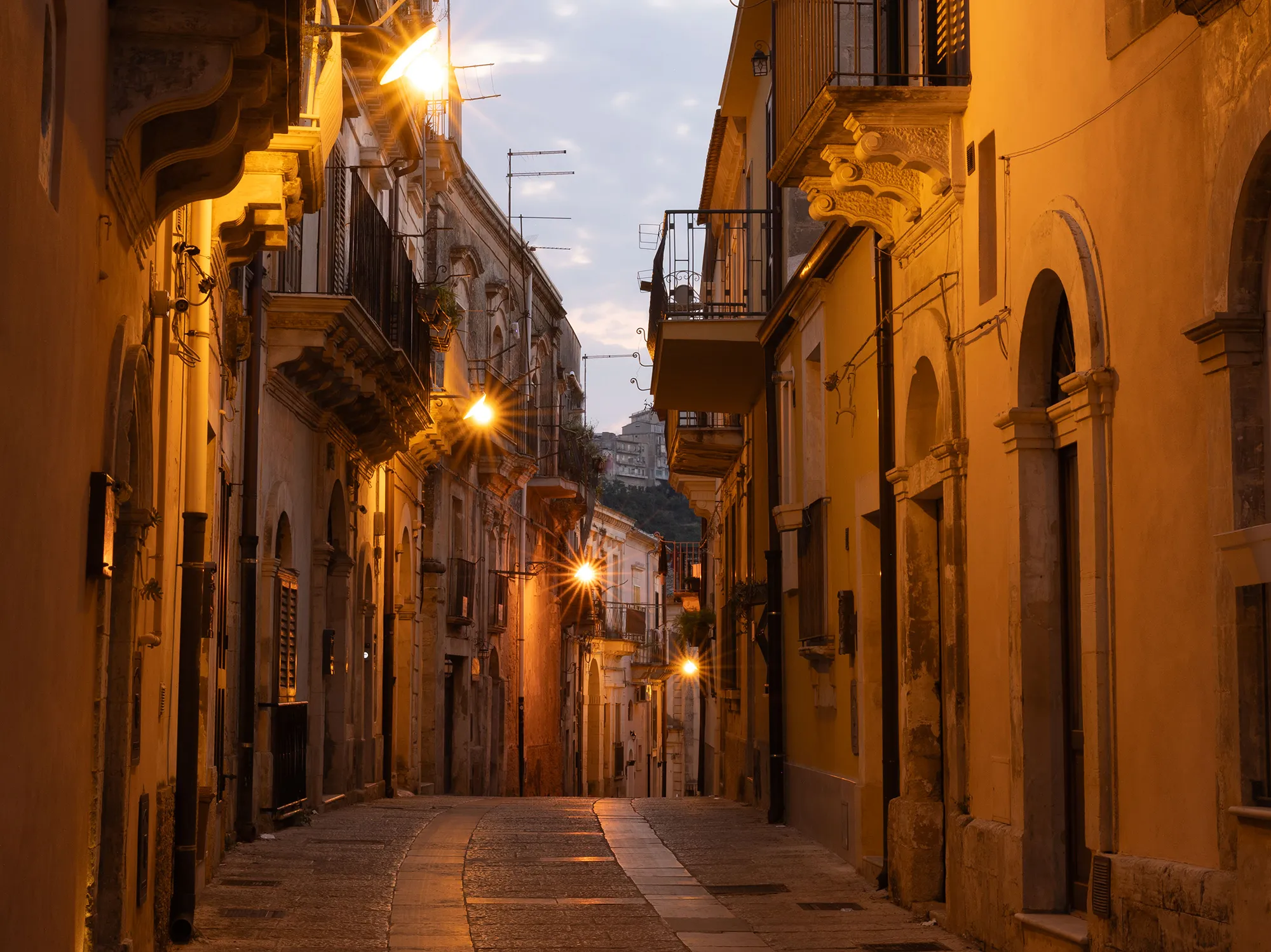
Streetlamps along an empty street in Ragusa Ibla.
By the autumn of 1882, Antonino still visits his groves every morning. But instead of walking them, he stops by the old tree at the cistern and puts his hand on it. Salvatore has taken over the farm, and his two little girls are chasing frogs in the gebbia.
A young man arrives at the gate for payment. This is someone new, because the courteous man hasn’t been on the road in years. When the Lo Cascios’ grandson had a falling out with old Ferrante’s widow, there was no need for anybody to go to the new Italian courts of Palermo, because the courteous man could take care of the dispute and get everybody back to work. The young man takes the money, asks about Antonino’s health, and leaves.
Pietro has returned home. He works for a merchant in Palermo, exporting lemons and oranges to Liverpool and New York.
Nino isn’t at supper. That’s not unusual these days, because Nino is often out.
Rosalia clears the old farm table under the vine and sees Nino out at the gate, talking to the carter, polite as can be, in new boots, with a shiny watch on a chain. He rests one hand on the gatepost, perfectly at ease.
She knows that way of standing. She saw it almost twenty years ago, when a man in a good coat waited at that same gate to be invited in.
She doesn’t call him in for supper. Instead, she goes to the painted chest, folds the clean linens in among the lavender and lemon peel, and closes the lid. Then she sits down beside it and listens to the water running in the channels.
Nobody steals another lemon from the Sclafanis, ever.
Palermo, 1872
The Sclafanis never existed. But a Palermo doctor named Gaspare Galati did.
In 1872, Galati inherited a lemon grove of about four hectares, a short walk from the city walls. His brother-in-law, the previous owner, had died of a heart attack after a string of threatening letters.
Galati studied the letters and discovered that they came from a man named Benedetto Carollo. This was the grove’s own warden, and he had been skimming a fifth of every sale. But he was also letting lemons disappear, and quietly running down the grove’s reputation. That way, he could buy it cheap. So Galati fired him and hired a new warden.
On the night of July 2, 1874, the new warden was shot dead in a lane beside the grove. The killers had built a firing platform behind a stone wall to wait for him. Then the letters started arriving at Galati’s door. When the police failed to protect him, he fled Sicily and wrote to the Minister of the Interior in Rome.
The investigation that followed gave us one of our earliest glimpses of how the citrus groves of Palermo became the incubator for the dark business that would define the next chapters of Sicily’s history.
By then it had a name. In 1863, a popular Palermo play about prison bosses, I mafiusi di la Vicaria, put the word mafiusi on stage, set in the same Vicaria prison the Sclafanis feared. Two years later, a government report from Palermo used the word mafia officially for the first time.
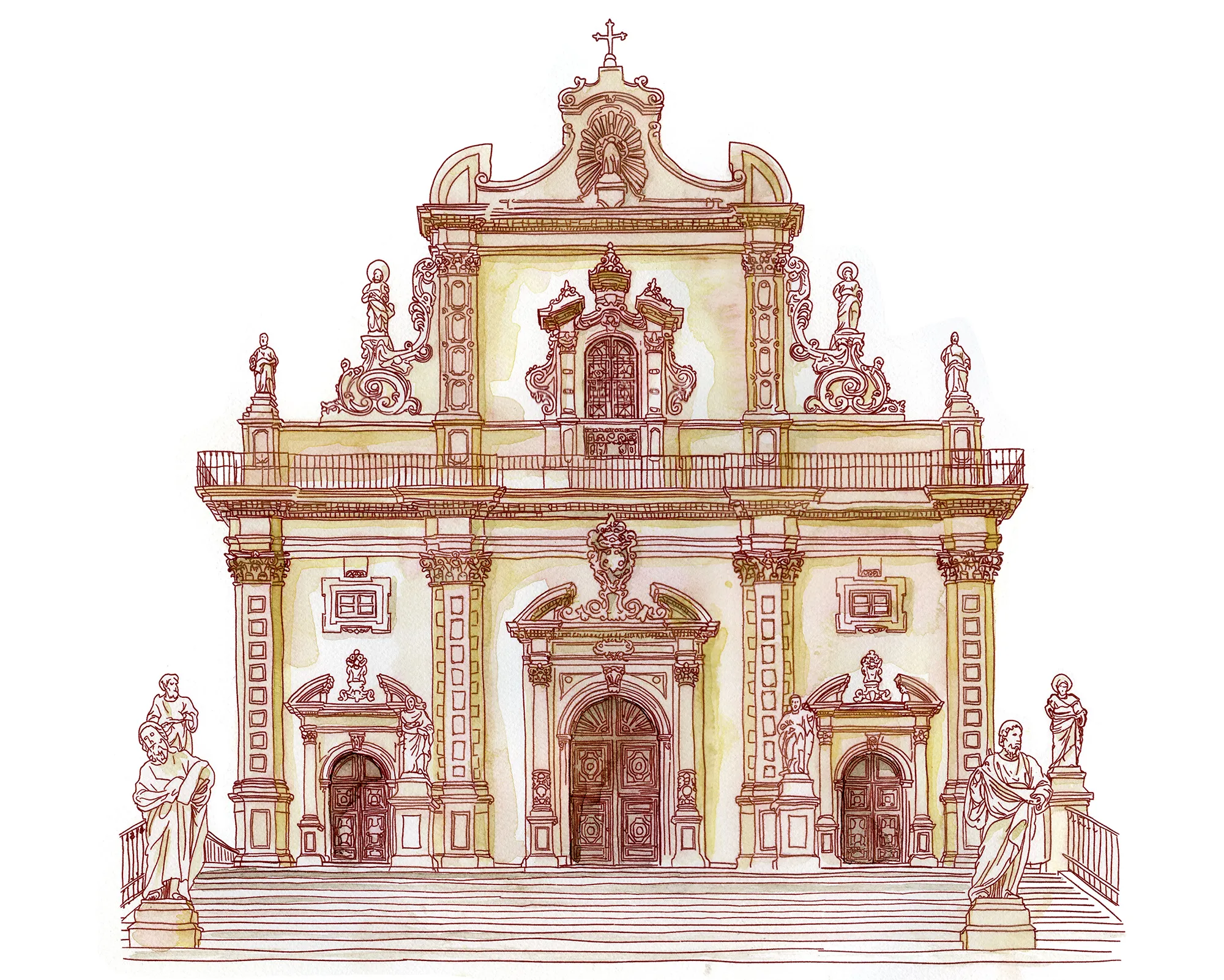
The Chiesa di San Pietro in Modica Bassa, its baroque facade the warm color of honey, with statues of the apostles standing guard over the steps. Liner pen and watercolor washes.
In 1876, Leopoldo Franchetti, a young Tuscan aristocrat, came to Sicily to see the problem for himself with his colleague Sidney Sonnino. Together, they traveled the island for months under the assumption, or perhaps the bigotry, of educated northern Italians that violence grows out of poverty. So they were looking for the origins of the Mafia in the wrong places: in the parched interior and among the wheat estates and the poverty-stricken sulfur towns.
Then they came to the edge of Palermo.
What he saw there was not misery. It was the most beautiful farmland in Europe. Orange and lemon trees, bright fruit glowing in the dark foliage. Stone walls and villas. If any place in Sicily looked peaceful, prosperous, and orderly, it was here.
But why then, pondered Franchetti, was the violence the worst here? These were the gardens of the Conca d’Oro! Wealth, not poverty, had bred it. He called it an “industry of violence.”
For more than a century, historians have followed Franchetti into those groves. Salvatore Lupo titled his history of the Mafia Il giardino degli aranci, The Garden of Oranges. John Dickie’s Cosa Nostra, perhaps the best-known English-language history of the Mafia, begins with Dr. Galati and his lemon grove.
But in 2017, three economists, Arcangelo Dimico, Alessia Isopi, and Ola Olsson, tested the idea with numbers. In the early 1880s, there was a vast parliamentary study that asked local magistrates across Sicily to describe the most common crimes in their districts. When the economists mapped the answers against the crops from each district, one crop stood out. Citrus. Not wheat or olives or vineyards. Lemons and oranges.
They traced the Mafia’s rise to the enormous surge in foreign demand for Sicilian lemons that followed once James Lind’s experiments helped convince the British Navy that citrus prevented scurvy. They called their paper “Origins of the Sicilian Mafia: The Market for Lemons.”
Lemon groves were among the most valuable farmland in all of Europe, but unlike many other crops, they were very much exposed. The fruit hangs out in the open. The trees take years to grow, and a grove can lose its value in a single night.
The Bourbon state that had ruled Sicily before was always weak in the countryside, but the new Italian state was distant, and just as weak. There were men who knew how to sell a very real product: protection.
The sociologist Diego Gambetta has argued that this is what the Mafia fundamentally is: a business that sells protection.
The genius of the Mafia is that it can manufacture the demand for its own product. The economist Oriana Bandiera studied why the Mafia spread like it did. When land was divided among many small owners, each grower who paid for protection pushed the thieves onto neighbors who hadn’t.
The Citrus Kingdom has been a story of human ingenuity. Arab engineers who taught a valley to hold water. Gardeners who grafted a citron onto a sour orange. A colonel who spent five years on two hundred grafts to make a lemon ripen early. And those growers who learned to starve a Femminello so it could flower in summer, when profits were highest. All of this was ingenuity that was rewarded by the extraordinary value of citrus.
In the same groves, under the same trees, men discovered that the threat of violence could be harvested like fruit. So the Mafia was ingenuity too.
There were other industries in Sicily where the Mafia flourished. The sulfur mines of the interior for example, where there was sudden wealth in places that couldn’t be protected by the state. But, it turns out, lemons and oranges in the groves around Palermo were by far the fullest breeding ground for the Mafia.
Even the Mafia’s favorite gun, the lupara used by Nino, came from the countryside. The gun became so closely tied to the Mafia that a Mafia killing came to be called simply morto di lupara.
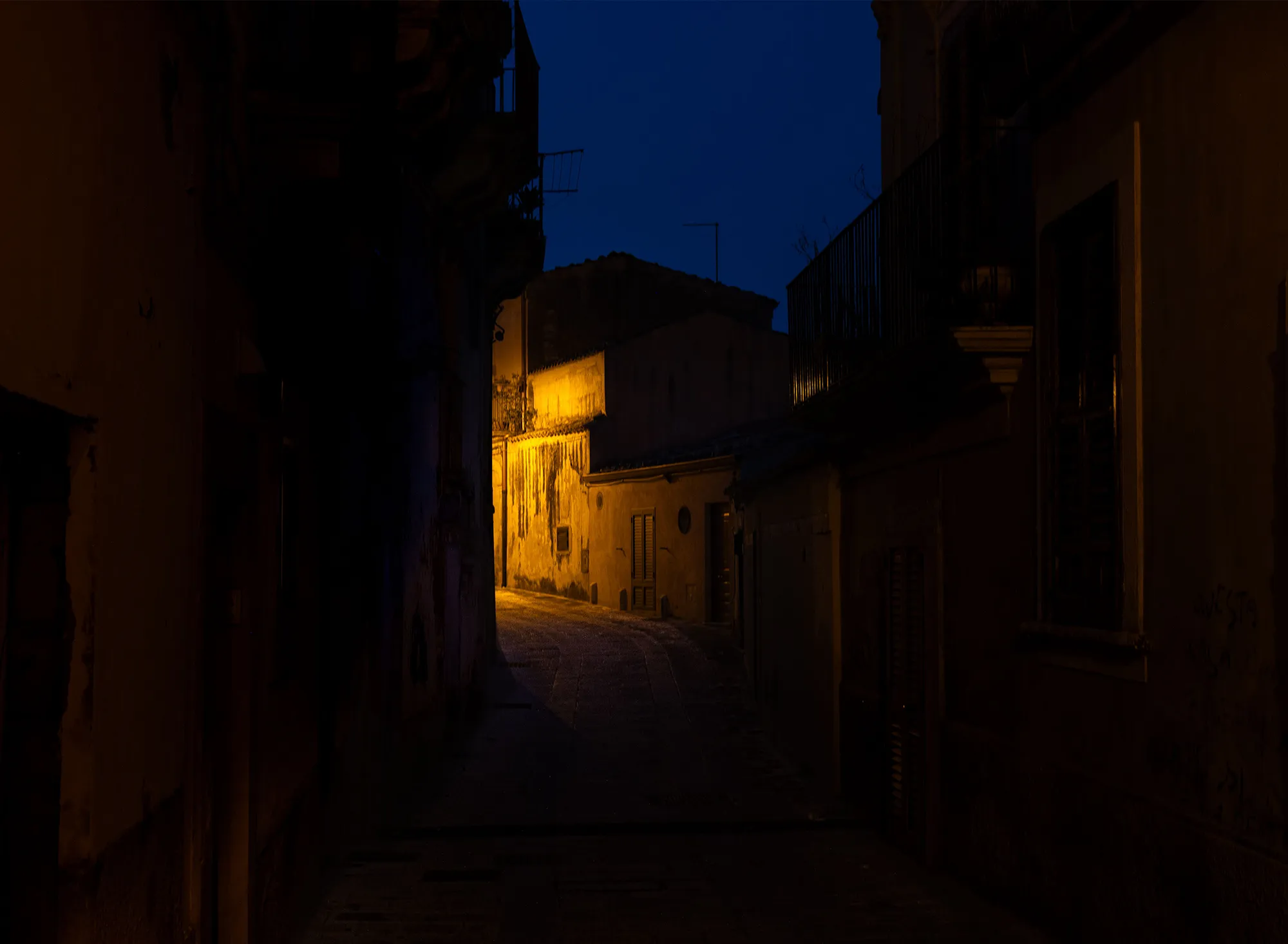
An alley in Ragusa Ibla at night.
Leaving Modica
In the morning, I meet Jane, Iva, and Ivan at the rental car.
Iva is standing beside the driver’s door with her arms folded. She is holding two empty bottles of nail polish.
I look at the scrape. Then I look at it again.
The free paint job the couple coaxed out of a mechanic in Marzamemi had dried like a dull white bandage on a glossy white car. Iva’s theory is simple. The repair didn’t look wrong because of the color, but because it didn’t shine. Car paint shines. Nail polish shines. Therefore, nail polish.
So she has painted the entire repair with clear nail polish. It turns out that she wasn’t looking for just any clear nail polish, but the kind with a little purple glitter.
In the morning sun, the scrape glitters. It catches the light from thirty feet away. It’s still a dull patch on a rental car. Now it’s a dull patch on a rental car in evening wear.
“Better,” Iva says.
It is lipstick on a pig. Sparkly lipstick.
We leave Modica, and Iva insists on driving.
And to be honest, Iva has a right to drive the car now. It’s sort of even hers. She is the one who restored it. The panel sparkles in the sun as we make our way out of the gorge.
As we climb toward the plateau, the Sclafanis are still on my mind, and I tell Jane that this area, the area that looks most like the international depiction of the island, is the place that held out against the Mafia the longest.
This area, the Ragusa province, was called the provincia babba, the naive province, for most of the twentieth century. In addition to growing carobs and almonds, Ragusa grew lemons and oranges too. But there was something about the province that made it almost immune to the Mafia. Nobody has figured out exactly what, but there are many theories. Some people think it’s because the farms were smaller, or that the towns had their own strong local institutions. Some people believe it was the aftereffects of the earthquake of 1693, which gave these cities newer and fresher arrangements of land and power.
Which of those is true, I have no idea. But what I can say is that the Mafia grew in particular conditions, in a particular place, and only much later did it reach this corner of Sicily. The province isn’t so naive anymore.
But the place where it was born is the place our whole trip began.
I keep thinking about Palermo’s Conca d’Oro. It was as close to paradise as Sicily ever built.
On that first night in Taormina, a man on his balcony told me that the history of Sicily and citrus is the history of water, and who controls it. Now I know who controlled it, at least for a while. I don’t yet know what they did with it.
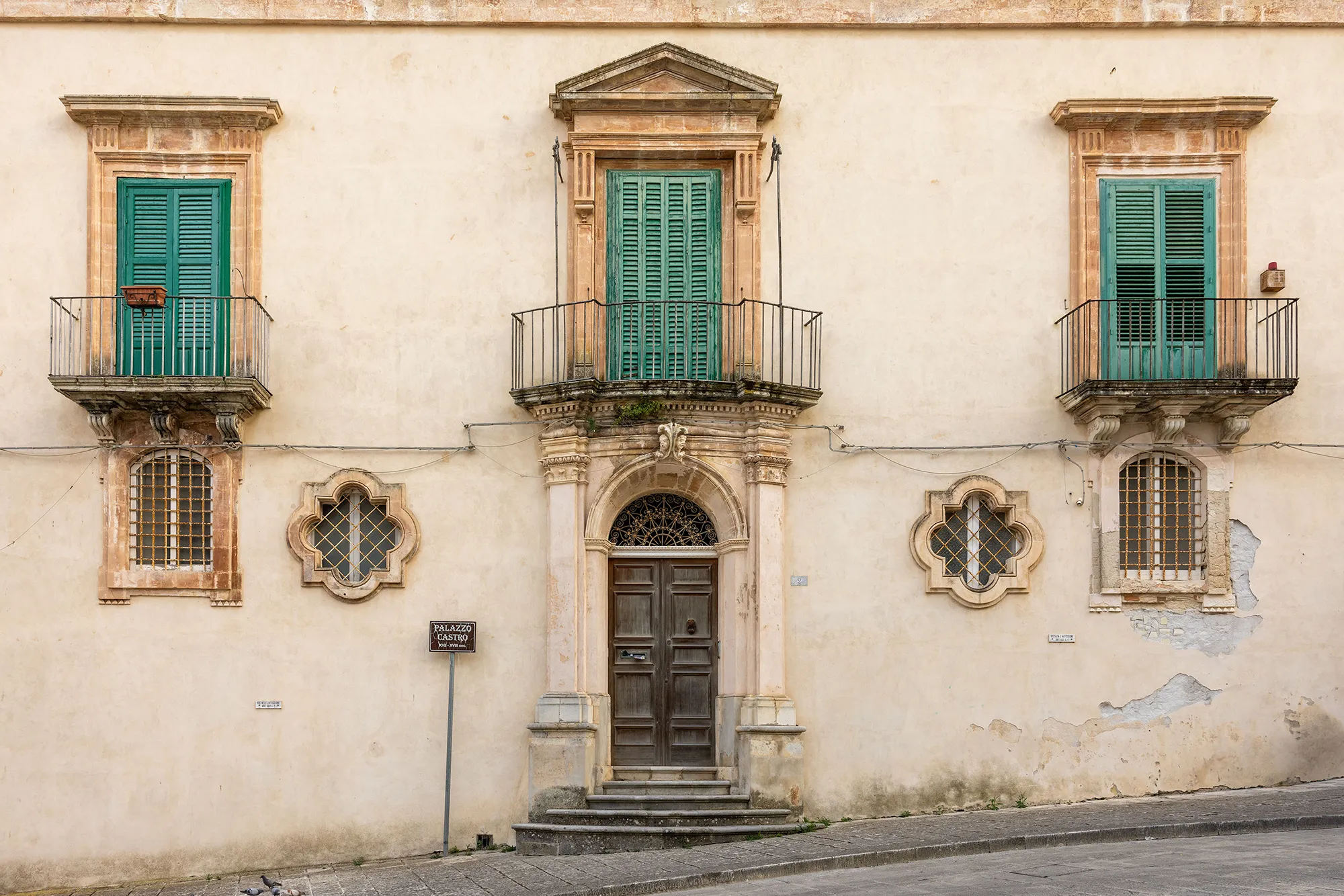
A palazzo in Ragusa Ibla, its teal shutters set in carved honey-colored stone above a grand wooden door.
The road curves ahead of us, and suddenly, there it is. The city of Ragusa in the morning sun. Its historic center is balanced on an island of limestone, stacked on the spine of a rock like the dreams of a fantasy illustrator.
Iva gasps. She actually slows the car.
“Look at that,” she says. She is awestruck by the magical city of honey limestone houses hanging off the ledges of every mesa.
“That’s Ragusa,” I say.
“No.”
“That’s Ragusa. We were there yesterday. You said it was like any other European city.”
“That is not the city we went to yesterday.”
“It’s the same city. That’s Ragusa Ibla right there.”
Iva shakes her head, eyes on the road, absolutely certain. “You are trying to trick me,” she says. “This is a different city.”
Ivan, in the passenger seat, studies the view and says nothing at all.
I have a theory about Iva, and it begins with Eurocrem.
When Iva was a girl in communist Yugoslavia, before Nutella reached her corner of the world, there was Eurocrem, made in a factory in Serbia under license from an Italian company and sold in every shop from Slovenia to Macedonia.
It came in two styles. One was a spread, but the other was a bar called Eurocrem Blok. Its defining feature was that it came in two colors, side by side. A dark brown half of cocoa. A pale half of hazelnut and milk. Some kids preferred one half over the other, and sometimes they argued about which half was better. But the two sides never mixed.
Iva wanted Eurocrem the way the British Navy wanted lemons. When she wanted it, she found a way to get it.
Consider the evidence. In Oregon, Iva informed me that Nutella cannot be mixed with anything else. Nutella is Nutella. On this trip, a matte white repair could not be allowed to sit beside glossy white factory paint; the two halves had to match, and if paint couldn’t do it, nail polish would. And this morning, a city that Iva had decided was boring could not also be the most beautiful city she has ever seen. Those are two different halves. They cannot be the same bar.
So it must be a different city.
I know, I know. History never has a single cause. It wasn’t lemons alone, or weak government alone, or land alone. I stand by every word of that.
But Iva is not history. Iva is Eurocrem.
She drives on toward Palermo with both hands on the wheel, the repair glittering beside her like a brooch, completely untroubled. Behind us, the most beautiful city she has ever seen, which is not Ragusa, slides out of view.