Vendicari and the Citrus Before Time
Notes on the wetlands of Vendicari and the long stretch of time before Sicily had citrus at all.
October 3, 2026
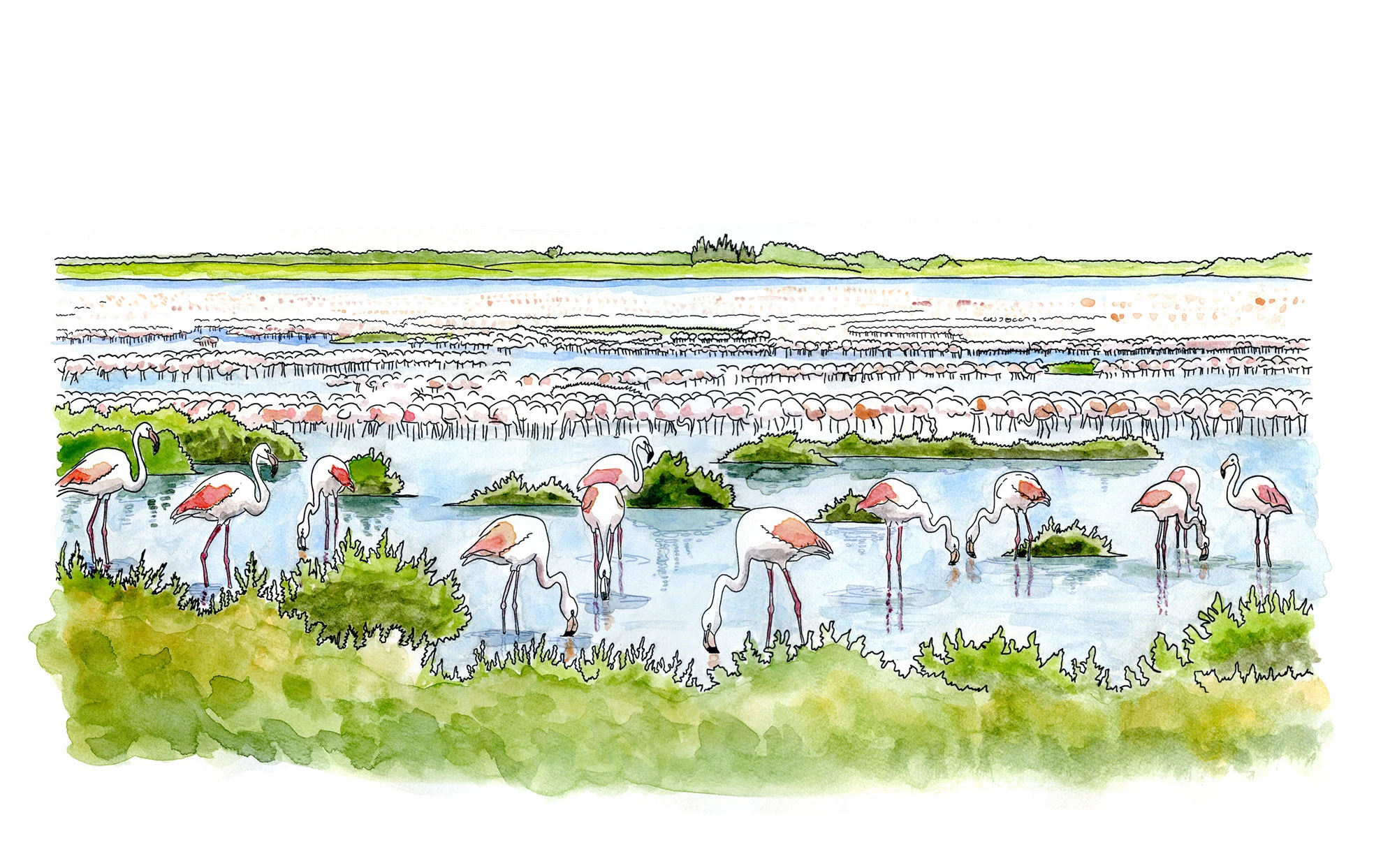
Greater flamingos in the lagoons of Vendicari Nature Reserve. Black liner pen and watercolor.
Along the Ionian coast, in the far southeastern corner of Sicily, is the Riserva naturale orientata Oasi Faunistica di Vendicari. It’s a thin strip of coastal salt pans, shallow lagoons, sand and Mediterranean scrub.
I slip out long before Jane, Iva and Ivan wake, getting a lift from our apartment host and heading out toward the coastal lagoon trails by sunrise.
There are towering tamarisks here, and dwarf palms, and miles of sedges and reeds. Glasswort grows at the edges of the water. Since so much of Vendicari is low vegetation, the sky and the blue sea beyond hold most of the weight.
I walk out to the largest lagoon, which is nestled between the beach and rolling hills, and when I get there I am floored by the flamingos. Are there 10,000 here? They stretch out so far, they are just strokes of pink and white. At the shoreline edge, Black-winged Stilts pick along the shallows, and herons move between the reeds. Vendicari is a key stopover for birds, who’ve been dropping out of the sky to rest here on their journeys north and south for thousands of years.
Everywhere else you go in Sicily, the mark of man is ever-present. Every hill is terraced, every valley is stitched with roads and buildings, and wild plants have been replaced by orchards and vineyards. Just about everywhere in Sicily has been rearranged for man. It’s surprising to learn how much of it was rearranged for citrus and other fruit.
Vendicari is one of the few places in Sicily that is largely untouched, still left to the wind and the salt and the birds.
It is a good place to think about citrus before we started arranging it to suit us.
A Dragonfly with the Wrong Name
When I continue on to a series of tidal pools, I see a Southern Migrant Hawker patrolling above the vegetation. It’s a big blue-eyed dragonfly that occasionally freezes in midair, hangs there for just a moment, and then zips away.
Its name is a little misleading here. Aeshna affinis is a Mediterranean insect, and it’s native to places that are just like this all across its range. It loves these sun-warmed pools that start to dry up by August — perfect breeding habitat. Here in southeastern Sicily, this dragonfly is simply a resident.
Its name comes not from what it does here in its native home, but from what it’s doing fifteen hundred miles north. In a warming Europe, the Southern Migrant Hawker is colonizing further north. It’s moved into Germany and the Netherlands. And now, even England.
We often look at the case of a single, thriving animal as a sign that everything is okay in the world. But as this hawker has expanded its range, on the same continent and during the same warming years, insects have been plummeting. A long-running study in German nature reserves found that flying insects had declined by more than three-quarters in under three decades, a rate of decline that is alarming to anyone studying insects. It is one of the earliest unequivocal signs that our biodiversity is plummeting faster than we can measure it.
I went looking for small insects last year, on a river road in Costa Rica, and found that they are the infrastructure everything else is standing on. One winner is not a healthy world. Abundance is not the same as diversity.
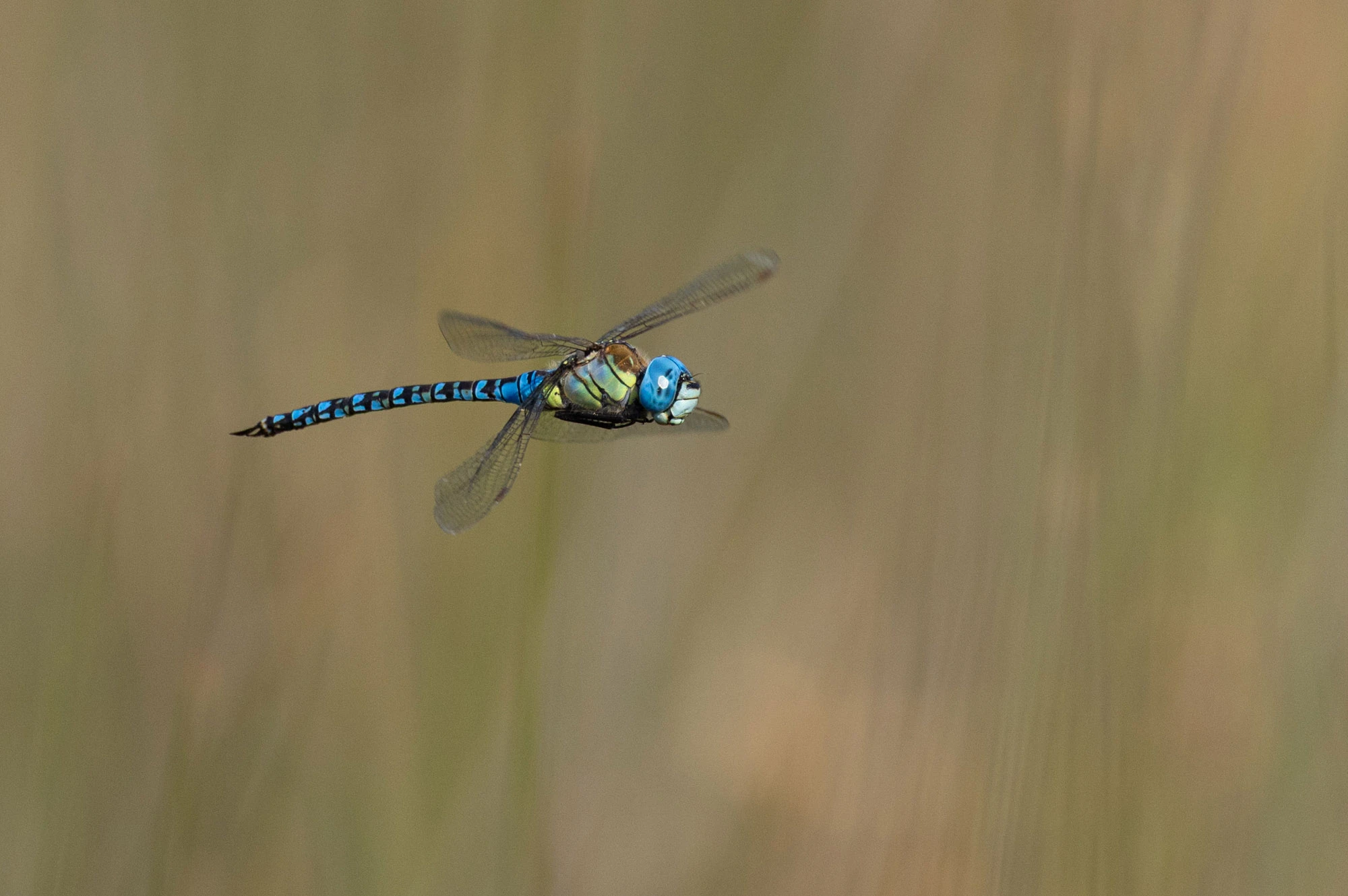
A Southern Migrant Hawker at Vendicari, Sicily.
Everything Arrives
Things have always been arriving in Sicily. They arrive on wings and in storms. Seeds arrive inside birds. Plants cross seas slowly and animals cross them quickly.
But of course, humans accelerated the process. The same ships that carried pottery, gods and soldiers also carried seeds and stowaways. Citrus came to Sicily that way.
But the citron that reached this island from India had its own migration story, and its own origin story, that preceded its Sicily history by millennia. To find where it started, you have to go several thousand miles east, to the mountains where China, Myanmar and northeastern India meet, and back about eight million years.
Eight Million Years in Yunnan
In Lincang, in Yunnan Province, someone split open a rock and found a leaf. It belonged to a citrus tree, Citrus linczangensis, and it is the oldest one we have. If we are to understand the citrus in Sicily, and by that I mean if we are to understand the history of Sicily, we have to recreate the world where that citrus tree grew.
Of course, we can only guess at that world. But through the records we do have of it, we can try to recreate it. Will you join me, and travel back in time with me?
Arriving there in the Late Miocene world of Yunnan, China, we would find a landscape that is both warm and dripping wet. Imagine rivers winding through lush green valleys that collect in shallow lowland lakes.
Perhaps we are in a mid-elevation clearing, where enough light peers through the canopy that it forms a cloudy shaft of white light in the forest behind us. We are peering out over the ledge of a steep mountainous grade. Across the chasm, we can see evergreen forests climbing up every slope.
And wait just a minute, what is this? Citrus trees nestled in the explosion of green.
We have found what we were looking for, that citrus. It’s hard to imagine what its fruit looks like, because the fruit is absent from the fossil record, but perhaps it is a grape-sized fruit, pale yellow and superficially resembling an unripe kumquat.
This part is easy to imagine, because it’s in the fossil record of other leaves from this region. We lean in and pull a branch closer, to examine the leaves.
The first thing we might notice is that there are holes chewed straight through the leaves. The edges are bitten off, and larvae have fed on the leaf, tunneling through its interior. There are also little insect galls, tiny swellings where little psyllid bugs have tricked the leaf with chemicals into building a house for them. That chemical conversation is the beginning of what will make citrus taste and smell the way they do. Sunkist, Orange Starbursts and Dreamsicles, if only you knew your origin story.
Look carefully around you. On one trunk, there is a dragon, clinging with its head held high. It's an agamid lizard, green as the leaves, with a low crest running down its spine. Spines ring its eye. When it raises its head, the skin of its throat opens into a flash of orange and pale blue, for the ladies, and then folds shut again. Color can entice, but also provoke attention.
It sits there, completely silent, completely motionless, until a beetle crosses the leaf next to it. Then it’s gone.
Higher up in the understory, a pheasant glides into view. It’s extravagant, with a copper-colored back and black wings marked with cream. Its throat shimmers blue-green when it catches that misty light. When it lands awkwardly in the leaf litter, it begins scratching through fallen leaves. It’s looking for anything its generalist stomach can take: seeds, insects, the fruit that fell in the night.
And there are bigger creatures here than the pheasants. Perhaps it’s a large ape, shaking the branches as it moves through the canopy.
It’s a Lufengpithecus ape, and we are shocked that such a substantial primate can manage the upper stories of the forest. Its face, with its powerful jaws, is vaguely familiar, but unlike any modern ape. It’s hunting for high-elevation fruits.
Perhaps we are watching it as it finds a cluster of ripe fruits above us, feasting, and knocking a few off their branches. They come tumbling to the ground with a dull knock, rolling until they nestle underneath an island of ferns. Perhaps another animal will find them.
How a Tree Learns to Travel
Fruit gives a rooted plant a way to move.
An animal is attracted to the sweet taste or scent, and eats it, carrying the seeds in its tummy until it’s poop time. A bird might swallow a small fruit and cross a ridge. A mammal might defecate in a river, sending the seed downstream. Over thousands of generations, fruits allow trees to wander. But also over thousands of generations, those journeys begin to separate populations.
Each citrus population faces a different environment. One is in a wetter valley, another at higher elevation. The insects between each ridge and valley are different, as are the fungi, and the birds and mammals that feed on them. In one place, a thicker peel helps keep the beetles out. In another, stronger oils or acidity provide some advantage.
Climate is changing around them too. The Asian monsoon that was so prevalent in the early fossil record of citrus will weaken over time. In response, the forests will become more seasonal. And over millions of years, habitats will fragment, and populations that were once isolated will reconnect. The cooling of the Earth, the same cooling that may have helped kill off the last of the Lufengpithecus apes, would become instrumental in shaping a world that would diversify citrus into thousands of wild forms.
Climate makes the citrus and unmakes the ape.
Eight million years before anyone grafts a mandarin to a pomelo, citrus is already setting its terms.
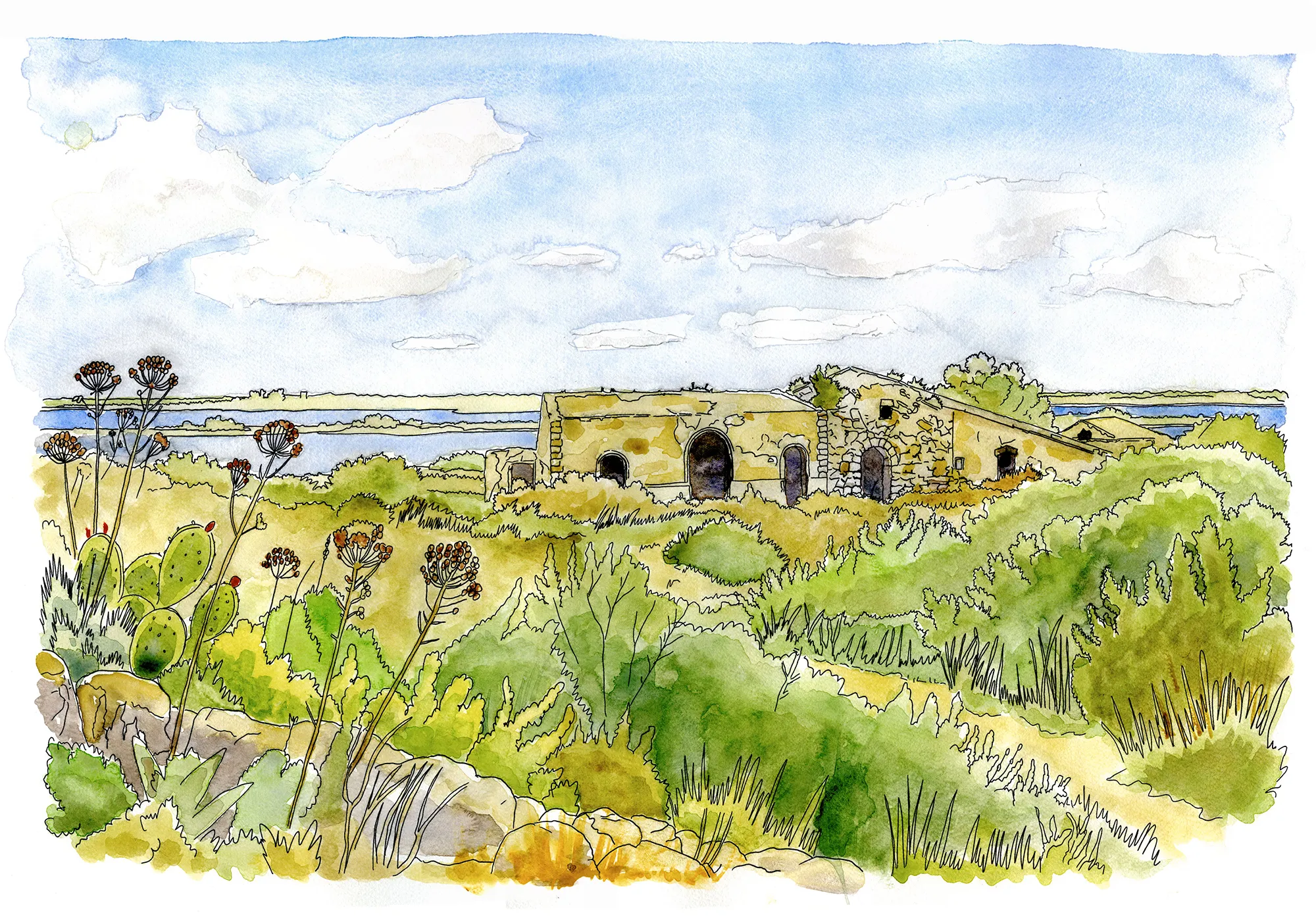
The Trigona, a sixth-century Byzantine monument in the Cittadella dei Maccari, Vendicari. Black liner pen and watercolor.
The Citrus We Lost
Sitting here in our imaginary view of a Yunnan forest, we are privy to only this single species, but in the last 8 million years, an unimaginable number of citrus fruits came into existence. Some were tiny and clustered, while others were green when ripe. Was there, at one time, a citrus fruit that tasted a little like the grape bubblegum of our youth?
We’ll never know. But it’s important to consider and imagine that their aromas may have ranged from floral to resinous to sharply pungent, including scents that, had they somehow survived the evolutionary game of roulette, may have ended up in our perfumes, desserts or color palettes.
Imagine that most branches of the citrus family disappeared long ago, as forests dried or their favored pollinators went extinct. The species that survive today are just fragments of a galactic evolutionary world.
Let’s leave those Yunnan mountains and return to your kitchen. Let’s crush that citrus leaf. Let’s crumble that white citrus flower in our palm. Let’s mandoline the zest off that lemon, watching those droplets of oil ooze from the skin.
Where did these aromas come from? Why do they exist?
It’s not easy to imagine, but that lemon perfume may have started as some chemical that warded off insects, or even slowed the creep of a fungus.
Or it may have been a scent that held its strength in the wind, luring in pollinating butterflies and bats.
Which came first, and which ultimately gave us the smells we know? I can't say. But I do know that some of those aromas were almost certainly aimed at our lizard and our pheasant, and that ape too. That sweet aroma would mean the citrus would get its seeds carried far from its mother tree.
Almost everything about citrus was an eight-million-year negotiation with the forest and its creatures.
Four Wild Ancestors
There are still plenty of wild citrus plants out there, survivors of the long arc of time. Many of them are inedible, others are obscure enough to be used in regional cooking, but never grown commercially. Some may grow in a single valley, and are still unknown to botanists.
One we already know: the citron, the strange old fruit that began this story in Palermo. Not only was the citron the first citrus to establish a foothold in Sicily, but it was an actual wild fruit. Not a dog, but a wolf.
Another will be more familiar to you, and you may have always assumed it was something cultivated from something else. But that small, soft, loose-skinned fruit that packs a punch of sweetness, the mandarin, is a wild fruit.
And while the mandarin is small, the pomelo is immense, and it often grows bigger than a human head. It features a thick rind wrapped around huge segments of pale pink flesh. This fruit, which you can sometimes find at the grocery store, is also a wild fruit.
A fourth one is less known. It’s the Small-flowered Papeda. It’s quite small, and its intense aroma evolved on the islands of the Philippines, where in the extreme south it continues to be used to acidify kinilaw, the Filipino ceviche. It may be less known than the other three, but it is critical; its genetics are behind many of our modern limes.
Many oil and watercolor painters believe you only need a limited palette of pigments to create any color. The artist Anders Zorn, for example, developed his Zorn palette: yellow ochre, vermilion, ivory black and lead white. Four colors to paint everything.
And all of man’s citrus comes from just four lineages. The citron, the mandarin, the pomelo and the papeda spent millions of years drifting apart. Man began to paint with them.
The Citrus Equations
Nobody knows when farmers first crossed a mandarin with a pomelo, probably somewhere in southern China about 3,000 years ago, but that cross became the bitter and fragrant fruit we talked about in Cefalù — the sour orange — the tree that would hold up the entire island’s economy.
Mandarin + pomelo = sour orange.
But Asian farmers continued to tinker with cultivated mandarins and sour orange. My peelable sun came into being when Chinese farmers re-crossed the mandarin and the pomelo.
Cultivated mandarin + pomelo = sweet orange.
The citron shows up next, and it’s critical. Somewhere far from China, perhaps in Persia or the eastern Mediterranean, someone crossed a citron with a sour orange. So a lemon, then, carries three lineages of ancient wild citrus.
Citron + sour orange = lemon
Or, citron + (mandarin + pomelo) = lemon
One of the great crosses in citrus actually happened in the Caribbean, during the age of pirates and plunder. In Barbados, in the 1700s, pollen from a sweet orange fertilized a pomelo flower. It was not due to human tinkering or grafting, but a happy wild accident.
The fruit was later named for the way it hangs together in large clusters, like grapes.
Sweet orange + pomelo = grapefruit
The limes are stranger still. The little Key lime is citron crossed with that severe papeda, micrantha.
So those little margarita limes?
Citron + papeda = Key lime
And then a lemon crossed with a Key lime is the fruit that is grown widely in places like Mexico and Southeast Asia. The Persian lime, the Tahiti lime, or as we call it in the United States, the lime.
Key lime + lemon = Persian lime
Or
(Citron + papeda) + (citron + mandarin + pomelo) = Persian lime.
You were brave to travel with me to the slopes of ancient Yunnan, so I’ve made you a cocktail to celebrate our safe return. How about a caipirinha with a lime wedge on the glass?
Wait just a minute before you squeeze that lime! It is citron plus papeda plus mandarin plus pomelo. That makes it the amalgamation of all wild citrus lineages used by mankind. Cheers to eight million years of separate evolution brought together.
A clementine is a mandarin that’s been crossed with a sweet orange. So you can think about it like this:
Mandarin + sweet orange = clementine
Or
Mandarin + (cultivated mandarin + pomelo) = clementine
Some citrus we know less about. The most dangerous and wonderful of all, the bergamot, is a mystery. But we believe it is more or less:
Citron + mandarin + pomelo = bergamot
And those yellow-orange sweet lemons?
Citron + mandarin + pomelo = Meyer lemon.
So, the more citrus we create, the more likely they are going to be reshuffled combinations of the same four ancestors.
Mutations and Grafts
But we’ve already learned on Mount Etna that not all change comes from interbreeding ancient cousins.
The blood orange did not come from a new cross at all. It came from a sweet orange that mutated, a switch turned on inside the fruit that let it hoard red pigment.
Sicily’s mountain oranges, the Tarocco, the Moro and the Sanguinello, are sweet oranges that carry that switch, and the cold Etna nights flip it on, so they bleed red juice. The navel orange is a mutation too. It’s a seedless sweet orange with a second small fruit budding at its blossom end.
So Sicily’s Citrus Kingdom was built in two different ways. Hybridization kept shuffling the four ancient citruses into new fruits. And mutation altered the fruits that resulted. Add grafting to the mix and you let people freeze and keep what they liked; otherwise most of these accidents and experiments would never have survived a generation.
In Lipari we learned about a retired colonel who spent five years grafting citron, sour orange and lemon into a new fruit. He believed he was inventing something. But really, he was doing the same thing by hand that nature was doing all along.
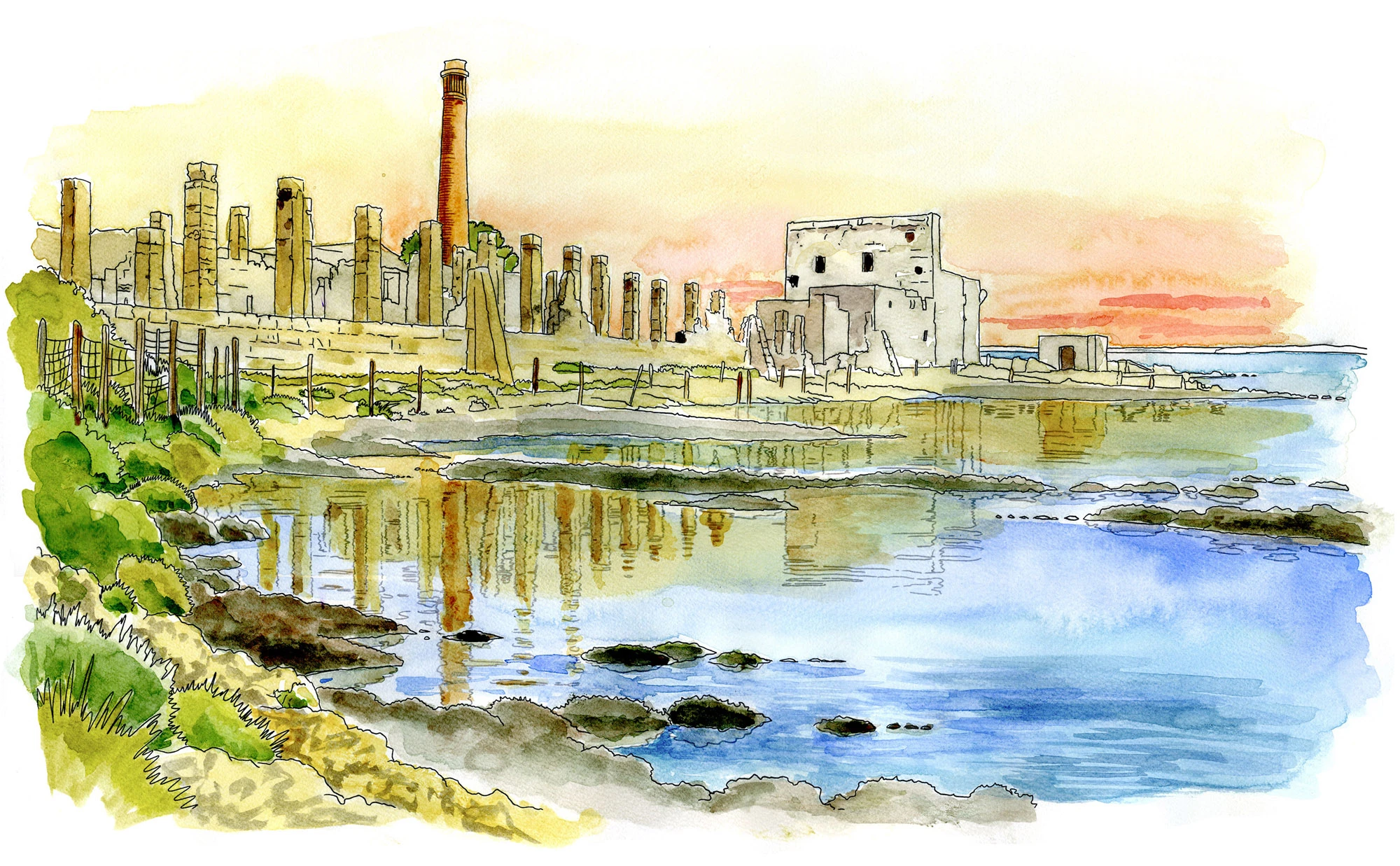
The ruins of a tonnara at Vendicari Nature Reserve. Black liner pen and watercolor.
Back to the Lagoon
As I keep walking through Vendicari, ancient Yunnan recedes and the salt marsh comes back into focus. The lagoon ahead of me is filled with flamingos, thousands of them, maybe ten thousand, turning the shallow water pink and white.
I’m trying to pick out a needle in a haystack, the possibility of a few Eurasian Spoonbills hiding among them.
The Ionian Sea lies just beyond the marsh, and as I stand here looking, Southern Migrant Hawkers are still working the edges of the reeds.
After eight million years, the line between nature and culture starts to blur. A Sicilian lemon tree stands on both sides of it.
But there is something about that human side.
I have been following citrus through Palermo, Cefalù, Lipari and Etna as if the point of it all was the fruit. It wasn't. Every orchard meant cleared land, cut terraces, grafted trees, and water.
The man on the patio in Taormina said the history of citrus in Sicily was a history of water and of who controlled it. Whoever held the water decided which fields paid and who shared in the money. Vendicari, with its lagoon and no orchards, is one of the few places that escaped.
Out over the lagoon, a hundred flamingos are flying low. Then some of them aren't flamingos. The spoonbills break away and drop into the green water, sweeping their strange bills through the shallows.