
Part VIII of The Citrus Kingdom
Conca d’Oro and the Last Mandarin
The rental car is due back in Palermo. There is still one thing I want to tell you.
November 2026
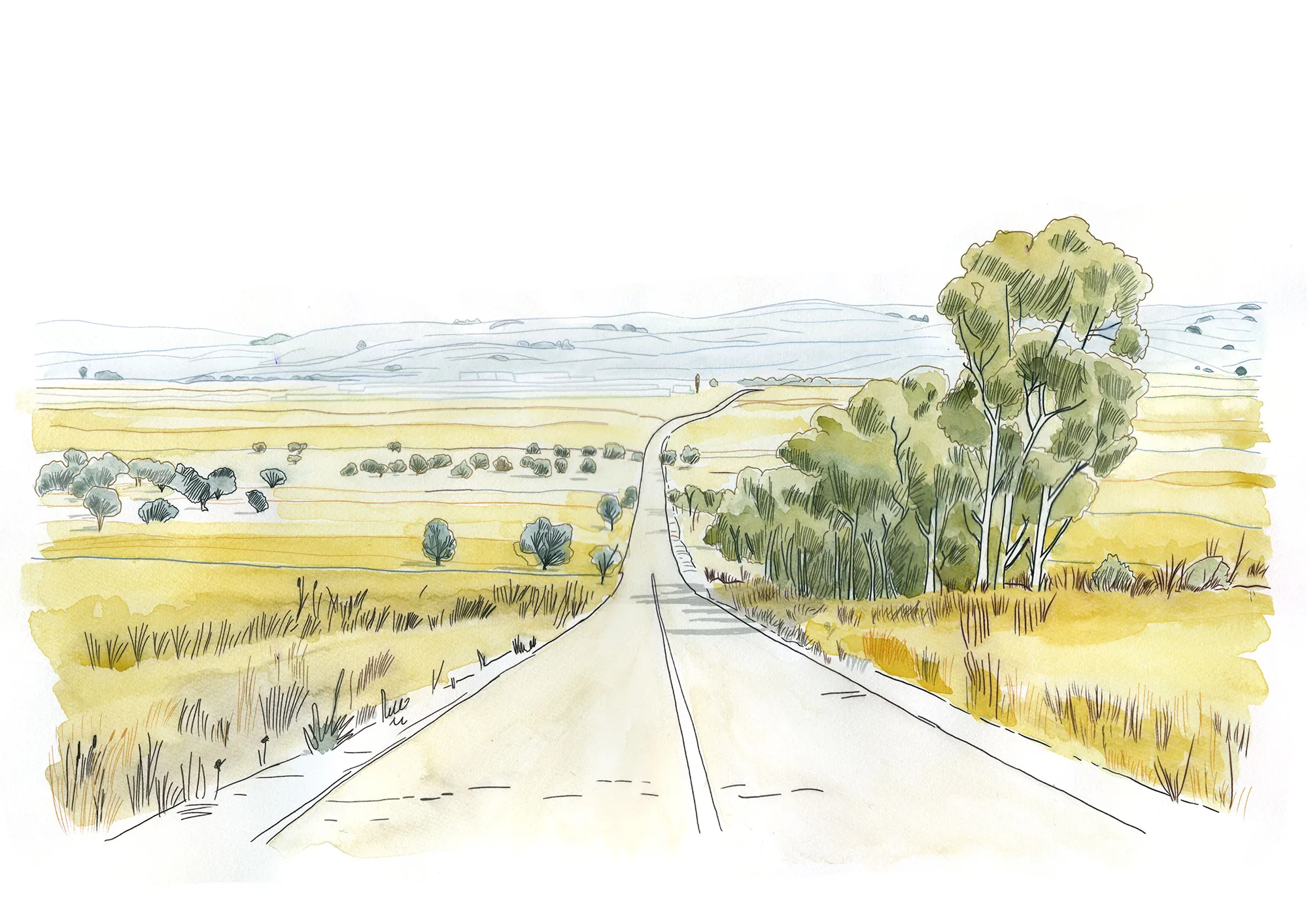
The road north from Gela, through gold fields and olive trees. Liner pen and watercolor washes.
It’s quiet in the rental car. Ivan is at the wheel, Jane and Iva are in the back, and nobody has said anything for a while. We are headed north from Gela on the Sulfur Road, and I am looking out the window at this sun-parched land, all ochre grasses and red earth.
Then a long, winding belt of green. A jungle on either side of a lazy river, the Fiume Maroglio. Beyond it are greenhouses and rows of oranges and olives, side by side.
For just a second, something brilliant flashes out of that green. Turquoise and electric azure and terracotta, with near-black flight feathers. It’s a European Roller, and the first time I’ve ever seen one in flight with all its colors. To my mind, the roller is Europe’s second most beautiful bird, after its cousin the bee-eater. But with its wings open and in perfect light, it gives the bee-eater a run for its money.
I keep it to myself. A bird would only make Iva unhappy, and the car is quiet anyway. Weeks after we get home, Jane tells me she saw it too.
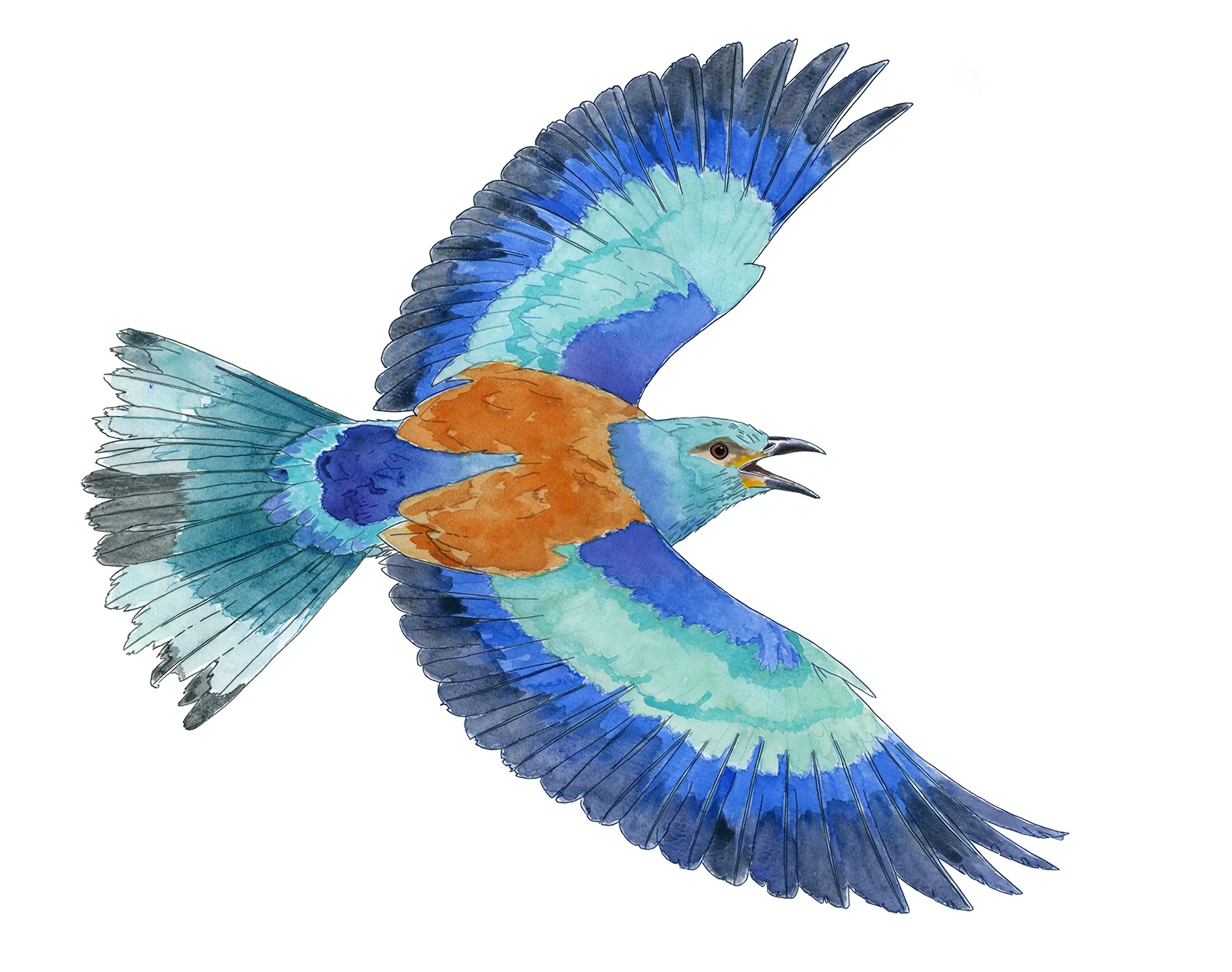
A European roller in flight. Liner pen and watercolor washes.
I look over at Ivan, which reminds me to ask: would you mind joining me just once more on a trip back in time? I know I promised in Modica that would be the last one.
Let’s stand on the rooftop of this old tuna cannery and look down at us, yesterday. There’s Erik and Jane, walking alongside Iva and Ivan in the coastal fishing village of Marzamemi. Iva suggests that on our last night in Modica, we should skip dinner out and just eat something at the house.
Look at Erik, I tell you. Look at how this is music to his ears.
Ivan agrees with Iva, and suggests we find a grocery on the way back. But almost as he says it, he notices a fruit cart on the side of the road and starts chatting up the vendor. He buys a whole bag of small, oblong tomatoes and a Femminello lemon. At the cannery, they pick up some tuna and sea salt.
“We really don’t need to find a grocery anymore,” Iva says. “We have just about everything we need.”
Let’s follow them back to Modica, up the eight flights of stairs, past the alley cats and the capers growing out of the old walls. Almost immediately, Iva slips out again, and she’s gone for some time. When she comes back, she is carrying a bottle of Sicilian wine. She has also visited two salumerias, and she has two sausages and a local cheese.
Ivan improvises with his handful of ingredients, slicing up the tomatoes and mixing them with capers, olive oil and tuna, with the Femminello squeezed over the top.
There they are on the balcony, and Modica is all lit up, twinkling in the dark. It is our best meal in Sicily, partly because of the food and partly because of the donkey raiders. Since our first days on the island, Ivan and I have been building a saga about a band of donkey raiders terrorizing northern Sicily. Tonight Ivan invents the raiders’ simpleton helper, the one who feeds the donkeys, and he cracks himself up so badly he can’t stop laughing. Ever since Iva and Ivan have been on their journey to fix the dent, their urge to turn this into a no trip has melted away. Some of the best food I have ever eaten was made by Iva or Ivan. My favorite pizza was made on their kamado grill, with mushrooms they had foraged themselves.
There are no Instagram, TripAdvisor or TikTok reviews. And you can almost see it in Ivan’s face while he’s chopping vegetables in front of a city of magic, a quiet recognition that maybe Dassel, in Meeker County, Minnesota, might not offer everything that Modica does. Iva points up at the bats darting over the rooftops. I don’t tell her those are swifts.
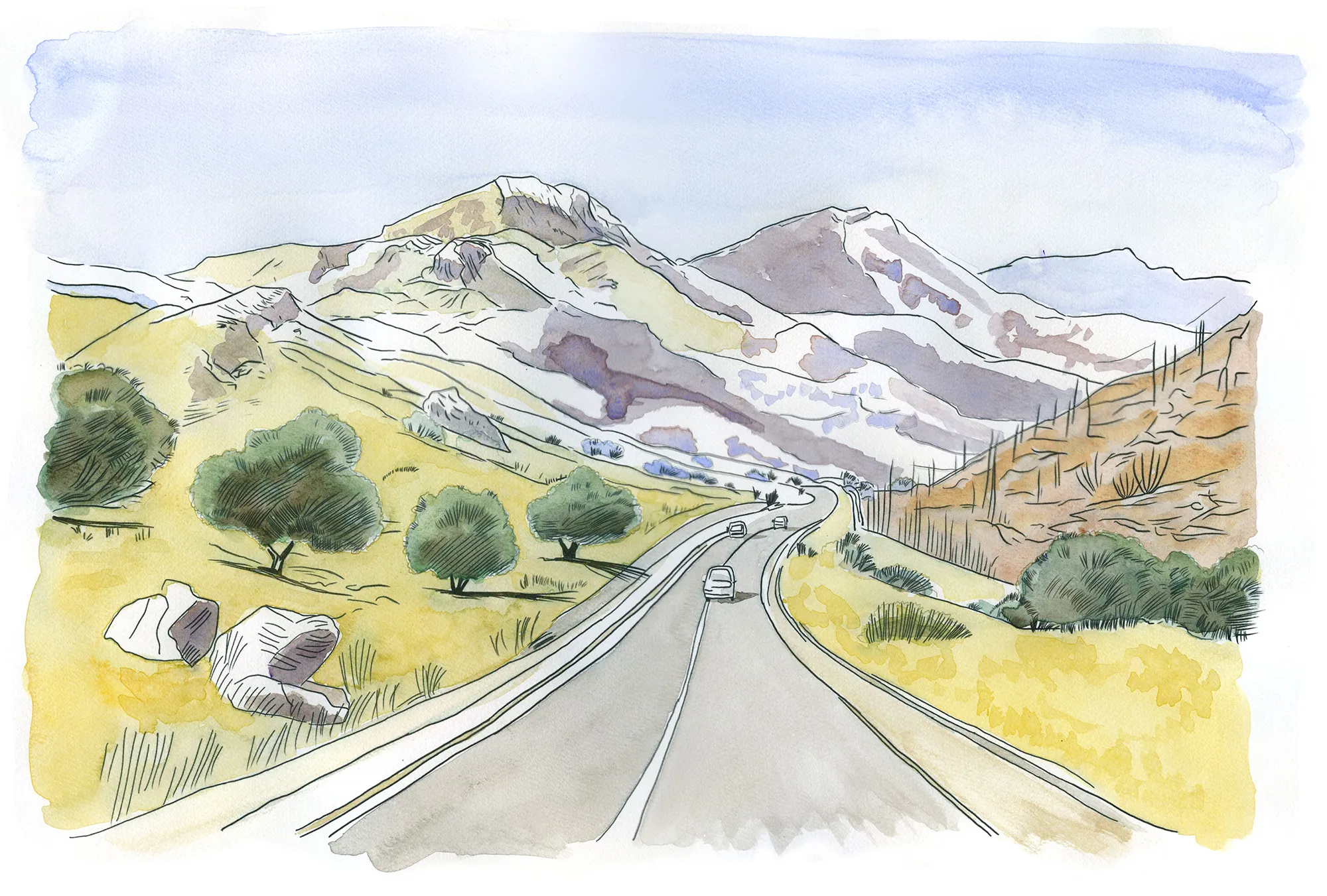
The road into the mountains of the Sicilian interior. Liner pen and watercolor washes.
On the Sulfur Road headed west, while I stare out the window, Iva and Ivan reckon with the fact that we are mere hours away from the rental car parking lot. And, despite the fact that the paint job and the nail polish job were of premium quality, something else is needed. Something to conceal the crime.
If perhaps the nail polish sparkles just a little too much, maybe a little dirt could lure the rental car agents off the scent.
As we drive past almond farms and dry, red-earth valleys of olives and tomato greenhouses, Ivan says that all we need is mud. But there is no mud in Sicily in July.
But I’m not thinking about mud. I’m thinking about the orange groves and the lemon groves. I’m thinking about the one Sicilian citrus fruit that we have yet to discover.
It turns out, there is one more, and it is, in every way, the last.
Tonight, we will return the car in Palermo. The rental lot is on the edge of the city, out on the plain the Sicilians have always called the Conca d’Oro, the golden shell.
This whole series began in the Conca d’Oro. But on this trip, I was only there briefly, as we left the rental car parking lot.
So before we arrive, let me tell you about it. And let me tell you about the last fruit, because it grew there too.
The Last Fruit
Of the four wild ancestors we met at Vendicari, the citron, the pomelo, the papeda and the mandarin, the mandarin is the one that has waited the longest.
The mandarin is one of the oldest citrus lineages, and it is the very last to arrive in Sicily. As we have learned, the citron came with the Arabs, as did the sour orange, and the sweet orange came later on Portuguese ships. The mandarin came with the British.
In the early 1800s, when Napoleon held most of Europe and the Bourbon king had fled Naples for Palermo, the British Navy was all over the island. A British ship brought a few mandarin trees from China, and around 1810 they were planted in Palermo’s new Botanical Garden. From the garden, the trees went out into the Conca d’Oro, and from the Conca d’Oro to the rest of the Mediterranean.
I have always loved oranges, but you have to fight an orange. You dig your thumbnail into it and tear the peel off in pieces. A mandarin you can peel with your thumb, in one long spiral, and it gives itself up in segments. It is the easiest citrus fruit there is. Our most typical winter breakfast is two soft-boiled eggs and two satsuma mandarins.
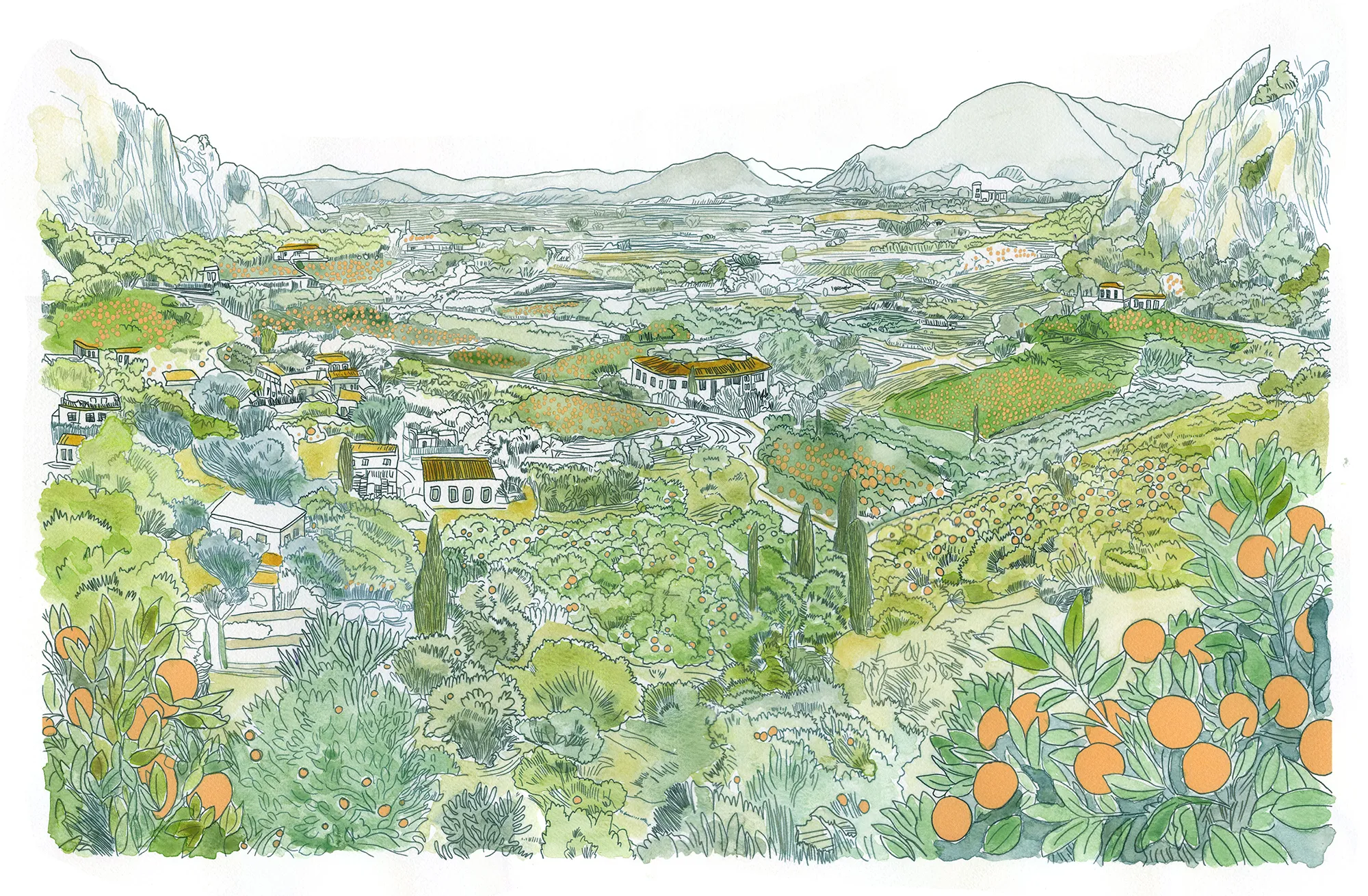
The Conca d’Oro as it once was, citrus groves and villas from the mountains to the sea. Liner pen and watercolor washes.
The Golden Shell
The first time I saw the Conca d’Oro, I was driving back to Palermo from the west, and below me Palermo was spread along its bay, and all around it, filling the space between the mountains and the sea, was a place I had trouble deciphering in the haze.
The Conca d’Oro is the wide plain that surrounds Palermo. It’s a bowl of flat land that is ringed by mountains on three sides and by the Mediterranean on the fourth.
For a thousand years, the Conca d’Oro was a massive garden, a paradise that could be mistaken for a work of nature. But the reality is that Sicilian soil was never easy, and of course Sicilian summers are hot and dry. This plain of paradise was built by man, and it was built with water.
It was the Arabs who first brought citrus and rice, both of which needed enormous amounts of water. They built the system that fed their crops — the wells and channels, and those sophisticated water tanks and mule-driven wheels.
When the Normans conquered Palermo, they knew to embrace this technology, and their kings ringed the city with pleasure gardens like the Favara, a palace whose orange trees were reflected in artificial lakes.
Throughout this thousand-year history, travelers kept writing about it. In 1184, Ibn Jubayr, a Muslim pilgrim en route to his home in Spain, described the Conca d’Oro as “Proudly set between its open spaces and plains filled with gardens, with broad roads and avenues, it dazzles the eyes with its perfection.” In 1787, Goethe wrote, “It is the most wonderful place in the world: regularly laid out by art, it still looks a fairy spot; planted but a short time ago, it yet transports you into ancient times.”
By the nineteenth century, when the mandarin joined the other citrus, the Conca d’Oro was one vast citrus grove. The French novelist Guy de Maupassant gushed over it, calling it a fragrant forest.
The Conca d’Oro was a monument to human ingenuity, as great as any cathedral in Sicily. It was alive, and it fed a city.
Out the window, a greenhouse flashes white in the sun, and then another. Ivan is watching the ditches along the road. He’s looking for mud.
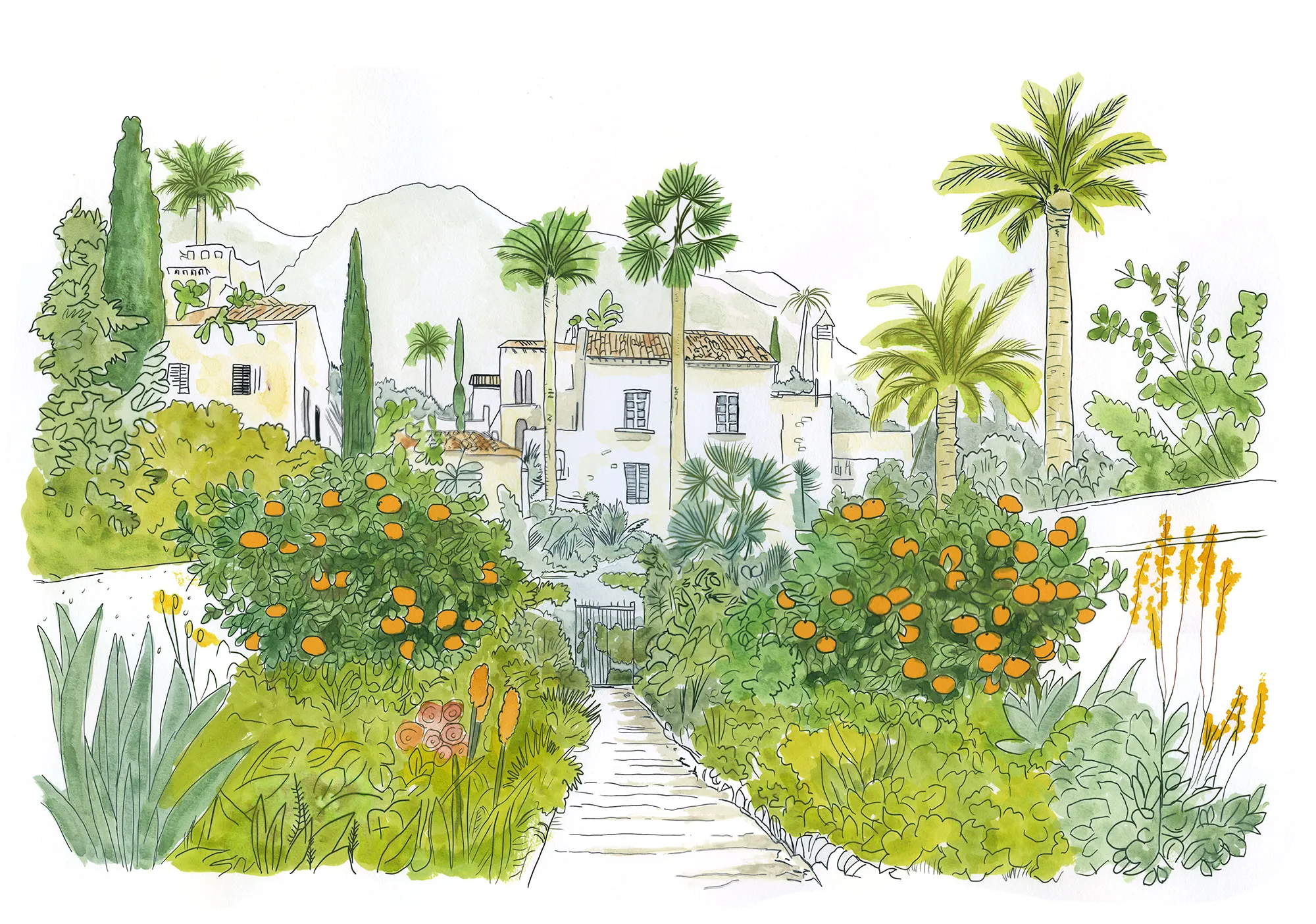
A citrus estate in the Conca d’Oro, its mandarin trees heavy with fruit. Liner pen and watercolor washes.
The Late Mandarin
At the southeast edge of the plain, below a mountain called Monte Grifone, is a small farm settlement called Ciaculli. It’s where the late mandarin was born.
Sometime in the 1940s, in a grove in Ciaculli, a mandarin tree of the common Avana variety put out a single branch that behaved differently from the rest. Its fruit ripened late, long after every other mandarin, from January all the way into March. A grower noticed. Somebody cut that branch and grafted it onto other trees, and the late mandarin spread through the groves.
Locals called it u marzuddu, the March one. Today it’s called the Mandarino Tardivo di Ciaculli, the late mandarin of Ciaculli.
The Tardivo was prized because it was late, sweet and fragrant at a time of year when little other fruit was left on the trees.
I should tell you now that I never tasted one in Sicily. We were there in summer. The Tardivo ripens in winter.
The gardens around Palermo didn’t stop growing citrus when the nineteenth century ended, and the courteous man at the gate didn’t go away.
By the 1940s, Ciaculli and its neighbor, Croceverde, were the heart of mandarin country. And they belonged, in every way that counted, to a family called Greco.
One Greco managed an estate of about 300 hectares of citrus, most of it mandarins. When one of his sons was killed, the two branches of the family, cousins who had grown up among the same trees, went to war with each other. Just after the Second World War, they were fighting among the mandarin trees.
The Grecos who survived became the most powerful family in the Sicilian Mafia. By the 1950s, one of them, Salvatore Greco of Ciaculli, sat at the head of its first governing commission.
On the morning of June 30, 1963, a farmer in Ciaculli found a car abandoned on his land, among his citrus trees. The doors were open. One of the tires was flat. On the back seat were a gas canister and a fuse that had been lit and had burned out.
He called the police.
The police and the carabinieri came, and they called the army. Seven men gathered around the car among the groves. The youngest of the officers, Lieutenant Mario Malausa, was twenty-four.
They were examining the car, looking for clues. Then one of them opened the trunk, where the real bomb was waiting for them.
The bomb killed all seven of them. The car bomb was meant for Salvatore Greco, but it had stalled on a flat tire in a citrus grove.
After the Ciaculli incident, the car bomb became the signature weapon of the Mafia. One of the first went off in mandarin country.
After that, for a few years anyway, the Italian state came for the Mafia as it never had before. It arrested almost 2,000 people, and the Mafia’s commission dissolved itself. Salvatore Greco fled to Venezuela.
But what were these mafiosi fighting for in the citrus groves?
It wasn’t mandarins.
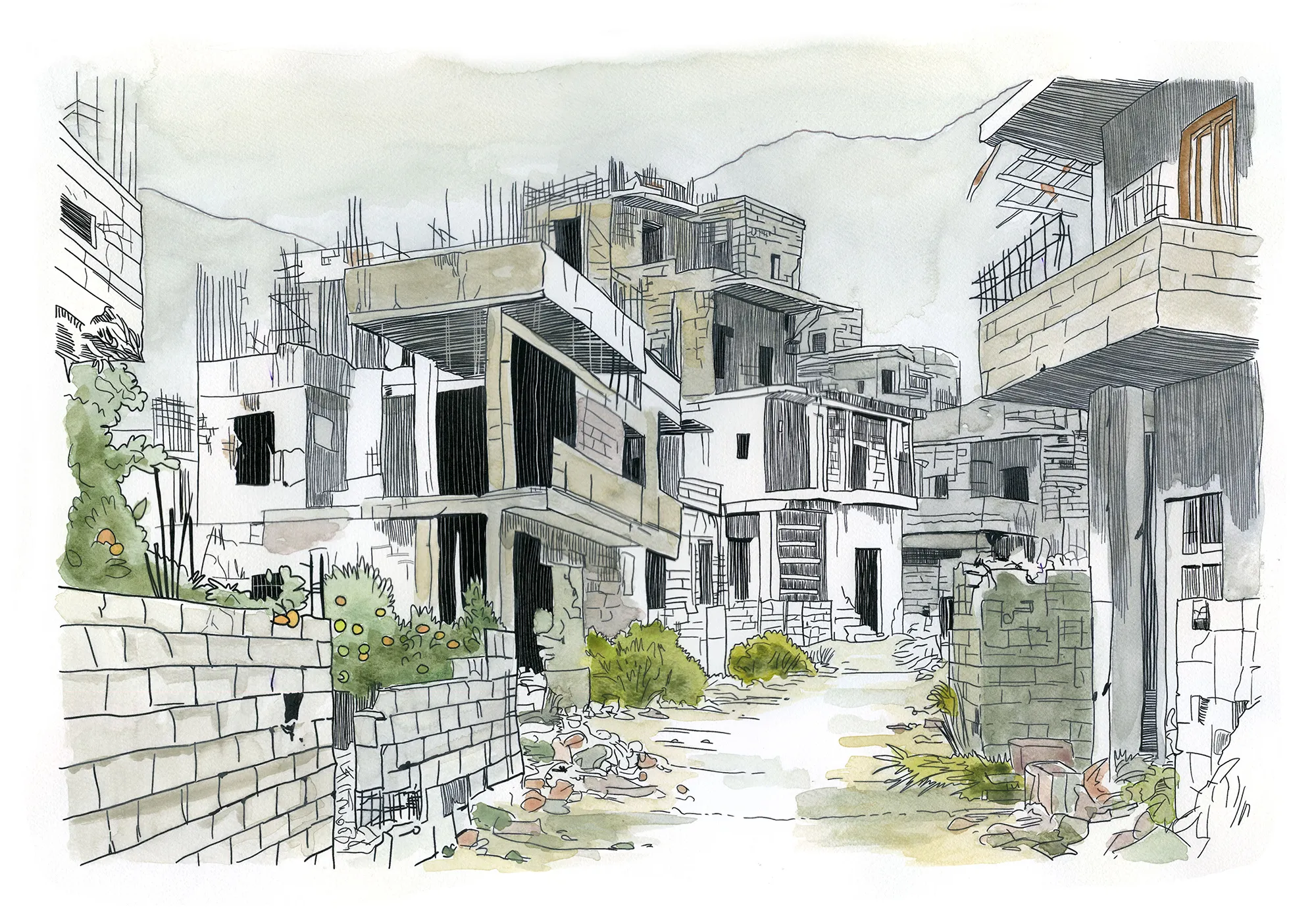
The sack of Palermo: unfinished concrete where the groves used to be. Liner pen and watercolor washes.
The Sack
When we left Modica, I told you that I knew who controlled the water in the Conca d’Oro, at least for a while. I didn’t yet know what they did with it.
After the Second World War, Palermo grew fast. People came in from the countryside and the interior, looking for work, and between 1951 and 1961 the city grew by a hundred thousand people. They needed somewhere to live.
In 1958, a young Christian Democrat named Salvo Lima became the mayor of Palermo, and his ally Vito Ciancimino took charge of public works and building permits. In five years, the city signed more than 4,000 building licences. More than half of them were issued in the names of three pensioners who had nothing to do with construction.
Three pensioners. Front men, names on paper, so that the people who were really building never had to appear. It was ingenious, in its way.
And the land they were building on was the Conca d’Oro.
The war that ended with the bomb in the grove was fought, in large part, over building sites and construction contracts. The battles were over who would get the permits. Who would supply the concrete. It was over who would pave the golden shell. In fact, the killing was the same business as the concrete.
The bulldozers came; they surrounded the city like tanks, and groves that had taken a thousand years to build were gone in a season.
The gebbie were filled in, and the stone channels that fed the groves were broken apart. The walled gardens and the old villas disappeared, replaced by apartment blocks eight or ten stories tall. They were all built as fast and cheap as possible, with no urban planning whatsoever. By the end, 3,000 hectares of the Conca d’Oro’s orchards and citrus groves were gone.
The newspaper L’Ora gave it a name: il sacco di Palermo, the sack of Palermo.
The agronomist Giuseppe Barbera remembers it as a boy. His family had a villa at Resuttana, in the middle of the Conca d’Oro, three kilometers from the cathedral. In the winter of 1965, his father kept finding excuses not to take the family out there. Barbera didn’t understand why. The concrete had surrounded it.
Yes, this is a Mafia story. But the sack was more than mafiosi. It was mayors and permit officers. And it was contractors and banks. And it was planners looking the other way, and laws that bent when they wanted to be bent.
The sack of Palermo was an inside job, and it was done by an alliance. Some people profited, but many more looked away, out of fear or because they had no say. The few who stood up to it all paid for it, sometimes with their lives.
A thousand years to build a paradise. Twenty to bury.
Tonight, when we return the car, we’ll be parking on that ground.
In the side mirror, I can see the door where the nail polish is. In this light, it sparkles.
Why does an entire city go along with something like this?
Because the killing didn’t stop. It got worse.
In the 1970s, the money transitioned from concrete into heroin. And then the heroin money went back into concrete. In the early 1980s, a Mafia clan from the interior, the Corleonesi, wanted it all, and they went to war to get it all. In three years, at least 400 people in Palermo alone were dead. They were shot up in bars, and while driving their cars, and often in front of everyone. Many more simply vanished, and were never found.
In the middle of mandarin country, Michele Greco, the head of the Mafia’s commission, lived on a sprawling citrus estate where, he would later boast, he entertained prosecutors and police chiefs. He set up a heroin laboratory right on his property. And during this time, he was receiving European subsidy payments while destroying citrus crops he never touched.
The gatekeeper of the mandarin groves was being paid by Europe to destroy fruit that no longer existed.
In 1982, the Italian government sent a general to Palermo to end the Mafia once and for all. This general had been based in the city for just over a hundred days, when gunmen pulled up alongside his car one night and shot him and his young wife dead.
What the Orange Tree Knows
Out the window, the land is the color of a lion.
I keep thinking about what it means to pave a garden. When the Conca d’Oro was all groves, the rain would come down and the trees would hold that water. For a thousand years that water flowed through the channels and tanks.
But concrete doesn’t drink, and when the rain falls on a paved plain, it goes straight to the sea, and it takes everything in its way. The sack of Palermo buried the most beautiful farmland in Europe, but it also eviscerated its way of holding water.
Sicily has been doing this to itself everywhere else too, and for a long time. Today, almost all the island’s wetlands are gone, having been drained long ago, and more than half the water leaks out of the systems designed to take it somewhere else.
But there is another input that is being added to this stressed system. The climate is turning on Sicily. Two summers ago, the island’s water reservoirs went dry, and entire towns were forced to live on rationed water. Citrus growers had no water for their groves.
Then, in January of this year, that other edge of a changing climate went to work, and a storm stalled over Sicily and poured rain across the island. In Niscemi, a hill town above the Gela plain, the waterlogged clay gave way. A landslide four kilometers in length began to slide off the ridge. More than 1,500 people were evacuated. “The entire hill,” said the head of Italy’s Civil Protection, “is collapsing onto the plain of Gela.” It was sliding toward the Maroglio.
That July, I watched a roller fly out of the green along that same river.
In Taormina, I met ecologist Eric Gangloff and his wall lizards. Long after Sicily, I asked him whether his lizards were near the limit of the heat they could take.
He told me they’re very good at handling it. A wall lizard moves around to find the right temperature, and takes refuge when it gets too hot or too cold. “As long as there are resources, shelters, rocks, plants,” he said, “I think these guys will be fine for a while, even as it continues to get warmer.”
But there was a catch. A lizard can move around to escape the heat of the day. At night, when it’s asleep, it can’t. “They are kind of beholden to the environment around them,” he told me. Warmer nights can become a trap.
So are we. We just have longer supply lines.
Citrus trees can’t escape the weather. They just sit there where we plant them.
Sicily’s citrus has survived for a thousand years because people did the adapting for them. They dug the channels, made the grafts and discovered when the branches did strange things. But blood oranges only turn red when the nights are cold.
Sicilian farmers are already adapting the only way they can. Already, you can see it along the coasts. They are replacing their citrus trees with avocados and mangoes. I don’t blame them for one moment. They are being as resourceful as their ancestors were.
Gangloff warned me about a version of this. “It’s easy for someone without a biology background to look around and say, ‘Look, there are lots of plants and lizards, so everything must be fine!’” A mango grove is green too.
I also asked Gangloff whether all that close work had changed how he sees the bigger picture.
He said that studying these animals up close had given him hope. That it’s incredible such complicated systems exist and work at all, and that the fact that they keep responding and adapting means there’s still time to turn things in a better direction. He worried that so much of the dire research paints a picture of a world that is already ruined. “So what’s the motivation to do any work to make it better?”
“Frankly, I don’t see an alternative to being hopeful,” he said. “I think the lizards have taught me that.”
The Moment Palermo Fought Back
In the 1980s, a handful of magistrates began following the Mafia’s money and convincing its members to testify against their bosses. Eventually, hundreds of mafiosi found themselves on trial together, in a bunker courtroom built beside Palermo’s prison. In 1992, the Mafia murdered the two magistrates who had led the effort, Giovanni Falcone and Paolo Borsellino.
But this time, Palermo didn’t look away. White bedsheets appeared on balconies across the city, many painted with anti-Mafia slogans. Then, twelve years later, in 2004, Palermitans woke one morning to find tiny stickers plastered all over the city. They said:
“Un intero popolo che paga il pizzo è un popolo senza dignità.”
An entire people who pays protection money is a people without dignity.
They called themselves Addiopizzo, which translates as “goodbye, pizzo.” Shops began putting up signs saying they didn’t pay, and customers began choosing those shops.
It began with stickers, but it kept going. Some of the land came back, too. Property seized from the Mafia is farmed today, including the mandarin groves in Ciaculli.
There are a lot of people out there who recycle. Or turn off the tap when they brush their teeth. Or stop on the side of the road to bring an injured animal to a rehabber. All good. But I am thinking about those shopkeepers right now. Palermo began to change when enough people stopped paying and fought back together.
What’s left is small.
Ciaculli and Croceverde, below Monte Grifone, are among the last large green spaces of the old Conca d’Oro. In 1999, about ninety farmers there formed a consortium to save the Tardivo di Ciaculli, and today the late mandarin is protected as a Slow Food presidium.
It’s a remnant, like the roller’s river this morning, a green belt through a brown land.
Ivan turns off the highway.
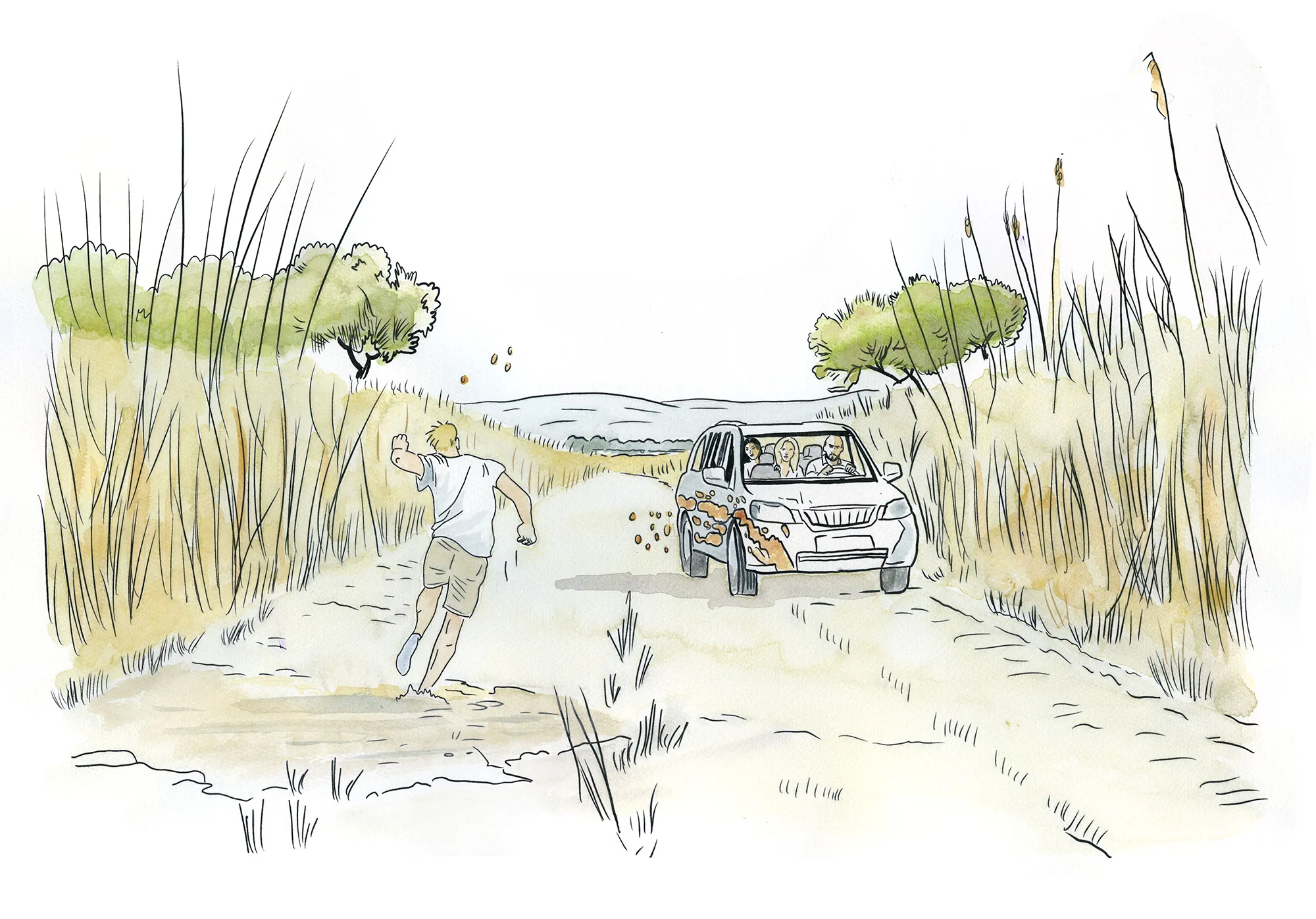
Covering up the crime on a gravel track off the highway. Liner pen and watercolor washes.
The Mud
It’s a gravel track off the highway. A band of giant reed runs along a little creek, and there’s water in the creek. On either side are rows of olive trees.
There’s a puddle on the track. Ivan drives into it, and the car barely splashes. It’s more a damp spot than a puddle.
Ivan suggests that Iva get out and throw some mud on the car.
I say I’ll do it.
Iva’s nails are freshly polished, and I could pretend I’m sparing them. Really, I just want to stretch my legs.
I get out. There’s no mud in the puddle. It’s hard sand, baked into the clay. I work my fingers into it until I have a handful, and I throw it at the side of the car.
I can see Iva and Ivan through the windshield. They think this is hilarious. But they are also judging my work.
Ivan is the one who hit the wall. I’m the one throwing the dirt. I go back to the puddle and dig out a second handful.
It’s not really dirt or mud. It’s hard sand with pebbles and clay.
By the third handful, I’m thinking of Antonino, the character I invented, guarding his own trees in the dark. I am not Antonino. I am old Ferrante.
I throw the third handful.
Jane, in the back seat, says nothing at all.
I get back in the car with clay under my fingernails. The creek is running ten feet away, and we couldn’t find enough water to make mud.
We are all in the car now.
We drive north past Mazzarino and Caltanissetta, the old sulfur capital of Sicily. Every few miles there’s an abandoned farmhouse with its roof fallen in, a good place for a roller to nest. A town sits on a mountaintop far off.
Ivan has spent the whole trip insisting that Minnesota would be more interesting to him than any of this. Back on the balcony in Modica, I was comparing Modica to a typical Minnesota small town. But the truth is that Minnesota is stunning, in the same quiet way as these hills. It has forests and long agricultural sweeps, isolated farmsteads and native prairie. Sicily’s subtle landscapes are famous and people are attracted to them because they’ve grown up with them on food labels and Mafia movies. Minnesota’s aren’t, and I only know them because I’m from there. Ivan would be underwhelmed if he went to Minnesota seeking its small towns. It takes someone who grew up there to show him its beauty. It would require a yes trip.
The sand and clay bake onto the side of the car. It looks entirely created. Like someone was trying to cover up a scrape along the side of a car. Nobody mentions it.
We come down out of the mountains at Termini Imerese and turn west along the coast toward Palermo. It’s evening when we reach the city.
Coming in on the highway, we pass the Castello di Maredolce, the old Norman Favara palace, with a mandarin grove still growing beside it. It’s a fragment of the golden shell, right there by the road. We don’t stop.
Then we’re on the ring road, cutting across the old plain. The apartment blocks go on for miles, eight and ten stories of stained concrete, built fast and never finished, balconies crowded with laundry and satellite dishes. Trash is piled along the curbs. There are rows of abandoned construction projects and open garbage dumps. This is where the groves were. From the road, I can’t see any gold left in the shell. We drive the sack of Palermo to return the car.
The Lot
The rental car parking lot is out on the edge of the old plain. The blocks around it are elegant, and then, within a street or two, they aren’t. Concrete balconies, peeling plaster, laundry. Not far away is the street where Vito Ciancimino once lived. And somewhere out here, in Uditore, was Dr. Galati’s lemon grove, where his new warden was shot dead one July night in 1874.
It’s evening, and the office is closed. There’s nobody there.
We park the car in the lot and leave it. The sandy clay is caked on the side of the door, ridiculous and obvious, and there’s no one to see it.
Nobody says the word scrape. There’s nobody there to say it.
All that ingenuity: a free paint job in Marzamemi, two bottles of glittery nail polish, three handfuls of clay, and nobody ever looks.
As far as I know, the rental car agency never charged Ivan for the damage. Or at least, that’s what Ivan tells me.
Late
At home, I open a bottle of mandarin soda. It’s made with juice from the Tardivo di Ciaculli, the late mandarin.
On the trip, I drank a few Sicilian mandarin sodas. But it was never this one. The Tardivo only reached me after the trip was over.
Jane was dubious when yet another package from Sicily arrived all scuffed up in the mail. But tonight, in early November, I have just finished writing The Citrus Kingdom, and Kellan surprised us with a visit home from college.
I take out my rum snifters, and pour it cold. Drink it slowly. Enjoy it. I’m nervous to drink mine.
It’s delicious, and nothing like orange soda. There’s a natural sweetness, and then a tartness right behind it.
It’s only a soda. Sixteen percent juice, a long way from a perfect fruit picked from a tree in Ciaculli on a cold March morning. But it’s the last mandarin, and I tasted it late.
The Newsletter
A buried garden and the last mandarin.
Food, history and travel notes from the road, free by email.
Almost there. Check your inbox to confirm your subscription. Nothing there in a few minutes? Subscribe on Substack.
Not an email person? Follow along on Threads, Facebook, Bluesky or Mastodon.