Taormina and the Volcano Oranges
Portuguese ships, a fennel salad, and fruit darkened by volcanic soil.
August 20, 2026
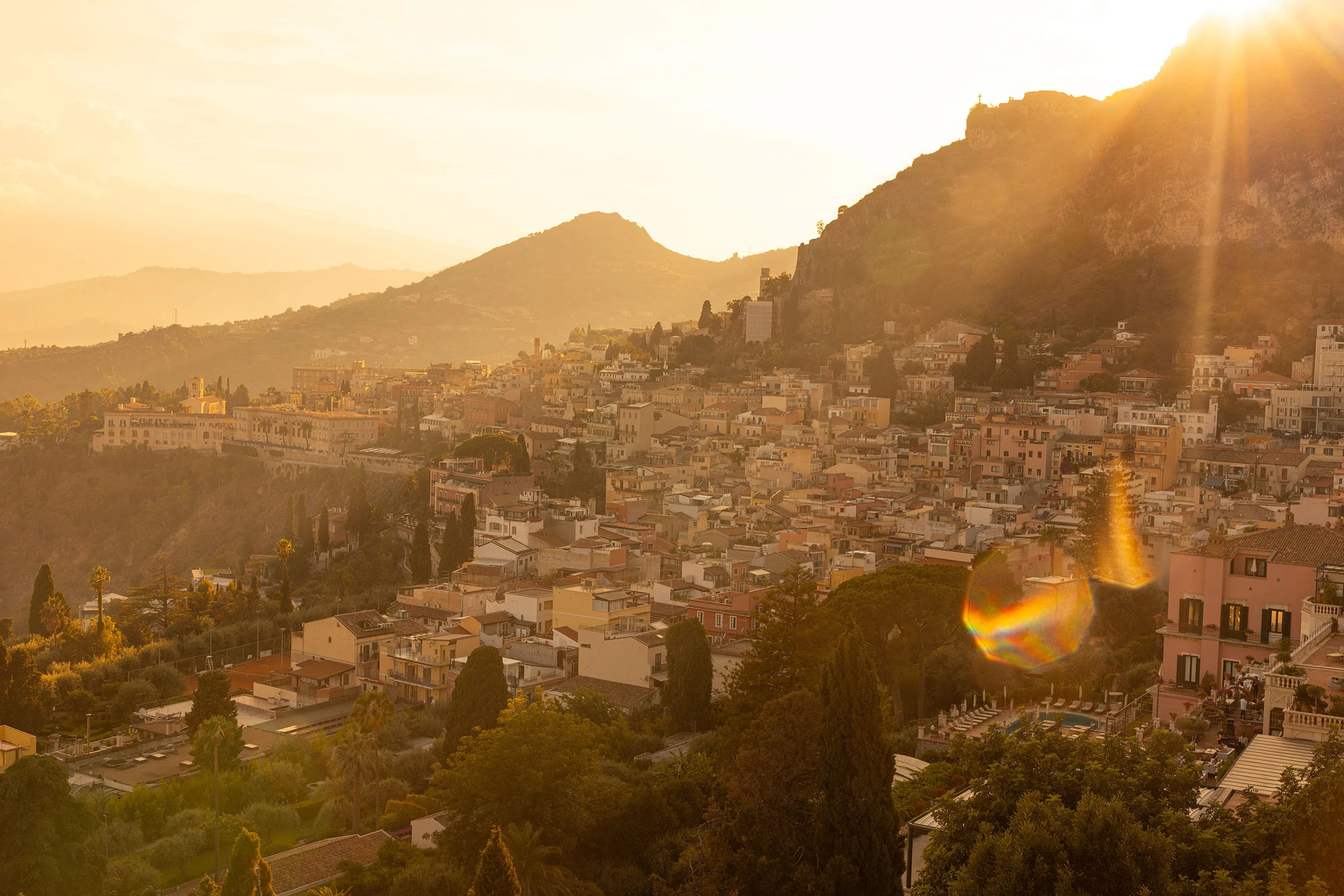
Mount Etna beyond the town of Taormina, Sicily.
Sometime in the 1990s, while I was still living in Los Angeles, a man from San Pedro came to Taormina on vacation and went home with a handful of lizards.
He released them in his backyard. They stayed. And they began to spread.
I am at the ancient Greek theatre in Taormina, chasing that last sweet orange light of sunset. The theatre holds an unrivaled view of the historic town, the Ionian Sea and Mount Etna, billowing smoke.
But I am losing that light, which I didn’t expect to slip behind Monte Tauro, and now I am trying anything to keep up with it. The problem is simply the crowds. The so-called White Lotus effect is real; after Season 2 was filmed here in Taormina, tourism in Sicily exploded, with Taormina—the setting of the HBO series—at the extreme. Even we are here because Iva’s TikTok and Instagram feeds were colonized by Taormina, so much so that it was an algorithmic inevitability that we would end up here.
The crowds on the main street are so thick that there is no way I can make it across town, where light is still sifting through the alleys. But one golden rule about crowds in historic cities is that they never leave the main drag. This is true any time of day, in every city, any time of year. So all I need to do is navigate the small side streets and I should appear on the other side in time.
But my route keeps putting me at dead ends, and I find myself backtracking like a kid in a corn maze. I need to get up and over, but I’ve lost the light! A man in a sharp suit is standing on a stair landing above me. He doesn’t ask me what I’m doing. Instead, he tells me his apartment is four stories up. I should go out on his patio.
It’s exactly where I want to be. He opens the apartment door and we rush up the three remaining flights of stairs, through his apartment and out onto his patio. His wife and daughter appear impeccably dressed, elegant enough for the opera—silk, jewelry, careful hair, the unmistakable air of an evening that had been planned properly.
While I look out over the town, the dad tells me they bought this apartment because his wife has had a lifelong love of theatre, and this apartment has a view of the small Roman Odeon below and the great Greek-Roman theatre overlooking the sea.
Our conversation, mostly conducted through the teenage daughter as translator, shifts from theatre to the idea I’ve been brewing. I squeeze the citron I bought at a citrus-themed market below and tell them I want to write about our trip through the history of Sicily’s citrus.
The family goes quiet for a moment.
Then the daughter translates for her father.
“Yes,” he says. “The history of Sicily and citrus is the history of water, and who controls it.”
Jane is out with Iva and Ivan, who have spent an hour and a half walking along the main drag reading TikTok reviews, studying menus, navigating reservations.
I order a pizzette and a beer and sit out on the street. I am hopeful my travel crew finds a wonderful meal, but I am delighted for my twelve-minute meal.
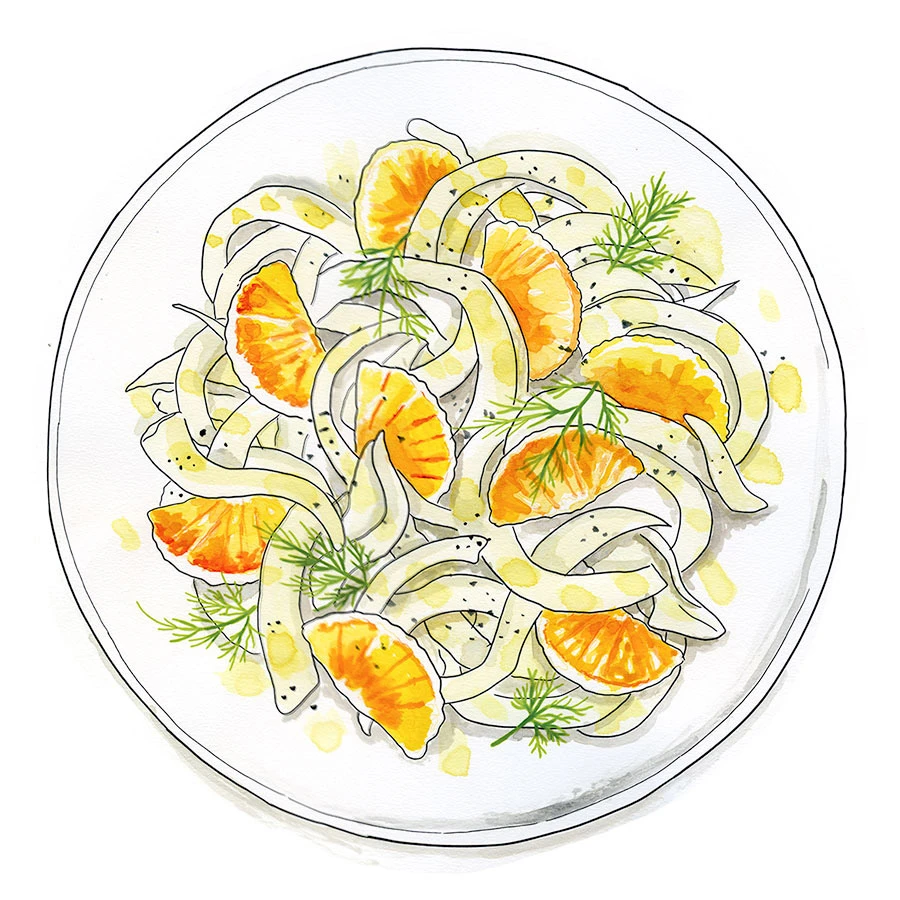
Sicilian orange and fennel salad sketch. Liner pen and watercolor.
A Salad of Oranges and Fennel
Earlier that day, though, I had eaten something that stayed with me: my first Sicilian orange-fennel salad. It was almost absurdly simple—supremed oranges and chopped fennel with olive oil, dill and black pepper—but it was delicious. And it reminded me how much I have always loved orange.
As a kid, my love for the color, the flavor and the fruit was well known in my neighborhood. I even carried the nickname Orange Popsicle. Throughout my life, I have chased orange.
But it was Jane—my sweet orange—who brought the fruit itself back to the center of my life. Jane learned from her mother to be picky about fruit: to wait for it, choose it carefully, and eat it when it was exactly right. To be seasonal about it. She was the one who got me peeling oranges again.
And now, in Sicily, I had started looking for orange-fennel salad everywhere.
By the time I was eating it in Taormina, oranges had already been growing in Sicily for many centuries. But they were not necessarily the oranges I was thinking about.
The Arabs had brought the orange west long before. It was the sour orange; fragrant and acidic, the universal rootstock for the island’s citrus-based economy.
But the orange I knew, the orange of peeled sunshine, would come much later.
Some time around the beginning of the sixteenth century, Portuguese ships were returning to the west with sweet oranges from Asia. Nobody knows when the first sweet orange appeared in the Mediterranean, although it’s possible they trickled in before the Portuguese.
But the Portuguese became so closely associated with sweet oranges that the West began naming the fruit after the little country. The Greeks called it portokáli, and the Turks called it portakal. Arabs referred to the sweet orange as burtuqāl. Persian called it porteghāl.
The Portuguese were particularly good at moving things like this because their maritime world was completely different than the Arabic trade networks that had connected Asia to the Mediterranean. Those older routes were extraordinary achievements, but they operated largely as networks of specialists: different merchants, different vessels, different bodies of water, with goods passing from one system into another. Imagine dugout canoes, river barges, camel caravans, mule trains, Phoenician merchant ships, Arab dhows, and lateen-rigged Mediterranean coasters, just to get a fruit seedling across the world.
The Portuguese increasingly stitched those worlds together into one machine.
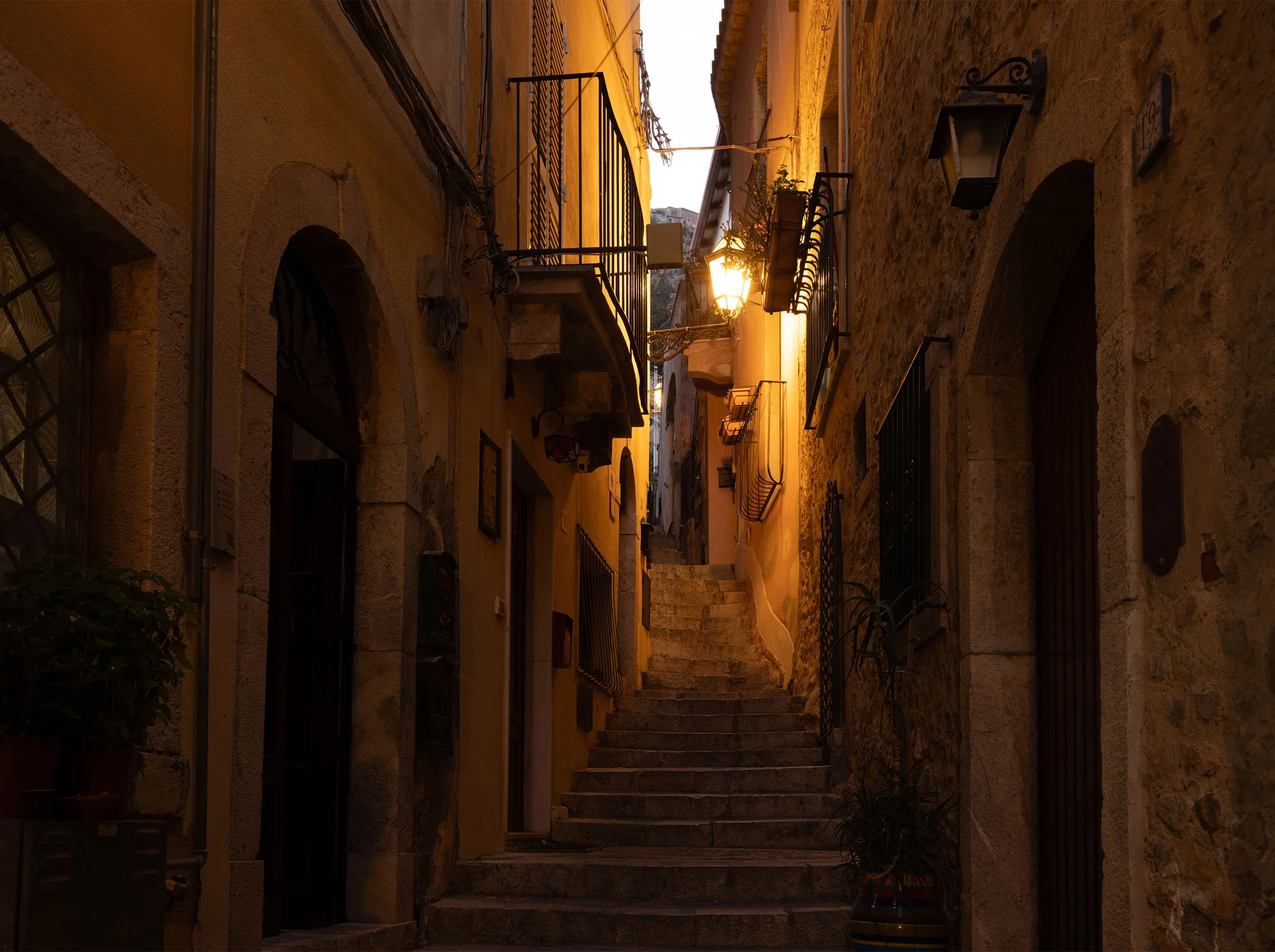
A steep stone staircase in Taormina.
The India Run
I don’t know the name of the ship that first carried one of these sweet oranges west, or whether the first traveler was a fruit, a seed, a cutting or a sapling. But I can imagine the ships that carried them.
By the early sixteenth century, the Portuguese had developed the India Run, an annual procession of Portuguese nau ships leaving Lisbon, rounding the Cape of Good Hope and entering a world whose winds were still unknown to Europeans.
They would leave in March: leave too late and you’ll miss the southwest monsoon and spend months stranded in Mozambique. If everything went well, these ships would reach Goa or Cochin by September. The entire voyage lasted a year and a half.
Let’s imagine one of those ships. Crammed with pepper, cloth and porcelain. Goats and sheep and seeds and chickens. People on board the ship will change. Local pilots and interpreters will board and depart. The ship itself is the most consistent thing. It is like a maritime Swiss Army knife riding through a Portuguese network of empires and fortified posts that stretch from Europe and Africa to Japan.
For generations, Sicilian growers called an old blond sweet orange Portugal. In dialect the name survived in forms such as aranciu partuallu. Portugal was no longer merely the country from which ships sailed, but something growing on Sicilian trees.
But the name did not survive the twentieth-century, and in its place, this orange became known as Biondo Comune: the Common Blond. That would mean the fruit survived while the voyage vanished from its name. Sicily had received a wandering fruit. The question was how it became Sicilian.
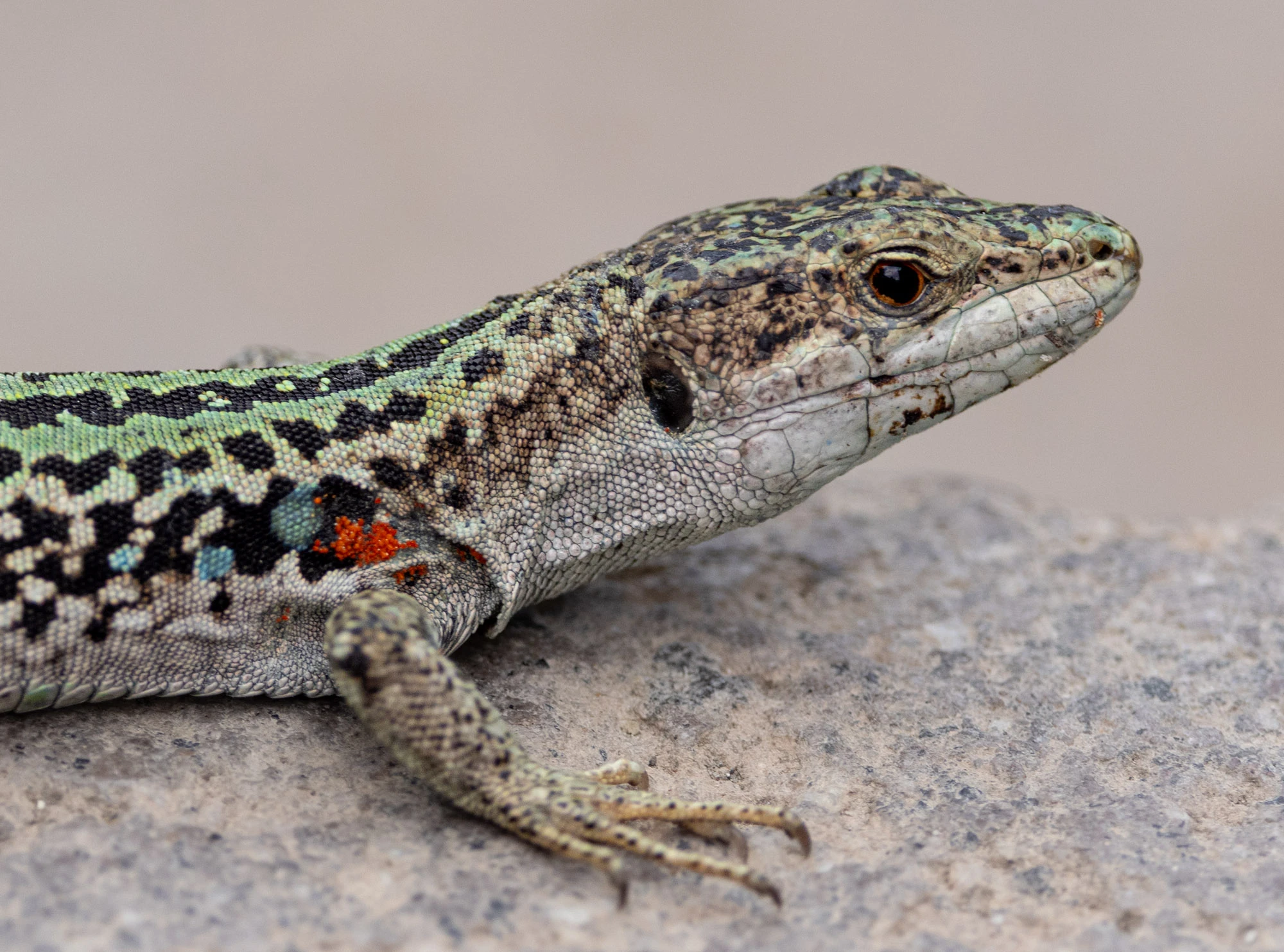
An Italian Wall Lizard, photographed in Lipari.
Wall Lizards in the Villa Comunale
In the morning, I sneak out while Jane sleeps and wander through Taormina until I reach the Villa Comunale, the town’s public gardens.
The place barely seems real. Palms, cycads, enormous cypresses and flowering trees spill down the hillside toward the Ionian Sea. Strange nineteenth-century towers rise out of the vegetation: brick-and-stone mini-castles, forts that are like they were designed in a dream.
But it isn’t the miniature castles or the exotic trees that hold my attention.
It is the people carrying tiny fishing poles.
They are scattered strangely through the gardens: technical clothes, baseball caps, colored hair, nose rings. Americans. They move slowly around walls and shrubs, staring intently into places where I can see absolutely nothing.
Then a pair passes my bench.
“This one is always here,” the man says.
The woman extends the tiny fishing pole. A moment later there is a lizard in her hand.
When a tall, inquisitive-looking man comes up the garden steps towards them, I ask him what on Earth they are doing.
His name is Eric Gangloff, an evolutionary ecologist at Ohio Wesleyan University who studies how reptiles and amphibians respond to changing environments. I start asking questions. Our conversation will continue long after we are back from Sicily.
And, unexpectedly, Eric’s lizards will help me understand how an orange becomes Sicilian.
“So why Taormina?”
“In the 1990s, someone from the San Pedro neighborhood of LA was on vacation in Taormina, snatched up a handful of lizards, and released them in his backyard!”
The lizards stayed. Then they spread. Today they are thriving around San Pedro and expanding into the surrounding area. And something else has happened: the Los Angeles lizards are bigger than the ones here in Taormina.
Eric is working with evolutionary ecologist Kinsey Brock to compare the native Taormina population with the introduced San Pedro population, trying to understand what, if anything, the lizards had to change to become successful in a new city.
Los Angeles is not the only accidental experiment. Wall lizards have established themselves in several places across North America. Eric has studied a closely related species in Cincinnati since 2020. Others have established populations in British Columbia, California and the Northeast.
Put a lizard somewhere it does not belong, and sometimes it dies. But, sometimes it reorganizes its life and becomes part of its new home.
What interests me immediately, though, is something much simpler. Eric and his team are seeing lizards everywhere.
I am not.
I consider myself a decent naturalist. I see lizards. But these people are spotting animals that seem completely invisible to me—something moving in a bush, a shape against a wall, a flicker that I never register.
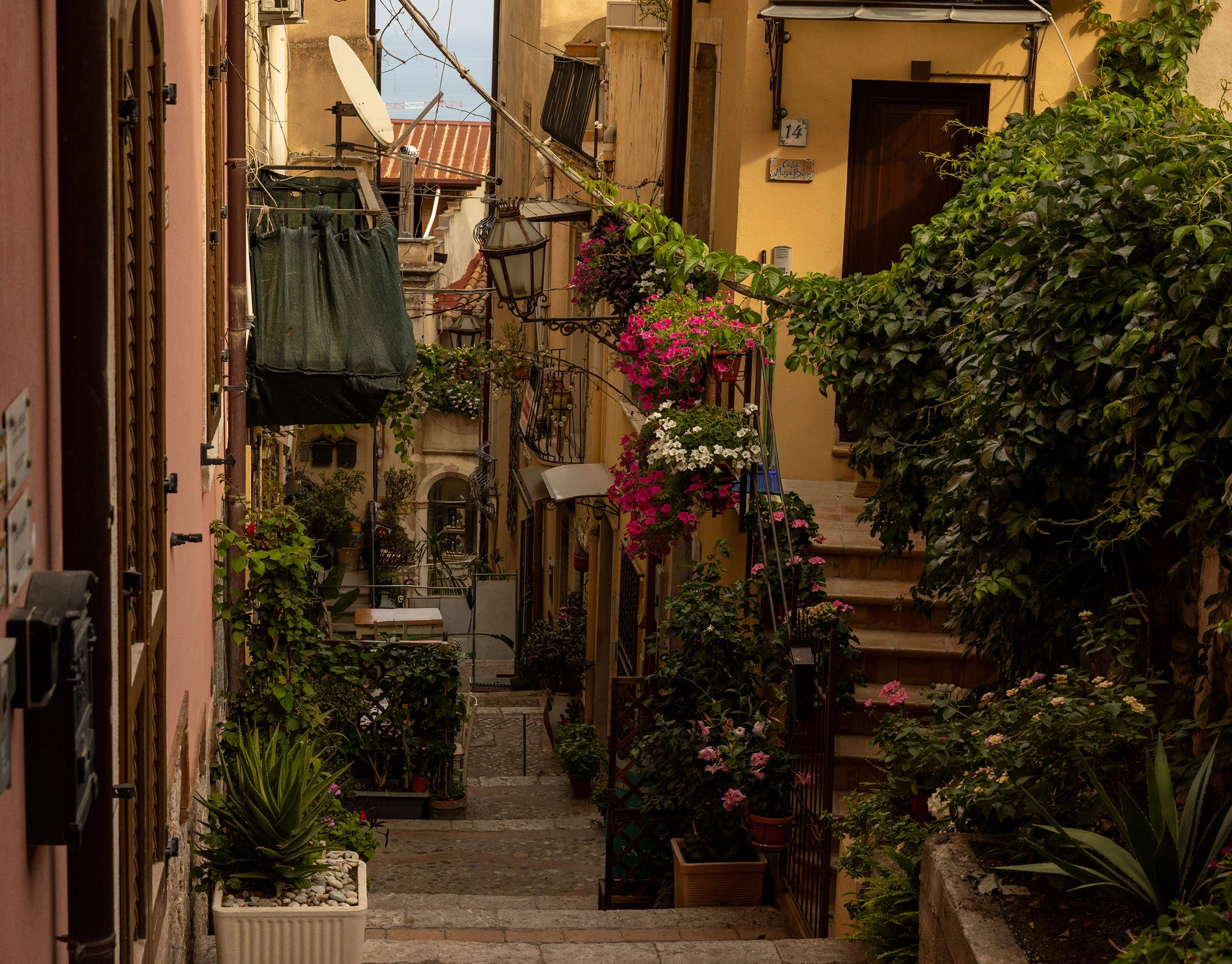
A flower-filled alley in the old town of Taormina.
“What are you seeing that I’m not?”
Eric says,
“As I always tell my students, ‘You have to have the lizard in your heart.’”
They have spent thousands of hours looking for these animals, he explains, and have become tuned to their body shape, their movements, even their sounds.
But there is a cost to that kind of specialization.
“I regularly miss very obvious things in the field because I’m so hyper-focused on just finding one organism.”
I love this.
Eric is a specialist studying one of nature’s great generalists.
I gesture around us at the Villa Comunale. It seems like such an artificial place for this conversation: an eccentric nineteenth-century garden full of palms, cycads and plants carried here from around the world, dotted with strange Victorian castles and surrounded by the walls and buildings of Taormina.
“Do the lizards actually like places like this?”
Very much.
“The manicured gardens provide ideal habitat for these guys, especially because of the added water and, likely, additional insects.”
The more Eric explains it, the less artificial the garden seems from a lizard’s perspective. A garden is food, shelter, shade and sun, with fountains attracting insects. Even the crowds may help by discouraging predators.
The lizards are extremely adaptable to human-built landscapes. His group was staying down by the sea and walking up to Taormina each day, and there were lizards all along the route.
That raises the less charming side of the story.
“So are these lizards basically winners?”
“The wall lizards are taking over!”
He means it half cheerfully and half as a warning. The success of one adaptable introduced species always comes at the expense of another.
Abundance is not the same thing as diversity.
This is where Eric gives me another way to think about the lizards.
Generalists.
Places that seem wildly different to us may not be so different to a lizard. Cincinnati, Los Angeles, Taormina—even a ski town in the Pyrenees buried beneath snow for five months of the year—can all contain some combination of what a wall lizard needs. Eric points out that Cincinnati is actually warmer than many places wall lizards inhabit in Europe, while San Pedro is much cooler than Taormina. Our map of these places is not necessarily the lizard’s map.
“Evolution generally works pretty slowly,” Eric tells me, “but when we have a resourceful, generalist species like these lizards, they tend to exploit new resources surprisingly quickly.”
Behavior goes first.
The lizard finds another wall. Another food source. Another patch of sun.
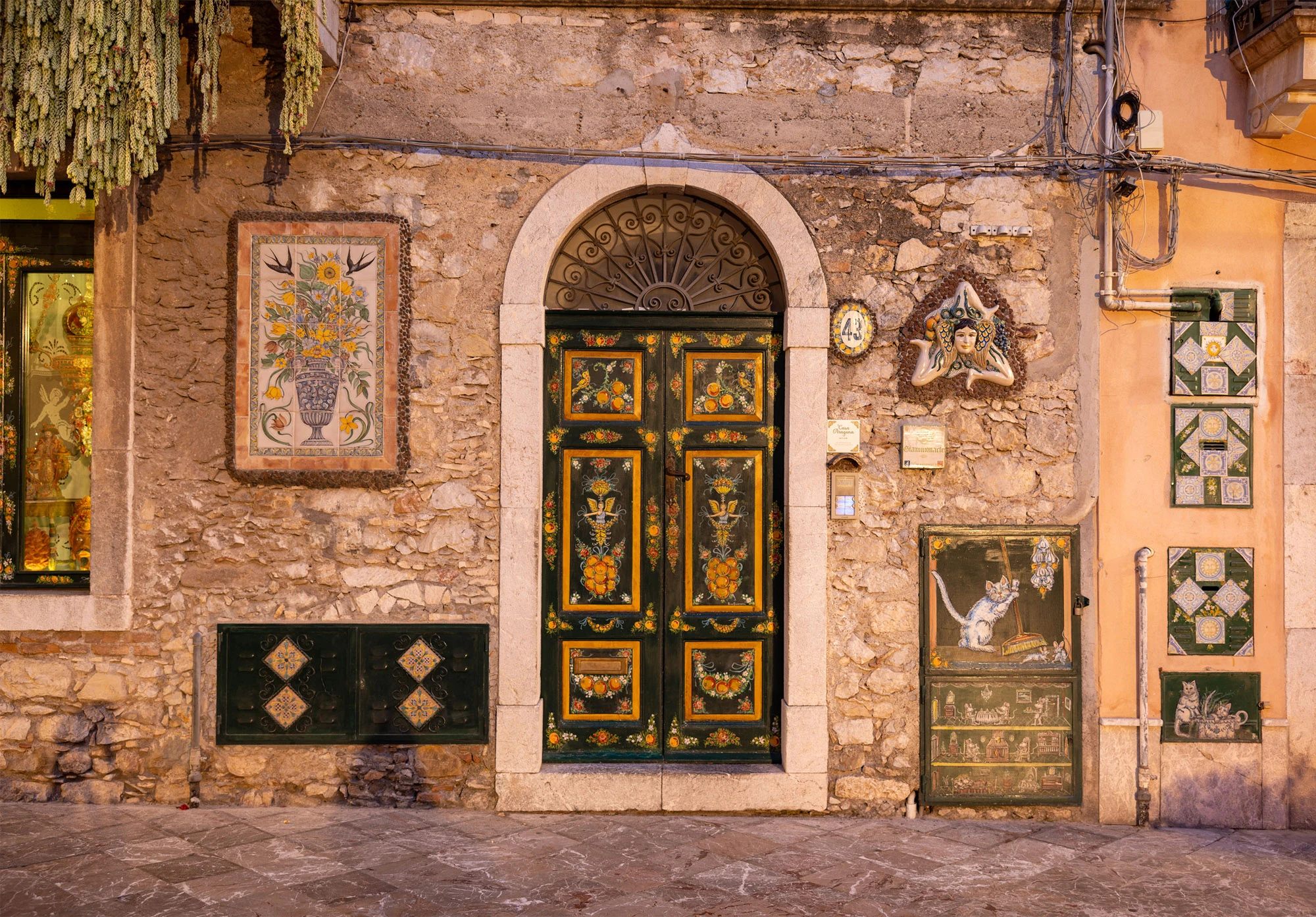
A weathered doorway in Taormina with orange fruit motifs.
“And that can then give evolution the time it needs to ’catch up’ to the new environment over many generations.”
That is an extraordinary advantage.
A generalist does not require the world to remain exactly as it found it.
It improvises.
Beholden to the Night
But there is another force Eric spends much of his life thinking about: temperature.
A lizard has a trick available to it that an orange tree does not. If it gets too hot, it can move.
Wall lizards are extremely good at what biologists call behavioral thermoregulation. They shuttle through their environment, finding sun when they need warmth and shade or shelter when they need to cool down.
Even on very hot summer days, Eric says, the Cincinnati lizards he studies can sometimes be more constrained by temperatures that are too cool than by temperatures that are too warm.
But nighttime is different.
During the day, a lizard can make decisions.
At night, asleep, it loses much of that power.
“When they’re sleeping at night,” Eric tells me, “they are kind of beholden to the environment around them.”
His work with other researchers has suggested that warmer nighttime temperatures can become a kind of thermal trap. Not the obvious catastrophe of an animal suddenly overheating, but the quieter physiological cost of being just a little too warm, night after night, when there is nowhere to go.
And humans, of course, have thermal limits too.
In Taormina, Eric’s team generally works from eight in the morning until noon or one. After that, he says, staying outside in the summer heat simply stops being a very good idea.
Eric’s lizards make me think again about the Portuguese ships. The Portuguese succeeded for something like the reason the wall lizard succeeds. Instead of being adapted to one place, like the shallow-draft mashoof that poled its way up the Tigris, the Portuguese Nau could navigate any ocean.
Humans move things. Humans construct environments. Certain organisms are unusually good at taking advantage of the environments we construct.
Over Mount Etna
Speaking of humans moving, we’re leaving Taormina; ready to cross over Mount Etna.
In the parking garage I yell “Watch out—” just as Ivan crashes into the side of the concrete wall.
The scrape along the side of the clean white Chinese rental is long, deep, and irreversible.
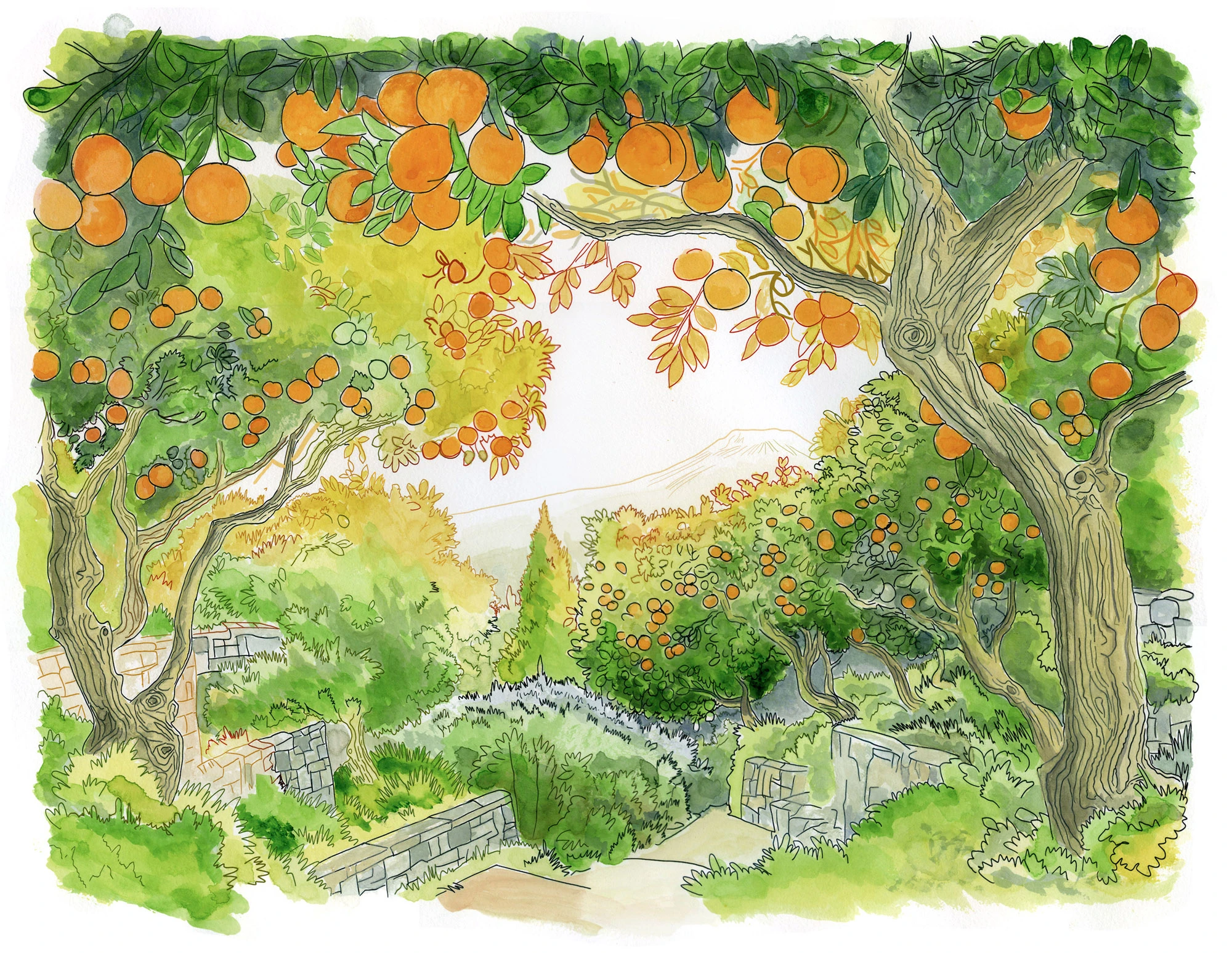
Orange groves on Mount Etna sketch. Liner pen and watercolor.
We leave Taormina and begin climbing the slopes of Mount Etna with a big dent, passing through small towns and then up into oak and chestnut woodlands bordered by dry grass. Hoopoes are calling from the edges of scrub thickets, and the landscape is dotted by hazelnut groves.
We pass into the thin band of vineyards and visit a small vineyard operating out of their home. There are stone walls separating properties here, and beyond us are old agricultural buildings, made of stone and thick with ivy. Mount Etna wines are known because of the volcanic soil they grow on. Below us, everywhere are oranges, and they too are known for where they grow. Miles and miles of orange groves spread across the lower volcanic landscape.
I had been thinking of the sweet orange as a great traveler.
Humans took oranges across oceans and planted it wherever they thought it would prosper. But orange trees can’t behave like Eric’s lizard. They can’t leave a wall that has grown too hot, or run into the shade, or scurry to the next valley.
So humans became the mechanism on which citrus adapted. We moved it, we supplied the water and grafted it a million times. We noticed mutations, and unusual fruit, and when something was working for us, we propagated it. In this way, humans moved the habitat around the tree. That helped the sweet orange spread far from its origins in Asia.
But Mount Etna tells the other half of the story. Once a traveler stays somewhere long enough, the place begins working on it.
It evolves, because the heat here matters. So does the cold. And the elevation, and the water. And most of all, the volcanic ground underneath. It grows warmer here, then colder. A typical Mount Etna afternoon is loaded with bright Mediterranean heat, and in the dead of night the cold can bite.
Someone always notices first. One tree ripens on its own schedule. One grower prefers a flavor the others walk past. A mutation shows up uninvited, a fruit turns an unexpected color, and a branch gets cut, grafted, and passed on.
The wandering orange starts acquiring a local identity.
Generalism gets you here. Specialization is what happens next.
And this brings me back to something Eric told me about nighttime. During the day, his lizards can move. At night, he said, “they are kind of beholden to the environment around them.” An orange tree is beholden to it all the time.
And here on Etna, being beholden to the night would produce something extraordinary.
For the orange, those nights helped create one of the most remarkable expressions of the fruit humans had carried out of Asia.
Sicily already grew blond sweet oranges—Biondo Comune oranges, Ovale oranges and Valencia oranges; the recognizable descendants of the wandering sweet orange I knew as a child.
Ferrari’s Hesperides and the First Red Oranges
Long before these oranges had a name, oranges were already refusing to behave.
I find this out almost by accident, reading about a Jesuit priest in seventeenth-century Rome named Giovanni Battista Ferrari. He was a scholar specializing in Hebrew and Syriac. This might sound like a strange gateway into citrus, but these old languages were hard to sort, and Ferrari was good at learning to sort things.
By the 1630s, Ferrari had traded languages for fruit. He wrote to citrus growers up and down the Italian peninsula and asked them oddly specific questions. He asked them what they grew, and what they called it. He wanted to know if their citrus trees were doing anything weird. He asked them to send him drawings of their fruits, and the fruit itself.
The answers were pure chaos. Volumes of answers about citrus crossed with citrus. Farmers grafting the strangest fruits. Every local area had its own name for every fruit, and those names kept multiplying. Nobody could keep up.
In 1646 he wrote a huge book called Hesperides, which described an orange with purple flesh that tasted like grapes, spotted far to the east.
I’d assumed the red started here, on Etna. But a single line in a 400-year-old book is proof that red oranges had origins elsewhere.
But something did happen here. Mount Etna’s unique temperatures and soils created the Sicilian blood oranges: Tarocco, Moro and Sanguinello. There is more to these fruits than just oranges with red pigment.
If you eat a navel or a valencia orange, they will taste sweet and juicy, and they can be perfectly perfect in an orange-y way.
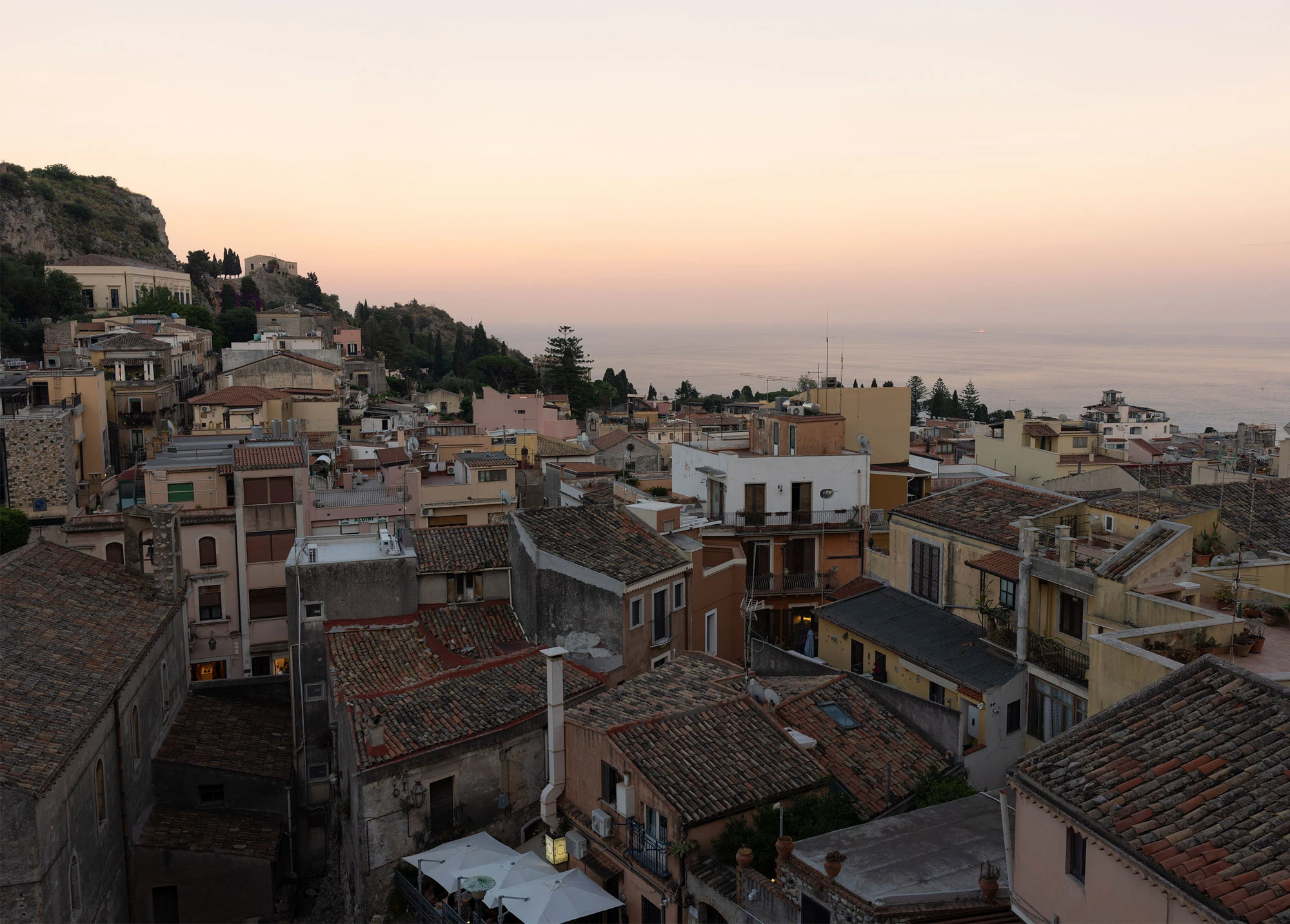
Sunset over Taormina and the Ionian coast.
But Sicilian blood oranges are quite different. They are sweet, but with an undercurrent of tang — the taste of raspberry, infused with lemony acid and even notes of red wine. Helena Attlee writes about this in The Land Where Lemons Grow. She describes Tarocco oranges as having a “complicated, multi-dimensional flavour.”
Moro oranges are darker, and they can even feel almost black. They are sharper, bolder, more acidic, deeper.
Both oranges trace back to Sanguinello, a streaked red orange that ripens in spring, long after every other orange has finished.
That color comes from anthocyanin. It’s the same pigment that makes pomegranates brilliant magenta. It’s usually rare in citrus, but loaded in blood oranges.
And it needs cold to develop. The EU’s legal definition of Arancia Rossa di Sicilia makes this official: the fruit belongs to this particular climate, and nowhere else.
As Attlee puts it:
“So it’s cold, not warmth, that sets blood oranges on fire on the Etna plain.”
A genetic mutation created the mechanism that allows these oranges to accumulate red anthocyanin pigments. But it’s Etna’s cold nights which help switch it on. It’s a balance of mutation and temperature, and somebody willing to tinker with grafts.
Gesualdo Di Naro’s Orchard
Around the beginning of the twentieth century, in the citrus country of Syracuse province, a man named Gesualdo Di Naro entered an orchard in the Carbone area near Pedagaggi. He recognized what appears to be a spontaneous bud mutation from Sanguinello trees.
When Di Naro entered that orchard, there was something about this bud that made him stop. Like Interdonato, he had a decision to make.
A bud mutation is only a random accident until somebody looks at it and says there is something about it that is worth keeping. And Di Naro turned one bud into a new grafted tree. And then it became several trees, and then an orchard.
What the Blood Orange Made of Sicily
Once Sicily made these oranges, what did the oranges make of Sicily?
The answer turns out to be pretty much everything. As export markets opened, eastern Sicily began to reorganize its entire economy around citrus. Lower elevation vineyards and olive groves were torn apart. Hillsides were cut into terraces. Rock was broken up to make retaining walls.
Water was found, moved, argued over, because none of it works without irrigation — the first half of what that man on the patio in Taormina told me on our first night: the history of Sicily and citrus is the history of water.
By 1958, Sicily was producing something like 400,000 metric tons of oranges a year, absurdly nearly sixty percent of everything grown in all of Italy. And the geography of this boom is concentrated on this Eastern Sicily region we’re driving through now.
Which gives a second meaning to something I’d written down without thinking much of it: below us, everywhere, are oranges. Miles and miles of orange groves spread across the lower volcanic landscape. At first, I didn’t understand what that really meant. Now I understand that it was a hundred years of people betting on this fruit.
Which is maybe the only way to explain what we barely notice. It’s not just the orange-fennel salad. It’s the orange juice and the orange granita and the marmalade and the candied peel folded into every pastry. It’s the orange motif painted on doorways and ceramics, on dresses and Christmas ornaments. In Sicily, orange is everywhere. Over generations, an abundance of the fruit integrated into every aspect of Sicily.
Eventually Tarocco, Moro and Sanguinello became not merely oranges grown in Sicily but Arancia Rossa di Sicilia—a protected name whose legal definition now depends upon the relationship between these fruits and this particular landscape.
That changed the meaning of the orange here. A traveling fruit became a specialty, a protected agricultural identity, something Sicily could send back out into the world carrying Sicily’s name with it.
Generalism had brought the orange to Sicily. Specialization gave Sicily an orange to call its own.
Jane taught me to wait for fruit, to choose it carefully, eat it only when it was exactly right, be seasonal about the whole business. I used to think that was just pickiness. Now I wonder if that kitchen habit is the story of the Sicilian orange.
I am thinking about that man on his patio in Taormina, and what he told me. I’d only been ready to hear half of it.
The history of Sicily and citrus is the history of water.
But I can’t make sense of the other thing he told me.
And who controls it.
I still don’t know. Not yet.