
Belize Moleskine Journal Notes
A pocket journal from southern Belize, filled with my own maps and a field guide to its wildlife.
Updated September 29, 2026
For this trip, I carried the small, classic-size Moleskine journal, the kind that fits in a shirt pocket. Before I left, I used its pages to map out the entire trip, from the coast to the rainforest and the villages along the way to Monkey River Town. I also condensed the animal and plant field guides I would have otherwise carried into its pages, sketching and noting the birds, mammals, reptiles, trees and reef fish I hoped to see. That way, a single small notebook became my map, my field guide and my journal, all in one.
I traveled with Vance, camping in the underbrush behind a beach at Hopkins, working our way south to Monkey River Town, then turning inland to San Ignacio and across the border to the Maya ruins at Tikal. The last pages were written on the road, in bars and on the riverbank, and they grew into two stories: The Philosophy of Monkey River Town and Old Highways of Peten.
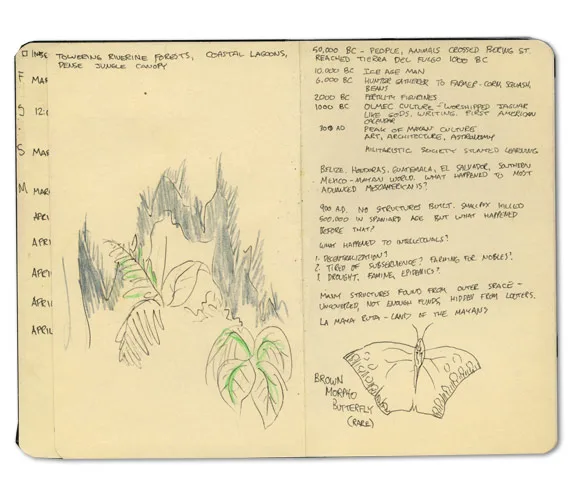
Towering riverine forest and a timeline of Mesoamerica, from the first people to cross the Bering Strait to the collapse of the Maya, with a brown morpho butterfly.
Forests of the Maya
Belize is a small country, but it holds lowland rainforest, pine ridge, mangrove coast and the second-largest barrier reef in the world. The Maya farmed these forests for thousands of years, and the British logged them for centuries, first for logwood dye and then for mahogany. I condensed their botany into the first pages: the ceiba, sacred to the Maya, the guanacaste, the gumbo-limbo and the palms.
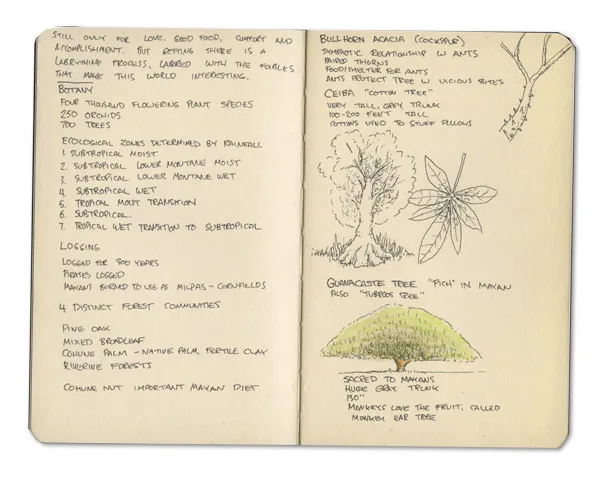
A botany of Belize, its ecological zones and forest types, beside a bullhorn acacia, a ceiba, or cotton tree, and a guanacaste, whose fruit the monkeys love.
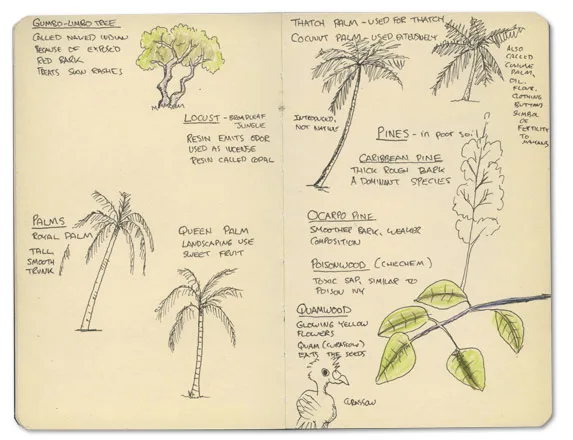
The gumbo-limbo, royal and queen palms, thatch and coconut palms, Caribbean and ocote pines, poisonwood and quamwood, with a great curassow.
Toucans, Jaguars and Howler Monkeys
Southern Belize still holds most of the large animals of Central America. The Cockscomb Basin, below the Maya Mountains, was set aside for the jaguar, and black howler monkeys were brought back there after they had vanished from the area. The national bird is the keel-billed toucan and the national flower the black orchid, and both are here.
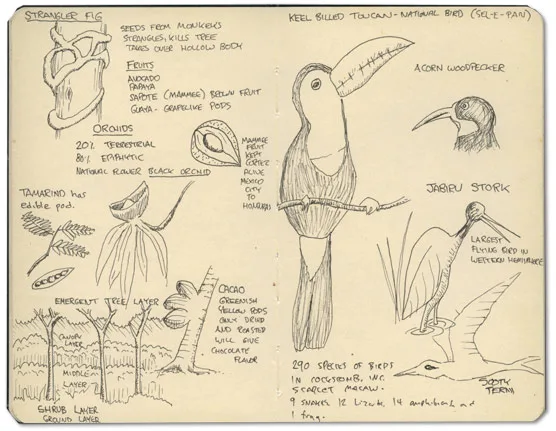
A strangler fig, the layers of the rainforest, cacao and the black orchid, facing the keel-billed toucan, an acorn woodpecker, a jabiru stork and a sooty tern.
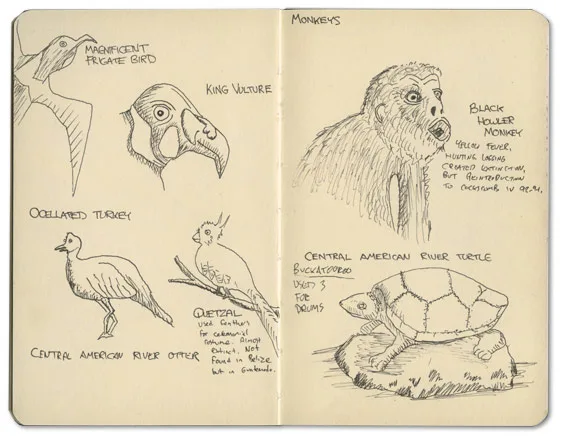
A magnificent frigatebird, a king vulture, an ocellated turkey and a quetzal, with a black howler monkey and a Central American river turtle.

A spider monkey and the cats of Belize, the jaguarundi, margay, jaguar, ocelot and puma, with an anteater and a coati.
Snakes, Manatees and the Reef
The coast is another country: mangrove, lagoon and reef, with West Indian manatees in the shallows and crocodiles in the rivers. The forest floor has its own hazards, the botfly, the scorpion and above all the fer-de-lance, the snake most feared in the Caribbean lowlands. The tapir, which Belizeans call the mountain cow, is the national animal.
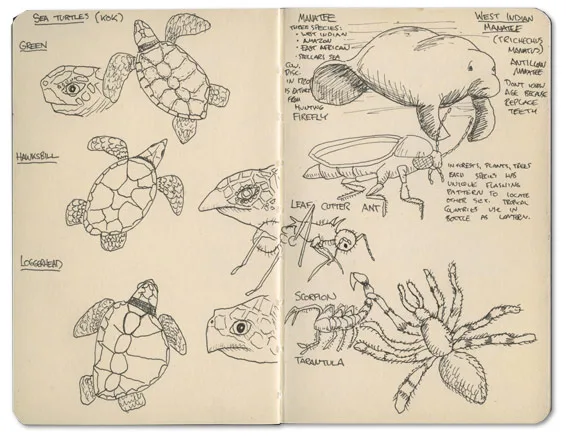
Green, hawksbill and loggerhead sea turtles, a West Indian manatee, a leafcutter ant, a firefly, a scorpion and a tarantula.
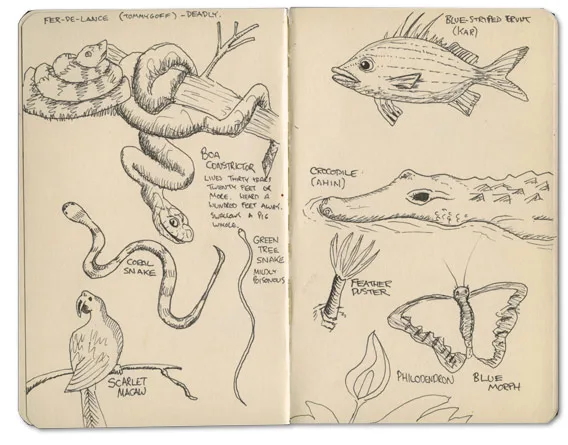
A fer-de-lance, a boa constrictor, a coral snake, a green tree snake and a scarlet macaw, with a blue-striped grunt, a crocodile, a feather duster worm and a blue morpho.
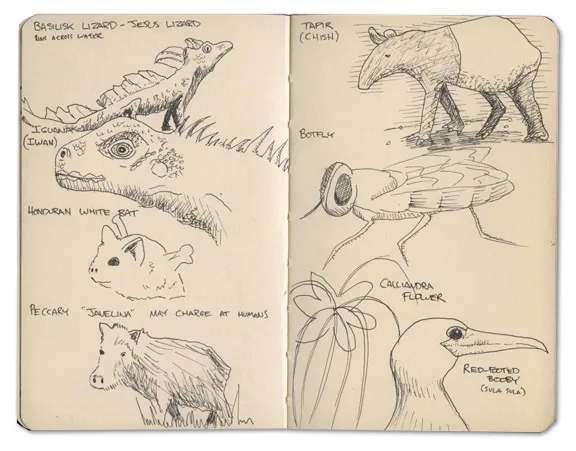
A basilisk, the Jesus lizard that runs across water, with a green iguana, a Honduran white bat, a peccary, a tapir, a botfly, a calliandra flower and a red-footed booby.
The People of Belize
The country’s history is as mixed as its forests. The Maya were here first, the British came for timber and stayed until independence in 1981, and the Garifuna, Creoles, Mestizos, East Indians and Mennonites each arrived by a different road. I wrote them all down, alongside notes on Placencia, Monkey River Town and the Toledo District in the far south.

Notes on sugar, timber and independence, and on Placencia, Monkey River Town and the Toledo District, with a paca, a heliconia, a cat-eyed snake, a spadefish and a sapodilla, once tapped for chewing gum.
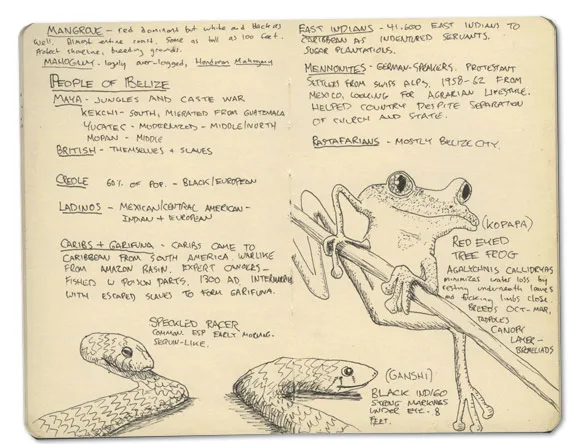
The people of Belize, from the Maya and Garifuna to the Mennonites, with a red-eyed tree frog, a speckled racer and a black indigo snake.
Up the Monkey River
The rest of the journal is the trip itself. Lunch was triggerfish and a Belikin beer. At Monkey River Town there was a restaurant with three tables and unfinished walls, and a river so shallow we had to get out and push the boat. I woke up covered in bites, and drew the crocodile tracks we found. In San Ignacio, the hotel had no water because the town’s main had broken.

A gray angelfish, a barrel sponge, a lavender sobralia orchid and a nurse shark, with a temple at Tikal and notes on the cave of Actun Tunichil.

A dock and notes from the first day on the road to Hopkins, with a lunch of triggerfish and Belikin, facing the Cockscomb Basin and a leafcutter highway on the forest floor.

Overheard notes from the bars of Placencia, and Alice’s Restaurant in Monkey River Town, with a bottle of hot sauce on the table.
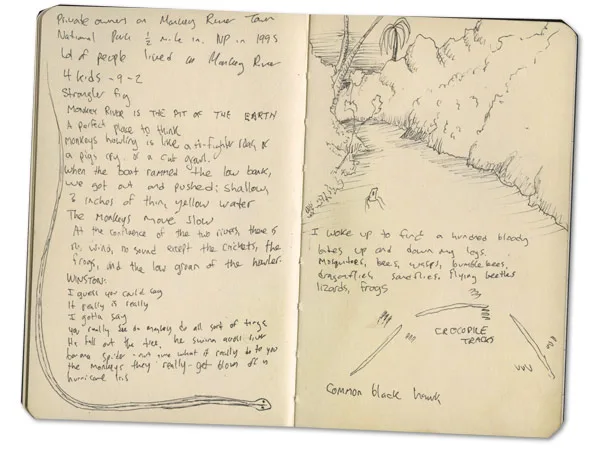
Notes on Monkey River, the pit of the earth and a perfect place to think, with the howlers, the shallow yellow water, crocodile tracks and a common black hawk.

Bamboo reed used to build houses, a banana spider and a tree frog, facing a street in San Ignacio outside the Casa Blanca hotel.

A bottle of Marie Sharp’s habanero sauce with its ingredients, red habaneros, carrot, onion, key lime juice, vinegar, garlic and salt, facing a plate of food and a Burning Toucan sauce label.