
El Valle de Antón Moleskine Journal
Ink and watercolor sketches of the birds, frogs and orchids of a Panamanian volcano crater.
Updated September 29, 2026
El Valle de Antón is a small mountain town built on the floor of an extinct volcano’s crater, about two hours west of Panama City and some 2,000 feet above the Pacific lowlands. The cooler air, the ring of forested ridges and the streams running off them make the caldera one of the easiest places in Panama to see cloud-forest wildlife, and these pages are what I found there: a bay-headed tanager, a scarlet-thighed dacnis and an orange-bellied trogon, an orange-sided leaf frog, a long-tailed damselfly and a spider orchid, along with a few watercolors of the valley itself. El Valle was once the stronghold of the Panamanian golden frog, which has all but vanished from the wild since the chytrid fungus swept through Central America; I wrote about that epidemic, and the glass frogs that remain, in The Wise Glass Frog of El Valle de Antón.
I stayed at the Canopy Lodge in the valley, and on one night of hard rainy-season rain I waded the creeks with Mario, a biologist and herp guide, and Jose, the lodge’s birding guide. The Sunday market, the trails up to La Mesa and long lists of birds all found their way into the journal. It was also in El Valle that I found a strange white spider posing as part of an orchid, which took years to put a name to: the flower crab spider. The valley sits on my hand-painted map of Panama.
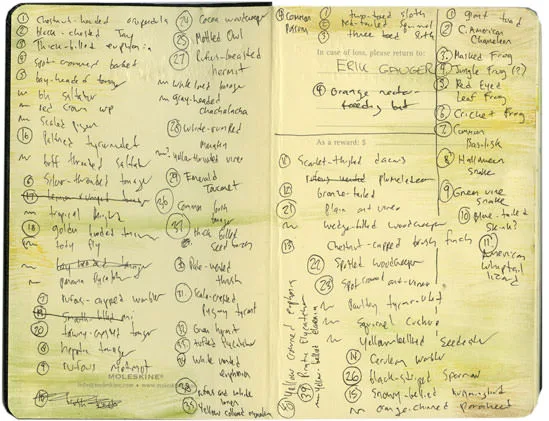
The first page of the bird list, from the chestnut-headed oropendola to a scarlet-thighed dacnis, beside tallies of sloths, frogs, snakes and lizards.
The Golden Frog’s Valley
On Sundays the town fills with an open-air market of fruit, plants and carvings, and many of the carvings are yellow frogs. The Panamanian golden frog is the national symbol of a young country and the emblem of El Valle, and it runs through these pages as both, long after it disappeared from the streams.
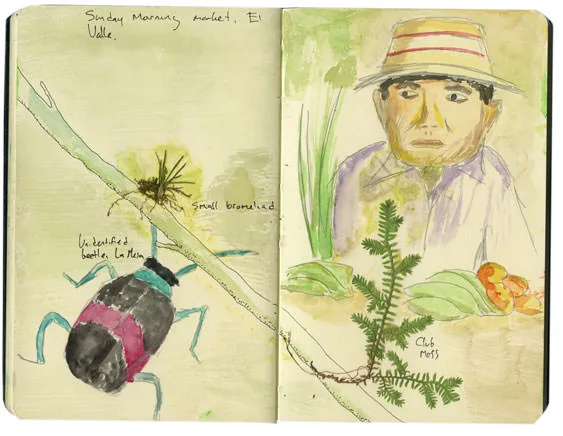
The Sunday morning market in El Valle, with an unidentified beetle from La Mesa, a small bromeliad and a sprig of club moss.
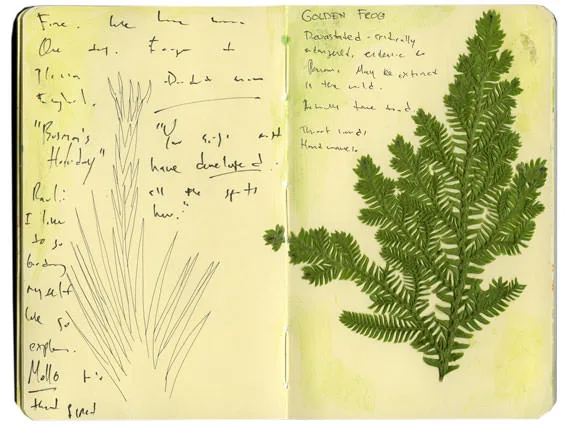
Notes on the golden frog, devastated and possibly extinct in the wild, beside a pencil study of grasses and a pressed fern.
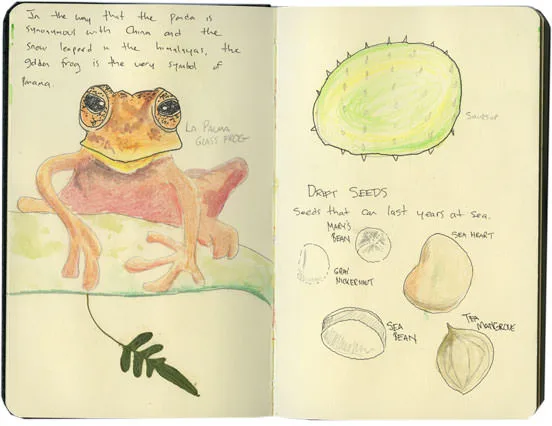
A La Palma glass frog under a note that the golden frog is the very symbol of Panama, and a soursop beside drift seeds that can survive years at sea: Mary’s bean, gray nickernut, sea heart and sea bean.
Night in the Streams
The streams run cold and fast off the ridges of the crater, the kind of water the golden frogs once lined. At night they still hold plenty: glass frogs so translucent that their organs show through their skin, leaf frogs, basilisks, cane toads and katydids, all of it visible only in the beam of a lamp.
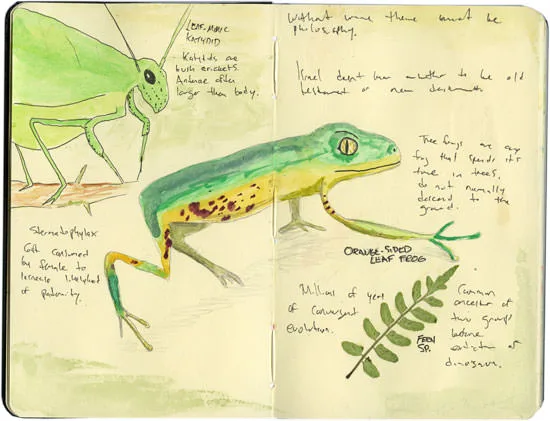
An orange-sided leaf frog and a leaf-mimic katydid, with notes on tree frogs and a pressed fern.
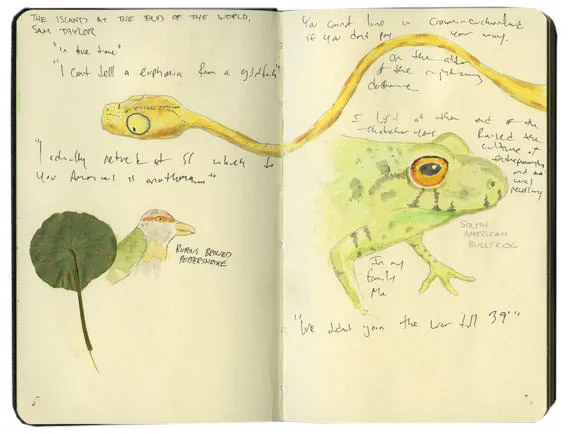
A slender yellow snake, a rufous-browed peppershrike and a South American bullfrog, with lines copied from a novel by Sam Taylor.
A glass frog, a pressed club moss and a white-bellied antbird, with notes on the antbirds that follow army ant swarms.
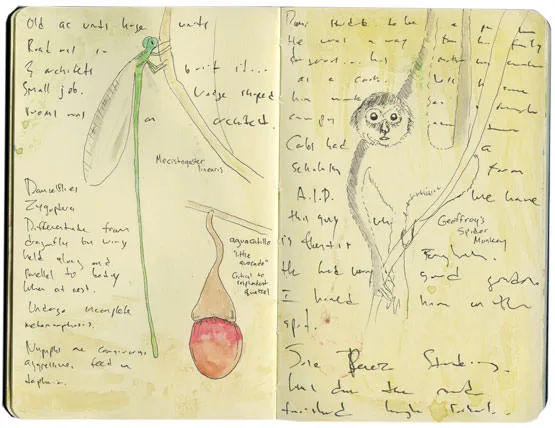
A long-tailed damselfly, an aguacatillo fruit, a favorite of the resplendent quetzal, and a Geoffroy’s spider monkey.
Tanagers, Trogons and Motmots
El Valle sits between the Pacific lowlands and the cloud forest of its ridges, and it draws birds from both. The forest around town holds tanagers, trogons and owls, and the tody motmot, a small and secretive bird that brings birders to El Valle from all over.
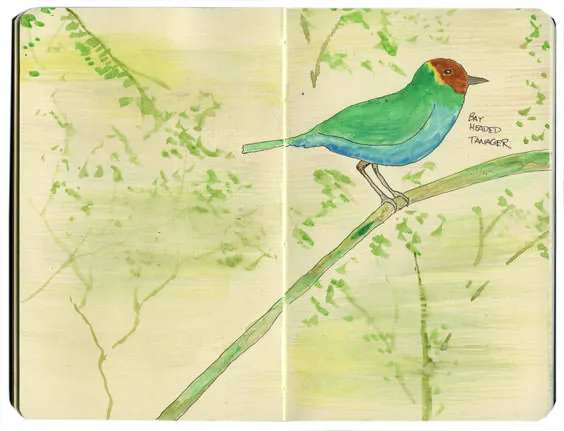
A bay-headed tanager, green and blue under a rufous cap.
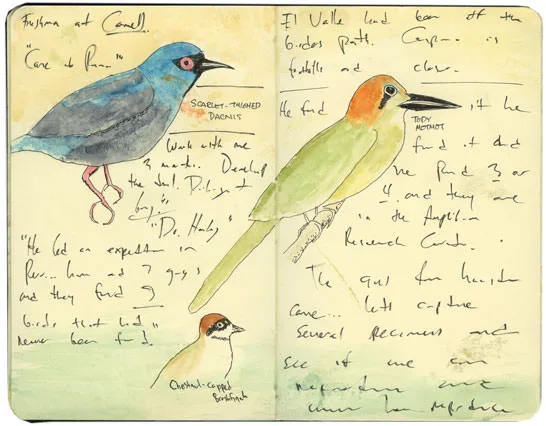
A scarlet-thighed dacnis, a tody motmot and a chestnut-capped brushfinch, surrounded by notes.
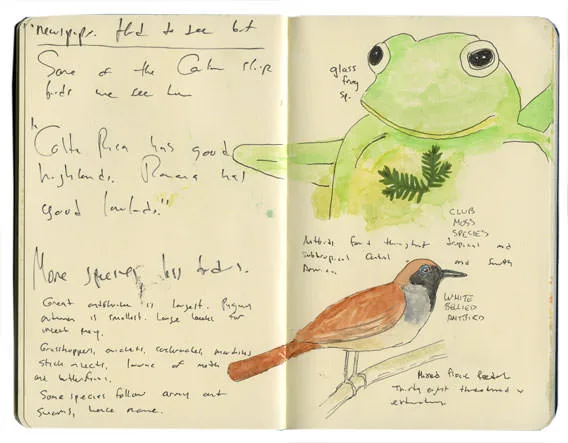
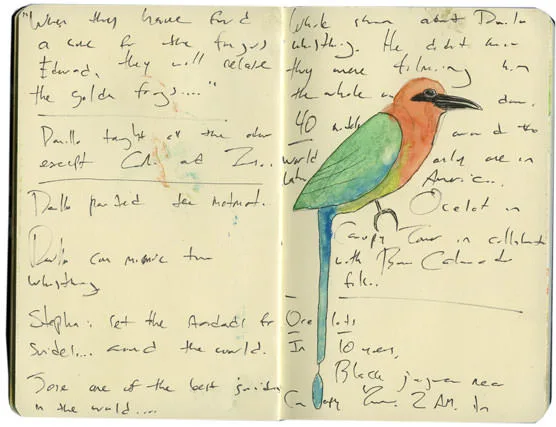
A motmot with its racket-tipped tail, beside notes on the golden frogs, a guide who could mimic bird whistles, and ocelots.
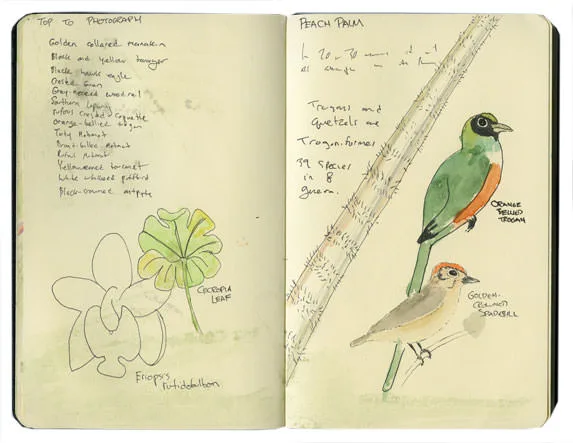
An orange-bellied trogon and a golden-crowned spadebill on a peach palm, with a wish list of birds, a cecropia leaf and the outline of an orchid.
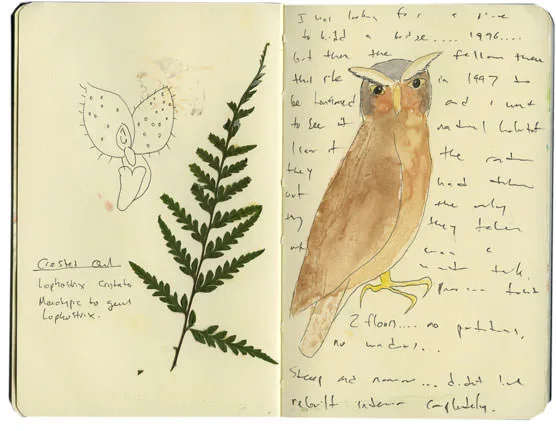
A crested owl, Lophostrix cristata, the only member of its genus, with a pressed fern and an unfinished flower.
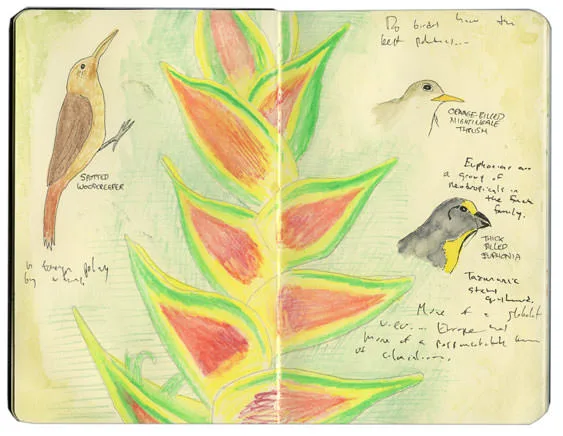
A heliconia in flower, with a spotted woodcreeper, an orange-billed nightingale-thrush and a thick-billed euphonia.
Spider Orchids and Sensitive Plants
The last pages turn to plants: a spider orchid with its long, spidery sepals, a flowering anthurium and the sensitive plant, a creeping pantropical weed whose leaves fold shut at a touch, pressed flat between the pages. Beside them is a blue-throated goldentail, one of the hummingbirds that work the valley’s flowers.
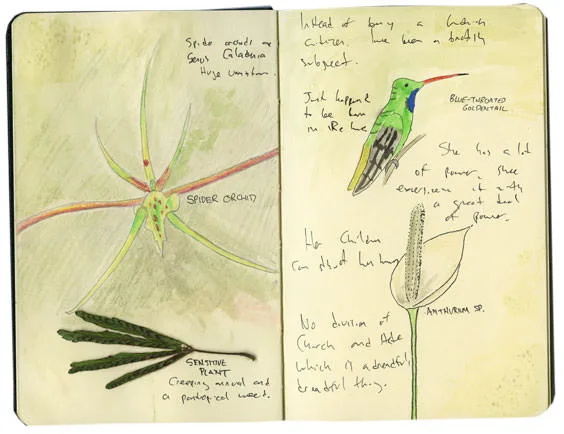
A spider orchid, a blue-throated goldentail hummingbird, an anthurium and a pressed sprig of sensitive plant.