
San Isidro, Ecuador Moleskine Journal Notes
My Moleskine notebook from Ecuador's Eastern Slope of the Andes.
Updated September 29, 2026
These days, I am seeing more folks typing away at some small device while they are traveling. I wonder if the habit takes away from them being in a place. The moleskine journal is about the size of a smart phone, and has none of the features. But every year I find it the best way to organize my travels for my travel photography blog, collect ticket stubs, pressed flowers and stamps, and make notes for my blog. On the Eastern Slopes of the Andes, there was quite a bit of rain, and so I found myself often perched under the awning, painting whatever I could see in the downpour.
San Isidro is a birding lodge in the cloud forest near Cosanga, on the eastern slope of the Andes, where the mountains begin their long fall toward the Amazon. I traveled there with Gabriel, a naturalist and bird guide, by way of the high páramo at Papallacta Pass and the hummingbird lodge at Guango, a journey I wrote about in The Sylph in the Forest. From San Isidro we walked the Guacamayos Ridge Trail, looking down the throats of bromeliads for frogs. The whole route is on my painted map of Ecuador.

The checklist opens the journal, from a great thrush and a blue-and-white swallow to the Andean condor, carunculated caracara and paramo ground-tyrant of the high pass.
The Eastern Slope
The Andes run the length of South America, and in Ecuador they rise as two parallel ranges. Cross them eastward from Quito and the land changes by the thousand feet: treeless páramo, then temperate forest, then cloud forest heavy with moss, bromeliads and tree ferns. Each band has its own birds, frogs and plants, and the steep slopes keep them apart.
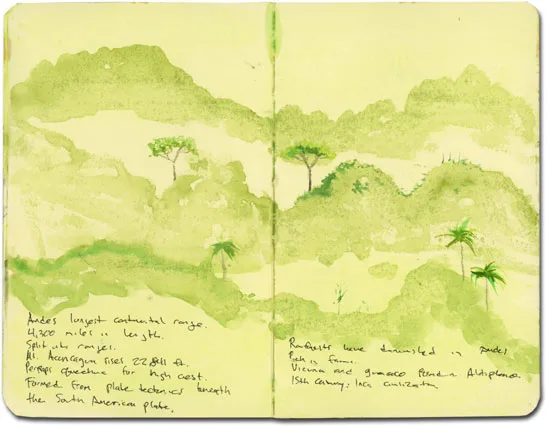
Green watercolor hills of the eastern slope, with notes on the Andes, the longest continental mountain range on Earth, from Aconcagua to the Inca.
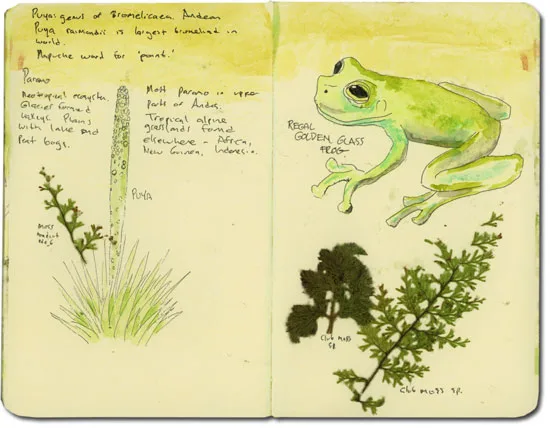
A puya and notes on the páramo, a green glass frog and two pressed club mosses.
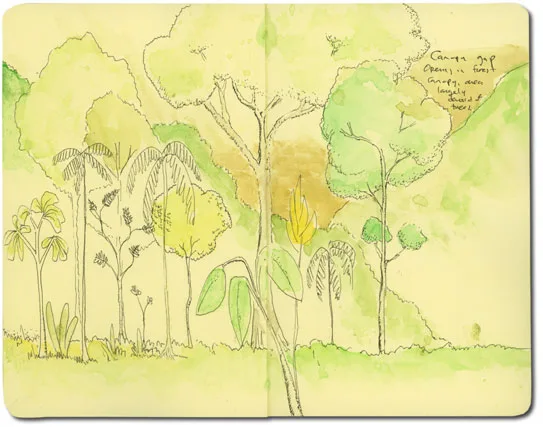
The cloud forest in pencil and wash, with a note on the canopy gaps left by fallen trees.
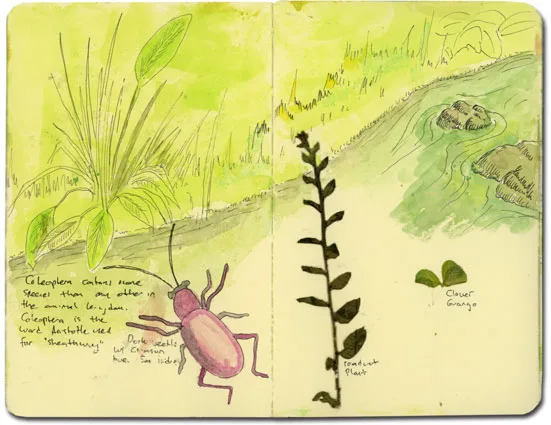
A dark beetle of crimson hue, with a note that beetles hold more species than any other order of animals, a pressed plant and a clover from Guango.
Birds of the Cloud Forest
San Isidro is known for its tanagers, hummingbirds and quetzals, and for an owl that has puzzled ornithologists for years. The San Isidro owl looks like something between the black-and-white owl and the black-banded owl, and its identity is still argued over. We saw one perched near our cabins, and it went into the list.
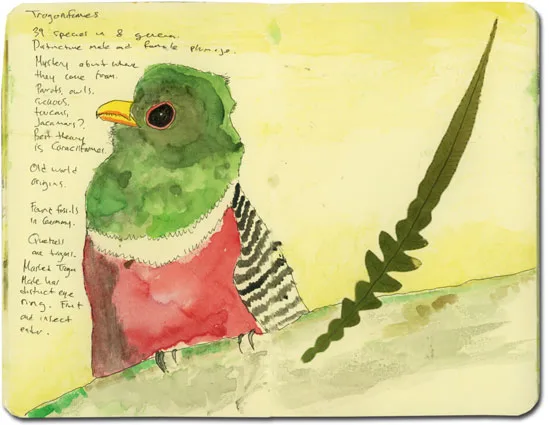
A trogon, with notes on the trogon order, its Old World origins and fossils found in Germany, and a pressed fern.
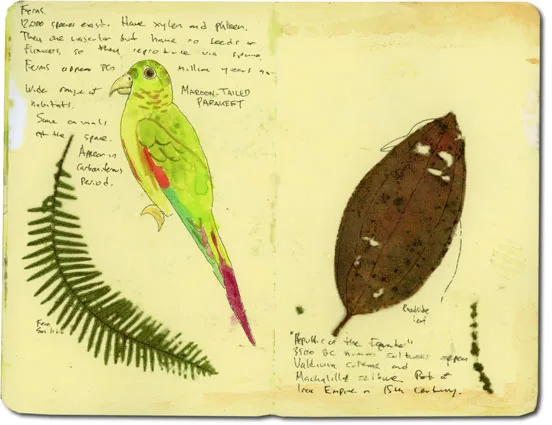
A maroon-tailed parakeet and a pressed fern, with notes on ferns and on Ecuador’s ancient Valdivia and Machalilla cultures.
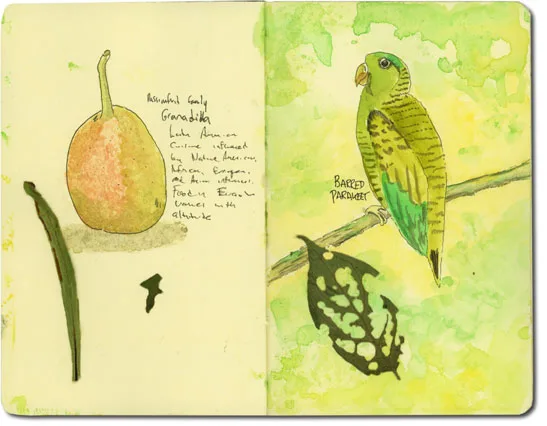
A granadilla, the sweet passionfruit of the Andes, and a barred parakeet, with pressed leaves.
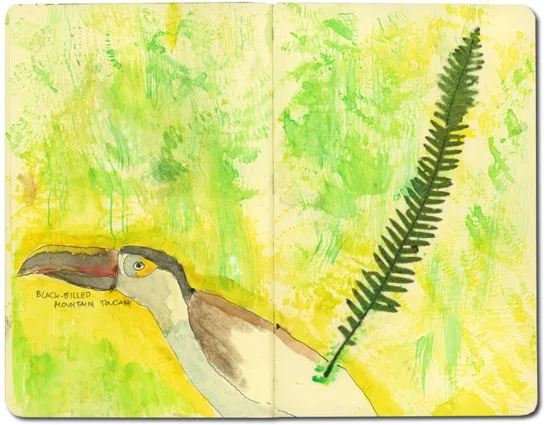
A black-billed mountain toucan against a wash of green, with a pressed fern.
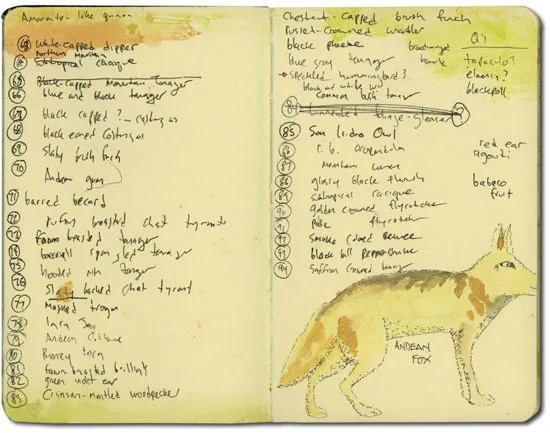
The bird list reaches the San Isidro owl, beside an Andean fox.
Frogs, Snakes and Moths
Frogs were my own quarry. Ecuador has hundreds of amphibian species, and many of the smallest are rainfrogs, which skip the tadpole stage and hatch from their eggs as tiny adults. At night the lodge lights drew moths, and the trails and roads turned up snakes, from a harmless slug-eater to the common lancehead, one of the most dangerous snakes in South America.
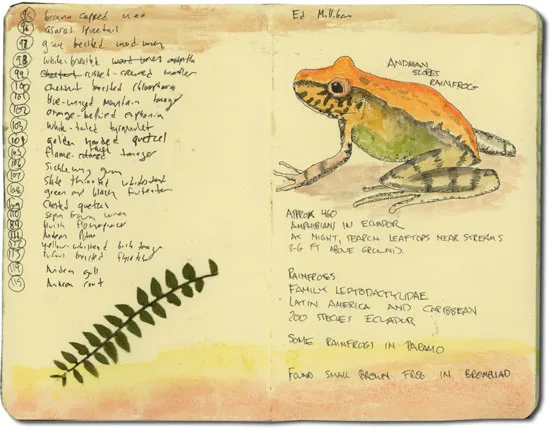
An Andean slopes rainfrog with notes on rainfrogs, and a line about the small brown frog I found in a bromeliad.
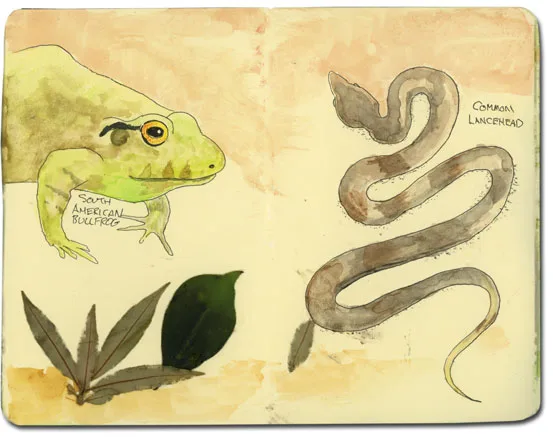
A South American bullfrog and a common lancehead, with pressed leaves.
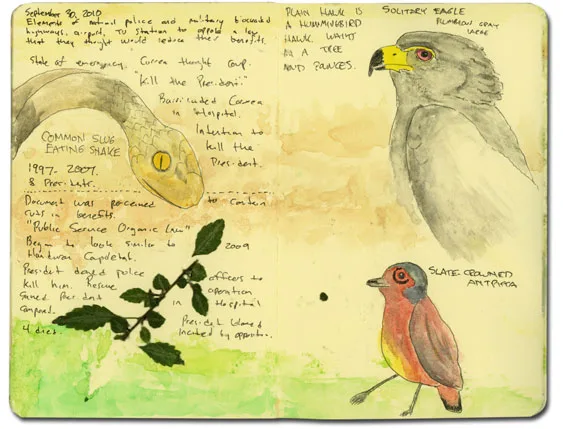
A common slug-eating snake, a solitary eagle and a slate-crowned antpitta, around notes on the police uprising of September 30, 2010, when President Correa was held in a police hospital.
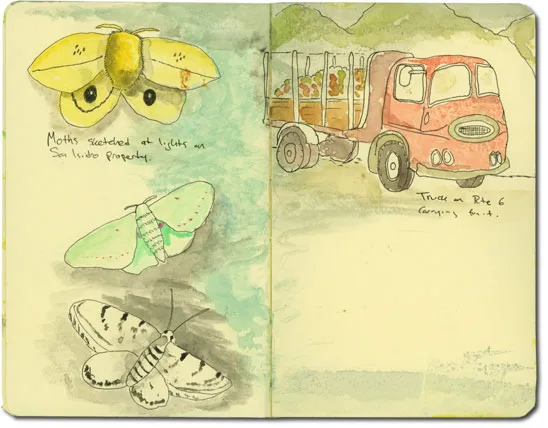
Moths sketched at the lights on the San Isidro property, and a truck loaded with fruit on the road.