
Dominican Republic Moleskine Journal
Watercolor and ink sketches of the birds, reptiles and coastlines of Hispaniola.
Updated September 24, 2026
I kept this small Moleskine journal during a trip to the Dominican Republic for a wedding. Before we left, I spent weeks learning the plants and animals of Hispaniola, and I hoped to reach some of the island’s remote corners. Delayed flights and the usual travel troubles kept us from getting very far, so much of this journal became a study of the island I wanted to see, sketched from field guides and filled in with the wildlife I found along the way.
An Island Made of Two Islands
Hispaniola is a remarkable place for a naturalist. It is the second-largest island in the Caribbean, with mountains, deserts, mangroves and reefs, and many of its species live nowhere else on Earth. The journal opens with the Hispaniolan lizard-cuckoo and the solenodon, a strange, shrew-like mammal with a venomous bite that has survived here since the age of the dinosaurs. Later pages include the endangered Ridgway’s hawk, now down to a small number of breeding pairs, and the narrow-billed tody, a tiny, bright green bird found only on this island. There are also rhinoceros iguanas, anoles, a Hispaniolan common treefrog, and the Jaragua dwarf gecko, one of the smallest reptiles in the world, discovered on Isla Beata off the southwest coast.
Part of the reason is geology. Hispaniola is really two islands stitched together: millions of years ago, a northern island and a southern one drifted into each other, and the seam still shows in the wildlife, with some species found only on the old southern block around the Barahona Peninsula. The island also holds the extremes of the Caribbean. Pico Duarte, in the Cordillera Central, is the highest mountain in the region at just over 10,000 feet, while Lake Enriquillo, a salt lake in the southwest, is the lowest point, well below sea level, and home to American crocodiles and rhinoceros iguanas. Even the national bird is a one-off: the palmchat, which builds great communal nests in royal palms and is the only member of its own bird family.
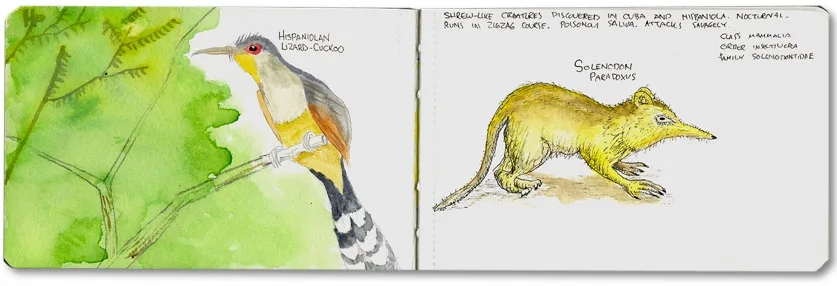
A Hispaniolan lizard-cuckoo and a Hispaniolan solenodon, one of the island’s two surviving native land mammals.
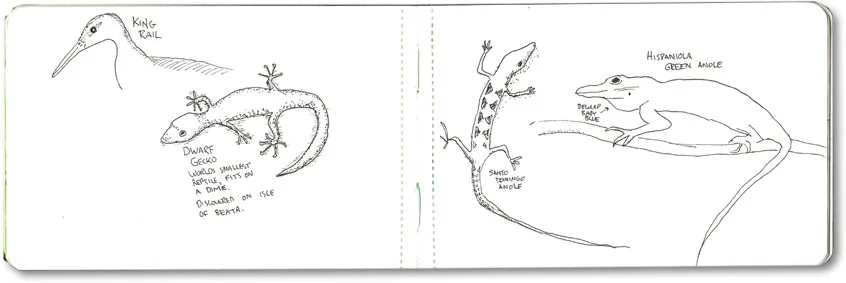
A king rail, the Jaragua dwarf gecko, a Santo Domingo anole and a Hispaniolan green anole.

Ridgway’s hawk, one of the rarest birds of prey in the world, and the narrow-billed tody, both found only on Hispaniola.
Mapping the Island I Wanted to See
I also drew a map of the Dominican Republic, from Monte Cristi in the northwest to the Samaná Peninsula, Los Haitises and Punta Cana in the east, and the islands of Saona and Catalina in the south.
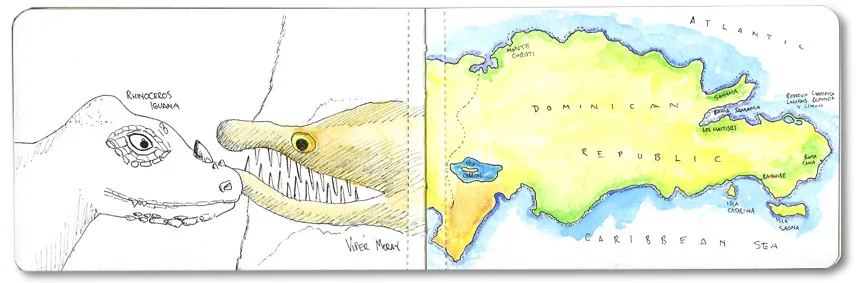
A rhinoceros iguana meets a viper moray, beside my map of the Dominican Republic.
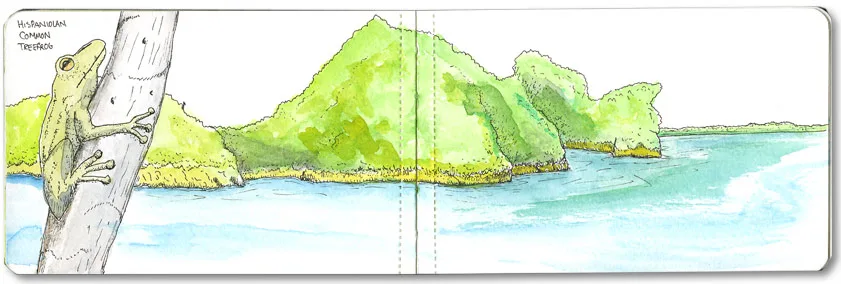
A Hispaniolan common treefrog, and forested islands rising from the bay.
Salt Flats and the Sea
The journal closes with the sea: a viper moray, a Cuban dogfish, flamingos in the salt flats, and the Antillean mango, a hummingbird that shimmers green and purple in the right light.
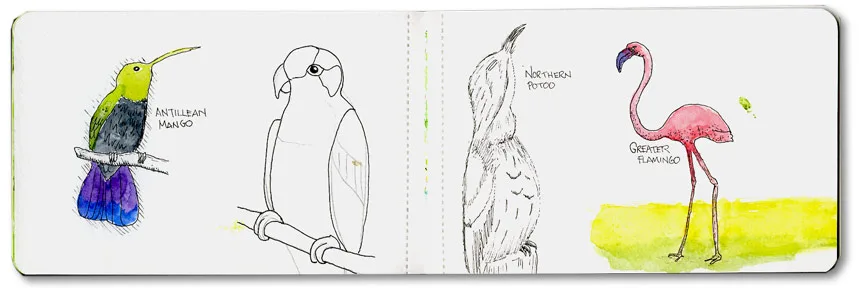
An Antillean mango, an unfinished parrot, a northern potoo and a greater flamingo.
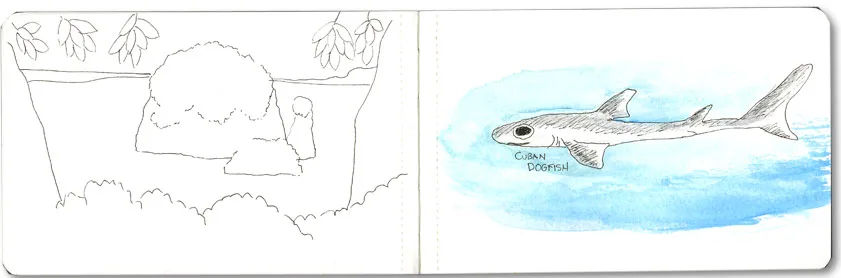
An unfinished forest scene, and a Cuban dogfish, a small shark of the deep Caribbean.