
Aeolian Islands Map
A hand-drawn map of the seven volcanic islands of the Tyrrhenian Sea, north of Sicily.
Updated September 29, 2026
Stories from the Aeolian Islands: Lipari and the Colonel's Lemon
The Aeolian Islands rise from the Tyrrhenian Sea north of Sicily as a scattered chain of seven volcanic islands: Lipari, Vulcano, Stromboli, Salina, Filicudi, Alicudi, and Panarea. The ancient Greeks called them the Isole Eolie and believed them the home of Aeolus, keeper of the winds. Stromboli has been in nearly continuous eruption for two thousand years. The archipelago is a UNESCO World Heritage Site. I made this map using watercolor and Copic markers.
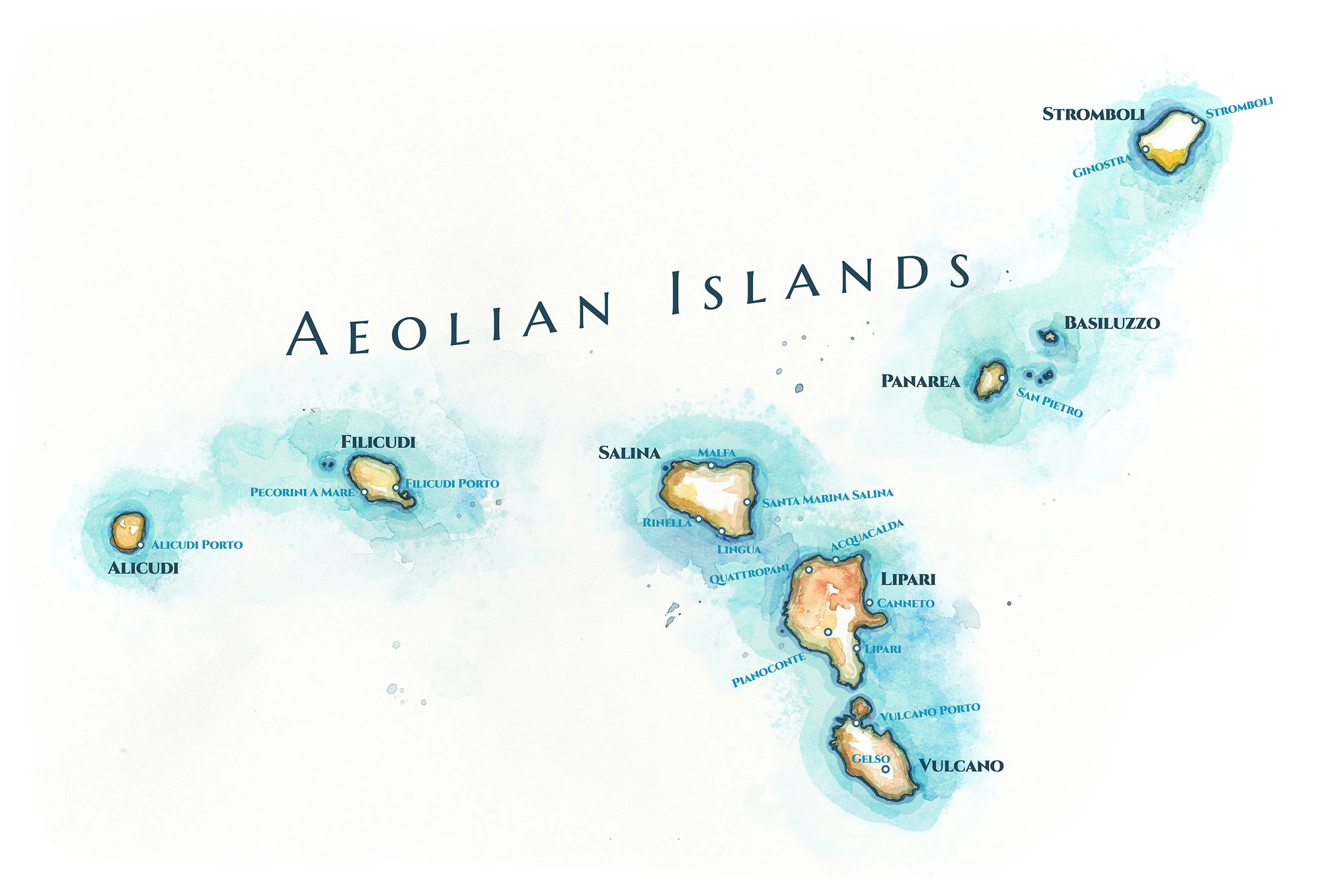
On the map the islands fall into a loose chain. Alicudi and Filicudi, the smallest and most remote, trail off to the west. Salina, Lipari and Vulcano run in a line toward the Sicilian coast, and Panarea, its satellite Basiluzzo and finally Stromboli stand off to the northeast. Lipari is the largest and busiest, with its port town, Canneto and the villages of Acquacalda, Quattropani and Pianoconte. Salina is made of two old volcanoes joined at the waist, and its peak is the highest point in the archipelago, green with ferns and planted with capers and Malvasia vines. The other islands have only a harbor or two: Rinella and Lingua, Vulcano Porto and Gelso, San Pietro on Panarea, and Ginostra on the far side of Stromboli, a village long reachable only by sea.
These islands gave the world some of its words for fire. Vulcano was the forge of the god Vulcan, and it lent its name to every volcano on Earth. Stromboli, which throws up small bursts of lava every few minutes, is called the Lighthouse of the Mediterranean, and geologists use its name for that kind of eruption. On Lipari, Neolithic people quarried black obsidian and traded it across the Mediterranean, and the island’s northeastern shore is still white with pumice.
The islands hold one of the rarest reptiles in Europe, the Aeolian wall lizard, which survives only on a few sea stacks and one headland of Vulcano. Eleonora’s falcons nest on the cliffs in late summer, and every spring and fall, migrating birds cross these waters between Africa and Europe.
My Travels in the Aeolians
Jane and I crossed by ferry from Milazzo to Lipari with our friends Iva and Ivan, and one morning at breakfast on Lipari I finally saw the European Bee-eater I had chased for fifteen years. I wrote about the island, its lemons and the colonel whose name one of Sicily’s lemons carries, in Lipari and the Colonel’s Lemon. The islands also appear on my Sicily map.