
A companion to Chili Peppers of the World
The Scoville Ladder
Every pepper on the page, from the sweet bell to the ones that come with warnings.
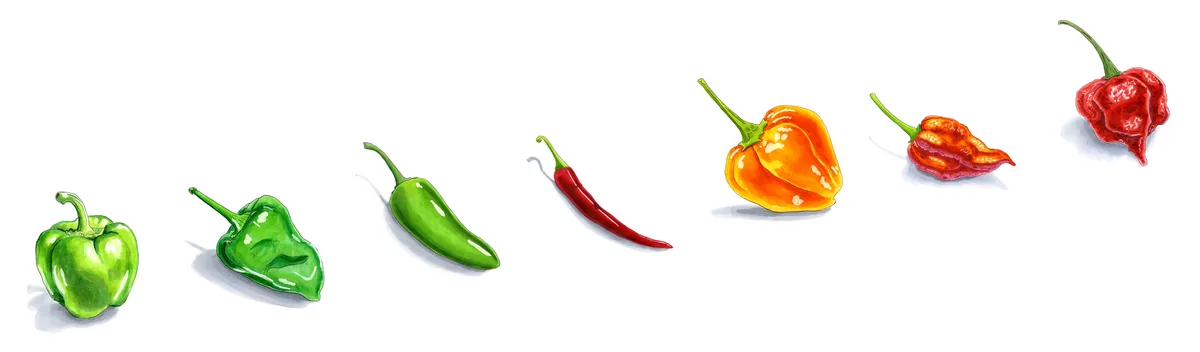
Scoville heat units measure how much capsaicin a pepper carries: how many times its extract must be diluted before a taster stops feeling the burn. Each bar spans the range for that pepper, on a scale where every step is ten times hotter than the last. Tap a name to read about it on Chili Peppers of the World.
Heat ranges are the ones given for each pepper on Chili Peppers of the World. Published Scoville figures vary with growing conditions; claimed records are shown at the claimed figure.
Where the Scale Came From
In 1912, Wilbur Scoville, a pharmacist at the Parke-Davis drug company in Detroit, needed a way to compare the heat of one pepper with another. His method was simple. He soaked a measured amount of dried pepper in alcohol, then diluted the extract in sugar water, again and again, and handed each dilution to a panel of five tasters. When three of the five could no longer feel any burn, he stopped and wrote down how many times the extract had been diluted. A pepper that had to be diluted 5,000 times was rated at 5,000 heat units. He published the method that year in the Journal of the American Pharmaceutical Association, under the modest title “Note on Capsicums.”
The test had an obvious weakness: it ran on human tongues. Tasters tire after a few samples, no two palates are the same, and results from different labs could disagree by half. Since the 1980s, labs have measured capsaicin and its relatives directly, with high-performance liquid chromatography, which reports parts per million; multiply by about fifteen and you are back in Scoville units. The old name stuck anyway. Pure capsaicin comes out at about sixteen million, so the hottest peppers on this page, at two million and more, are roughly an eighth of the way to the chemical itself. Published figures still swing with soil, water, heat and stress, so read every bar above as a range, not a reading.