
Case file · Chapter 11
Patrick Moore's Walrus “Fraud” Claim Falls Apart
Patrick Moore calls the Our Planet walrus deaths a fraud by Attenborough. His own sources say otherwise.
Updated August 24, 2026
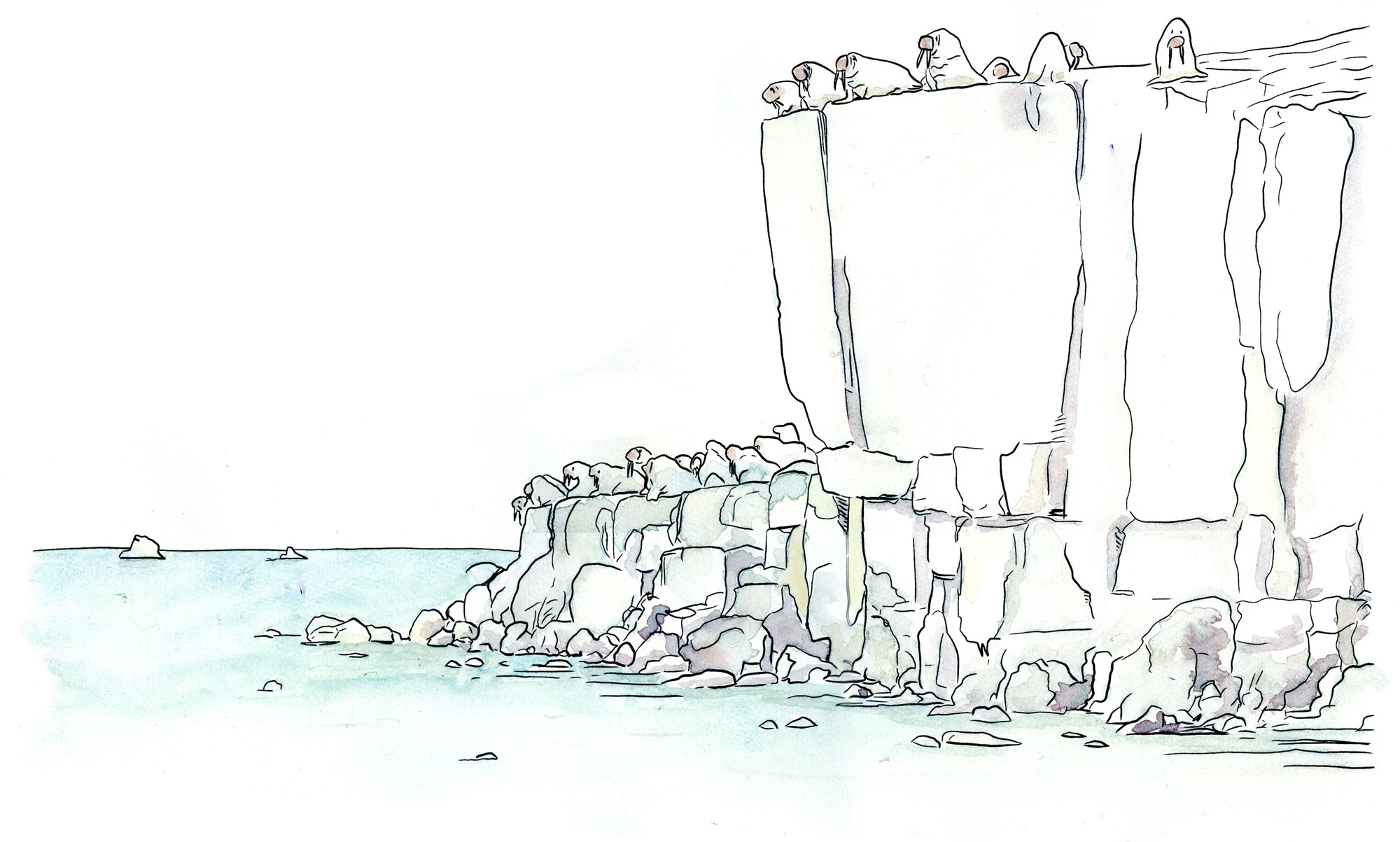
Most chapters in Fake Invisible Catastrophes and Threats of Doom at least try to fight on the ground of climate science—a temperature record, an ice-core proxy, a population estimate, something with numbers attached that a reader could in principle go check. Chapter 11 doesn’t bother with any of that. Moore says so himself, in his opening line: “This will be a very short chapter as it doesn’t take long to expose another fraud perpetrated by Sir David Attenborough.”
Short, because there’s no science to argue with. What follows for seven pages isn’t a rebuttal of walrus biology, sea-ice research, or Arctic ecology. It’s a fact-check of a Netflix voiceover—built almost entirely on one newspaper clipping and one blogger’s recollection of it. That distinction matters more than anything else in this chapter, because it is the whole chapter. A documentary narrator choosing a dramatic word, or a producer rounding a cliff height for a script, is the kind of thing that happens constantly in nature broadcasting. It says nothing whatsoever about whether the underlying trend—in this case, Arctic sea ice loss reshaping where walruses have to haul out—is real. Moore needs you not to notice the swap. Watch him make it.
What Attenborough Actually Said, and What Moore Says He Meant
In April 2019, Netflix’s Our Planet aired “Frozen Worlds,” an episode narrated by David Attenborough that included footage of walruses falling from cliffs above a crowded haulout on Russia’s Chukotka coast. Attenborough’s narration: their “natural home is out on the sea ice,” and they haul out on the beach “out of desperation, not out of choice.”
Moore’s response is total: “This is an outright lie. The natural home of walruses is in the sea, just like it is for their pinniped cousins, seals and sea lions… They do not haul out on land ‘out of desperation,’ they do it out of choice for very good reasons.” He spends the rest of the chapter building toward the claim that walruses don’t need ice at all—that the entire premise of the scene, climate change forcing them ashore, has “nothing to do” with what happened.
Here is the sleight of hand, on page one: “out of desperation” is doing a lot of narrative work in a documentary script, and it’s fair to find it overwrought. But whether that specific phrase is melodramatic is a question about broadcasting style. It is not the same question as whether the sea ice these animals used to rest on has been retreating, or whether that retreat is why 5,000-plus walruses were packed onto one stretch of beach at all. Moore answers the second question by refuting the first one, and hopes you won’t clock the substitution.
The Witness He Never Mentions
To make his case that bears, not climate, caused the cliff fall, Moore leans on a single source: an October 17, 2017 Siberian Times story about a bear incursion at Ryrkaypiy, and a quote from Viktor Nikiforov of a local WWF patrol describing walruses panicking and falling as bears approached. “That seems pretty straightforward,” Moore writes.
Notice what he never does: he never establishes that this is the same event captured in Our Planet. He has a place name in common—Ryrkaypiy—and treats that as proof. What he leaves out entirely is the person who actually directed and filmed the walrus sequence: Sophie Lanfear of Silverback Films.
On the record, describing her own footage, she said the opposite of what Moore needed her to say: “We filmed Pacific walrus falling from high cliffs. They were not being driven off” by bears. Crew members were stationed to watch the surrounding cliffs and stayed in radio contact specifically to flag approaching bears, and none were present when the animals fell. She described watching them “teetering back and forth on the edge before finally, falling off”—exhausted, overcrowded animals losing their footing, not a stampede. And she was explicit about what the climate claim actually was: “the reason walrus used this haulout location is because of a lack of sea ice in the region.”
A chapter that opens by accusing a filmmaker of lying about his own footage cannot skip the filmmaker’s own account of that footage. That’s not a citation Moore couldn’t have found—it was covered by the WWF, the Royal Television Society, and the Grantham Research Institute at LSE, all specifically rebutting the Crockford version Moore repeats uncritically. He left it out because it doesn’t just complicate his argument. It ends it.
“Bears, Not Climate” Is the Wrong Question
Grant Moore everything. Say bears really did startle the herd at that exact moment and that is really why some number of walruses went over the edge. It changes nothing about the claim the documentary was making, because it answers a different question than the one being asked.
What sent a particular walrus over a particular cliff at a particular second is a proximate cause. Why 5,000 female walruses and their cubs were massed on that narrow stretch of coast in the first place—dense enough that some ended up stranded above a sheer drop with nowhere else to go—is the ultimate cause, and it’s the one the film was actually about. These are not competing explanations. They’re answers to two different questions, and both can be true at once: a startled bear can be the last domino, while a shrinking, less reliable sea-ice platform is the reason the dominoes were ever stacked that high to begin with. “Bears, not climate” is a false choice built to sound like a gotcha.
Moore even hands you the evidence for this himself and walks right past it. His own footnoted source, the World Wide Fund for Nature, states that walrus habitat requires “the reliable presence of open water to access these feeding areas, and suitable ice or land for hauling out.” Ice or land—land as the fallback when ice isn’t there. That sentence is the mechanism Attenborough described. Moore quotes it as if it settles the opposite.
A Biology Lesson From the Man Who Got the Biology Wrong
Two pages after accusing Attenborough of “tak[ing] advantage of the average person’s lack of knowledge about obscure details concerning nature,” Moore writes this: “the reason walrus have those huge tusks is so they can dig for clams and other species such as worms, gastropods, cephalopods, crustaceans, and sea cucumbers.”
That’s the classic walrus myth, and it’s wrong. Walruses find food with their vibrissae—the sensitive whiskers on their snout—rooting through sediment, waving a flipper, or jetting water at the seafloor to expose prey, then sucking the animal out of its shell. Their tusks show wear consistent with being dragged through sediment, but researchers who’ve studied the abrasion patterns have found they are not used to dig up prey at all. Tusks are for hauling the body out of water onto ice or land, for dominance and defense between individuals, and for working through ice—not foraging. It’s a fact any basic marine-mammal reference gets right, in a chapter whose entire premise is that the other side doesn’t understand walrus biology.
A few lines later, Moore states walruses “can only dive to a depth of about 91 meters (300 feet)” as a hard ceiling, used to explain why they’re restricted to shallow coastal shelves. Tagged, tracked walruses have been recorded diving well past that—past 500 meters in published telemetry studies—making them considerably deeper divers than the number Moore presents as settled fact. The general point, that walruses concentrate their feeding in shallower water, is reasonable. Presenting a false hard limit as the corrective fact undercuts the correction.
Two Data Points, Two Different Excuses
To back up the bear explanation, Moore reaches for a second example: a similar cliff-fall pattern the U.S. Fish and Wildlife Service documented for three years running at Cape Pierce, Alaska, beginning in 1994. But by his own account, “the people who witnessed it were unable to determine the cause,” and Moore’s own guess is different from his walrus-cliff theory a paragraph earlier: not bears this time, but “a rapidly growing population” pushing animals into denser haulouts.
Notice what just happened. Two similar cliff-fall events, two different Moore explanations, neither one climate—and the second explanation, crowding from population growth forcing animals into tighter, more dangerous haulouts, is not actually incompatible with the mechanism he spent the whole chapter denying. A herd forced to concentrate onto less available real estate is exactly the kind of pressure that reduced sea ice creates too. He isn’t defending one consistent alternative theory. He’s reaching for whatever excuse is nearest at hand, event by event, so long as it isn’t the one Attenborough gave.
One Blogger, Wearing Three Hats
Strip out the Siberian Times clipping and Chapter 11’s sourcing collapses to one person. Susan Crockford is the source for the Ryrkaypiy account, the source for the extended passage on walrus haulout history that Moore calls “the most credible analysis” available, and the source for his closing citation—a video from the Global Warming Policy Forum, an advocacy body that also hosts her self-published reports. Crockford has no walrus research of her own; she is a retired adjunct zoologist who runs a blog, polarbearscience.com, funded through GWPF-linked channels. A chapter that overturns footage backed by the film’s own director and a body of published tracking research, on the authority of one blogger cited three separate ways, isn’t weighing evidence. It’s laundering one source through repetition.
And the literature Moore never touches is not thin. The U.S. Geological Survey has run a Pacific walrus tracking and coastal-haulout program for decades, with a public database of documented haulouts back to 1852 and peer-reviewed papers modeling how walrus habitat use shifts as sea ice retreats. None of it appears in this chapter. Not one figure, not one finding, not one line acknowledging the field exists. Moore wrote seven pages about why walruses don’t need sea ice without citing a single study of walruses and sea ice.
Journalists Make Mistakes. Science Doesn’t Work That Way.
This is the point worth sitting with, because it’s the whole chapter in miniature. Documentary crews and nature narrators get individual details wrong all the time—a cliff height rounded for drama, a word chosen for its emotional pull, a producer’s press line that overstates a mechanism. That is an occupational hazard of translating a large, technical body of research into seven minutes of narrated footage, and it is a completely different kind of error than a flaw in the underlying science. One is a slip by a person on a deadline. The other would require the physical measurements—the ice-extent record, the tagged-animal tracking data, the haulout database going back to 1852—to be wrong.
Every other chapter in this book at least tries to attack the second kind of error. This one only ever finds the first kind, and then argues as if finding it settles the second question too. That’s not a scientific rebuttal. It’s a media grievance dressed up as one, and the dressing only works if the reader never separates “a narrator overstated a scene” from “the climate isn’t changing where walruses live.” Those are not the same claim, and no amount of tabloid clippings about one bear incursion changes that.
What an Honest Chapter Would Have Said
Strip Chapter 11 to its frame and here is the entire structure holding it up: one newspaper story about a different bear incident, asserted without proof to be the same event as the footage in question. One blogger, cited three times over, standing in for a field of published research Moore never opens. A director’s on-record rebuttal, left out entirely. Two walrus-biology claims—the tusks, the dive depth—that are simply wrong, offered as corrections from a man accusing his opponent of exploiting public ignorance. And beneath all of it, a category error dressed up as a gotcha: a documentary’s word choice mistaken for a claim about climate.
There was a genuinely interesting, honest version of this chapter available. Wild animals under stress do sometimes die from causes that have nothing to do with climate; documentary narration does sometimes reach for the most dramatic word available; population growth against strict hunting limits really can crowd a haulout. A careful writer could have made all of those points, engaged the actual tracking literature, and produced something worth arguing with. Moore didn’t write that chapter. He wrote seven pages fact-checking a Netflix voiceover, called it a fraud, and closed by daring Attenborough to rebut him.
Consider it done. Not with a data record he never opened, but with the on-record witness he never named, the peer-reviewed tracking research he never cited, and two facts about walrus anatomy he got backwards while accusing someone else of exploiting the reader’s ignorance. He asked for the walruses to be a fraud. What he built instead is a case study in the difference between catching a journalist in a slip and disproving a science—and in seven pages, he never once managed the second thing.