
Case file · Chapter 2
Patrick Moore's Coral Bleaching Denial Debunked
Moore claims the study behind the Great Barrier Reef bleaching headlines doesn't exist, and that 225 million years of coral history means today's reefs have nothing to worry about.
Updated October 3, 2026

In 2022, I photographed the coral reefs of Tikehau, French Polynesia. These healthy reefs are among the most magical places on Earth, and they are vital to the planet's health and to human economies.
Patrick Moore’s second chapter of Fake Invisible Catastrophes and Threats of Doom focuses on the coral bleaching that occurred in the Great Barrier Reef in 2016. He says that because coral reefs are underwater, they are invisible to us, and so they are a perfect example of how the media can fabricate catastrophes by hiding them in places we cannot see.
Patrick Moore’s claims, falsehoods and straight out glaring mistakes speak to his complete ineptitude on these subjects, and are a reminder that it’s better to rely on mainstream science journalism from credible publications over these dubious, discredited prophets.
What is Coral Bleaching?
Coral bleaching is a phenomenon that occurs when coral reefs lose their vibrant colors and turn white or pale due to the expulsion of the symbiotic algae, called zooxanthellae, that live within the tissues of the animals that construct corals — polyps.
These algae provide corals with a significant portion of their energy through photosynthesis. The relationship between corals and zooxanthellae is mutually beneficial; corals offer a protected environment and compounds necessary for photosynthesis, while zooxanthellae provide sugars and oxygen to the corals.
Coral bleaching can be triggered by various environmental stressors, with the primary factor being elevated sea temperatures. When water temperatures become too high (typically just a few degrees above the normal summer maximum), corals become stressed, causing them to expel their zooxanthellae. Without these algae, the corals lose their color and a vital source of nutrients.
I spent years reporting on coral bleaching during the period in which we were still learning about the effects of coral bleaching to coral reefs around the globe. During this time, I was focused on writing about the other stressors that can contribute to coral bleaching, like runoff and land pollutants from overdevelopment, ocean acidification, disease and overfishing. But the reality is that elevated sea temperatures caused by anthropogenic climate change is the primary culprit of the global phenomenon, including at the Great Barrier Reef. There is no disagreement on this among scientists.
Coral bleaching is a significant concern for the health of coral reefs worldwide, as it can lead to coral mortality if the stress is prolonged. While some corals may recover if conditions return to normal, severe and repeated bleaching events can have long-lasting impacts on the overall health and biodiversity of coral reefs.
This explanation of the threats posed by coral bleaching is a great summary.
What Percentage of the Great Barrier Reef is Dead?
There is a big difference between a coral bleaching event, and dead corals, and even dead coral reefs. I have witnessed coral bleaching events in the northern Bahamas during warm summers in the late 2000’s. These affected corals, which tended to be individual corals rather than an entire reef, turned a color that is almost translucent white. It is honestly truly a scary sight. But those corals were able to bounce back from coral bleaching events, which was welcome news at the time, because nobody really knew what would happen. Now, we know that corals can bounce back sometimes, but that repeated, severe warming events are a death sentence to any reef.
So, you can have coral bleaching, which does not immediately mean the death of corals. You can have dead corals, from coral bleaching, but that does not necessarily mean the coral reef ecosystem has died. For our purposes here, a dead coral reef means the coral reefs are dead, most of the biodiversity is gone, and the limestone structures created by corals that have existed for thousands of years are covered in macroalgaes that make any comeback impossible any time soon.
Many corals do not recover from coral bleaching, and that is exactly what happened to the Great Barrier Reef in 2016 when 30% of the corals of the Great Barrier Reef died.
According to The Smithsonian Magazine,
Nine months (after the bleaching event, scientists) assessed the reef again via satellite and in the water to see how many of the corals had survived and regained their color after the heatwave. According to a press release, what they found is that 29 percent of the 3,863 reefs that make up the GBR lost two-thirds of their coral, mostly in the north of the reef. Averaged over the entire 1,400 mile-long GBR, about 30 percent of the corals died off in the 2016 event.
The panic around the world, among scientists and the general population, when a third of the corals of a reef (technically, many reefs) the size of Italy all died in a single year.
In 2017, a similar sea temperature warming caused a further twenty-percent of Great Barrier Reef to die off, meaning that 50% of the Great Barrier Reef was…dead.
Some good news came in the early 2020’s, when scientists began to see fast-growing coral recovery on the Great Barrier Reef. The problem, however, is that the diverse, slow-growing corals were being replaced by a monoculture of fragile, small corals. This is akin to a healthy forest being chopped down, and then recovering with a monoculture of eucalyptus or acacia — not a recovery of the forest at all.
And so, despite this good news of a partial recovery, the Great Barrier Reef is still under severe threat from coral bleaching events, including another severe one in 2022 and, in 2024, the fifth mass bleaching since 2016. Within a year, coral cover fell by a quarter on the northern reef and by almost a third on the southern reef. The Australian Institute of Marine Science now describes a reef swinging “between record lows and record highs in a relatively short amount of time, where previously such fluctuations were moderate.” A reef that rebuilds itself with fast-growing, heat-sensitive corals, only to lose them in the next marine heat wave, is not a recovered reef, and the multiplying factors of reef death will continue with successive coral bleaching events.
A reef on a treadmill
Moore says reefs have survived 225 million years, so there is nothing to worry about. This is what Australia’s own reef monitors have actually measured. Each line shows how much of the reef surface is covered by living hard coral, the animals that build the reef, in one region of the Great Barrier Reef. Higher is healthier. The shaded columns are mass bleaching years. Read it left to right and you see a reef that crashes, rebounds and crashes again, faster than it used to.
- 1The crash, 2016–2019. Back-to-back marine heat waves in 2016 and 2017 bleached and killed coral across the northern and central reef. The north fell to its lowest cover on record; the central reef’s cover was cut in half.
- 2The rebound, 2021–2024. Cover climbed to the highest levels in decades. This is the part Moore’s side points to. But the regrowth was mostly fast-growing Acropora, branching and table corals that grow back quickly and, in AIMS’s words, “are the first to go.”
- 3The crash again, 2025. After the 2024 mass bleaching, the fifth since 2016, cover fell by a quarter in the north and by almost a third in the south in a single year. The south is now below its long-term average.
The peaks don’t mean the reef is fine. The pattern is the problem: bigger swings, more often, with less and less time to recover before the next heat wave.
Show the numbers
| Year | Northern | Central | Southern | AIMS report |
|---|---|---|---|---|
| 2016 | — | 29% | — | 2020/21 |
| 2017 | 10–12% (record low) | — | 37% | 2017/18, 2019/20; 2020/21 |
| 2019 | — | 14% | 29% | 2020/21 |
| 2021 | 27% | 26% | 39% | 2020/21 |
| 2022 | 36% | 33% | 34% | 2021/22 |
| 2023 | 35.8% | 30.7% | 34.0% | 2023/24 |
| 2024 | 39.8% | 33.2% | 38.9% | 2024/25 |
| 2025 | 30.0% | 28.6% | 26.9% | 2024/25 |
| 2026 | 35.1% | 31.6% | 26.4% | 2025/26 |
| Long-term average | 27.0% | 20.0% | 29.3% | 2025/26 |
Sources: Australian Institute of Marine Science, Annual Summary Reports of Coral Reef Condition, 2017/18 through 2025/26; AIMS, “Great Barrier Reef more volatile with sharp declines in coral cover” (2025).
Moore’s Claim that the 93% of Great Barrier Reef Affected by Coral Bleaching Study Does Not Exist is False
Patrick Moore claims that the study which triggered the 2016 headlines about 93% of the Great Barrier Reef being affected by coral bleaching, which is the foundation for his Chapter 2 argument, did not exist.
He claims that these 2016 headlines are a false narrative, without any report to back up the following typical headlines from that news cycle:
National Geographic: 93 Percent of the Great Barrier Reef is Suffering
Scientific American: Bleaching Hits 94 Percent of the Great Barrier Reef
CNN: Coral bleaching affects over 90% of Great Barrier Reef
Time Magazine: A New Survey Says 93% of the Great Barrier Reef Has Undergone Bleaching
British Columbia journalism professor Sean Holman fact-checked Patrick Moore’s claim in this excellent summary published shortly after Fake Invisible Catastrophes and Threats of Doom was self-published by Moore. Holman found that many of the articles that reported on the news did indeed reference the source. He found the work of Terry Hughes and the National Coral Bleaching Taskforce, an Australian government entity which exists to coordinate research around Australia’s coral bleaching events, to be responsible for the report.
Holman writes:
When I emailed Hughes, the distinguished professor who leads Australia’s ARC Centre of Excellence for Coral Reef Studies, about Moore’s allegation, he forwarded me a news release distributed on April 20, 2016. The release, available to anyone searching his research centre’s website, announced the “results of extensive aerial and underwater surveys reveal that 93% of the reef has been affected” by the coral bleaching that was then unfolding on the Great Barrier Reef. Hughes was even quoted as saying only seven per cent of the reef had escaped that bleaching, a condition that corals can recover or die from. The complete survey findings were later published in the prestigious scientific journal Nature.
Patrick Moore’s Claim that Warming in our Ancient History Shows that Coral Reefs will be Resilient Today is False
Patrick Moore writes that coral reefs are not under threat, because, he claims, “they have survived three ice ages…and many other cataclysms far more extreme than anything happening in the present era. The modern corals have evolved from their ancestors 225 million years ago when the climate was far warmer than it is.”
The research and evidence that coral reefs around the world, including the Great Barrier Reef, are under extreme threats from climate change and other human-caused stressors, are not disputed by marine scientists.
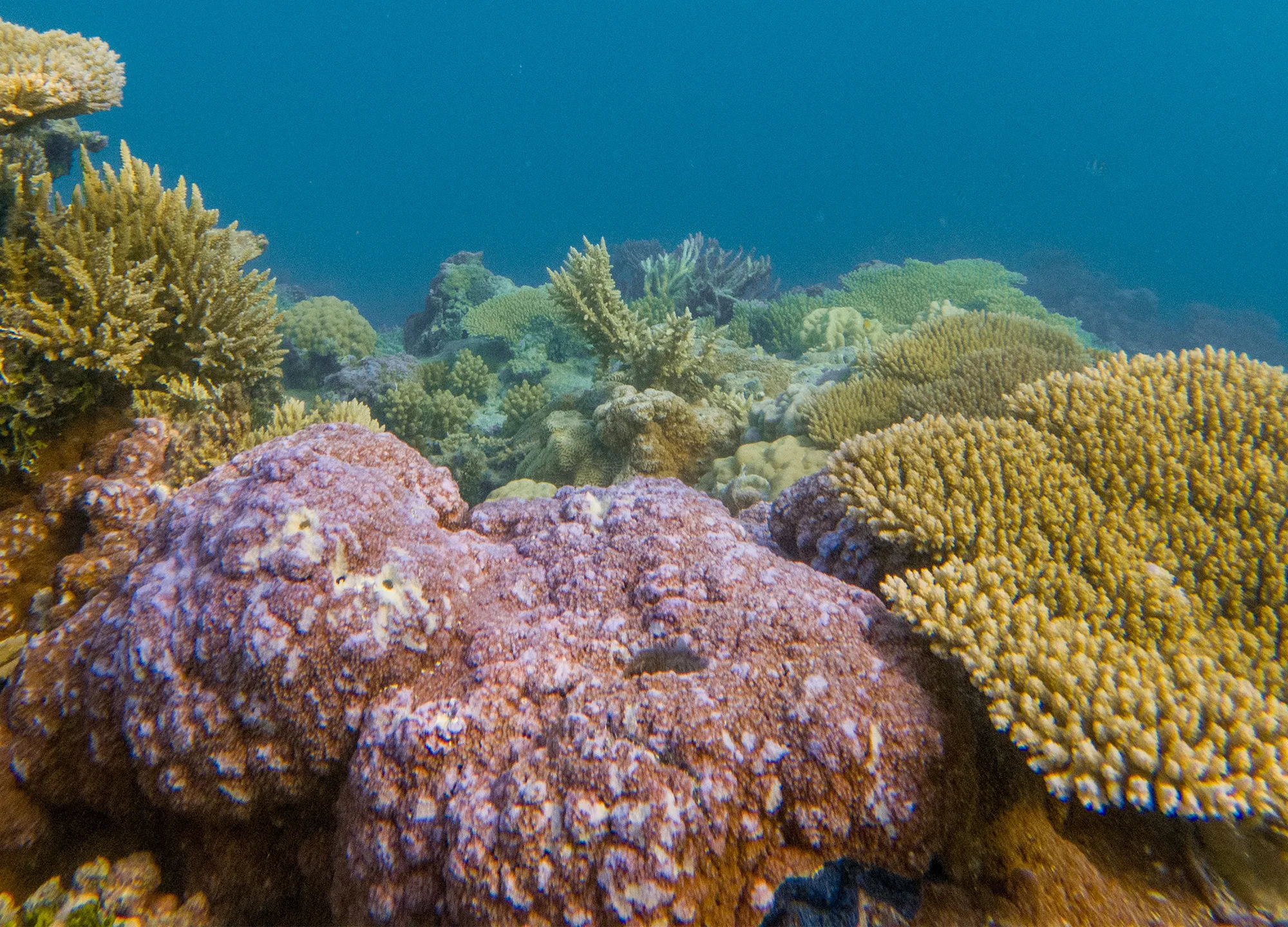
Table and branching corals crowd a single stretch of reef in Tikehau, French Polynesia. Corals as a group are ancient, but a living reef like this one takes centuries to build, and a few weeks of marine heat can bleach it.
Patrick Moore's statement that current coral reef die-offs and coral bleaching are not of concern because corals have existed for 225 million years is laughable, and not a scientifically valid argument to dismiss the current threats to coral reefs. While it is true that corals have a long evolutionary history and have survived various environmental changes over millions of years, the current challenges they face are largely a result of human-induced factors.
225 million years ago is a time-scale unfathomable to us, and irrelevant to the time scale that impacts human civilization today. Back then, the air was not breathable to us, and the world was alternatively too hot, or too cold, for our species to have survived. There were times that Earth fell into extreme extinction events.
During the Ordovician-Silurian Extinction, 443 million years ago, the planet underwent a major ice age, causing a drop in sea levels and a loss of around 85% of marine species.
360 million years ago, during the Late Devonian Extinction, about 70% of species on Earth, including many marine and terrestrial organisms, disappeared.
252 million years ago, during the End-Permian Extinction, 96% of all marine species died out, and so did about 70% of terrestrial species.
During the End-Triassic Extinction, about 201 million years ago, massive volcanic eruptions, climate changes, and the loss of about 50% of marine species was among the most transformative moments in the arc of life on Earth.
During the End-Cretaceous Extinction, 66 million years ago, the Earth was covered in massive fires, tsunamis, and a nuclear winter effect, resulting in the loss of around 75% of Earth's species.
During many global catastrophes, almost all of which were related at least in part to climate change, coral species survived and eventually adapted. In fact, most ancient cataclysms happened slowly, sometimes over millions of years. Just because individual corals survived global catastrophes hundreds of millions of years ago doesn't mean the Great Barrier Reef has not lost about 30% of its corals in events that have occurred in the past decade.
Patrick Moore’s argument that coral reefs are not under threat simply because the order survived millions of years is not a logical argument, because, were those cataclysms to take place today, the planet would not be conducive to human civilization or to the richness of global biodiversity we have today — and that is the point — not that some deepwater species of coral, hiding in the dark underbelly of the oceans, will emerge as the future of corals a million years from now — a time scale which is not important to the health and productivity of the planet today.
Patrick Moore seems to be arguing about whether coral species will survive, not whether coral reef ecosystems will die off. Of course some coral polyp species will survive! But the death of coral reefs is something different. It is about the collapse of massive ecosystems, that includes coral extinctions, fish extinctions and invertebrate extinctions.
When coral reefs die, it is very difficult for them to bounce back in a time scale relevant to human civilization. I have seen these dead reefs. They become home to weedy macroalgaes that turn the reefs into ghost towns. Most life vanishes.
Scientists estimate that about 50 percent of the world’s coral reefs have died in the last 30 years. Patrick Moore does not dispute this fact. What Patrick Moore is stating is that he thinks they will bounce back in the future, because they can evolve. Yes, species evolve, but evolution takes thousands or millions of years.
Coral reefs are indeed resilient and have adapted to changing conditions over geological time scales. However, the rate at which environmental changes, such as ocean warming and ocean acidification, are occurring due to human activities is unprecedented in the history of coral reefs. This rapid change exceeds the ability of corals to adapt and recover.
My Experience with Coral Scientists, Coral Reef Activists and Marine Science Journalists is a Direct Rebuke to Patrick Moore’s False Narrative
Without bothering to supply evidence or make a case for it, Patrick Moore explains why he thinks scientists lie about the threats that climate change and other manmade influences exact on coral reefs. He says, “Unfortunately, the answer is: for academic status and money.”
I have been grateful to have a life of professional experiences that discounts this insane claim.
Coral Reefs around the World
I have had the opportunity to dive and snorkel in coral reefs in Mexico, Panama, Florida, the Bahamas, the Lesser Antilles, the Greater Antilles, the Society Islands and the Tuamotus for over forty years of my life. I have seen unimaginably vibrant coral reefs, healthy coral reefs, dying coral reefs, and dead coral reefs.
Patrick Moore says that pedestrians like you and I can utilize direct experience to counter scientific claims. That we can just read headlines as a way to counter scientific theories.
Our direct experiences, like my 40 years of seeing coral reef declines, coral bleaching and efforts to protect reefs, is extremely insightful, but it is not the same as the scientific method, and peer-reviewed research. Direct observation and direct experience are a part of the scientific method.
Work with Coral Scientists
Without evidence, Patrick Moore claims that the thousands of peer-reviewed research papers around the world are to be dismissed because he thinks scientists are after status and money.
I am grateful to have worked with coral ecologists and marine scientists on coral reef issues for over 10 years of my life. I worked with scientists associated with the United Nations, the US Department of the Interior, the Sierra Club, Woods Hole Oceanographic Institution, and some of the most respected individual coral reef scientists in the world.
This idea that these scientists are scheming to concoct fake research in the interest of money and fame falls completely contradictory to my experience. The scientists I worked with loved their profession, and they were deep thinkers who placed their profession above short-sighted self-interest.
Of course there have been instances of scientific misconduct, including faked research, plagiarism, and other unethical behaviors. But these cases represent a tiny minority of scientists and research studies. The overwhelming majority of scientists adhere to high ethical standards and are committed to the principles of honesty, integrity, and the pursuit of knowledge.
The scientific community has developed robust mechanisms to ensure the credibility and reliability of research, such as peer review, replication studies, and rigorous scrutiny of research methods and results. Scientific journals and institutions also have ethical guidelines and codes of conduct in place to deter and address misconduct. Every field of science has embedded mechanisms to continue to improve their own field’s ethics and reliability.
Most scientists are motivated by a genuine desire to contribute to their field, expand knowledge, and address important questions. They pursue their research out of curiosity and a passion for discovery rather than primarily seeking fame or money. Scientific research often requires years of dedication, hard work, and collaboration with peers, making it less likely for someone to engage in misconduct for personal gain.
When scientific misconduct does occur, it is typically exposed and addressed through the scientific community's self-correcting mechanisms. Misconduct undermines the credibility of the entire field, and scientists and institutions have a strong incentive to maintain the integrity of their work.
Patrick Moore’s anti-science blanket statements about scientists is sad, and completely baseless.
Coral Reef Activists
In addition to working with coral scientists, I have had the opportunity to work with the same coral reef activists who were part of the task force that worked with Presidents Bill Clinton and George W. Bush on the creation of Papahānaumokuākea, the vast and remote marine national monument located in the Northwestern Hawaiian Islands. These activists worked with the Obama Administration to quadruple the size of Papahānaumokuākea, the largest protected space on Earth.
During my many years of working closely with these champions of conservation, I learned that their demeanors and professionalism was exactly opposite of the unfounded claims made by Patrick Moore.
Science Journalists
As a life-long media consultant, I work with journalists, editors, publishers and owners of media empires every day of my life. In particular, I have had the opportunity to work directly with science journalists. Rather than finding them to be involved in a money-making conspiracy, in bed with politicians and scientists, as claimed by Patrick Moore, I have found most science journalists to have a common love for knowledge and education and the subjects they cover. Science journalists don’t enter such a field to make millions, they do it because they love that profession. Science journalism, like science, has mechanisms that encourage the highest levels of integrity — and in my experience of working with thousands of journalists, including hundreds of science journalists throughout my career, I have found no evidence of Patrick Moore’s fallacious claims.
Like any field, there are surely exceptions, and not all science journalists may consistently meet high ethical standards. More likely, bad science journalism most often happens when general media report on subjects they are unqualified to write about.
Here in the United States, the concept of a free press and journalists operating in a Marketplace of Ideas is deeply ingrained in the principles of democracy and the First Amendment of the U.S. Constitution. In this system, it is up to the public to consume and evaluate media to make informed decisions. The diversity of voices and ideas in the media landscape is seen as a cornerstone of a functioning democracy. In a free marketplace of ideas, there is always the assumption that bad journalism will exist, but it is up to us as the public to understand that we should pursue most of our news through the highest-quality, and least biased media.
It should be no surprise that the media that promoted Patrick Moore’s are the ones most associated with low credibility, pseudoscience and antiscience. The Interactive Media Bias Chart is a great way to think about where we should consume most of our media. Even if we disagree about what media rest at the top, it should be self-evident that pursuing unbiased, highly reputable media is the best path towards sound knowledge and understanding of the world we live in.
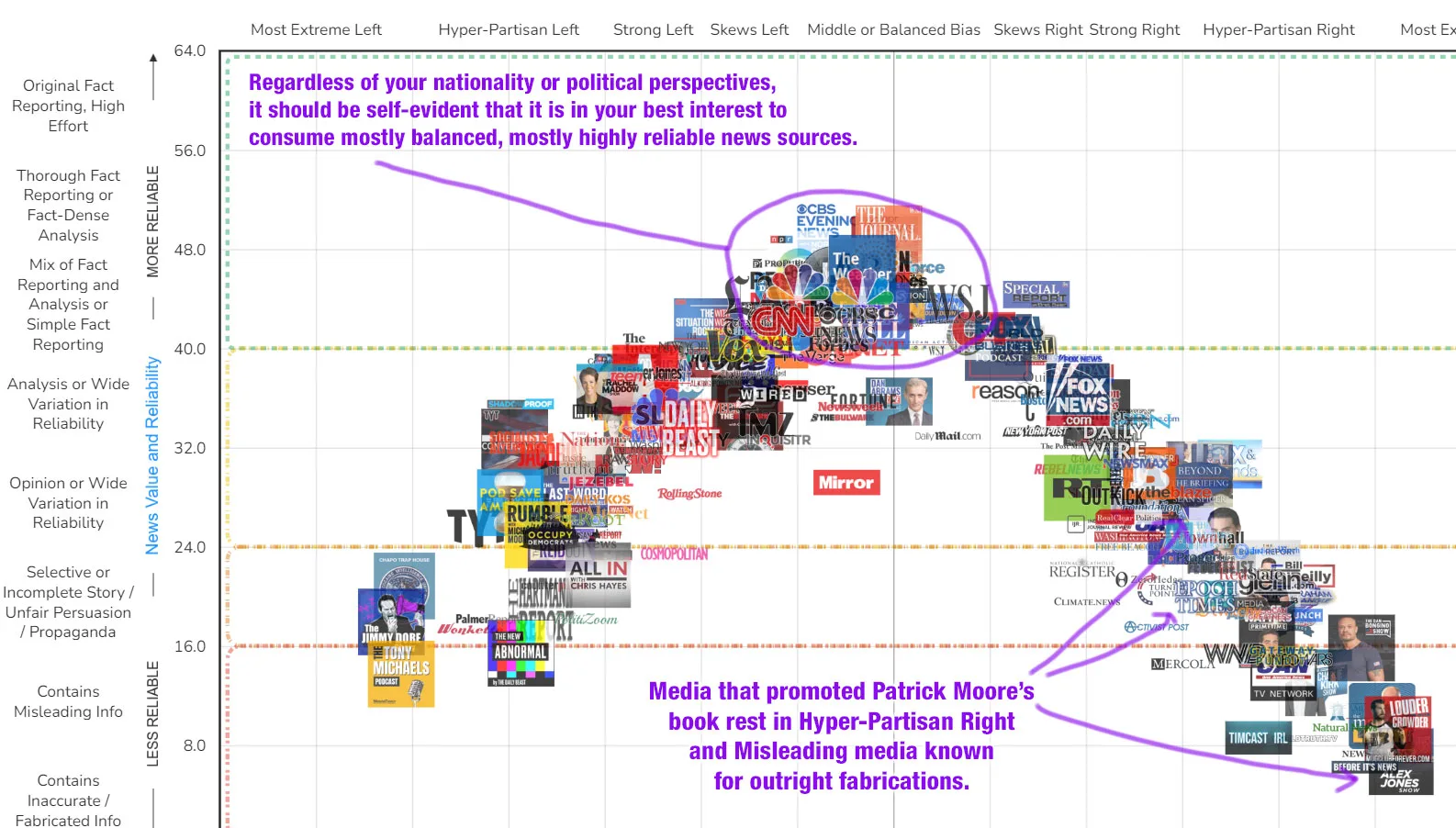
Patrick Moore's book was promoted almost exclusively by low quality, hyper-partisan news media known universally for the lowest quality misinformation.
It should be no surprise that the publication that promoted Patrick Moore's book the most, the Epoch Times, lacks reliability, professionalism and has the lowest reputation among the scientifically literate. The Epoch Times is a bees nest of scientific misinformation, and has been central to Qanon conspiracies, anti-vaccine misinformation, anti-climate change pseudoscience. The Epoch Times is considered one of the primary spreaders of COVID misinformation in North America.