
Guana Cay Blog Archives
Part one of two: the legal & political fight — real-time dispatches, 2005–2011
This page is the paper trail: the real-time blog dispatches I filed as the Great Guana Cay story unfolded between 2005 and 2011, while the island's residents fought Discovery Land Company's Bakers Bay Golf & Ocean Club through the Bahamian courts, the Privy Council in London, the press, and the United Nations. These posts used to live scattered across a couple dozen individual pages; they're consolidated here, in one place, organized by topic rather than by original URL. I've cleaned up the formatting and removed accidental duplication, but the reporting itself — including quotes, press releases, court filings, and the voices of the people who lived it — is preserved as it was written at the time.
For the current state of the story and the science behind it, start at the Guana Cay overview page instead. This page is the archive underneath it.
A note on how to read this page: these are dispatches written in real time, on one side of an active legal and political fight, between 2005 and 2011 — so words like “illegal” and “unlawful” generally reflect the legal position the Association and its counsel were actively arguing in court at that moment, not a final court ruling. For the record: the Privy Council's 2009 judgment did not find the Heads of Agreement void, though it did recognize the residents' "legitimate expectation of consultation." Where later documents — the monitoring reports, the 2012 coral reef decline study, and the case study refutation — confirm, update, or complicate something said here in the moment, I've added a note at that point.
This archive is long, so it is split across two pages. Part 1 (this page) gathers the legal fight, the developer, the University of Miami, and press coverage. Part 2 gathers the environment and the science — coral reefs, mangroves, the Bahamian environment, and golf & development conflicts: go to Part 2 →
Contents
Part 1 — The Legal & Political Fight (this page)
- The Legal Fight: Save Guana Cay Reef vs. the Government & the Developer
- Local Rights & the Hope Town District Council
- From "Rise Up Sweet Island": the Yosemite allegory & Troy Albury's affidavit
- Discovery Land Company
- Bakers Bay Golf & Ocean Club
- University of Miami
- Press Coverage
Part 2 — The Environment & the Science
The Legal Fight
From legal-case.html — the Privy Council fight
January 01, 2010
Neil Hartnell writes: 'Lost opportunity to clarify murky' approval process.
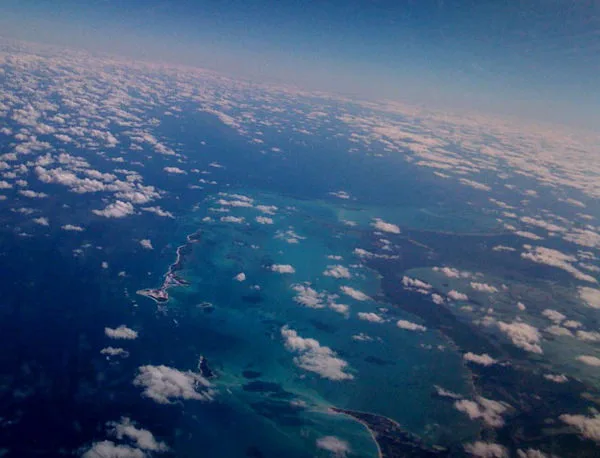
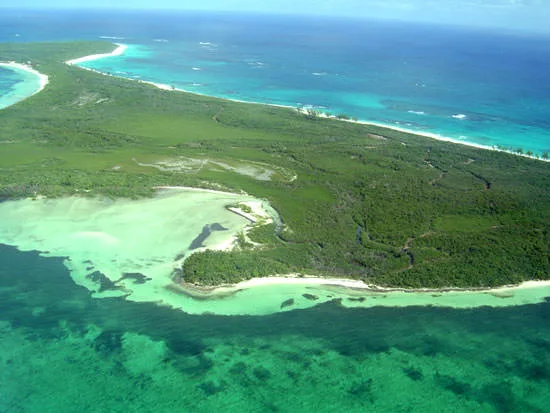
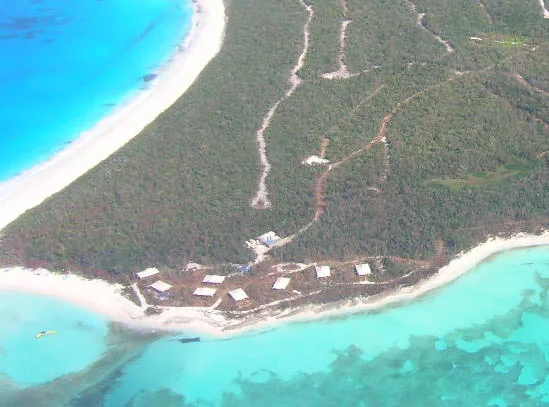
The rape of Great Guana Cay: This incredible photograph taken by a commercial airline pilot in the summer of 2009 shows the scope of the Bakers Bay development's footprint. The white spots on the Atlantic side of Great Guana Cay are breakers against the coral reef.
By NEIL HARTNELL
Tribune Business Editor
Posted to the Tribune on November 20, 2009
THE attorney representing opponents of the $500 million Guana Cay mixed-use resort development yesterday said it was "regrettable" that the Privy Council did not determine in its ruling whether developers and the Government could sue each other under a Heads of Agreement, describing the case as "a lost opportunity to bring clarity to the murky development process in the Bahamas".
Fred Smith QC, the Callenders & Co attorney and partner, said the four-year legal battle waged by his clients, the Save Guana Cay Association, against the Bakers Bay Golf & Ocean Club project had "highlighted and focused the need for the Government" to legislate this nation's development approvals processes, bringing clarity to both this and the rights of affected residents.
Responding to the Privy Council's ruling, which prevented his clients from blocking Discovery Land Company's development on the grounds that the project's Heads of Agreement was 'ultra vires' or improper, Mr Smith said: "Regrettably, the case does not analyse what a Heads of Agreement is, and whether a Heads of Agreement is binding and lawful — a public expression [of intent] more than a binding document.
"Regrettably, the Privy Council has not clarified the issue of whether a developer could sue the Government to enforce a Heads of Agreement or vice versa."
Mr Smith questioned whether, for instance, if a Heads of Agreement contained provisions for a developer to clear up any environmental damage if they failed to meet their obligations and abandoned the project, the Government "would be able to sue them to enforce these provisions or not".
The newly-named QC added: "Unfortunately, at the Supreme Court, the Court of Appeal and the Privy Council, there was a lost opportunity for bringing clarity to the development process in the Bahamas, as murky as it is, without legislation that explains a step-by-step approach."
The Association's four-year fight, Mr Smith said, had been "highlighting and focusing the need for the Government to legislate process and rights in regard to all development initiatives.
It's not going to away.
They're repeating it with the BEC Abaco power plant."It's sad that three levels of the judiciary did not take a more proactive approach in helping to guide the development process in the Bahamas."In its ruling, the Privy Council acknowledged previous findings by Court of Appeal president, Dame Joan Sawyer, who noted that the Bahamas had "no comprehensive legislation for environmental protection, or public consultation on the disposition of public land".In other words, major chunks of the Bahamas' development approval process, especially as it relates to major mixed-use resort projects, is not contained 'in stone' via statute legislation.
Rather, it is in policy, which can be changed at a stroke by public officials. The Privy Council, in its judgment, found the Guana Cay Heads of Agreement was intended to provide a framework for the planning and decision-making that would guide the development going forward."It is common ground that the provisions as to the granting of leases were too uncertain to be legally enforceable.
Other provisions of the Heads did probably create legally enforceable obligations.
But it is unnecessary to form a final view on that, since on any view the Heads constituted a considered political commitment on the part of the Government of the Bahamas, matched by the Developers' financial commitment to investment in the project," the Privy Council found."The proposed development was on any view a major development with far-reaching economic, social and environmental consequences.
It involved an investment of the order of $500 million. It involved large-scale infrastructure projects, both on land and in the sea.
The population of the Cay was going to increase greatly, and the pattern of its economic life was going to be transformed."Any complex project of that sort requires a strategic framework of planning and decision at the outset, followed by detailed planning and detailed decisions on particular matters as it goes forward.
In such a situation there is no fettering of official discretion in starting with a carefully-formulated general policy.
Indeed, to start without a carefully-formulated general policy would be a recipe for bad administration."
Mr Smith yesterday told Tribune Business that the Association wanted the Government to pass a Freedom of Information Act and Environmental Protection Act, especially since there were no statutory provisions requiring an Environmental Impact Assessment (EIA) to be published prior to a major development being approved.
And the Association's legal battle is not over yet, Mr Smith telling Tribune Business they were awaiting a hearing date from the Court of Appeal for their second bid to block the Guana Cay project, which is directly challenging the permits, approvals and licences given to the developers. Warning that the project's opponents were "not going to disappear into thin air", Mr Smith pledged that the developers would still be subjected "to an awful lot of scrutiny" as they moved forward with what he described as a "10-year project".
Asked to recall what the Association had achieved so far, Mr Smith said the Government's Planning and Subdivisions Bill appeared to be attempting to codify and legislate, via statute, a much clearer development process.
The Bill, he added, dealt with issues such as EIA publication, town planning input and public consultation."The success that we have had so far is that there has been a substantial revamping of the EIA, a substantial revamping of the EMP," he said.
"There has been a lot of scrutiny and focus on environmental issues by the developers and the Government."The case has also caused the Government to implement a lot of the provisions in its Planning and Subdivisions Bill.
The Government, through this Bill, is going away from this overarching Heads of Agreement and is going back to more localised input and statute."In the meantime, the Association was going to monitor the developers to ensure they complied with local and local government rights, plus environmental laws, and assess their compliance with other obligations.
November 18, 2009
Privy Council Vindicates Right to Consultation
Save Guana Cay Reef has posted a press release on the Privy Council Ruling:The following comments result from the Judgment delivered by the Privy Council on November 17, 2009 in the Save Guana Cay Reef & Bakers Bay development continuing litigation saga.
SGCRA is very pleased that they have finally had their day in Court at the Privy Council.
Although SGCRA is disappointed that the Privy Council did not declare the Heads of Agreement ultra vires and stop the project, SGCRA is still very happy that SGCRA has been able to make a meaningful contribution to the enormous issues affecting the Bahamas by development, especially in the Family Islands where there remains such beautiful and unspoilt land.
The Privy Council noted that;
"The Bahamas are known throughout the world for their natural beauty. It is also well known that the rich, natural resources and especially their coral reefs are risk from indiscriminate development".
SGCRA is pleased that even the Privy Council recognized the issue of "indiscriminate development" plaguing the Bahamas.
The Privy Council also noted that regrettably;
"The Bahamas has no comprehensive legislation for environmental protection, or public consultation on the disposition of public lands…".
SGCRA joins the continuing chorus calling on the Government to pass environmental laws and a freedom of information act which are sorely needed in The Bahamas development landscape.
SGCRA is pleased that the Privy Council also recognized that, although the BEST Commission does not exist as a statutory body, the preparation of Environmental Impact Assessments, have "become the usual practice", and"standard practice" in The Bahamas.SGCRA laments the fact that what should have been a simple judicial review matter and which should have been dealt with quickly, by the Courts in 2005, has taken nearly five years to wind its way through the judicial system. The Privy Council has criticized this process and stated that "These proceedings have followed a tortuous course".
SGCRA urges the Government and the judiciary, in future, to give priority to the disposition of judicial review proceedings, not only in the protection rights, but for the good administration of public law matters.
SGCRA is very pleased to note that the Privy Council recognized that SGCRA had a "legitimate expectation of consultation" which is an important step to prevent abuse in the exercise by Government powers and to prevent indiscriminate development.
In this regard, SGCRA was pleased to note where the judgment said "It is unfortunate that the Minister (Allyson Maynard)did not make good her promise of a meeting."The Privy Council also noted that consultation should also be "informed".
The Privy Council judgment is not the end to this fight.
Challenges through the courts have been only one avenue of challenge. SGCRA will continue to bring domestic and international publicity to this abuse and to the injustice to which the people of Guana Cay were subjected by the delays in the judicial process, the collaboration between the Government and the Developers, the financial pressure brought by Baker's Bay and the destruction of the environment and the ruination of the peaceful Family Island style life which this $500,000,000 mega anchor development project and Central Government's dictates and abuse have raped the Cay with.
November 17, 2009
Ragtag Reef Defenders Vow to Continue Fight after Privy Council Loss, Fight to Protect Diminishing Destinations in Caribbean Expands
Save Guana Cay Reef lost its case at Privy Council today.
Here is a quote from Save Guana Cay Reef President Troy Albury on a local forum:
The whole purpose of our fight from the start has been twofold.1 . to protect the environment — There are no laws on the books in reference to the environment so consequently there is nothing to enforce . So we have to do as Livingston Marshall says — balance the environmental impact — read — destruction with the monetary benefits . So in other words if someone can make money now forget about the environmental impacts later.
2. To be sure that these developments are monitored and that the local residents rights are not trampled and they are consulted on what is going to have a tremendous effect on their lives and wellbeing . Too many things are done in 'under the table' deals . Unfortunately there is no law that says we have to be consulted or even made aware of the these deals. Even the BEST commission which supposedly is supposed to approve and monitor the developments does not exist in law.
So we again call on our government to give us a Freedom of Information Act so there can be transparencies in these deals as well as an Environmental Protection Act to protect our natural resources . Until these two laws are in place we just have to hope that the government and developers will honor all of their promises. But like my mother used to say " a promise is a condolence to a fool."
I have no regrets and I am proud of the accomplishments SGCR has made. Countless hours of work by people dedicated to the cause will not go unnoticed. We have made a difference and we will continue to make a difference in the way Bahamians think about their environment and anchor developments.
September 11, 2009
Wilson City Power Plant
Take a look at this video about the power plant being built on Abaco. Abaconians are really coming together on this issue. That is important, because that's the beginning of building long-term environmental movement in a community. Click on the image to watch the video:
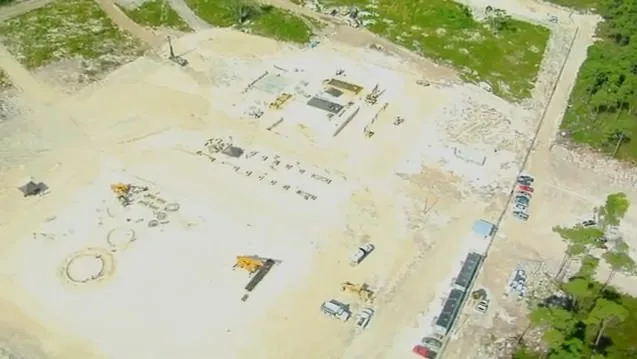
The video does a good job of calling out Prime Minister Ingraham on the incongruity of his platform — which called for transparency, environmental soundness and local government involvement, versus this Bakers Bay style project, being fast-tracked without local involvement and without transparency.
September 9, 2009
Britain Takes Over Turks & Caicos
Britain has suspended Turks & Caicos self governance after intense corruption in the island nation. Britain alleges that high level members of government were accused of selling crown land for personal gain and misusing public funds.
The claims of Crown Land corruption closely resemble events which led to the Bahamian government signing a Heads of Agreement with Bakers Bay Golf & Ocean Club. The plaintiffs in the court case argue the Bahamian government's decision to enter into a Heads of Agreement were irrational and not in the interest of the island's residents or the Bahamas. Follow the news on Turks & Caicos, the only island nation to share the Bahamas Archipelago. Britain Takes Over Turks & Caicos
July 1, 2009
A Primer on Her Majesty's Most Honourable Privy Council

Benjamin Franklin appears before the Privy Council in 1774.
In one week from today, Save Guana Cay Reef will appear as the appelant at Privy Council in London. This 'court of last resorts' is the highest court in the Bahamian judicial system. SGCR will argue that the government and developers pursued a deliberate policy of non-consultation with the residents of Great Guana Cay, in order to fast-track a development that would harm the island's ecosystem, culture and environment.
Her Majesty's Honourable Privy Counil began in the year 895, when King Alfred's group of advisor's were known as the King's Privy Council. Historically, the King and Queen heard final appeals, but since they could not take on every appeal, the Privy Council took on a role similar to the United States' Supreme Court.
As the United Kingdom expanded its empire across the globe, the Privy Council began taking on cases throughout the Kingdom. Through the last several hundreds of years of history, the Privy Council became the court which heard final appeals from people in India, Africa, the Far East and the Americas.
Today, the Privy Council is one of the highest courts in the United Kingdom, and performs judicial functions for British Overseas Territories, Sovereign Base Areas, Crown Dependencies, and some of the Commonwealth countries. In small countries like the Bahamas, where judges are, by the sheer smallness of the government, are often too close to the government-in-power to truly be impartial. For the Bahamas, whose government corruption is well known and documented, the Privy Council acts as a final check to a court system which has inherent weaknesses of partiality.
When SGCR is heard before the Privy Council, they will in fact be making an appeal to the Queen of England, who refers her judgment to the Privy Council, which meets on Downing Street.
These areas all hear cases at Privy Council:
Anguilla
Antigua and Barbuda
Bahamas
Belize
Bermuda
British Virgin Islands
Brunei
Cayman Islands
Cook Islands
Dominica
Falkland Islands
Gibraltar
Grenada
Isle of Man
Jamaica
Mauritius
Montserrat
Niue
Pitcairn Islands
Saint Kitts and Nevis
Saint Lucia
Saint Vincent and the Grenadines
Sovereign Base Areas of Akrotiri and Dhekelia in Cyprus
St. Helena and dependencies
The Crown dependencies of Jersey and Guernsey
Trinidad and Tobago
Turks and Caicos Islands
Tuvalu
As the SGCR case against Bakers Bay Club and the Government of the Bahamas has proceeded through the Bahamian legal system, it has met before Privy Council on two occasions. On both occasions, the Privy Council offered a favorable result to the residents of Guana Cay. At one point in 2006, the Privy Council halted construction at Bakers Bay Club until a decision was made by the Bahamian Courts. This construction halt lasted six months, and according to Bakers Bay Club, cost them millions of dollars.
Read more:
I recommend The Last Flight of the Scarlet Macaw, for a Belize environmental case which ends up at Privy Council. Although the result was unfavorable to the appellants, the case was the first of its kind in Privy Council, and the SGCR case is much stronger.
A quote from the New York Times review of the book:"You may think you've heard this tale before: the tree/bird/fish huggers against the land-raping multinationals. But few parts of Barcott's story are what they appear: what's local is global, insiders are outsiders (and vice versa) and scientists transform themselves, with the signing of nondisclosure agreements, into "biostitutes" for hire. Matola herself is a complicated hero — "strange and sometimes aggravating."
June 26, 2009
New Tribune Article, "Constitutional Rights at Stake"
June 26, 2009
Two Weeks to Privy Council, Guana Residents Reflect on Save Guana Cay Reef Triumphs

Readers have asked for a summary of where everything stands on the Great Guana Cay environmental battle as the final Privy Council court date looms less than two weeks away. New readers should read Eyes of the West Indies to learn more about the issues. You can also check in at Save Guana Cay Reef to learn more about the issues and donate to the locals who are fighting Bakers Bay Club.
The locals of Great Guana Cay have recently spoken about their plight at the United Nations.
In 2004, then Prime Minister of the Bahamas Perry Christie actively promoted his road to economic success for the Bahamas: entice large-scale developers to Bahamas' quiet out-islands, give them incentives to build massive developments, and these developments will in turn seed the quiet economies into flourishing tourism industries.
The small island of Great Guana Cay was to become one of these anchor developments. Bakers Bay Golf & Ocean Club would be a luxurious golf and marina development, catering to U.S. west coast mega-rich, superstars and aging golfers.
Discovery Land Company, the Bakers Bay developer, signed into a Heads of Agreement with the Perry Christie Administration. The document gave them unprecedented access, rights and privileges. The Bahamian central government even offered to hand over Great Guana Cay's public land to the developer.
In the Bahamas, this public land is called Treasury Land and Crown Land, and is designed to be held in perpetuity by Bahamians. On Great Guana Cay, which is only six miles long and a quarter mile wide, the crown and treasury lands were the island's only remaining public land.
This land, in fact, was where the islanders foraged for land crabs; a 200 year old tradition in the Abaco Islands, of which Great Guana Cay is a very small part.
The only problem was, the Bahamian residents of Great Guana Cay were never consulted. Nobody ever bothered to ask them if this is what they wanted.
Suddenly, a distant government had decided that their island would become a golf course. That their way of life would be gone forever. That their children would be raised adjacent to a gated community of California-style megadevelopment buildings, rising in all its pink splendor high up in the air, populated by fast-talking foreigners with poodles and big opinions on marlin hooks and golf gadgets.
What's worse, some locals were beginning to sense that such a large development: a massive contoured golf course, a 240 slip marina, hundreds of mansions, a hotel, tennis courts, restaurants, entertainment centers, could pose a threat to their island's treasured natural resources — one of the best remaining examples of a Northern Bahamas coral reef, a wildlife-rich mangrove, orchid and bromeliad coppice forests, refuge for numerous endangered species, and an aquamarine bay filled with endangered sea turtles, scattered starfish and conch, bottom-feeding sharks.
Quickly the Bahamian residents joined with hundreds of homeowners and formed an association called Save Guana Cay Reef.
Now, so far, this was all expected. Golf developments are used to locals forming opposition to their developments. The threats that golf courses pose to local communities and environments are well known, and so developers are prepared for any possible action a local community may take against them. Discovery Land Company, one of the most cunning and successful luxury golf developers, was more than prepared for even the most vicious opposition to their development. No problem, all was accounted for.
In the end, the developer has more resources. No local group lasts more than a few years.
Except that on Great Guana Cay, the impossible happened.
For some reason, the locals continued to fight. All of the analysts and lawyers and consultants from the Bahamian government had no idea what was coming.
The locals of Great Guana Cay agreed to fight Discvery Land Company indefinitely.
The locals found a lawyer who was willing to take on their cause pro bono. Attorney Fred Smith took Save Guana Cay Reef through four years of the Bahamian courts, fighting both the Discovery Land Company and the Bahamian government. After four years of legal fights and many losses within the Bahamian court system, the case will now be heard by Privy Council in London.
Since the beginning, the locals have raised the point that the Perry Christie Anchor Development project was bound for failure. We now know these early concerns to be prescient. I compiled the current status of all of the anchor developments here.
Let’s look back at why the Great Guana Cay locals initially decided to oppose Bakers Bay Golf & Ocean Development:
Construction is killing off the Guana Cay reef.A barrier reef encloses one of the Bahamas' most spectacular, most bio-diverse and most critically important Bahamian natural heritage sites in existence. The reef is enduring run-off, pollution and nutrient overload during construction of the massive development. Rich coral communities lie only 45 feet from the 13th fairway. Coral ecologist Dr.
Mike Risk has stated this activity will destroy the coral reef within a matter of two to three years. The mangroves ecosystem has been uprooted and replaced by a marina for megayachts. Mangroves are critical to small islands for several reasons. They filter the nutrients from land, which is vital for coral reef health. They are also the fisheries for many of the seagrass bed and coral reef fish.
Lastly, they are a natural bulwark against hurricanes. Islands that develop their mangroves areas away often face increasing erosion problems in the future.
The mangroves area of Great Guana Cay also held species of flowering plants such as orchids and bromeliads. Bird migration routes permanently disrupted. The northern end of Great Guana Cay was first land for migrating warblers and other birds migrating on the Atlantic flyway. This habitat was unique in the Abacos but now has been lost.
Warblers need landfall after a lengthy sea route from the Atlantic states to the Caribbean en route on their continental journeys.
Great Guana Cay was a unique habitat because of the Bakers Bay property — thick in diverse terrain that no longer exists elsewhere in first landfall. Sea turtle nesting grounds disrupted. Since Bakers Bay Club began construction, sea turtle nesting grounds on the island have diminished.
Traditionally, green turtles, loggerhead turtles and hawksbill turtles all nested on the beaches of the Bakers Bay property.
These threatened and endangered species face fewer undeveloped beaches to nest, and the Bakers Bay beaches are another property lost to overdevelopment. Traditional crabbing grounds lost. Crown and Treasury Lands are public lands to be used for the benefit of Bahamians, in many ways like American national park land.
But the Bahamian government offered Great Guana Cay's public land to the gated Bakers Bay Club. For 200 years, Guana Cay residents used this mangrove-rich land as for crabbing; literally, for subsistence hunting of the island's land crabs. This land is now under construction.

These losses, possibly illegal, constitute a component of the legal battle. Locals believe that they should have a say in their own future. As somebody who grew up with a strong belief in ideas like local rights, individual rights, community rights and the rights in general of smaller units to more efficiently determine the health and success of their community, I concur with the locals of Great Guana Cay that they too should have political rights to determine the fate of their grandchildren. Gated golf communities are a subculture in and of themselves, and do not necessarily attract the highest quality people in the world.
Such a megadevelopment would alter the makeup of the island. Guana Cay's rich culture of native Bahamians and respectful cottage tourists would be forever altered by a golf community.
Guana's successful economy works well largely because it is a place for people to escape the kind of place that Baker's Bay would become. Endangered species. Developments built today have a higher standard to pass than developments built in say, the 1950s or 1960s, when we did not understand the consequences of development in sensitive areas.
Today, the Bahamas and Caribbean are one of the 'hotspots' for major diversity problems. Guana's north end is a unique habitat that scarcely exists anymore in the Northern Bahamas. Three species of sea turtle will be affected by this development, endangered elkhorn and staghorn corals will be affected by this development.
Migrating Atlantic flyway bird species (already in decline) will be affected by the destruction of their habitat here, which is important because the N. Abacos are first land after hundreds of miles of Atlantic flight.
Although the EIA didn't spend much time on the threat of the development to passerines, I am more convinced that this is significant as well. Erosion danger. The destruction of mangroves and coppice at the Bakers Bay property is significant. The right hurricane could significantly alter the island; split it in two.
In general, however, the erosion, silting, pollution, and sedimentation created by the clearing of native habitat will have spiraling significance in threatening the coral, the island's makeup, the beaches, and more. Remember that Baker's Bay isterraformingthe northern end of Guana. This is completely, 100% unacceptable in such an area.
The environmental consequences of such actions are considerable. Danger to Island's Economy. While the developer believes that this development will improve the economy of the island, many locals on Great Guana Cay disagree, and many believe that the development will harm their economy.
There are several indications that Bakers Bay is doing very bad; letting their Central American workers go, falling behind on payments, and seeing very slow purchase rates on their lots. Guana had 100% employment. It is a model of a successful economy.
But I know for a fact that many people are turned off to Guana because the development represents that the island is losing its charm which made it so successful for so many years. It is not up to a foreign developer to claim what is good for a place. It is up to the people who live there.
I talked to economists about this issue, and they were not convinced that Baker's Bay was so good to the local economy. And also, in terms of community rights, it doesn't matter what the development will do to the Abaco economy. It matters what it will do to the economy of the place that it affects.
June 24, 2009
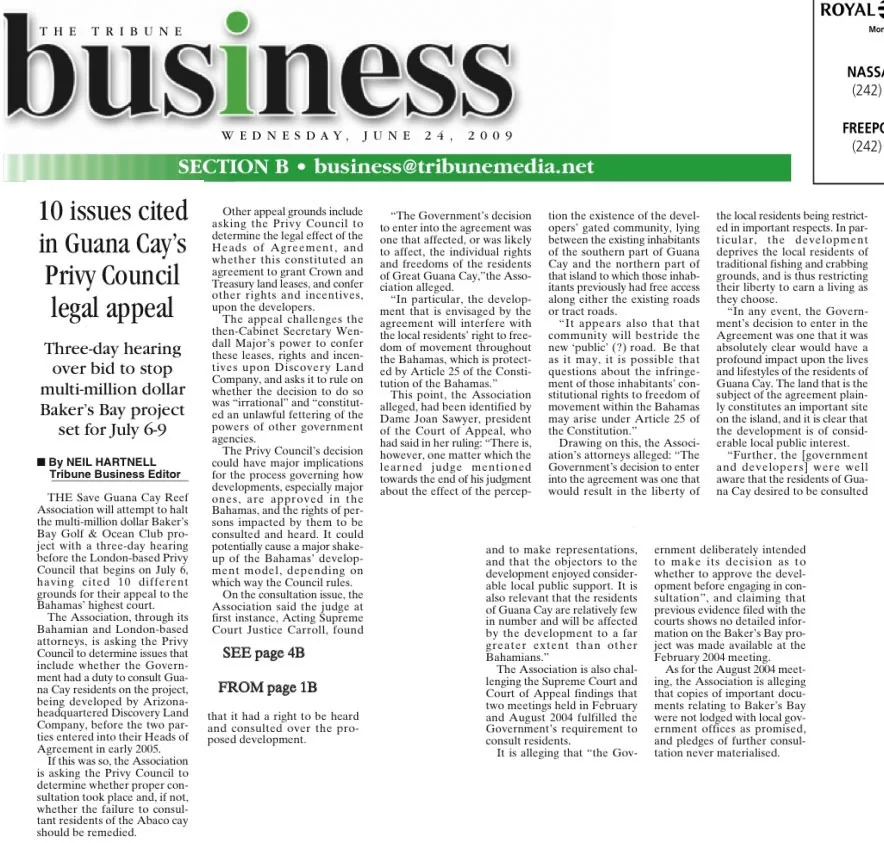
Tribune Article Explains Save Guana Cay Privy Case
Just received this article from the Freeport Tribune, explaining the Guana Cay legal case. Link to PDF
June 15, 2009
Privy Council in 3 Weeks, New Images Reveal Details of Bakers Bay Construction Site
Save Guana Cay Reef's legal case against Bakers Bay Golf & Ocean Club and the Bahamian government now moves to Privy Council, the highest court in commonwealth countries. This court acts as a 'Supreme Court' for commonwealth countries like the Bahamas.
Privy Council will hear the arguments between July 7 and July 9 in London.
Meanwhile, back on Great Guana Cay, details of the construction site reveal that many of the promises the developer boasted of are simply not being followed. And project deadlines are slipping off track.
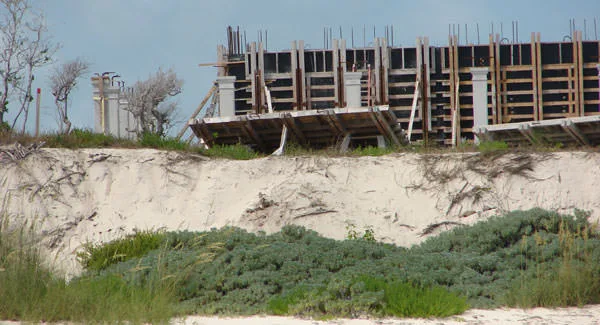
The developer advertised that Bakers Bay Club was environmentally sound, in part, because the homes would be built far from the coastal dunes and that a strict coastal buffer zone would be enforced. The image above shows the first home site in construction. It is the only home being built as of June 16, 2009.
The EIA stated the existence of coastal buffer zones as if they were facts; but here, with the very first home site, the developer has already thrown out some of their simplest environmental promises. Read the EIA
Here is a screenshot of the developer's own EIA, criticizing development too close to the shore.
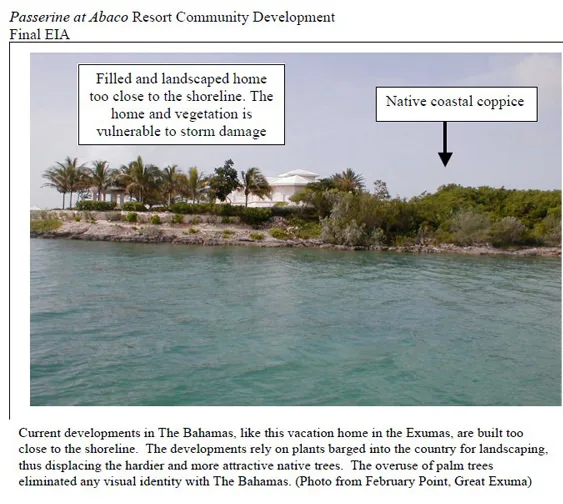
Coastal buffer zones are crucial for the health of nearshore environments, as construction adjacent to beaches creates erosion and pollutants. While the settlement in Guana Cay also has buildings built near the coast, this settlement has existed for 200 years, long before the age of environmental awareness; and it is the sheer size of Bakers Bay which makes coastal buffer zones critical. In addition, the Bakers Bay property is the only property adjacent to the largest and most important part of the coral reef.
This home is being constructed nearly hanging over the coastal dune, precisely in the area where endangered sea turtles are known to nest.
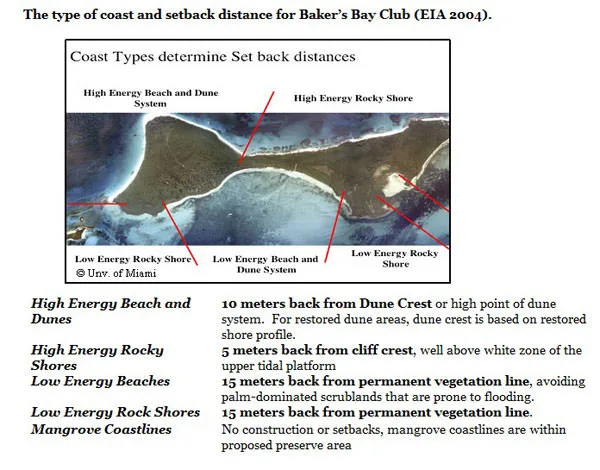
Here is some information on coastal setback distances according to the EIA. The home above is located on the Atlantic side, which is categorized by the EIA as "High Energy Beach and Dune System."
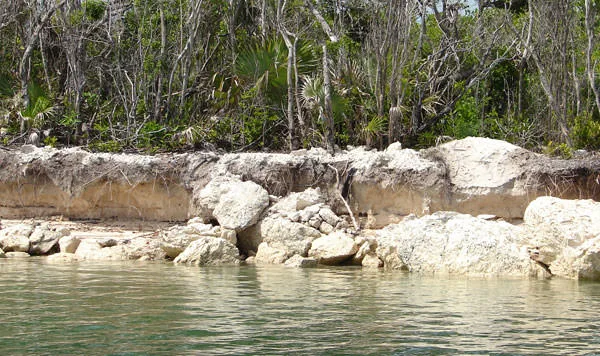
This image depicts erosion inside the marina.
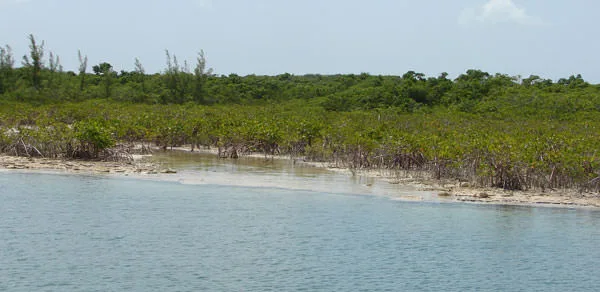
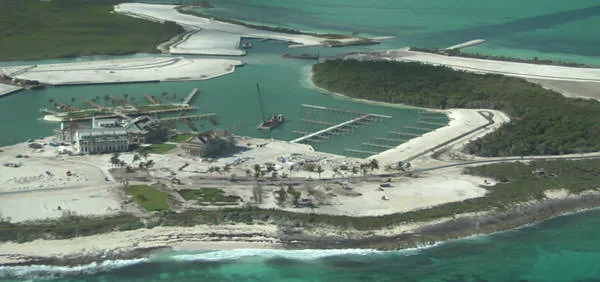
This image shows that in order to build the marina channels, large sections of mangroves had to be removed.
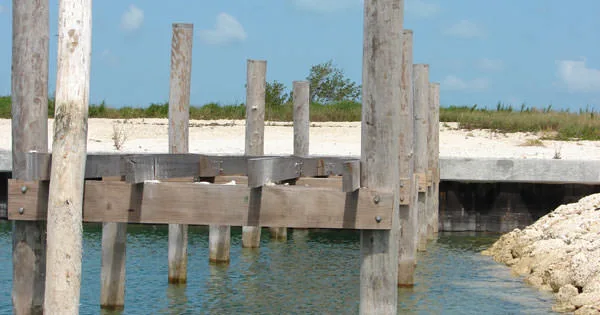
Although the marina is now officially open, many details are incomplete. The marina opened six months late, in April 2009.
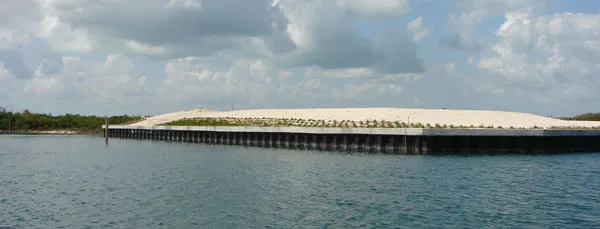
This image depicts unfinished golf course details adjacent to the marina.
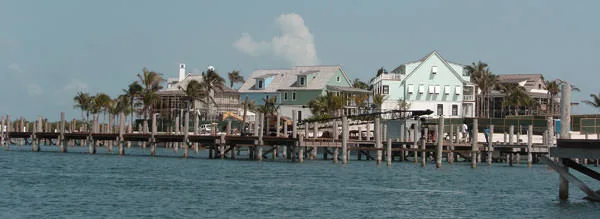
An image of the marina village. Visitors have stated shock at the marina's lackluster visual appeal. One visitor writes, "I expected something luxurious, but Bakers Bay is ordinary...very ordinary. I never thought Treasure Cay Marina was all that exciting, but now that I see Bakers Bay, I am really disturbed. This is such a nice area, and they have turned it into that cookie-cutter look. What a shame! There are so many areas in the Abacos with class, and this is not one of them."
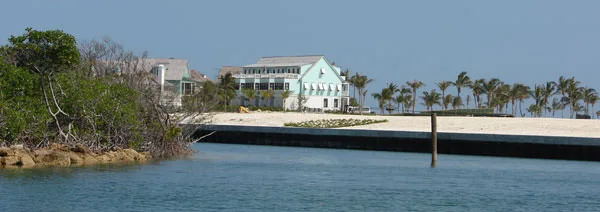
Detail from the marina.
August 12, 2008
Guana Cay Granted Conditional Leave for Privy Council
According to the Tribune, Save Guana Cay Reef has been granted leave for the Privy Council. Fred Smith is quoted in the article, "We believe we have a very strong case, and have been denied due process. The issue of the ability of the Prime Minister to bind the country as to Heads of Agreement will be determined at the highest level...for the future development of the Bahamas, these are matters which are of fundamental importance."
March 20, 2008
Privy Council, At Last
Save Guana Cay Reef has applied to leave for Privy Council. A more detailed explanation of Privy Council and current events will be appearing soon.
February 19,. 2008
Reef Defenders Lose Appeal

The next step for case #1, Privy Council. Photo courtesy SGCR.
Here is a note from Save Guana Cay Reef President to the Abaco out-island community after losing the appeal in court. You can read a Nassau Guardian article on the subject here.
As many of you have probably heard by now the judges in the court of appeal in Nassau ruled yesterday in our appeal. Unfortunately the news is not good. The judges ruled that the decision in Freeport will stand. Each one of the three judges gave an hour long ruling that went through all of our grounds of appeal and basically they sided with the trial judge below.
They all admitted there were some gray areas but they quoted lots of laws that say that the government has the right through its legislative authority to do all the things it did .
All of them hinted that they maybe did not agree with how it was done or it could have been done differently but the government did what they were statutorily required to do by law so there was no grounds for appeal. Even though there are no environmental laws in the country they did consult with the BEST commission and according to law the judges cannot place another scientists view over the one provided by a government mandated organization.
We still believe both of those statements to be a matter of linguistics and interpretation but that is a matter for the lawyers to work out. Our lawyer is reviewing the judgement and we are considering our next move. Fred came out of court smiling and the first words out of his mouth are we are headed to the Privy so we will see over the next couple of days what our next course of action will be .
Troy AlburySGCRA
January 8, 2008
News Clippings
The following articles cover press from late last year on the Guana Cay court case.
12.07.07
SGCR Vows to Fight Indefinitely
11.24.07
Anti-Bakers Bay Group Launches Third Judicial Review
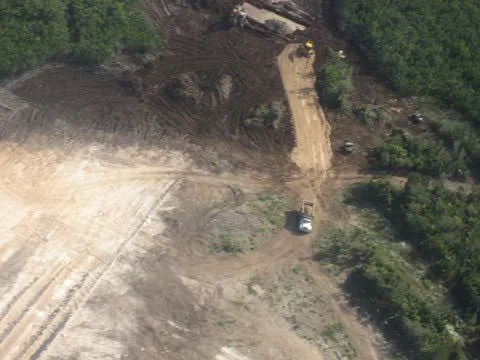
Save Guana Cay Reef will launch its third judicial review against the Bakers Bay Golf & Ocean Club. This review centers around the Hope Town District Council, the local government council, and the way in which the council pushes forward permits opposed by the locals on the very island it affects.
On November 29, Save Guana Cay Reef will ask the court for a stop work order, putting an end to all work on the Bakers Bay Club site until the issues can be examined in court.
11.22.07
Tribune on 2nd Guana Cay Case
This is an early October article from the Nassau Tribune on the 2nd legal case against the Bakers Bay Club. Anything by Neil Hartnell on the Great Guana Cay case is a great read — this one will help interested readers get caught up on current events on Great Guana Cay.
10.03.07
Save Guana Cay Reef Issues New Case
Below is a press release from Save Guana Cay Reef announcing a second lawsuit against the Bakers Bay development.
On September 29 2007, the Freeport Supreme Court ordered that Save Guana Cay and Aubrey Clarke could issue a new Judicial Review case to sue the Government and Hope Town District Council, the local government district for Guana Cay and the Bakers Bay Developers.
This is the 2nd Judicial Review case launched against the Government and Developers. It is the 1st against the Hope Town District Council.
Save Guana Cay is an association of Bahamians and foreign residents dedicated to preserving their unique heritage and culture, the land and marine environment, promoting respect for locals to be responsible for their island and saving Crown Land for future generations of Bahamians.
Guana Cay is internationally recognized as a unique marine and land environment and boasts one of the most picturesque and pristine traditional old Bahamian communities in the Abacos.
Despite this, in February 2005 the PLP Cabinet, under the direction of PM Perry Christie, and after years of secret planning and negotiations with developers, and following its now disgraced Anchor Project policy, dictatorially and without consultation with the residents of Guana cay, signed a Heads of Agreement with Bakers Bay, a foreign real estate developer, to allow a tax free $500,000,000 hotel, residential, golfing and the largest marina project in the Bahamas.
Since then the residents of Guana Cay mounted and continue to fight for their rights. They believe that the golf course will destroy the rich marine reef life.
The exclusively affluent and foreign gated residential community will destroy one of the few remaining forests, containing a fabulous variety of flora and fauna, in the Northern Bahamas.
The marina dredging and silting will destroy Joe's Creek, and the hundreds of ancient mangroves which protect against hurricane storm surges and are the nurseries for the marine life on which the fisherman on the island depend.
Their traditional crabbing and hunting grounds have been lost, as the former PM Perry Christie agreed to give it to the developers for $1 per acre or some other secret amount. Despite elections promises to the contrary, the FNM, according to the Developers, has issued the Crown Land Deed to the Developers of the last remaining 179 acres of Crown (public) Land left on the island. There will be no room for the local community to grow in the future. The 150 Bahamians will be surrounded by over 700 foreigners.
Perversely….the Developers, who only paid $1 per acre, have now offered to sell 1/3 of an acre of our Bahamian Crown land back to Bahamian citizens for $50,000 or $150,000 per acre, thereby making a swift profit of 149,999%. What were the PLP and what are FNM Cabinet ministers thinking?
The development will be completely out of scale with the small island community, dwarfing it in size. The construction of the development is expected to take 10 years, and will require hundreds of transient foreign laborers. The social, economic and environmental life of this old Bahamian community is being destroyed. The local citizens are becoming foreigners in their own land.
In Save Guana Cay Case number 1, the Association obtained an injunction (after several appeals in the courts in the Bahamas) from the Privy Council in London, stopping the development until the trial. In October 2006, at the trial, acting Justice Carroll, in the Supreme Court, ruled that the Heads of Agreement was valid and allowed the development to continue. Save Guana Cay appealed and is waiting for a Court of Appeal decision.
At the Court of Appeal hearing the Government and Developers argued that even if the Heads of Agreement was invalid they had received all necessary permits from the necessary government departments, and were therefore not relying upon the Heads of Agreement as authority to proceed.
In their pre election promises, the FNM party promised freedom of information, promotion of local rights and preservation of Crown Land for Bahamians. Since the FNM became the government, Save Guana Cay have repeatedly asked the FNM to make full disclosure of all of the permits.
Despite their promises the FNM has failed and refused to give any information and Bakers Bay claims that the FNM government has given 150 acres of Crown Land to the developers.
The citizens of Guana Cay, trusting the FNM, are appalled by the FNM's betrayal, even though 90% voted for the FNM in the general elections.
Now, after pressure from the Court of Appeal, the Developers, 2 years later, have provided copies of the permits they say were necessary to proceed with the development. For 2 years, the PLP and the FNM have kept the details of this development secret from their own Bahamian citizens, preferring instead to conspire illegally with the foreign developers, and permitting the rape and destruction of the environment, as they have done in Bimini and elsewhere.
Save Guana Cay case number 2 challenges all of these so called "permits".
The defendants in this action are The Queen, the Director of Physical Planning, The Prime Minister, the Town Planning Committee, the Minister of Maritime Affairs and Labour, the Minister of Public Works and Transport, the Commissioner of Police, the Water and Sewerage Corporation, the Hope Town District Council, the Attorney General, and the Developers, Passerine at Abaco Limited, Passerine at Abaco Holdings Limited, Bakers Bay Limited, Bakers Bay HOA Limited, Bakers Bay Marina Limited, and Bakers Bay Foundation Limited.
Save Guana Cay claims that the defendants did not have lawful authority to give the permits; that contrary to law the citizens of Guana Cay were not consulted; and that in any event granting the permits was irrational and contrary to the Constitution because they discriminate against Bahamians and residents who have to pay customs duties while the Developers and their buyers invest and own tax free.
Save Guana Cay also claims that Crown and Treasury Land is only for public purposes and for Bahamians. It is not supposed to be given away to foreign developers, for their profit, tax free.
No agreement under the Hotels Encouragement Act was given by way of disclosure; so the citizens of Guana Cay ask this FNM government to make full disclosure and tell the public on what lawful basis Customs is allowing Bakers Bay to import materials customs duty-free?
The Association continues to ask for discovery and will shortly be seeking another injunction. We will go to the Privy Council again if necessary. The English seem to have a little more respect for local and environmental rights than our own country.
Bakers Bay is continuing to desecrate, destroy and ruin the environment. See the photos exhibited with the court papers.
The citizens of Guana Cay will continue to fight for their rights as against the PLP, the FNM, and these destructive foreign Developers who have taken away their environment, heritage and quaint, picturesque Family Island.
Troy Albury is the president of Save Guana Cay, and copies of the action and his affidavit are attached as well as a copy of the Court order.
This war will continue and the citizens of Guana Cay need funding to continue to fight for their rights. We invite the public to visit our website, contribute to our cause financially, and to give support by letters to the Editors, press statements, telephone calls to the FNM members of parliament and in any other way possible.
This is not just about Guana Cay! This is a fight for the future of the Bahamas! What is happening in Guana Cay is one of the more abusive examples of what is happening all over the Bahamas.
Save Guana Cay is a member of Save The Bahamas and supports all those other freedom and environmental fighters in Nassau, San Salvador, Bimini, Harbour Island, Mayaguana, Rum Cay, Exuma and elsewhere in the Bahamas, the Caribbean and the rest of the world, fighting to protect their homes, cultures and environments from ignorant and blind politicians and rapacious and destructive developers. The politicians care for nothing more than to win political brownie points by announcing some development and the developers to make a fast dollar!
Please help us to protect our children's heritage and the future of the Bahamas!
Troy Albury
Aubrey Clarke
Anthony Roberts
Frederick R. M. Smith
Counsel to SGCRA
05.14.07
Save Guana Cay Reef calls on the new FNM Government to bring Sunshine to Guana Cay
The Save Guana Cay Reef Association continues its fight to protect the rights of the Bahamians and residents of Guana Cay.
After having completed a very successful international exposure of their plight at the United Nations, the Association applauds the FNM Government's commitment to freedom of information and, in particular, Prime Minister Ingraham's speech in Abaco promising that the Ministries of Government will now make relevant information available to the public.
For 2 years, the Association has been trying to discover what permits, approvals, concessions and/or licenses may have been issued to the Bakers Bay Developers by the Hope Town District Council, Ministry of Works, BEST Commission, Ministry of Health and other Government organizations.
Disgracefully, for 2 years, they have been stonewalled and not one piece of information has been provided, other than by Captain Allens of the Docks Committee.
The Association celebrates the arrival of the Government in the sunshine and is now taking the FNM Government, its Manifesto, and the promises of the Prime Minister at face value.
Today, the Association has written to Mr. Hubert Ingraham, the Prime Minister, Mr. Zhivargo Laing, the Minister of State for Finance, Mr. Sidney Collie, the Minister of Lands and Local Government, Mr. Neko Grant, the Minister of Tourism, and Mr. Earl Deveaux, the Minister of Works requesting that Bahamian citizens at Great Guana Cay be provided with the normal information which citizens of a country, especially those on the local level, should be entitled to.
Attached are copies of all of the letters.
The citizens of Guana Cay continue to fight for their environment and in particular, for their rights under the Local Government Act, the visionary piece of legislation which the FNM enacted when they were in power in 1996.
In addition, the Association's letters call upon Mr. Collie as the Minister responsible for Crown Lands to stop the trespass and destruction of the Crown Land at Guana Cay, especially since Ms. Deborah Fraser of the Attorney General's office has given evidence that no Crown Grants had yet been issued to the Bakers Bay Developers. The rights of the citizens of Guana Cay have been savaged over the last 2 years by the PLP administration, their small community has been destroyed and their environment is being devastated.
The citizens of Great Guana Cay call upon the FNM Government to make good on its promises to protect the Bahamian people from abuse, protect Crown Lands for Bahamians, and make full and transparent disclosure about what the PLP Government has allowed the Bakers Bay Developers to do at Guana Cay.
Frederick R. M. Smith
05.21.07
"Case May Rock Nation"
On May 17, the islanders of Great Guana Cay once again met with Discovery Land Company in court. As you know, the locals lost the case in the Supreme Court during the time that Perry Christie served as Prime Minister.
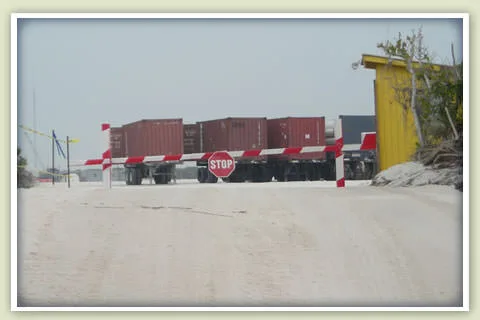
This image shows the guarded entrance to the crown and treasury land — now illegally in the hands of the developer. The appeals case looks at the illegality of giving crown and treasury land — similar to National Park land in the United States — to a foreign entity for a pittance. Photo by Anonymous.
The appeal was extremely successful, and the appeals court judges asked very, very difficult questions of Discovery Land Company. Michael Barnett, lead attorney for Bakers Bay Club, was largely at a loss as judges asked very specific and very pointed questions.
The judges did not place an injunction on Bakers Bay Club; but they promised to have a decision within two months. Bahamians are very excited about the prospect of having the Supreme Court decision overturned, as the evidence that the developers and the now-out-of-office Central Administration together engaged in an illegal and unethical proposition that willfully hid crucial details from locals, and intentional stepped over legal bounds to make this monstrosity happen.
5.22.07
What are they Hiding?
The following letter from Fred Smith to the attorney for Discovery Land Company/Bakers Bay Club and the Former Bahamian Prime Minister's administration steps up the requests to see documents that Discovery Land Company is trying very, very hard to keep hidden from public view. In the United States, these sorts of documents are public. But Discovery Land Company, and the former administration don't want the public to find out what they know, because if these documents are uncovered, we'll find out just how illegal the relationship and Heads of Agreement between the two entities really is.
Mr. Michael Barnett
Graham Thompson & Co.
Dear Sir:
Re: Save Guana Cay Reef Association — Your undertaking to immediately provide copies of Permits; discovery generally
Thank you for your letter of the 22nd instant.
I am surprised that your clients are resistant to the scope of documentation to be discovered.
I note your reference to the provision of "permits" relating to your clients "construction" on Guana Cay.
This is not what was undertaken.
You will recall considerable exchanges between the Court and Counsel for the parties relating to the basis upon which your clients were engaging in any activities on the Cay.
You represented to the Court that everything your clients were doing had all necessary approvals, permits, licenses, agreements as may have lawfully been necessary under the relevant statute, be it from some central government or local government authority, and hence your clients' activities never did and do not rely on the Heads of Agreement as a basis for engaging in any activities.
In particular, in relation to the lawful basis upon which your clients were purporting to build anything, lay out roads, etc., or the basis upon which they were importing materials (for instance, under the Hotels Encouragement Act or the Heads of Agreement) and the basis upon which they were conducting extensive dredging, drainage, construction works, bulldozing, destruction of mangroves, tearing down and uprooting forests, taking away sand and blocking Joe's Creek, and particularly any such works on the Crown and Treasury Lands and the basis upon which your clients purported to possess and occupy such lands.
You will recall that, as a result of such representation, the Court of Appeal denied the injunction because they held, if your clients had all lawful permits even if my clients won the appeal, your clients may still have been lawfully entitled to do what they had been doing.
Whilst my clients do not agree with that proposition it is nonetheless the basis upon which you undertook to provide the relevant documents and the basis upon which the Court refused the injunction.
Unless we have your confirmation by return that your clients will comply with the undertaking given to the Court and not in the narrow sense which you now suggest, we shall have no alternative but to take action upon the breach of your undertaking.
In addition, please provide the remaining items sought.
Yours faithfullyCALLENDERS & CO.
Frederick R. M. Smith
April 24, 2007
SGCR Press Release:Their homes have been invaded, their lands have been stolen
SGCR Press Release:Their homes have been invaded, their lands have been stolen| 04.24.07Save Guana Cay Reef Association alerts press to their ongoing battle for local and environmental rights in the Bahamas
In October of 2006, the Association appealed the Decision by Acting Justice Norris Carroll dismissing the judicial review against the Government and the Bakers Bay Developers.
The appeal is set for hearing on May 17, 2007. In the meantime, the Save Guana Cay Reef Association has applied for an injunction to restrain the Developers from continuing the desecration of the environment.
Since the Judgment the Developers have torn down many acres of forests, destroyed huge mangrove swamps and have been extremely busy dredging the marina basin.
In addition, the Developers have made applications to build but the Hope Town District Council, based on the objections from the Association, has deferred granting permits.
In addition, despite many requests from the Association to the District Council to let them know what permits have or have not been given, both the Attorney General and the District Council have failed to provide information to the residents of Guana Cay.
Thus, it can be seen that the fight to protect local government rights and the environment in Guana Cay is also a fight for all Bahamians for freedom of information.
The Court of Appeal is set to hear the Association's application for an injunction tomorrow, April 25, 2007, in the Court of Appeal in Nassau.
In addition, however, the Developers have demanded that the Association pay $100,000 by way of security for their costs.
The Association says this is another attempt by the Developers to block legitimate and reasoned challenges to the Government and other development activities.
Counsel to the Association, Frederick Smith, said
"The passionate freedom fighters from Guana Cay will not give up. Their homes have been invaded, their lands have been stolen, their peaceful, quiet and traditional way of life has been challenged by the quest for the almighty dollar.
The people of Guana Cay want the Government and the Developers to know that the Bahamas is not for sale. Our homeland is not for sale. It is not all about the money! People have rights. Local Government legislation gives the people of Guana Cay the right to say what should or should not happen on their island.
Dictatorial Cabinet politicians and all for profit developers will remember that the people of Guana Cay are passionate about their local rights and are committed to protecting their environment. The fight will go on despite all the obstacles that the Government and the Developers may try to throw up!"

Foreigner-owned machinery, like tanks, stand ready to plow through Guana Cay's heritage. This photo from early 2006 depicts a part of Guana Cay that has already been destroyed.
In addition, the Save Guana Cay Reef Association is travelling to New York to attend and make a presentation on sustainable development in island locations.
The Association intends to make a presentation before hundreds of delegates at the United Nations. The Association intends to highlight the desecration of their homeland and environment on Guana Cay and to demonstrate that this is but one example of the shortsighted and destructive real estate and marina developments ongoing throughout the Caribbean and other coastal and other Island nations.
Mr. Smith also said
"What is happening in Guana Cay is but a microcosm of the challenges faced by so many other communities in small Island and coastal states and locations throughout the world. We hope that the freedom fighters in Guana Cay will help to educate the world about how important it is to preserve and protect local rights and the environment!"
Attached is a copy of the letter sent to the District Council requesting information which continues to remain unanswered.
Link to copy of unanswered letter
May 4, 2007
Save Guana Cay Reef Secures Donations
Save Guana Cay Reef was recently ordered by the court to put up a $100,000 security bond after applying for an injunction to halt development at Bakers Bay Club. Read the article in The Nassau Guardian:Article from The Nassau Guardian
November 21 , 2006
Supreme Court Decision Flawed, Independence Questioned
Justice Carroll insults Abaco Sailing Community in illogical Argument
Justic Carroll's supreme court decision to have the local's case against the Bahamian government and the Discovery Land Company was made in a judgment that went on for over 200 pages. In all of those 200 pages, discussion of the environment was limited to just one paragraph. Before reading the paragraph, remember that the environmental arguments made by the locals of Guana Cay are supported by an international consensus of coral reef and conservation specialists, including top-level conservation NGO's. All Bahamian environmental NGO's support their position. Here is Justice Carrol's reasoning:
"It is to be observed that the Applicants do not appear to have anything against the coming of foreign second homeowners or even against foreign persons who come and live on their sailboats or yachts: Thousands of these latter are said to come year after year and the Applicants herein want the environment to be protected so that such persons can continue to come, year after year. They want these kinds of tourists, visitors,homeowners to come but not to the Developer's project!
It is a known fact that sailboat owners and yachtsmen also find it necessary while anchored in our pristine waters to get rid of their domestic and personal waste and that for the most part it gets deposited into those pristine waters!"Great Guana Cay, at any one time, has about 20 visiting sailboats or yachts, most of which are visiting the main settlement harbour, a natural harbour which has been traditionally used for commerce and tourism since the earliest days of the cay.
At any one time, about 8 of those 20 visiting boats, most of which are sailboats, can be seen moored in the pleasant Bakers Bay. Bakers Bay itself is one of the attractions that brings sailors to Guana Cay. The peaceful Bay's incredible beauty attracts perennial visitors. Bakers Bay itself is a seagrass area, facing the Sea of Abaco.
It is filled with turtle grass, starfish, and roaming nurse sharks. The environmental impact of about eight sailboats a day on these seagrass beds is next to nothing. These boats drop an anchor, probably leach some gasoline.
To suggest that the Abaco sailing community dumps their personal and domestic waste in the seagrass shores of Bakers Bay is illogical and ignorant. International regulations about disposal of waste are strict; and the sailing community, which itself is an environmentally responsible community, tends to follow these laws carefully.
It is undoubtedly extremely unlikely that sailboats in Bakers Bay dump their waste in the bay, ever. Even the chance of being caught by fellow boaters would be enough to dissuade an isolated litterbug. To compare these 8-boats-a-day to the dangerous megadevelopment being constructed by the Discovery Land Company is preposterous.
The Bakers Bay Club will terraform the northern 2/5's of the island, dig out a giant 250 slip marina, build 500 buildings, a hotel, tennis courts, recreation facilities, and invite...yes invite the so-called megayachts — 100-300 foot super-yachts, into Bakers Bay. Their megadevelopment will destroy the coral reef, mangroves and important fisheries associated with the island's only estuary.
Recent news raises serious questions about whether this decision was fully independent — not because of anything specific to Carroll personally, but structurally: as the update below explains, acting Supreme Court justices in the Bahamas at the time lacked the constitutional security of tenure needed to be insulated from the political administration that kept them employed.
Updated November 21 , 2006
Justice Carroll Not Independent
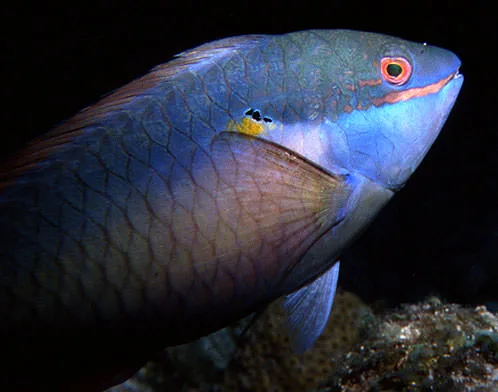
Photo by Erik Gauger. The Guana Cay reef is in imminent danger,according to several well known conservation groups.
A thunderstorm of press has gathered in the Bahamas over the latest of many twists and turns in the Bahamian court case against the Bahamian government and Michael Meldman's Discovery Land Company. Justice John Lyons, in unrelated court cases, has determined that the Bahamian constitution has been severely compromised.
Supreme Court justices must constitutionally have tenure to make Supreme Court decisions — but Justice Norris Carroll is not tenured, and is therefore influenced by the political atmosphere that keeps him employed. This press release from the locals of Guana Cay comes out as Discovery Land Company asks them to pay for the billion-dollar project's legal fees.
This move is another example of the developer's ill will toward the people of Great Guana Cay. While the developer admitted that the local's case against them has helped them change some of their most unsustainable components of their development, they still insist on crushing the local's right to defend their island.
In this latest move, the locals also claim that Acting Justice Carroll is not independent of the politics and powers that be.
The allegations of corruption in the current Bahamian administration are making the rounds in the newspapers as it becomes clearer that these allegations of corruption are bringing down the administration.
Here is the press release from Save Guana Cay Reef:At a hearing before Justice Carroll in Freeport today the Save Guana Cay Reef Association took 2 preliminary objections as to the court's jurisdiction to hear any aspect of the matter and in particular to deal with applications by the Government and the Bakers Bay Developers for an order that the Association pay 2 different sets of costs of the Developers' and the Government, and asking for them each to be certified fit for 2 counsel each, i.e.
4 sets of counsel costs against the Association.
The Developers were represented by Robert Adams of Graham Thompson and Co, and Leif Farquharson represented the Government. Fred Smith appeared for the Association. No appeal has yet been filed by the Association on the Judicial Review ruling of Justice Carroll as the costs issue had yet to be ruled on.
Mr. Smith objected to the hearing on 2 points. Mr. Smith submitted that,
Justice Carroll ruled against SGCR and continued with the hearing of the costs application. The Developers and the Government submitted that costs are normally paid by the loser and this case should not be an exception.
Mr. Smith argued that this was a case of major and general public importance and that his clients should not be penalized in costs. He said;
"The Association is comprised of citizens who were simply standing up for their local rights. The courts are not there just for the rich or powerful. If the Court orders the Association and Mr. Clarke to pay costs it will send a chilling message to people in the Bahamas."
"It will mean that there is a big huge gate at the entrance to the halls of justice, and you can only unlock the gate with money. If you do not have money, or if you are not big and powerful, stay away because you will not be able to afford justice."
"This is unconstitutional. People will thereby be deprived of their right of access to the courts for determination of their rights. What's the sense in having fancy laws and courts if you cannot enjoy their protection…if you get chased away because you cannot afford them? If you cannot afford to get through the gate because you cannot afford the membership fees?"
Mr. Smith also submitted;
"The Developers have already put into evidence that Mr. Clarke and the Association have no assets, so why bother to ask for costs? I'll tell you why! Because, once the court orders costs, they will put in big fat huge bills, get their certificates and demand payment; then they will hound Mr. Clarke and the Associations into bankruptcy. Then we will not be able to appeal, or if we do huge security for costs will be sought which will again be another roadblock to justice."
Mr. Adams and Mr. Farquharson submitted that justice should be blind; "The court should not take into account whether you are rich or poor"
Justice Carroll adjourned to make his decision. In the meantime he invited the Developers and the Government to consider being "gracious" to their neighbors and citizens.
In the meantime, Mr. Smith asked for leave to appeal to the Court of Appeal on the 2 objections to jurisdiction.
If Mr. Smith is correct in his second objection as to Justice Carroll not being institutionally independent because he does not have security of tenure, it will mean that the Judicial Review application will have to be heard again by a new judge.
In addition however, if Justice Lyons is correct, and the independence of the judiciary has been compromised by Cabinet's failure to comply with the provisions of the Judges Remuneration and Pensions Act, there may be no judges with jurisdiction to hear the retrial of the Judicial Review Application. Indeed, the Court of Appeal judges may suffer from the same constitutional infirmity.
"That is the conundrum. That highlights the constitutional crisis"said Mr. Smith."Until this issue is finally determined by the Privy Council any litigant from 2003 onwards may be able to challenge any ruling or judgment of the Supreme Court on this issue of judicial independence. That is why we must get this determined as soon as possible so that the people of the Bahamas know where we stand."
"We cannot continue in this Constitutional limbo land!"
November 24, 2006
Guana Cay Files its Notice of Appeal
From the Press Release dated November 24, 2006: The Save Guana Cay Reef Association has filed its Notice of Appeal against the Judicial Review judgment of Acting Justice Norris Carroll. The Association intends to pursue its appeal as soon as the Court of Appeal can hear it.
In the meantime, the Association is battling a claim by the Government and its developers for payment of their costs in the Supreme Court trial. Justice Carroll refused to recuse himself on the costs application.
That too will soon be dealt with by the Association. The Association remains steadfast in its commitment to resist this abusive and inappropriate mega development to which the pristine natural environment of Great Guana Cay has been subjected. The developers have commenced extensive civil works again. The Association is now considering other actions and the possibility of an application for an injunction to restrain the developers from continuing with the works in the meantime. Attached is a copy of the Notice of Appeal and the recent order by Justice Carroll.
October 19, 2006
Guana Cay Locals' Supreme Court Case Thrown Out
As widely expected, Justice Norris Carrol threw out the local's Supreme Court case. Construction has restarted at Bakers Bay. The court's decision was based on the notion that the federal government has ultimate authority over the economic direction of the country.
The environmental issues, at the heart of this debate, have been addressed by the developer, and were also not addressed in the lengthy ruling. Although the news is a blow to local rights, tourism and the Bahamas environment, the appeals process, and, if necessary, the Privy Council, come next. Guana Cay locals are energized to end the siege of their island.
August 09 , 2006
Injunction Upheld against Bakers Bay Club
Privy Council votes to maintain injunction against work at Great Guana Cay site. No construction at Bakers Bay in the foreseeable future. Time and credibility are running out for beleaguered developer. Read pre-trial press here

Construction in the marina after the injunction was lifted from May to July (construction has now been halted again) was irresponsible, shifting the nutrient levels dangerously close to the coral reef. Bakers Bay Club will now have to await the decision of the Bahamas Supreme Court in order to continue environment-altering construction.
August 02 , 2006
Bakers Bay Club using Intimidation Tactics
One week after the Privy Council announced construction at the Bakers Bay Club site must be halted, American Bridge (the developer's construction company) appears to be leaving the island. Amidst the noise and the dust and the barges cranes swinging back and forth, Discovery Land Company makes an unusual move.
I am attaching a press release from Save Guana Cay Reef which explains Discovery's latest move. You can also read about it inThe Nassau Guardian.
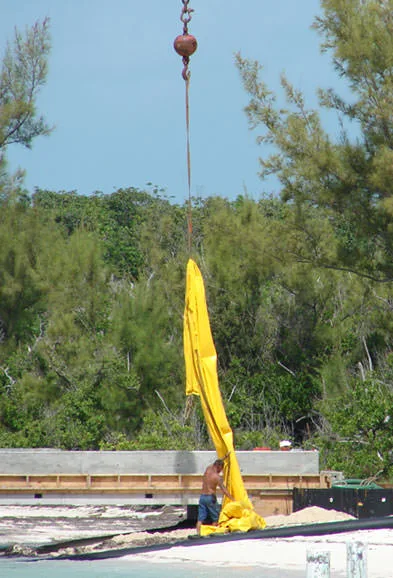
American Bridge workers remove the silt curtain, which was haphazardly used to minimize silting into the nearshore environment during dredging and construction. It appears that American Bridge is packing up to go, for the time being anyways.
Workers are holed up at the Northeastern end of Great Guana Cay. Living conditions here are harsh, and there are whispers of massive worker backlash against the developer. Now, it appears work is stopping almost entirely.
SAVE GUANA CAY REEF ASSOCIATION
PRESS RELEASE
Bakers Bay Developers bring pressure on Association
Make statutory demand before applying to liquidate
Save Guana Cay Reef Association Limited
August 1, 2006
The Association announces that it has been served with a Statutory Demand by the Bakers Bay Developers in respect of costs of $10,000 ordered to be paid by the Court of Appeal on June 28, 2006.
The Statutory Demand is signed by Mr. Joey Arenson, who is a Director of Passerine at Abaco Ltd. and Passerine at Abaco Holdings Ltd.
The Association views this Statutory Demand as a prelude by the Bakers Bay Developers to try to kill the Save Guana Cay Reef Association.
If the $10,000 costs are not paid then the Bakers Bay Developers can petition the Supreme Court to liquidate and wind up Save Guana Cay Reef Association Ltd.
This is another example of the vindictive approach by the Bakers Bay Developers in dealing with the people of Guana Cay.
The President of the Association, Mr. Troy Albury said
"This Demand and threat by the Bakers Bay Developers demonstrates their lack of respect for the people of Guana Cay.
The people of Guana Cay are fighting to protect their culture, tradition and environment. Instead of recognizing the legitimacy of our position, and recognising that we do speak for the people of Guana Cay, Bakers Bay are trying to use this demand for the payment of costs to muzzle and suffocate us to death.
Our Association speaks for the hundreds of Bahamians in Guana Cay who are desperately fighting to preserve our way of life.
It is a disgrace for the Bakers Bay Development Company, even though it is entitled to costs, to use this as a means of trying to kill our Association."
Mr. Smith, Counsel for the Association, said
"This is highly unusual. The Association, the Government and the Bakers Bay Developers are in the thick of legal battles. We are all waiting for a decision from the Supreme Court.
Usually parties wait until all the legal battles are over and the dust has settled to claim costs that have been awarded and to set off awards of costs that have been made throughout the different stages and levels of the fight .
The attempt by Bakers Bay to collect this $10,000 is simply an attempt to bring pressure to bear on the people of Guana Cay to stop their fight for justice.
The people of Guana Cay will not be intimidated".
The Association has appealed the decision of the Court of Appeal awarding the costs against the Association and if Bakers Bay Developers move to liquidate and wind up the Association, they will have to apply for a stay pending the outcome of the Privy Council Appeal.
A copy of the Statutory Demand is attached hereto. Section 188 of the Companies Act 1992 Chapter 308 provides that if the debt is not paid within 21 days of service the Developers are entitled to present a winding up petition in the Supreme Court against the Association.
Frederick Smith
July 27, 2006
Massive Court Victory for Guana Cay Islanders
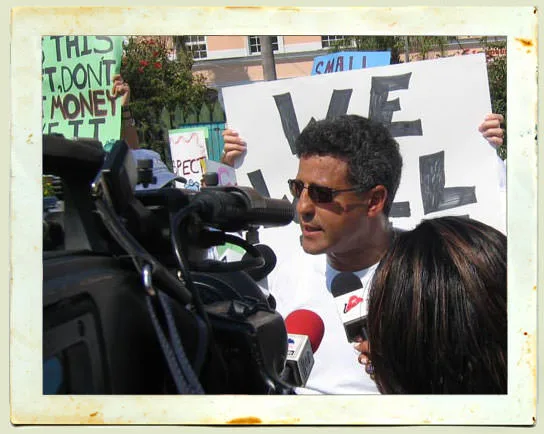
Save Guana Cay Reef attorney Fred Smith faces the press in undated photograph. Photo SGCR.
"The people of Guana Cay are dancing and celebrating in the streets"For two years, the local Bahamian population of Great Guana Cay has been embroiled in a bitter battle with an American golf course developer, Discovery Land Company, whose plan to build a mega-development is opposed by most Bahamians and a consensus of coral reef scientists around the world.
The fight has been centered around an 18-hole golf course, 500 residential units and a marina for mega-yachts, to be dynamited out of mangroves. Since 2004, the residents of Great Guana Cay have been stating that such a development would invariably destroy their coral reef, eliminate their mangroves and alter the environmental relationship between their island's unique terrestrial ecosystem and the nearshore environment. The battle has taken many turns, especially in the Bahamian Supreme Court system.
But just now, the locals of Great Guana Cay have secured an amazing battle victory; a victory in a war that is expected to last years, and the outcome of which has been deemed by environmentalists to be crucial to the future of coral reef and mangrove conservation in the Caribbean. In November 2005, after consulting with their 10-man legal team, Discovery Land Company voluntarily decided to halt construction on their development until the Supreme Court case against them and the Prime Minister was decided.
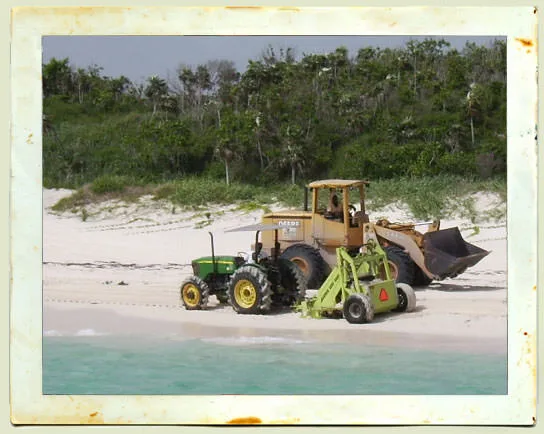
Construction Equipment is photographed on July 29 on the Atlantic-facing beaches, despite a work stop order from the Privy Council in England. This area is an important sea turtle nesting site, and such construction equipment is strictly forbidden on such beaches. All 7 species of sea turtles are endangered. 5 of them visit these waters, and at least 2 species nest on this beach. Photo SGCR.
For two years, the local Bahamian population of Great Guana Cay has been embroiled in a bitter battle with an American golf course developer, Discovery Land Company, whose plan to build a mega-development is opposed by most Bahamians and a consensus of coral reef scientists around the world. The fight has been centered around an 18-hole golf course, 500 residential units and a marina for mega-yachts, to be dynamited out of mangroves.
Since 2004, the residents of Great Guana Cay have been stating that such a development would invariably destroy their coral reef, eliminate their mangroves and alter the environmental relationship between their island's unique terrestrial ecosystem and the nearshore environment.
The battle has taken many turns, especially in the Bahamian Supreme Court system. But just now, the locals of Great Guana Cay have secured an amazing battle victory; a victory in a war that is expected to last years, and the outcome of which has been deemed by environmentalists to be crucial to the future of coral reef and mangrove conservation in the Caribbean.
In November 2005, after consulting with their 10-man legal team, Discovery Land Company voluntarily decided to halt construction on their development until the Supreme Court case against them and the Prime Minister was decided. The hope was to avoid a court injunction. But since the Bahamian Judge has been deliberating for months and no decision is expected any time soon, Discovery Land Company appealed successfully to the Bahamian court system to be released from their voluntary work stop on May 8 th.
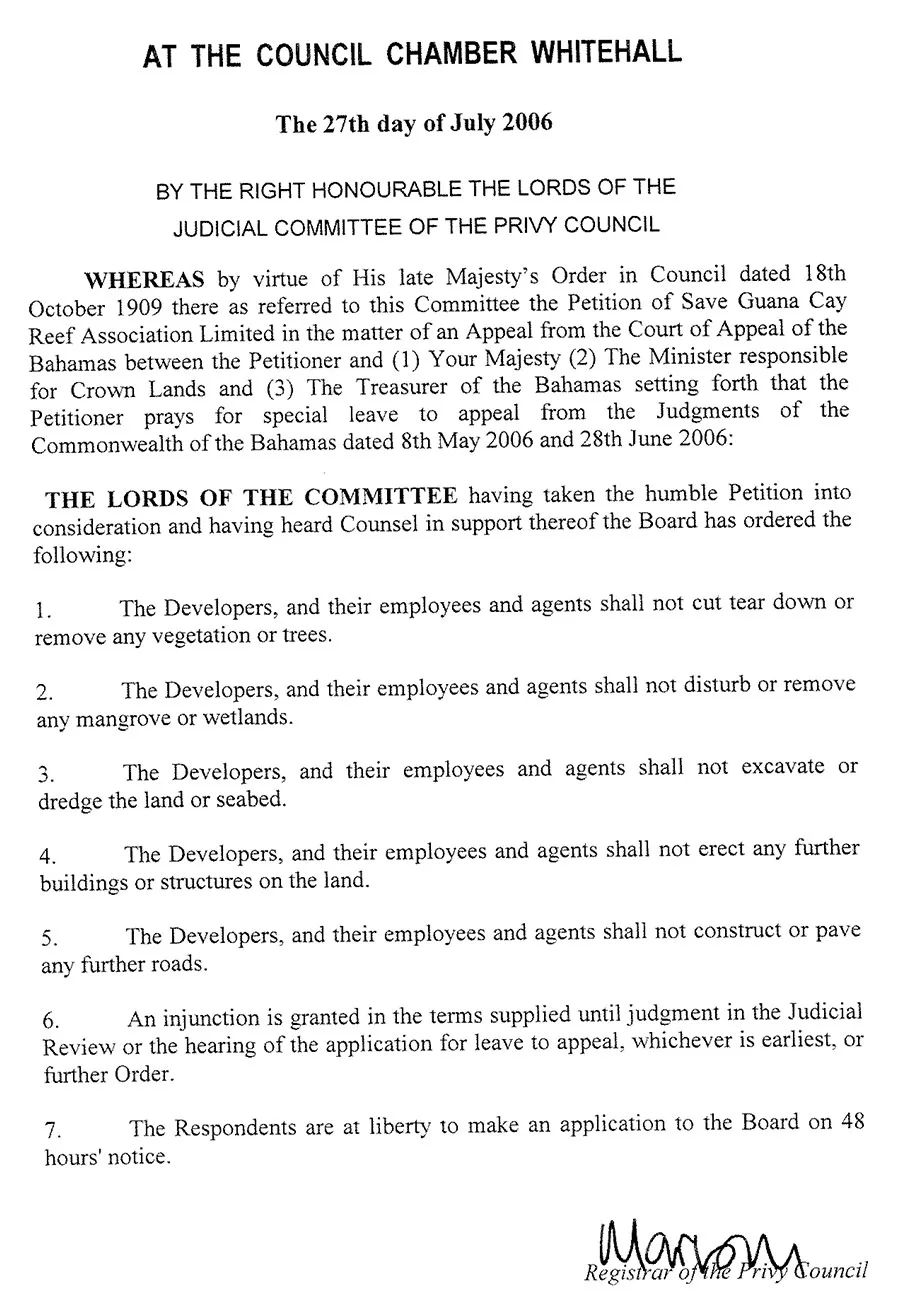
Starting work at Bakers Bay Club, of course, meant further destruction to Great Guana Cay, and so mangrove destruction and further threats to the coral reef began at a blistering pace.
But today, Fred Smith, a bright Bahamian attorney with a singular devotion to this tiny cay, successfully urged the Privy Council to halt all work at the Bakers Bay Club until the Supreme Court Case has been decided.
(read the full Submissions)
The Bahamas is a small country, and in such a political closed-circle, corruption and influence come easily. This is especially possible with regards to the Great Guana Cay issue, because the Prime Minister himself, whose administration are defendants in this case, are basing their administration's success on the idea of planting 'anchor developments' in each of the Bahamas' out-islands, rolling through red tape and local opposition in the hopes of quickly creating employment.
But an outlet exists for corruption in the Bahamas court system: The Bahamas is part of Great Britain's loose confederation of independent states, the so-called 'Commonwealth.'
Above their own Supreme Courts, each member of the Commonwealth has an outlet to the 'Privy Council', a Commonwealth-wide Supreme Court that serves to keep small-countries' own court systems in check. Notes from the Road interviewed Attorney Fred Smith shortly after his victory. We asked him why a Privy Council is necessary. Smith says, "It's our lifeline to a more enlightened jurisprudence, and it insulates our jurisprudence from nationalism, insularity, myopia, subconscious political interference, and sometimes lack of intellect."
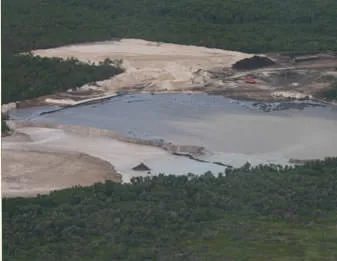
Marina construction was occurring at a rapid pace. Photo SGCR.
Fred Smith argued to the Privy Council that the relationship between Discovey Land Company's Bakers Bay Club and the Prime Minister of the Bahamas was in fact not legal, and that the 'Heads of Agreement' document that was designed between the two entities should be thrown out. Smith has argued that the proper permits for the development were never authorized, that development went ahead without the involvement of the local community and local regulatory obligations, that crown land cannot be given away to foreigners, etc.
The Bakers Bay Club, which had been thrilled to be able to work through the months of June and July are now certainly holed up in their Northeastern Guana camp, angry, confused. The swearwords eminating from that place must be horrendous.
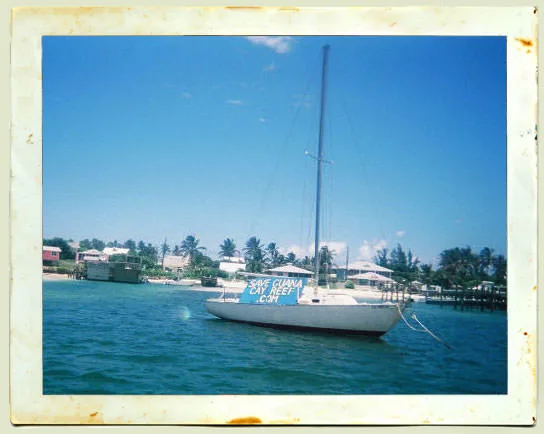
Opposition to Bakers Bay Club is everpresent on Guana Cay. Photo W. Schubert.
The anger shows. In recent months, as the developer appears to lose more and more ground in the public eye, in the international press and with conservation NGO's, they have begun to act increasingly belligerant towards those opposed to their development.
A recent interview on the Bahamas' most popular radio show featured Livingston Marshall, the Environmental and Community Affairs officer for the developer, and Steve Adelson, one of the development's general managers. In the interview, Marshall exclaimed that the opposition to their development hardly existed, and that only a few tired souls continued to persist.
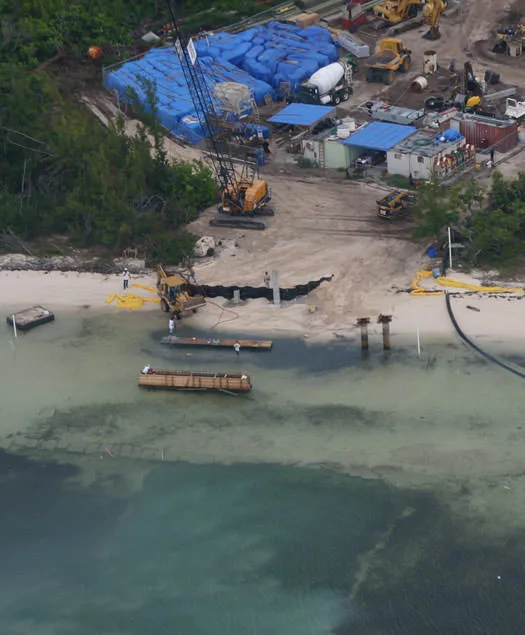
Use of silt curtains was irregular.
This statement is one that Marshall exclaims over and over again. In an email, he writes, "Name me just two people who are against us?" The Bahamian press, which at its worst is too lazy to edit the developer's press releases, will print these releases in their entirety.
In almost every release, the developer states that the opposition to their development is financially-motivated, or the realm of foreigners, or is almost non-existent. All of these notions have been thoroughly debunked over a year ago, but in the Bahamas, truth can be coated with sugar and money. It's ironic that a widely unpopular foreign developer, led by a board of arrogant, image-conscious executives, is able to tell native Bahamians that they don't exist, and that they are not Bahamian, all at the same time.
But if you've ever read the advertorials in magazines like Executive Golfer, which fawn over the successes and alleged handsome qualities of the Discovery Land Company's CEO, it makes sense that the Discovery Land Company sees truth as something you can buy.
Fred Smith called the radio show and responded by saying that it simply wasn't true, and Dr. Marshall knew it. That the shares of 'Save Guana Cay Reef' were distributed among hundreds of residents of the island, none of which had given up on the cause.
Not only are the majority of Guana residents opposed to the development, but the Bakers Bay Club is voraciously opposed throughout the Abaco Island chain.
Although the Abaco Message Board, which is the de facto means of communication for Abaco residents, maintains a strictly non-political atmosphere, it defers political talk to the Save Guana Cay message board; another indication that the guana Cay's opposition to bakers bay club is central to Abaco culture. The talk show host asked Marshall to respond, after these short commercial messages. When Marshall and Adelson came back on the program, they quickly changed the subject.
According to locals, on Bahamian Independence Day a few weeks ago, an American general manager for the Bakers Bay Club was enraged to find a Bahamian family celebrating their independence with a barbecue on the public beach, as was customary in the Bahamas. The general manager allegedly ordered Bakers Bay Club guards to have them removed, but the family refused. When the police told general manager Carter Redd to lay off, the family was allowed to cook their hot dogs on the beach, as is allowed in Bahamian law.
A few days before the Privy Council case was announced, the Bakers Bay Club announced they were creating a foundation called the Fig Tree Foundation, which would help locals of the island in a number of ways, including offering them multi-million dollar lots at the Bakers Bay Club for $50,000. It was clear that Discovery Land Company was trying to buy out opposition to their development.
The developer's press release printed in The Nassau Guardian states, "Bakers Bay CEO, Mike Meldman said the mission of the Fig Tree Foundation Ltd. is to protect the Great Guana Cay community and enhance the quality of life for all people living on Great Guana Cay.
The Foundation will accomplish this mission by raising funds which will be dedicated to all facets of the Great Guana Cay society and directed toward the community's educational, environmental, medical and general social needs."
The developer continues to state, "With the guidance of key members of the community who will help direct resources, the Fig Tree Foundation Ltd. aspires to strengthen individuals, institutions, the environment, and services on Great Guana Cay."
But there are no key members of the Guana Cay community in the Fig Tree Foundation.
Failing to follow up words with deeds is no isolated incident with Discovery Land Company supporters. Dr. Marshall's comments that "(Bakers Bay Club) will install web cams within the next several days/weeks such that additional external monitoring of the project can be had…" If you compare that statement with the words on Page 77 of the initial developer's Environmental Impact Assessment, "THE MOST CRITICAL TECHNOLOGY TO BE USED ON THIS PROJECT IS ON-SITE "WEB-CAM", USED TO MONITOR VARIOUS PHASES OF CONSTRUCTION.
Real time web-cameras will help prevent problems from occurring as well as help guide restoration of "errors".
Of course, none of these important considerations have yet to be implemented. If the "most critical technology" to be used for monitoring construction, has not been implemented, what about the rest of the prevention, mitigation, monitoring, and reporting actions which have been promised?
The Environmental Impact Assessment has been critically maligned by experts as being an unsubstantial document. Despite it being light on critical environmental elements, the developer continues to ignore its most essential recommendations. It is so likely that the Fig Tree Foundation is being used as an attempt to divide and conquer the locals of Great Guana Cay that in the press release, this point is brought up:
" In reference to Discovery's motive behind launching the Fig Tree Foundation, Mr. Meldman said, "We do this sort of thing everywhere our properties are located. This is not being done here at Great Guana Cay just because we want to quiet the previous situation."
Notes from the Road has been looking into this claim. To date, we have found no evidence that foundations were set up at any of Discovery Land Company's mainland U.S., Hawaii and Mexico golf courses. Can you buy the truth?
Perhaps in the Bahamas, but with the intervention of the Privy Council, the watchful eye of NGO's, a motivated and proud island and growing dissent throughout the Bahamas, Discovery Land Company is quickly learning that Great Guana Cay is no Executive Golfer Magazine.
Fred Smith's submission to the Privy Council begins with these nine points:
1. This is a matter is of great public importance for the future of The Commonwealth of The Bahamas.
2. The Petitioner prays that pending the hearing of the Petition for Special leave to Appeal being heard in October 2006, Your Majesty in Council will see fit to order that judgment the Court of Appeal dated May 6, 2006, whereby the Developers (as described in the Petition) were relieved of their voluntary and unsolicited undertaking not to proceed with the physical works of a development on Great Guana Cay in The Abacos, will be stayed, thus preserving the status quo until final determination of this matter.
3. Although it is a matter which focuses on a small cay in one of the Family Islands of The Bahamas, Great Guana Cay in the Abacos, it affects the lives of many other communities throughout the Bahamas where identical challenges have arisen.
4. It concerns the lawful entitlement of local communities in the Family Islands to decide whether or not they would, through the provisions of the Local Government Act, grant licenses and permits for certain developments as opposed to the Respondents entering into secret agreements granting omnibus approvals to developments without regard to the many laws which ought to govern the process.
5. It concerns the attempt by local communities to save their pristine marine and land environments from massive destruction. It concerns the attempt by such communities to preserve their culture, heritage and traditional way of life in the face of foreign land speculation which involves the creation of exclusive mega yacht, residential and golfing hotels and communities from which the locals are effectively excluded.
6. It concerns respect for local rights; wholesale disregard by central government of local rights as set out in the Local Government Act; failure on the part of the Government, Respondents and developers to respect for the Rule of Law and due process; failure to respect legitimate expectations to consultation before the grant of licenses and or permits for development activities; the illegal collusion between central government and developers to permit massive and environmentally destructive developments without regard for the grant of lawfully required permits under various laws; the protection of Crown and Treasury lands (which are to be held in trust and for the benefit of Bahamian citizens) from illegal alienation by the Respondents to foreign land speculation developers for little or no consideration without Parliamentary approval as required by law.
7. The outcome of this matter ultimately affects how dozens of foreign developments in The Bahamas (representing billions of dollars of investments), where the Government of the Bahamas has entered into what have come to be known as "Heads of Agreements", will be conducted.
8. Will the Respondents (who have no lawful authority to enter into the Heads of Agreements) be able to arbitrarily dictate what is to happen in the Family islands without reference to the relevant laws, or the wishes of the local islanders, or will the Government (the Respondents) be held accountable to respect the laws of The Bahamas?
9. In the meantime, until the matter is determined by the pending judicial proceedings, the Petitioners invite Her majesty in Council to preserve the status quo. If the destruction of the environment is permitted to continue, there will be nothing left to litigate about, as their heritage, culture and traditional way of life will have been irreversibly destroyed.
SAVE GUANA CAY REEF ASSOCIATION PRESS RELEASE
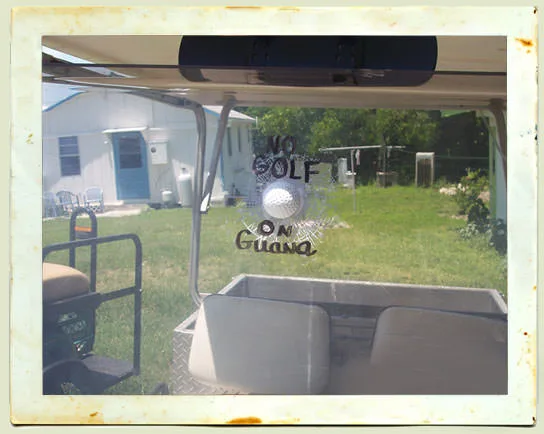
Anti-Bakers Bay Club signs dot the island. Photo Anonymous.
PRESS RELEASE
Victory at the Privy Council!
Privy Council issues injunction against Bakers Bay Developers
Privy Council orders Developers to continue to abide by November 2005 undertaking to stop work at Bakers Bay Development on Guana Cay
27.7.06
The Privy Council today ordered a stay of the Court of Appeal Ruling dated May 8, 2006 releasing the Developers at Bakers Bay in Guana Cay from their undertaking not to continue with any physical works at Guana Cay.
On Tuesday, July 25, 2006, the Save Guana Cay Reef Association filed its Petition for special leave to appeal to the Privy Council against the May 8 decision of the Bahamas Court of Appeal releasing the Developers of their November 2005 undertaking to stop work in Guana Cay.
In the application for special leave to appeal, the Association asked for a stay of the Court of Appeal's decision and for the reinstatement of the undertaking by the Developers to stop work until the Supreme Court gave its judgment.
As a result of the May 8 decision of the Court of Appeal, the Developers were released of their undertaking if Justice Carroll in the Supreme Court in Freeport did not, by May 31 2006, deliver his ruling on the judicial review application.
To date, Justice Carroll has not issued his Ruling in what is admittedly a very complex and complicated case for the Bahamas.
In June 2006, as a result of the Court of Appeal decision, the Bakers Bay Developers started working again; clearing forests, burning trees, dredging the beaches, dredging the mangroves, and destroying the physical and marine environments.
The Association had opposed the motion in the Court of Appeal by Bakers Bay to be released from their undertaking on the ground that it was causing irreparable damage to the environment. The Association also filed a motion in the Court of Appeal asking for an injunction in the event that the Developers were to be released of the undertaking.
The Association also sought an injunction against the Secretary to the Cabinet, the Prime Minister as the Minister responsible for Crown Lands and the Treasurer of the Bahamas.
The Association also applied to commit the Developers for breach of their undertaking.
A copy of the undertaking is attached.
In the May 8 decision, the Bahamas Court of Appeal ruled that there was no evidence to indicate breach of the undertaking and consequently did not order committal of the officers and directors of the Developers. There is still a committal action before the Supreme Court. The Court of Appeal said that they did not consider the undertaking should last indefinitely.
The Court of Appeal also said that they regarded the Association's application for an injunction as misconceived, dismissing it and ordering the Association to pay the costs of the Government.
Subsequently, on June 28, 2006, the Association applied to the Bahamas Court of Appeal for permission to appeal the May 8 decision of the Court of Appeal to the Privy Council.
The Court of Appeal dismissed the Association's motion for leave to appeal on the ground that the Court of Appeal did not have jurisdiction and also refused a second application for a stay of the Development pending an appeal to the Privy Council.
The Court of Appeal also ordered the Association to pay $8,000 in costs to the Government and $10,000 to the Developers.
Subsequently, on Tuesday, July 25, the Association filed its application for special leave to appeal in the Privy Council.
In view of the ongoing destruction of the environment, the Solicitor for the Association, Mr. Theo Solley of Muirhead and Co. and Counsel Ms. Ruth Jordon, were able to obtain an urgent hearing before the Privy Council today.
The Privy Council issued an injunction in the terms of the letter of November 22, 2005 from Graham Thompson & Co. until the Judgment of the Supreme Court or the Petition for Special Leave whichever is the earlier, with liberty to the Developers to apply to discharge the order by 48 hours notice.
The Board was Lord Scott, Lord Brown and Lady Hale.
Photographs showing the extent of the ongoing devastating and destructive work to the environment are attached to the next email which may be published.
Mr. Smith, Counsel to the Association, said:
"This appeal before the Privy Council comes in a long line of continuing applications being mounted by the people of Guana Cay through their Association to protect and preserve their rights and the environment.
The people of Guana Cay remain serious, committed and determined to fight for their rights and they anxiously await the decision of Justice Carroll on the merits of the judicial review application.
The people of Guana Cay vow to continue the fight.
The people of Guana Cay are dancing and celebrating in the streets".
The submissions made before the Privy Council in support of the stay application follow in the next email as well as the actual Petition filed.
Frederick Smith
From local-government.html — local rights and the Hope Town District Council
January 14, 2009
Abaco Study Discusses Sustainable Planning
Larry Smith of BahamasPundit wrote another interesting article on development and Abaco. Here I quote three paragraphs from the article. A study by Andrews University suggests that conventional resort developments are a bad model for Abaco; exactly what The Great Guana Cay Blog has been saying since 2005:
"Conventional resort development typically features large hotels, a closed environment, golf courses, and a utility infrastructure that demands high water use and distant power transmission," the proposal says. "This model typically relies on a cheap labor force, high numbers of visitors, and intense access to amenities such as beaches, marinas and nearby transportation (airports).
"When systems fail over time, projects can become difficult to maintain because the Bahamas does not provide a sophisticated maintenance industry to sustain such a scale of development. This can mean further reliance on imported labor or the gradual transformation of the project into an obsolete and unmanageable relic. (Such) projects are sometimes abandoned with devastating affects on the local job market and economy (eg: the Four Seasons Resort on Exuma) and irrevocable harm to natural ecosystems."
The Andrews proposal seeks to define which communities should be built in what sectors of the island based on the best Bahamian settlement traditions, improved for the 21st century. Special requirements such as green corridors for wildlife are also stipulated, while conventional resort development is discouraged.
Read the full article by Larry Smith.
February 25, 2008
Duncombe Critical of Inland Marinas, Golf Development
From ReEarth. You can read more about Albany at the ReEarth website section on this development.
Environmental activist Sam Duncombe is criticizing the proposed digging of a deep channel through one of the longest stretches of continuous beach in New Providence. The developers of the Albany project are proposing to do the work in order to create a canal. But Duncombe wants lawmakers to enact legislation that would prevent the cutting of Bahamian beaches and the creation inland marinas. She also wants Bahamians to pressure the government to put its feet down on foreign investors whose developments cause major erosion and destruction of Bahamian beaches.
During a press conference on Adelaide Beach Tuesday, Duncombe pointed out markers on the southwestern coastline that developers plan to use as guidelines for where the marina slip would begin. She also took reporters on a ten-minute walk outlining the amount of beach area that Bahamians would have access to once the Albany project is completed.
Since the Progressive Liberal Party signed the Heads of Agreement, the Albany project has been met with a mixture of support and criticism. Some Bahamians have taken issue with the proposed redirection of traffic in the area and limited access to Adelaide Beach; while others welcomed the development and the potential benefits it could bring to the community and local economy.
At a town meeting to discuss the development last year, a group of Adelaide Village residents and business owners said the project would have a positive impact on the village.
The Bahamas Environment, Science & Technology (BEST) Commission website contains a 124-page Environment Impact Assessment (EIA) of the Albany project, outlining the impact it will have on the environment and marine life. Duncombe is encouraging Bahamians to become familiar with the document.
"People need to recognize the power we have as individuals and collectively when we speak and what that power means to politicians," she said. "The Clifton Cay development was another example of how incredible and how powerful people can be, because during the first and only meeting the government had about Clifton, over 500 people showed up at Lyford Cay town hall and everybody said 'no', so Clifton never happened," she said.
According to Duncombe, once developers build the canal, they will have to place heavy machinery on the beach to dredge the sand in order to renourish the beach."What we have to know is that when you cut through a beach it's going to erode over time," she said."I've been coming out here for 20 years and I can tell you without a doubt, every summer there are thousands of people coming out here enjoying the beauty and serenity of the beach. Do we want to give that up for a few hundred wealthy people?"
11.22.07
San Salvador Locals and Development
An update by Neil Hartnell on the San Salvador development issue. San Salvador's Pigeon Creek area is considered its most ecologically important. The local environmental group has put forth a proposal to turn that area into a national park, but those plans are being ignored, and investors are preparing to develop part of it.
11.21.07
Tribune Article on Hope Town District Council
Neil Hartnell covers the Hope Town District Council updates on permits to Bakers Bay Club.
06.27.07
Don't Forget what happened in Hopetown
Bahamians should have a record of the history of the earliest incidents surrounding the Bakers Bay controversy — these documents are critical in explaining the abuse of power and the threats to the young Republic. On May 19, 2005, the central Bahamian government overstepped their authority and granted permits to Bakers Bay Club, even though these were permits to be issued, or not issued, by local government. Local government for Great Guana Cay is called the Hopetown District Council.
05.08.07
Guana Cay Citizens at United Nations Today
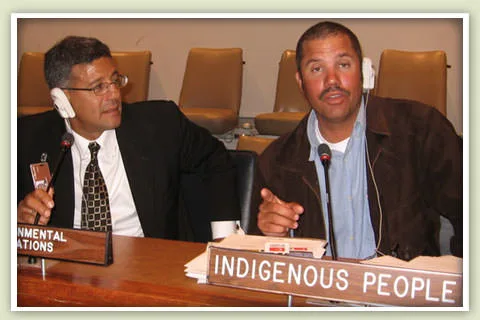
Today is a historic day for the fight against the Discovery Land Company's massive megadevelopment on Great Guana Cay. The citizens of Guana Cay, their attorney and a group of scientists will be representing the push for sustainability in the Bahamas today. I will be reporting in with updates all day. Here is an article from The Nassau Guardian: Click to visit Nassau Guardian Article: Guana Cay fight goes international. Smith to speak at United Nations. By ANGELO ARMBRISTER
05.08.07
Outline of United Nations Presentation
|The following is Attorney Fred Smith's outline to the United Nations speech given today in New York. I encourage you to read the entire outline, which is linked at the bottom of this post.
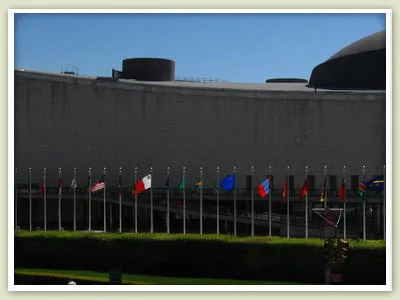
Tuesday, May 8 at the United Nations: sunny Bahamian weather in New York City.
Mangroves are critical ecosystems for shore protection and fisheries. They are essential to a healthy coastal environment; yet they are being destroyed worldwide at an accelerating pace. They represent an international environmental resource that is little understood or appreciated.
In The Bahamas, vast areas of mangroves are being destroyed by foreign development speculators to create all-inclusive tourist resorts and exclusive real estate, golf and marina developments. In Bimini and in Guana Cay the devastation has been catastrophic and continues.

Delegates listen to a speech given by the group affiliated with Guana Cay and Bimini, on the relationship between mangroves and coral.
The Government of The Bahamas, in particular the former recent PLP administration of Prime Minister Perry Christie, which was last week voted out in general elections after five years in power, has encouraged and promoted this at the altar of "Development" at all costs! Despite paying lip service to "Environmental Protection", there is no environmental protection act.
This presentation is part of a group presentation on behalf of the Save Guana Cay Reef Association, an NGO from the Abacos in The Bahamas in conjunction with the Mangrove Action Project, an NGO from Bimini on the legal and policy challenges faced in protecting mangroves, and by extension the environment in The Bahamas. This paper addresses issues relating to environmental protection, tourism, land and marina developments and land use in The Bahamas.
These are issues which present challenging social, economic, and political considerations, not only for The Bahamas, but also for neighboring Caribbean nations and coastal communities worldwide, especially those that are being "discovered" by developers, precisely because they are beautiful, pristine and secluded environments, away from the hustle and bustle of large towns and cities and therefore ripe for glossy development plans and marketing to affluent second home buyers, golfers and mega yacht owners looking for offshore berths.
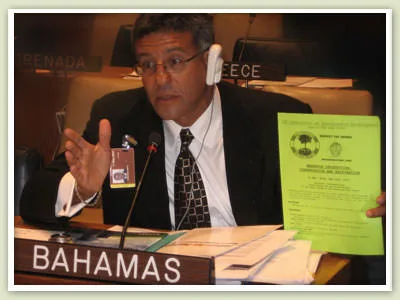
Fred Smith at the United Nations
Leaders in coastal communities are challenged to become educated, debate and develop rational approaches to these challenges. Although there are many similarities in the impact on the environments of coastal communities, their cultures and rights are often affected in unique local ways.
This paper will focus on The Bahamas, and in particular, Great Guana Cay, a small island in the northern Bahamas Island chain known as The Abacos. Although localized, the story of Guana Cay represents a microcosm of what is happening throughout The Bahamas, and elsewhere in coastal communities. It is a story that is still unfolding politically and in the courts...
You can read the complete outline of the United Nations speech today. Click here.
February 21, 2007
Guana Cay Citizens Demand Rights, Vow to Fight On
Today's press release from the citizens of Guana Cay:
February 21, 2007
Guana Cay Residents continue to fight for right to be heard!
Claim that as citizens in their own home they have a right to be consulted!!
Bahamian citizens continue to fight for their rights as Bakers Bay and Government continue to mash them up!!!!
Save Guana Cay Opposes Applications by Bakers Bay to Hope Town District Council for 6 permit applications for projects each ranging from $600,000 to $1.6M for buildings at Great Guana Cay
Save Guana Cay Association continues to wage war on the Bakers Bay developers. They have discovered that the Developers have applied to build millions of dollars worth of buildings on Guana Cay.
Counsel to the Association, Fred Smith, has written today to the Hope Town District Council asking them to give the people of Guana Cay their right to be heard.
The text of the letter is set out below.
"We act on behalf of Save Guana Cay Reef Association Limited, as well as Mr. Anthony Roberts, Mr. Aubrey Clarke, Mr. Stephen Jenkins, Troy and Maria Albury, various other residents and landowners and citizens of Great Guana Cay
As you are aware, the Association and Mr. Aubrey Clarke are currently plaintiffs in litigation against the Bakers Bay/Passerine Group of Companies proposing to develop the northwestern portion of Great Guana Cay. The Prime Minister and various other government agencies are also defendants.
Our clients have challenged the legalities of the Heads of Agreement. More particularly, our clients have also vigorously complained that throughout this process they have not been provided with an opportunity for proper consultation and participation as stakeholders in the decision-making process of any central and/or local government person or agency having responsibility for consideration of applications.
Central to our clients' complaints is the fact that our clients consider that it is the local government's authority, specifically the district council, which has the duty and responsibility under the Local Government Act to consider the many different applications which will need to be made under the Local Government Act. Apparently, many applications have somehow been made directly to central government agencies in Nassau thus bypassing the local district council.
In addition, apparently in between the recent elections of new members to the district council, the administrator to the Council apparently issued certain permits.
Despite our many requests to central government, to the Attorney General and to the administrator, no one has seen fit to provide the citizens of Great Guana Cay with copies of either the applications or the permits issued.
The reason for this is that our clients were not given an opportunity to be heard on any such applications and the persons to whom we have written are anxious and fearful that if we are provided with copies of the applications and/or the permits, we would then seek to challenge them in court.
We are able to confirm that this is indeed the case. Once our clients do find out what permits have been issued, they will take appropriate action to seek to quash those decisions.
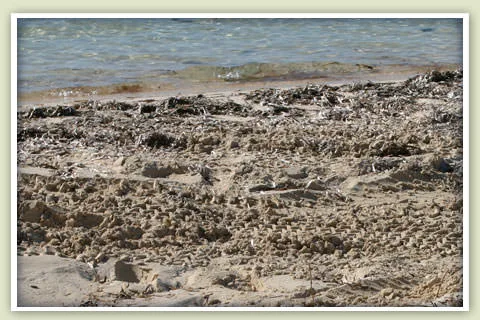
Locals have been denied rights as the developer and the Central Government Plotted to make foreigners rich at the expense of the community.
We should also refer you to the several letters written by the previous Chief Councillor, Mr. Walter Sweeting complaining that the district council has been bypassed in the consideration of applications and the issuance of permits. Again, this is a matter which we intend to continue to pursue as soon as we discover the relevant information.
We therefore take this opportunity to ask you to please provide us with copies of any applications and/or permits that have previously been made of which your council or the administrator is aware, either to the central government and its agencies and/or to the district council and/or such as may have been issued by the administrator to the Council.
We have previously requested this of Mr. Wayne Hall who was your Chief Councillor since Mr. Sweeting demitted office.
It is therefore with considerable appreciation that our clients have now been made aware by the posting of a Notice indicating that six permit applications have been posted on February 17, 2007on the post office board in Hope Town (and I might add not at Great Guana Cay), indicating that there are a number of projects ranging from $600,000 to $1.6M which applications are due to be heard this Thursday, February 22, 2007.
As a general point, our clients are opposed to the scale, scope and extent of the proposed development.
As you are aware, our clients' complained of the extensive environmental, social, cultural damage as well as the destruction of their traditional way of life.
Local government is all about local rights and taking into account the views and allowing those who are most closely affected by the proposed developments, to be consulted and to have their views properly considered. The district council is statutorily supposed to be representative of the citizens, residents and landowners of the district.
We are aware however that your council has some qualification and appointment challenges. We understand that many of you were actually appointed by the central government and not elected to office. Our clients reserve their rights to challenge this process as being illegal and intend to do so in due course.
Our clients would like to have an opportunity to make representations with regard to those proposed applications.
In that regard, our clients would like to have copies of the documents submitted by the applicants, so that they, and their advisors, can consider the same and be properly advised with regard to matters they might wish to raise which may be of concern regarding the applications.
Our clients have only just been made aware that these applications are before the council and not having had the benefit of any details with respect thereto, and given the fact that the applications will be considered so soon, our clients will not be in a position to be properly informed so as to be able to make sensible, rational and constructive comments.
We also understand that your council has been provided with copies of the BEST Commission reports and the current Environmental Impact studies. These have been repeatedly promised to our clients but, again, despite the fact that our clients are the ones most affected, they have not received copies thereof.
May we also ask that, in the spirit of transparency, accountability and in the interest of natural justice, and having regard to our clients' rights to be heard, that we be provided with copies so that we can take they into account when making representations. Our clients are prepared to pay the cost of any copies, and are prepared to collect them at your convenience.
In the meantime, we ask that you adjourn the consideration of these applications until such time as our clients have been provided with the information sought.
Accordingly, may we please have confirmation that you will provide the information sought and adjourn the hearing of the applications.
We must put you on notice that if our clients are not treated fairly and if the applications are considered and/or approved without our clients being given the proper opportunity to make representations for your consideration, our clients will bring proceedings to enforce their rights in due course.
Our clients do not wish to litigate against their neighbours but must emphasise that the central government and the developers appear to be using our clients' neighbours and pitting them against each other.
Yours faithfully,CALLENDERS & CO. Frederick R. M. Smith
June 16, 2006
The Mayor of Great Guana Cay
Glenn Laing is the sort of fellow to whom laughs come easily. People, when imagining him, imagine his belting laughs, strung out over gentle conversation and the martini shaker. On the small seven-mile islet of Great Guana Cay, Glenn is known for his alcoholic concoctions; his bartending prowess has won him many awards. Forever it seems, Glenn has presided over the bar, shaking the martini shaker amid a handful of drinkers, and a dry sub-tropical woods, and an empty beach, and a beautiful bay called Bakers Bay.
Glenn, a resort manager, a bartender, a man of many hats, is also, in the island nation of the Bahamas, a national hero. You wouldn't necessarily at first imagine it. Glenn is a soft-spoken middle-aged man. Bahamians from the northern island of Abaco and its many tiny cays have starkly different accents loosely based on their race. Caucasian loyalists, who settled in Great Guana Cay two-hundred years ago, have accents that resemble their ancestors: British colonists in the new world.
the tiny administrative center for Great Guana Cay. Photo courtesy Save Guana Cay Reef.
Abaconians of African descent, who became free men in the Bahamas, have entirely different dialects; and Glenn, as the only black Bahamian on Great Guana Cay, speaks in this gentle West Indian whirr.
Friends of Glenn refer to him in jest as 'the ladies man', but the Glenn people recognize is the one who loves Abaco, and wants to share its rich history with everyone he knows. He is a genuine Abaconian; a representive of an island region in the Bahamas so different, so isolated, so unique from the rest of the country that only recently in history, the island chain fought and lost in an attempt to become its own nation.
Glenn also happens to be the District Councillor of Great Guana Cay in an administrative unit consisting of Great Guana Cay, Man-O-War Cay and Elbow Cay.
In the Abacos, Glenn is known as "Mayor Glenn."
Normally, a district councillor is the sort who helps speed along the permit process, who votes on regional island matters, fights for well-needed funds to patch pot-holes or to repair pilings on the mail boat dock. The distant Central Government often ignores Abaco, which with its healthy tourism and timber economy, does more than its fair share in funding the faraway treasury.
Campaign T-Shirt for Mayor Glenn. Photo courtesy Save Guana Cay Reef.
Glenn probably never imagined he'd preside as Great Guana Cay's elected representative during this time. Glenn probably never imagined he would preside over Great Guana Cay when the seven mile island began to symbolize to all Bahamians the rights of local communities and Bahamians in general against a distant and arguably corrupt central government. In 2004, the citizens of Great Guana Cay learned that the Central Government of the Bahamas had designed a questionable relationship with an American golf course developer called Discovery Land Company.
The Central Government would hand over key obligations of its responsibility on Great Guana Cay to Discovery Land Company such as sanitation and waste management, in exchange for granting Discovery Land Company unimaginable rights to build an unimaginable footprint of a golf course, gated community and marina, spanning 2/5ths of the island. The island's mangroves would be blasted by dynamite, torn to shreds. The island would be cut into parts to build an unnatural marina for mega-yachts. And a consensus among marine scientists would predict that Discovery Land Company's Bakers Bay Golf and Ocean Club would destroy the nearshore marine environment of the island, which, the locals explained, was vital to their economy and culture.
The world's top marine biologists and conservationists would join Glenn and the islanders of Great Guana Cay in fighting the quite possibly illegal relationship between the developer and the government, claiming that the development would destroy the island's coral reef, and that local communities must be afforded a say in the destiny of their own community's future.
But little could be done. In the fall of 2005, things started looking bad for the island of Great Guana Cay. And then Glenn began feeling chest pains. A few hours later, a stroke. In his bed in the days before being flown to the United States, where he continues to this day in recovery, he was talking nonsense, mostly. He was saying things like this, "I've got to save the Bahamas! I have to get better, so I can save my island!"
Great Guana Cay had seen its first casualty. Glenn, the island's public face was now on some bed thousands of miles away. A temporary representative could theoretically be elected in his place, but he would have no vote, and no say.
Discovery Land Company, around this time, was moving in for the kill. From the outside, it had appeared that the islanders were growing weak and unable to continue the fight against the foreign developer and the Prime Minister. The San Francisco golf development company put forward their Bahamian face, Dr. Livingston Marshall, to attack and attempt to discredit the people fighting for their island's coral reef and community. That November attack is now known as the Dr. Livingston Marshall paradox.
From "Rise Up Sweet Island" (unpublished, 2005–2006)
Erik never finished this piece for publication — most of it was raw, unedited material unsuitable for the record. But a few passages hold up as real reporting and are preserved here.
Troy Albury's Sixth Affidavit: Fishing and Land-Access Rights
Great Guana Cay has always been a fishing community. Although the island consists of both second-homeowners and native Bahamians, it is the Bahamians who have largely maintained the traditional fishermen lifestyle. Although the Great Guana Cay issue is now known around the world, few have focused on the fishermen themselves. In fact, these Bahamian fishermen are helping lead the charge against the Bakers Bay Club, and with good reason too. They know by experience what will harm their fisheries, their source of employment.
The sixth affidavit of Troy Albury mentions this:
"The community of Guana Cay has approximately 150 Bahamian residents, landowners and a further 150 non-citizen home owners and periodic residents. Of the Bahamians there are many fishermen. In fact Guana Cay traditionally has had a small fleet of fishing vessels and enterprises of approximately 15 vessels and approximately 30 fishermen. These vessels and the fishermen fish for lobster, conch and fish throughout the year during the relevant seasons for the catch. In addition, these fishermen are landowners and residents of Guana Cay, and they are also mechanics, craftsmen, carpenters, joiners and persons employed in the boat maintenance and fishing trade, in addition to the actual fishermen themselves. This continues to be an economy and traditional way of life in the community."
In Troy Albury's sixth affidavit, the island's fishing-village culture is described further:
"A culture has developed on Great Guana Cay as between the Bahamian landowners and residents and the non-Bahamians of mutual respect, accommodation and cooperation in respect of almost all facets of our daily existence in the small community. Crime is almost non existent and happens rarely, if at all. For the most part we sleep with our windows open and doors unlocked. At times many homes are unattended for weeks and unlocked. I can personally say that I do not even know where the keys for my home are as they have never been used."
Later, the affidavit addresses the fishing grounds directly:
"Residents and the fishermen rely on the pristine marine wetland, reef and water environment. That is why the local economy of Great Guana Cay has for decades continued to thrive. For instance, the local fishermen and visitors do not over fish the conch, lobster and fish stock in and around the Island and the fishing fleet generally travels great distances to other fishing grounds for any large commercial catch. This has all resulted in a very attractive and desirable community, environment, and sustained a marine and land resource on, in and around Guana Cay."
On the security guards restricting access to Crown and Treasury land, Albury's affidavit states:
"My family, and many other residents of Guana Cay, have, since the establishment of fences and barriers along the perimeter of the Crown or Treasury land, been prevented entry thereto and also because there are security officers patrolling the perimeters we have been periodically refused entry and have been unable even to walk along the coastline to access the beaches, traditional crabbing grounds and other areas where we have crabbed, picked fruits such as coca plum and seagrapes and otherwise used the areas both below and above high water mark traditionally."
And on the buoy lines placed to restrict access by boat:
"The buoy lines have prevented many residents, who have traditionally accessed those public beach areas by boat, from accessing them. It appears that the Developers are doing everything which they can, not only to prevent access to what may be their perceived property, but also to Treasury Land, Crown Land and beaches to which we have always traditionally had access."
Even fishermen from neighboring islands who traditionally used the public areas of the Bakers Bay area were reportedly denied access. The affidavit records testimony from a Man-O-War Cay community meeting:
"At the meeting, there were many fishermen and residents of Man-o-War Cay. A number of them protested and complained that they have been denied access to traditional crabbing grounds in the development site. They said that since the Development has begun, they have periodically attempted to land on the beach and/or to walk inland in order to access the crabbing area. The crabbing area is located in that part of the Development which comprises, for the most part, Crown Land and/or Treasury Land. Even though this land does not belong to the Developers, they have posted security guards which patrol the area and those guards do not allow them to enter the property."
All of this was happening before major construction had even begun.
The Yosemite Allegory
Written December 2005 (approximate date).
Let's imagine the following. I will use Yosemite National Park as my example, because it is a spectacular and well known symbol for America's public lands. If you wish to replace in your mind another such wonder from another country, please do so. Imagine the Vatican, or the Alps, or Mount Fuji, or the Kremlin. Imagine Mount Everest, or Tikal.
Imagine that a group of foreign theme-park developers sign a secret document with the President. The document is the result of months, maybe even years, of exchange between the president and these developers. They call the document, "Heads of Agreement."
The document is an agreement that turns over Yosemite National Park and portions of adjacent National Forest to the foreign developers, to build an electronic fun park. It is likely that the President had no authority to turn over the land to a foreign developer, but the laws seem confusing. There is no observable way to keep the President from moving forward.
The people living in the Sierra Range adjacent to Yosemite National Park, many of whose families had been living on land adjacent to the park for hundreds of years, were not consulted publicly. The developers held a public meeting, but they announced it only six hours before, while most of the Yosemite Valley residents were working outside of the valley.
Under a hotel-encouragement act, the President offers several exemptions from a wide array of taxes and obligations, including property taxes, customs duties and stamp duties. The developer is given the authority to import and export construction equipment. The President hands over control of the local utilities — water, sewage, phone and even electricity — to the developer, and even gives the developer rights to extend existing roads and allow them special access through Yosemite's famous valley, even at the expense of residents or the environment.
All of this sounds insanely unlikely, and it may be. But everything you read above happened. Although instead of America and the President and Yosemite, it is the Bahamas and Prime Minister Christie and Guana Cay's crown and treasury land.
The Developer & Incidents
Discovery Land Company
August 6, 2012
Death at Yellowstone Club
Teenager dies at Discovery Land Company-managed property in Montana.
Read Bloomberg’s report on the Yellowstone Club crash.
August 10, 2010
Spanish Oaks Blog Discovered
As Discovery Land Company megadevelopment Spanish Oaks, based in Texas, spiralled towards foreclosure, a blog by residents of the community offer clues about Discovery Land Company and prospects for Bakers Bay. Read the Spanish Oaks blog here. It is a fascinating look at how residents see a Discovery Land property once the property is in trouble.
Here is a sample blog post from March 30, 2010.
You might wish to expand on these topics and prepare now to attend the annual meeting (as of this writing, unscheduled) which is perhaps the most important one we've had in our short life as Spanish Oaks. The more people who speak up, stand up and make their feelings known, the more force it will have. This is no time to be passive-aggressive.
It is said that the annual (2009!) meeting is being held off until they get their financial house in better order.
1- Are funds co-mingled from the golf club to the general project?
2- Why is there only about $5000 in the reserve fund for the project? (Note east side road deterioration.)
3- What is being done about the sorry state of our common areas: weeds, erosion to the 'paths,' the broken curbing, the mail area trash? What is the state of our common area landscaping contract?
4- How does the east end mail area get so trashy AND NO ONE IN MANAGEMENT notices until upset owners complain? How can we insure more pro activity?
5- Is it time to seriously talk about eliminating staffing both gates — at least overnight — to reduce expenses? (Speed passes and push button codes would allow entry.)
6- What plan does Discovery have to revitalize the project?
For new owners note: When Daniel Porter passed control to Discovery, we noted a different view of the 'plan' for the community and what appeared to be a relaxed set of design rules. IF THAT HAPPENS AGAIN, we can expect another set of changes. Will this affect us and how?
April 1, 2010
Battered Farallon Capital Management Plans Restructuring
According to the Wall Street Journal, Farallon Capital Management is planning a restructure.
Some are wondering whether this could impact Bakers Bay Club. According to sources, Farallon Capital Management has been a key investor in Discovery Land Company projects.
According to the Wall Street Journal, Farallon's assets have declined by 40%. This paragraph seems to indicate that Farallon may cut its real estate assets.
"Other changes could be coming. Farallon's real-estate holdings that declined in 2008 didn't bounce back in 2009 the same way the firm's credit holdings did. Farallon executives have talked about restructuring or selling about $2.5 billion in existing real-estate assets, among other options, a person close to the matter says."
We'll be sure to stay on top of this news and its potential impact on Bakers Bay.
Link to NY Times Blog Post
Link to WSJ Post
August 25, 2006
McMansion Concern over Gozzer Ranch
I was not surprised to find that the Spokesman Review, the newspaper covering North Idaho, finds Discovery Land Company developments distasteful. For a year, Notes from the Road has argued that Discovery Land Company builds trashy mega-developments that do not fit in to the local environment or culture at all. This is especially true at Guana Cay, where the development's proposed style is so distasteful that it will irreparably harm the local tourism economy, which relies on idyllic qualities, natural beauty, and an old architecture steeped in history.
This is what the Spokesman Review says about the Bakers Bay Club sister project:
"The resort — which seems ripped from the golf Mecca of Palm Desert and plunked in a former hayfield — caters to an average client that Chesrown describes as a 46-year-old incredibly wealthy workaholic with a big ego and passion for golf. This typical client owns numerous homes and is looking for a distant summer getaway the whole family savors. Some people compare these golf communities to a Disney World for adults but with family-friendly activities."
January 17, 2006
Cordevalle Golf Club in Violation of 1996 Use Permit
Cordevalle Golf Club, also a gaudy, over-the-top Discovery Land Company project, was found in violation of their 1996 use permit. According to Unfarallon.info,
"The San Jose Mercury News identifies Farallon and developers Haas & Haynie as the principal partners of a luxury golf club in San Martin, Santa Clara County. Once called “Lions Gate,” the development was opened as Cordevalle Golf Club and Resort in 1999."
"In 2002, the Santa Clara County planning commission discovered that Cordevalle was in violation of its 1996 use permit. First, the commissioners contended, the golf course never honored its commitment to reserve 60% of the total rounds on an annual basis for public use. Instead, it offered invitation-only individual memberships priced at $250,000. Second, it failed to carry out a host of environmental protections promised in 1996. The Planning Commission held a series of public hearings to determine whether to revoke or revise Cordevalle’s use permit." — Unfarallon.info
Bakers Bay Golf & Ocean Club
October 1, 2012
Multiple Reports Surface: Bakers Bay Targets Local Businesses Associated with Coral Reef Group
Multiple reports have surfaced that Bakers Bay is turning back visitors whose rentals come from local business-owners affiliated with efforts to protect the coral reef. Local businesses are furious. According to one business owner: "They are discriminating against the customers of our neighbors, for what? For caring about their environment? This sets a bad, dangerous precedent for relations with the community."
September 12, 2012
Bakers Bay Commitment Failures
Sketch of a house in the Guana Cay settlement.
Locals are pointing out that Bakers Bay has not lived up to its commitments to the community.
An article in the Nassau Guardian describes how locals on Great Guana Cay are pointing out that Bakers Bay has not lived up to its community promises as described in the Heads of Agreement.
From the article:
Arguing that it would only cost the developers $300,000-$400,000 to construct these amenities, Mr Albury urged the Hope Town District Council, the area's local government authority, not to grant Baker's Bay any more construction permits or duty-free equipment/material imports until the situation was rectified.
"Every other week they've got approvals in for new houses, but there are no permits — and no drawings have been done — for the community facilities. There's not even a start," Mr Albury complained.
He said the amenities, according to the Heads of Agreement, were supposed to have been completed by 2008 and before Baker's Bay moved on to Phase Two — the very construction stage it is now engaged in."
Source
October 24, 2011
Historic Break in Reef Defenders Case
Save Guana Cay Reef is back in court as judges agree that the case in opposition to the construction of the Bakers Bay Golf & Ocean Club has a compelling chance of success. Save Guana Cay Reef will face the Bahamian Government and Discovery Land Company in court early next year.
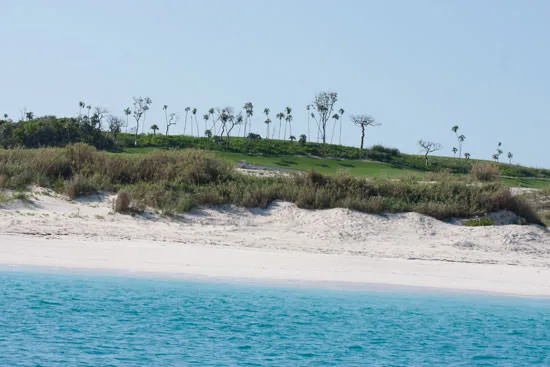
Locals on the small island of Great Guana Cay were concerned that the developer would fail to follow their own environmental monitoring agenda. Five years after a lawsuit began, evidence of follow-through on any component of the monitoring program is scarce. Here, the golf course creeps up to within feet of the island's coral reef.
Over the past 6 years, the court case has taken a number of twists and turns. Every time, the government and the developer were able to block the appellents on technicalities. But in the latest round of trial battles, the judges agreed that the case should be heard on its own merits, and not dismissed simply based on a neverending string of legal technicalities.
The Save Guana Cay Reef case has become a driving force in the Bahamian legal system, forcing a conversation and even legal precedent for the importance of consultation, the rights of locals and even environmental considerations.
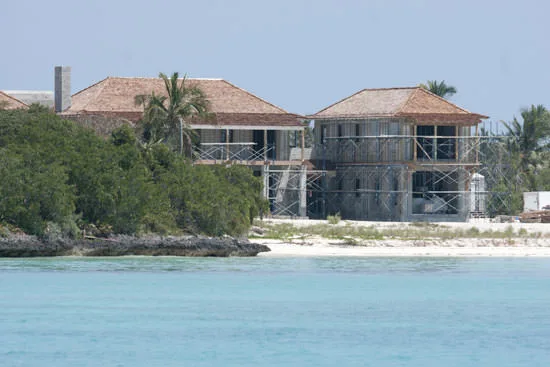
A California-style mega-resort is being constructed on the northern end of Great Guana Cay. Locals believe the large imprint of this development will wreak havoc on their coral reef.
This latest Leave to Appeal is an important step in the ongoing case against the Bakers Bay Club development. The Tribune quotes Save Guana Cay Reef attorney Fred Smith: "This case remains of pivotal importance to the Bahamas" in establishing jurisprudence that will guide future governments and developers on the development process, in the context of environmental and local community rights, Mr Smith said.
Read the complete article by Neil Hartnell at The Tribune.
September 11, 2011
Reef-Side Erosion at Bakers Bay
Images of the beach adjacent to the most critical section of the coral reef at Bakers Bay after Hurricane Irene:
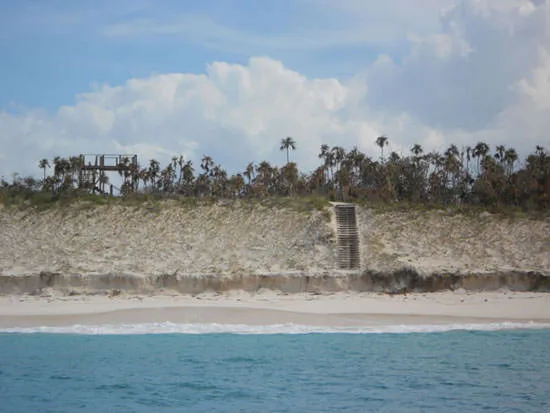
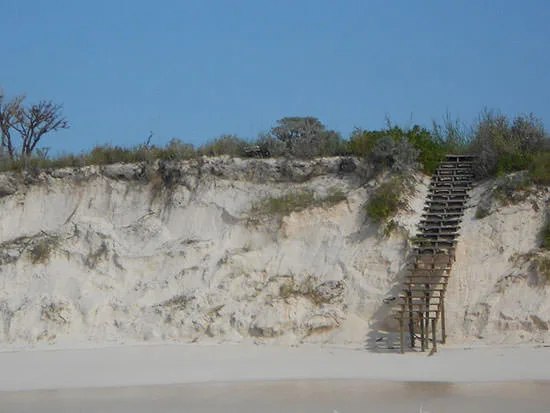
April 18, 2011
A Coral Reef's Worst Nightmare

I was disappointed to see how close the Bakers Bay Club golf course was to the ocean. This photo shows the golf course literally feet from the ocean. This part of the course is only yards from the most important and largest sections of the Atlantic-side coral reef. The sheer amount of fertilizers, watering and nutrient-creation from this course are stunning. And there is no public monitoring by any group. This scenario is a worst-case scenario for Guana's reef.
2026 update: this is no longer a prediction. A 2012 survey by Goreau, Cervino, and Albury found the reef directly downslope of these greens had roughly 20 cases of White Plague disease where the earlier baseline had seen one, along with heavy nutrient-indicating algae growth that thinned out with distance from shore — a pattern the researchers traced to fertilizer leaching through the unlined, largely permeable buffer below the course.
April 16, 2011
Bakers Bay Questions
Here is a first set of questions that I think anybody who is interested in the megadevelopment saga of Bakers Bay should be asking. I do not know the answer to all of these questions. The only answer I cannot accept is for the developer to say that the economy made these promises impossible.
1. What happened to the 1.2 Million Bahamas National Trust Donation?
Baker's Bay announced that they would offer the Bahamas National Trust a donation of $1.2 Million over a six year period. It's now 2011, five years into the donation terms. How much did Baker's Bay actually contribute to the Bahamas National Trust?
2. What happened to the Fig Tree Foundation?
Baker's Bay created a non-profit foundation called the Fig Tree Foundation, whose purpose is to "protect the Great Guana Cay community and enhance the quality of life for all people living on Great Guana Cay. The Foundation will accomplish this mission by raising funds which will be dedicated to all facets of the Great Guana Cay society and directed toward the community's educational, environmental, medical and general social needs."
Source
3. Did you know that Baker's Bay is offering 20 lots to Bahamians at $50K each?
Baker's Bay claimed in 2006 that 20 lots from the Baker's Bay Club would be sold to Great Guana Cay locals for $50,000 each in order to raise funds. Is this offer still available and are Great Guana Cay locals aware of this offer?
Nassau Guardian Archives
4. What happened to Monitoring by Earthwatch and the University of Miami?
The following five questions are sourced to the Heads of Agreement document betweeen Bakers Bay and the Bahamian central government.
Heads of Agreement PDF 1, Heads of Agreement PDF 2
7. What happened to the Clinic with a nurse and/or doctor, with helicopter usage to the mini hospital in Marsh Harbour?
8. What happened to the promise for police on Great Guana Cay?
9. What happened to the Environmental outreach with the community of Great Guana Cay, as promised in the Heads of Agreement?
10. What happened to the Fire House promised for Great Guana Cay in the Heads of Agreement?
11. What happened to the Beach pavillion with picnic tables and grills at the "public beach" as promised in the Heads of Agreement?
12. What happened to fresh water and access to a sewerage plant as discussed in public meetings between Baker's Bay and stakeholders?
13. Bakers Bay advertised itself as a Blue Flag Marina, which is an award that goes to marinas that meet certain environmental standards. Now that the marina has been open for two years, why is Bakers Bay not advertising its affiliation with Blue Flag?
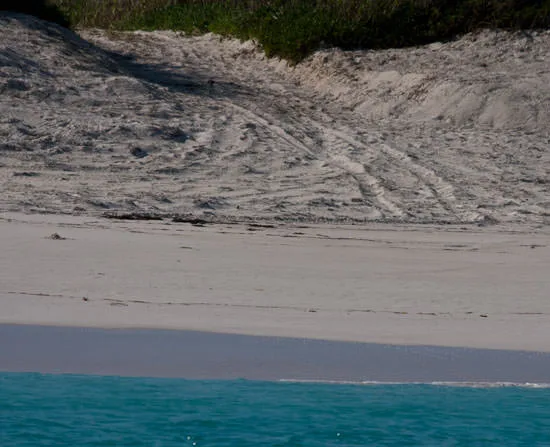
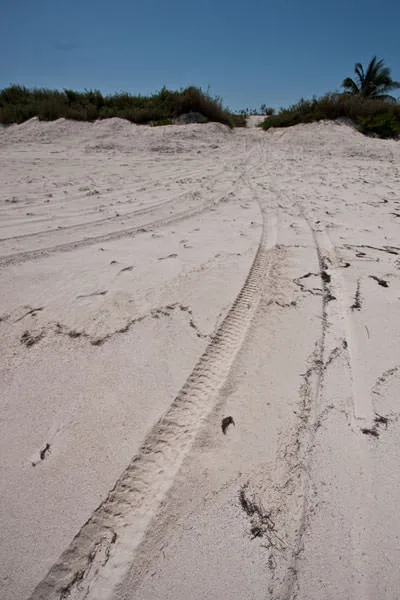
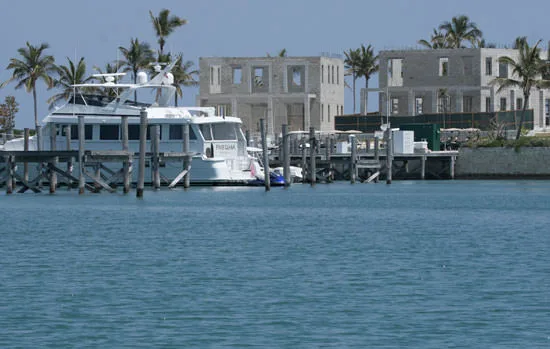
Even in April 2011, numerous tracks are golf cart and/or truck tracks are found on the beach leading from the Bakers Bay golf course. The beaches here are critical as year-round sea turtle nesting grounds, and Bakers Bay is very well aware that conservationists frown deeply upon driving vehicles on sea turtle nesting grounds.
April 8, 2011
Yes, the Beaches at Bakers Bay are Public
All beaches in the Bahamas are public to 10 feet above high tide line, and anybody should feel welcome on Bakers Bay beaches. If for any reason, security guards attempt to stop you, record them with your video camera or camera phone, document the event and report to local authorities.
March 12, 2011
Sailing Bloggers feel Bamboozled by Bakers Bay
I saw this post on Bakers Bay Club today, and I thought I'd post a portion of it here. Remember that there are very few blog posts or articles written about Bakers Bay at all. The only material you see written is in golf advertorials. So it is interesting to note that almost anything in print that isn't paid for by Bakers Bay is negative press.
"Our ride this morning took us to Bakers Bay where a very upscale marina and development is struggling to stay alive. An acre lot there is a million dollars. That might explain the slow development. There is a restaurant at the marina. They were serving breakfast and according to the menu, the prices were actually lower than other eateries on the Cay. What the heck, let's eat. We ordered and decided to have a mimosa for starters. Mimosa is Champaign and orange juice and replaces Blood Marys which Bear and I do not like. Usually the Champaign is some cheap swill but it goes well with the OJ.
"When the check arrived, we thought there was a mistake. The food was $28 and the four Mimosas (served in scrawny 2 ounce flukes) were $25 each. Wow! That must have been some really great Champaign. Now I know how the place plans to help the bottom line. That might explain why we were the only folks eating breakfast. Breakfast shot our budget for the day."
Was it Boone's Hill Bubbly in that Mimosa?
Read the rest here.
May 6, 2011
Bakers Bay Airplane Woos and Wows
A clip from the May 2011 Abaconian shows a press release of the Discovery Land Company's 727 flying to Abaco from New York, carrying rich guests in hopes of wooing them into buying land at Bakers Bay.
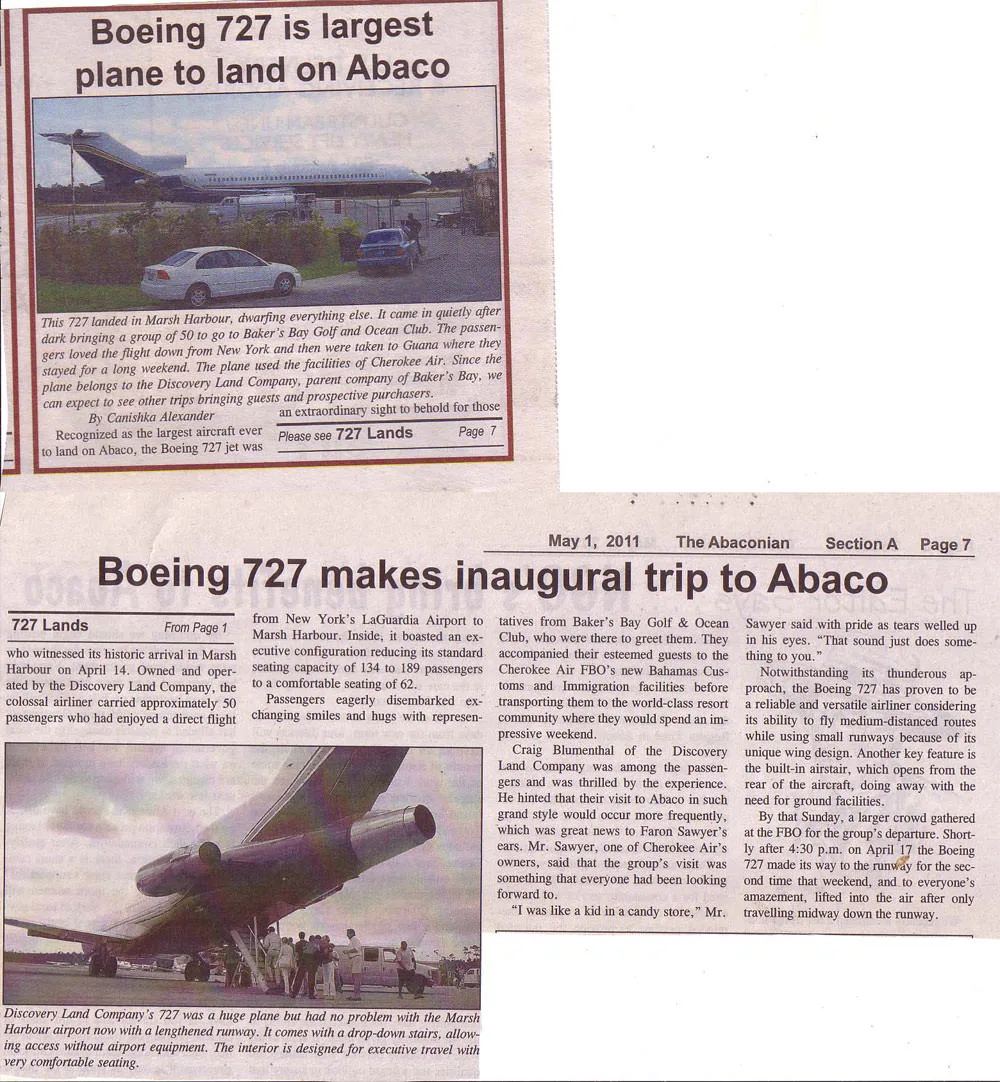
May 28, 2010
State of the Island
New photographs, taken only a few days ago, reveal the extent of devastation by Bakers Bay Club. As early as 2005, my travel photography blog was predicting that the footprint of the Bakers Bay development would be massive. Although the photos below, taken only a few days ago, show a globally important marine area completely transformed by a megadevelopment, you should know that the construction process at Bakers Bay is still in its early phases. Only a handful of the buildings are complete. When Bakers Bay is complete, the only natural area remaining will be the Joe's Creek area, most clearly visible in the 3rd image, lower right.
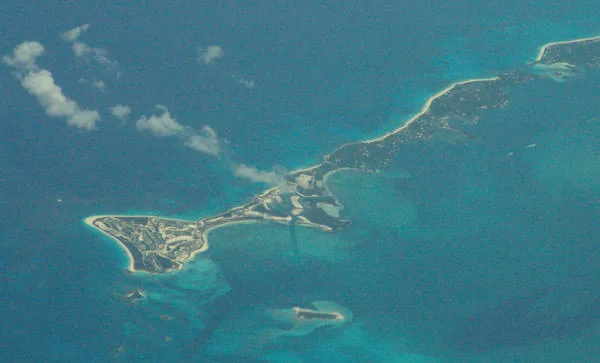
Compare these photos to the promises of the EIA, which stated, "The 'open space' in the development will help residents appreciate the natural vegetations communities now present on the islands. The diverse coastal coppice and wetlands will be incorporated into the development and golf course design to preserve the unique landforms of the property. This landscaping will rely heavily on native plants and seed stock, with an aggressive program to protect and re-locate the slow-growing native trees. The developers seek to achieve a uniquely Bahamian project."
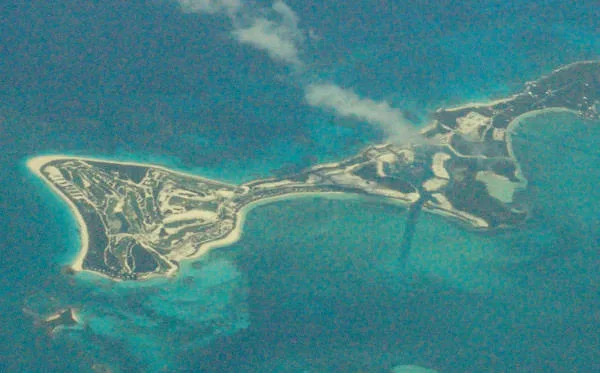
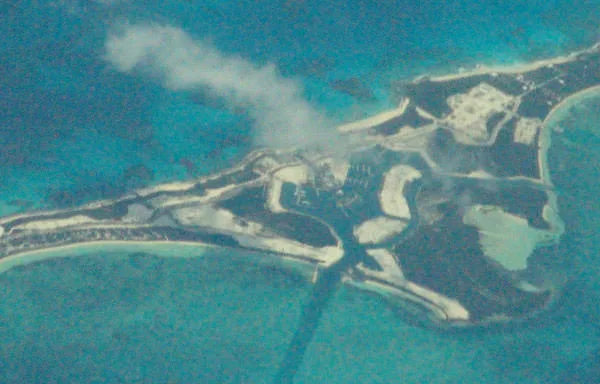
This image reveals just how close the marina is to the coral reef. You can see reef structures in this image.
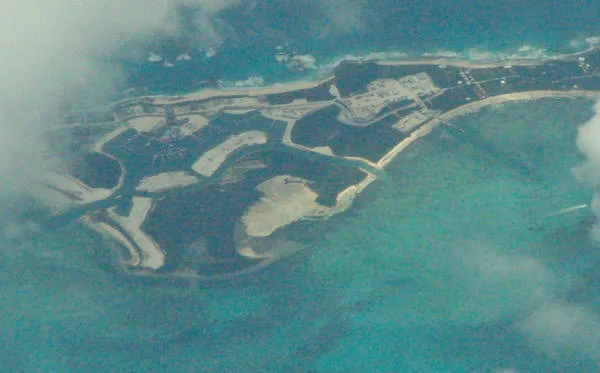
June 1, 2010
Hoping to Pack them in like Sardines
Recent aerial imagery of Bakers Bay proves several points we have been making in the past — the lots at Bakers Bay are so tiny, it appears they want to pack them in like sardines in a tin can. And there is nothing wrong with small lots, except in a case like this. Small lots means lots of buildings — 550 are proposed — and that is much too high density for this ecosensitive marine region.
But the aerial images also suggest something else that is quite interesting. Only one home is under construction at Bakers Bay, and one lot has been cleared for construction.
The permit for the first lot is under the name Michael Meldman, the CEO of Discovery Land Company. This means that even in May 2010, it appears that no homes are being built for paying clients. Does anybody know why?
The golf course is in final stages of development. Men in hazmat suits are spraying the course regularly in hopes of turning the sand green with grass. Shouldn't dozens of homes now be under construction? If you have any thoughts on this, reply at Abaco Forum's Rant or on the Great Guana Cay Facebook Forum.
We are also interested in the golf course being built so close to the water. Here, this segment of golf course is placed right on the beach.
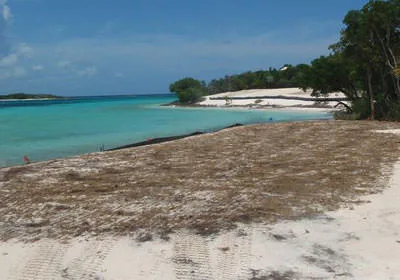
The ninth hole at the Bakers Bay golf club. As suspected, the golf course is being built directly adjacent to the beach without sloping to avoid pesticides, pollutants and nutrients from entering the nearshore environment. In the background is Gumelemi Cay and the north end of Great Guana Cay. This area is the beginning of the most critical section of the Great Guana Cay reef.
The EIA stated, "The development design aims to minimize chronic environmental degradation to the island environment with special consideration to creating a coastal buffer zone, and minimizing ground water contamination and management of solid wastes and pollutants."
Later, the EIA lambasts developments in other islands where developments are built too close to the shore.
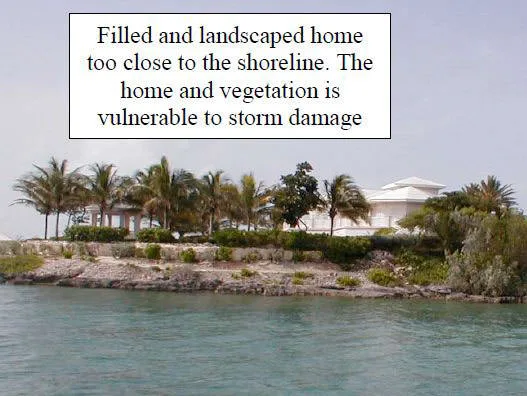
But in this image, we see that Bakers Bay, like the developments it lambasts, homes are being built as close to the water line as possible. As we suspected.
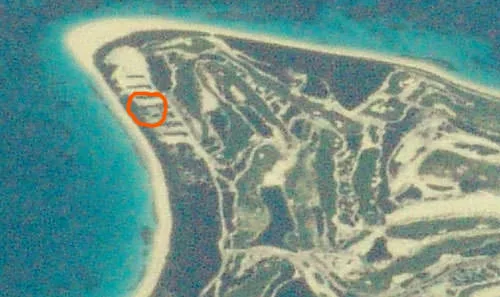
August 9, 2010
Bahamas Columnist Reports Coral Disease off Bakers Bay Golf & Ocean Club
Bahamas Punch columnist Nicki Kelly reports coral disease killings corals off Bakers Bay golf course.
Locals have been reporting Bakers Bay employees in orange hazmat suits spraying the golf course early in the mornings, adjacent to the golf course. In the developer's EIA, the danger of fertilizers is mentioned:
Golf courses are intensive production systems, and the frequent mowing and application of fertilizers or pesticides requires careful management to avoid damage to the surrounding environment. Nitrogen, phosphorus and many pesticides are potential pollutants of groundwater, and monitoring of their movement from turf grass areas to receiving waters is needed. Passerine at Abaco RCD strives to demonstrate golf course best management practices to reduce the threat of NPS pollution to marine and wetland resources.
Golf course fertilizers are notorious for creating a set of conditions unfavorable to corals. These fertilizers have high levels of chemicals such as nitrogen and phosphorous, which spurs the growth of algae in the water, stressing the corals, and making them more susceptible to disease.
Notes from the Road obtained images from divers directly off the Bakers Bay golf course. The images are possible early signs that the golf course is killing the reef as predicted by locals and coral scientists.
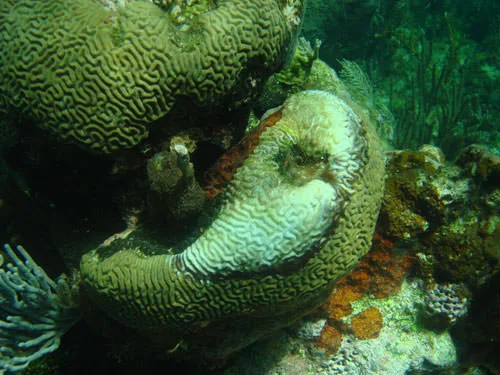
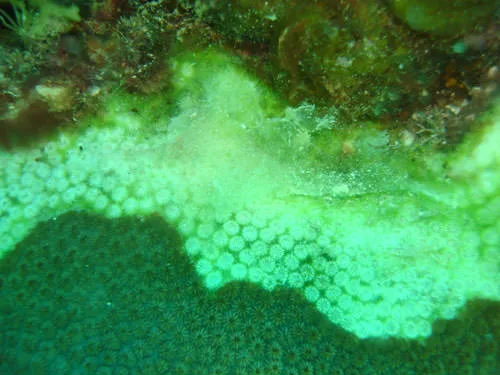
July 8, 2009
Hubris
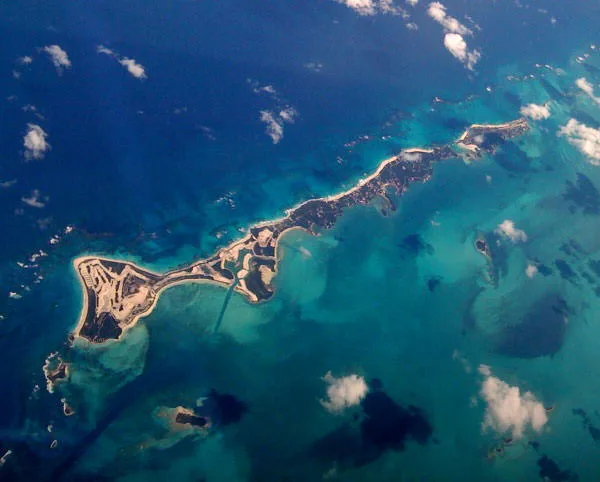
I just received this image of Great Guana Cay taken at 24,000 feet. It is the best image yet explaining the unbelievable hubris of Discovery Land Company and the University of Miami scientists who, in their EIA for the development, wrote, "The Developers believe that good environmental stewardship will add value to the community, as well as protect property from storm damage and erosion. The Project is compatible with the pattern of development of second homes and vacation homes throughout the cays and mainland of Abaco."
For those of you who are not that familiar with Great Guana Cay's development issue, let me explain a few things. The orientation of this image is not exactly north to south. You can visit my Guana Cay map to compare.
In the upper edge of this photo is the Atlantic Ocean. Hugging the Atlantic side of the ocean is the Guana Cay coral reef, which is part of the Abaco Barrier Reef. The swollen end of the island is where you can see a golf course and home lots being constructed. This area is where the Guana Cay coral reef is its most magnificent, and may be the best or second best reef — in terms of sheer diversity, coral sizes and overall reef size, that exists in the Abacos.
The rest of the denuded areas are the rest of Bakers Bay Club; more home lots and the marina itself. This marina was dug from porous limestone. Pollutants from the marina will have a quick path to the reef.
The sedimentation, nutrient, pollutant and silting issues being created by this development are very clear by the scope and size of land removal occurring at a fast pace. It is in the interest of global conservation and the preservation of reef ecosystems to have construction at Bakers Bay halted as soon as possible. Today is Day 2 in the Privy Council court. Godspeed, reef defenders.
July 4, 2009
Bakers Bay Club and Environmental Reporting
In an earlier post, we discussed how all of the local's concerns about Bakers Bay Club's harm to the local environment, culture and economy have begun to actually happen. As the Guana Cay residents are only a few days away from their court date at Privy Council, I thought we should take a look at Discovery Land Company's early promises of environmental monitoring and reporting. Have they followed through with monitoring and reporting as established by early promises and references in the EIA? Was the promise of environmental monitoring and reporting a sham? Read on and decide for yourself.
Environmental monitoring is the act of having an independent team of scientists monitor the quality of an environment; ultimately the review and publication of monitoring results is to satisfy some objective. When a developer who is engaged in practices that could harm a local environment is required or volunteers to have their practices monitored, the idea is that this monitoring and reporting serves to make the affected community aware of potential incidents, to keep them involved in the development process, and ultimately, to provide a check and balance, a motivator, to keep the developer's development practices in check.
According to the developer's EIA, this quote summarizes what Discovery Land Company promised:
With the Great Guana Cay Foundation, the Environmental management team will work to develop strategies and scope of work for implementing: • Educational outreach programs and training programs • Clear management and project communications and reporting • Independent reporting and verification
The course of development, the results of the monitoring programs and any incidental occurrences will be documented on a regular basis. Information gained and processed will be reported directly to all necessary government agencies and stakeholders. A defined liaison will be identified with this responsibility.
Unfortuantely, none of the above has happened. If there was a monitoring team on site, there no longer is. Kathleen Sealey, who was once in charge of the project, is no longer involved, and Earthwatch, which once helped with environmental monitoring, has not visited the island since about 2006.
Locals have been denied any reporting whatsoever. Guana Cay residents have never seen any incident reporting, and they have been denied all the monitoring and reporting activities the developer promised.
Discovery Land Company stated that a Ms. Shenique Albury was the representative between Discovery Land Company and the locals, but few people know who this person is, and she has not been on Great Guana Cay since 2005, at which time she left to complete her studies.
Discovery Land Company created a website that was designed to look like the developer was gearing up for an extensive monitoring and reporting function. Non-functioning links to environmental reports and web cams would allow all affected parties the opportunity to be involved and notified of construction practices and their consequences onsite. The website was designed to look independent of the developer themselves, as if a third party was responsible for independent monitoring. The website, which has not been updated since November 24, 2005, or almost four years ago, was a complete sham, designed as marketing tool to make it look like Discovery Land Company intended to provide incident monitoring and reporting to the local community.
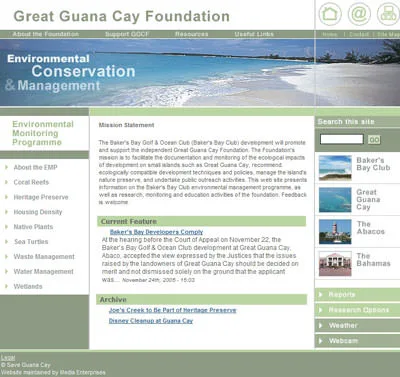
Kathleen Sealey writes in the developer's EIA, "THE MOST CRITICAL TECHNOLOGY TO BE USED ON THIS PROJECT IS ON-SITE "WEB-CAM", USED TO MONITOR VARIOUS PHASES OF CONSTRUCTION. Real time web-camera will help prevent problems from occurring as well as help guide restoration of "errors"."
Of course, the web-cam has not been implemented. There is a WEBCAM tab at the Great Guana Cay Foundation website, but it is not functional. Locals were led to believe that the University of Miami monitoring team would allow transparent access to all construction activities. In fact, construction activities are so secretive that local's are often kept off public beaches near the development.
Without Monitoring: without real public monitoring, there's simply no way for locals or regulators to know whether Bakers Bay is complying with basic safeguards around fuel handling, sea turtle nesting grounds, invasive species, or pesticide use — and that lack of accountability is itself the problem this monitoring program was supposed to solve. It is a shame, but hopefully the lesson will serve other local groups throughout the Caribbean basin that promises are often just tools to make megadevelopments more palatable.
Learn More: Read the University of Miami EIA. Read the University of Miami EMP.
2026 update: the concern above turned out to be well-founded, and we now have the paper trail. The monitoring reports later obtained show that of twelve site reports produced by the University of Miami's own environmental team, only the first (a March 2005 baseline) went to the government's BEST Commission — the other eleven were addressed to a Bakers Bay executive instead. The same reports document repeatedly failed sediment curtains, an incomplete coastal buffer, and, by December 2008, water inside the marina measured at roughly 30 times the turbidity of water outside it.
May 28, 2009
Bakers Bay Memo Reveals Speeding Issues
Over the years, I've been reporting (and have witnessed firsthand) the reckless driving of Bakers Bay employees at the settlement in Great Guana Cay. I have always argued that you judge a development by how they fit in with and assit the local community — this memo confirms the disregard that many Bakers Bay employees have for the local community at Great Guana Cay:
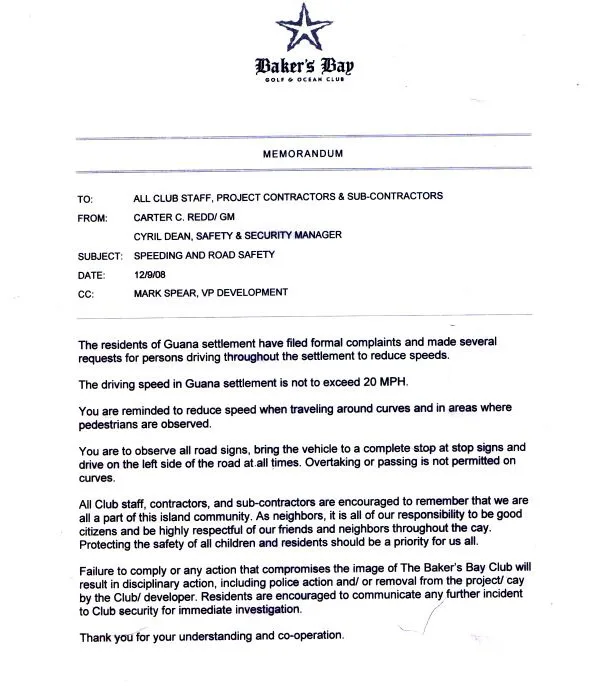
May 8, 2009
Captain Laments Bakers Bay Changes
This is a guest essay from a sailboat Captain who frequents the Abacos.
Fifteen years ago I had the wonderful opportunity to travel through the Abacos with my parents on their sailboat. I spent the entire three weeks of my college Christmas break exploring the Bahamas, sailing from island to island and getting to know the Bahamas for the first time. Something about that trip hooked me for good, the remainder of my days sitting in class were spent daydreaming of the islands and their magical waters.
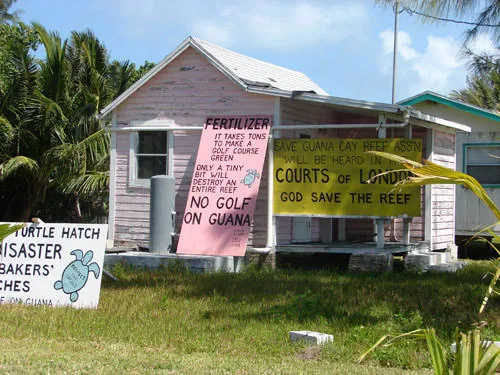
Photo SGCR
During that particular trip I had sailed with them to Eleuthera where we spent a week or so before heading to the Abacos where I spent the rest of my vacation. The Bahamas at that time had a feeling of being detached from the rest of the world. The people who called these islands home and the few visitors who made the trek here were rewarded with some of the most unspoiled and pristine ocean ecosystems on Earth. It was this natural beauty that lured me into fantasizing about returning to these islands on my own boat and with more time.
That time came a few years later when I made the commitment to a vessel of my own and a commitment to explore the Bahamas without time constraints. I invited my girlfriend, now wife to join me and after a yard sale she flew down with a one way ticket. I picked her up in Marsh Harbour, Abaco and for the next two months we slowly made circles around all the islands of the Abacos. We lit the famous lighthouse in Hope Town on Elbow Cay, walked the quaint streets of Plymouth on Green Turtle Cay, bought a used snorkel from Troy at Dive Guana on Great Guana Cay, and spent countless days snorkeling the barrier reef that lies just offshore all the islands.
Since we were on a shoestring budget with a focus on making our experience last as long as possible we got most of our food from the sea. I had some fishing experience, but after going hungry too many times I discovered getting in the water and spearfishing was a much more effective and proficient form of providing protein. This experience also made both of us somewhat of marine biologist of a sort.
Jeannette did not carry a spear, but she was a quick learner and would help me spot prime fish or the telltale antenna of a lobster hiding under a ledge. With more and more time spent in the water we were soon able to quickly discern what certain ecosystems held as far as fish, lobster, conch, and the health of the reef. On this trip we ended up spending seven months sailing through the Bahamas all the way down to Staniel Cay in the Exumas covering roughly five hundred miles within the Bahamas and fifteen islands.
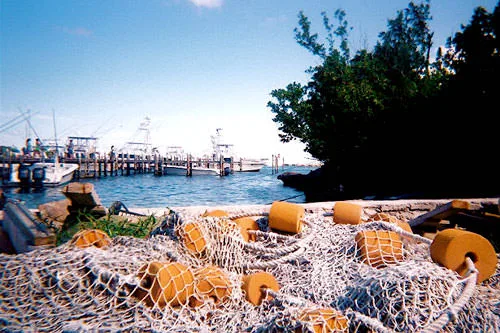
Photo by Whitney S.
Since then my wife and I have sailed an additional 10,000 miles through the Bahamas and once to the Leeward and Windward islands of the Eastern Caribbean. We have first hand witnessed the difference between a thriving reef and one that more resembles a desert graveyard. With each returning trip to the Abacos we have seen the changes both on land and below the surface. On Great Guana Cay we remember anchoring in Bakers Bay by ourselves, walking our dog through the ruins of the Disney cruise ship depot. Even though they were ruins, the style and motif was that of the islands, somewhat of a Robinson Crusoe theme. Thatch roof buildings that blended with the landscape. Small boardwalks and dirt paths weaved among the casuarinas and palm groves.
We would pack a lunch and enjoy the shade of the woods and marvel at how fast nature could reclaim its lost property. It was also a prime location to access the reefs just around on the ocean side. A short dingy ride from the anchorage around the north end of the island lay some of the most prolific reef in the Caribbean. Magnificent staghorn coral gardens, elkhorn coral, and giant brain coral make the reef an astonishing labyrinth of underwater habitat.
Coral formations that are scattered across the sugar sand bottom in thirty feet of water and reach to within feet of the surface provide a beautifully balanced ecosystem for a plethora of fish. With water so clear spotting fish on the bottom thirty feet below allows you so observe the wonders of this underwater world in incredible detail. Returning to the miles of beach that make up the shore at the Bakers Bay anchorage after a day of snorkeling the reefs we clean the fish and start a fire as the sun begins to settle in the late afternoon.
As other sailors would share this paradise, potluck dinners would form on the beach of Bakers Bay. As the rum and stories flowed into the night around a small fire on the beach friendships were formed in a setting that makes you love life the way you wish everyone could. It was all so simple and free where if you took the time to find the spot you could experience nature at its best.
After years of finding these amazing anchorages and falling in love with all that is provided for us on this beautiful planet we have come to realize how rare these areas are. Not only are these magical destinations far and few between, but they are also very delicate and complex. What makes the Bakers Bay area the ideal tropical paradise with its miles of pristine beach, lush palm groves, and world class reefs are the lure for commercial development. The last time we sailed past Bakers Bay we nearly cried at the destruction of this piece of paradise. Although you can still legally anchor in Bakers Bay it is no longer a place where one would care to spend much time.
With their private dock and ferry service shuttling high paying guests to their resort the once ideal anchorage has been bought out by visitors striving to experience the Bakers Bay area how it once was. It's odd how in the attempt to develop and exploit this area for the natural attractions that were the lure in the beginning they are now destroying their most valuable resource.
The argument that they are bringing jobs and money to the local population is turning a blind eye to the fact that without preserving the resources already in place, they are taking jobs from the local fishermen, destroying the dive industry as the reefs are being killed from the golf course runoff, and ultimately leaving an ugly scar on the land and in the eye of the locals. Great Guana Cay where Bakers Bay is, is too small of an island to support this scale of development and the ecosystem and locals will be the ones to pay the price.
Captain Brian Pucella
March 15, 2009
Aerial Photos Reveal State of Development at Bakers Bay
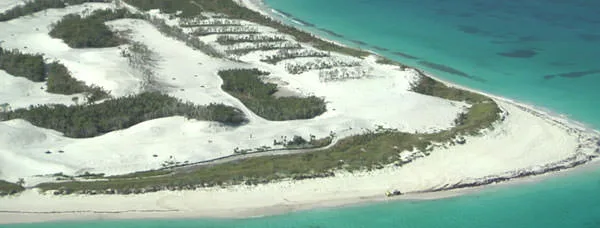
March 2009: an image of the golf course, which is being constructed feet away from the coral reef.
March 2009: the marina, which was supposed to have opened in November 2008, appears underwhelming in comparison to the watercolors depicting it. More imortantly, the marina butts directly up against the island's coral reef — a recipe for ecological disaster.
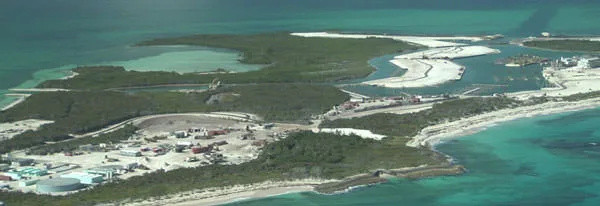
March 2009: the marina with a view of the deepwater channel. By cutting the island in half, critics worry that without the protective mangroves that existed here before, a strong hurricane could rip the island in two.
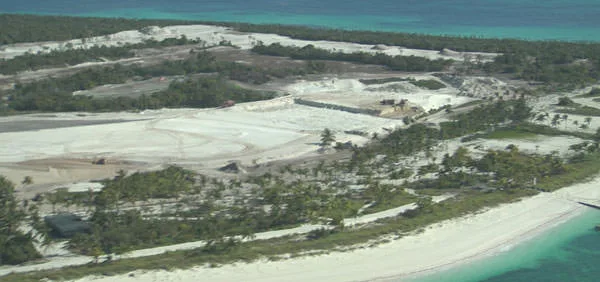
March 2009: image reveals massive terraforming of native habitat.
March 9, 2009
Bakers Bay Fails to Donate Full Sum to Bahamas National Trust
In 2007, controversial megadevelopment golf developer Discovery Land Company offered $1.2 million to Bahamas National Trust. Bahamas National Trust is the only private environmental organization in the world that is also charged with the country's primary environmental challenges by the government itself. It is an unusual relationship, and while the federal government of the Bahamas only offers the organization a pittance, Bahamas National Trust needs to rely on outside donors.
The move was vehemently criticized by environmental groups:
Mangrove Action Project Article on Donation, Freeport News on Bakers Bay 'Blatant Bribe'
Notes from the Road has held for several years that Bakers Bay Club does not hold up to the donations that it so publicly declares. Here is another example. Bakers Bay Club indeed donated to Bahamas National Trust, but only a quarter of what they said they would this year. Bakers Bay just announced they were donating $100K — a quarter of the publicized amount for the year.
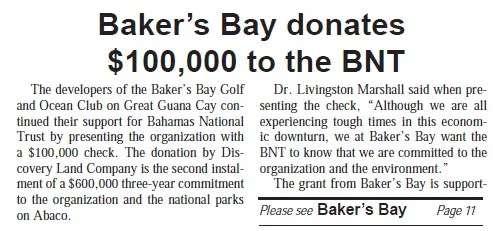
January 14, 2009
Bakers Bay Club Marina Opening Delayed
According to the latest issue of The Abaconian, delays in Bakers Bay Club opening its marina continue. Although the marina was advertised with a November 2009 date, it has now been pushed back to April 2009. That is a six month delay on a flagship launch.
January 14, 2009
Blogosphere Negative on Bakers Bay Club
The cruising world has its share of bloggers and other online users. We track how the blogosphere responds to news about Great Guana Cay and particularly about the Bakers Bay Club. Repeatedly, we find almost unanimous disapproval of the Bakers Bay Club. A few recent examples:
1. Hockey star Gary Aldcorn, who played 226 games in the National Hockey League for the Boston Bruins, Detroit Red Wings, and Toronto Maple Leafs, is now part of the cruising community. In his lyrics, he laments the Bakers Bay Club.
South through the isles of Abaco, Manjack, Green Turtle — and away we go
The weather's fine around the Whale, Hit the sea of Abaco — and away we sail
Visit Guana and Treasure Cay, Rue the day they sold Baker's Bay
link
2. A boating account of visiting Bakers Bay
Bakers Bay was a disappointment. It is now the playground of the rich and selfish and piggish. Two mega yachts anchored right in the channel depicted in Steve Dodges Cruising Guide to the Abacos — we sailed between them. They had all their boat toys out — runabouts, wave runners, skidoos, etc and just being a nuisance.
link
December 4, 2008
Notes from the Road in Vanity Fair, January 2009

Vanity Fair writer Punch Hutton erred in a November 2008 Vanity Fair article when he did a write-up touting the Bakers Bay Golf megadevelopment. He erroneously called Guana Cay's reef the third largest in the world. This was not a typo. The idea that the Abaco barrier reef is the world's third largest is a colloquial misbelief that gets passed around among tourists in the Northern Bahamas. How did this misnomer get passed on to Punch Hutton? Probably from the marketing material that was sent to him by the Bakers Bay Club. The marketing folks at the Bakers Bay Club are notorious for passing on fibs and mistruths to editors in an effort to make their golf megadevelopment sound better. I have also written to Southern Boating and Links Magazine (see article here) correcting errors that were likely directly passed on from marketing material to press.
Why do consumers of travel journalism let travel writers get away with so much? In an age when so many developing country issues and so many environmental issues are directly tied to tourism, travel writers need to be held to a higher standard.
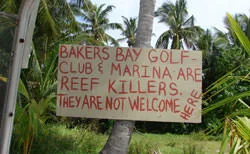
I am grateful to Vanity Fair for not only printing my letter to the editor, but for doing such a great job in fact-checking my own letter. The letters department graciously allowed me to prove all my claims by citing and allowing experts to explain my claims. But Vanity Fair left out the most important part — the fact that writer Punch Hutton made such a large editorial error. That's fine with me — letters' sections notoriously need to edit letters down in size. So I'll make the correction here:
Punch Hutton falsely claimed that Bakers Bay Golf & Ocean Club sits on the third largest reef in the world. This is far from the truth. Here are some that are much bigger: The Great Barrier Reef in Queensland, Australia is the largest in the world. The Belize Barrier Reef is the second largest in the world. The New Caledonia Barrier Reef is almost a thousand miles long. And the Andros Barrier Reef, in the Southern Bahamas, is considered the third largest reef in the world.
That doesn't take away from the Abaco barrier reef. It is quite large, and of extreme importance to the future of West Indies marine conservation. It is also stunningly beautiful. This reef's apex of diversity is off the edge of the tiny island of Great Guana Cay. Specifically, just off the shore from the Bakers Bay Golf & Ocean Club golf course.
Oh, you want to read my letter to the editor? Pick up January 2009 Vanity Fair.
August 12, 2008
Open Letter to Megastar Cher from Great Guana Cay
After megastar escapes from 'Moonscape' Bakers Bay Club
Dear Cher,
We are the Bahamian citizens of Great Guana Cay, which you visited last month.
Our ancestors have lived on this island for 200 years. We are proud of our tiny island, with its smiling people, lovely visitors, its blue water, its white beaches.
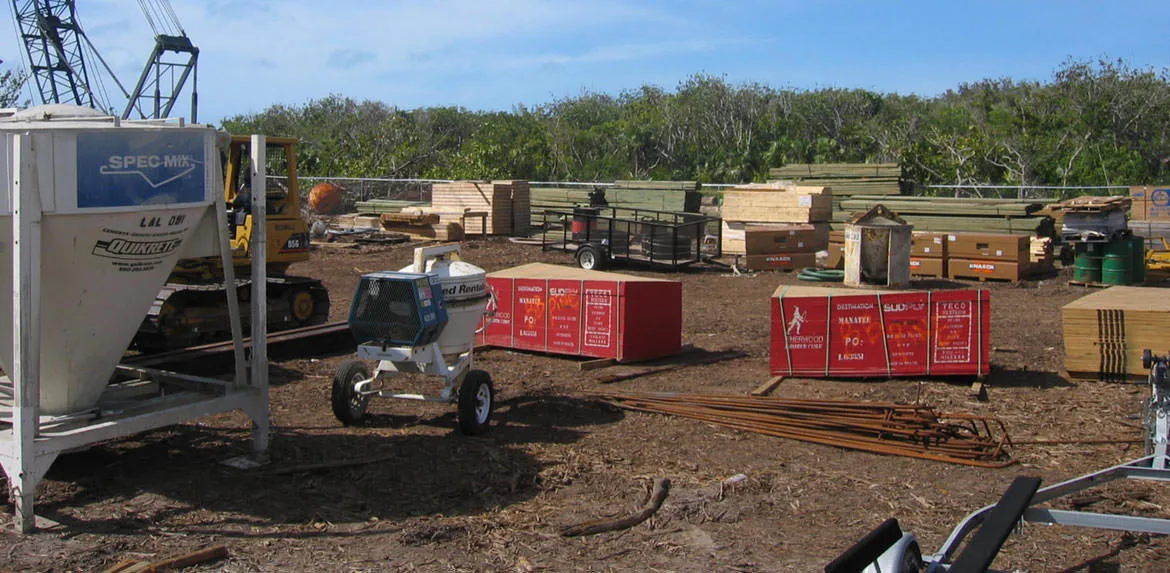
The decisions Hollywood celebrities make affects wildlife and small countries immensely. Megastar Cher, after visiting Bakers Bay Club, realized the development was an environmental catastrophe.
We are proud of our old loyalist architecture, of our diverse and colorful settlement, the gardens we create, our lovely moon-shaped harbor. We are especially proud to have one of the Caribbean's most spectacular coral reefs — stunning elkhorn and staghorn structures which are home to brilliant angelfish, wily soldierfish, shimmering sardines in our networks of underwater caves. We are proud of our many species of sharks. We hold especially dear our three species of sea turtles that nest on our shores each year. Their offspring will travel the world by ocean current, but they will have been born here, and they will return here.
We are proud of our migrating birds — dozens of species of warbler, bright marsh birds feathered in green, blue and ochre, kestrels, bananaquits, even glossy ibises. We are proud, even, of our mangroves and our deep-rich forest, filled with delicate orchids and primeval bromeliads, and flowers found in few other places around the world. This jungly place produces plenty of mosquitoes, yes, but the mangroves that sustain mosquitoes are necessary as part of our unique ecosystem. Mangroves are the nursery of the coral reef, and mangroves also keep our island intact.
And, it takes a sort of unique person to like a place like Great Guana Cay. It's not for everyone, and we've understood that ever since our ancestors toiled for conch and sisal, and settled in this distant outpost of the western hemisphere. Small spaces, and particularly small islands, make for unique living conditions — it boxes some people in. We thrive here because we love our neighbors and because we see the ocean as part of our backyard, not as our limits.
We understand that you had a horrible time at the Bakers Bay Golf & Ocean Club development property, which is under construction on the northeastern end of our tiny island. We agree, what you described as a moonscape used to be our island's mangroves before it was slated to become a golf course and marina to the rich and famous. You are not alone.
For three years, we, the Bahamian residents of this island, have been fighting the Bakers Bay Club on the grounds that it will devastate our sea turtle nesting grounds, our coral reef and our mangroves. Yes, we don't like mosquitoes either. But we'll take them over the devastation of our island, our way of life, our children's future and our economy. If celebrities like you buy into the Baker's Bay Club, our children will have no hope. The Sierra Club, the Mangrove Action Network, the Global Coral Reef Alliance, all Caribbean turtle conservation organizations, researchers from NOAA and marine institutions around the world, as well as Jean-Michel Cousteau, the world's most revered marine conservation figure, all support our efforts to save Guana Cay reef. You can learn more at saveguanacayreef.com
Please do not consider your time at Bakers Bay representative of the Bahamian experience, and particularly, of the Great Guana Cay experience.
Your fans in Great Guana Cay,
Save Guana Cay Reef Association LTD, General delivery, Great Guana Cay, Abaco, Bahamas
July 27, 2008
Megastar Cher Rescued from 'Moonscape' Bakers Bay Club
Dozens of eyewitnesses helped us piece together a sensational rescue from last week. Pop superstar Cher was invited to tour the Bakers Bay Golf & Ocean Club. The Bakers Bay staff rented a house for her to stay in the Orchid Bay development area, on the south end of the island.
But, according to local eyewitnesses, Cher complained about the Bakers Bay Club, citing that the place looked like a moonscape, without any trees. She was outraged by the mosquitoes, flies and other critters at Bakers Bay. Enraged at the environmentally irresponsible development, Cher demanded a hundred-and-fifty foot yacht rescue her from Great Guana Cay immediately. Getting such a yacht proved impossible for the Bakers Bay staff, who showed visible stress at Cher's demands.
Cher was livid. At Docksiders, a beautiful upscale restaurant overlooking the harbour, she refused food or drink. Apparently, her horrible experience at Bakers Bay had sent her into an understandable shock. As the Bakers Bay staff were unable to meet her request for a hundred-and-fifty foot yacht, the sea plane owned by the Miami dolphins owner made a dramatic entrance at Fisher's Bay. Cher was quickly rescued from Bakers Bay. The sea plane launched from the bay, and Cher was gone. She was taken to Harbour Island. Far to the south of the Abacos, Harbour Island is an established wealthy hideaway for stars. No mosquitoes there. And no environmentally irresponsible moonscape either.
The Cher incident is another in a growing list of celebrity mishaps and embarrassments at Bakers Bay.
February 18, 2008
Still No Transparency, No Accountability
Three years later, Bakers Bay Club offers little of the transparency recommended in their own Environmental Impact Assessment. Bakers Bay Club gives the appearance of being open and transparent about their plans, but if you examine their claims and the EIA itself, you will find that over the past three years, most of the critical information is still missing.
- After receiving criticism about the lack of marine information in the EIA, the developer was expected to produce a new, revised EIA. That EIA was apparently never actually created. The official EIA is still the original one.
- The EIA makes several suggestions for involving the community and environmental organizations in reporting. Those suggestions were never made, even the most important ones, as charged by the EIA. Although Livingston Marshall, VP of Environment and Community Affairs at Bakers Bay, stated such efforts would be put in place, they never were.
- The environmental monitoring team allegedly produces a report card for the development on a monthly basis, but that report card has never been made available to the public.
- Primary questions about the developers plans for hurricane protection, wastewater treatment, removing nitrogen from the water — have never been answered. It is widely understood that the developer has not yet figured these parts out.
January 01, 2010
Bakers Bay EIA Addendum
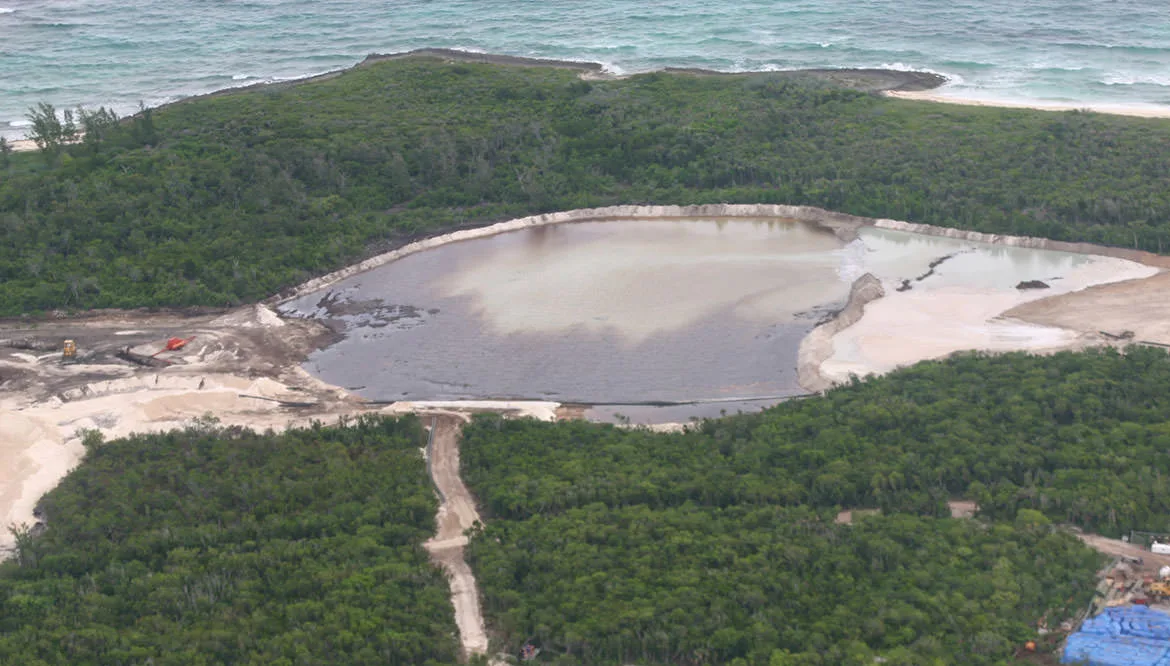
I want to share this addendum to the Bakers Bay EIA with you. Three years later, this addendum is even more unbelievable to read than when it was originally discovered. I am leaving it in its original format with the University of Miami logo on it.
This document helps clarify the position of the environmental monitoring team for the project, and how they admit in these notes that they are subjects of an experiment, and the ultimate environmental effects of this development are simply an experiment for the benefit of science. This is the great irony of the Guana Cay debacle. Foreign scientists can establish a monetary relationship with a foreign developer in a country hungry for jobs, and completely shirk the local community and its environment for the supposed interests of the greater good. This reminds us why Great Guana Cay is an issue about the importance of locals as being the most important components of their environmental and cultural future. Smaller units — families and communities — are the ones who understand and are closest to the long-term future of their home.
The leader of the Environmental Management Team which created the document below represents a minority in the conservation community which arrogantly assumes otherwise. I am also adding photographs from August 2007 into the text. The highlighting is my own.
CHAPTER 9: ENVIRONMENTAL MANAGEMENT PLAN. The involvement of ecologists and a research team is critical to understanding the longterm impacts to the island environment. The Passerine at Abaco presents a great opportunity to local and international naturalists to study first hand the impact of various practices, and see the long-term implications of development. The promotion of Passerine at Abaco as a case study site for small island development will encourage independently funded research on the island, and in adjacent marine environments.
Plan Components and Overview: The Passerine at Abaco is a unique development project in the transparency of its site management and environmental reporting. The project will be an experiment in sustainability for small island developments. Clearly, local residents or Bahamians in general would not appreciate being the site of "experimental" approaches to development of their natural resources, but the aim of the experiment is to provide a truthful documentation of the real ecological costs.
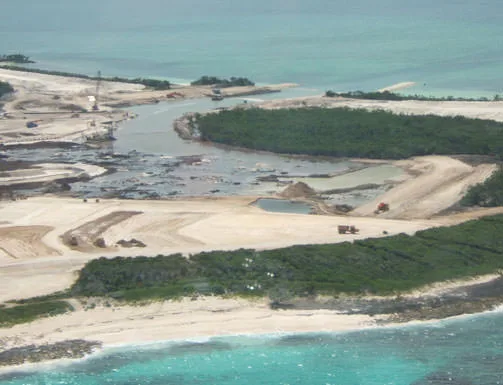
Much of Great Guana Cay's mangrove habitat is gone, and in its place, a dangerous marina is being constructed, which is expected to leach nutrients into the coral reef (you can see coral structures in the lower righthand of this image). Courtesy SGCR
The Great Guana Cay site is already severely impacted by previous development at the "Treasure Island Site". (Erik: this was true, but the Disney/Premiere/Meister environmental damage to the site was a fraction of the Discovery Land Company danger to the site, and is essentially an irrelevant point.) The appendices include a section of news articles from 1988 and 1989 on the controversies that surrounded the original construction of the cruise ship resort site and approach channel. Without legal action against the present owner for mitigation costs, the ecological health of the property will continue to decline. There are significant environmental issues associated with: unknown material dumped in two landfills; invasive alien plants displacing native vegetation; invasive alien insects (Lobate Lac Scale Insect) impacting the health of native trees, especially after hurricane disturbances.
Erosion of beaches from the removal of dunes and natural vegetation along Bakers Bay; erosion of beaches from Australian pine (invasive alien plants); accumulation of trashes and unregulated dumping.
There is no stewardship of the natural resources or management of the property of this time. Many people, both local residents and visiting yachtsmen, reportedly use the property, yet no person or organization takes responsibility for management or stewardship of the resources. (Erik: the use of the land was minimal; at most for crabbing, at worst wandering sailors and children littering along the paths) As land becomes increasingly scarce in the Abacos (and all of The Bahamas), there needs to be an overall land use plan that sets aside natural areas for tourism, recreation, and conservation of the natural heritage of the country.
The Marina is being built dangerously close to the coral reef. This Environmental Management Plan (EMP) outlines four components that set a model for private land stewardship in the country, particularly for private resort communities with technologies and protocols appropriate for use in national parks and publicly-held lands (Crown land).
Four facets of the EMP designed to disseminate information, define procedures and accountability and coordinate all necessary personnel and stakeholders include: Bakers Bay Club EIA — Addendums 131, March 2005, Part 1, 131: 5.) Clearly articulated and measurable environmental goals; 6.) Educational outreach programs and training material for a. Contractors, construction crews and all on-site workers, b. Local communities, c. Regional Non-government environmental organizations (e.g. Friends of the Environment), d. Local businesses and business leaders; 7.) Clear management and project communications and reporting with a. Published "Chain of Command" for site management, b. Documentation and accountability to EIA policies, c. Incident reporting and management plan, d. Clear reporting responsibilities; 8.) Independent reporting and verification, with monitoring data available in a "scorecard" format.
It is often very difficult to document the real ecological costs of development until many years after the developers have completed the job and left. The long-term environmental impacts pose a significant financial burden to residents of the resort community. For example, resort development in the Florida Keys commonly underestimated the flushing rates of residential finger canal systems. Twenty to thirty years after the construction, residents are faced with very expensive mitigation options to improve near shore and canal water quality, with millions of dollars slated for advanced wastewater treatment plants, backfilling canals, and re-landscaping canal margins.
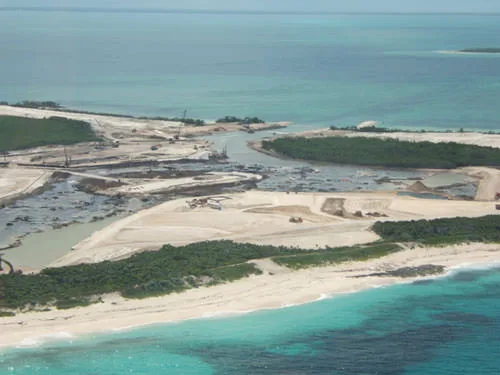
11.21.07
Guardian Ponders Why Homeowners are Selling Guana
Why are Guana Cay homeowners selling property on Great Guana Cay — the answer is obvious — Bakers Bay Club is ruining the island. This article in the Guardian poses the question:
Article
08.25.07
University Class Erupts over Bakers Bay Propaganda
Imagine yourself in a classroom somewhere in the United States.
Imagine that this classroom is a class on environmental science. Imagine that the Professor asks each of his students to pick a country somewhere in the Caribbean Basin and to write about some environmental issue the country is dealing with.
Imagine that today is the day for the girl who has Bahamas to give her speech.
Imagine that the girl who got Bahamas is up on the podium, the words 'Guana Cay' appear on the projector screen. She says that there is this island in the Northern Bahamas called Great Guana Cay. Her best friend's dad, he works for a company called Discovery Land Company, which is building a golf resort there.
She explains that before the developers arrived on the island, things were terrible. There was rampant crime, for example. The developer's have to be alert, for fear they will be assaulted or mugged.
Her presentation went on to repeat ugly, dehumanizing stereotypes about the islanders themselves — framing the people of Great Guana Cay in crude, prejudiced terms lifted straight from the developer's own talking points, as though the local Bahamian community were an obstacle to be replaced rather than a community with two hundred years of history on the island.
She explained that the developers were a model for environmental practices, and their environmental practices should be followed throughout the Bahamas. She did not get into details, or show any photos of the work site.
Now imagine that the young woman who has Costa Rica is sitting in her seat, gripping her chair, incensed. Imagine that Costa Rica is a very bright young woman. She is aware of the controversy at Great Guana Cay. She reads Notes from the Road. She is familiar with the court case arguments and the environmental science which predicts the development will kill the island's coral reef within a matter of years.
She gets up and says that this girl, Bahamas, has bought into propaganda and the developer's bullshit. She explains to the class that the Baker's Bay Golf and Ocean Club project by the Discovery Land Company is one of the most controversial projects in the Bahamas. She says that it is opposed by conservationists and coral reef scientists around the world.
She explains that the 170 people who live on Great Guana Cay are a resilient and fiercely independent people who have populated this lonely outpost on the edge of the Atlantic for 200 years, crafting it into a peaceful and charming fishing and tourism community with 100% employment, no crime, and no police.
She explains that Guana Cay holds what scientists say may be the best reef in the Bahamas.
That day was April 20th, 2007. The professor of the class asked that the name of the University not be named.
The professor allegedly told the student to re-do her report on the Bahamas. She was told that she should not have relied on the developer for all of her information. Costa Rica was commended in front of a very tense class.
07.04.07
Bakers Bay Club Accused of Blatant Bribe
The Freeport News wrote a stunning article today on the recent news of the Bahamas National Trust's alleged bribe from Discovery Land Company. Below are a few quotations. "It is with extreme disgust that we, the Save Guana Cay Reef Association, read in the papers that such a 'blatant bribe' was being used to sway the public opinion in reference to the Bakers Bay development, in Guana Cay," the SGCRA statement said.

"The Bahamas National Trust graciously received the donation. We realize they are a cash strapped organization and we respect their work, but that is no reason 'to sell your soul to the devil.'
"Accepting the donation is one thing, we cannot fault them for that, but the gushing words of praise that followed in the press release from the BNT, was nothing short of appalling."
The SGCRA noted some early literature produced by the developers in which they mention the BNT as being a part of the project. They were even mentioned as being a part of the environmental monitoring team in the Heads of Agreement between the developers and the government.
06.27.07
Locals suggest Discovery Land Money is Bribe
The following is a press release intercepted from Discovery Land Company. This is an exquisite example of how the company is using donations to lure the Bahamas' environmental officials into accepting their ecological nightmare. Notice how they misspell environment.
"Bahamas National Trust and Bakers Bay Join Forces To Preserve Evironment" Mr. Neil Mckinney, Mr. Glenn Bannister, Dr Livingstone Marshall, Mrs. Beverly Taylor and Mr. Eric Carey
FOR IMMEDIATE RELEASE
Nassau, Bahamas. June 25, 2007…. The Bahamas National Trust's (BNT) ability to achieve its mission was significantly enhanced on Monday when Discovery Land Company (DLC), developers of The Baker's Bay Golf and Ocean Club at Great Guana Cay, Abaco, announced a pledge of $1.2 million to the organization.
"The Trust is very grateful for this generous grant by Discovery Land Company and the Baker's Bay Golf and Ocean Club which will support the mission of the organization, and more specifically assist in providing management and infrastructure for national parks throughout our country," said Mr. Eric Carey, Executive Director of the BNT.
06.27.07
Ocean's Empty
Mike Meldman, the CEO of Discovery Land Company and an actor in the breezy summer Blockbuster, "Ocean's 13", appears to be on a public relations rampage to fix his company's image, and to make Bahamians and his clientele forget that Discovery Land Company is destroying Guana Cay and one of the Bahamas' most critical reef systems.
I am going to show you some examples of Discovery Land Company's recent attempts to fix their public relations image, illustrated through clippings in the press and their own marketing language. While you read these real-life recent examples, remember that Discovery Land Company is not in business to help people out and be friendly to everybody, nor are they in business for peace and love. They are in business to make money and to satisfy their investors.
If Michael Meldman were just wasting millions of dollars on philanthropic endeavors, he would be fired by his investors. No, these following examples are carefully crafted corporate decisions to maximize revenue. These are advertising and public relations dollars designed to confuse and deceive both the Bahamian public and Discovery Land Company's clientele. Will Bahamians take the bait?
Take a look at this example. On April 2, 2007, the University of North Carolina announced that they were creating an environmental professorship in which Meldman was the primary donor in a multi-million dollar professorship for environment and conservation studies. To the student press at UNC, the irony of this made front-page headlines. The students understood that Meldman was trying to use money to fix the perception of himself and his company. Clipped from an official UNC publication:

In May 2007, Discovery Land Company updated its website and added a new section which is designed to make the company look philanthropic. There are no details, only vague writing that says the company will help with foster children. But it sounds good.

Yesterday, the Nassau Guardian published a press release entitled, "BNT benefits from Baker's Bay" which announced that Bakers Bay Club was giving $200,000 to the Bahamas National Trust (BNT).
I admire the Bahamas National Trust deeply, and I encourage donations and support to this institution whose importance to the Bahamas grows every day. But Baker's Bay Club did not give this gift out of good will, love for the environment or for the people of the Bahamas. If they spent their millions so freely, their investors would fire them. Rather, the Baker's Bay Club is offering this donation, at the very least, to improve their public image. At the very worst, the donation will be used to as a carrot, dangled to lead Bahamians from the devastation and outrage being caused by this unacceptable megadevelopment.
I have seen the worldwide coral reef and mangrove communities speak out against this development. I have listened to eminent marine biologists and conservationists denounce this megadevelopment for the many ways it will harm crucial reef, mangrove and terrestrial environments. Let's be clear about one thing — Guana Cay's environment is unique in this world, and its elkhorn and staghorn coral structure is considered one of the best and last of its type in the world. National treasures like Guana Cay need to be protected.
Guana Cay's marine environment has supported a sustainable fishing community for generations, its beauty draws international tourism not only to Guana Cay's small cottage tourism center, but its reef helps fill up hotels and homes in places like Treasure Cay, Hopetown and Green Turtle Cay. Beyond the vital economic importance of Guana Cay's unique and fragile environment, is the overriding international importance of saving these unique environments before it is too late; before these treasures of God are gone forever.
The article quotes: "Those funds will come in the form of $200,000 per year in each of the first three years and thereafter we will sit with The Trust and we will look at its accomplishments, objectives and milestones, with a view to supporting the trust again to the tune of a second three-year grant for another $600,000." To me, this reads like an attempt to use future funding as leverage over the Trust's public positions.
Baker's Bay Club has come up with an ingenious way to ensure they can dangle money in front of an underfunded agency with the hope of influencing policy. I have seen Baker's Bay Club use money to influence and change public opinion many times before. Bakers Bay CEO Michael Meldman, in a previous Nassau Guardian article, was quoted as defending his motives for donating money to offset negative publicity on Guana Cay. He said, "We do this sort of thing everywhere our properties are located. This is not being done here at Great Guana Cay just because we want to quiet the previous situation."
But actually, after calling all of their other properties, we found no similar foundations or donations existed at the time that article was written. Money is being channeled by calculating marketers precisely to change opinions in the Bahamas, even while outside of the Bahamas, opposition to the project is unanimous among professionals concerned about the effects such a development will have.
Bahamians are deeply religious, deeply moral people. They understand that their natural environment is a great economic and cultural resource. They will not be fooled by the latest comedic public relations scam perpetrated by the Baker's Bay Club.
Baker's Bay Club has lost the scientific battle over whether their development is good or bad for the environment. An international scientific consensus strongly condemns the large, dangerous footprint of this megadevelopment. I urge the BNT to take sides on this issue which is so important to the Bahamas' future. Bahamians are not owned by rich Americans dangling carrots in front of their mouths. Perhaps it’s time for the Bahamas to seriously consider abandoning this illegal and dangerous development and strongly consider the Baker's Bay property, its coral reef, the nearby Fowl Cay reef, and the mangrove and orchid forests of Guana Cay's northeastern wilderness into a national marine and terrestrial park. The economic and environmental benefits will resound for generations, and the positive press will help reverse the negative press Bakers Bay has brought to this proud country.

Here is the article and quote from the Nassau Guardian article I mentioned above:


Here is another example of Bakers Bay Club using the Bahamas National Trust to their marketing advantage. They actually claim that one of their public relations' schemes consists of Bahamas National Trust officials. But read below and then see the letter from the Bahamas National Trust: Q: How will development efforts impact Joe's Creek, the mangroves and the bonefish flats on Guana Cay?
A: Contrary to prevalent rumors, Joe's Creek, the mangroves and the Guana Cay bonefish flats will all be preserved and not altered by development (EDITOR's NOTE: Discovery Land Company's advertising material was inaccurate. Mangroves have been removed, destroyed and Joe's Creek has been severely mangled.) The Joe's Creek area is the centerpiece of a 70-acre preserve (EDITOR'S NOTE: Less than 70 acres of the Joe's Creek area remain) which will be set aside by the developer. The preserve will be established to forever maintain the land in its current natural state.
The general public will continue to have access to this preserve area for crabbing and other uses consistent with the environmental sensitivity of the area (EDITOR'S NOTE: locals who have accessed this public land for generations have been turned back by Discovery Land Company sentries). A developer-funded interpretive center, public trail system and 5-acre public beach park will provide restrooms, fire pits and a public dock for small craft. The preserve will be governed by an independent foundation made up of representatives from the College of the Bahamas, Bahamas National Trust, and the University of Miami.
(EDITOR'S NOTE: the above statement is inaccurate. At the time of printing, the Bahamas National Trust had no intention of being involved in this scheme. See note below from the executive director of the Bahamas National Trust in response to the above advertising material.) April 20, 2005
Troy D Albury,
Thank you for the letter of April 14, 2005 regarding Bahamas National Trust's involvement in the proposed development at Guana Cay, Abaco.
January 22, 2006
Aerials Show EIA Recommendations Out the Window
The following photographs examine the dangerous gamble Discovery Land Company is making with Guana Cay.
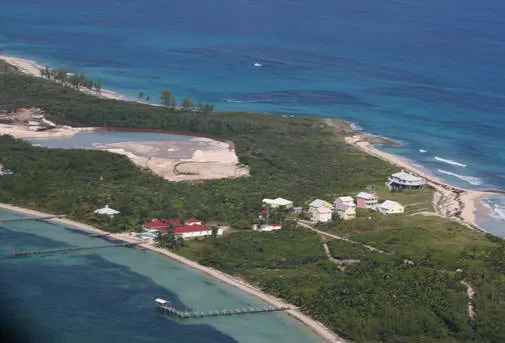
Impossibly close to current developments, the Bakers Bay Club marina is being shelled out of Guana Cay's mangrove areas. Constant development threatens nearshore waters: The development of the marina continues dangerously close to the reef-side of the cay with no use of plastic barriers between the construction area and the coral reef. Guana Cay's porous limestone means pollutants, nutrients and construction-related chemicals will almost instantly leach out into the reef: a potent combination which scientists indicate will devastate this reef, one of the last remaining truly healthy reefs in the Atlantic-Caribbean. Detail of marina construction on the Sea of Abaco side. Bakers Bay Club's Tent City. Foreign worker's lounge in an isolated camp in the northern sector of the island while native residents are terrorized by the Bakers Bay Club.
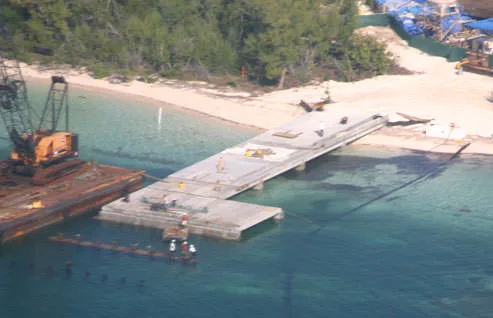
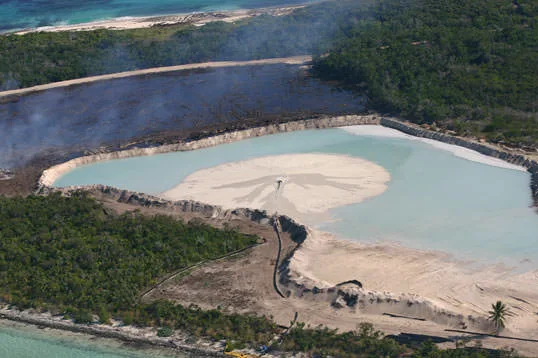
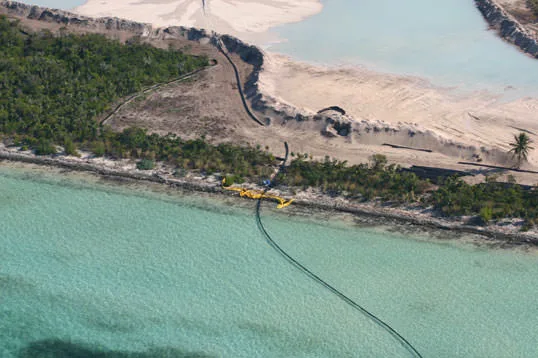
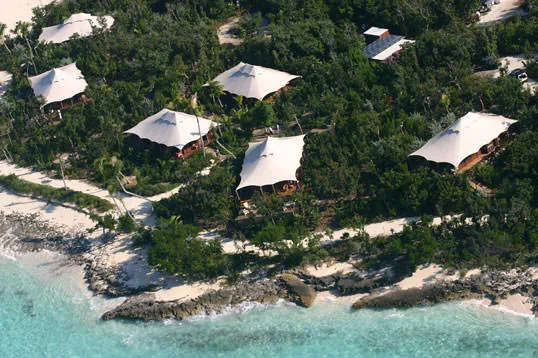
February 13, 2007
New Photos Reveal Unspeakable Devastation
New photos taken in February 2007 reveal the extent of what has been lost at Great Guana Cay. Saving the island and its nearshore marine environment now requires speed and action from Bahamians, concerned tourists and the government.
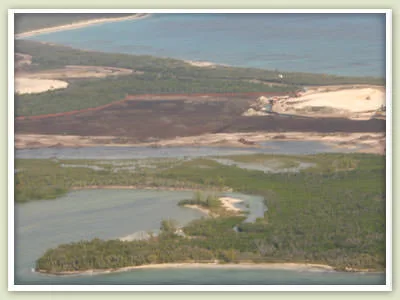
The island is nearly cut in half as development of the marina unfolds.
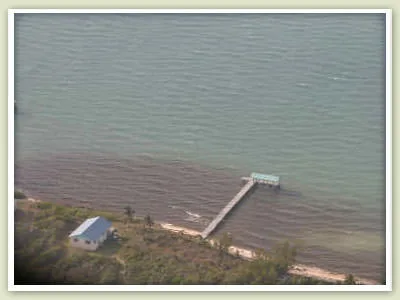
Strange sediments appear in the water adjacent to construction.
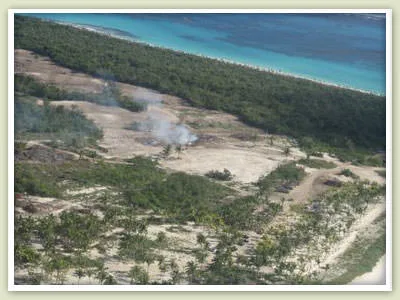
Every day, there are more plumes of billowing smoke and less land. Here, fast-paced construction abutts the coral reef.
October 19, 2006
Funny Business with the Field Club
The Bakers Bay Club is practicing funny business. Foreign employees of the Bakers Bay Club appear to mock the native residents of Great Guana Cay, who approach this public beach by boat. Anthony Roberts asked the Chief Councilor, Wayne Hall, if it was against the law to drive on beaches. His answer was yes. Anthony then asked, "Then why are the employees of Bakers Bay Club allowed to drive the beach at Bakers?" Hall answered that he was not aware that they were driving on the beaches and asked what they were driving? Roberts answered, "ATV's and tractors!" Additionally, Bakers Bay employees were raking the beach with ATV's, which is clearly also against the law.
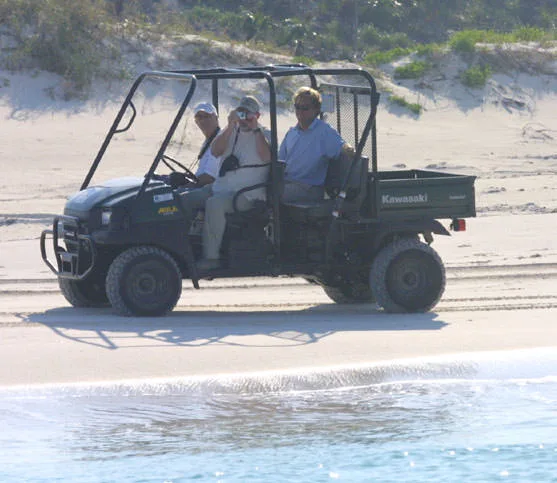
The Bakers Bay Club employees have been, or were, driving without licenses all about Guana Cay for months.

In current (April 2006) Bakers Bay literature, the Bakers Bay Club refers to a large hunting grounds on mainland Abaco. Rumor on the Abaco mainland has it that this is an additional 3,000 acres of crown land, although that information cannot be independently verified. In this literature, Bakers Bay Club writes that they will be hunting 'Abaco duck.' Locals refer to the White-Cheeked Pintail as the "Bahama Duck" but there is no such thing as an "Abaco Duck." The species they are referring to is clearly a no-take species under Bahamian hunting regulations, and a threatened West Indian endemic.

Sept 23, 2006
Bakers Bay Club Environmental Documents filled with misinformation, irrelevancies
Discovery Land Company offered to share information and work with one environmental group; a local group based in the Bahamas. In response to this group's criticism and suggestions of the project, Discovery Land Company offered the environmental group some documents. Below is the partial text of one of those documents. It is titled, "BAKER'S BAY GOLF COURSE DESIGN NARRATIVE." It is not signed or dated. No individual claims responsibility for the document. The document is irrelevant to the environmental concerns at hand, which is not surprising, as this has been the case throughout Discovery Land Company's stay on Guana. Below is the text of the document in italics. Comments are in regular type.
Past experience has proven this, as there have been no negative effects noted on any of their previously developed projects. Other projects include The Estancia and Mirabel Clubs in Scottsdale, Arizona, Ironhorse in Whitefish, Montana, Vaquero, in Dallas, Texas, and the recently completed Kukio Golf and Beach Club, on the Island of Hawaii.
For two years, Discovery Land Company has stated that their developments in other locations have had no similar negative effects on the environment — this is of course true; none of their developments are located in similarly ecosensitive locations, and certainly none of their developments are located adjacent to a coral reef. In fact, the soil type common to Discovery Land Company's other locations could be called of a terrigenious composition, compared to the carstic limestone of Great Guana Cay, which is so permeable that a glass of water would simply dry up on the surface and almost instantly sink into the island.
There are many examples where such developments have damaged coral reef ecosystems. The unnamed author does not seem to have a grasp of the science relevant to coastal eutrophication and coral reef biology and the impacts of such a project on these very fragile and threatened ecosystems.
The developer believes that the keys to short and long-term success are strongly influenced by three essential elements: 1. employing responsible, qualified personnel, consultants and contractors, 2. proper construction, and, 3. effective water management. To that end, they have assembled a highly qualified project management team to lead them to success at Baker's Bay.
The unnamed author is quick to remind its readers about the benefits of the project to employment, and the qualities of its employees. But such a report should focus on the greatest threat — the coral reef. Here we are already through the introductory comments of the report, and the reef is not even mentioned. Where are the micrmolar amounts of nitrogen and phosphorous from the so-called safe examples mentioned above? The author cites that similar Discovery Land Company developments have had no negative effects on water. If this were to be the case for Bakers Bay Club, Discovery Land Company could provide critics with the levels of nutrients that would leach out into the coral ecosystem during, throughout and after development. Of course, the developer cannot provide this information, even though it is easy to acquire and estimate: the result would spell doom for the reef.
RESPONSIBILITY: The Golf Course Superintendent will be responsible for the long-term operation and maintenance of the golf course, including irrigation and drainage systems, soil and water testing, and fertilizer and pesticide usage. The Superintendent will employ the use of professional turf-grass, soil consultants, and other industry professionals as necessary to assist in developing maintenance and management programs directed at minimizing potential negative impacts from the golf course operation, including the non-target application of applied fertilizers or pesticides.
He will employ and train a qualified, capable staff that shares the developers' interest in protecting the environment, human and natural resources in and around the project site. The Golf Course Superintendent will also be responsible for complying with all regulatory agencies, relating to the proper storage, care and use of all fertilizers and pesticides. He will be responsible for monitoring and maintaining all drainage systems, ensuring that they are operating as designed and constructed, thereby protecting the site, and surrounding natural resources of Baker's Bay.
Interesting that responsibility for the fate of one of the Caribbean's last great coral reefs will come down to decisions made by a golf course superintendent. If you compare this with the fact that the University of Miami's grant to Discovery Land Company ends in December 2006 — will a loan golf superintendent make all decisions without coral scientists on-hand? It seems so. And the report refers not once to the coral reefs whatsoever, but does mention fertilizers or pesticides. It should be noted that the golf course at Winding Bay has recently had significant problems with seashore paspalum living up to its name — to thrive without pesticides and herbicides. A golf course superintendent will not have the knowledge or resources to keep the golf course green without increasing nutrient levels far above that required to keep the reef alive.
GOLF COURSE DESIGN: The golf course is designed by Fazio Designs Inc., one of the worlds most noted Golf Course Architectural firms. Within their designs, they strive to create a golf experience that nurtures the natural characteristics of the land, and creates an enjoyable golf experience. One of the notable features of Fazio designs is their tendency to shape the golf courses to contain the golf ball, creating contours that move towards the center of the golf hole. This shaping characteristic serves to contain most sheet flows of water during intense storm activity, into low areas within the golf course corridor, where they are contained, and piped to detention areas.
It's interesting that the author is so willing to admit that Fazio golf courses are created for people who aren't very good at golf. Since we know that Discovery Land Company has no intention of lining the golf courses, and since we know that the course will sit on limestone, we know that its impossible to keep the nutrients from leaking into the reef system, despite efforts to control the flow of these nutrients. The long-term maintainability of the golf course will be determined by the golf course design and construction. The Developer recognizes this fact, and has demonstrated in the past on other projects, that they are committed to constructing golf courses responsibly.
It now sounds like this is simply a public relations piece. This developer has been severely criticized for their plans on Great Guana Cay, by experts. They have not employed the appropriate experts, and words do not change those facts.
The Developer strives to use the best information and consultation available, including applicable University testing, industry proven methods and practices, as well as the latest technological innovations with a common goal within their projects of creating great golf courses that meld seamlessly into their natural surroundings and environment. The selection of proper turf grasses, soils, and irrigation systems are essential to the long-term maintenance of healthy turf grass. The developer agrees with the philosophy that a properly constructed golf course leads to managing healthy turf.
Healthy turf, due to proper construction and management requires less pesticide use and much lower fertility requirements than an improperly constructed golf course. In order to achieve their goal, the Developer constructs their courses using the construction methods and Best Management Practices as suggested by such agencies as the United Golf Association, Golf Course Superintendents Association of America, Golf Course Builders Association of America, and the American Society of Golf Course Architects.
None of the organizations above have created any guidelines on the protection of coral reefs from unsaafe levels of nutrients, and erosion leading to sedimentation. Any guidelines that this developer is referring to are therefore completely irrelevant!
The turf types selected for the golf course will be those that rate very high by the National Turfgrass Evaluation Program trials for climate and conditions similar to the project site. Due to the climate, soil and water characteristics found at Baker's Bay, the turfgrass selected will be an improved variety of Seashore Paspalum. The turf areas will be maintained in such a way to promote healthy, deep-rooted plants that are resistant to stresses. Sound cultural practices, including traffic control to minimize turf wear, aeration to decrease soil compaction, mowing the turf at the proper cutting heights, and judicious irrigation will ensure that a healthy stand of turf is maintained, which decreases the need for fertilizer and pesticide applications.
Seashore Paspalum is a relatively new grass to the golf turf industry. Kukio, a Discovery Land Company project on the Big Island of Hawaii was one of the first golf courses to plant an improved variety of Seashore paspalum throughout the entire golf course, including the greens surfaces.
Kukio is a particularly poor example, as the soil composition in Hawaii is very different than Guana Cay. The soil there absorbs nitrates and phosphates efficiently, whereas in a dry limestone such as Guana, none of this happens.
It was selected for many reasons, however it's most impressive attribute is its ability to withstand high concentrations of salts, including sodium and chloride that are found in ocean and brackish waters. Due to Paspalum's high salt tolerance, many of the common turfgrass pests that plague other turfgrasses, are almost non-existent. At Kukio, no herbicides have been applied to the golf course in over three and 1/2 years. There are no other golf courses that can make that claim along the Kohala coast, as they are all established with strains of Bermudagrass. Additionally, it is being confirmed by university and private testing that many turfgrass insects do not inhabit Paspalum turfed golf courses. It is believed that the high salt concentrations of the irrigation water cause irritation to the endoskeletons and epidermis of the insects, causing them to seek other sources of food and shelter.
The developer's reliance on turfgrass to solve so many of the issues associated with this project is dangerous; again, Hawaii and the Abaco chain have incredibly different weather. Although many benefits of Paspalum are cited, the string of benefits the grass proposed does not make up for its inefficiencies; in particular its eventual need for pesticides and fertilizers.
August 25, 2006
More International Publications Discuss Bakers Bay
...and Miami Herald weigh in on the situation at Great Guana Cay and the Bakers Bay Club. This constant press is very bad for Discovery Land Company, but it does no favors for tourism to Abaco: more proof that Bakers Bay Club is already gnawing at the strength of Abaco tourism.
August 18, 2006
Bakers Bay Club Losing Millions
In a recent press releases, the Bakers Bay Club claims they are costing Discovery Land Company millions of dollars. In a press release given to the Bahama Journal, Dr. Marshall states,
"When you find that you are continuously spending but not taking in, well of course you head down the road where you might be looking at more red ink as opposed to black ink, so it's that type of thing for us...But this company did not come to The Bahamas on a wing and a prayer — they came here exceptionally well planned. I think that is also true of their financial picture, and so while it is costing us, we are prepared to stay in this for the long haul and to be able to weather any financial challenge we might experience." Bakers Bay Club blames their losses on the locals of Great Guana Cay. But people have a right to defend and determine their island's future. It is, ironically, the Bakers Bay Club partners themselves who are responsible for bungling this giant investment project. Period.
August 09, 2006
Tales of Creepy Developer Tactics
For the last two years, Bakers Bay Club has attempted to misrepresent to the public how many Bahamians on Great Guana Cay back opposition to their development. In one instance, Dr. Livingston Marshall, Vice President of Environmental and Community Affairs, questioned whether there were more than two members of Save Guana Cay Reef, the organization of locals formed to represent opposition to the development.
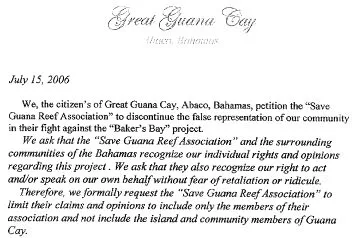
A petition helped convince the Privy Council to continue the injunction against the Bakers Bay Club.
But throughout all the public relations spin, there were 170 residents of Great Guana Cay who signed the original petition against the Bakers Bay Club, and Save Guana Cay Reef's membership consists of hundreds of Bahamians and homeowners on the island. The developer argued that Save Guana Cay Reef did not represent the community, and as evidence they submitted a petition signed by 73 individuals.
But the Privy Council was aware that the petition was floated around the island under the premise that if people signed the petition, Discovery Land Company would give money to the community that they promised under the public relations spin scam called the Fig Tree Foundation.
Many were surprised to find that there were children's signatures, and signatures of those who favored Save Guana Cay Reef on the petition. It turns out that the petition was circulated under a false premise, and many signed it just so that the petitioners would leave them alone! Others signed it under the premise that by signing it, they would be helping the sick and needy.
Dr. Livingston Marshall stated that he was sharing his most recent EIA and EMP with Michelle Bethel of Bethell Environmental Ltd, a Bahamian environmental planning group. This statement was produced after criticism that Marshall and the Bakers Bay Club were not sharing vital documents with the public. Now, Bethel has shared her findings.
In summary: Bakers Bay Club is clueless and has no idea what they are doing. For two years, the locals of Great Guana Cay and dozens of conservation organizations have been arguing that Bakers Bay Club's plan is dangerous for the coral reef. They have replied by attempting to condemn the people who oppose their project. But in this latest twist, the agency whom they offered to communicate with also lends their doubts.
It appears that Bakers Bay Club hired a Mr. WM. Kent Alkire, II, an agronomist and golf course environmental consultant with Golf Ventures International, to produce a report about fertilizer use and sustainability. The report has nothing to do with Bakers Bay Club or Guana Cay, or even the Bahamas. It is a general report that doesn't even mention anything about corals or mangroves. In fact, Marshall's use of such an erroneous report to justify their development is just another red herring.
In the developer's material, Bakers Bay Club writes, "At the Baker's Bay site, the sand bed will be placed over the existing sub-soil, comprised of a variety of soils, ranging from clay and silt to course sand. The intent during construction will be to create a "perched' water table below the capping sand. Water that percolates through the sand root zone will be slowed as it travels downward and encounters the native soil. This decrease in percolation rate and the slower draining sub-soils will aid in collecting suspended solids carried down from the overlaying sand. The turf-grass root system will be encouraged to root into the sub-soil, with the ultimate goal of the root systems utilizing the solids that may have leached through the overlaying sand."
According to locals on Great Guana Cay, a local family went to the northeastern end of Great Guana Cay to light a fire and play music, a custom for local families celebrating the Bahamian independence day. Employees of Bakers Bay Club reportedly rushed to the beach and told them they could not light a fire or have music on the beach. The BBC dispatched six security guards to stand over them at the high water mark and watch over them. When the family started to light a small fire to cook hotdogs and hamburgers, General Manager Carter Redd reportedly threatened to call the police. An article on the subject: Locals harassed at beach.
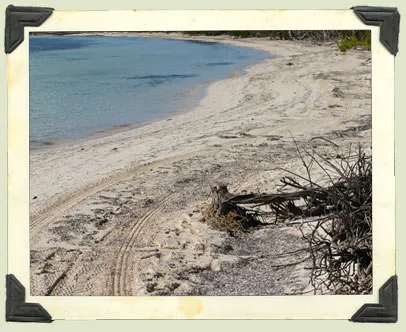
There are no laws preventing Bahamians from lighting fires or playing music below the high water mark, and the police were in agreement with the family. According to witnesses, Carter Redd was told to leave them alone so they could celebrate their holiday. This instance is not isolated. Locals enjoying their traditional rights have been harassed by Bakers Bay Employees on many occasions. Some instances have made it to the local press and have even been admitted by BBC officials in the press. It is truly ironic that on independence day, a foreign entity is reminding Bahamians that their rights and independence are truly being lost.
Discovery Land Company has announced that about 17% of its Bakers Bay Club workforce now consists of foreign workers, most likely from Mexico and Central America. Discovery Land Company had formerly been beating the Bahamian jobs drum as a way of routing the more encompassing issues of community rights and the environment. They can no longer do this. Like many hasty foreign developers, Bakers Bay Club is giving up on Bahamian labor. Many developers believe that Bahamians are inefficient and lazy, but this is far from the truth. Bahamians are hard workers with diverse skill-sets. By hiring laborers from thousands of miles away, Bakers Bay Club again sticks its middle finger at Abaco.
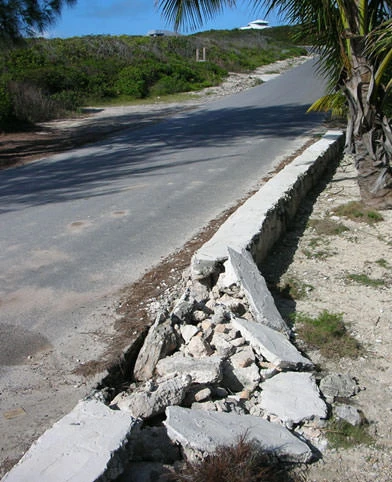
The Golf Cart rammed into Dolphin Beach Resort
On January 16, 2007 at around 10 PM, three Bakers Bay Club employees crashed into a wall at Dolphin Beach Resort after a night of alcohol, according to locals. The golf cart flipped over and the female in the cart was pinned underneath the cart. Bakers Bay Club has yet to apologize or offer to fix the damage.
This is the second hit-and-run incident allegedley involving Bakers Bay Club employees. In the United States, the driver would be arrested with DUI charges. But on an island without police, you can get away with anything!
In the weeks leading up to 10 AM, Friday, January 5, workers at the Bakers Bay Club organized and planned a formal protest against the golf club work site in the Northern Bahamas. According to Bakers Bay workers, Discovery Land Company had been attempting to cut the worker's hours and their pay. The economics of the Bakers Bay Club is set up so that if the project is completed in 5 years, the senior brass in the organization will get rich. At 10 years, the outfit will break even. Beyond 10 years, the outfit will lose money.
Workers said they were being scheduled under conditions they described as almost slave-like, and reported often getting extremely short notice of when workers are to report to work or not report to work. Workers have taken the ferry all the way from Marsh Harbour to Guana Cay only to find that they are told they are not needed that day. They are forced to wait three hours for the next ferry. Bonuses went unpaid, and workers were critical of differences in expected pay, according to a Nassau Guardian article. The company also allegedly declined to give the workers Christmas bonuses they had promised them.
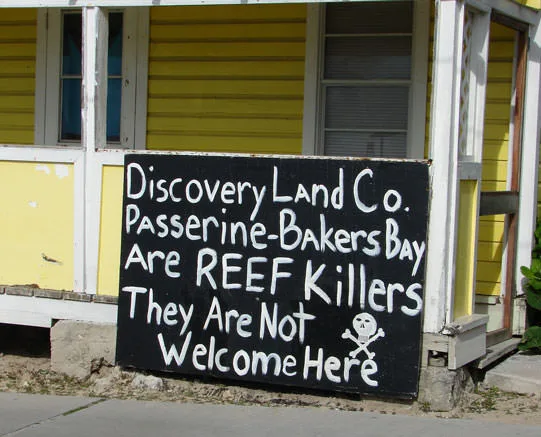
Guana Cay embraces for the 2007 defense of its culture
But adding to the worker's claims that they were working in slave-like conditions, many claimed they were forced to dig holes with their bare hands because of a lack of tools. The goal, some believe, is to drive down the will of the Bahamian workers, and create an environment that allows Bakers Bay Club their much preferred use of foreign labor from Latin America.
After the 30-40 workers protested in front of the Bakers Bay Club office, pointing out the slave-like conditions they are subjected to, the Discovery Land Company backed down and offered them additional benefits and a promise to treat them more fairly.
Anybody interested in the subject of Bakers Bay Club will find numerous articles and oral explanations of the Bakers Bay Club mistreatment of Bahamians.
July 12, 2006
Beach Harassment Continues on Northern End of Guana Cay
According to locals on Great Guana Cay, a local family went to the northeastern end of Great Guana Cay to light a fire and play music, a custom for local families celebrating the Bahamian independence day. Employees of Bakers Bay Club reportedly rushed to the beach and told them they could not light a fire or have music on the beach. The BBC dispatched six security guards to stand over them at the high water mark and watch over them. When the family started to light a small fire to cook hotdogs and hamburgers, General Manager Carter Redd reportedly threatened to call the police. An article on the subject: Locals harassed at beach.
There are no laws preventing Bahamians from lighting fires or playing music below the high water mark, and the police were in agreement with the family. According to witnesses, Carter Redd was told to leave them alone so they could celebrate their holiday. This instance is not isolated. Locals enjoying their traditional rights have been harassed by Bakers Bay Employees on many occasions. Some instances have made it to the local press and have even been admitted by BBC officials in the press. It is truly ironic that on independence day, a foreign entity is reminding Bahamians that their rights and independence are truly being lost.
June 22, 2006
Bakers Bay Club Hires Foreign Workers
Discovery Land Company has announced that about 17% of its Bakers Bay Club workforce now consists of foreign workers, most likely from Mexico and Central America. Discovery Land Company had formerly been beating the Bahamian jobs drum as a way of routing the more encompassing issues of community rights and the environment. They can no longer do this. Like many hasty foreign developers, Bakers Bay Club is giving up on Bahamian labor. Many developers believe that Bahamians are inefficient and lazy, but this is far from the truth. Bahamians are hard workers with diverse skill-sets. By hiring laborers from thousands of miles away, Bakers Bay Club again sticks its middle finger at Abaco.
January 18, 2006
Bakers Bay Club Employees & Golf Cart Accident
The Golf Cart rammed into Dolphin Beach Resort
On January 16, 2007 at around 10 PM, three Bakers Bay Club employees crashed into a wall at Dolphin Beach Resort after a night of alcohol, according to locals. The golf cart flipped over and the female in the cart was pinned underneath the cart. Bakers Bay Club has yet to apologize or offer to fix the damage.
This is the second hit-and-run incident allegedley involving Bakers Bay Club employees. In the United States, the driver would be arrested with DUI charges. But on an island without police, you can get away with anything!
January 16, 2006
Bakers Bay Quells Protests with Money
In the weeks leading up to 10 AM, Friday, January 5, workers at the Bakers Bay Club organized and planned a formal protest against the golf club work site in the Northern Bahamas. According to Bakers Bay workers, Discovery Land Company had been attempting to cut the worker's hours and their pay. The economics of the Bakers Bay Club is set up so that if the project is completed in 5 years, the senior brass in the organization will get rich. At 10 years, the outfit will break even. Beyond 10 years, the outfit will lose money.
Workers said they were being scheduled under conditions they described as almost slave-like, and reported often getting extremely short notice of when workers are to report to work or not report to work. Workers have taken the ferry all the way from Marsh Harbour to Guana Cay only to find that they are told they are not needed that day. They are forced to wait three hours for the next ferry. Bonuses went unpaid, and workers were critical of differences in expected pay, according to a Nassau Guardian article. The company also allegedly declined to give the workers Christmas bonuses they had promised them.
Guana Cay embraces for the 2007 defense of its culture
But adding to the worker's claims that they were working in slave-like conditions, many claimed they were forced to dig holes with their bare hands because of a lack of tools. The goal, some believe, is to drive down the will of the Bahamian workers, and create an environment that allows Bakers Bay Club their much preferred use of foreign labor from Latin America.
After the 30-40 workers protested in front of the Bakers Bay Club office, pointing out the slave-like conditions they are subjected to, the Discovery Land Company backed down and offered them additional benefits and a promise to treat them more fairly.
Anybody interested in the subject of Bakers Bay Club will find numerous articles and oral explanations of the Bakers Bay Club mistreatment of Bahamians.
September 9, 2007
NOAA Case Study Attributes Nutrients
A NOAA Case Study attributes nutrients to the destruction of Looe Key. This is important, because if as the United States is officially recognizing the role of nutrients in coral reef destruction, the issue is making the rounds in the press around the world. Even as global warming remains an easy scapegoat for coral reef destruction, the word on development nutrients is gaining ground in the press and in broader scientific circles.
Jult 6, 2006
Jean-Michel Cousteau comes to the assistance of the Great Guana Cay Residents
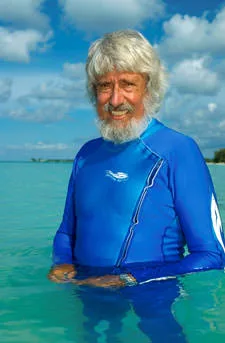
Jean-Michel Cousteau, who recently helped convince President Bush to protect 1200 miles of Hawaii's coral reefs in one of the boldest environmental moves of history, has just come to the aid of the Great Guana Cay native residents. Cousteau urges the island nation of the Bahamas to reconsider the Bakers Bay Golf and Ocean Club.
He writes, "...the Discovery Land Company Bakers Bay Golf and Ocean Club development may undermine the environmental health of the region; specifically affecting the nesting sea turtles of Gumelemi Cay and to the north, and impacting the neighboring reefs adjacent to the proposed golf course. Knowing from experience that ecological consequences of very large developments that do not have strict environmental safe guards can have far reaching consequences, I urge you to review the environmental impact of this development and consider the consequences for future generations of your citizens."
University of Miami
October 2, 2009
University of Miami Outrages Bahamians with new Press Release
The University of Miami Office of Media Relations issued a press release today claiming that Kathleen Sullivan-Sealey, the official 'researcher' working for Bakers Bay, is helping to "create the first sustainable tourist project in the Bahamas." The press release uses colorful language and lavish photos to clearly promote the relationship between Kathleen-Sullivan Sealey, the University of Miami, and Discovery Land Company.
The article also makes no bones about the University's position on Bakers Bay Golf & Ocean Club, claiming, that Sealey is helping to "guide the construction of a sustainable development called the Bakers Bay Golf and Ocean Club."
This official press release is an outrage on several levels, and Bahamians have a right to be angry. I will provide several ways for Bahamians to act and respond at the end of this entry.
Outrage 1: Sustainable Development Claim is False.
The official communication from the University of Miami states that the Bakers Bay Golf & Ocean Club is a sustainable development. That statement is false. (Years later, the record only confirms this further — see Bakers Bay Club Case Study Refuted for the point-by-point 2012 documentation of how far the marketing claims strayed from what was actually built, fertilized, and, for a 12-month stretch, monitored.)
The Sierra Club, Jean-Michele Cousteu's Ocean Futures Society, Greenpeace, Global Coral, and hundreds of coral scientists, including senior accomplished marine biology professors at the University of Miami, oppose the Bakers Bay Golf & Ocean Club on several environmental fronts.
It is widely considered one of the most unsustainable developments in the Caribbean.
Outrage 2: University of Miami Promised No Support for Bakers Bay
According to a letter from the University of Miami Office of Vice President and General Counsel to the attorneys who represent Save Guana Cay Reef, "The University has never given any project sponsored by Discovery at Bakers Bay or at any other location in the Bahamas its endorsement, support or blessing.
The University has never and does not now endorse, support or promote Bakers Bay and categorically and unequivocally states that any representation made otherwise is false and without the University's knowledge.
We have recently seen evidence that the Company has continued to misrepresent the University's neutral role with respect to the legitimacy of the Bakers Bay project..."
Once again, the University of Miami's name is being used to further the agenda of one of the most unsustainable developments in the history of the Caribbean.
Outrage 3: Earthwatch Cited
The article claims, "Dr. Sullivan-Sealey heads the project on Coastal Ecology of the Bahamas, supported by the EarthWatch Institute. The 10-year project involves visiting the major islands in the archipelago to assess the state of the coastal environment." The article fails to mention that Earthwatch pulled out of the Bakers Bay Club project, following extensive criticism about their involvement in this project.
Outrage 4: The Press Release Claims that this is the FIRST sustainable development in the Bahamas.
While the claim that Bakers Bay is a sustainable development is clearly false, the claim that it is the 'first' sustainable development is an outrage, and an indication that whoever fed this information to the University of Miami clearly disrespects Bahamas' sustainable development heritage.
A sustainable development is a development that is built without compromising the ability of future generations to meet their needs. In other words, the development does not affect the environment and economy of the place it inhabits. Bakers Bay, which has torn apart the island's mangroves, cannot honestly claim this distinction.
There are great examples in the Bahamas of sustainable developments, here are some of them:
1. Nettie's Different of Abaco was a beautiful genuine ecodevelopment that operated in the Abacos as a simple bone-fishing resort. The owner, who closed the resort as she grew older, used the resort to teach people about ecology, sustainable practices. She was actively engaged in environmental issues in the Abacos.
2. Tiamo Resorts is considered the Bahamas best example of an ecodevelopment and is applauded by environmentalists, biologists and travel media for its genuine sustainable qualities.
3. Small Hope Bay Lodge — is a genuine sustainable lodge whose size is appropriate to the sensitive space it lives in.
The University Response So Far
I talked to the author of the press release. Her intentions were genuine and she was surprised to learn of the real situation at Bakers Bay. She clearly was not informed about the reality behind this development and expressed sincere sorrow for the misrepresentation.
What you Can Do
Ask the University of Miami to retract the press release claims that Bakers Bay is a sustainable development.
Contact the University of Miami Student Newspaper, The Miami Hurricane. They can be contacted by phone or email:
Phone: 305-284-2016
11.21.07
U of Miami Ship Damages Reefs, University Mum
For the past two years, I have been reporting on the ways the University of Miami has been involved with the Bakers Bay Club. The Bakers Bay Club has used the University of Miami to legitimize its development, even putting its logo on its marketing materials to make their development look as though it has been rubber-stamped by the institution.
But now a new twist — the Miami Herald is reporting "The University of Miami's marine research ship struck and stuck fast on a shallow reef in Biscayne National Park, then cruised on without reporting the incident."
Read the article.
Many conservationists are frustrated with the University of Miami's position with the Bakers Bay Club; this incident serves to further question their integrity in the Caribbean.
September 25, 2006
University of Miami Letter to Discovery Land Company to Cease and Desist use of its name
Discovery Land Company, which has been using the University of Miami name for commercial purposes despite being told by the University to cease and desist use of their name to lend credence to their world-wide despised golf development, now harms not only the Bahamas, but the credibility of a respected and renowned institution.
To quell escalating international anger over the involvement of University of Miami scientist(s) and graduate students in one of the Caribbean's most controversial projects of history, the University of Miami's Vice President offers the following open letter, addressed to the attorney for Save Guana Cay Reef.
September 7, 2006
Dear Mr. Smith:
The University of Miami entered into a sponsored research grant agreement ("Grant") in January 2005 with Discovery Land Company (hereinafter "Discovery" and sometimes the "Company"). The Grant, which is valid through December 2006, requires Dr. Kathleen Sealey, a faculty member at the University of Miami and the Principal Investigator, to conduct a marine science research study entitled "Biological Diversity Status and Change with Small Island Development in the Northern Bahamas."
Generally, the Grant requires Dr. Sealey and her staff to provide monitoring services with regards to the environment, barrier reefs, fish habitats and less intrusion and the general welfare of the people residing on the island, and to provide monthly reports on collection of field data. As you are well aware, Dr. Sealey has no authority or power under the Grant to compel the Company to adhere to her findings and observations.
One of the primary missions of a major research university is to broaden the academic wealth of knowledge in all disciplines. Dr. Sealey, like the rest of the University of Miami faculty, is encouraged to follow that mission. At any given point in time, the University has hundreds if not thousands of clinical and ecological sponsored research studies conducted by its faculty members around the world for hundreds of companies. At the request of its faculty, the University of Miami will enter into agreements with public and private entities to support their independent research, foster their academic freedom and reserve their right to publish the developed work product. The University encourages the independent work of its faculty.
This does not mean that the University agrees (or disagrees) with the intellectual research conclusions reached by its faculty members.
In October 2005, the University wrote Discovery demanding that it cease using its name in a way that implied or suggested that it endorsed or was commercially affiliated with the Baker Bay project or any other of its commercial ventures.
Additionally, the University emphatically requested that the Company cease and desist using all signs, twin logos and websites containing the name of the University in conjunction with the name or symbol of the development project or that of the Company, and cease and desist making any references to the University's involvement with the Great Guana Cay Foundation which requires separate University approval.
We pointed out to the Company that the University must be assured that any and all of its signs, websites, communications or advertisements to the public, whether for business, marketing or political purposes, will not utilize the University's name except as allowed under the Grant, which expressly forbids utilization of the University's name without "written permission" (emphasis added).
The University, however, believed then and continues to believe that the Company has the right under the Grant to use the report and name of Dr. Sealey in her position as a professor at the University of Miami.
In late October 2005, Discovery responded by stating that it was taking the first step to immediately cease all references to the University in distributed materials.
The University has never given any project sponsored by Discovery at Baker's Bay or at any other location in the Bahamas its endorsement, support or blessing.
The University has never and does not now endorse, support or promote Baker's Bay and categorically and unequivocally states that any representation made otherwise is false and without the University's knowledge.
We have recently seen evidence that the Company has continued to misrepresent the University's neutral role with respect to the legitimacy of the Baker Bay project, and the University will be considering such further action in this regard as may be appropriate.
The University of Miami's official position is summarized as follows:
Hopefully this will clear the record regarding the University's relationship or lack thereof, with the Baker's Bay Development Project. I will personally visit your country within the next thirty days for the ostensible purpose of learning more about the facts and circumstances surrounding utilization of the University's name. I look forward to meeting you upon my visitation.
With regards,
Robert L. Blake, Vice President, General Counsel and Secretary
January 01, 2010
Who does Dr. Sullivan-Sealey Represent?
According to locals, in a recent meeting held at the Guana Cay school house 26 Aug 2006, Mrs. Sullivan-Sealey said she was not working for the University of Miami and made it quite clear that she was working on a 'GRANT' through the College of the Bahamas.
She distributed business cards with: Kathleen Sullivan Sealey, PhD. Dean, Faculty of Pure and Applied Sciences and Acting Executive Director, Marine and Environmental Studies Institute. Who does she work for?
In July, she told Great Guana Cay locals that she does not receive any money for her work at the Bakers Bay Club project.
Her words do not match the statements of the Bakers Bay Club, which on numerous occasions expressly refers to Sullivan-Sealey and the Environmental Management Team as a University of Miami-backed operation and Sealey (who heads the team) as a scientist from the University of Miami.
Additionally, Sullivan-Sealey made a statement that she was surprised that Bakers Bay Club employees were driving on the beach, and she told locals to notify her so she can file an incident report. But how could she not be aware of these obvious breaches?
Locals have been reporting these breaches for months, and the evidence has appeared in several online journals and in dozens of photographs, especially during the height of sea turtle breeding season.
If Sealey has not heard of these cases, there appears to be a serious disconnect between Discovery Land Company and the Environmental Monitoring Team.
Is Discovery Land Company listening to anything Sullivan-Sealey is saying?
And why does the Discovery Land Company and Sullivan-Sealey claim such wildly different things about who represents the Environmental Monitoring Team?
Notes from the Road hopes that Kathleen Sullivan-Sealey joins the international community and the locals of Great Guana Cay and denounces the unsustainable megadevelopment proposed by Discovery Land Company.

Discovery Land Company refers to the Environmental Management Team as from the University of Miami.

In Spring 2006, Discovery Land Company referred to their Environmental Management Team as consisting of 8 University of Miami scientists. We believe these scientists to consist of Kathleen Sullivan-Sealey and 7 graduate students.
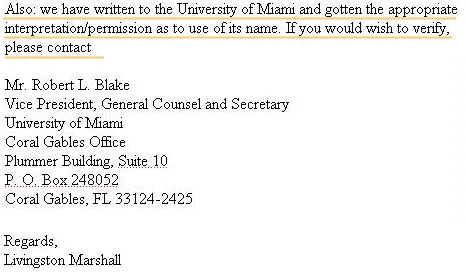
On June 6, 2006, Dr. Marshall wrote to Notes from the Road, reporting that Discovery Land Company has permission from the University of Miami to use their name, and he refers me to legal counsel of the University of Miami.
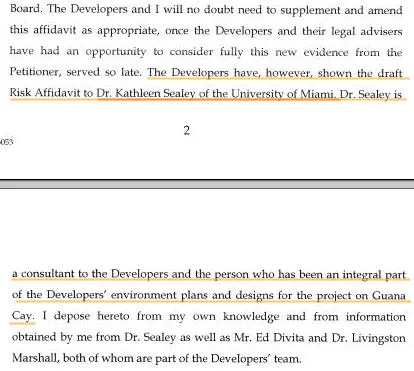
In the Affidavit of Joseph Arenson, dated August 9, 2006, Discovery Land Company again refers to Sullivan-Sealey as a University of Miami scientist, as well as a consultant to the developer.

This Larry Smith article on bahamaspundit.com refers to Sealey as a University of Miami biology professor.
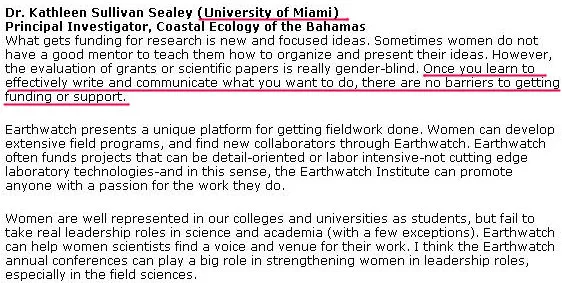
Earthwatch, which either grants Sullivan-Sealey or used to grant Sullivan-Sealey on the Bakers Bay Club project, refers to her as from the University of Miami, and shows that she teaches classes on how to get grant money. If she teaches people that there can be no barriers to getting funding, why is the source of her funding and support in the Bakers Bay Club matter so unusual?
Press Coverage
October 2, 2009
Abaconian Writes Deceptive Article on Bakers Bay
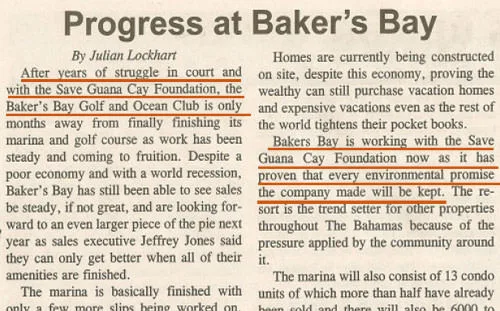
If you read the latest article in the Abaconian about Bakers Bay Club, you may be a bit confused. The article states that while Bakers Bay Club was in court for years with Save Guana Cay Reef, that all of that is past them now and they are now working together with Save Guana Cay Reef, and that they've upheld all of their environmental promises.
Of course, the article is deceptive, and was probably spoon-fed to the Abaconian by the developer. No, it is false to refer to court issues with Save Guana Cay Reef in the past tense, because those court battles are now at their height. Also, Bakers Bay Club formed its own 'association' called Save Guana Cay Association, which is designed to sound like Save Guana Cay Reef Association.
So, with an innocent writer, you can easily control what they say, by saying, "Yeah, we used to be embroiled in legal battles with Save Guana Cay, but now we're working closely with Save Guana Cay." Of course, the statement is cleverly deceptive — Save Guana Cay Reef vehemently opposes Bakers Bay, but Save Guana Cay is Bakers Bay Club's internal public relations mechanism.
Sadly, this sort of aggressive puppeteering works all too often, and these developers are experts at the game of using local media to redefine the debate.
The loaded statement in the article about Bakers Bay keeping every promise is clearly false. There are years of evidence compiled that directly refute this claim in this blog and elsewhere.
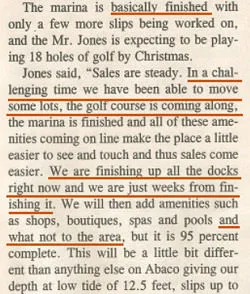
The clip above strikes me as strange as well, because the tone of Bakers Bay is one of attempting to market a project by putting good spin on it. Check out the following bullet points and then reread the clip:
- Bakers Bay is behind on many of its construction goals. The marina was supposed to be complete a year ago.
- Locals have reported that only a very few lots have been sold in the past six months.
11.03.07
Sierra Club Responds to Southern Boating Magazine
This summer, Steve Dodge, a writer who often writes about Abaco, wrote the following about Bakers Bay Club in Southern Boating Magazine, a magazine about yachting in the Southern United States and the Caribbean.
What's new? Bakers Bay Club is again under construction after a lengthy legal and political battle. The principle opposition from a group called Save Guana Cay Reef argued that the golf course fertilizer would kill the reef lying northeast of the cay. They also protested that some crown land was leased to the developers, arguing crown land should only be leased to Bahamians.
Angelfish photographed on Great Guana Cay reef. Erik Gauger.
A judge's decision cleared the path for the developers to resume. We all know that development forever alters natural places, but the developers of Bakers Bay have an environmentally sensitive culture and promise to preserve as much of the area's natural beauty as possible. Instead of killing local trees and plants with bulldozers to build roads, the plants and trees have been dug up and moved to a nursery to be replanted later. Thousands of orchids and bromileads were are also saved while invasive trees and plants have been removed.
The golf course will be planted with paspalum grass, which does not require large amounts of fertilizer and can actually be watered with brackish water if necessary. The entire course is designed to drain inward to a lined retention pond. The greens will be built with lined catch basins and water and fertilizer will be piped to the retention pond where both will be recycled. According to the plan, the entire community will be served with reverse osmosis water and the first sewage treatment system in Abaco. Homeowners will be permitted to clear only 30 percent of their land for the house footprint, and will not be allowed to bring in exotic plants.
One of the biggest departures is that waterfront property owners will not be permitted to build docks; they will use the marina for their boats. The beach will, for the most part, stay the way it is. The marina, which is expected to open in late 2008, will accept transfers for overnight dockage as well as lunch it will have the first pump out station in Abaco. Things are going to change at Bakers Bay — a temporary increase in barge traffic for one thing — but the end result should be the most environmentally sensitive development ever built in Abaco, and preserve a favorite cruising ground.
The article contained errors in logic, and so both Troy Albury and myself responded to it in letters to Southern Boating:
Letter from Troy Albury to Southern Boating
In your May 2007 issue you cover Abaco. Obviously you have obtained information about the development at Bakers Bay on Guana Cay from the developer. The environmental achievements that you claim for the developers are all under question. Hundreds of acres of mangroves have been clear cut and filled in for home sites. You also did not mention that they have strayed from their Environmental Impact Assessment in the areas of waster management.
Numerous organizations have spoken out against the project and they will continue to do so. Each and every issue of your magazine covers some location that is deemed beautiful enough to be considered a great place for “boating”. Ironically it seems that you have forgotten that the areas themselves need to be preserved. There are many people who disagree with the developer’s assessment that the resort would be the most environmentally sensitive project ever built in the Abacos. Please visit our website saveguanacayreef.com for the other side of the story.
Troy Albury, President
SGCR
Letter from Erik Gauger to Southern Boating
There are several factual errors in your article on the Baker’s Bay Golf & Ocean Club and it sounds as though the writer “took the bait” of the developer’s marketing propaganda. These falsehoods have been exposed by the press and in the court room. Contrary to the article in your magazine, legal action continues. Let’s be clear about one thing — Discovery Land Company’s Baker’s Bay megadevelopment is opposed by thousands of coral reef ecologists and scientists. The large imprint of this development, which is adjacent to a coral reef considered by scientists to be among the very best in the Bahamas, is wildly denounced by experts.
The author says that thousands of orchids and bromeliads “were also saved.” This is what visitors are shown. By destroying mangroves but keeping the orchids, Baker’s Bay will destroy the island’s only fish nursery. There are three endangered nesting sea turtles on the island. Eminent sea turtle conservationists and Jean-Michel Cousteau have denounced Baker’s Bay for the danger their plan poses to sea turtles. The author wrote about the golf course being planted with paspalum grass, but he misunderstands the facts and why it is not the magic solution the developers believe it to be.
I have spoken to many paspalum experts, and all of them would disagree with the author. Coral reefs are unique ecosystems in that they require a minimum amount of nutrients in order to survive. While I am in favor of development, no sane person can condone large developments adjacent to such pristine reefs. The boating community is aware of this issue and it is my understanding that the vast majority are against the Baker’s Bay Club because it is dangerous to this crucial environment and it is anathema to the qualities that make boating in the Bahamas a unique, rich experience.
Erik Gauger
Portland, OR
Notesfromtheroad.com/guana/
Steve Dodge responded to Albury and myself in the same issue. I will address the errors he made in his response after all letters to Southern Boating have been published.
Steve Dodge Response to Troy Albury and Erik Gauger
In response to the letters by Troy Albury and Erik Gauger, I wish to say that the views I expressed regarding the Baker’s Bay development on Great Guana Cay were formed after considering the Save Guana Reef position as the claims and plans of the developer. I continue to find the position of the developer more credible. Consider the following:
Baker’s Bay will be the only development in Abaco with a sewage treatment system and will have the only marina pump out station. Everything else in Abaco, as far as I know, utilizes septic systems, which leach into the water.
The density of the development is projected to be 358 unit for each 1.63 acres of land. It should be noted that build out will probably be 15-20 years, and that most of the residential units will be occupied not more than a few months each year.
Land owners may clear about 40 percent of their land for the residence. A coastal buffer setback of at least 50 feet from the beach or tup of the dune is in place and no docks are permitted along the beach. I continue to believe that this development is better that what might have been done — 1,000 half-acre lots with septic tanks and 40-100 docks lining beautiful Baker’s Bay beach. This is not just conjecture — the previous land owner’s master plan had two units/acre and a landing strip.
The highest court in the Bahamas decided in favor of the developer in October 2006. Some people think that an appeal to the Privy Council in London has a chance. As a practial matter, I don’t believe the case has great strength. The developer’s plans were reviewed and changed by the Bahamas Environmental Science and Technology Commission. The developer accepted these changes.
I find some claims in the letters opposing my position difficult to believe, ie. — “thousands of coral reef ecologists and scientists” and “hundreds of acres of mangroves have been clear cut.” I am aware that some reef ecologists oppose thr project; I do not think that thousands have done so. Some mangroves have been destroyed to build the marina, the marine village and some nearby homes — probably 70-80 acres, rather than “hundreds.” And 70 acres of natural mangroves have been put in a preserve monitored by scientists from the University of Miami.
Finally, I am also concerned about the possible adverse environmental impacts of all developments existing and new. I hope existing cesspits on the outer cays and on Great Abaco are upgraded, and I hope marina pumpout stations become standard. I agree with the letter from Jean-Michel Cousteau and the response of (now) Prime Minister Hubert Ingraham posted on Erik Gauger’s website, and fully support careful monitoring. I would be happy if Baker’s Bay were never developed, but I do not think that is a rational hope. I think the proposed development is better than many alternatives. I believe that Great Guana Cay reef will continue to be one of the most beautiful places in the Bahamas.
Steve Dodge
In the November 2007, the Sierra Club responded to Steve Dodge with the following letter. The letter was signed by the IVP of the Sierra Club, and the Sierra Club's Coral Working Group team.
Sierra Club Response to Steve Dodge
Dear Editor,
We are responding to the recent letters regarding the Baker’s Bay Club mega-development on Great Guana Cay in the Northern Bahamas.
The Sierra Club has been following the Baker’s Bay Club development since 2005. The developer asserts this development will set high environmental standards for developments in the Bahamas. This worthy goal, however, is contradicted by the sheer scale of the development planned for Guana Cay. The core issues are whether a mega development of this size is environmentally and culturally appropriate for this slender, lightly populated island; and whether the rights of the affected communities to participate in the land use review and approval processes related to this development were respected. We support the efforts of the Save Guana Cay Reef Association to assert its legal rights related to participation in the approval processes required for this development, and their preference for a smaller scale development which would not include a marina or golf course.
The developer has pledged to follow an Environmental Management Plan including numerous actions to prevent or mitigate the numerous environmental threats identified in the Environmental Impact Analysis, and a monitoring and reporting system to track and report on any adverse events. To our knowledge, however, no such reports have been made public. If the required monitoring is occurring, the reporting has not been shared with those most affected, the residents of Guana Cay.
Michele Perrault, International Vice President, Sierra Club
Dr. Judith Lang, Sierra Club Coral Working Group
Dave Raney, Sierra Club Coral Working Group
07.15.07
Links Magazine Regrets Error in Island Debate
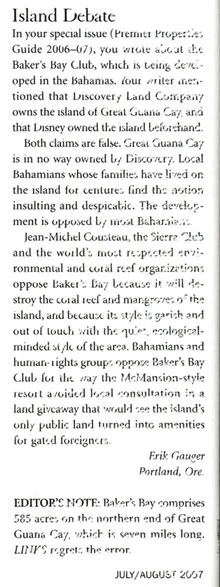
In its July/August 2007 issue, Links Magazine printed my letter, and added that they regretted the error their writer made regarding the Bakers Bay Club. After discussing the issue with Links Magazine staff, it became apparent that the freelance writer who wrote the summary of the Bakers Bay Club 'took the bait' of the developer's marketing material.
Bakers Bay Club marketing material is hilarious — designed for french poodle-toting bobos — it is sappy, poorly written and obviously devised to sugarcoat. But Bakers Bay Club marketing material is also insidious; and it is written without regard to the truth, and particularly without regard to the issues and environmental concerns the development is raising in the local and scientific communities.
Golfers who are opposed to the Bakers Bay Club should scour their publications each month and stay alert for further mistakes being written about the development. Pay particular attention to the Robb Report, and to special advertising supplement material in wealthy lifestyle magazines.
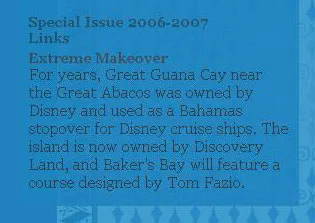
Despite the embarrassing error, Discovery Land Company still advertises the error prominently on their Bakers Bay Club site (as of July 15, 2007) designed by Imaginary Forces.
06.10.07
"Too much big-scale development..."
New York's The Buffalo News writes a piece on the Abaco Out-Islands. The author captures the importance of small-scale tourism in the islands. She also observes the irony of Bakers Bay Club. I enjoyed the quote about big resorts being all the same. I cannot stress to traveler's enough the misery that large developments inflict — both on the traveler and the community where these developments are built.
This piece in the Buffalo News is also an important landmark, because it reminds us that there are no positive reviews of the Bakers Bay Club. The travel press are not blind — anybody writing about Bakers Bay Club does so negatively. There is no good press about Bakers Bay Club, anywhere, unless it has been paid for by Discovery Land Company.
Below are some quotes from the piece:
“Each island has its own character, and it’s different every time you visit,” says Kathryn Posten of Orlando, Fla. In contrast, she says, “Big resorts have beautiful scenery, but beyond that, they’re much the same.”
Another appeal: A notable shortage of “too much” — too much glitter, too much noise, too much business, too much big-scale development. Leave that to Nassau, the Bahamas’ busy capital on the island of New Providence, and nearby Paradise Island. The Abacos are the kind of islands Jimmy Buffett sings about: tiki bar havens where you hoist a brew with friendly locals while you catch Stone McKuen’s band’s seductive ditty, “Do Me,” or listen to the Barefoot Man’s CD extolling the virtues of Great Guana Cay. Miles-long curves of floury sand are marked by a single set of sunbathers or a few frolicking children.
...As in most places in this world, change is afoot....The government seeks a balance between preservation and tourism, say tourism officials, but just what that balance should be is a matter of debate. Upscale development has its critics, and the 585-acre luxury housing development Bakers Bay on Great Guana Cay has caused outrage among locals, who are concerned that runoff from the golf course will harm Great Guana’s reef.
Despite some commercialism and a few larger hotels, Great Abaco retains wild spaces that seem almost endless, where you can kayak, snorkel, track the rare Abaco Parrot and see the wild Barb horses, thought to be descendants of animals brought by the Spanish.
06.27.07
Southern Boating Factual Errors

Yikes! Another publication has made all sorts of mistakes when writing about the Bakers Bay Club. It is impossible such a magazine could write this article without getting their information directly from the developer themselves. This is poor journalism, and Southern Boating has no excuse to make such grave factual errors. I urge the boating community to ask their magazine to decline such errors in the future. Here is my letter to the editor:
Dear Editor,
I was surprised to read your article on the Baker’s Bay Golf & Ocean Club in the Northern Bahamas. There are several factual errors, and it sounds as though the writer ‘took the bait’ of the developer’s marketing propaganda. Let’s be clear about one thing — Discovery Land Company’s Baker’s Bay Golf megadevelopment is opposed by thousands of coral reef ecologists and scientists. Baker’s Bay Club is opposed by the Sierra Club and some of the most revered marine scientists in the world.
The large imprint of this development, which is adjacent to a coral reef considered by scientists to be among the very best in the Bahamas, is wildly denounced by even the most conservative experts. For Southern Boating to say that Baker’s Bay has an ‘environmentally sensitive culture’ is simply a falsehood. These falsehoods have been exposed by the press and in the court room. Contrary to the article in your magazine, legal action continues.
The author says that thousands of orchids and bromeliads ‘were also saved.’ This is what visitors at the development are shown. But think about it — removing orchids out of an important mangrove area whose link to the coral reef is vital and then bulldozing those mangroves does not mean Baker’s Bay is saving anything. There is no ecological value to creating an orchid nursery. It simply sounds good to an uneducated audience. There are no endangered orchids or bromeliads on Guana Cay. However, there are three endangered nesting sea turtles on the island, and eminent sea turtle conservationists and Jean-Michel Cousteau have denounced Baker’s Bay for the danger their plan poses to sea turtles. By destroying the mangroves, but keeping the orchids, Baker’s Bay will destroy the islands only fish nursery, and destroy bonefishing flats which boaters sustainably use in small numbers each year.
The author wrote about the golf course being planted with paspalum grass. But he misunderstands the facts surrounding paspalum grass, and why it is not the magic solution the developers believe it to be. I have spoken to many paspalum experts, and all of them would disagree with the authors words.
Coral reefs are unique ecosystems in that they require a minimum amount of nutrients in order to survive. While I am in favor of development, no sane person can condone such large developments adjacent to such pristine reefs. The Caribbean’s coral reefs have been severely degraded over the past 50 years due largely to developments like this one. The boating community is aware of this issue and it is my understanding that the vast majority of them are against the Baker’s Bay Club because it is dangerous to this crucial environment and it is anathema to the cultural qualities that make boating in the Bahamas a unique, rich experience.
Erik Gauger
April 2, 2007
National Geographic Honors Megadevelopment Fight
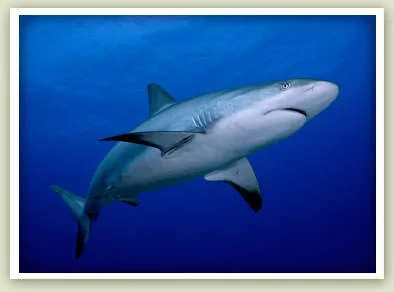
The Northern Bahamas, including the reef at Guana Cay, are the richest shark waters in the world. The March 2007 issue of National Geographic visits the Bahamas megadevelopment issue from the perspective of Shark conservation. This reef shark image is a stock photo.
The March 2007 issue of National Geographic honored those fighting against megadevelopments in the Northern Bahamas. The article follows Sonny 'Doc' Gruber, a University of Miami marine biologist who owns and operates a lab dedicated to studying shark behavior in Bimini.
Bimini, like Guana Cay, is a small island facing an outsized American development. Bimini's story is especially sad: the development in Bimini has lashed mangroves; but Bimini is so tiny, these mangroves form the wilderness that supports both the island and its nearshore environment.
Of the beautiful photographs accompanying the National Geographic article, the photograph of the lemon shark in the mangroves particularly struck me, for Guana Cay has its own mangrove river, the biology of which is so similar to this one. The Discovery Land Company development on Guana Cay has already all but destroyed this crucial marine-terrestrial environment.
I will quote liberally here from the talented Jennifer Holland. Many people in the Bahamas are thankful for her important piece.
Gruber has been studying Bimini's lemon sharks for some 25 years, amassing a detailed database that's the largest for any shark population, anywhere on Earth. His findings on how sharks affect their environment and what they need from it confirm, along with numerous other studies, the life-giving nature of mangroves — which is one reason the biologist is fighting mad about a contentious and outsize resort elbowing its way onto tiny North Bimini Island. Condos, a marina, and a casino are already underway, and plans call for a waterside golf course. Local Bahamians are worried about their shrinking access to fishing grounds, as the seafloor is dredged and the land locked up in gated communities.
Gruber has his own concern — the mangroves. "They'll all be wiped out if the developers have their way," he says. "The North Sound will be the 18th hole. You can have your mai tai there."
As recently as 2002, plans were in motion to set aside 5 marine areas to preserve the economic and ecological lifeblood of the Bahamas, with Bimini rated as the highest priority. But a change in government put off the project, and there's been no movement toward protection, despite angry prodding and accusations of corruption. Instead, giant resorts such as the one being built on Bimini have grown up on several outer islands. "The government is selling off this environment, cheap," Gruber says.
Note: I highlighted the reference to the Prime Minister Christie Administration, which is a defendent in the Great Guana Cay case against the Bakers Bay Club. Here, even the National Geographic refers to the callous disregard of the Christie Administration.
April 24, 2007
Editor of Links Magazine Apologizes to Notes from the Road
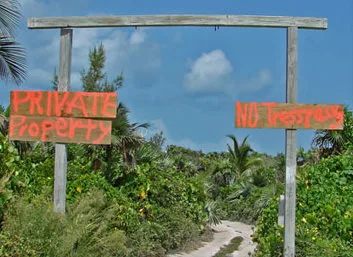
After Links Magazine wrote an article depicting Michael Meldman and the Discovery Land Company as the owners of Great Guana Cay, I asked them about it. The editor responded. Just as we thought, it looks like Discovery Land Company is telling these magazines that they own the island, and these golf magazines are not objectively critical of the marketing material being spun into their advertorials.
Links Magazine is not the first golf magazine to make glaring errors about the Bakers Bay Club. It is important to stay vigilant about all the golf magazines. Most of them are no longer writing anything on Bakers Bay Club. But if any of them does, it is extremely important to contact every single one of their advertisers if they publish false material about or from Bakers Bay Club.
Here is the response:
Mr. Gauger:
Thank you for your note regarding the ownership situation of Guana Cay. We hired a freelance writer for the note and apparently, he got some false information, most likely from the developer. We apologize for the error.
We will talk to the writer and attempt to clarify the situation in an upcoming issue. If you have questions or concerns, please contact me at 843-842-6200. Thank you for your patience and understanding.
Editor
04.17.07
Michael S. Meldman Distinguished Professorship in Conservation Scholarship at UNC, Daily Tar Heel Comments
Michael Meldman, whose Bakers Bay project became, for many critics, the case study in what large-scale resort development could do to a fragile reef ecosystem, has just teamed with the University of North Carolina to create the "Michael S. Meldman Distinguished Professorship in Conservation Scholarship." (For his fuller, sourced career record, see Michael Meldman: Discovery Land Company CEO.)
Since Michael Meldman's megadevelopment is opposed by several of the most respected and influential conservation organizations and the entire coral reef community, it might seem ironic that a large American University would accept his money.
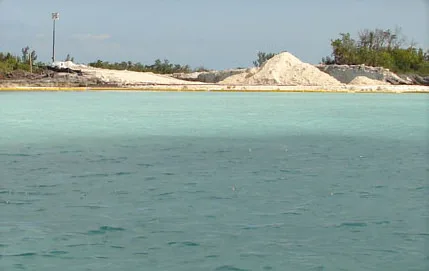
UNC accepted Michael Meldman's money and they put his name on their environmental professorship. But did they really know who he is?
But then, the subject of 'Rise Up Sweet Island' is the story of Meldman's Discovery Land Company — a company that has used unimaginable tactics to make their development appear the 'green good guys', even as mangroves are yanked from their roots and local rights are squashed.
Michael Meldman's megadevelopment is opposed by some of the world's foremost conservationists and environmentalists because its footprint is much, much, much too large for an island the size of Guana Cay; and because the project plans for the development mean the coral reef and unique ecosystem of the island will be destroyed.
It's hard not to read Meldman's donation to the Tar Heels as also serving to offset the mounting press about his development in the Bahamas. Donors often donate in order to make up for some perceived personal weakness, or to correct a perceived weakness in the public's eye.
Douglas Crawford-Brown, Professor of Environmental Science and Policy Director for the new Institute for the Environment at UNC-Chapel Hill, wrote a response to several who wrote in about the Meldman issue. He writes, "Precisely the reasons why we accepted the gift to help develop the studies and processes that will reform such practices, bringing conservation and development groups to a neutral table (the University) to find more balanced solutions."
The tone is ironic because it is very unlikely that UNC accepted Meldman's money "precisely" because he is a controversial figure who is damaging the Bahamian environment. It is much more likely that UNC accepted his money without knowing about the depth of the controversy.
Secondly, Crawford-Brown's statement that UNC could be a neutral table to find 'more balanced solutions' suggests innocence on this subject. Throughout the Guana Cay issue, Discovery Land Company has tried to create an air of neutrality: They have a website called saveguanacay.com that appears to look independent, but is a mouthpiece of the developer. They have an 'independent' group of scientists who monitor the environmental impact, but there is nothing independent about what they are doing. The EIA was made to look like it was written by the University of Miami. In fact it was written by paid consultants to Discovery Land Company, using University of Miami's name in a way that greatly upset the University.
A University that accepts money from Michael Meldman and plans to use it to create a 'neutral table' is certainly not neutral. It seems that Crawford-Brown has a lot to learn.
The Daily Tar Heel Chimes In
Today, the University's student run newspaper wrote an article about the issue entitled, "Donor attracts flak for Plans. Company's resort said to harm reefs."
Internationally recognized coral scientist Tom Goreau and Greenpeace Oceans Specialist were both interviewed, representing the locals of Great Guana Cay:
"The planned golf course and resort site have been bulldozed for the development, Goreau said. The sediment and nutrient runoff from the construction will increase the amount of algae in the surrounding waters, which damages the coral."
"Algae could take over the whole reef," said John Hocevar, oceans specialist for Greenpeace. "It's pretty hard for reefs to come back from that."
Dr. Livingstone Marshall of Discovery Land Company, who Meldman defers all environmental questions concerning Bakers Bay Club on Guana Cay, was interviewed as saying that the company has set up nurseries on the island to help preserve native plant species. Readers of 'Rise Up Sweet Island' know that this has nothing to do with good environmental practices, and is in fact fluff.
The dichotomy between Dr. Marshall's comments and those of Goreau and Hocevar speak volumes.
04.21.07
UNC Newspaper Offers Sharp Criticism for Mike Meldman, Discovery Land Company
The editorial board of The University of North Carolina at Chapel Hill has some fighting words for Michael Meldman's ironic environmental contribution to the University.
In an editorial titled, "Do as I pay, not as I do", the staff writes,
"Is the University for sale? You might think so as you stroll across campus past academic buildings, dorms, libraries and stadiums all named for major donors.
On its face then, the funding of a professorship at the UNC Institute for the Environment by Michael Meldman, a resort developer, seems like just another business transaction. He coughs up a few million and gets a professorship in return. But even though Meldman might be no friend to the environment, having a professorship named after him still can be a positive development for the University..."
The article continues:
"Perhaps the most amazing part is the DLC attempts to pass itself off as an environmentally friendly development company. According to the DLC's mission on its Web site, each of its communities "will embrace the natural grandeur of their settings and celebrate the traditions of the land upon which they are built."
We'd love to know how killing the reefs embraces the natural grandeur, and exactly what local traditions will the multi-million dollar mansions, golf course and marina be celebrating? It seems unlikely that the 150 Bahamians who live on Grand Guana Cay and rake in an average $21,300 per year are accustomed to the golf and yacht club lifestyle."
I have an idea. The University should accept the money from Michael Meldman and use it to help the locals of Great Guana Cay fight to save their coral reef and mangroves. Good work University of North Carolina student journalists.
4.23.2007
Is Links Magazine Run by Idiots?
After reading this short article by Links Magazine, I have to ask, does this magazine have any editorial credibility whatsoever?

The article says that the island of Great Guana Cay is owned by Discovery Land Company. This is laughable and insulting to the people of Great Guana Cay, who have lived on the island for 200 years. Discovery Land Company acquired a portion of the land illegally.
Also, Disney never owned Great Guana Cay, or even a portion of it. During Disney's tenure, the land was owned by Meister, who sold it to Discovery Land Company.
It is likely that magazines like this take what these developers tell them at face value. In fact, this article reads as though Discovery Land Company's marketing material was reprinted almost verbatim. Magazines like this one aren't doing their readers any favors by running developer copy unchecked.
Discovery Land Company likely wrote the article, and wants people to think that they own the island for marketing purposes. If you look at the map that Discovery Land Company uses to sell people on their development, the map actually shows the area where their property ends...as water, falsely making it look like their property is indeed an island.
Additionally, Discovery Land Company wants to make Disney look as bad as possible. So it is likely that they contrived this article for their marketing agenda of using Disney as the bad guy.
I have emailed with and spoken with the editors of some of the other magazines that feature Discovery Land Company. One publisher/editor let it slip that he actually wrote a quote of a Discovery Land Company persona.
End of Part 1 of 2. Continue to Part 2 — The Environment & the Science →
The Newsletter
See the world through ink and dust.
New essays, field sketches and natural history from the road, free by email.
Subscribe on Substack