
The Baker's Bay Environmental Impact Assessment
Before a shovel touched Great Guana Cay, the developers’ own 2004 assessment predicted the wetland loss, marina damage, and golf course risk that followed — and called the project itself “an experiment in sustainability.”
Updated October 2, 2026
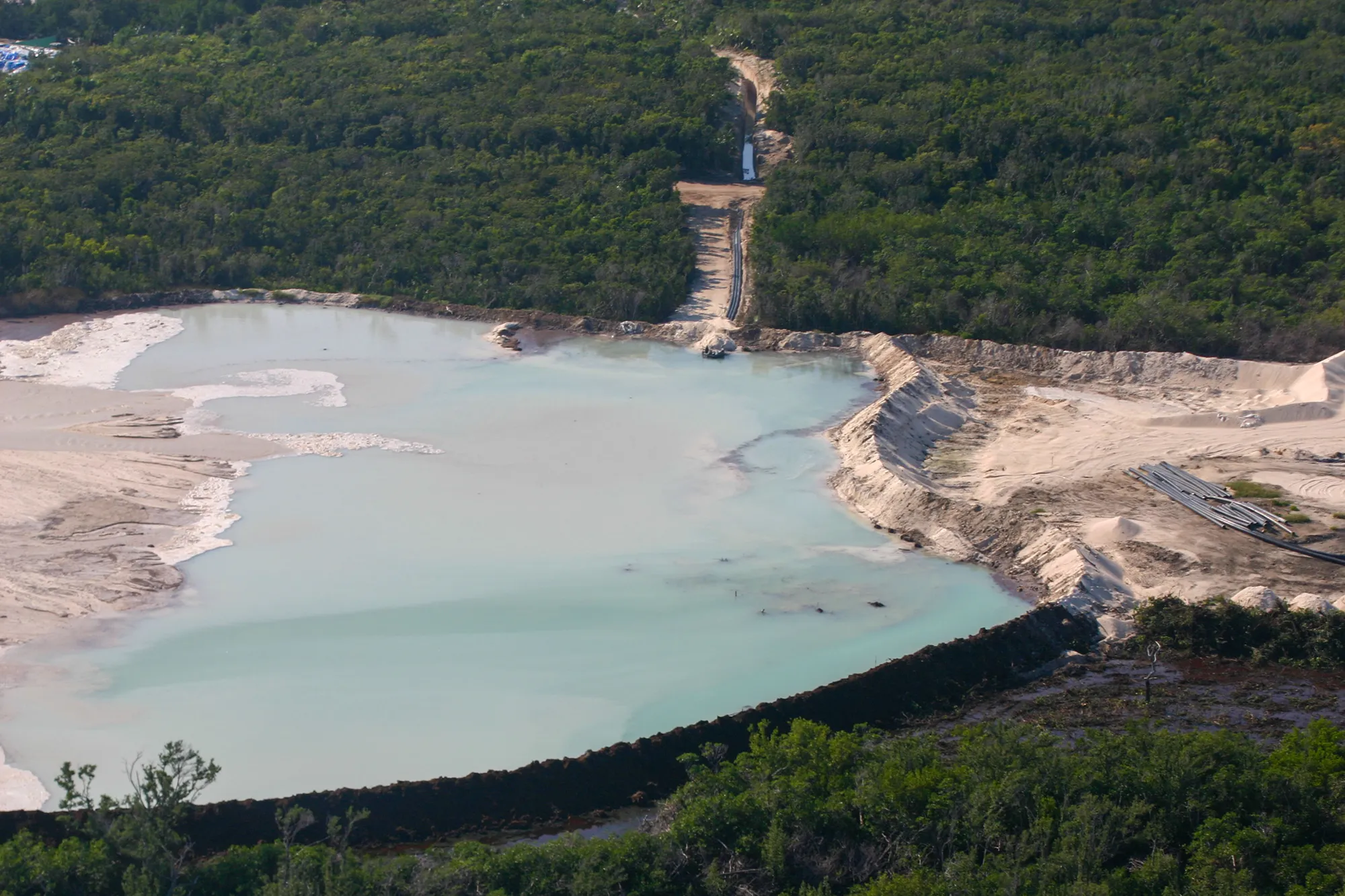
The Baker's Bay Environmental Impact Assessment was submitted to the Bahamas Environment, Science and Technology (BEST) Commission in 2004, before construction began on Great Guana Cay. It's a long, compiled filing — the primary report, supporting addenda, and an outline of the Environmental Management Plan (EMP) that was meant to follow it, running past 2,500 pages combined. What's collected below isn't a summary written from a distance; it's the EIA's own language, page-cited, describing the impacts it expected its own project to cause. Most of these passages have already been quoted, at various points and for various purposes, in this site's account of the Guana Cay delegation's presentation to the United Nations and elsewhere. This page brings them together in one place, alongside the EIA's own account of the monitoring and reporting it promised — a promise examined in more detail on the Environmental Management Plan page and in the monitoring reports that followed.
What the EIA Was For
Under the Heads of Agreement between the Government of the Bahamas and the Baker's Bay developers, the Environmental Impact Assessment was a precondition of the project moving forward at all: "The Developers have submitted at their own expense an Environmental Impact Assessment ('EIA') of the Development in accordance with the requirements of the BEST COMMISSION," the Heads of Agreement states, and "the EIA and Environmental Management Plan ('EMP') should be completed prior to commencement of construction." The EIA itself describes roughly 600 acres of Great Guana Cay land and marina footprint, cataloged in 2004 by University of Miami researchers before any of it was cleared.
The document's own Chapter 9 lays out what was supposed to happen next: an Environmental Management Plan, built around monitoring programs for three phases of the work — pre-construction, during construction, and post-construction — measured against "impact matrices and 'score cards'" (p. 2590 of the filing). That promise, and how it played out, is the subject of two other pages on this site, linked at the bottom.
The Impacts the EIA Itself Predicted
The EIA does not describe Baker's Bay as a project without environmental cost. At page 6, under the heading "Probable Adverse Impacts," it states plainly: "Short-term and long term environmental impacts will occur with such a large-scale land conversion. The developers and the environmental management team have identified areas of concern," and lists, among them, "Loss of local biological diversity and wildlife habitat," "Degradation of habitats for some wildlife species," "Loss of wetlands," a "probability of chronic ... stress to near shore marine communities," and "some chance of small scale fuel spillage and seeps."
At page 14, the EIA generalizes the point beyond Guana Cay to small islands generally: development of this kind brings "chronic eutrophication or nutrification of the island, leading to a loss of biological diversity and wildlife habitat degradation of the land and in the sea," "loss of critical habitats for wildlife on and around the island," and "increased sediment run-off and erosion due to large-scale vegetation loss in the construction phase of the development."
The mangrove wetlands were a particular concern. At page 81, the EIA states that "loss and severe alteration of inland mangrove areas will occur with marina construction," and at page 90, that "it is unlikely that a forest will ever recover from the golf course conversion." Later addenda are more specific still (page 27 of Part 2): the destruction of dense red mangroves 13 to 17 feet tall was described as a "certainty ... with marina construction," the resulting "changes will be permanent to the landscape," and there "is no doubt that there will be a loss of wetland and upland vegetation areas."
The Golf Course and the Marina
On the marina specifically, the EIA is candid about the stakes: "The marina area is particularly sensitive ecologically because of the diversity of vegetation communities that are small in scale and clustered in this area of the island," it states at page 82, adding: "It is possible to inflict irreparable damage to the environment in very short order with careless practices." The addenda go further on dredging (page 4 of Part 2): "Dredging is extremely destructive to near shore marine environments," capable of damaging "seagrass beds, an important fish habitat," disrupting "the near shore circulation and movement of sand," and threatening "the beaches of Baker's Bay, a critical natural resource to the development as well as local residents."
On the golf course, the EIA calls it "a keystone amenity" of the development, but at page 84 flags the same nonpoint-source pollution risk that would later become the subject of independent scientific review (see Dr. Michael Risk's assessment): "The location of golf courses near the coastline causes concern about nonpoint source (NPS) pollution effects on the water quality of surrounding marine and wetland environments. Of particular interest is the impact of herbicides, fungicides and fertilisers on groundwater quality." And on construction activity generally, at page 86: "Construction activities, by their nature, create many sources of potential pollutants, especially to near shore marine waters. Accelerated erosion and sedimentation caused by land disturbing activities is one of the major pollution problems caused by construction."
Where the Reef Fits In
For a project whose gravest risks were to the sea, the EIA spends remarkably little of itself there. In the 162-page version posted here, only about sixteen pages deal with the reef, seagrass or fish in any substance. The baseline description of the marine environment around the property is a few paragraphs — “Dense to sparse seagrass beds (dominated by Thalassia testudinum) provide critical habitat for finfish and invertebrates”; “the windward side of the Site has important hard-bottom habitats that include windward hardbar, patch reefs, fringing reefs, and deep reef resources” (Part 1, p. 43) — with species lists pushed to an appendix. There is no coral-cover survey and no map of reef condition: no measured baseline against which later damage could be proven.
Dr. Michael Risk, the coral reef scientist the islanders brought in, saw this immediately. Reviewing the EIA in February 2004, he praised exactly the land-side work — “Sections on terrestrial ecology, water management and solid waste management stand out as being very good” — and flagged the sea: “protection of the marine environment from land-based stresses produced by the project is not well documented, nor have adequate baseline data been taken” (his full report).
The EIA even explains, in its own words, why its water-quality approach would not catch reef damage. Citing water studies around New Providence, it notes that “despite alteration to 100% of the shoreline along Eastern Road, with loss of reef and seagrass habitats,” water-quality patterns were “not statistically different” from those near lightly developed islands, and concludes that detailed water quality monitoring is “essential for remediation of problems associated with coastal development, but not necessary for the identification or prediction of ecological impacts” (Part 1, p. 60). That gap — a thin reef baseline and a monitoring philosophy that could not see the reef — carried straight into the management plan and the monitoring reports that followed.
"An Experiment in Sustainability"
Perhaps the most quoted line from the EIA, cited repeatedly elsewhere on this site, comes from deep in the compiled filing, at page 1230: "The project will be an experiment in sustainability for small island developments." It's a striking admission for a document whose purpose was to justify approval of the project as filed — not a claim that the risks described above had been solved, but that Baker's Bay itself would serve as the test case for whether they could be.
The Monitoring and Reporting the EIA Promised
The EIA's Chapter 9 is explicit about what accountability was supposed to look like once construction began. At page 2593 of the filing, under "Incident Management and Reporting," it states that the Environmental Management Team, working with the Great Guana Cay Foundation, would develop "educational outreach programs and training programs," "clear management and project communications and reporting," and "independent reporting and verification" — and, most specifically: "The course of development, the results of the monitoring programs and any incidental occurrences will be documented on a regular basis. Information gained and processed will be reported directly to all necessary government agencies and stakeholders. A defined liaison will be identified with this responsibility."
Guana Cay's residents and landowners would seem to qualify as "stakeholders" under any plain reading of that language. Whether the reporting relationship that followed matched what's written here is the subject of the Environmental Management Plan, which spells out in more detail who monitoring reports were supposed to be addressed to, and of the monitoring reports themselves — which, for nearly two years, went almost entirely to a single named executive inside the development rather than to a government regulator or the public. Both are examined in detail elsewhere on this site.
Read the Full Document
The complete Environmental Impact Assessment, as filed, is available as a PDF: Baker's Bay Environmental Impact Assessment (PDF, 2004). It's a large, compiled document, and the page numbers cited above refer to the EIA's own internal pagination rather than the PDF's page count. For the plan that was supposed to put the EIA's monitoring language into practice, see the Baker's Bay Environmental Management Plan; for the record of what that monitoring actually found, see the Baker's Bay Monitoring Reports.